


Moving into a new home is one of life’s great milestones, and a housewarming party is the perfect way to mark the occasion — but there is one small catch. Many of your guests may know you well without knowing each other at all.
Neighbours who have never met your old friends, colleagues who have never visited your new street, family members who have only heard the names of people you work with: mix them all together in a half-unpacked living room and you have the recipe for a lot of polite smiling and not much else.
That is where a well-chosen game changes everything.
The twenty housewarming party games below are designed to get people talking, laughing, and genuinely curious about the strangers standing next to them.
Some are printable sheets you can prepare the night before, some need nothing but a little space and a big voice, and all of them work for the slightly awkward first hour as well as the looser, louder second one.
Pick three or four that suit your crowd, set them up before anyone arrives, and let the games do the hosting for you.
This post contains affiliate links — if you buy through them, I may earn a small commission at no extra cost to you.
Table of Contents
- Human Bingo Icebreaker
- House Scavenger Hunt
- Guess the Room Photo
- Advice for the New Home
- Two Truths and a Lie
- Home Trivia Rounds
- Guess the Price of the Furniture
- Would You Rather: Home Edition
- A Recipe for Your New Kitchen
- Who Am I?
- Housewarming Bingo
- A Wish for This Home
- Emoji Home Pictionary
- Letter to the Future Residents
- Neighbourhood Map Quiz
- Neighbour Introductions Round
- Room Design Challenge
- Packing Tape Sculpture Challenge
- Who Knows the Hosts Best?
- Moving House Charades
1. Human Bingo Icebreaker
Print one bingo card per guest before the party.
Each square contains a “find someone who…” prompt tailored to the housewarming setting — things like “has helped someone move house in the last year,” “has lived in more than three cities,” or “owns a piece of furniture older than they are.”
Guests mingle, ask questions, and write the name of a matching person in each square. The first player to complete a row, column, or diagonal shouts “Bingo!” and wins a small prize.
The game works for groups of 10 to 40 and takes about 20 minutes of active play. All you need are the printed cards and pens. Because every card is identical, there is a genuine race element that keeps energy high even in a large room.
Host tip: Resist the urge to let guests use the same name twice per card — make it a rule that each person’s name can only fill one square. This forces more conversations and stops two gregarious guests from filling each other’s entire cards in two minutes.

🛍 Shopping guide
2. House Scavenger Hunt
Hand every guest a printed sheet listing 15 to 20 clues that send them exploring the new home — things like “find something the hosts brought from their last place,” “locate the most unusual light switch,” or “spot where the hosts keep their spare keys hook.”
Guests work individually or in pairs, writing their answers on the sheet as they go. The person or team with the most correct answers at the end wins.
The scavenger hunt doubles as a house tour, which means your guests get to know the layout of the new home without you having to shepherd anyone room by room. It works best for groups of 8 to 30 and takes 15 to 25 minutes.
All you need are the printed sheets, pens, and a quick walk-through beforehand so you know the answers yourself.
Host tip: Include at least two or three clues that reveal something personal and funny about you as the homeowner — a quirky collection, an embarrassing decor choice, or a hidden snack stash. Those moments of discovery spark the best conversations and make the game feel warmly personal rather than generic.

🛍 Shopping guide
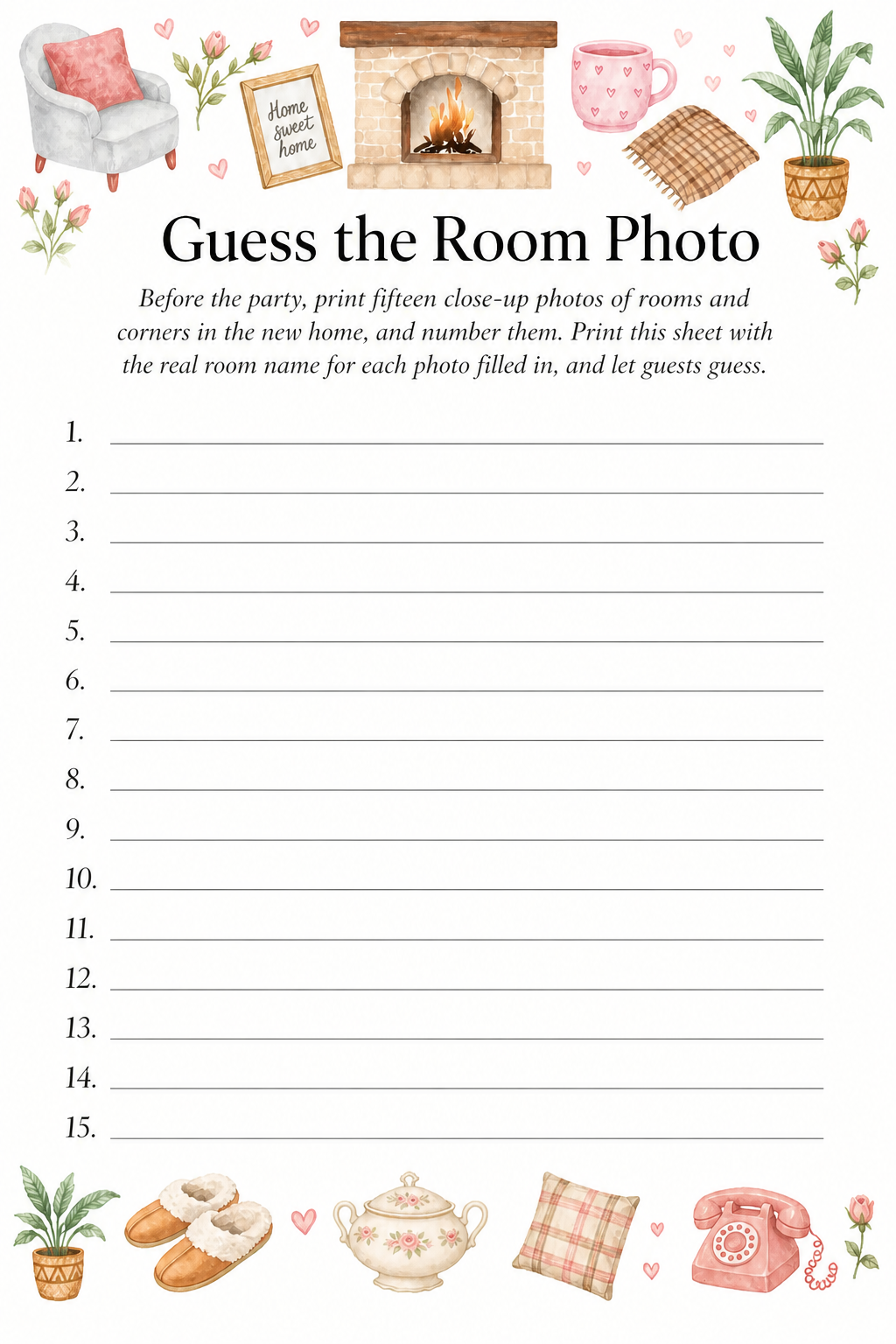
3. Guess the Room Photo
Before the party, take close-up photographs of unusual or distinctive details from around your new home — a patch of wallpaper, a door handle, a corner of the garden, the inside of a cupboard.
Print them out or display them on a screen, numbered one through ten. Guests receive an answer sheet and write down which room each photo was taken in. The person who identifies the most locations correctly wins.
This is a brilliant low-effort game that rewards the naturally observant and gives shy guests something concrete to focus on during the icebreaker phase. It suits groups of any size and takes about 15 minutes including the reveal. You will need a printer or a laptop, the answer sheet, and pens.
Host tip: Make at least two of the photos genuinely tricky — a patch of ceiling, a tile detail, the inside of the fridge — so that even guests who have been on the house tour do not sweep the scoreboard. A game where one person gets ten out of ten without breaking a sweat kills the fun quickly.
🛍 Shopping guide
4. Advice for the New Home
Place a stack of printed cards and a pot of pens near the entrance or on the dining table.
Each card prompts guests to write one piece of genuine home advice — a maintenance tip, a neighbourhood recommendation, a decorating regret they wish they had avoided, or a first-year lesson learned the hard way.
Guests fill in their card at any point during the party and drop it into a decorated box or basket.
At the end of the evening the hosts read the cards aloud, which makes for a warm, often hilarious closing ritual. The game is self-paced, needs no facilitation, and works for any group size. You need the printed cards, pens, and a collection box.
Host tip: Write a few cards yourself in advance and seed them into the pile — one genuinely useful tip, one funny cautionary tale, and one deliberately absurd piece of advice. When guests hear a ridiculous one during the read-aloud it signals that humour is welcome, and the remaining cards tend to be far more entertaining as a result.

🛍 Shopping guide
5. Two Truths and a Lie
Print a simple answer sheet for each guest with space to write their name and three statements about themselves — two true and one false.
The statements should be home or moving themed where possible: “I once rented a flat with no functioning oven for six months,” “I have painted a room four different colours in the same year,” or “I once accidentally locked a previous landlord out of their own property.”
Once everyone has written their three statements, guests take turns reading them aloud while the rest of the group votes on which one is the lie.
The printable sheet keeps things organised in a larger group and gives people a moment to think before they are put on the spot. The game suits groups of 6 to 20 and takes 20 to 30 minutes. No equipment is needed beyond the sheets and pens.
Host tip: Ask guests to fill in their sheets privately before the game begins rather than during it. People who write their statements while others are watching tend to overthink and produce very safe, easily spotted lies. Private writing time produces far more creative and convincing entries.

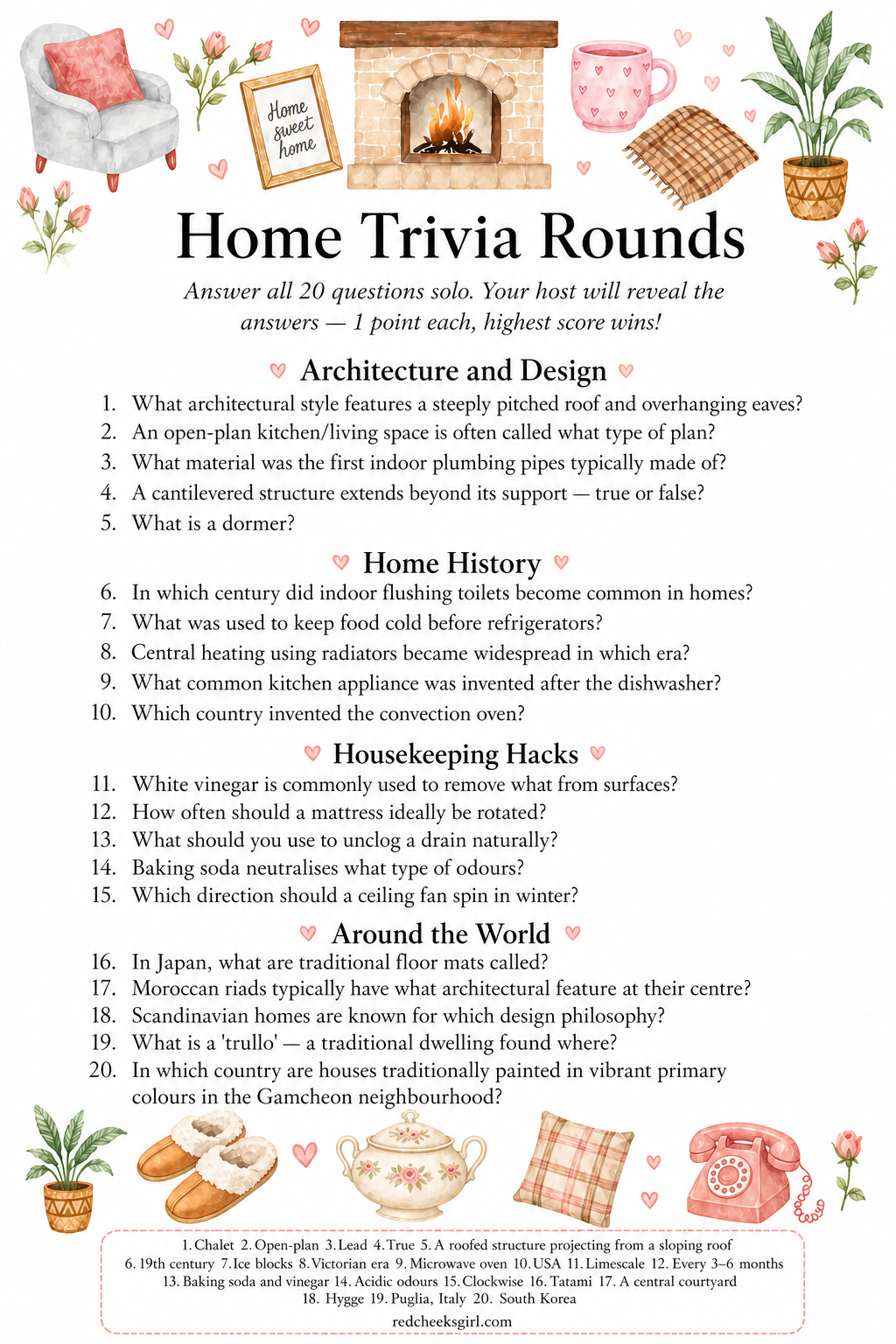
6. Home Trivia Rounds
Print a trivia sheet with 20 questions grouped into four themed rounds: architecture and design history, famous fictional homes from literature and film, home maintenance facts, and local neighbourhood knowledge about the hosts’ new area.
Guests answer individually or in small teams, writing answers on the sheet. Scores are tallied after each round, and the winning team takes a small prize at the end.
Trivia works especially well when guests do not know each other because it gives them an immediate shared goal and a reason to huddle. Teams of three to five work best, and the full game takes 25 to 35 minutes. You need printed sheets, pens, and a host or willing volunteer to read the questions aloud.
Host tip: Assign teams yourself rather than letting guests self-select — mix people who know each other with people who do not. Self-selected teams almost always divide along existing friendships, which defeats the icebreaker purpose entirely. A simple “count off in threes” around the room works perfectly.
7. Guess the Price of the Furniture
Walk guests through five to eight pieces of furniture or home items — either in person or via photographs on a printed sheet — and ask them to write down what they think each one cost.
Items should vary wildly in actual price: the vintage armchair that cost almost nothing at a car boot sale alongside the seemingly ordinary lamp that cost a small fortune. Guests write their guesses on the answer sheet, and whoever is closest across all items wins.
This game is consistently one of the biggest crowd-pleasers at a housewarming because it reveals the hosts’ bargain-hunting wins and expensive splurges in equal measure. It works for any group size and takes about 15 to 20 minutes. You need the printed answer sheet and pens; if you are doing the live walk-around version, simply gather guests in each room.
Host tip: Include at least one item where the real price is shocking in both directions — something that looks expensive but cost almost nothing, and something that looks cheap but was surprisingly dear. The gasps and debates those two items generate are worth more than the game itself.

8. Would You Rather: Home Edition
Print a sheet containing 15 to 20 “would you rather” dilemmas, all themed around homes, moving, and domestic life — “Would you rather have a beautiful kitchen but no garden, or a stunning garden but a tiny kitchen?”
or “Would you rather live in a house where every wall is a different neon colour, or a house where everything is beige?”
Guests answer individually on the sheet, then the host reads each question aloud and asks people to declare their choice with a show of hands.
The show-of-hands reveal sparks instant debate and gives introverted guests a structured way to join the conversation — they already have their answer written down and just need to raise a hand. The game suits any group size and takes 15 to 25 minutes. All you need are the printed sheets and pens.
Host tip: After each reveal, ask one person from the minority side to defend their choice. It is always the minority that generates the most interesting arguments, and it prevents the game from becoming a quick hand-raise exercise with no actual conversation attached.

9. A Recipe for Your New Kitchen
Each guest receives a printed card styled like a recipe form, with fields for “ingredients,” “method,” and “serving suggestion” — but the recipe they are writing is not for food.
Instead, they write a recipe for a happy home, a great neighbour, or a successful first year in a new house. Fields might read “what you will need,” “what to do first,” “what to avoid,” and “the end result.”
Guests fill in the cards at their leisure and hand them to the hosts at the end of the evening.
The format is open-ended enough that some guests write something genuinely moving while others go completely silly, and both outcomes are equally welcome. The game is self-paced and needs no facilitation, working for any group size. You need the printed cards and pens.
Host tip: Collect the cards in a small recipe box or binder so they become a keepsake the hosts can actually return to. Announcing this at the start of the evening makes guests take a little more care with what they write, and the finished collection is consistently one of the most treasured mementos from the party.

🛍 Shopping guide
10. Who Am I?
Write the name of a famous person, fictional character, or well-known public figure on a sticky note and attach one to each guest’s back without them seeing it. Guests then mingle and ask yes-or-no questions to figure out who they are — “Am I alive?”
“Am I known for something creative?” “Have I ever lived somewhere unusual or famous?” The first person to correctly guess their own identity wins, but the game keeps going until everyone has figured theirs out.
This is a classic for good reason: it forces every guest to approach strangers, ask questions, and listen carefully, all under the friendly pressure of a puzzle to solve. It works for groups of 8 to 30 and takes 15 to 25 minutes. All you need are sticky notes and a marker pen.
Host tip: Keep the names to real historical or public figures rather than fictional characters — guests tend to know far less about fictional universes than you assume, and nothing kills momentum like a guest who has never heard of the character on their back. Well-known architects, interior designers, and famous homeowners make perfect themed choices for a housewarming.

🛍 Shopping guide
11. Housewarming Bingo
Print a traditional 5×5 bingo card for each guest, but instead of numbers fill the squares with things that might happen at a housewarming party — “someone spills a drink,” “the hosts can’t find something they’ve packed,” “someone asks how much the house cost,” “a neighbour arrives with flowers,” or “someone gets lost on the way to the bathroom.”
Guests mark off squares as events occur naturally throughout the evening. The first person to complete a line wins.
Unlike most party games, Housewarming Bingo runs passively in the background for the entire evening, giving guests a reason to stay alert and chat about what they have spotted.
It suits any group size and needs no dedicated playing time — just hand the cards out at the door. You need printed cards and pens or small tokens to mark squares.
Host tip: Seed one or two of the squares with events you know will definitely happen — perhaps “host apologises for the mess” or “someone compliments the kitchen.” It guarantees that no card sits completely blank for the whole evening, which keeps even less competitive guests engaged.

🛍 Shopping guide
12. A Wish for This Home
Print one card per guest, designed like a small keepsake label with space for their name and a wish they are leaving for the home and its new occupants. Wishes can be practical, poetic, funny, or heartfelt — there is no wrong answer.
Guests write their wish at any point during the party and attach it to a string of mini cards, drop it into a jar, or place it in a decorative box provided by the hosts.
The collection of wishes becomes a genuine keepsake — something the hosts can display, read on anniversaries, or tuck into a time capsule. The game is entirely self-paced, requires no facilitation, and works for any group size. You need the printed cards, pens, and a collection vessel.
Host tip: Put the card station next to the food or drinks table rather than near the door. Guests linger at the food table naturally, and that extra minute of standing still is exactly the pause they need to think of something worth writing. Cards placed near the exit get rushed entries scribbled as people are putting on their coats.

🛍 Shopping guide
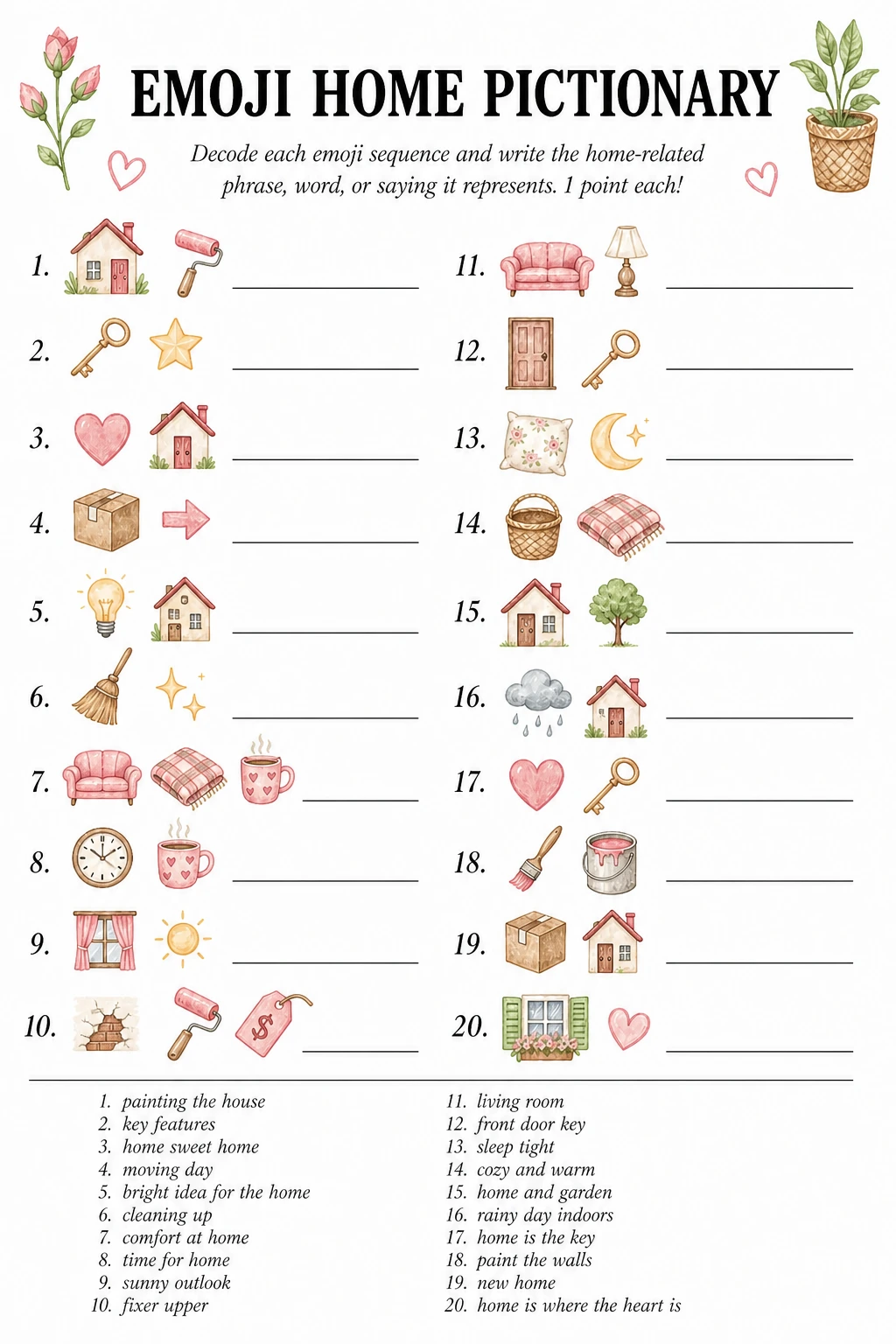
13. Emoji Home Pictionary
Print a sheet showing rows of emoji sequences — each row represents a word or phrase connected to homes, moving, and domestic life. Guests write their best guess for each sequence on the answer sheet, then compare answers as a group.
Points go to whoever lands closest to the intended answer, and the host reveals the official answers at the end with explanations where needed.
The beauty of this format at a housewarming is that the answers are specific enough to feel satisfying but loose enough to spark debate — half the fun is hearing the wildly different interpretations from across the room.
The game works for groups of any size and takes around 15 to 20 minutes. All you need are the printed sheets and pens.
Host tip: Accept all reasonable interpretations of each sequence rather than ruling strictly on exact wording. A game where guests feel their clever lateral thinking is rewarded generates far better energy than one where the host shoots down every near-miss. Keep the atmosphere generous and the laughter will take care of itself.
14. Letter to the Future Residents
Each guest receives a printed sheet designed as a letter template addressed to whoever might live in the house long after the current owners have moved on.
They are invited to write whatever they like — advice, predictions about the future, a description of what the house looked like at this exact moment, or a warm personal message to strangers not yet born.
Hosts collect the letters and seal them in an envelope to be opened on a significant future anniversary.
This is one of the most quietly powerful activities at a housewarming because it shifts guests’ perspective from the immediate party to the longer life of the home itself. It is self-paced and needs no facilitation, working for any group size. You need the printed sheets, pens, envelopes, and a sealed box or folder for storage.
Host tip: Give guests a quiet corner and five uninterrupted minutes to write if you want genuinely thoughtful letters.
Announcing it mid-party when conversation is loud and drinks are flowing produces short, jokey notes — which are also fine — but a brief quiet window early in the evening produces entries that will genuinely astonish whoever opens them in twenty years.

🛍 Shopping guide
15. Neighbourhood Map Quiz
Print a simplified map of the new neighbourhood — hand-drawn or lightly edited from a standard map — with key locations blanked out or numbered.
Guests are challenged to label as many locations as possible: the nearest park, the best coffee shop, the local pharmacy, the bus stop, the street the hosts walked down on their first morning.
Guests who already know the area well become instant local guides for those who are visiting for the first time.
This game doubles as a beautiful social lubricant because it immediately creates two types of guests — locals and newcomers — and gives them a natural reason to talk to each other. It works for groups of any size and takes about 15 minutes. You need the printed maps, pens, and a master answer sheet for the reveal.
Host tip: Include at least two or three locations that reflect the hosts’ personal experience of the area — the café where they had their first coffee after moving in, the park where they walked on the first evening.
Those personal details make the map feel like a story rather than a geography test, and they tell guests something real about the people who have just moved in.

16. Neighbour Introductions Round
Print a simple sheet listing five to eight prompt questions beneath a header that reads “Tell us about yourself.” Questions are deliberately simple and home-themed: “Where did you live before this?”
“What is one thing you wish someone had told you when you first moved to this area?” “What is your go-to housewarming gift and why?”
Every guest takes a turn standing up and answering two or three questions chosen at random by the host from the sheet. The group listens and is encouraged to ask one follow-up question.
The structure removes the terror of open-ended self-introduction because guests know exactly what they are being asked. It works best for groups of 8 to 20 and takes 20 to 30 minutes depending on group size. All you need are the printed sheets, pens, and a host willing to keep energy up between turns.
Host tip: Always go first yourself. Hosts who model the format — giving a warm, slightly self-deprecating two-minute answer — immediately lower the stakes for every guest who follows. If you share something genuine and mildly funny, the whole room relaxes visibly, and the introductions that follow are consistently better.
17. Room Design Challenge
Divide guests into teams of three or four and give each team a sheet of plain paper, some coloured pens or pencils, and a brief: redesign one specific room in the host’s new home with an unlimited budget and no practical constraints.
Teams have ten minutes to sketch a floor plan or design board and prepare a 60-second pitch explaining their vision. A panel of judges — usually the hosts — awards points for creativity, practicality, and presentation.
This game works brilliantly because it combines creativity with gentle absurdity — someone will always propose something wildly impractical and defend it with complete sincerity — and it gets teams bonding fast over shared design opinions and arguments.
It suits groups of 9 to 24 and takes about 25 minutes including pitches. You need plain paper, coloured pens, and a judging panel.
Host tip: Assign the same room to every team rather than giving different teams different rooms. When the pitches are delivered back to back for the same space, the contrast between wildly different visions generates the most laughter and debate. Comparing a minimalist concrete kitchen pitch with a maximalist wallpapered wonderland pitch for the same 12-square-metre room is comedy gold.
🛍 Shopping guide
18. Packing Tape Sculpture Challenge
Supply each team of three or four guests with one roll of packing tape and ten minutes to build a freestanding sculpture using only the tape itself — no other materials allowed.
The theme is “home”: teams might attempt a tiny house, a sofa, a moving box tower, or anything else inspired by the evening’s occasion. Once time is up, the sculptures are judged on sturdiness, creativity, and resemblance to the stated theme.
This fast, chaotic activity is ideal for the mid-party energy dip when conversation has warmed up but people need something physical to do. It generates instant laughter, requires almost no explanation, and produces genuinely impressive results from surprisingly competitive adults.
It works for groups of 9 to 24 and takes about 20 minutes. All you need are rolls of packing tape — one per team.
Host tip: Set the tape rolls on a hard floor or a large table, not on carpet — packing tape sculptures shed sticky ends everywhere, and carpet and tape are a deeply unhappy combination in a new home. A kitchen or hallway with hard flooring is ideal, and the mess clears up in under a minute.
🛍 Shopping guide
19. Who Knows the Hosts Best?
Before the party, prepare a list of 15 questions about yourself and your co-host or partner — your answers are the correct ones. Questions cover things like “Which room did we paint first?” “What was the first meal we cooked in this kitchen?”
“How many boxes did we move in?” “What is the host’s most controversial home decor opinion?” Read each question aloud to the full group and have guests write their guesses on a piece of paper.
After all 15 questions, reveal the real answers and tally scores.
Old friends will be confident they know you well; new neighbours and colleagues will be working from almost nothing — and the results almost always surprise everyone, including the people who have known you for years.
The game works for groups of any size and takes 20 to 25 minutes. All you need are paper, pens, and your prepared list of questions and answers.
Host tip: Include at least two questions where the answer surprises even your closest friends — something about the new home or the moving process that only happened recently. It levels the playing field between long-time friends and new acquaintances, and it guarantees that no single guest sweeps the board just by virtue of knowing you the longest.
20. Moving House Charades
Write 20 to 30 moving and home-related words or phrases on separate slips of paper and fold them into a bowl: “flat-pack furniture,” “lost in a removal van,” “painting the wrong wall colour,” “the neighbours introduce themselves,” “bubble wrap,” “mortgage,” “leaky tap,” “kitchen renovation.”
Divide guests into two teams. One player at a time draws a slip and acts out the phrase without speaking while their team guesses. The team with the most correct guesses in the allotted time wins.
Charades needs no introduction and almost no setup, which makes it an ideal anchor game for the part of the evening when guests want something energetic but you do not want to print anything or keep score carefully.
It works for groups of 8 to 30 and takes 25 to 40 minutes. All you need are slips of paper, a pen, a bowl, and a timer.
Host tip: Keep a few deliberately impossible phrases in the bowl — “subsidence” and “negative equity” are personal favourites — because watching someone mime a concept they barely understand in front of a whole room is consistently funnier than any of the easy ones.
Just make sure the person drawing the slip knows they are allowed to pass once per turn.
Frequently Asked Questions
How many housewarming party games should I actually run in one evening?
Two to four games is the sweet spot for most housewarming parties.
One icebreaker game for the first 30 minutes, one longer activity during the main part of the evening, and one closing ritual like Wishes for the Home or Advice Cards is usually enough to keep energy high without making guests feel like they are at a structured event rather than a party.
Having more games prepared than you need is wise — you can always pull out a backup if the evening is going well and people want more.
What if some guests absolutely refuse to join in?
Keep at least one or two self-paced activities running in the background — Housewarming Bingo and Advice Cards both work without requiring anyone to actively “play.”
Guests who are reluctant participants will often quietly engage with something they can do at their own pace without being put on the spot, and that is completely fine. Never force participation; the games are there to create opportunities, not obligations.
Do I need prizes for housewarming party games?
Small prizes are a nice touch but absolutely not required. A bottle of wine, a plant cutting, a nice candle, or simply the honour of being announced as the winner works perfectly well.
If you would rather skip prizes entirely, focus on games where the fun of playing is its own reward — charades, the design challenge, and the scavenger hunt all work brilliantly without any prize incentive at all.
When is the best time to run icebreaker games during the party?
Start your first icebreaker within the first 20 minutes, before most guests have settled into fixed conversational groups. Once people have been talking in the same cluster for 45 minutes, it becomes much harder to mix them up.
Games like Human Bingo and Who Am I work best in that early window precisely because they give people a task that naturally moves them around the room before social territories become established.
Can these games work for a small housewarming of fewer than ten people?
Absolutely. Most of the games in this list work well with as few as six guests.
For very small groups, lean towards games that work as a full group rather than in teams — Two Truths and a Lie, Would You Rather, Who Knows the Hosts Best, and the Letter to Future Residents all shine with small intimate groups.
Team games like the Design Challenge and Charades need at least eight to nine people to feel properly competitive.
📌 Save These for Later
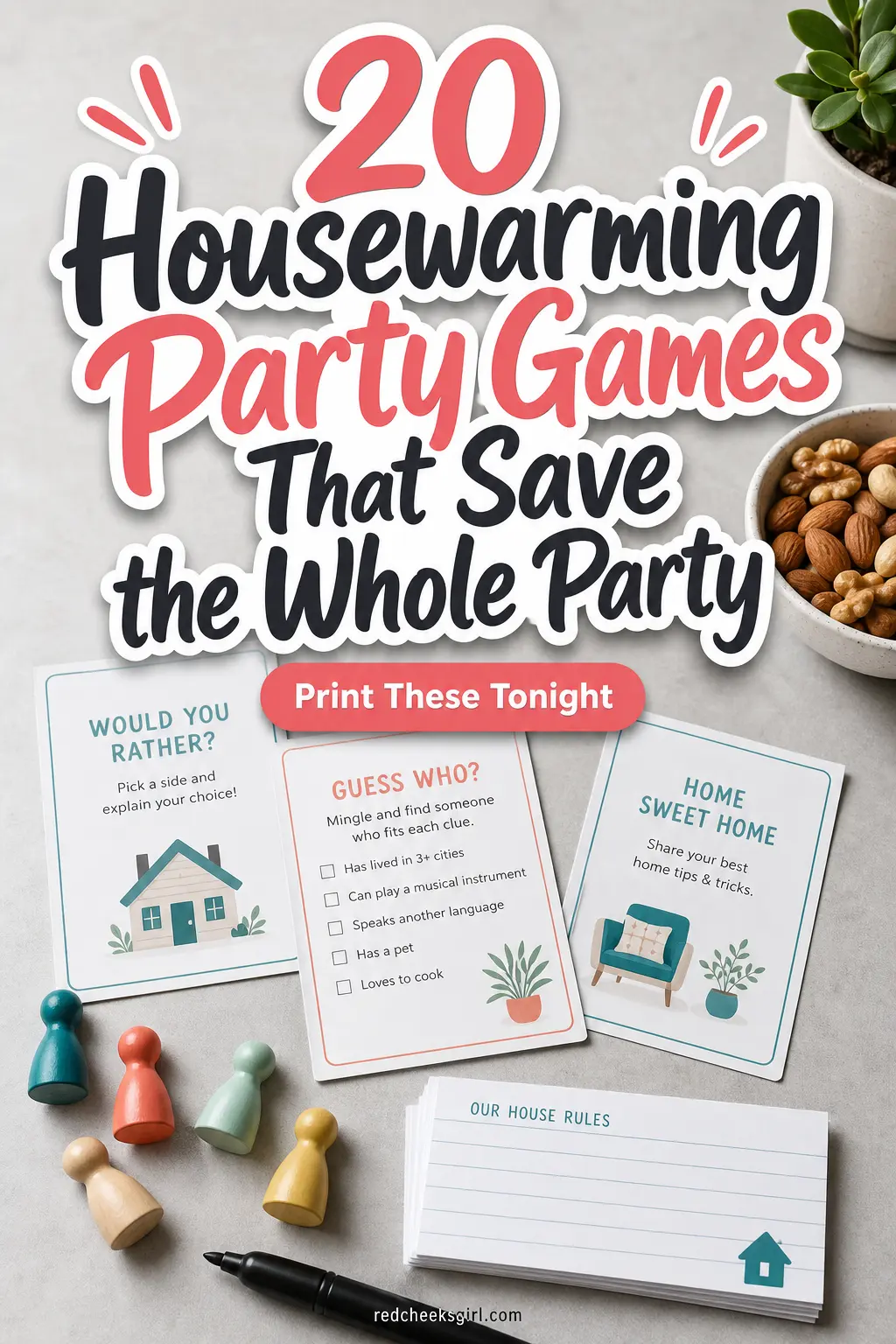
Loved these? Pin your favorite image below so you can find this list again when you’re planning.


20 sleepover games for teens that are actually fun — active, printable card decks, and quiet vibes

Light up your next party with 20 epic neon glow party games perfect for a blacklight night your teen

120 fun charades for kids sorted by theme — animals, actions, objects, jobs & sports. Free printab
Leave a Reply