

20 Christmas Party Activities With Free Printables for a House Full of Children

These christmas party activities for kids are built for the real thing: a living room full of children at different energy levels, some who want to run and some who want to sit quietly and colour.
Every activity here runs at the same time, in parallel, so no child is ever waiting. Print the sheets in advance, set up the stations, and the party runs itself.
This post contains affiliate links. If you buy through them, I may earn a small commission at no extra cost to you.
- The Party Passport With Station Stamps
- The Craft Station With Card and Glue (no printing needed)
- Christmas Bingo (4 bingo grids + call list)
- Pin the Nose on the Reindeer (no printing needed)
- The Scavenger Hunt Clue Cards
- Snowball Sock Toss (no printing needed)
- Colour by Number for the Quiet Corner (colour by number page, one per child)
- Musical Statues to Carols (no printing needed)
- Guess How Many Sweets in the Jar (tally card, one per child)
- The Sensory Bin Corner (no printing needed)
- Cut and Build a Paper Crown
- Pass the Parcel (no printing needed)
- Spot the Difference
- Biscuit Decorating at the Table (no printing needed)
- The Jumper Design Sheet
- Freeze Dance With Red and Green Cards (no printing needed)
- The Eight Piece Puzzle Race
- The Torchlight Hunt for One Hidden Object (no printing needed)
- The Fort Built From Cushions (no printing needed)
- The Take Home Certificate (certificate, one per child)
- Frequently Asked Questions
1. The Party Passport With Station Stamps
Each child gets a small folded booklet at the door. Every activity station in the room has a rubber stamp or a sticker, and children collect one each time they visit a new station. The passport keeps kids moving between activities without anyone needing to be herded.
Print one per child, folded down the centre to make a four-page booklet. You need a small ink pad and a different stamp for each station, or use star stickers if stamps are not available. Set up five to eight stations around the room before guests arrive.
The most common problem: children try to collect all stamps in the first five minutes and then wander. Fix it by telling them at the door that the last stamp is only given out thirty minutes before the end, so there is a reason to pace themselves.
Number your stations on the passport so children know where to go next and do not miss any.

🛍 Shopping guide
2. The Craft Station With Card and Glue (no printing needed)
A table covered with a paper cloth holds pre-cut card shapes: stars, trees, baubles, and strips of red and green paper. Children stick, layer and decorate however they like, with no template and no wrong answer. The station runs continuously so children can drift in and out between other activities.
No printing needed. Set out PVA glue in small pots with brushes, glitter glue pens, sequins, and felt-tip markers. Pre-cut the shapes the evening before so the station is ready to go the moment the first guest arrives. One adult can supervise a table of six children comfortably.
Glitter ends up everywhere. Use glitter glue pens instead of loose glitter, and put a cheap plastic tablecloth underneath. Children who are not yet confident with scissors will still have plenty to do because all cutting is already done.
- Pre-cut card shapes in red, green and gold
- PVA glue in small pots with brushes
- Glitter glue pens
- Sequins and foam stickers
🛍 Shopping guide
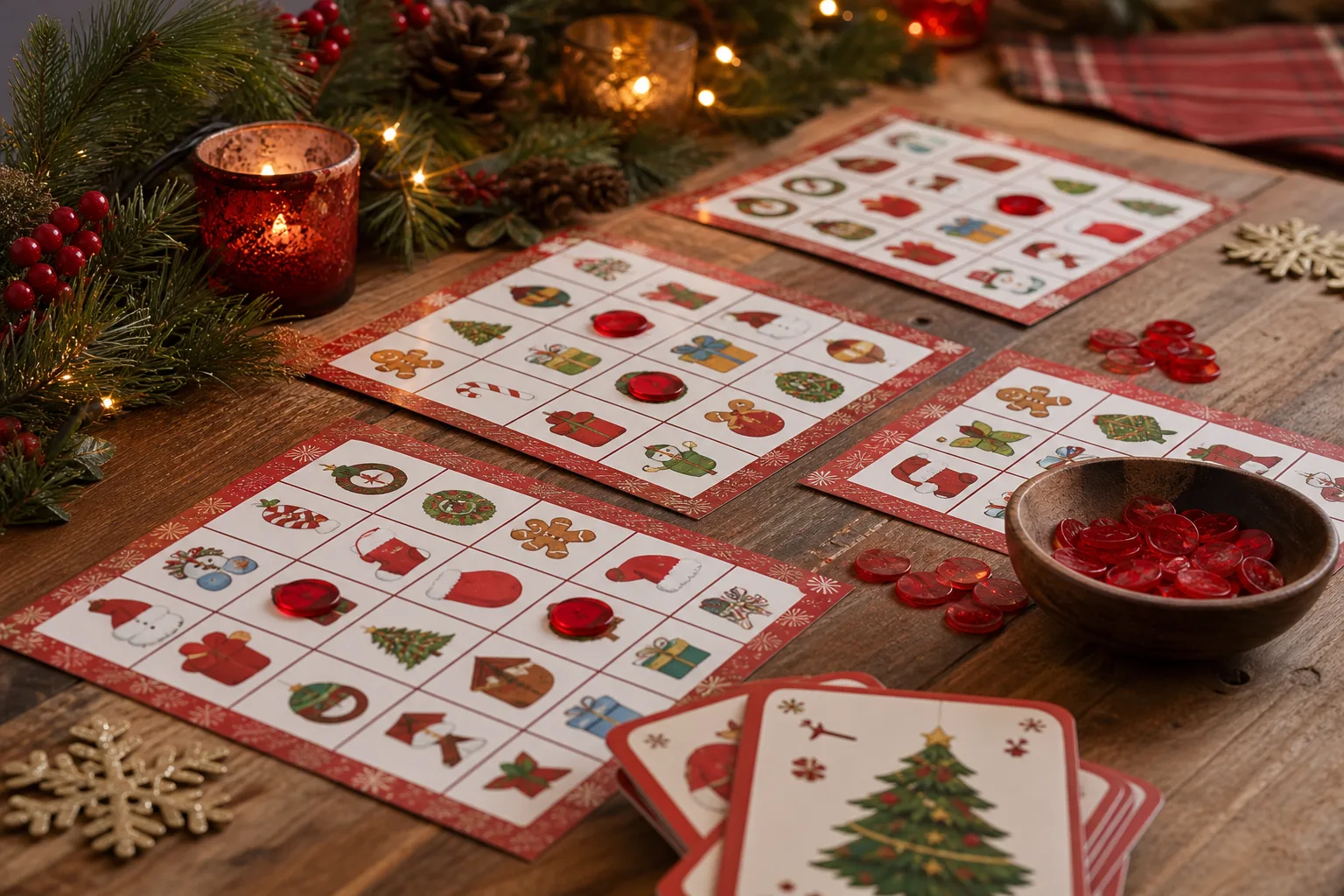
3. Christmas Bingo (4 bingo grids + call list)
Four different bingo grids, each filled with Christmas images instead of numbers: a robin, a candy cane, a stocking, a cracker, a star, a snowflake, a reindeer, a gift, an elf, a bell, a tree, a bauble, a snowman, a sleigh, a mittens pair, and a mince pie.
The caller draws a picture card from a bag and names it aloud; children cover their matching square with a button or a penny.
Print multiple copies of each grid so the whole room can play. Each grid is a 4×4 layout of 16 images drawn from the 20-image call list. You need a set of small counters per child: buttons, pennies, or dried pasta all work. The caller can be an adult or an older child.
With multiple grids in play, someone calls Bingo within the first few rounds. Keep momentum by playing until three winners, or switch to a full-house rule where all 16 squares must be covered. Have a small prize bag ready so winners stay involved rather than sitting out.
- Works for ages 4 and up
- Seats the whole room at once
- Rounds last about 8 minutes

4. Pin the Nose on the Reindeer (no printing needed)
A large reindeer face poster goes on the wall at child height. Each child gets a red circle with their name on the back, is spun gently three times, and tries to stick the nose in the right spot while blindfolded.
Whoever gets closest wins a small prize, but everyone gets to see where their nose landed, which is most of the fun.
No printing needed. Buy a poster version or draw a reindeer face on a large sheet of brown craft paper before the party. Use reusable putty on the noses so they stick to the paper without tape. Allow groups of four to six to play at once while other children watch and shout directions.
Young children find the blindfold distressing. Give under-fives the option to close their eyes and cover them with a cupped hand instead. Mark each nose landing spot with the child’s name in marker so they can compare at the end.
Let under-fives skip the spin and just walk forward with eyes closed.
🛍 Shopping guide
5. The Scavenger Hunt Clue Cards
Eight clue cards send children around the house or garden in sequence. Each card describes a hiding spot using a short rhyme or riddle, and a small token (a wrapped sweet or a sticker) waits at each location. Children work in pairs or small teams, which keeps the noise level manageable and means faster readers help slower ones.
Print the sheet and cut along the dotted lines for eight cards. Hide the cards and tokens before guests arrive. The clues should reference spots specific to your home: the fireplace, the tree, under the stairs, the coat rack, the kitchen sink. Write your location names into the blank fields on the cards before printing.
If pairs race each other and reach clues out of order, the hunt falls apart. Assign each team a different coloured token so they only collect their colour, and start each team at a different clue number so they are never crowding the same spot.
Laminate the cards if you plan to reuse the hunt at school or a second party.

6. Snowball Sock Toss (no printing needed)
White socks stuffed with more white socks become snowballs. Children stand behind a line of tape on the floor and throw their snowballs into a row of buckets or baskets set at different distances. The closest bucket scores one point, the furthest scores three. First to ten points wins.
No printing needed. Make at least twelve sock-balls so there is always one to grab. Label the buckets 1, 2, and 3 with sticky labels. A hallway works perfectly because it is narrow and keeps throws on target. Run this as a continuous drop-in station rather than a formal round so children can play whenever they like.
Sock-balls that unravel mid-throw are frustrating. Secure each one with a small rubber band around the middle. If the hallway is very long, move the buckets closer for younger children so the station does not become discouraging.
- 12 white socks stuffed and rubber-banded
- 3 buckets or baskets
- Painter’s tape for the throwing line
- Sticky number labels for the buckets
🛍 Shopping guide
7. Colour by Number for the Quiet Corner (colour by number page, one per child)
A detailed Christmas scene, a snowy village or a decorated tree, is divided into numbered sections. Children match each number to a colour in the key at the bottom and fill in the picture. The finished pages make a surprisingly good display strung on a piece of twine above the quiet corner table.
Print one per child on plain paper or light cardstock. Set out a pot of good coloured pencils rather than markers, because pencils blend better and do not bleed through the page. This station works well for children who need a break from the noise without feeling excluded from the party.
Children who race through it and then have nothing to do will drift towards the louder stations, which can upset the balance of the room. Have a second, more complex page ready for fast finishers, or invite them to colour a spare page as a gift to take home for a sibling.
- Ages 4 to 10
- Quiet corner or art table
- Works as a take-home activity too

🛍 Shopping guide
8. Musical Statues to Carols (no printing needed)
A playlist of upbeat Christmas carols plays while children dance. When the music stops, everyone freezes. Any child who moves is out, but instead of sitting idle they become a judge, watching the remaining players for wobbles. Last child standing wins.
No printing needed. Use a streaming playlist set to shuffle so the pauses are unpredictable. Play in the largest clear space in the house with furniture pushed back. Keep each round short: aim for three to four minutes of play so eliminated children are not waiting long before the next round starts.
Eliminated children lose interest fast and start disrupting the game. The judge role solves most of this, but if the group is large, run two simultaneous games in different rooms and combine for the final round.
The judge role keeps eliminated children fully involved rather than bored on the sidelines.
9. Guess How Many Sweets in the Jar (tally card, one per child)
A large glass jar filled with wrapped sweets sits on a table with a small sign. Each child writes their name and their guess on a tally card, folds it, and drops it into a box next to the jar.
At the end of the party, the host reads out the actual number and finds the closest guess. The child who guessed right wins the whole jar.
Print one card per child. Set up the jar and box near the entrance so children see it immediately when they arrive and have time to think about it during the party. Count the sweets before filling the jar and write the number on a card that you keep in your pocket until the reveal.
Children often try to change their guess after peeking at what others wrote. Have them fold and drop the card before they step away from the table. If two children guess the same number, the one whose card was dropped in first wins, so remind them to write their name clearly.
Use the actual sweet count for the reveal so the winner gets exactly the jar they guessed.

🛍 Shopping guide
10. The Sensory Bin Corner (no printing needed)
A large plastic storage box filled with white rice, silver tinsel offcuts, small wrapped gifts, jingle bells, and plastic snowflakes becomes a sensory bin. Children dig, pour, and sort with small scoops and cups. It is quiet, absorbing, and works for the youngest guests who cannot keep up with the louder games.
No printing needed. Fill the bin the night before. Add a few hidden small toys buried in the rice so children have something to find. Set it on a plastic tablecloth to catch spill. One adult nearby is enough; this station essentially supervises itself once children are settled at it.
Rice on the floor is the main hazard. A high-sided storage box with at least 15 cm walls keeps most of it contained. If a child has a known sensory aversion to texture, keep a tray of dry oats nearby as an alternative filling.
- Large plastic storage box (high-sided)
- White rice or dried oats
- Jingle bells, plastic snowflakes, small toy figures
- Small scoops and cups
11. Cut and Build a Paper Crown
The sheet prints as a flat crown template with a notched tab-and-slot system so children assemble it without tape or staples. Printed decorations, stars, holly, snowflakes, give it a finished look straight off the printer, but there are also blank panels for children to colour in their own design before cutting.
Print one per child on cardstock rather than plain paper so the crown holds its shape once assembled. Pre-score the fold lines with a blunt knife before the party if you have time, which makes folding much easier for small hands. Set this at the craft table alongside scissors and coloured pencils.
The tab-and-slot can be fiddly for children under five. Cut out the crowns in advance for the youngest guests and let them skip straight to decorating and wearing. Size the template to fit a head circumference of roughly 52 to 56 cm, with two slot positions so it adjusts slightly.
- Print on cardstock for a crown that survives the whole party.
- Pre-score fold lines with a blunt knife the evening before.

🛍 Shopping guide
12. Pass the Parcel (no printing needed)
A gift is wrapped in many layers, one per child. Between each layer is a small forfeit or a sweet. Children sit in a circle and pass the parcel while a carol plays. When the music stops, the child holding it unwraps one layer. The child who unwraps the final layer keeps the prize inside.
No printing needed. Wrap the parcel the evening before, counting layers carefully so every child gets exactly one turn. Write each child’s name on their layer in pencil on the inside if you know who will be there, and control the music stops to match.
Use a playlist on a phone and pause it without looking so the result feels genuinely random.
Tears happen when a popular child gets multiple turns and another gets none. The named-layer method prevents this entirely. If the guest list changes on the day, add or remove a layer before the game starts rather than adjusting mid-play.
Write each child’s name inside their layer so you can control the music stops fairly without it looking controlled.
13. Spot the Difference
Two nearly identical Christmas scenes sit side by side on the sheet. Children circle the differences they find with a pencil or a red pen.
There are ten differences in total, ranging from obvious (a missing star on the tree) to subtle (a candy cane flipped the other way). The answer key on the back of the sheet confirms which ten to look for.
Print one per child. Set this at the quiet corner table alongside the colour by number page so children can choose between activities. A fine-tip red pen or a pencil works best for circling; markers can bleed through and obscure the other side if the answer key is printed on the back.
Children finish at very different speeds. Fast finishers can challenge themselves to find all ten without any hints, while slower workers can be offered the answer key after a set time so nobody feels left behind.
This game pairs well with the full list of Christmas games for kids if you want to extend the quiet corner with more self-directed activities.
- Ages 5 and up
- Quiet corner or waiting time
- Can be taken home and completed later

14. Biscuit Decorating at the Table (no printing needed)
Plain pre-baked biscuits in Christmas shapes, trees, stars, stockings, and gingerbread figures, sit on the table with small pots of ready-to-use royal icing in red, white and green, and a selection of sprinkles and silver balls. Each child decorates two or three biscuits, wraps them in a small cellophane bag to take home, and adds a handwritten tag.
No printing needed. Buy or bake the biscuits the day before. Ready-made royal icing in squeeze bottles is the easiest option for a party setting. Cover the table with baking paper rather than a cloth so the icing that inevitably drips does not stain anything. Allow about fifteen minutes per child at the table.
Icing that is too runny floods the biscuit and children find it frustrating. Stiffen it slightly with a little extra icing sugar before the party and test it yourself first. Keep a damp cloth at the table for sticky fingers.
- Pre-baked Christmas biscuits
- Ready-made royal icing in squeeze bottles
- Sprinkles and silver sugar balls
- Cellophane bags and twist ties
15. The Jumper Design Sheet
The sheet shows a large outline of a Christmas jumper with a plain front panel and blank sleeves. Children draw and colour their own design onto the jumper: a snowman, a reindeer face, a slogan, anything they like. Finished sheets go on display pinned to a string across the wall, making an instant gallery of tiny fashion designers.
Print one per child. Coloured pencils work better than markers here because they allow fine detail on the smaller sleeve areas. This is a strong quiet-corner activity and takes roughly ten to fifteen minutes for most children. The display adds to the room decoration without any extra effort from the host.
Children who do not know what to draw will sit paralysed. Give them three starter ideas on a small card next to the pots: a snowman face, a striped chevron pattern, or the word CHRISTMAS in big block letters. That prompt removes the blank-page problem without restricting anyone who has their own vision.
The finished jumpers double as room decoration and give children a genuine sense of pride in the display.

16. Freeze Dance With Red and Green Cards (no printing needed)
Children dance while Christmas music plays. The host holds up a green card to keep dancing, and a red card to freeze. Anyone who freezes on green or dances on red is out.
The twist is that the host can flash the cards fast, slow, or in a long fake-out green before a quick red, which keeps children genuinely on their toes and laughing.
No printing needed. Cut two A4 sheets of card, one red and one green. That is the entire setup. Play in the living room with furniture cleared. This game works for ages three and up because the rule is simple enough for toddlers and the fake-out element keeps older children engaged.
Eliminated children droop quickly. After the first elimination, give eliminated children a card each (alternate red and green between them) and let them help the host signal. Now they are running the game rather than watching it, which is more fun than either option.
Give eliminated children a signal card immediately so they become co-hosts rather than spectators.
17. The Eight Piece Puzzle Race
The sheet prints as a Christmas scene divided into eight large pieces with thick cut lines. Children cut out their pieces, shuffle them face-down, and then race to reassemble the picture as fast as possible. The first child to flip their completed puzzle over and shout ‘Done’ wins the round. Play three rounds so there is more than one winner.
Print one per child on cardstock. Pre-cut the sheets for children under five. The pieces are large enough for children as young as four to handle confidently. This game works beautifully as a parallel station because each child works on their own sheet simultaneously, so there is no waiting and no turn-taking.
Children who have already seen the image reassemble it in seconds. Make the race fairer by turning all pieces face-down before starting and counting down from five. For older children, mix up one piece from a neighbour’s puzzle before the race begins and see if they notice.
Print on cardstock and the pieces survive multiple rounds without going limp.

18. The Torchlight Hunt for One Hidden Object (no printing needed)
One small Christmas figure, a tiny reindeer, a bauble, or a wrapped sweet, is hidden somewhere in the room. The lights go down (curtains drawn at dusk, or just dimmed). Each child gets a small torch and hunts for the hidden object.
The child who finds it keeps it and the next round starts with a new hidden object and a new child who hides it.
No printing needed. Cheap mini torches from a pound store work perfectly. Hide the object at child height and avoid impossible spots behind locked cupboards. Each round takes about three minutes, so you can run five or six rounds in fifteen minutes, meaning most children get a turn to hide.
Children with torches will immediately shine them at each other’s eyes. A brief rule at the start (torches point at the floor and walls only) prevents most of this. If the room cannot get dim enough, use glow bracelets instead of torches for a softer version.
- One small torch per child
- 5 to 6 small Christmas figures or wrapped sweets to hide
🛍 Shopping guide
19. The Fort Built From Cushions (no printing needed)
A pile of cushions, sofa pillows, throws, and blankets is placed in one corner with a simple brief: build the best Christmas fort you can. Children organise themselves naturally, assigning roles and making rules. The fort becomes a base for the quiet activities, reading, colouring, or simply sitting, for the rest of the party.
No printing needed. Pull cushions from sofas and beds before guests arrive and stack them in the corner. Add a string of battery-powered fairy lights inside the fort once it is built, which turns it into the most desirable spot in the room. One adult should check the structure is stable before children pile in.
Fort-building causes arguments about territory. Manage this by framing it as one shared fort for everyone rather than competing forts. If the group splits naturally into two teams who want separate forts, let them: two forts simply need a rule that both stay standing for the full party.
Children who are overstimulated by the louder games can retreat here without feeling excluded from the party.
🛍 Shopping guide
20. The Take Home Certificate (certificate, one per child)
Every child leaves with a personalised certificate naming them as an official Christmas Party Champion, with a blank line for the host to write their name by hand and the date. It is low-key but children treat it seriously, folding it carefully and carrying it home as though it is genuinely important, because to them it is.
Print one per child on bright white cardstock for a clean, crisp result. Fill in names with a dark felt-tip pen before the end of the party.
Stack them near the door so they are ready as children leave, alongside party bags if you are using them. This is also a discreet way to signal to children that the party is winding down.
Running out of certificates at the end is easily avoided: print two or three extras for unexpected guests.
For an added touch, fold each one into thirds and tuck it inside the party passport so children carry both home together as a single souvenir of the day.
See Christmas party games for the whole family if you want to extend the fun after the children’s party ends.
- Every child, no exceptions
- Handed out at the door as children leave
- Print a few extras for drop-in guests

Frequently Asked Questions
How do I stop children from queueing at the popular stations?
Set a visible timer at each station, three to five minutes, and move children along when it rings. The passport system also helps because children are motivated to visit every station rather than camping at one favourite.
Having at least two parallel versions of the most popular activity (two jars to guess, two puzzle tables) removes bottlenecks without you having to manage it actively.
What age group do these christmas party activities for kids suit?
Most activities here work for ages four to ten. The sensory bin and fort corner work well for children as young as two or three. The puzzle race, spot the difference, and scavenger hunt are best from age five upward. The bingo and freeze dance games are genuinely enjoyable across the full age range, which matters when siblings attend.
How far in advance should I print the game sheets?
Print everything at least two days before the party. This gives you time to reprint anything that comes out wrong, to cut card sets like the scavenger hunt clue cards, and to pre-score fold lines on the crown sheet. Leaving printing to the morning of the party reliably causes problems when the printer runs out of ink.
How many adults do I need to run all these activities at once?
Two adults handle a group of up to fifteen children comfortably with this setup, because the parallel structure means most stations are self-managing. One adult floats between the active games, the other stays near the craft and quiet corner. For groups over fifteen, a third adult makes a significant difference, particularly during pass the parcel and biscuit decorating.
Can I run these activities in a small house?
Yes. The key is separating loud and quiet zones rather than needing a lot of space.
Push furniture to the walls, designate the hallway for the sock toss and the torchlight hunt, use the kitchen table for biscuit decorating and the craft station, and keep the living room for sitting games and the fort.
Rooms feel larger once children are distributed across them.
Which printables work for a school or nursery Christmas party?
The bingo grids, the puzzle race, the spot the difference, and the colour by number page all work well in a classroom setting because they are self-contained and require minimal supervision. The jumper design sheet and the take home certificate also travel well to school.
The passport works if you can set up the stations in advance, which is easier in a hall than in a classroom.

23 apartment Christmas decor ideas for small spaces: no mantel, no staircase, no six-foot tree requi
Grab a christmas bingo printable free set with 10 different games, every grid size listed, for toddl
17 christmas holiday drinks alcohol batched in a jug, pot or bottle so guests pour their own. Make-a
Leave a Reply