

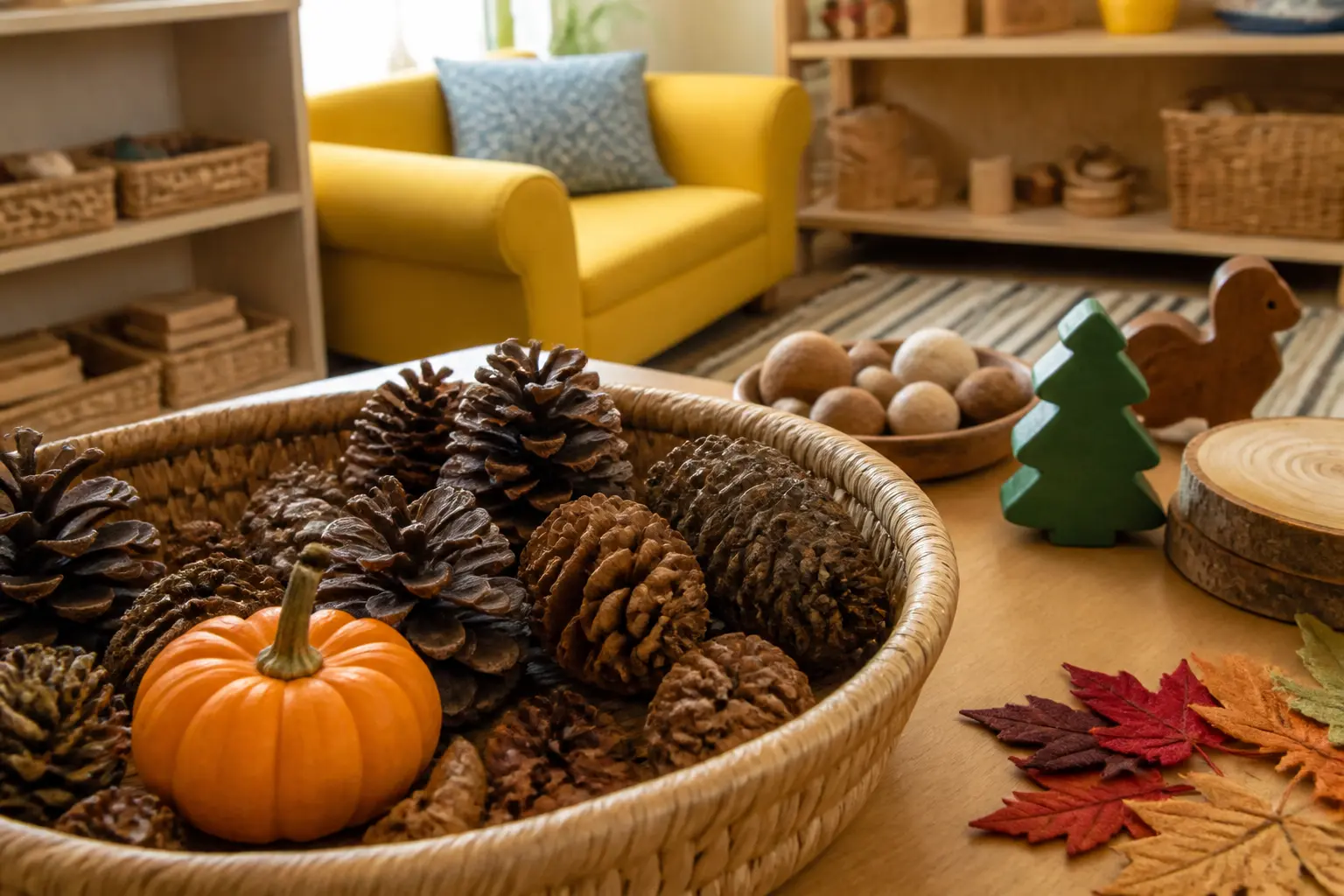
Five days, one coherent week. That is the promise here. Each day builds on the one before, so Monday’s leaf becomes part of Friday’s finished object, and no child has to start from scratch every morning. The teacher gets a plan, the children get a story that grows.
Every activity below works with three to five year olds in a group of twenty. Nothing is smaller than four centimetres, nothing needs hot glue or scissors sharp enough to worry about. The only tool that appears more than once is a foam stamp and a willing hand.
The week runs on five organising devices: a leaf passport (Monday), a post box that receives letters to autumn (Tuesday), a one-object museum where a child presents their find (Wednesday), a treasure trail with seasonal clues (Thursday), and on Friday the class assembles everything into one shared wall piece.
Browse by day or scroll by type, whichever suits your planning style.
This post contains affiliate links. If you buy through them, I may earn a small commission at no extra cost to you.
Monday: The Leaf Passport
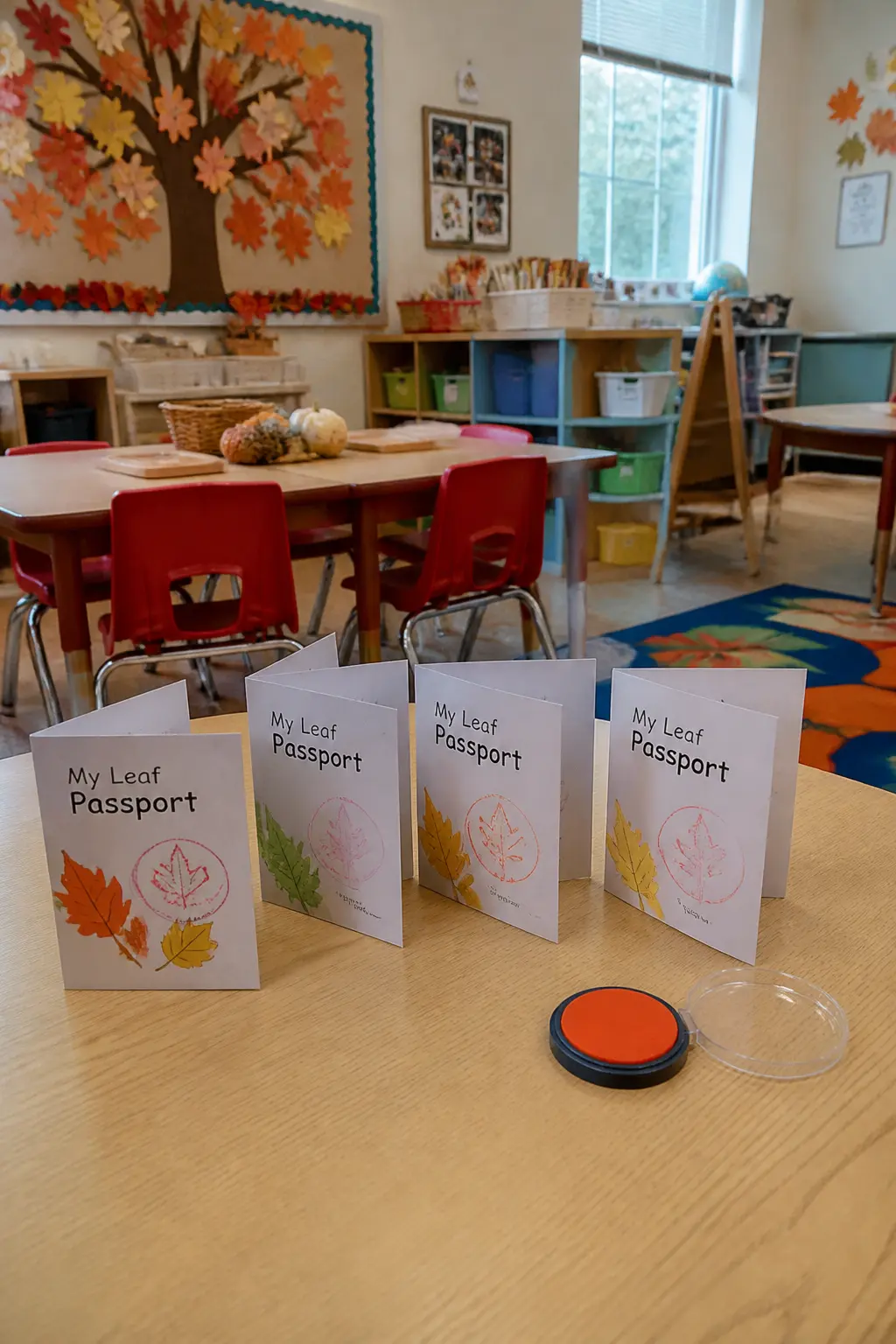
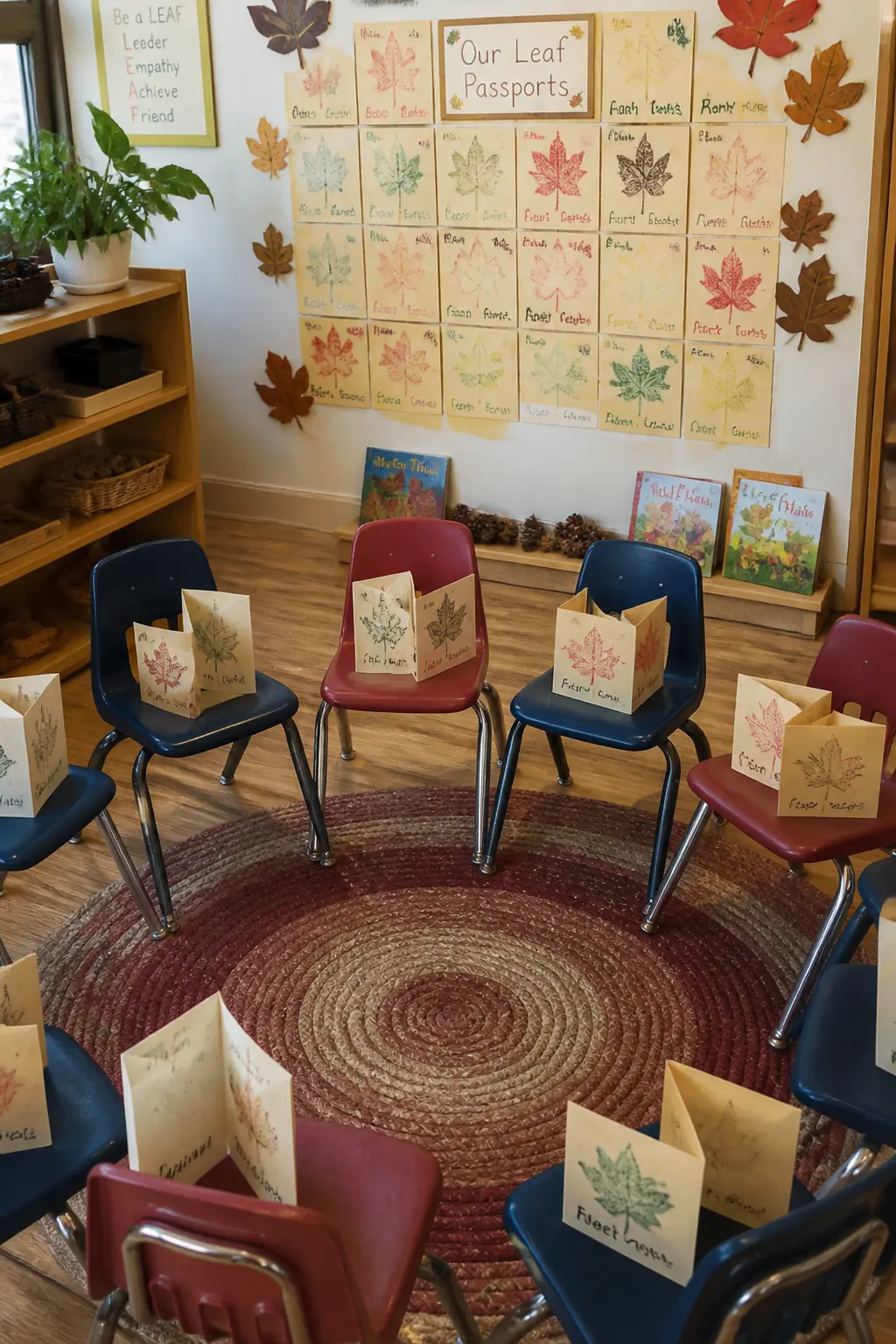
Monday’s device is a small folded card each child holds all week. It gets stamped with a new leaf species each morning, so by Friday it is a personal record of the week. Make twenty in ten minutes the night before using folded card stock, a staple and a marker for the child’s name on the cover.
Every Monday activity feeds the passport. The circle time introduces a real leaf, the song plants the name, the sensory tray gives children time to touch and sort, the making activity produces a stamped print that goes straight onto the passport’s first page. Keep Monday’s pace gentle: it sets the template all week follows.
Leaf Passport First Stamp
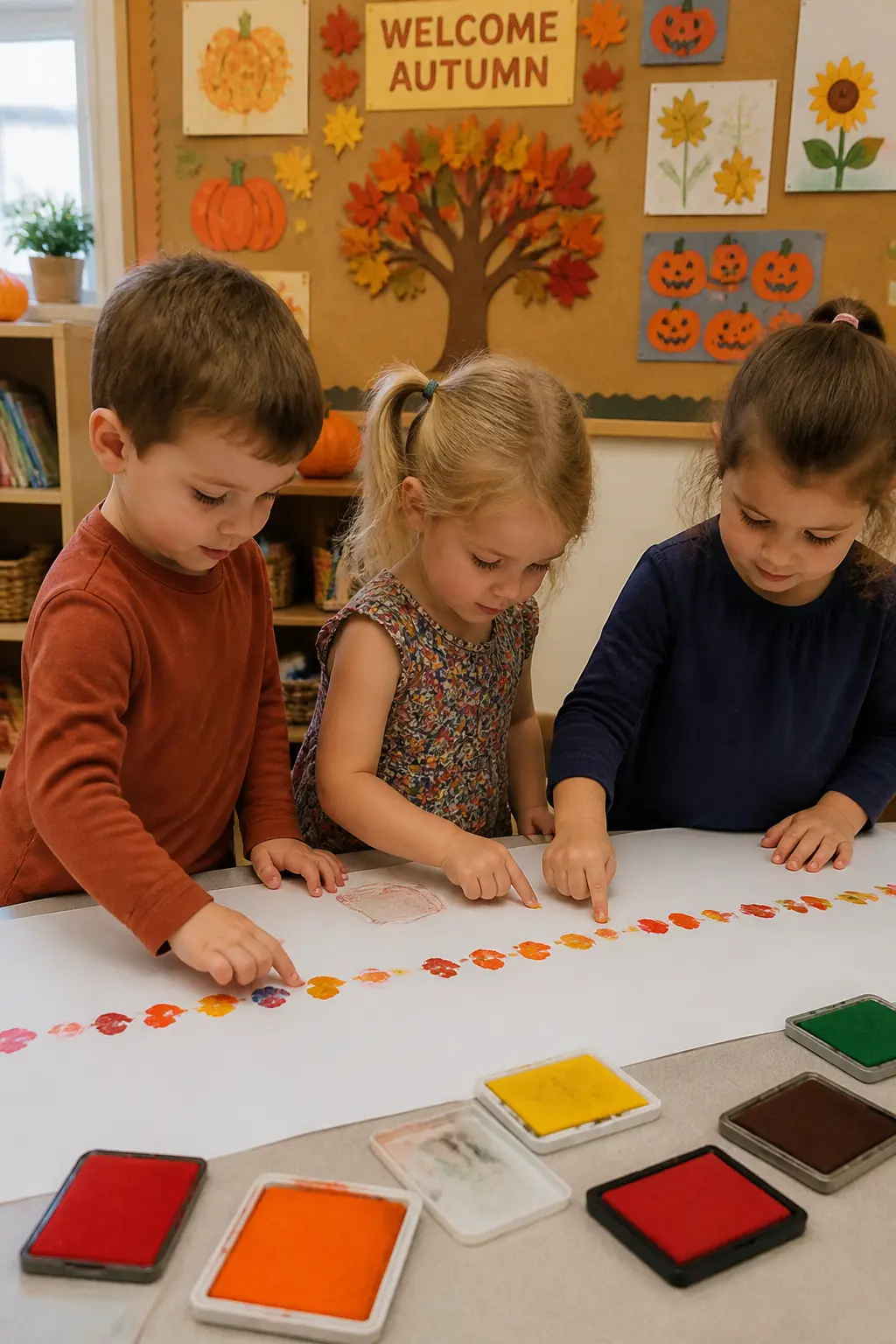
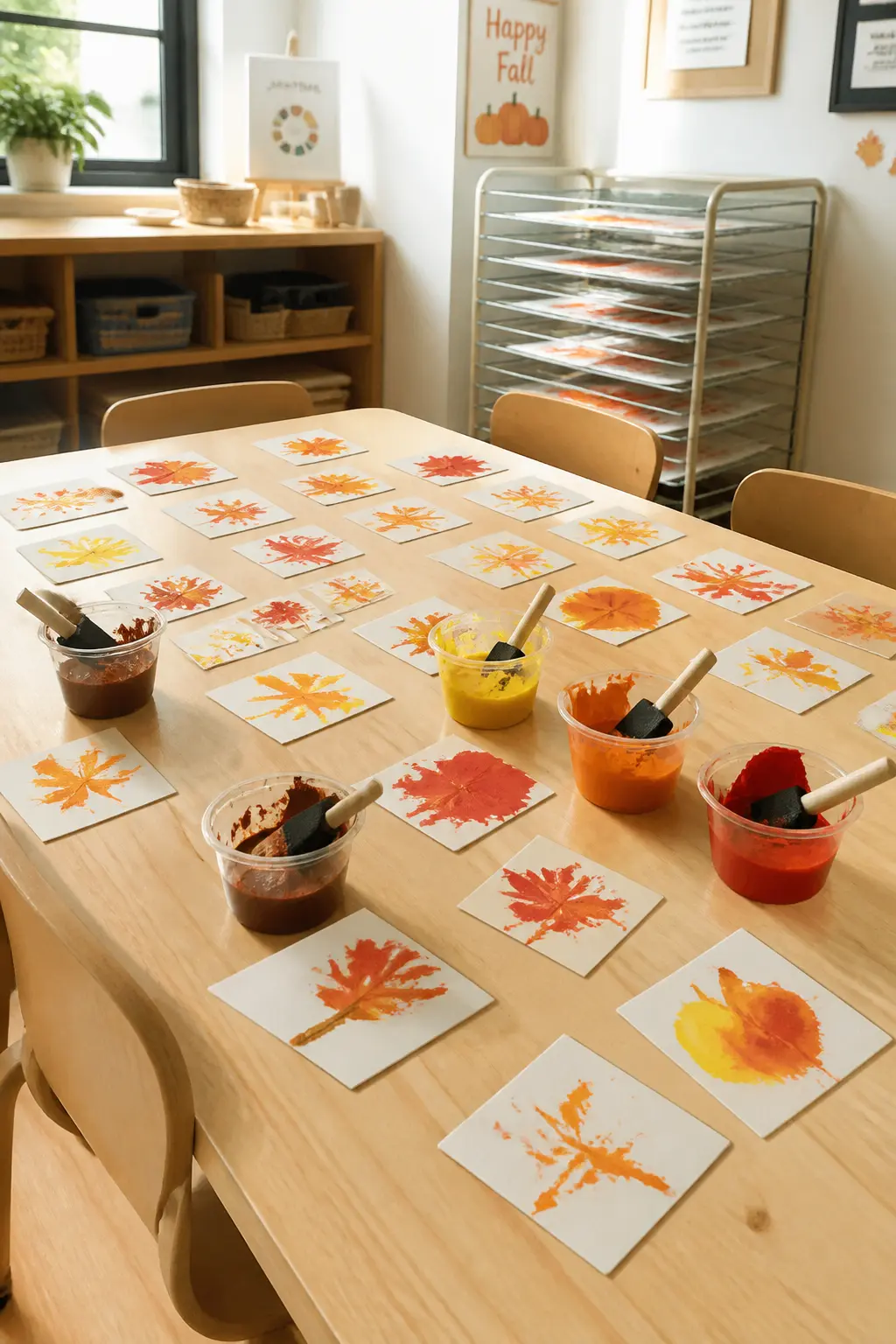
Each child receives their folded card passport at the start of circle time. The teacher holds up one large real leaf, names it slowly, and the group repeats the name twice. Children take their passport to a stamping station set up on a low table, press a foam leaf stamp into orange paint and stamp page one.
The passport goes into a named pocket on a wall organiser and stays there all week. On Friday it comes home. That going-home moment is the close of the week’s narrative arc, and children feel it.
Monday Weather Wall Starter
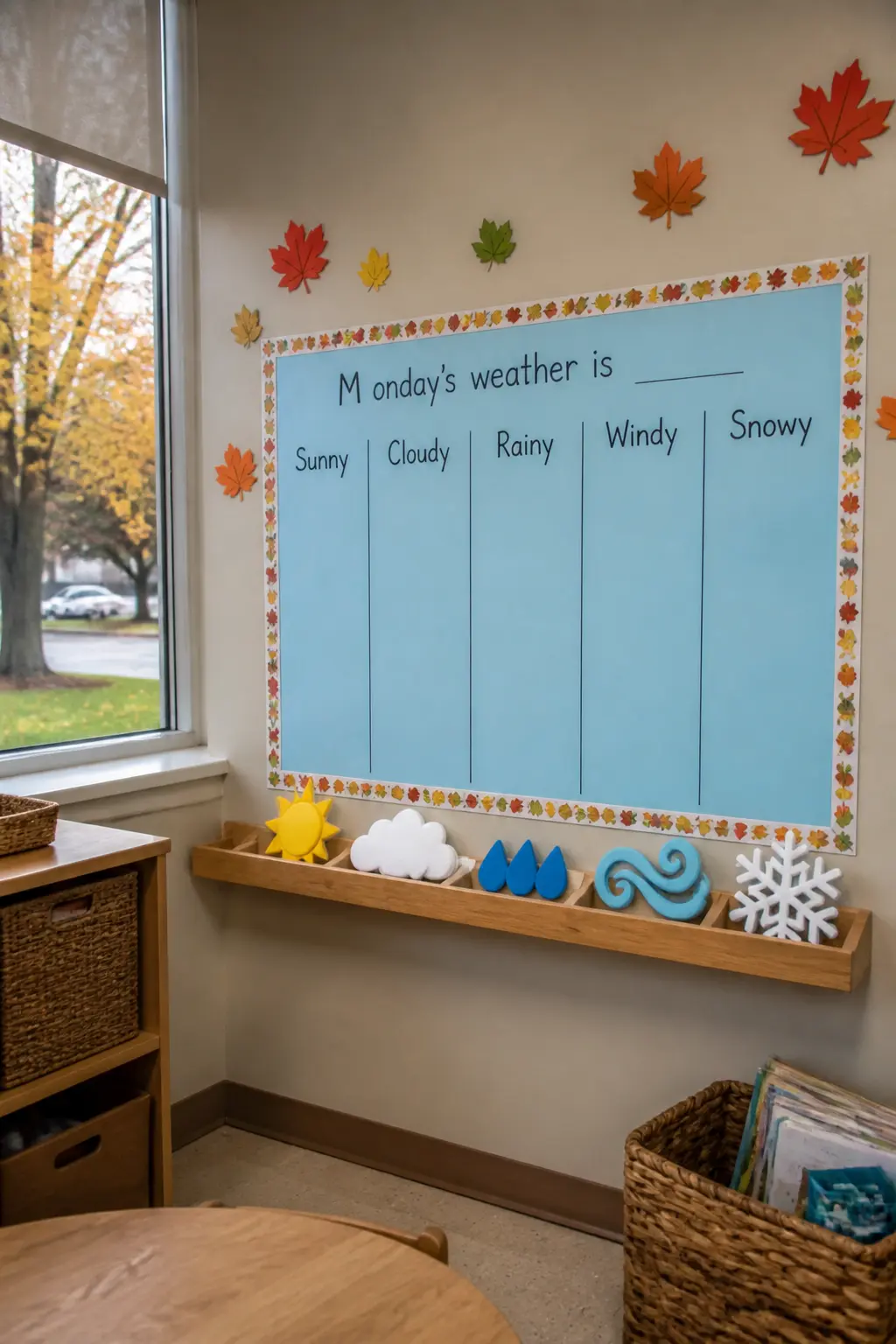
A large sheet of pale blue backing paper goes up on Monday morning with only the days of the week written across the top. Each day a child adds a weather symbol cut from foam (sun, cloud, rain, wind) to that day’s column. By Friday the weather wall is a five-day record the children made themselves.
This is the first layer of the Friday shared wall piece. Tell the children that on Monday. Knowing the weather wall will travel matters to this age group: they take more care with the placement.
🛍 Shopping guide
The Passport Stamp Station
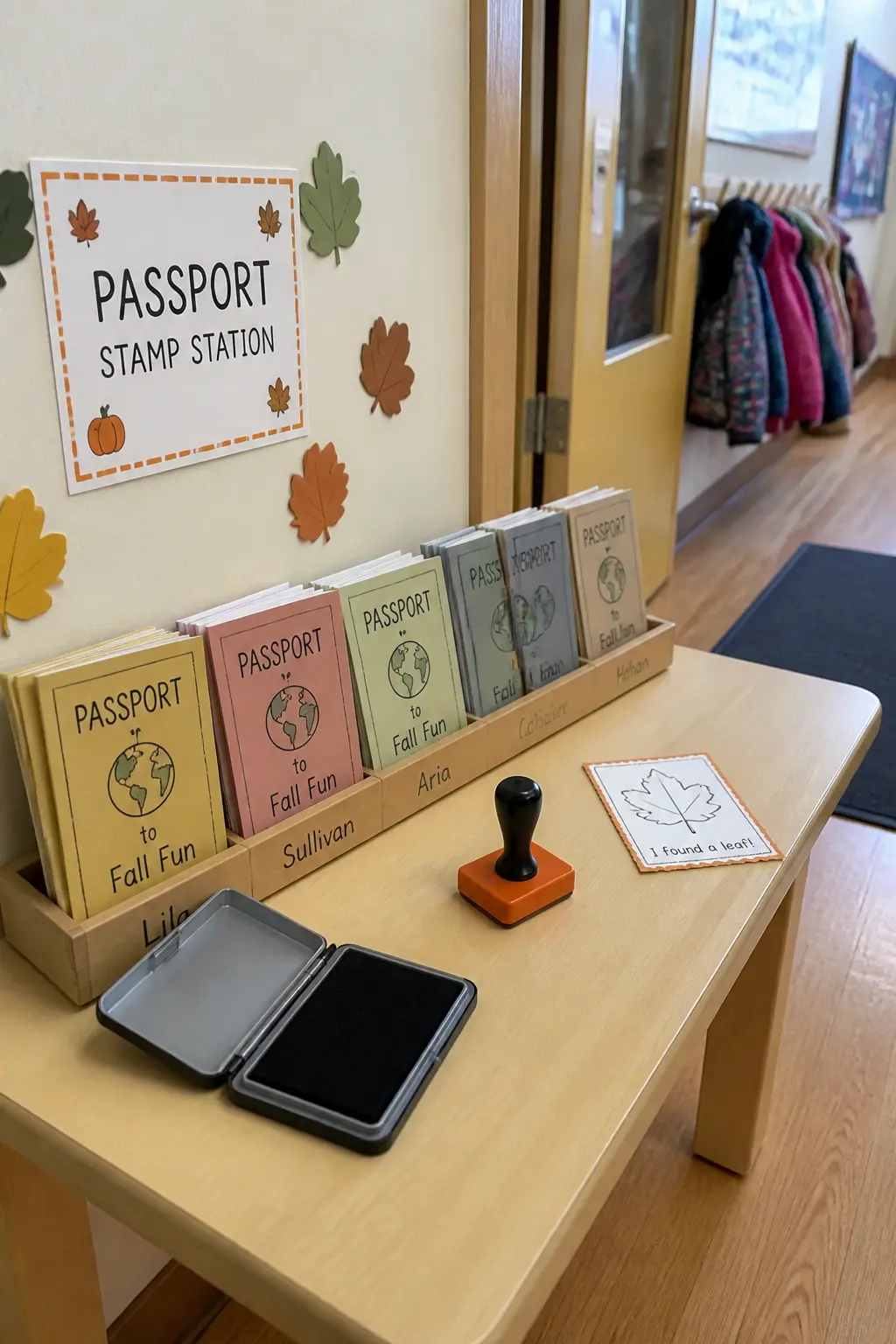
A low table near the classroom door holds the stamping station all week. Each morning a new stamp is set out with the day’s leaf species drawn on a small card beside it.
Children stop and stamp their passport on the way to their first activity. The stop is two minutes maximum and runs independently once children understand the routine, which takes one demonstration on Monday morning.
By Friday the passport has five stamps. The physical accumulation is visible evidence of the week passing. Three year olds who cannot read a calendar understand a full passport page.
🛍 Shopping guide
Leaf Identification Walk (Indoor Version)
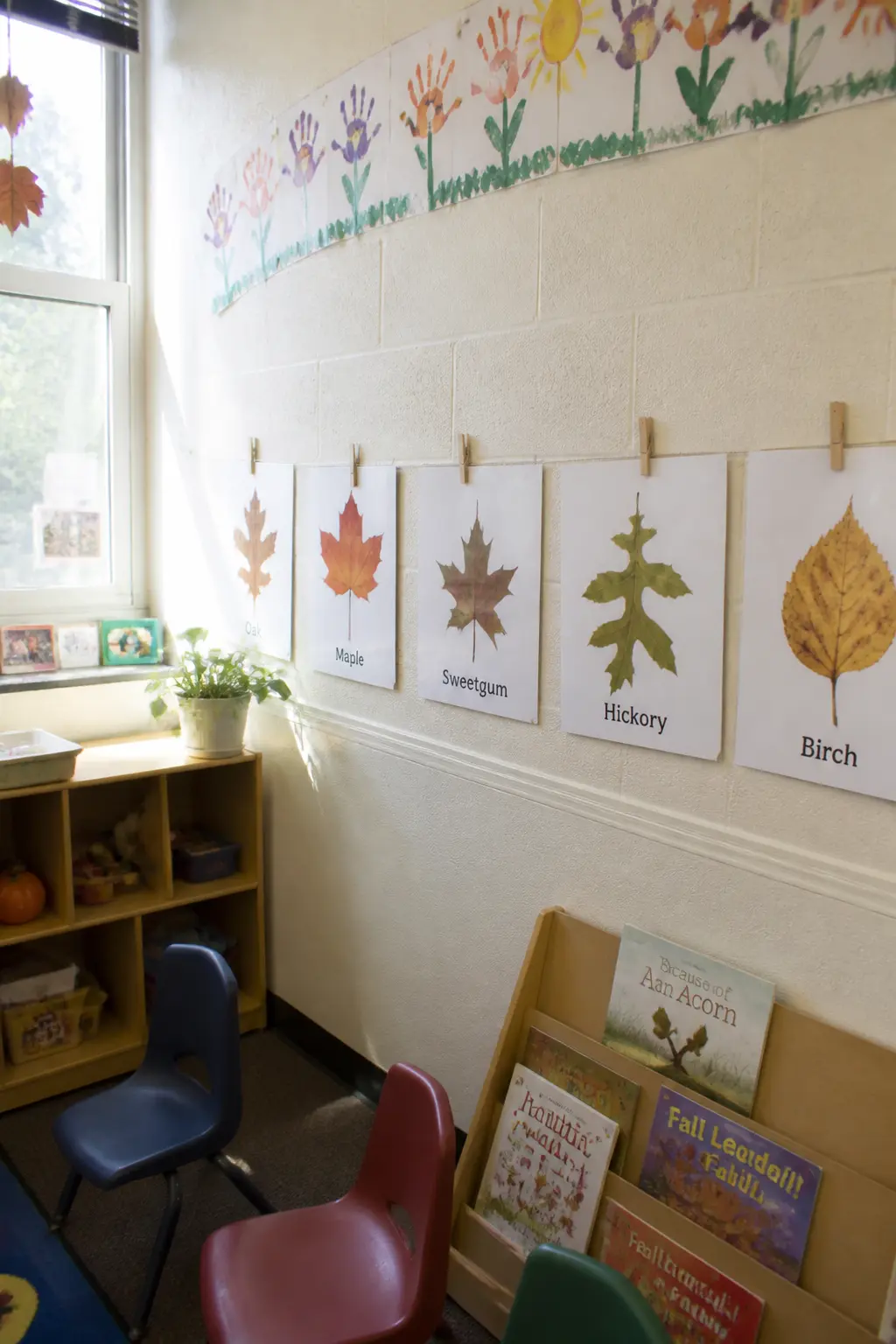
If outdoor access is limited, arrange ten large printed leaf photographs (A4, laminated) around the classroom walls at child height before school. Children walk the room with their passport and a crayon, making a tally mark next to each leaf type they recognise from the morning’s circle time. The walls become the walk.
This indoor version also works as a five-minute transition filler on any day. Leave two or three photographs up all week as a permanent reference so children can return to them independently when they want to check a leaf from the sensory tray.
🛍 Shopping guide
Autumn Walk Photo Board
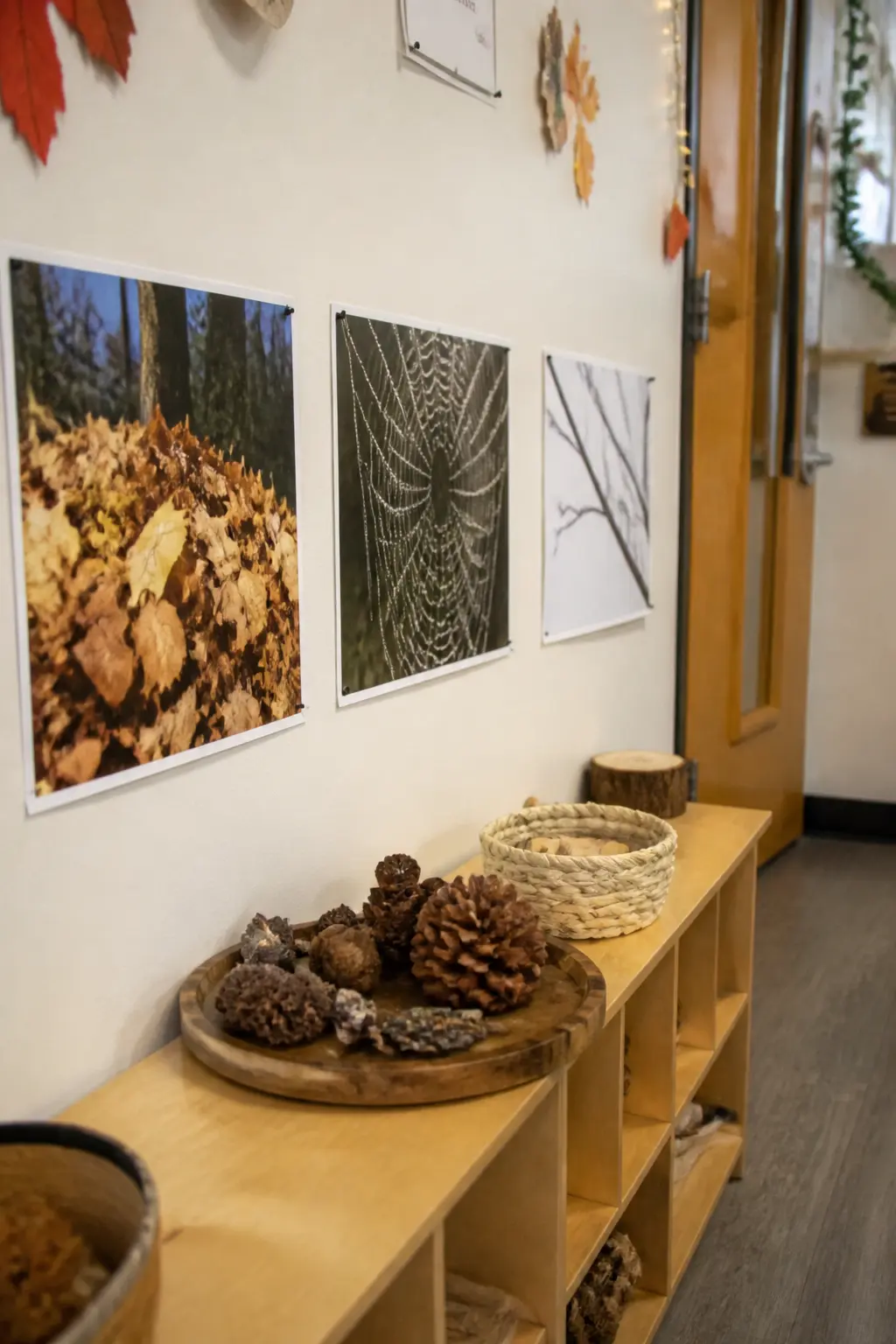
Before the week begins, take ten photographs outdoors of seasonal details: a pile of leaves, a bare branch, a damp path, a spider web, a conker on the ground. Print them at A4 and pin them at child height on Monday morning.
These photographs are reference material, not decoration. Children use them to check their sensory tray findings against real outdoor context.
For teachers whose classrooms have no outdoor access at all during the week, this photo board replaces the outdoor element completely. It also doubles as a talking prompt during the ‘Who Dropped This Leaf’ story circle: ‘Can you see where this leaf might have come from?’
🛍 Shopping guide
Tuesday: The Autumn Post Box
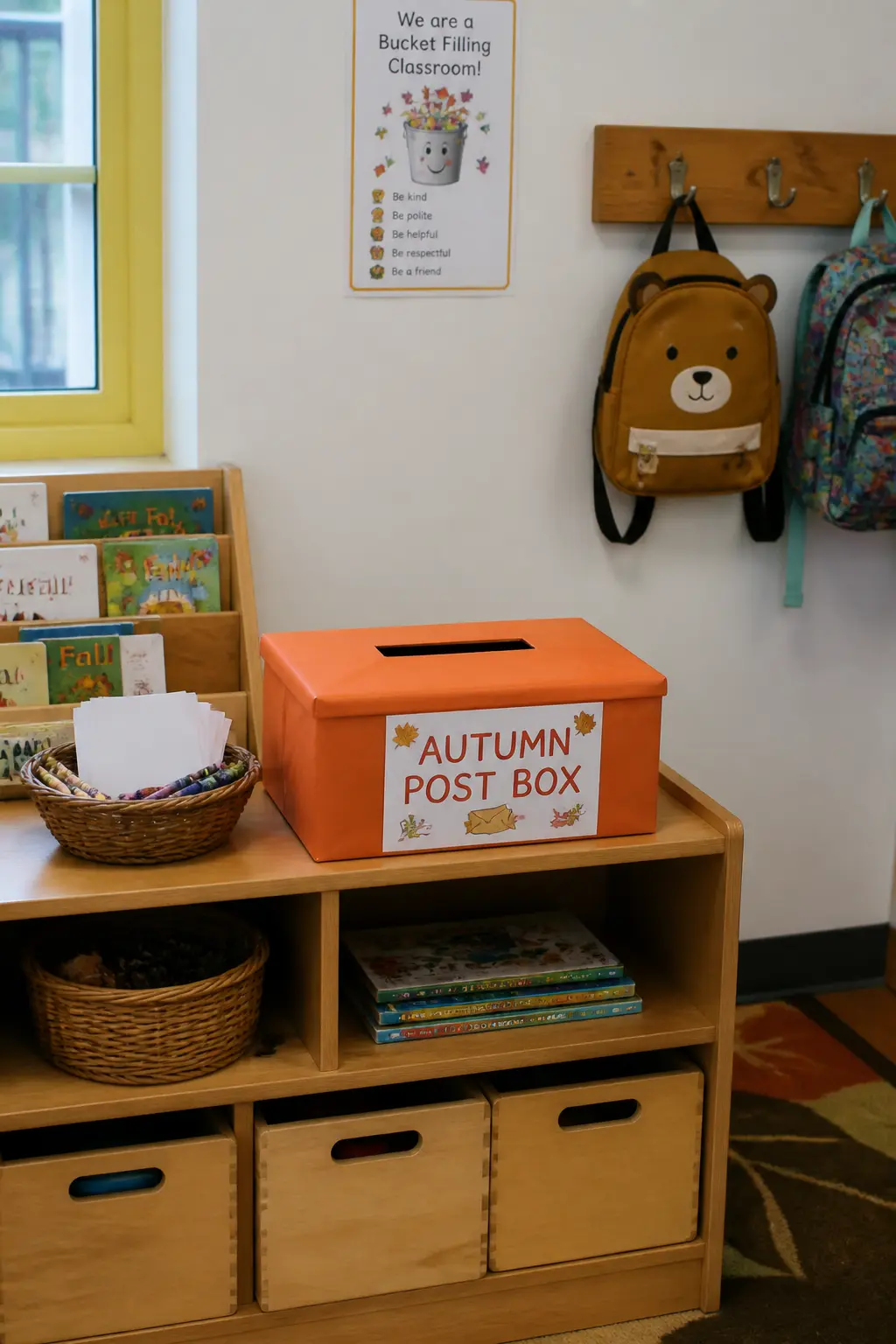
A shoebox wrapped in orange paper, cut with a slot on top, lives in the reading corner all week. On Tuesday children dictate or scribble a letter to autumn and post it.
On Wednesday morning the teacher reads one aloud at circle time as if autumn wrote back. The physical exchange lands hard with this age group: something went in, something came out.
Tuesday activities lean into language, weather observation and the idea that seasons can be spoken to. The making activity produces a decorated envelope that stays in the post box corner as display. Children who want to post again on Wednesday or Thursday are quietly encouraged.
Autumn Post Box Opening
Tuesday begins with the teacher carrying the post box to the carpet and opening it with ceremony. Nothing is in it yet, but the opening establishes the ritual. The teacher explains that by the time circle time ends today, all twenty children will have written or dictated something to autumn, and autumn will write back by tomorrow morning.
Children who want to draw rather than dictate get a blank card and crayons. The drawing counts as a letter. Every contribution goes in through the slot with the same physical posting action, which equalises participation across language levels.
🛍 Shopping guide
Letter to Autumn Dictation
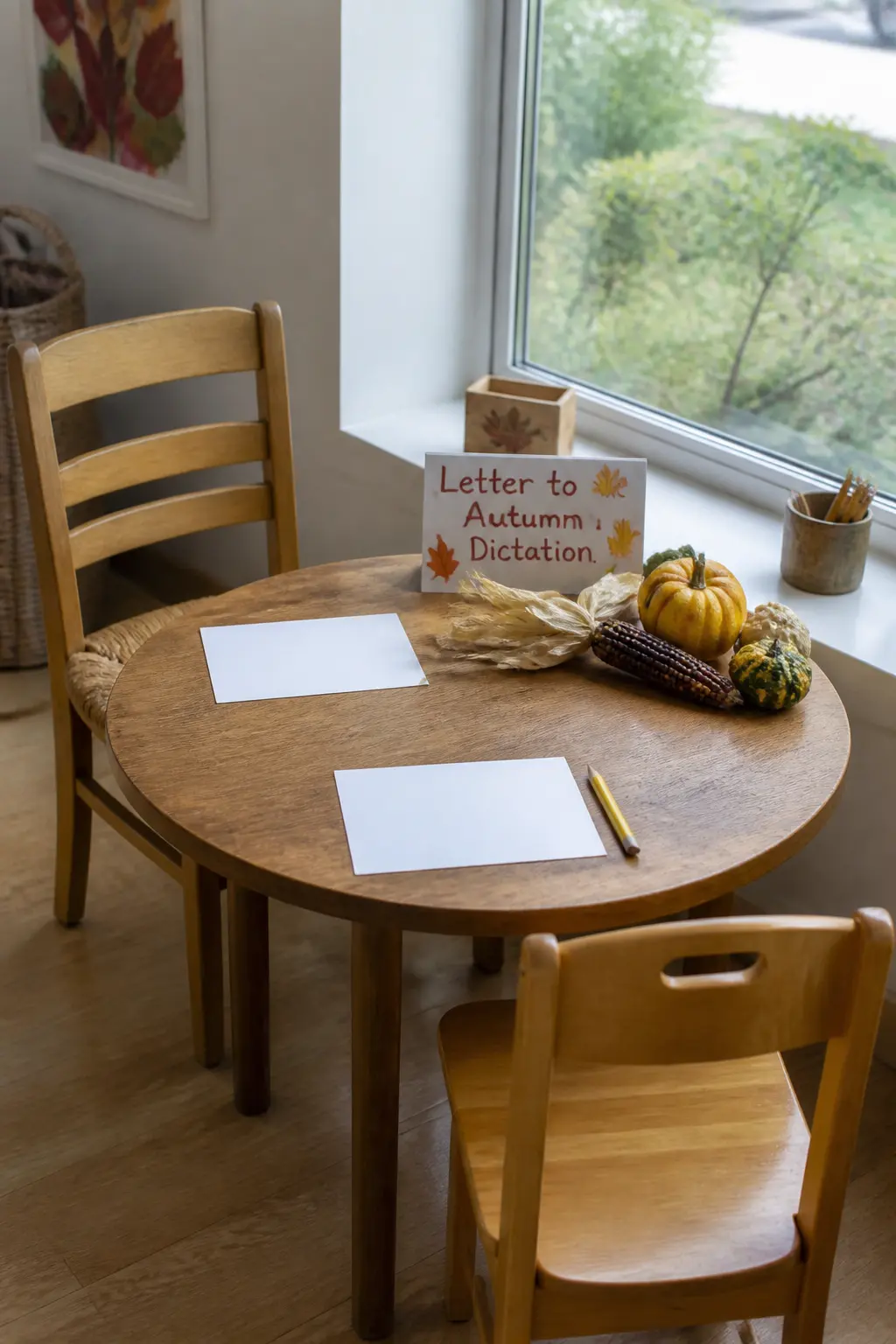
A teaching assistant or volunteer sits at a small table with blank cards. Each child approaches and dictates one sentence that begins ‘Dear Autumn.’ The adult writes it in large print, reads it back once, and the child signs their name in whatever form they can manage: a written name, a letter or a drawn symbol. All are valid.
If no assistant is available, the teacher runs this as a whole-group activity at circle time, taking three or four dictations aloud while the rest of the group draws their letters independently. Twenty cards take about twenty minutes in that format.
🛍 Shopping guide
Envelope Decorating
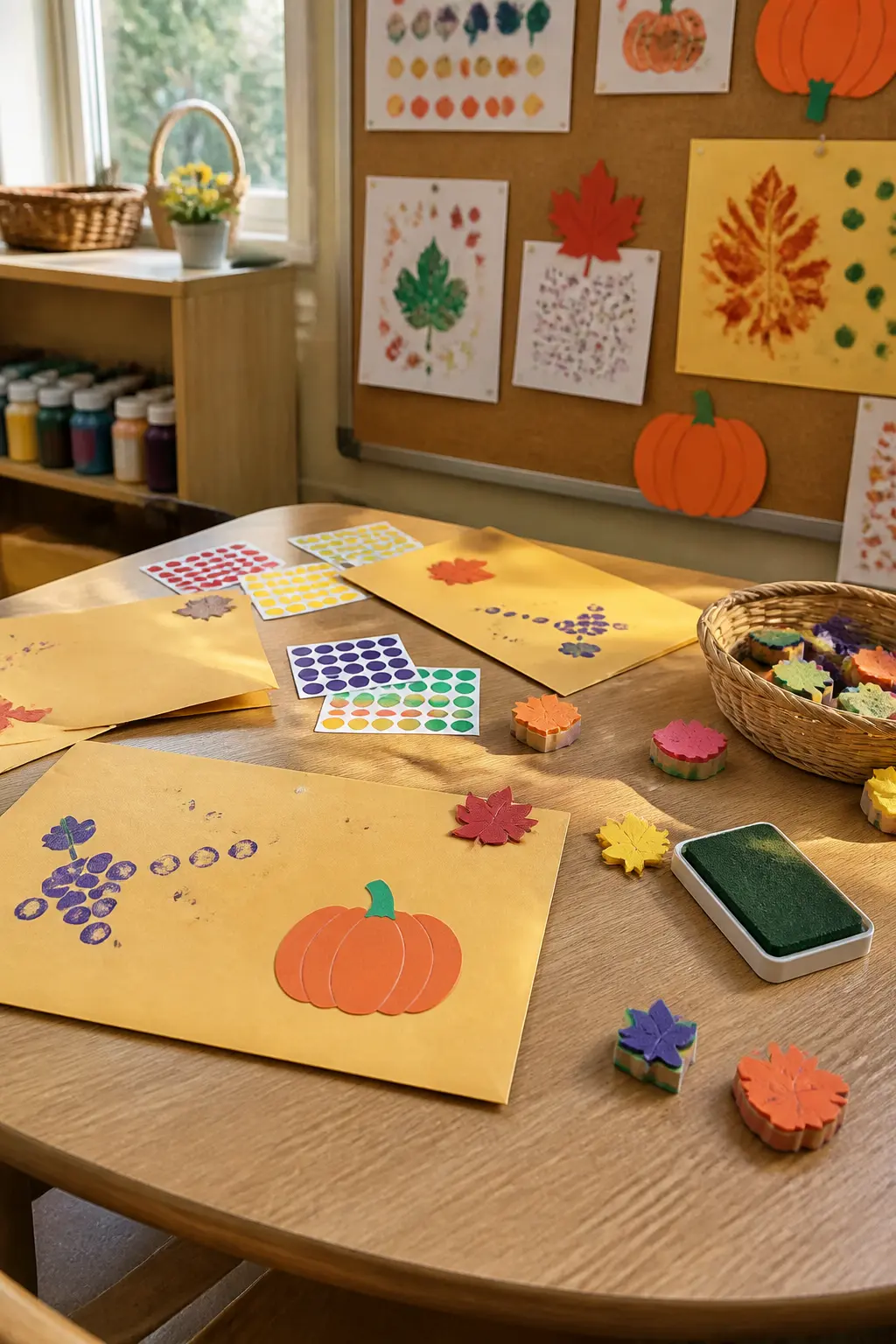
Each child decorates a large manila envelope with autumn-coloured dot stickers and foam stamp prints. The envelope does not mail anywhere: it goes into the post box corner display as Tuesday’s physical contribution to the week’s wall piece. Size the envelopes at A5 or larger so the stamps read clearly from a metre away.
Dot stickers in amber, rust and yellow are the fastest material for this age group: peel and stick, no glue, no mess, finished in five minutes and still visually strong. Set out four colours per table and let children choose without directing colour placement.
🛍 Shopping guide
The Autumn Replies: Reading Aloud
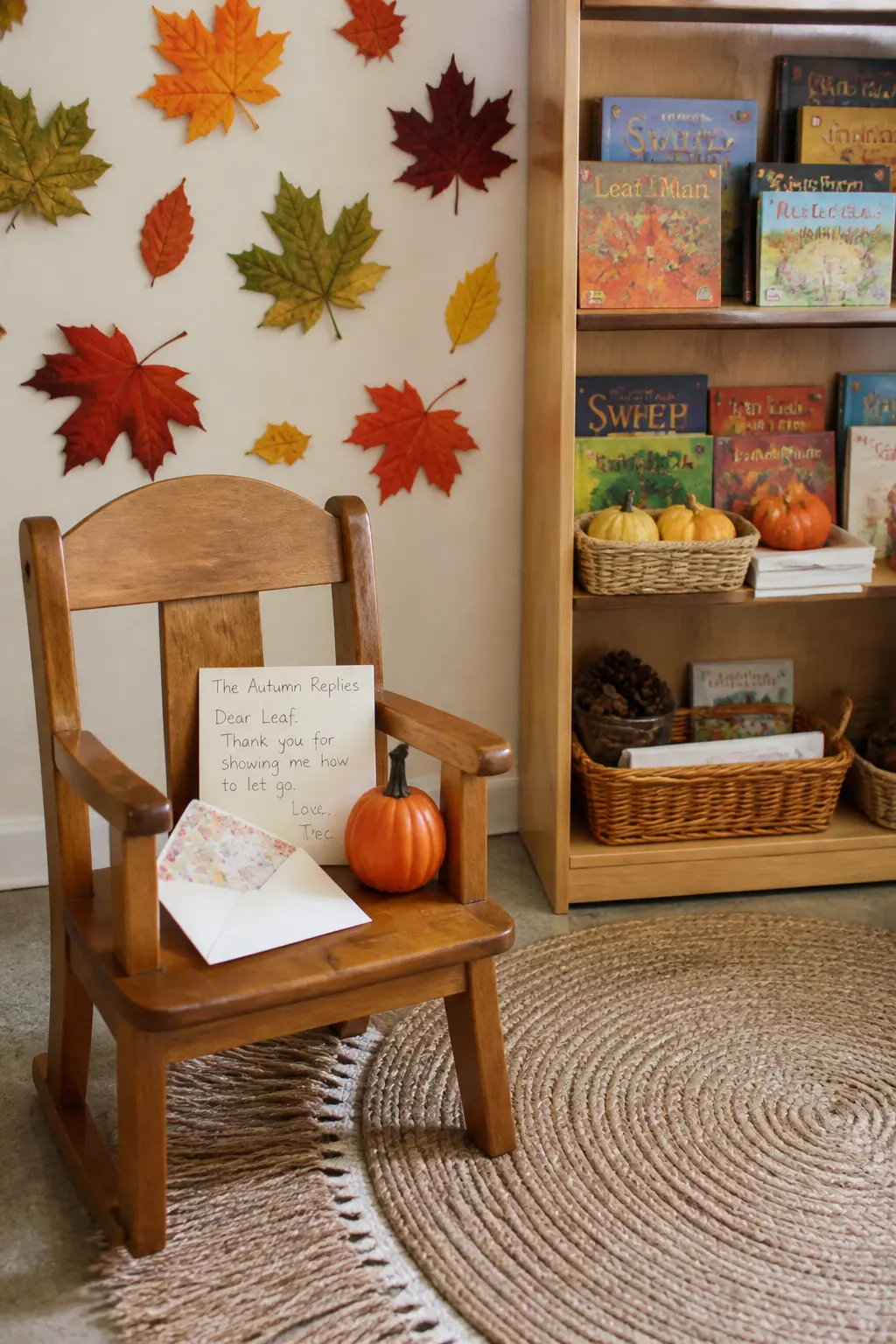
Wednesday morning the teacher arrives early and places one handwritten reply card in the post box, addressed ‘Dear Class’ and signed ‘Autumn’.
The reply picks up specific details from two or three real letters (with children’s permission): ‘I heard one of you thinks I smell like apples. You are right.’ The teacher reads it aloud at circle time while children listen without needing to respond.
That specific detail is the engine of the activity. A generic reply teaches children that letters receive generic replies. A specific one teaches them that writing is a way of being heard, which is a literacy lesson that takes three minutes and no worksheet.
🛍 Shopping guide
Wednesday: The One-Object Museum
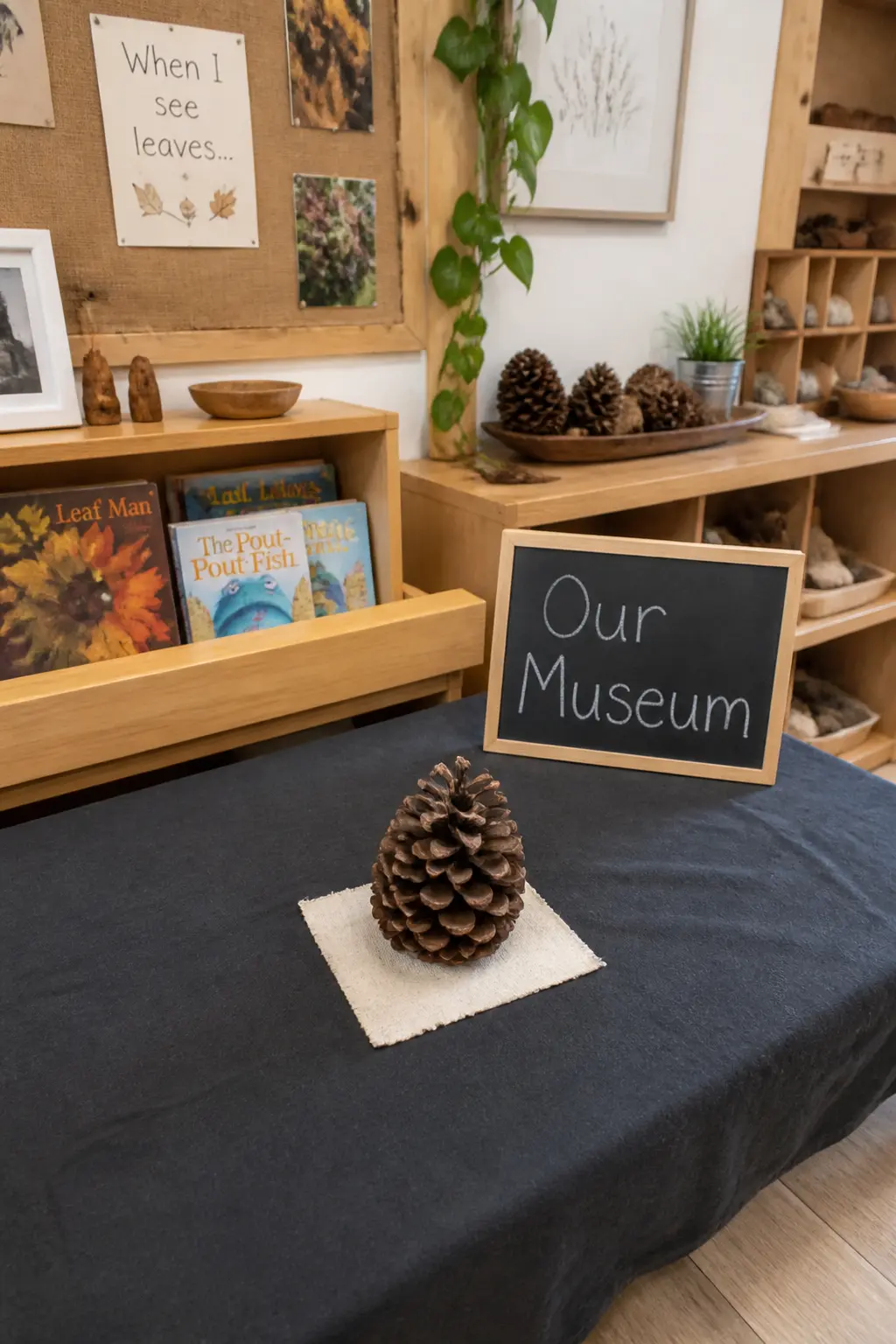
One table, one object per session, one child as curator. The child brings in (or picks from a nature tray) one seasonal find, places it on a small cloth square, and tells the group two things about it. The group asks one question. That is the whole format, and it takes four minutes.
Wednesday’s activities support close looking: a magnifier tray, a making activity that produces a label for the object, and a song about small things worth noticing. Every exhibit and its label gets pinned to a low board that the children can return to all afternoon. By Friday that board is one wall of the shared piece.
Museum Find Selection
On Wednesday morning a nature tray holds ten seasonal finds: a pinecone, a large chestnut, two seed pods, a piece of bark, a dried flower head and similar objects, all above four centimetres. The first child curator chooses one and places it on the museum cloth. The others go back into the tray for tomorrow’s curator.
Rotate a new curator at each session throughout Wednesday and Thursday. By Friday every child who wanted a turn has had one. Keep a class list on a clipboard beside the tray so no one is missed.
Two Truths About My Object
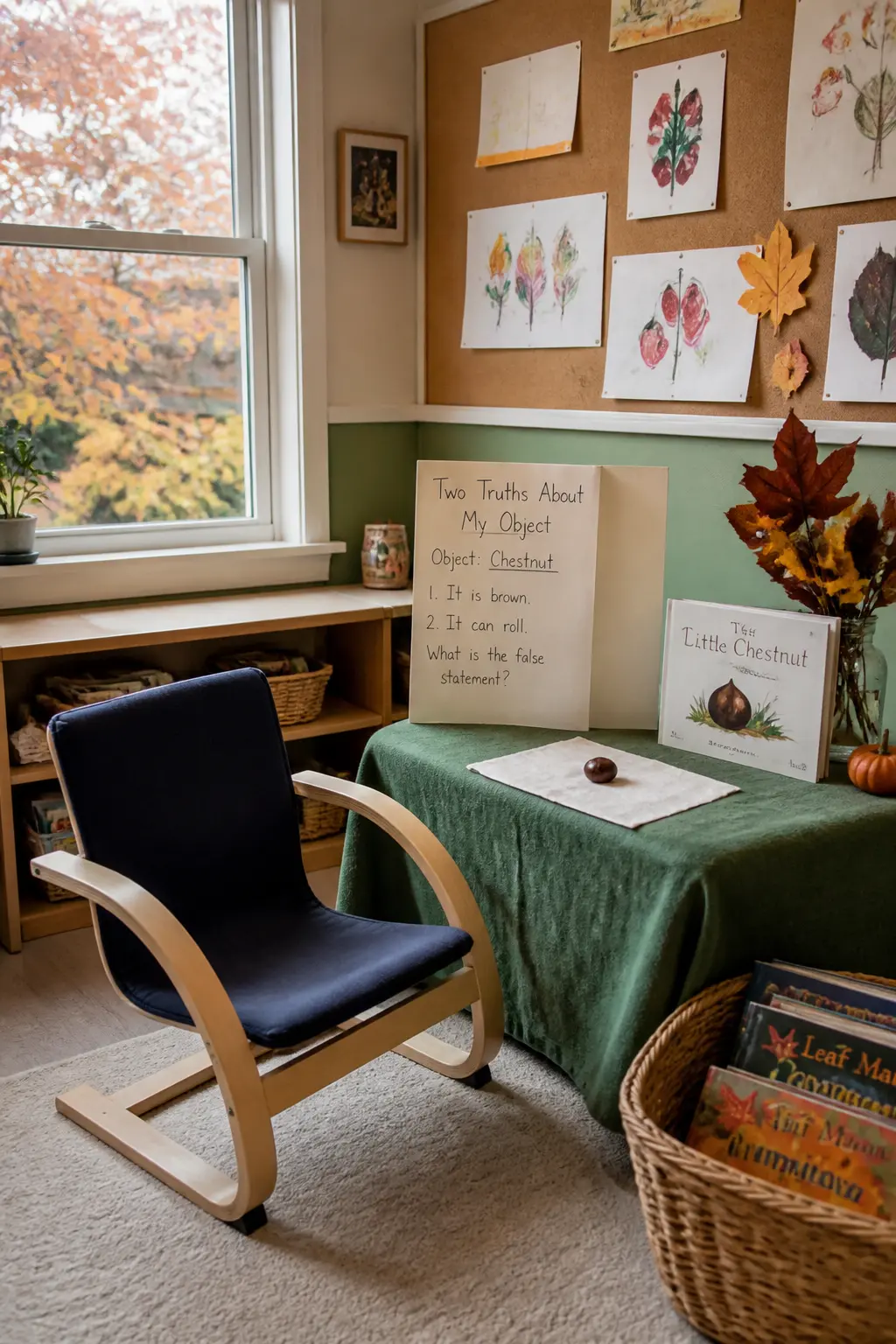
The curator holds their object and says two things about it. The teacher models on the first day: ‘It is round. It is hard.’ Then children go. A child who says ‘It smells like outside’ is doing exactly the right thing.
The group asks one question, the curator answers or says ‘I do not know’, and that answer is also right.
This format builds scientific language without drilling it. Over two days of curators, the group hears words like ‘rough’, ‘hollow’, ‘spotted’ and ‘heavy’ from their peers, which lands differently than hearing the same words from an adult.
🛍 Shopping guide
Thursday: The Treasure Trail
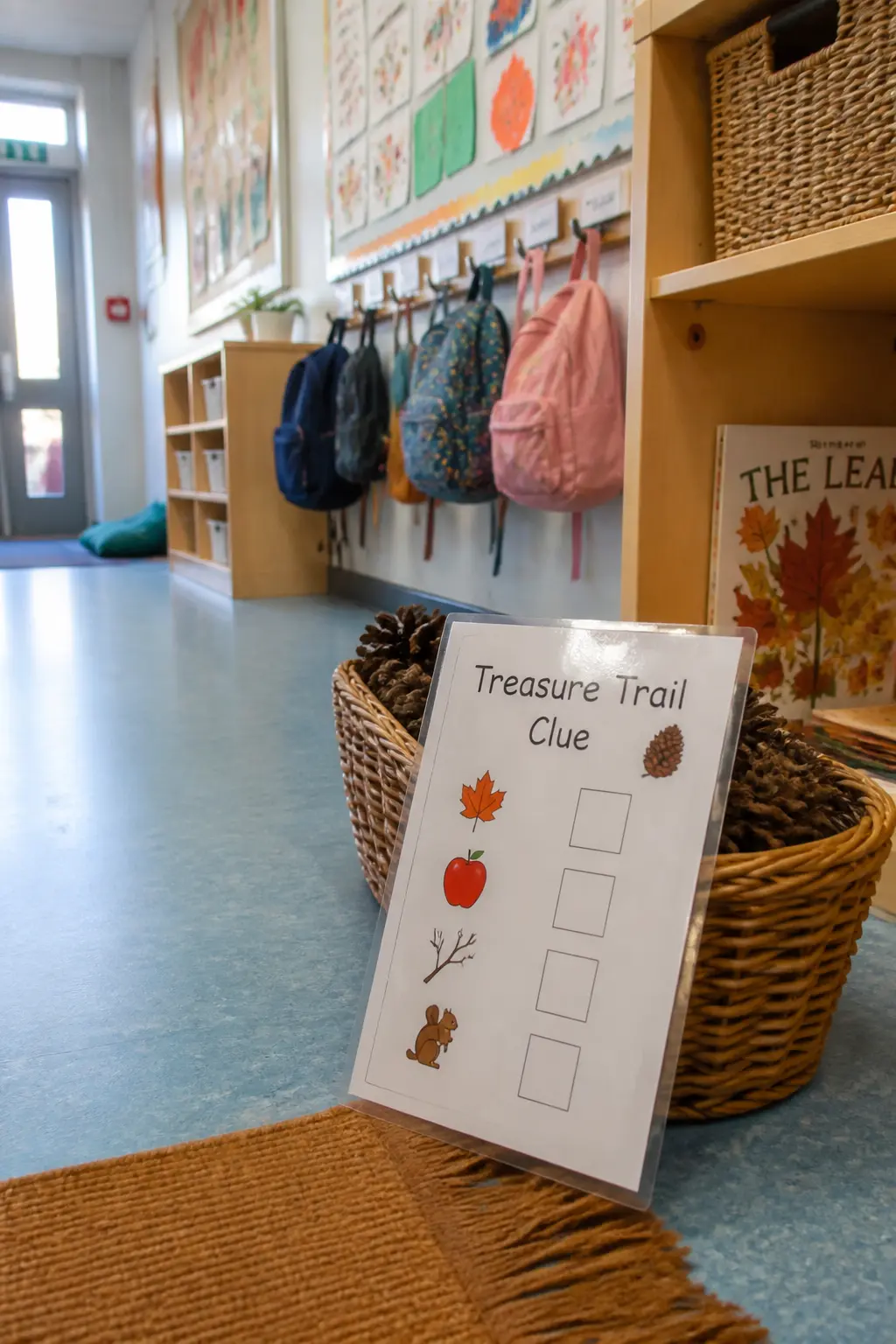
Six clue cards placed around the room before school starts. Each card names a seasonal object and has a simple pictogram so non-readers can follow. The group moves together, which means no running ahead and no one left behind.
The trail ends at a box holding one communal object: a pinecone, a dried leaf, a small gourd. That object joins the Friday assembly.
Thursday activities build momentum before the final day. The making activity produces one tile or square per child that will slot into Friday’s shared piece. Keep the pace brisk: by Thursday the children know the rhythm and they are ready to move faster through the familiar steps.
Treasure Trail Clue Cards Set-Up
Six clue cards, each showing a pictogram of a seasonal object: a leaf pile, a pinecone, a pumpkin, a conker, a bare branch, a spider web. Each card is A5 size, laminated, and attached to the object or to a surface near it.
Card one sits on the welcome mat. Finding card one tells children where to look for card two.
The whole trail stays inside the classroom or adjacent corridor. Plan the route in a loop so the group ends where it started. That loop structure prevents the sprint to the finish that breaks group cohesion in a class of twenty.
🛍 Shopping guide
Following the Trail Together
The group walks the trail as a unit. One child at the front holds the previous clue card and looks for the pictogram match. When they find it, they pass the card to the next child in line, who becomes the navigator.
Every child navigates for at least one leg of the trail if the group has twenty children and six clue stations: split the navigating into shorter sub-legs so no one waits the whole time.
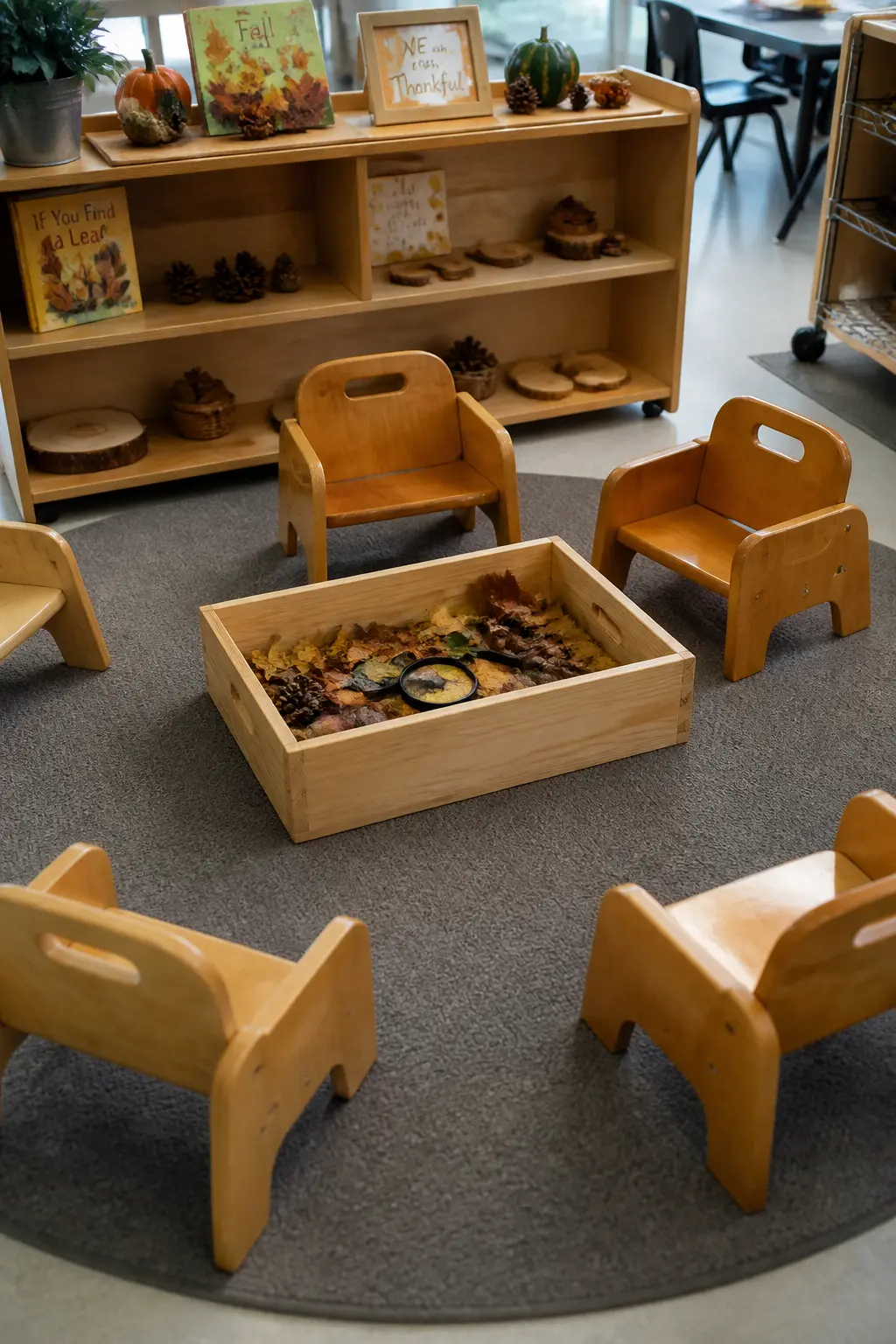
The trail ends at a small wooden box with a lid. Inside is the communal object for the Friday wall piece: a pressed fern, a dried rose head, a large acorn. One child opens the box. The group decides together where it will go on Friday’s wall.
🛍 Shopping guide
Conker Roll Race
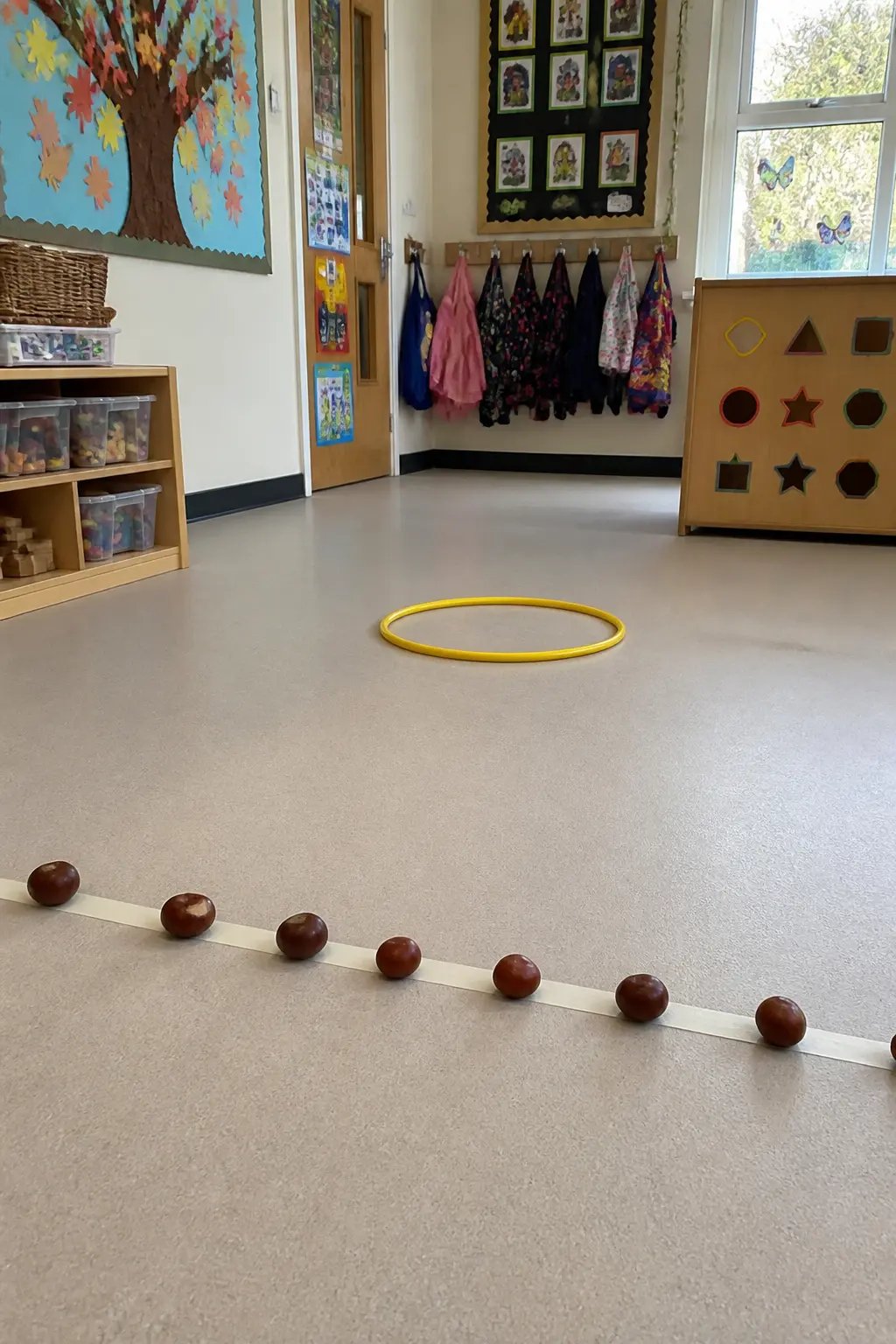
After the treasure trail, while energy is still high, set up a conker roll on the floor. Each child receives one large conker (or large wooden ball) and places it at a start line made of masking tape.
On a count of three, children blow their conker along the floor toward a finishing hoop. No touching, blowing only. The group plays twice and then the conkers go into the communal tray for Friday’s wall piece border.
Blowing a conker requires controlled breath, which is a pre-speech activity as well as a game. Children who need speech support get an extra turn, framed as a teaching moment rather than a correction.
🛍 Shopping guide
Friday: The Shared Wall Piece
Friday is assembly day. The leaf passport pages, the museum labels, the envelope display, the treasure-trail finds and Thursday’s tiles all come together on one large sheet of backing paper. Children take turns placing their piece. The teacher adds nothing except a title strip the class voted on during circle time.
The wall piece stays up until the following season. Visitors to the room can read the whole week in it. That continuity is the point: fall preschool activities that vanish on Friday afternoon teach the children that making is temporary. A wall that stays says the opposite.
Friday Wall Piece Assembly
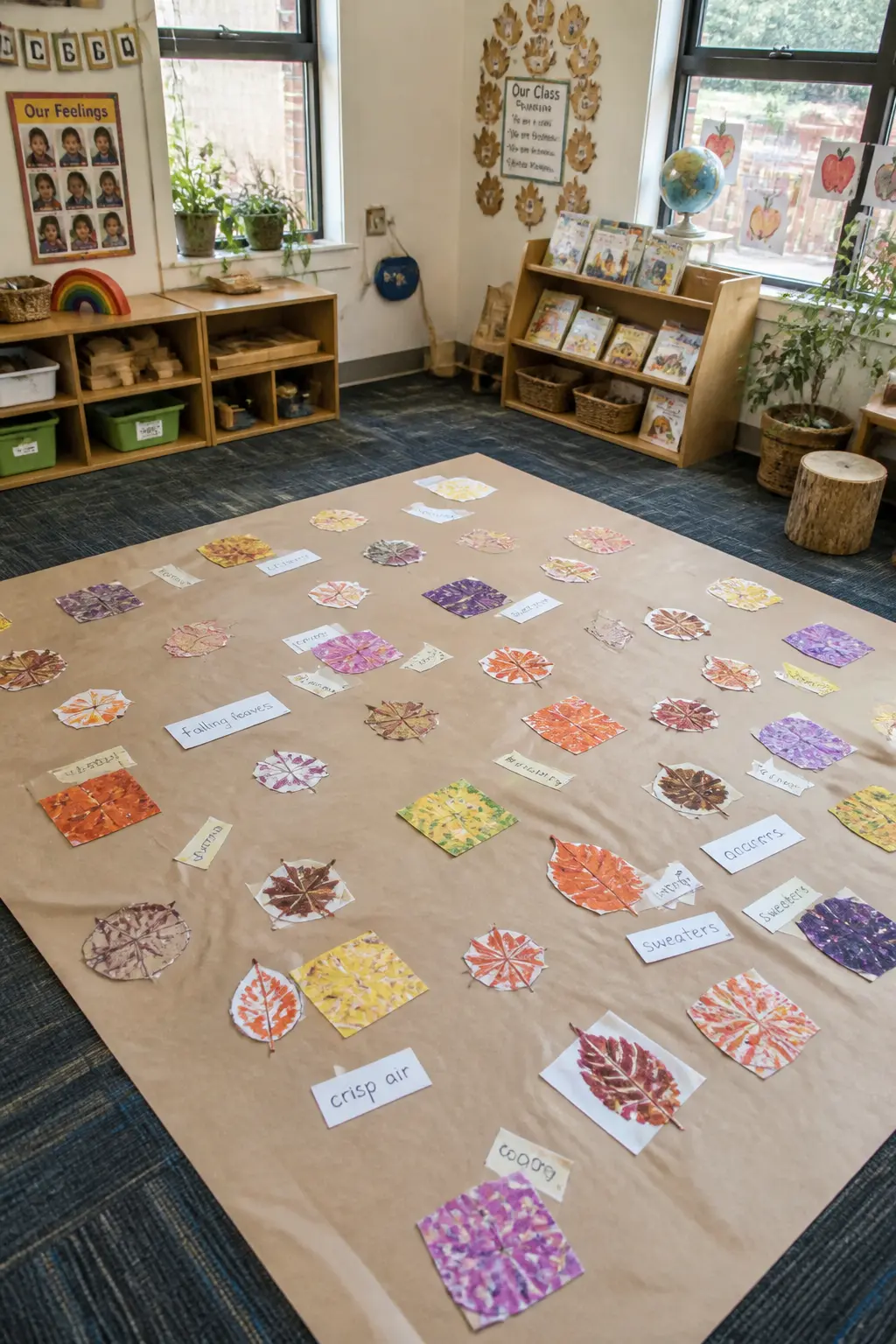
A large sheet of backing paper is laid on the floor at the start of Friday morning. The weather wall chart comes down and is placed at the top. Thursday’s painted tiles get arranged in a row below it.
Museum labels go in a strip across the middle. Decorated envelopes and leaf rubbings fill the lower section. The communal treasure-trail object gets glued (with PVA, which is safe and dry-fix) in the centre.
Children do the placing. The teacher does nothing except hold the backing paper flat and ask ‘Where do you think this belongs?’ The finished piece goes up on the wall before lunch. Everything in it has a maker’s name on its reverse.
🛍 Shopping guide
Class Title Vote
Before assembly starts, the teacher asks the group: ‘What shall we call our wall?’ Three suggestions go onto sticky notes and are read aloud. The class votes by pointing. The winning title gets written on a strip of card in large letters by the teacher, with each child adding one fingerprint dot to the border of the title strip.
Twenty fingerprint dots in autumn colours around a title strip turn a label into a collective signature. Every child’s mark is present. That matters more at this age than any individual attribution.
🛍 Shopping guide
Leaf Passport Sharing Circle (Friday Close)
The final circle of the week. Each child holds their passport and opens it to any page they like. Going around the circle, each child shows one stamp or drawing to the group and says one word about it. No prompting, no correction.
The teacher is the last to go and names one thing they noticed about the class this week.
The passports go into envelopes for home. Include a small note for families explaining each page: what the stamps represent, what the leaf rubbing is, why the title strip has their child’s fingerprint on it. Families who understand the week’s arc value it differently than those who see a packet of loose papers.
🛍 Shopping guide
Circle Time and Songs
Circle time anchors each day. The activities in this section are the first fifteen minutes: a call-and-response opener, a question on the carpet, and a song that names whatever the day’s leaf or object is.
Songs work best when they are short enough to learn in one sitting and physical enough that a three year old can stay in their body while singing.
None of these songs require a musical instrument, though a simple shaker made on Monday adds texture from Tuesday onward. The call-and-response patterns here are designed so that children who do not yet speak in full sentences can still join in with a single word or a gesture.
Leaf Name Song
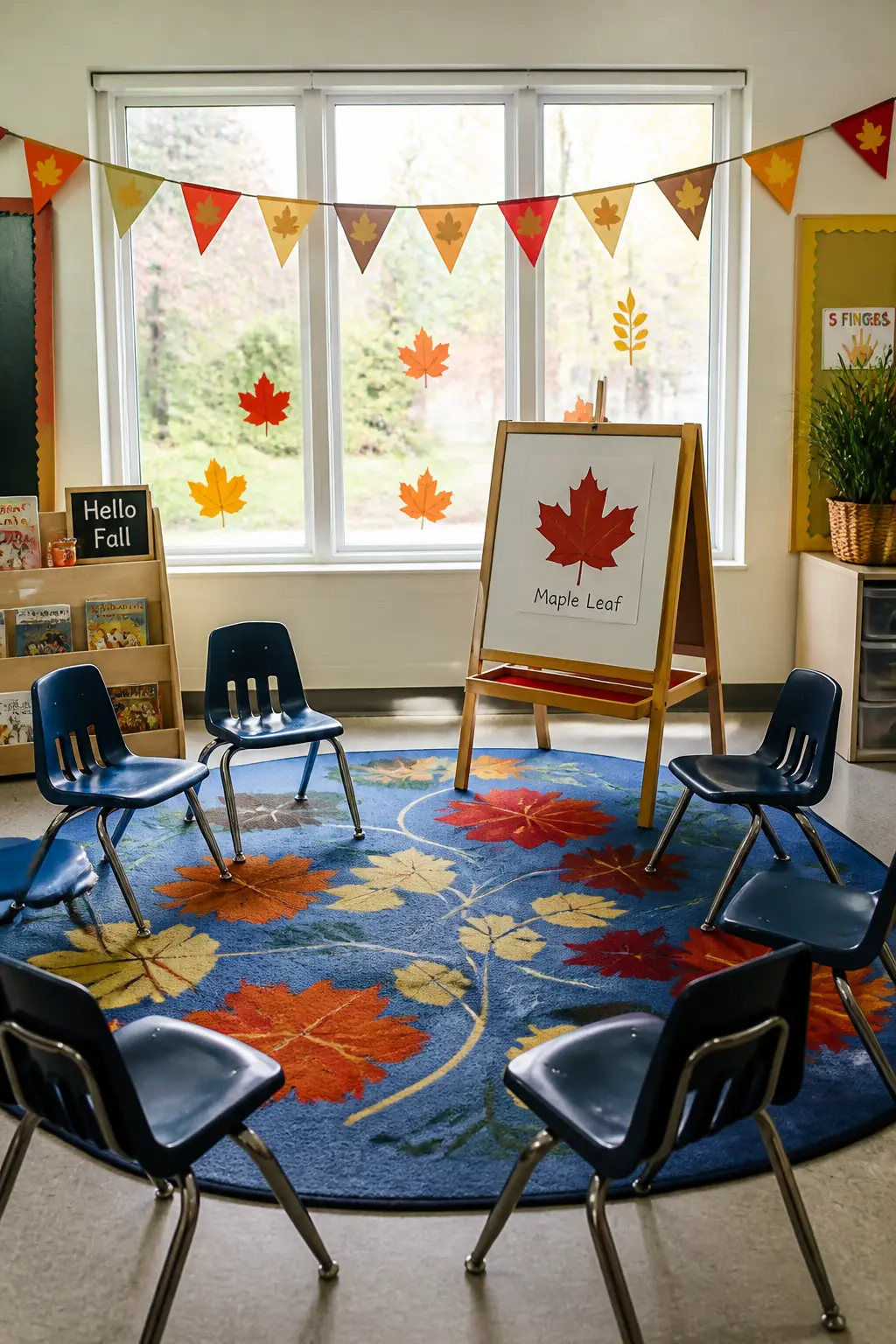
Sung to the tune of ‘Mary Had a Little Lamb’, each verse names one leaf the class has seen: ‘The maple leaf is red and round, red and round, red and round.’
The teacher points to a large picture card on the easel as each leaf name lands. Children who know the name call it out, children who do not hear it modelled.
By Wednesday the group can usually fill in the leaf name without the teacher. That moment of self-correction is the developmental win, not the song itself.
🛍 Shopping guide
Who Dropped This Leaf? Story Circle
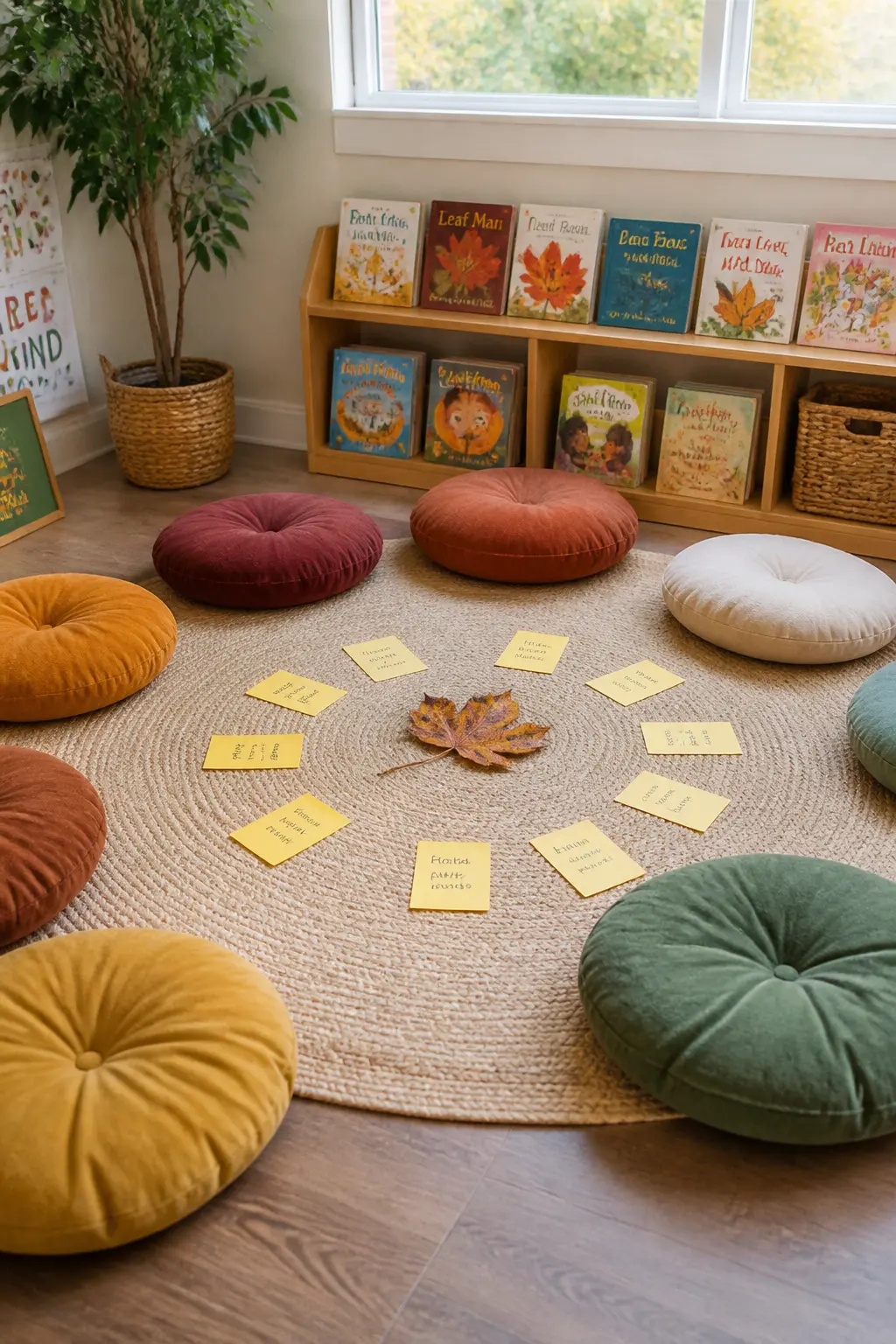
The teacher places one large leaf in the centre of the carpet and asks: ‘Who do you think dropped this?’ Children offer animals, trees, giants, fairies. The teacher writes each answer on a sticky note and puts it around the leaf. No suggestion is wrong. After ten answers the teacher picks up the leaf and says: ‘Let’s find out tomorrow.’
On Tuesday the teacher brings a picture of the tree species the leaf came from and the sticky notes come back out. That twenty-four-hour gap between question and answer is deliberate: it teaches children that curiosity can wait, which is its own lesson.
Acorn Drop Counting Song
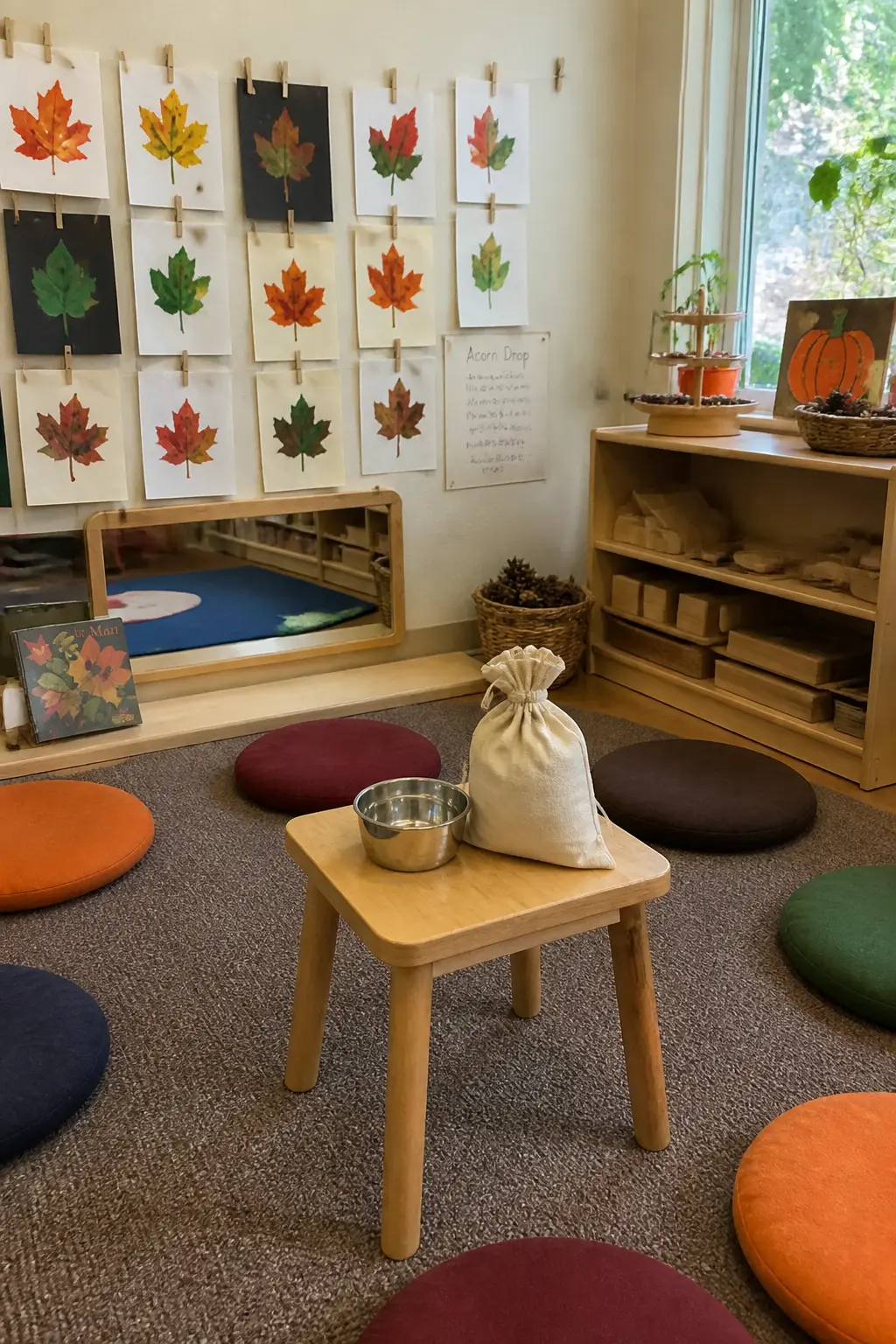
The teacher holds a fabric bag and drops one large acorn (or wooden bead above four centimetres) into a metal tin for each count. The sound does the work. ‘One acorn fell from the tree, plunk. Two acorns fell, plunk plunk.’ Children count the plunks, not the acorns they cannot see. Counting to ten takes under three minutes.
Repeat with the children dropping the acorns themselves in small groups of four. The physical action of dropping and hearing consolidates the count in a way a flashcard does not. This song returns on Thursday as part of the treasure trail opener.
🛍 Shopping guide
Autumn Calls and We Call Back
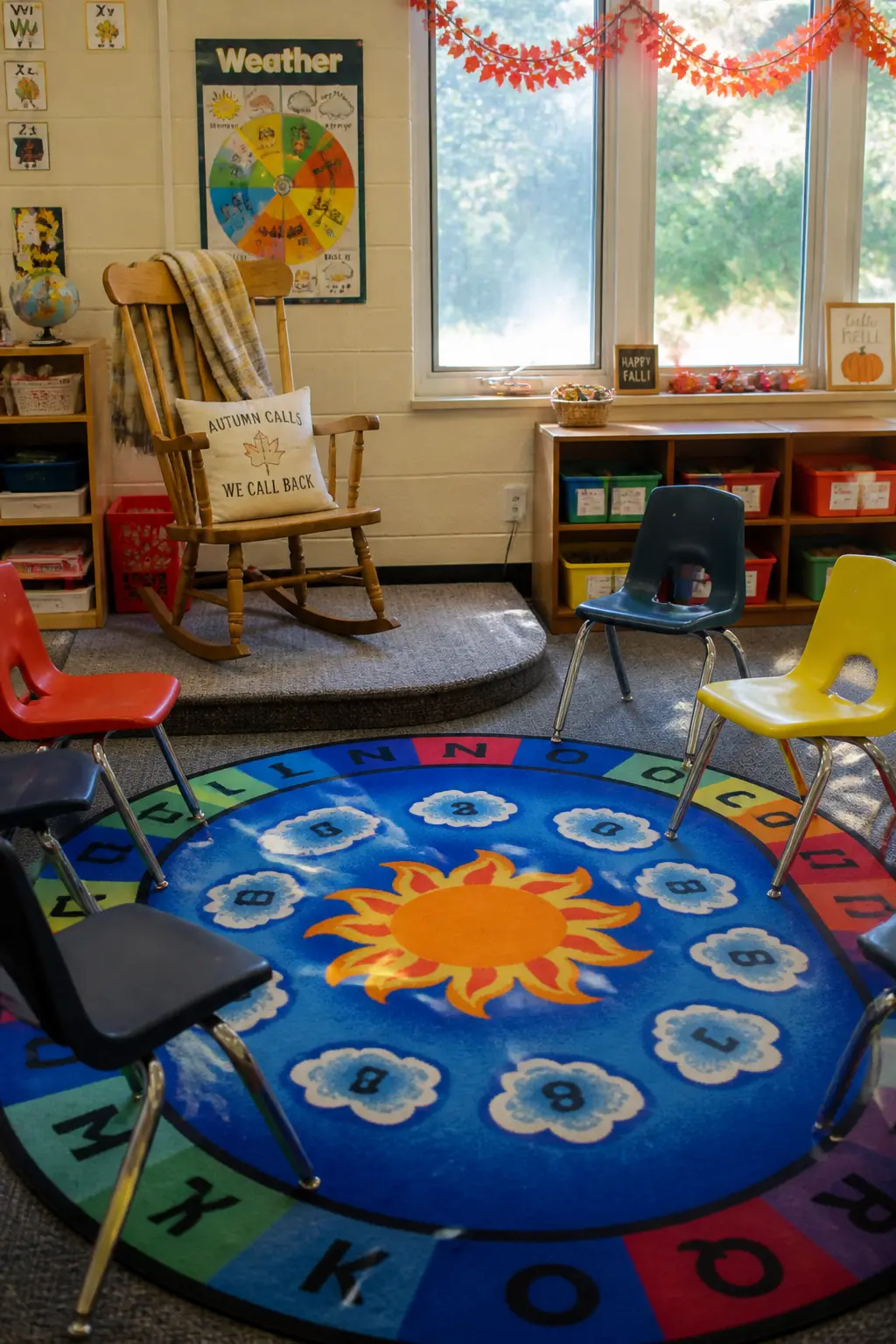
A call-and-response chant for Wednesday circle time. Teacher: ‘Autumn says the leaves go.’ Children: ‘Red, yellow, brown.’ Teacher: ‘Autumn says the air goes.’ Children: ‘Cold, cold, cold.’ Teacher: ‘Autumn says the squirrel goes.’ Children: ‘Find, find, find.’ Each round gets one word faster, which is the game inside the chant.
Add a new verse each day with the word that came from Tuesday’s weather wall or the Wednesday museum object. By Thursday the chant has five verses and the children are leading it without the teacher. That handover is the point.
Treasure Trail Song: What Comes Next?
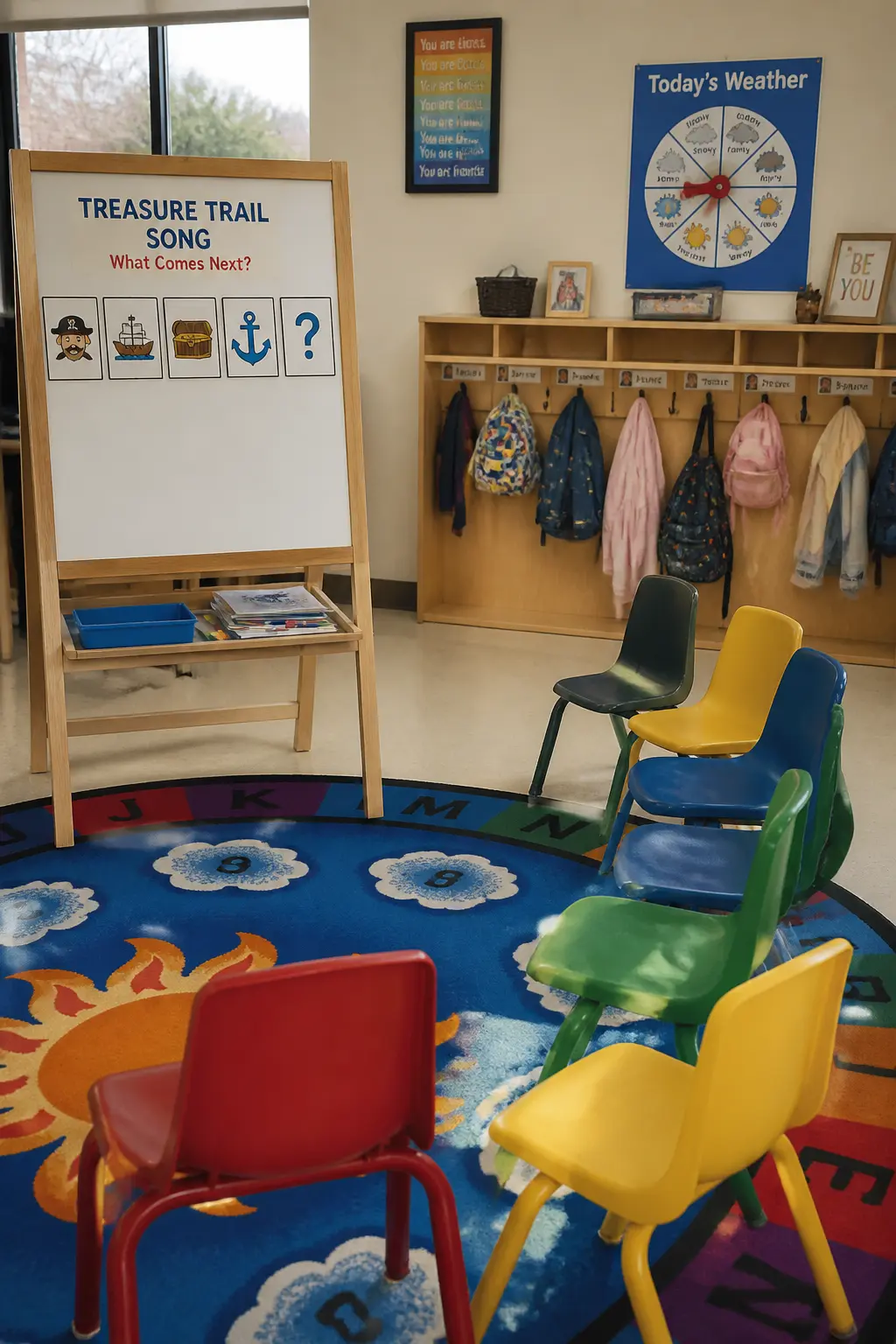
Before the trail begins on Thursday, the class sings a call-and-response that previews each clue object. ‘What comes after the leaf pile? (Pause) The pinecone.’ ‘What comes after the pinecone? (Pause) The pumpkin.’ Children who were paying attention on the set-up tour the previous day can answer from memory. Others use the pictogram strip displayed on the easel.
This song doubles as a memory warm-up and a preview of the trail route, which reduces anxiety in children who struggle with transitions or unpredictable sequences. Knowing what comes next is regulating, and regulated children trail-walk better.
Autumn Senses Chant
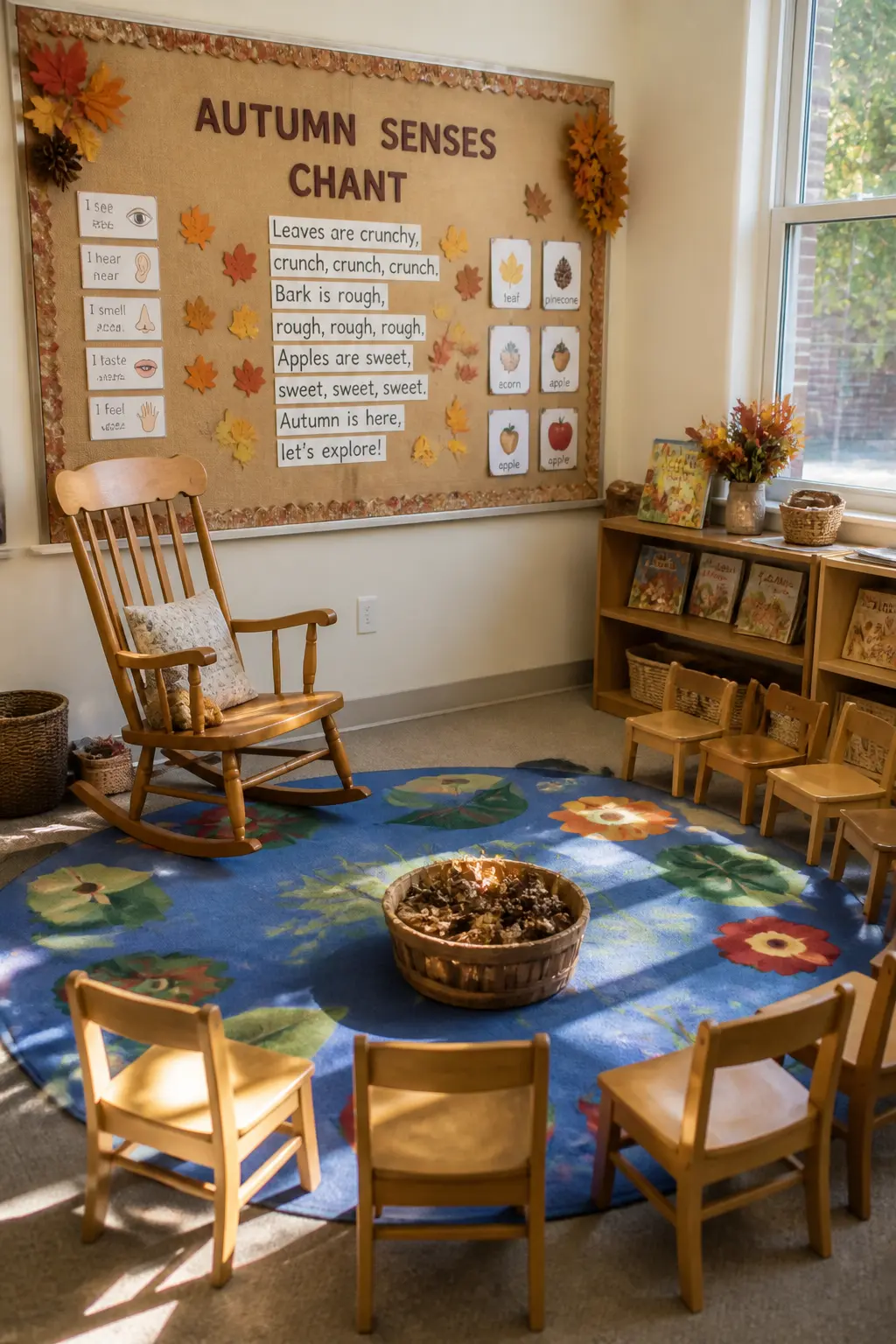
Monday’s opening chant names one sense per line: ‘I see a red leaf, I hear a crunchy leaf, I touch a smooth leaf, I smell a damp leaf.’ The teacher holds a real leaf for each sense and mimes the action. Children mime along.
On each repeat the teacher swaps in a different seasonal word suggested by the children: ‘I see a…?’ and waits.
This chant recurs on Friday as a closing ritual, bookending the week. On Friday the children fill every slot from memory. That the week opens and closes with the same chant is not laziness: it is the architecture of repetition with variation that this age group needs to feel complete.
Weather Observation at the Window
Each morning one child stands at the classroom window for sixty seconds and reports back to the group: ‘The sky is…’ and ‘The trees are…’ The teacher writes the two observations on the weather wall in the child’s own words, not in corrected standard vocabulary. ‘The sky is a bit white’ stays as written.
By Friday the weather wall holds five days of observations in children’s language. Reading them back at the closing circle shows the group that their words are worth keeping, which is one of the earliest and most durable literacy lessons a classroom can offer.
Squirrel and Acorn Movement Game
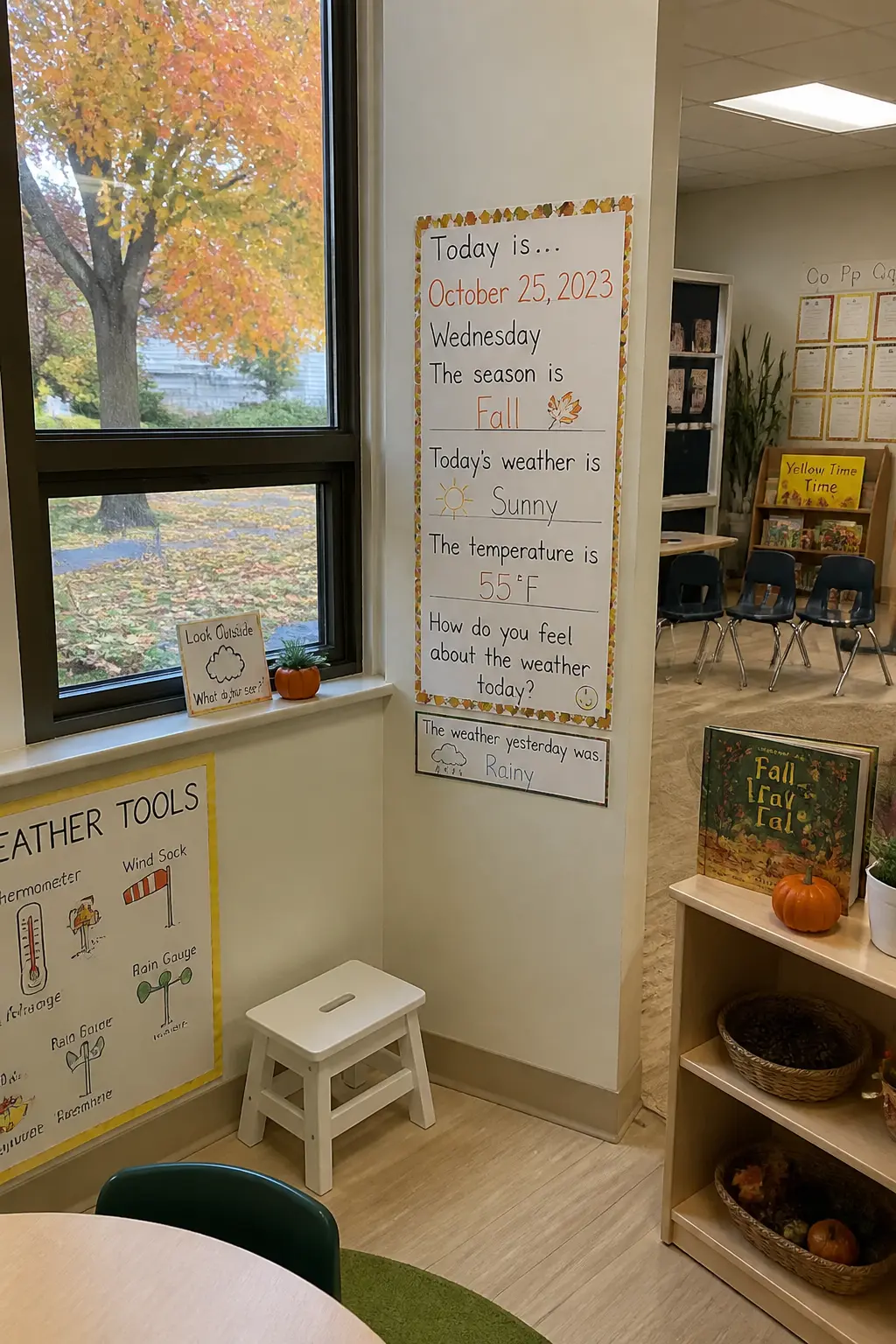
Children are squirrels. Six large hoops on the floor are trees. Ten large acorns (wooden balls or foam above four centimetres) are scattered on the carpet. On ‘Go’, children pick up one acorn each and run to hide it in a hoop-tree.
On ‘Winter is coming’, they freeze. Count the acorns in each tree together. Play twice, then return to the carpet.
The game teaches one-to-one correspondence and the concept of storing for winter at the same time. It also burns the energy that accumulates in twenty three-to-five year olds sitting for twenty minutes before it, which means the next seated activity goes better.
🛍 Shopping guide
Nature Sound Memory Game
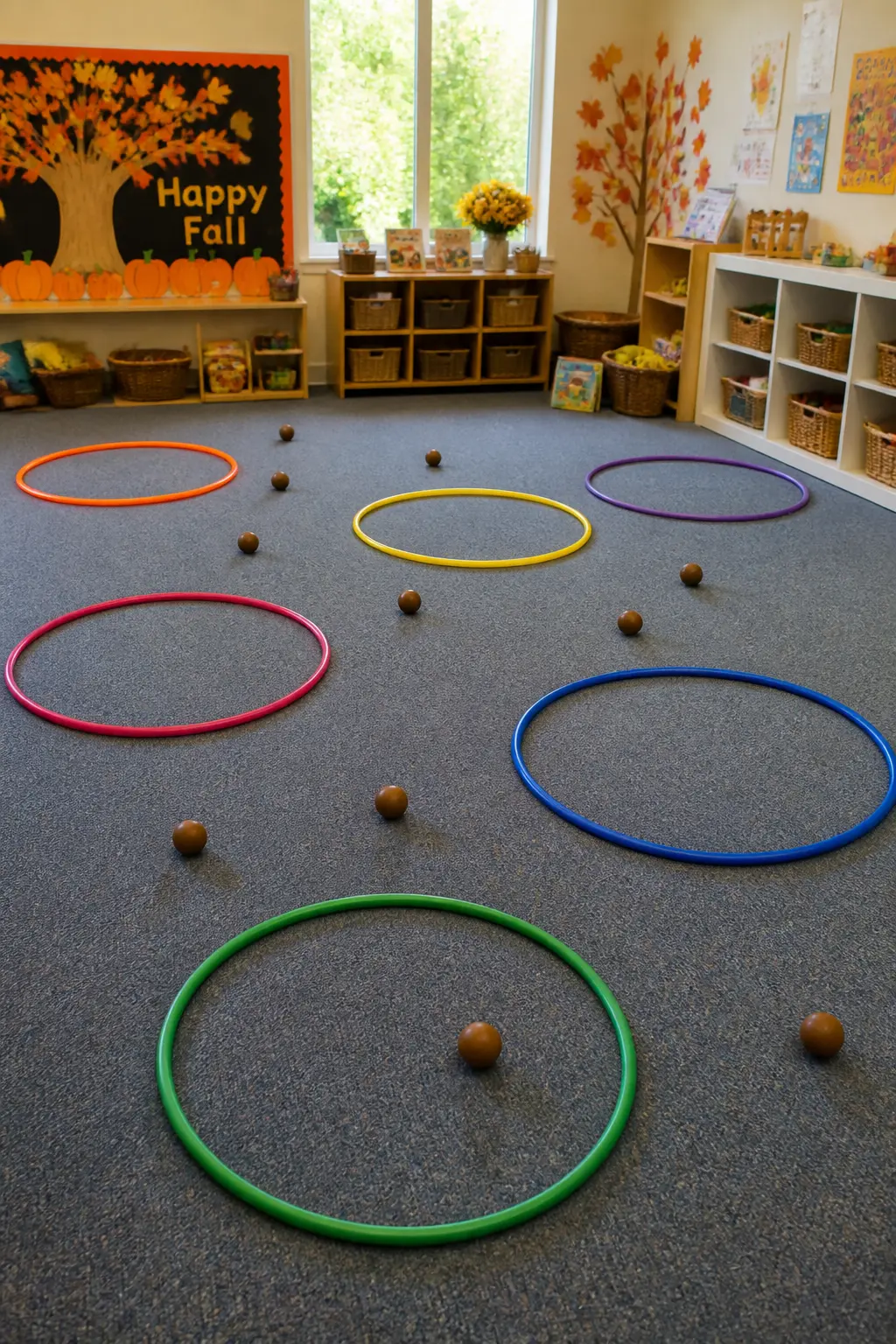
Six cloth bags each hold one seasonal material: dried leaves that crunch, seeds that rattle, a smooth stone, a piece of bark, dry corn husks and a small dried flower.
Children close their eyes and the teacher places one bag in each child’s hands for ten seconds. After six rounds the group names every material in order from memory. Most groups of fours and fives can manage four out of six correctly.
This game requires no materials beyond what is already in the week’s sensory trays, and it works as a five-minute filler on any day. It also develops auditory and tactile memory simultaneously, which is an uncommon combination in typical circle time formats.
🛍 Shopping guide
Autumn Alphabet Hunt
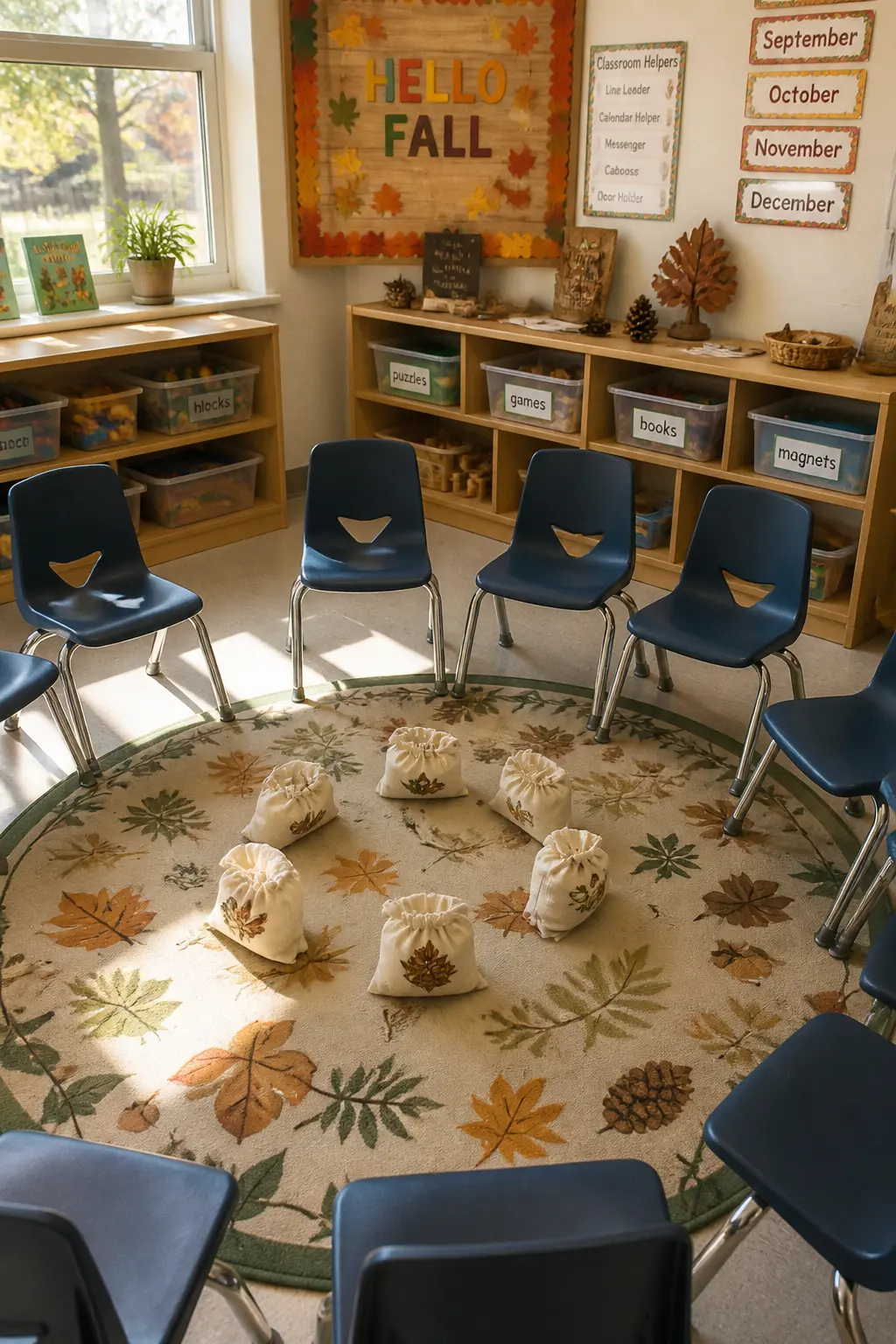
The teacher writes A-U-T-U-M-N vertically on the whiteboard in large letters. The group calls out one seasonal word for each letter: A for acorn, U for under the leaves, T for tree, U for umbrella (rain), M for mud, N for nest. Every suggestion is accepted, then the class picks a favourite for each letter and the teacher circles it.
The completed acrostic goes onto the wall as Tuesday’s language display. Children who are working on letter recognition benefit from seeing their spoken word anchored to a written letter. If you run a letter tracing activity alongside this, link it to the same six letters.
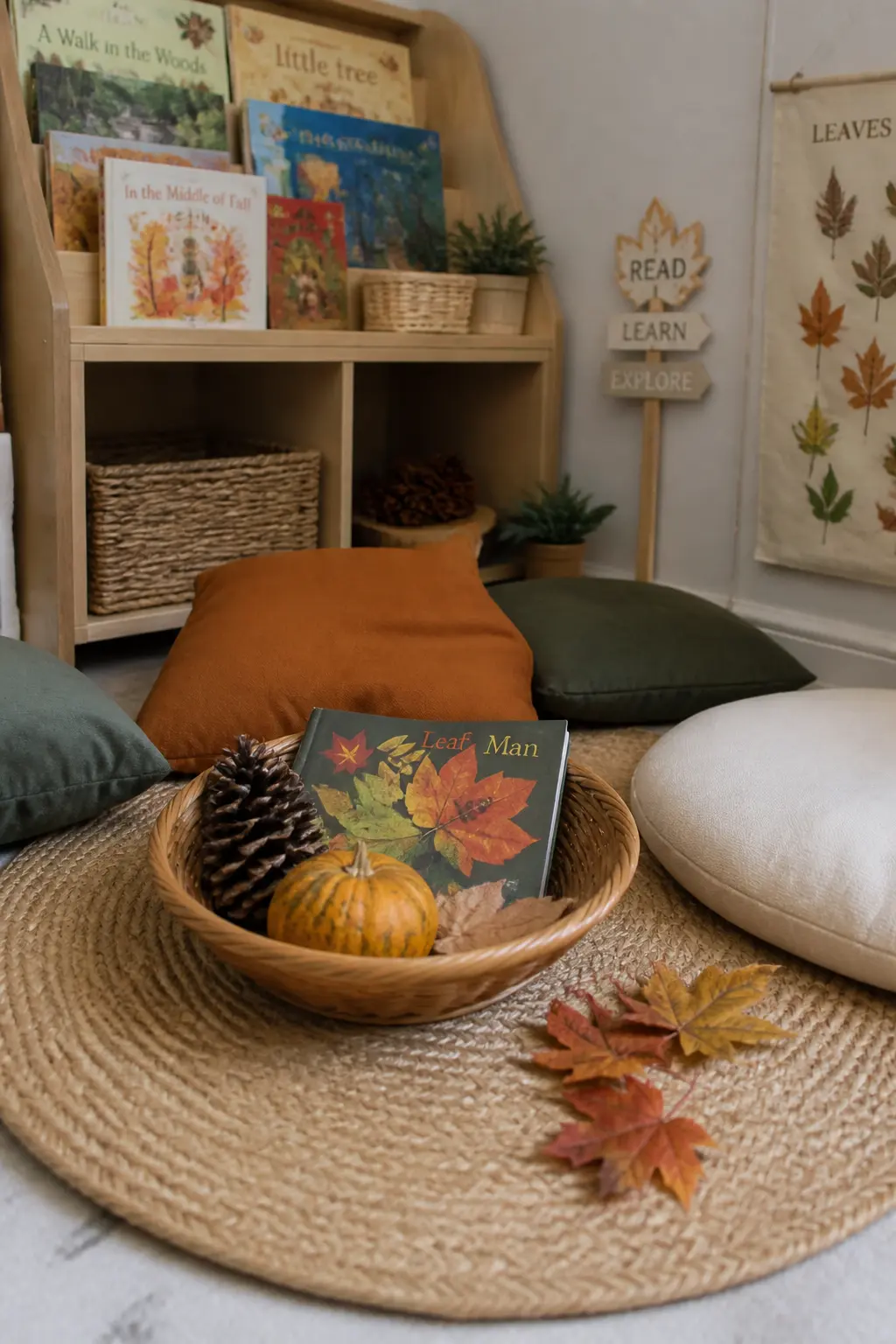
Autumn Story Basket
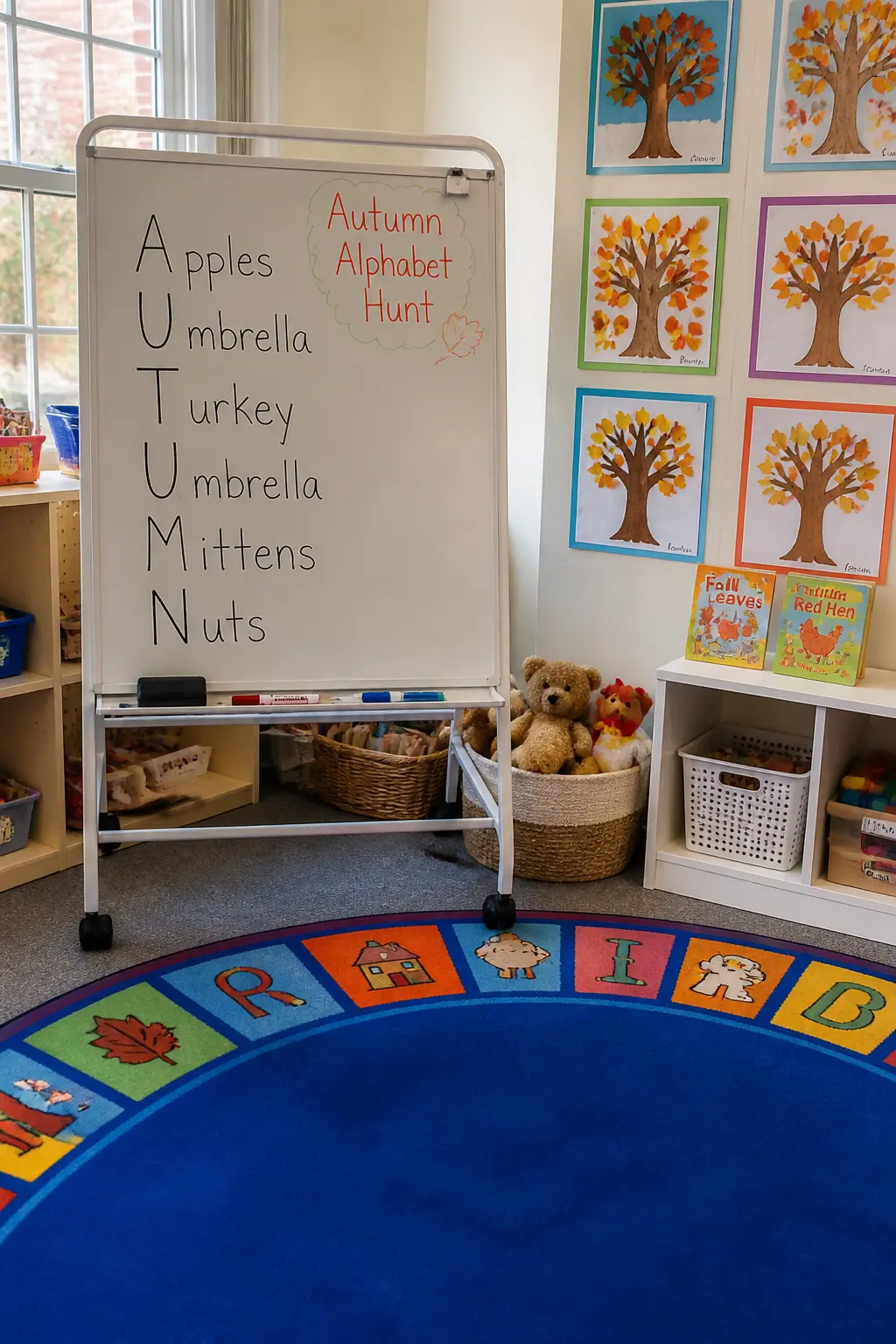
A wicker basket on the carpet holds five seasonal objects and one short picture book about autumn. At story time the teacher pulls each object out as it appears in the book. No object? The teacher improvises a connection: a stone becomes ‘the heavy feeling of a cold morning’. Children suggest connections unprompted by Wednesday.
The basket lives in the reading corner all week. Children return to it independently during free play, retelling the story to each other using the objects as props. Overhear these retellings: they are the most reliable evidence of comprehension this age group produces, and they happen without assessment.
🛍 Shopping guide
Who Has the Leaf? Listening Game
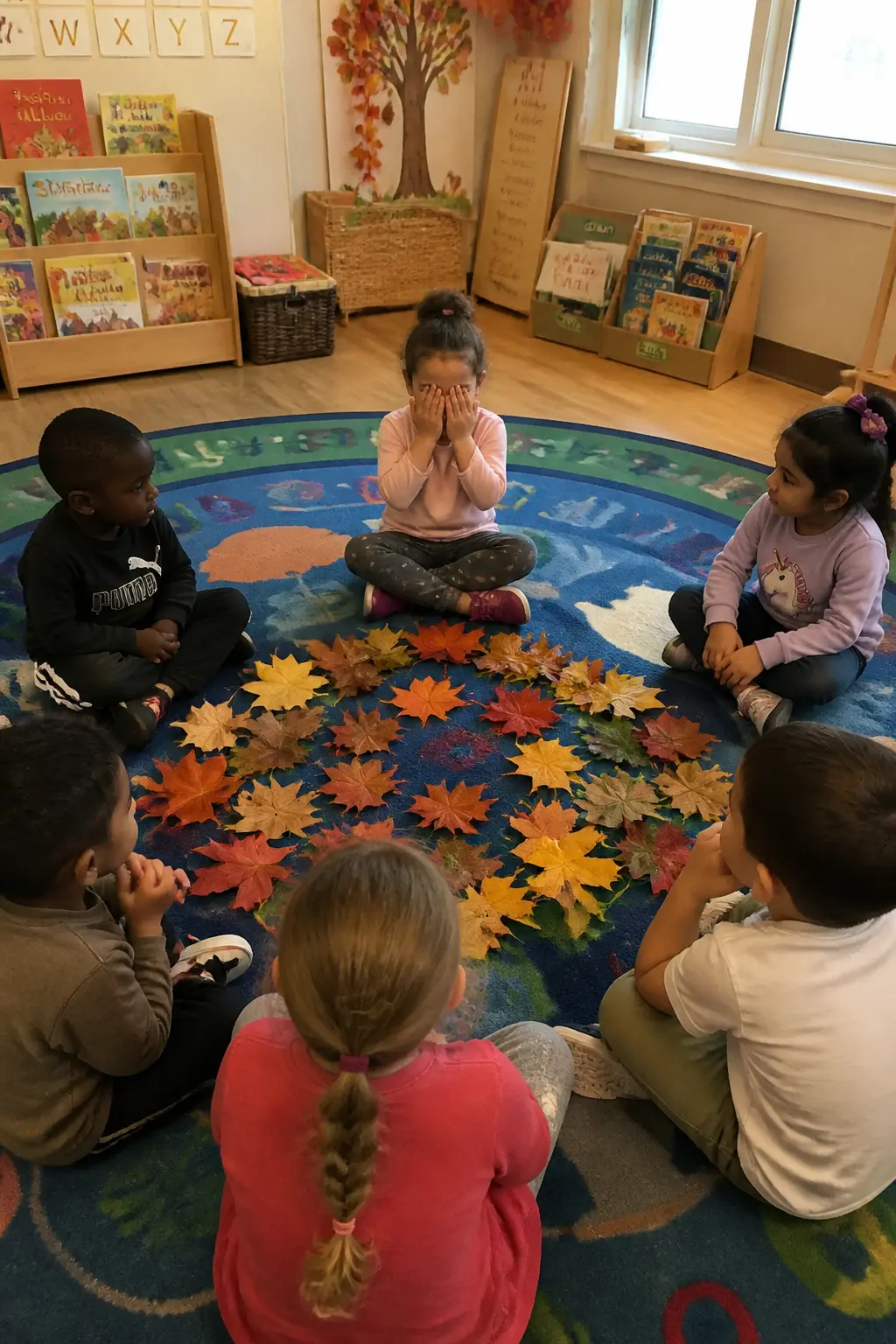
Children sit in a circle. One child closes their eyes. The teacher silently passes a large leaf to one child in the circle. ‘Who has the leaf?’ The seeker opens their eyes and has three guesses. The group uses poker faces (a concept three year olds find genuinely funny). The child who was holding the leaf becomes the next seeker.
This game builds sustained attention, theory of mind and the ability to read group behaviour, all in a five-minute circle game that uses exactly one leaf. It transitions naturally into the leaf passport stamping station because the leaf is already the focus.
Sensory Trays
One tray per day, set out before the children arrive.
Each tray contains the day’s organising material: Monday is loose leaves and bark pieces, Tuesday is dried corn and seed pods, Wednesday is soil and small gourds, Thursday is sand with hidden acorns, Friday is the leftover materials from all four previous trays mixed together.
The mixed Friday tray always surprises the children, and that surprise is productive.
Tray components stay above four centimetres so nothing is a choking risk, and every tray gets a laminated label with a pictogram so children know what is expected before an adult explains it. Fifteen minutes at the tray before formal circle time settles a group of twenty faster than any other transition strategy.
Loose Leaf Sorting Tray
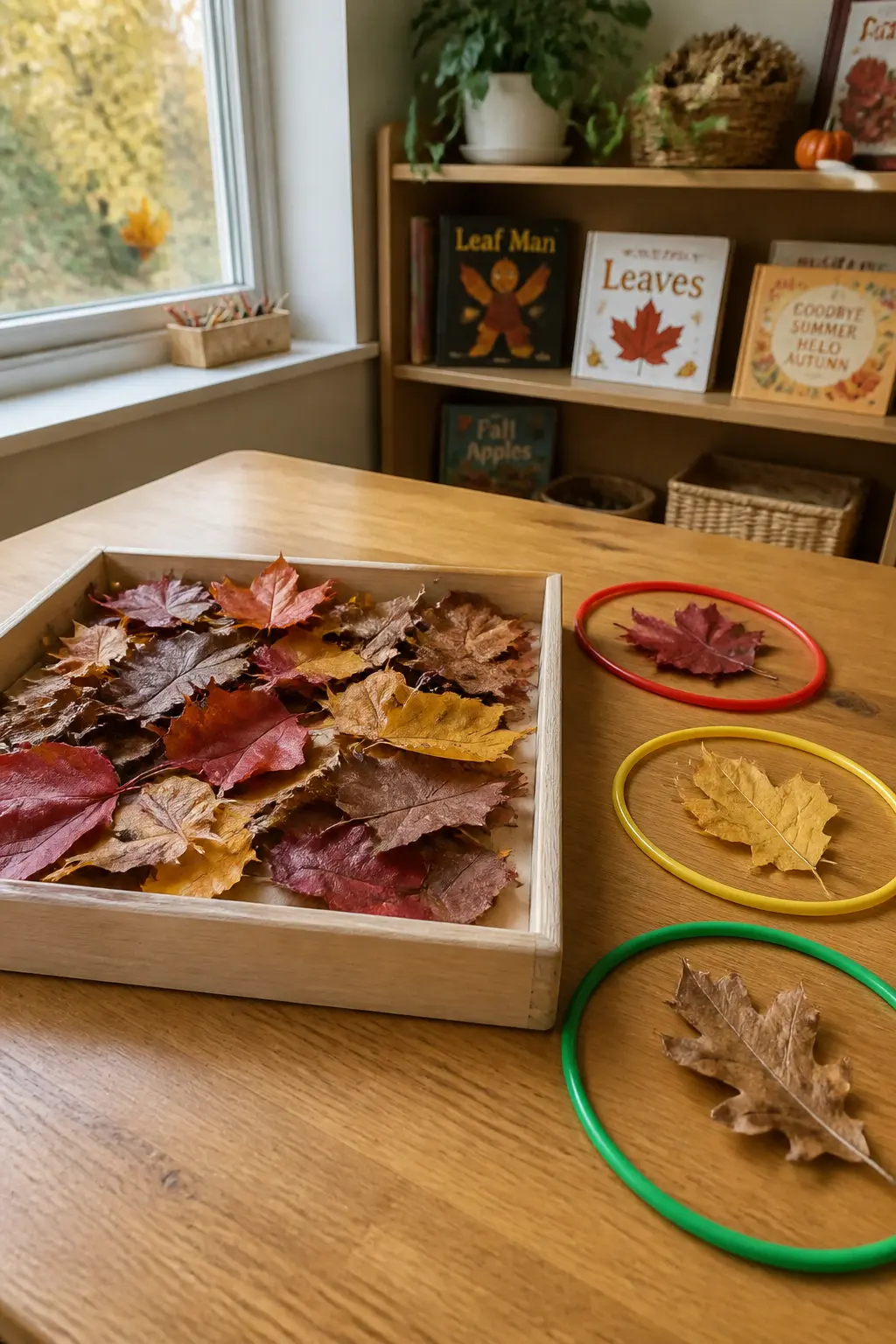
Monday’s tray holds ten to twelve real dried leaves (each above four centimetres) and four bark squares. Three sorting hoops in red, yellow and brown sit beside the tray. Children place each leaf in the hoop that best matches its colour. There is no wrong answer, which matters for a mixed group of threes and fours.
A simple pictogram card beside the tray shows the three hoops and a hand pointing. No adult explanation is needed once the card is in place, which frees the teacher for the children who need more support elsewhere.
🛍 Shopping guide
Seed Pod Sensory Tray
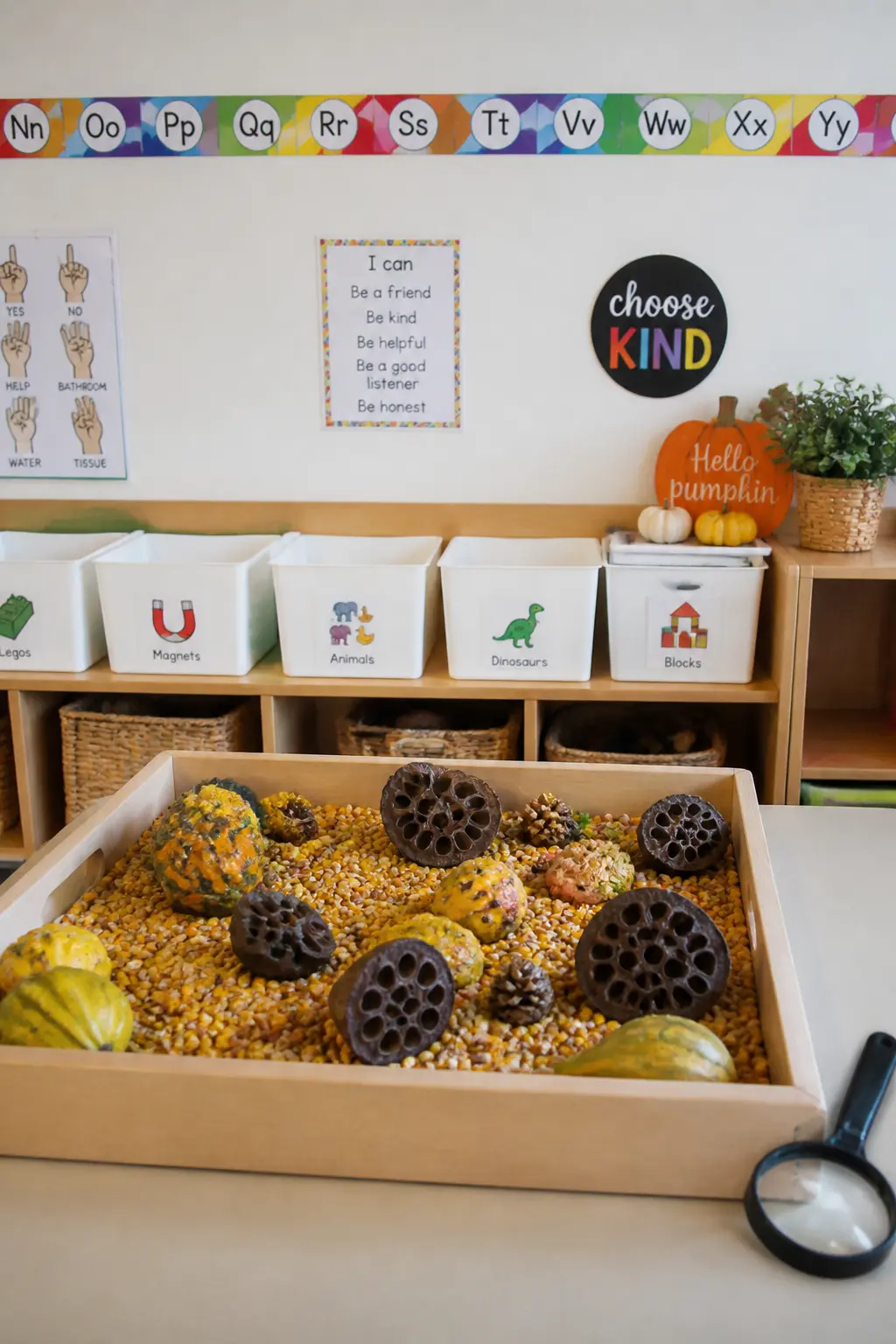
Tuesday’s tray holds dried corn, large seed pods, and a few small gourds above four centimetres. A magnifier glass sits beside it. Children shake the pods to hear the seeds inside, arrange the gourds by size, and compare the dried corn’s texture to the previous day’s bark. The comparison is the learning: same season, different texture.
Label the tray with a pictogram showing an ear and a hand so children understand it is a listening and touching tray as well as a looking tray. Three minutes per child at this tray is usually enough before they move to making.
Soil and Gourd Sensory Tray
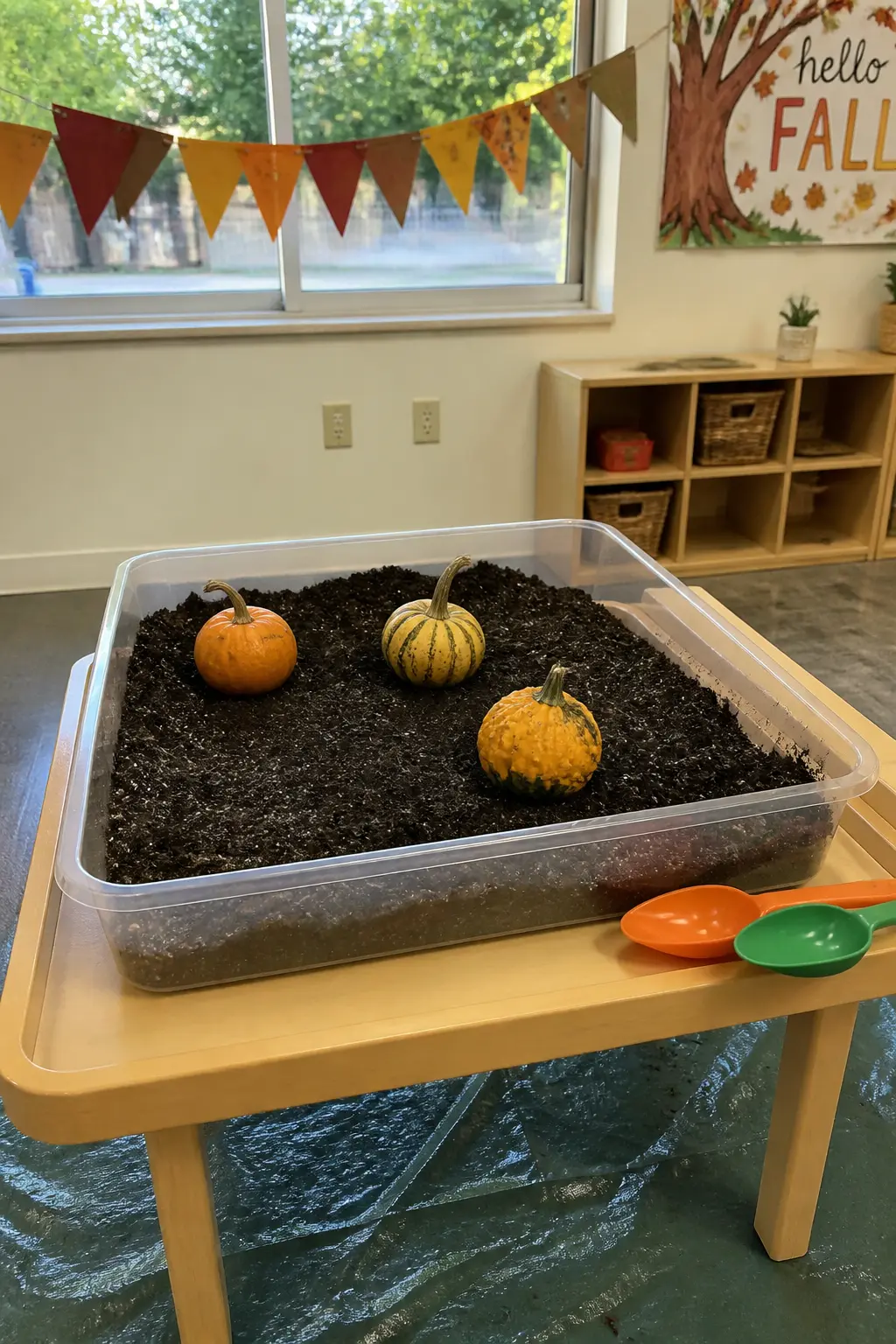
Wednesday’s tray holds damp potting soil, three small gourds and a set of large plastic spoons. Children bury the gourds and dig them up. The focus is texture: wet soil against dry gourd skin. A laminated card shows a hand pressing into soil and a question mark beside a gourd, which is enough instruction for this age group.
Place a waterproof mat under the tray and have a damp cloth nearby. Expect the soil to travel. Budget an extra three minutes of transition time on Wednesday for handwashing.
🛍 Shopping guide
Sand and Acorn Sensory Tray
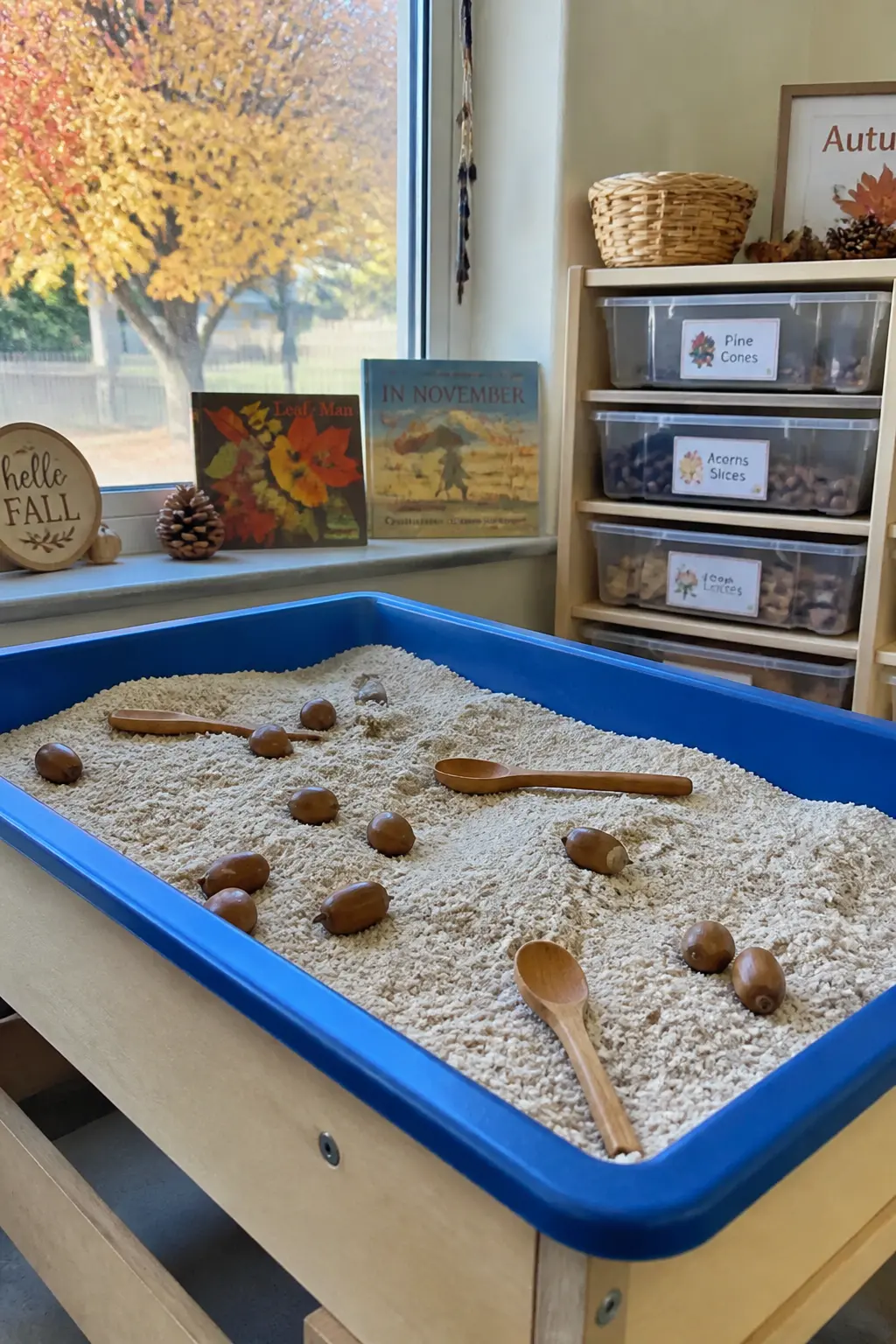
Thursday’s tray holds fine play sand with ten large acorns or large conkers buried in it. Children use their hands or large wooden spoons to find the hidden objects, then count them as they surface. Ten is the target count. A child who finds all ten first gets to re-hide them for the next group at the tray.
The re-hiding role gives fast finishers a second purpose at the tray without creating a competition. It also means the tray resets itself, which saves the teacher a step during transition.
🛍 Shopping guide
Pumpkin Seed Counting Tray
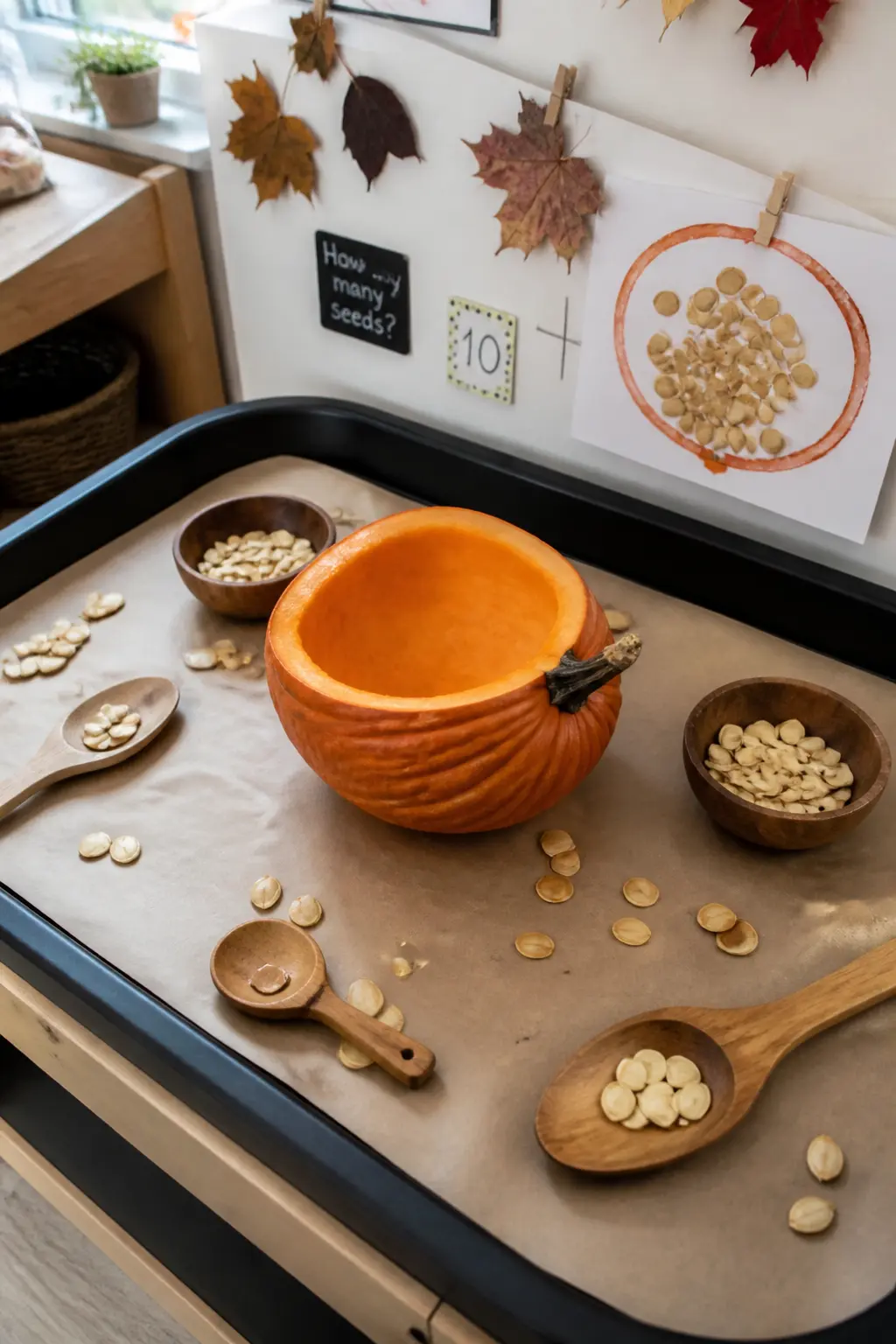
A cleaned-out pumpkin half sits in the centre of Friday’s mixed tray. Large dried pumpkin seeds (above four centimetres per cluster, or use large dried beans as a safe substitute) are arranged around it. Children scoop seeds into the pumpkin half using large spoons and count as they go. The pumpkin shell is the container and the prop simultaneously.
This tray reviews the week’s counting in an unstructured way. No target number is set. Some children count to five, some to thirty. The tray works for every level in the group without modification because the child sets their own endpoint.
🛍 Shopping guide
Making Activities
Each day’s making activity produces a physical object that travels forward into the week. Foam stamps, washable paint, torn paper, glue sticks and round-tipped scissors are the only tools in play. Every step has a finished-before-lunch window of twenty minutes, which is realistic for this age group when the task is set up before they arrive.
The making activities here avoid templates that require adult cutting in advance, because prep time is already short. Where a shape is needed, a pre-cut foam stamp or a torn paper technique replaces a scissor cut. If you are planning toward a preschool Christmas party later in the year, several of these making formats transfer directly.
Torn Paper Leaf Collage
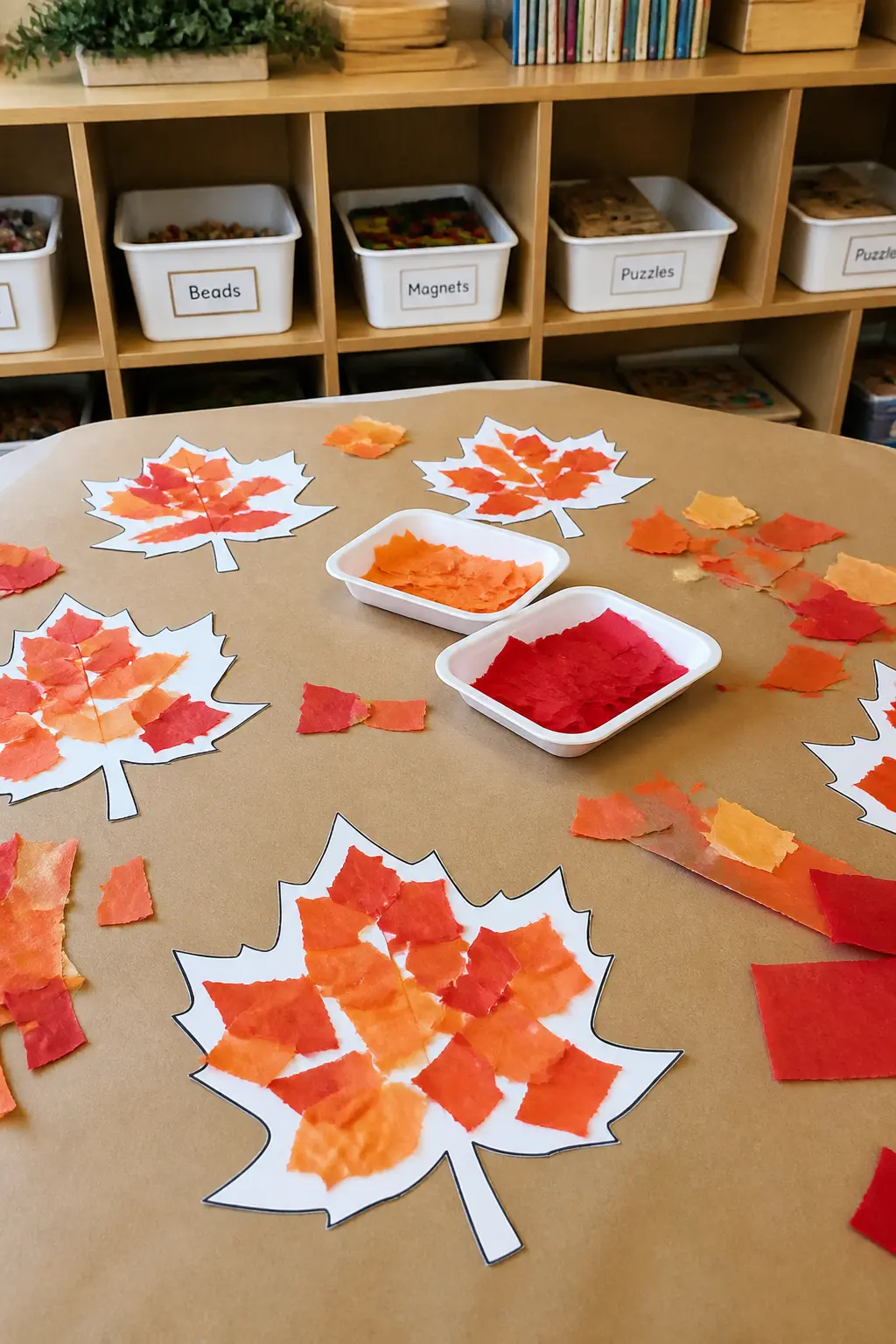
Children tear orange and red tissue paper into pieces and glue them onto a leaf shape drawn in thick marker on white card. No scissors. The tearing itself is a fine-motor activity and the variation in piece size creates texture that printed paper cannot. Each collage goes into the passport on page two.
Set out one glue stick per child plus a small tray of pre-torn pieces for children whose hands are not yet strong enough to tear. That accommodation takes thirty seconds to prepare and removes every moment of frustration from the table.
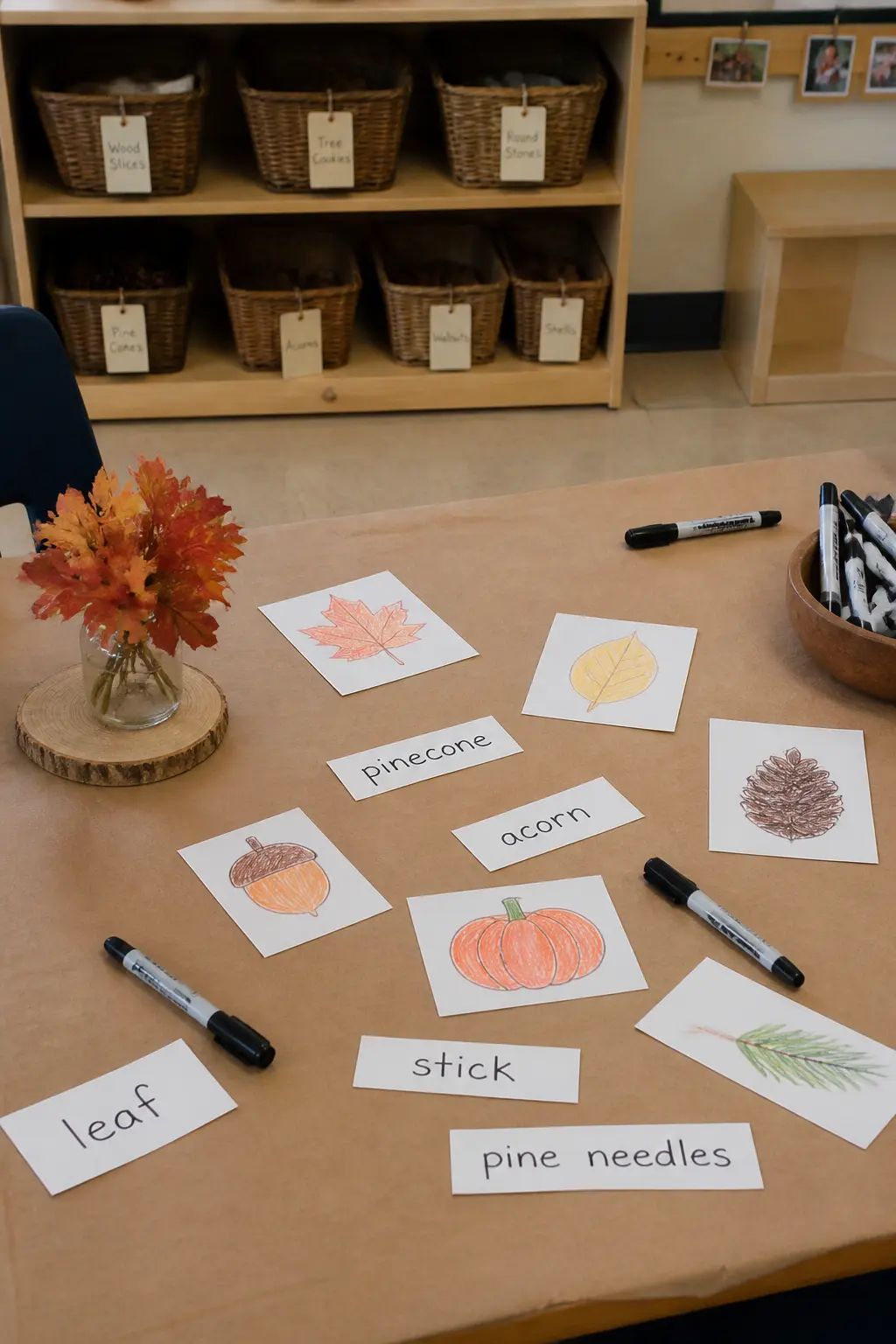
Museum Object Label Making
Each curator makes a label for their object: a strip of white card with a drawing of the object and the child’s attempt at its name. The teacher writes the correct name small at the bottom of the strip, below the child’s version.
Both versions stay on the label. The child’s version is not erased or corrected on top of: it is preserved alongside.
These labels go onto the museum table beside each object and later travel to the Friday wall piece. Sixteen labels in a row make a striking display strip and show the range of mark-making across the group, which parents read with genuine interest at pickup.
🛍 Shopping guide
Thursday Tile Making
Each child paints one square tile of white card (10×10 centimetres, pre-cut) with a single autumn colour: red, orange, yellow, rust or brown. One colour per tile, applied with a wide foam brush. No outlines, no shapes required. Twenty tiles dry while the group does the treasure trail and are ready to arrange on Friday.
The simplicity is intentional. By Thursday, children have made a collage, decorated an envelope and produced a museum label. The tile is a rest from detail, and a rest from detail produces better work than pushing through the week’s fifth complex task.
Leaf Rubbing Page for the Passport
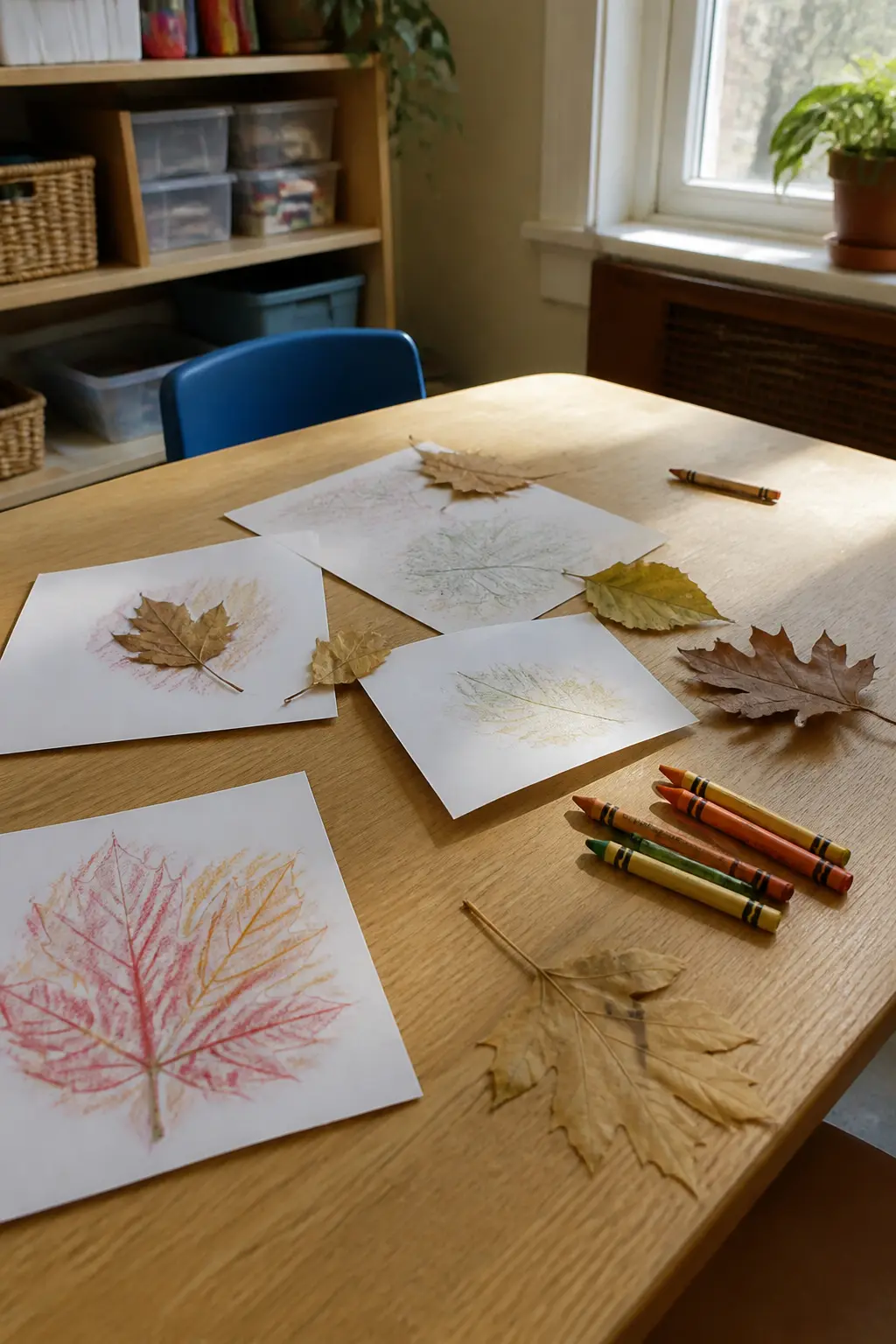
Children place a real dried leaf under a sheet of thin white paper and rub the side of a crayon across it. The leaf’s veins and edges appear. That moment of reveal is reliably delightful at this age, every time, no exceptions. The rubbing goes into the passport as page three on Wednesday.
Use crayons with the paper wrapper removed so children can use the flat side. Have leaves taped lightly to the table surface with masking tape so they do not shift mid-rub. Both of these micro-preparations eliminate the only two failure points in this activity.
🛍 Shopping guide
Bark and Texture Rubbing Comparison
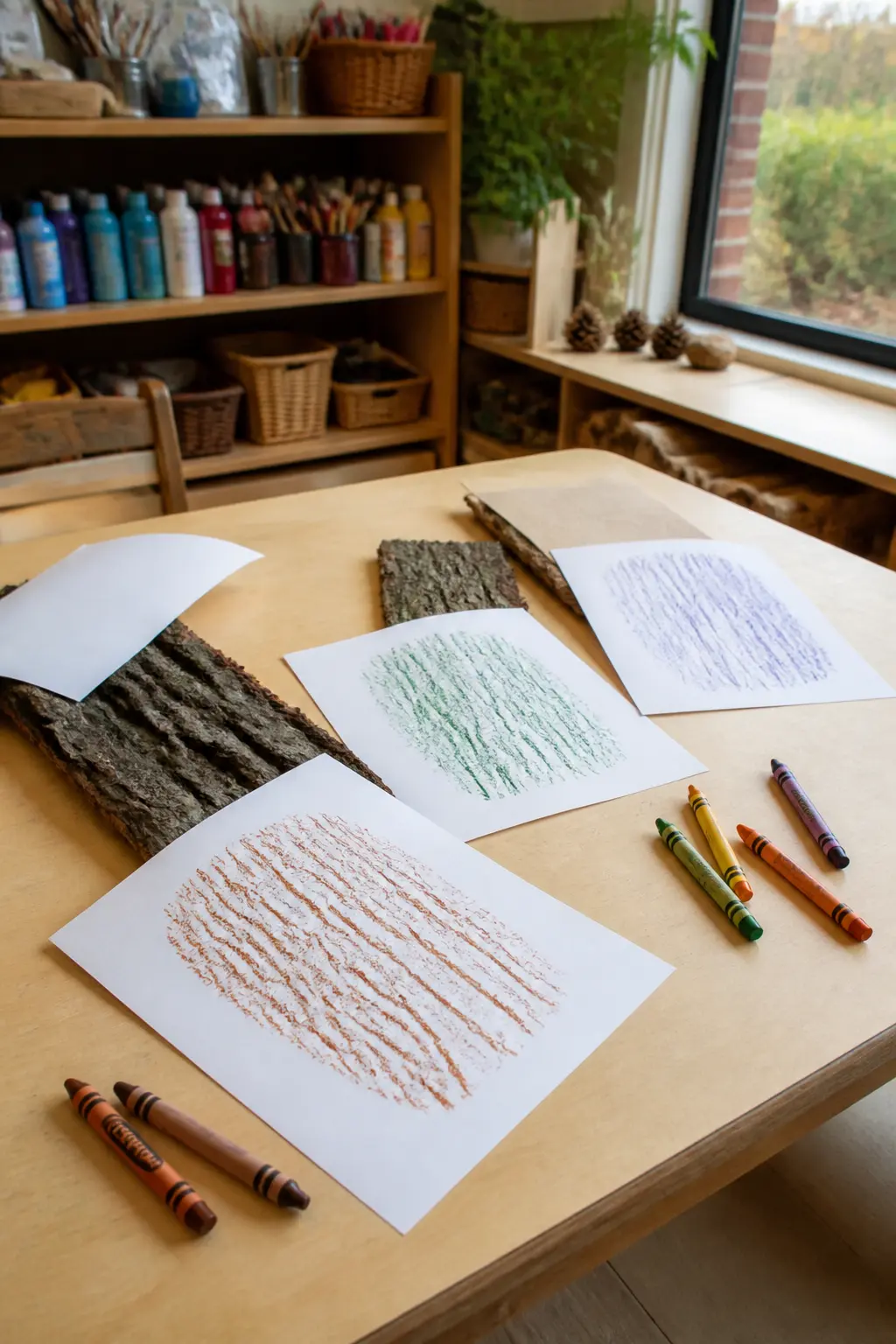
Set out three textured natural surfaces at the making table alongside Tuesday’s leaf rubbings: a piece of bark, a piece of hessian fabric and a rough stone (large enough that it cannot be swallowed, above four centimetres). Children rub each one and compare the results side by side. Which is roughest? Which makes the softest line?
This activity extends the leaf rubbing technique from Monday’s making activity and plants the word ‘texture’ through practice rather than definition. Staple the three rubbings together with a comparison heading written by the teacher: ‘Rough, rougher, roughest.’ The set goes into the passport as a bonus insert.
🛍 Shopping guide
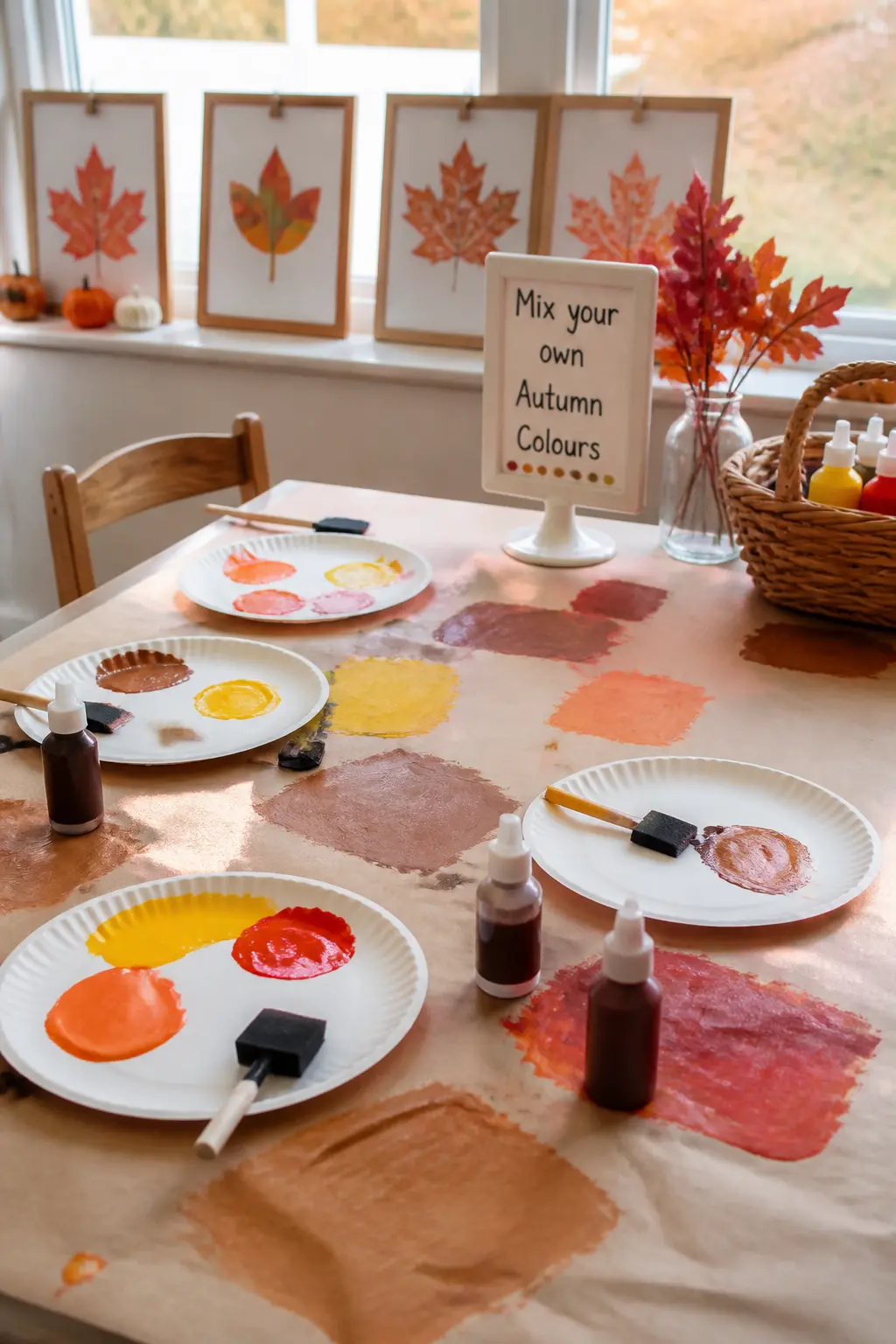
Autumn Colour Mixing
Two colours only per child: red and yellow. Children mix them on a paper plate palette using a foam brush until they have orange.
Then they add a tiny drop of brown (provided in a dropper bottle, one drop at a time) and watch orange turn rust. The paper plate becomes a colour record.
Paint a strip of each colour produced and label it with the child’s name and a teacher-written word.
Keep the palette count to two primary colours because unlimited colours at this age produces brown within ninety seconds and frustration shortly after. Constraints are not restrictive for three to five year olds: they are enabling.
🛍 Shopping guide
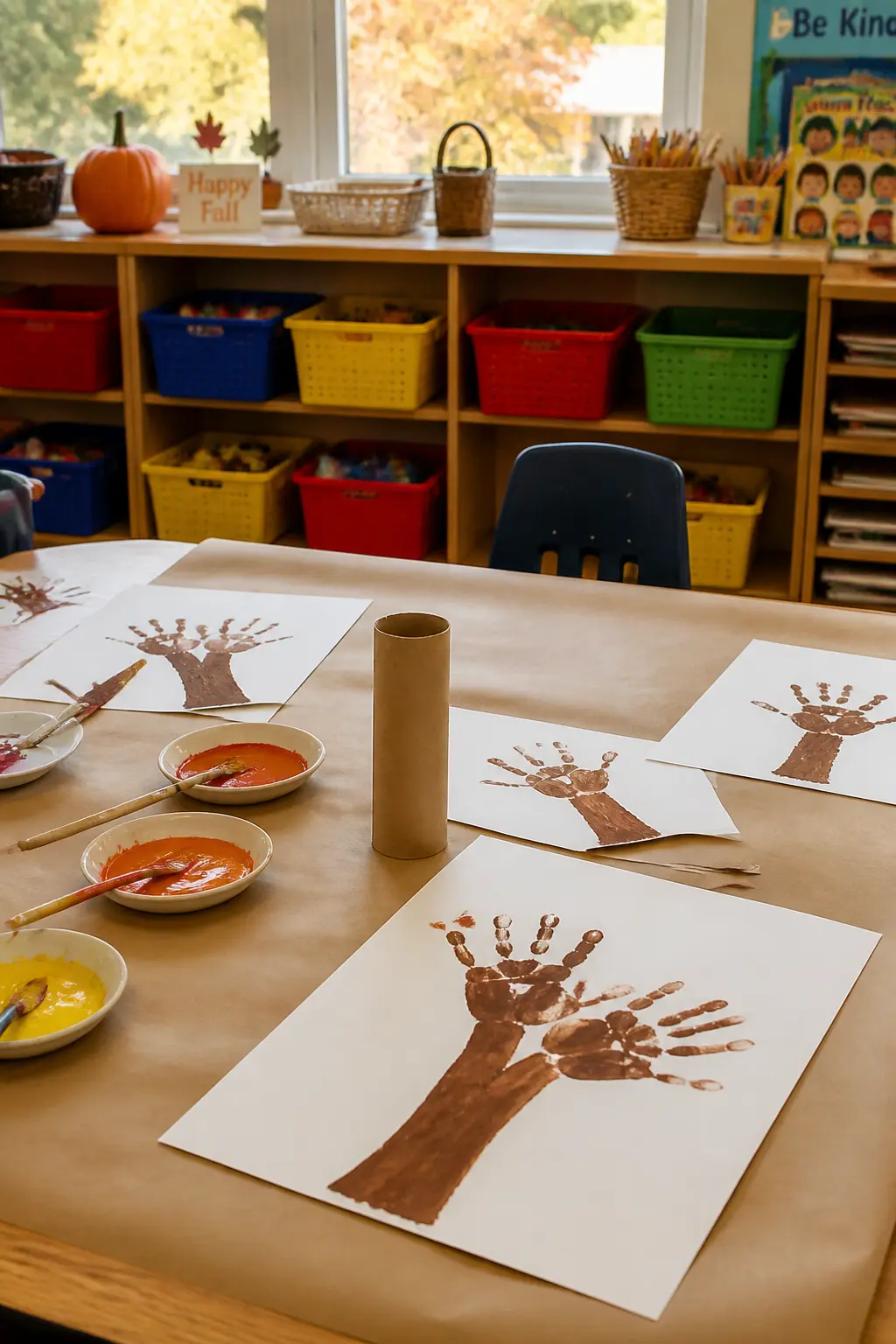
Handprint Bare Tree
Brown paint, a foam brush, one large sheet of card per child. The child brushes their forearm and hand in brown, presses it onto the card with fingers spread: the palm is the trunk, the fingers are branches.
A second hand print from the other arm, pressed beside the first at a slight angle, doubles the canopy. Finger-dot leaves in red, orange and yellow complete the tree.
This is Thursday’s making activity and every handprint tree gets added to the border of the Friday wall piece. Twenty trees framing the central assemblage turn the border into a forest, which is one of those layouts that photographs very well for the classroom newsletter.
🛍 Shopping guide
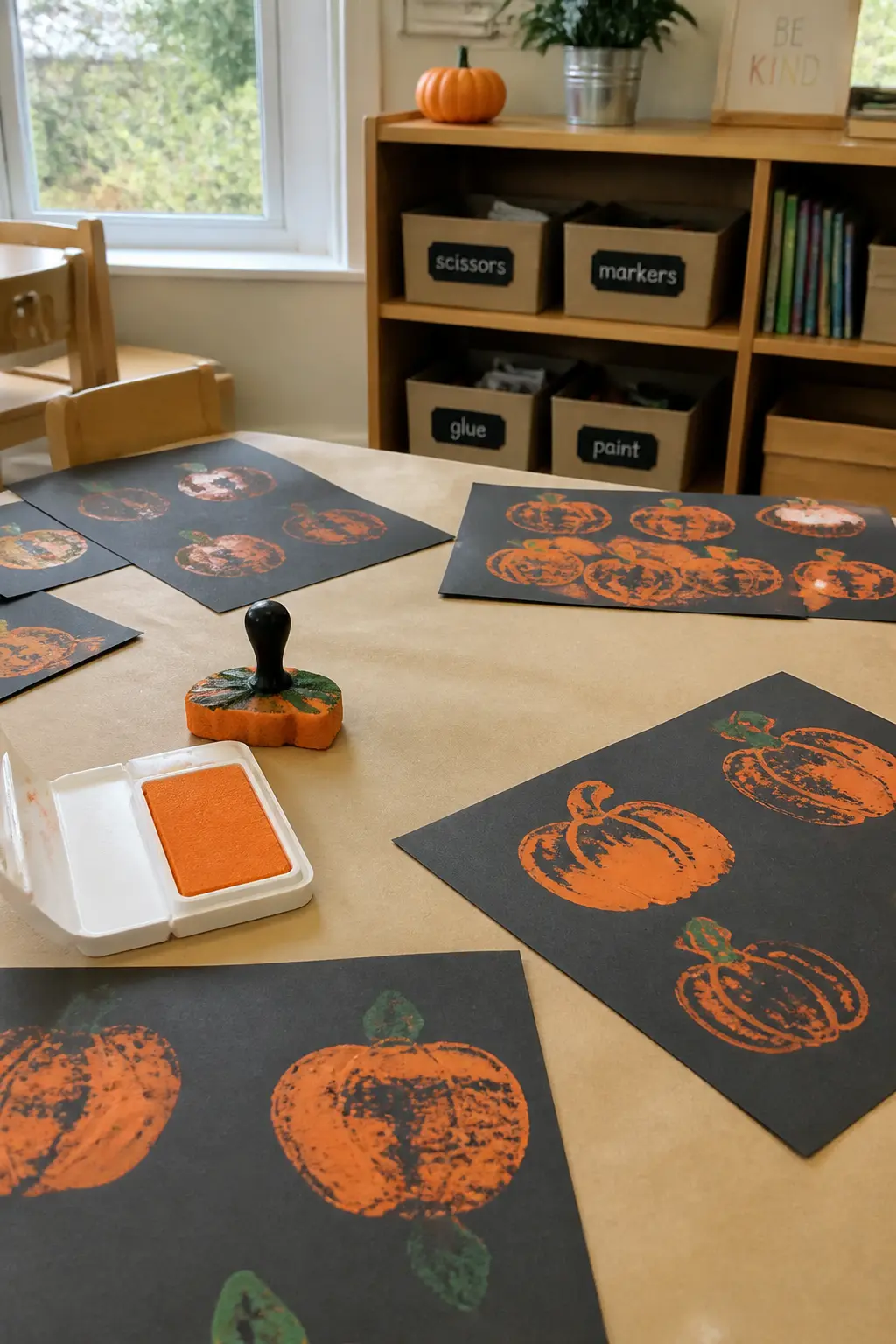
Pumpkin Stamping
Cut a large firm sponge into a pumpkin shape (ten centimetres minimum) or buy pre-cut foam stamps. Children press the stamp into orange paint and print onto black card. The contrast is strong and the results look finished immediately, which is motivating for this age group. Add a green fingerprint stalk above the pumpkin.
Pumpkin stamps tile beautifully. Line the prints up to make a repeating border strip for the Friday wall piece, or let each child keep their card. Both uses are equally valid: have a decision made in advance so children know where their print is going, because knowing the destination changes how carefully they place the stamp.
Frequently Asked Questions
How do these fall preschool activities work if my week is shorter than five days?
Compress Monday and Tuesday into one session by doing the passport stamp and post box letter on the same morning. The museum and treasure trail can run back to back on the second day. Friday’s assembly stays as the closing session. The week’s physical arc still works in three sessions instead of five.
What if children lose or damage their leaf passport mid-week?
Keep two blank spare passports in a drawer and replace on the spot without ceremony. Write the child’s name on the new one, hand them the stamp for whatever day it is, and continue. The activity’s value is in the daily stamping ritual, not in the physical object surviving perfectly.
Can these fall preschool activities work for a mixed age group of two to five year olds?
Yes, with one adjustment: pair a two-year-old with a four or five year old at the sensory tray and making table. The older child models the task, the younger child participates at their own level, and both benefit.
The museum curator role works best from age three upward; two year olds can participate as audience members or add a sticker to the label instead of drawing one.
Where do all the materials for the Friday wall piece come from?
Every material is produced during the week’s activities and stored on a dedicated shelf or in a labelled tray from Monday onward. Nothing is bought specifically for Friday. The wall piece uses the weather chart, Thursday’s painted tiles, Wednesday’s museum labels, Tuesday’s decorated envelopes and Monday’s leaf rubbings, plus the communal object from the Thursday treasure trail.
How do I manage sensory trays with a group of twenty when only a few children fit at the table?
Run the sensory tray as a rotation station rather than a whole-group activity. While six to eight children are at the tray, the rest are at the making table or in the reading corner.
Set a sand timer (three to five minutes) beside the tray so children self-regulate the rotation without adult management. A pictogram on the timer shows ‘your turn ends when the sand runs out.’
Are there ideas here that link to Thanksgiving or the broader autumn season?
Several of these fall preschool activities, especially the harvest vocabulary, the seed pod sensory tray and the counting activities, connect naturally to Thanksgiving themes. For dedicated Thanksgiving games and extensions, see the 40 Thanksgiving games roundup and the 25 fun Thanksgiving games list for age-appropriate follow-on ideas.
Circus activities preschool party games where every child plays at once — 12 movement-based games

25 one minute party games using household items — timed challenges, exact rules & a winner every 6

20 road trip games for every seat in the car — plus a printable pack to prep before you leave. Hou
Leave a Reply