

14 Thanksgiving Activity Sheets for a Rainy Day Indoors, With Free Printables
These printable thanksgiving crafts need nothing from a craft cupboard: just a printer, a stack of paper, and whatever colouring tools are already in the drawer. Ten sheets keep kids busy at the table, then four more activities follow that need no printing at all, which is useful when the ink runs out or the printer decides today is not its day.
This post contains affiliate links. If you buy through them, I may earn a small commission at no extra cost to you.
- Turkey Colour by Number
- Pumpkin Colour by Shape
- Harvest Counting Sheet
- Autumn Words Tracing Sheet
- Odd One Out: Harvest Objects
- Spot the Difference: Dinner Table
- Finish the Pattern: Leaves and Acorns
- I Spy and Count the Harvest
- Roll and Cover Turkey Game
- Thanksgiving Bingo
- Leaf Hunt in the Garden
- Sorting the Button Tin
- Turkey Shapes from Playdough
- Counting the Plates While Setting the Table
- Frequently Asked Questions
1. Turkey Colour by Number
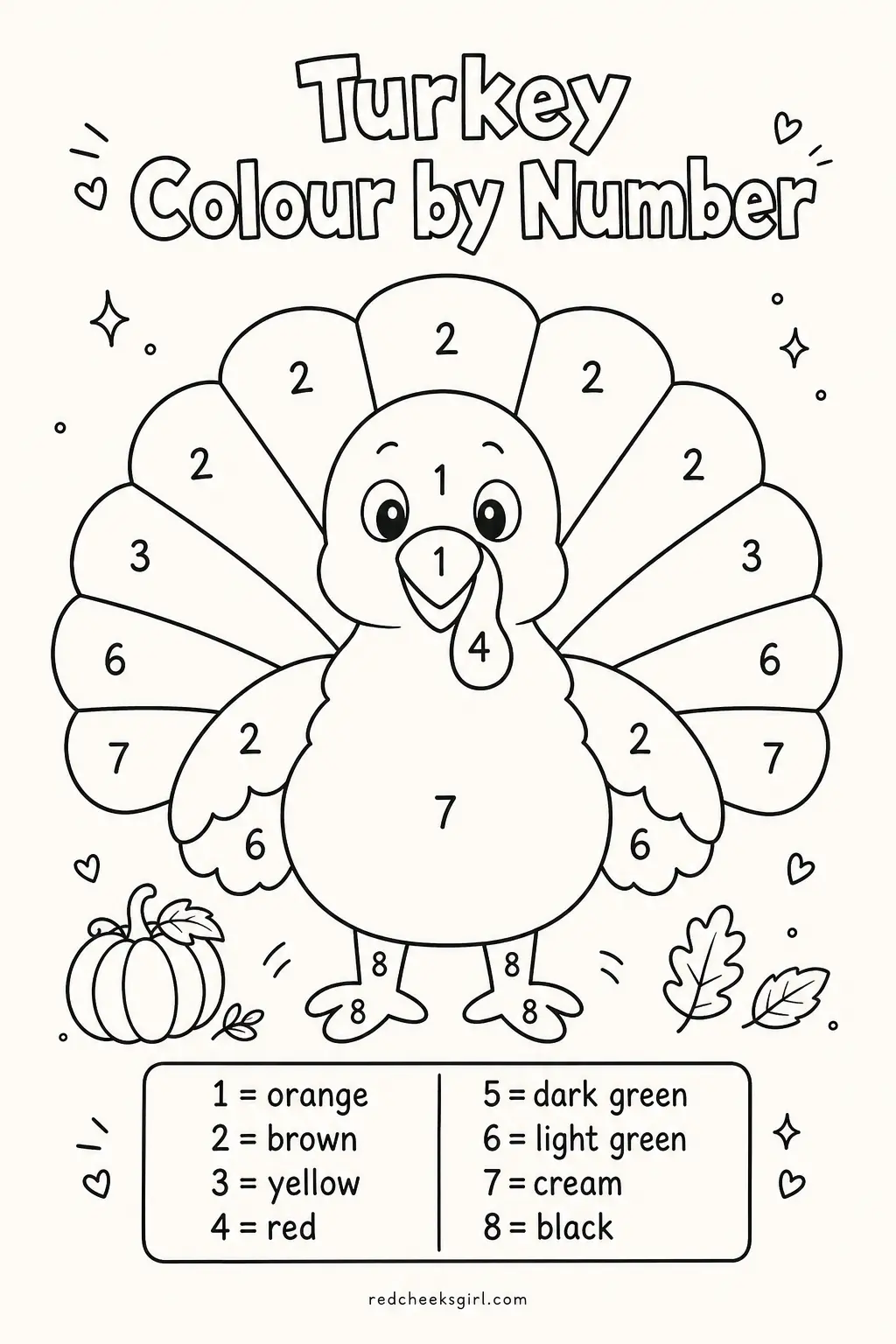
Each section of a large, friendly turkey is labelled with a number from 1 to 8, and a colour key at the bottom of the sheet tells a child exactly which crayon to reach for. The result is a fully coloured turkey with a fanned tail of autumn feathers, no artistic confidence required.
Print one sheet per child on standard letter paper. The activity takes roughly 10 to 15 minutes for ages 4 and up, longer if a child decides to press hard and make every section extra vivid. No scissors, no glue, nothing to lose under the sofa.
Younger children sometimes colour outside the lines and land in the wrong section, which makes the number key unreadable for them. Print a spare copy and circle the numbers with a thick marker before handing it over, so the labels are impossible to miss.
- Ages 3 to 7
- Solo or side by side at the kitchen table
- First activity of the session, easiest wins first
🛍 Shopping guide
2. Pumpkin Colour by Shape
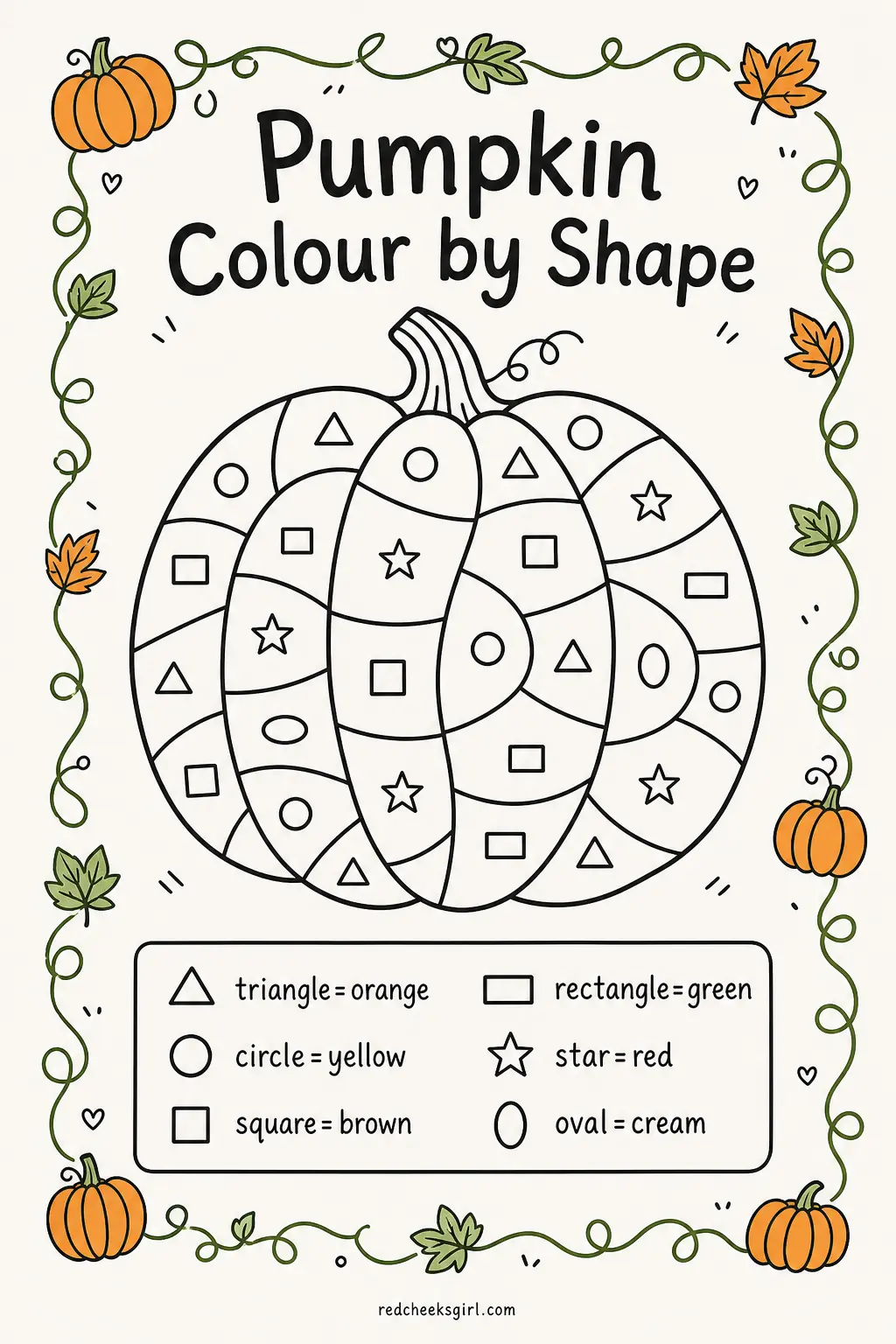
Instead of numbers, this sheet uses shapes: every triangle section gets one colour, every circle another, every rectangle another, and so on across five or six shapes. The image underneath is a round harvest pumpkin with a curly vine, and the shapes tile across it like a stained-glass window once the child works out the key.
Print on letter paper. Ages 4 to 6 will need a quick verbal explanation of the shape names before they start. The whole sheet fills in 10 to 20 minutes depending on how carefully a child stays inside the lines. A fine-tip marker or coloured pencil gives crisper results than a chunky crayon for this one.
If a child does not yet know all the shape names, skip the key entirely and let them pick any colour for any shape, which turns it into free colouring with a pretty structure underneath. The sheet still works.
- Crayons or coloured pencils
- One printed sheet per child
🛍 Shopping guide
3. Harvest Counting Sheet
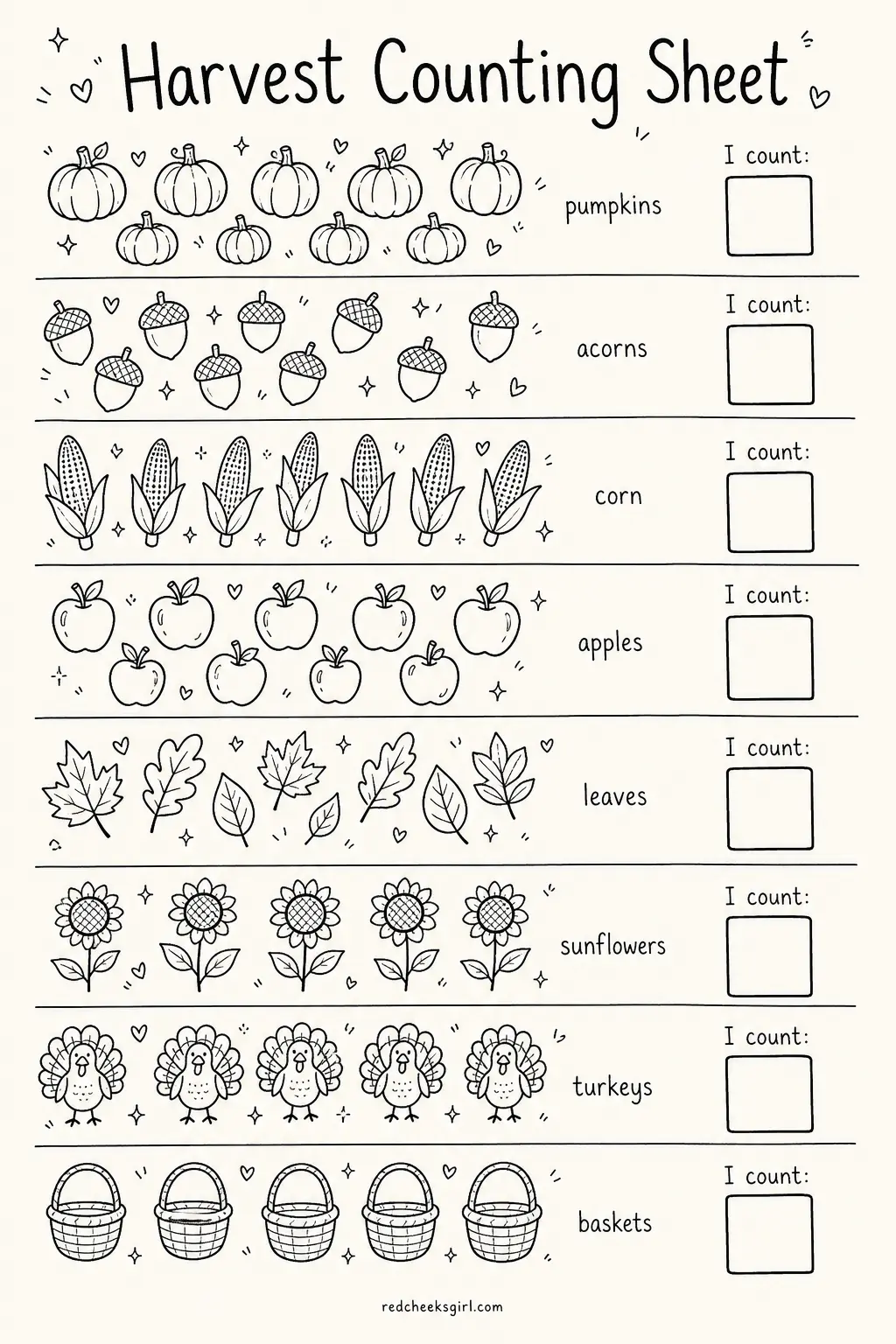
Eight groups of harvest objects are scattered across the page: pumpkins, acorns, ears of corn, apples, leaves, sunflowers, turkeys and baskets. A child counts each group and writes the total in a box beside it. Simple enough for a four-year-old, fast enough not to bore a seven-year-old.
Print one per child. The activity runs about 10 minutes. A pencil works better than a crayon here because writing in small boxes with a thick crayon frustrates young children quickly. If the child is still learning numbers, read the group names aloud together first so they know what they are counting.
For older children, add a follow-up question out loud: which group has the most? Which has the fewest? That stretches the sheet into a five-minute maths conversation with no extra printing needed.
Pair with the Turkey Colour by Number sheet so one child colours while another counts, then swap.
🛍 Shopping guide
4. Autumn Words Tracing Sheet
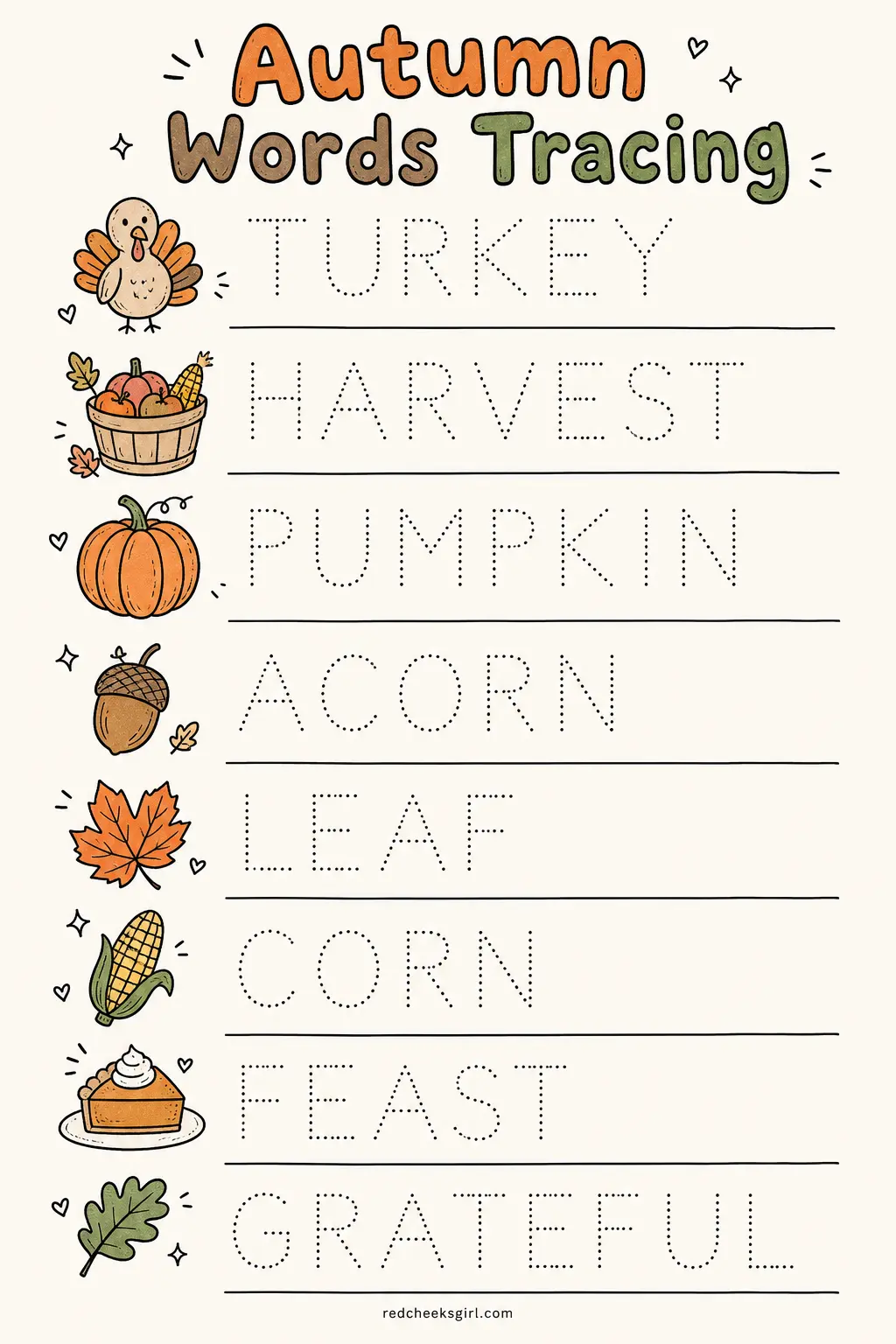
Eight autumn words sit on the page in large dotted outline letters: TURKEY, HARVEST, PUMPKIN, ACORN, LEAF, CORN, FEAST and GRATEFUL. A child traces each word with a pencil or crayon, then has a blank line underneath to copy it again freehand. It doubles as handwriting practice without announcing itself as such.
Print one per child. Ages 4 to 6 will focus on the tracing. Ages 7 and up will zip through the tracing and spend more time on the freehand copy. The sheet takes 15 to 20 minutes at a relaxed pace.
Dot markers work surprisingly well on this sheet, each dot landing on a letter dot rather than a full trace, which appeals to children who find pencil grip tiring. The result is bolder and more satisfying to a small child than neat pencil work.
- Pencil or fine crayon for tracing
- Dot markers as a fun alternative
🛍 Shopping guide
5. Odd One Out: Harvest Objects
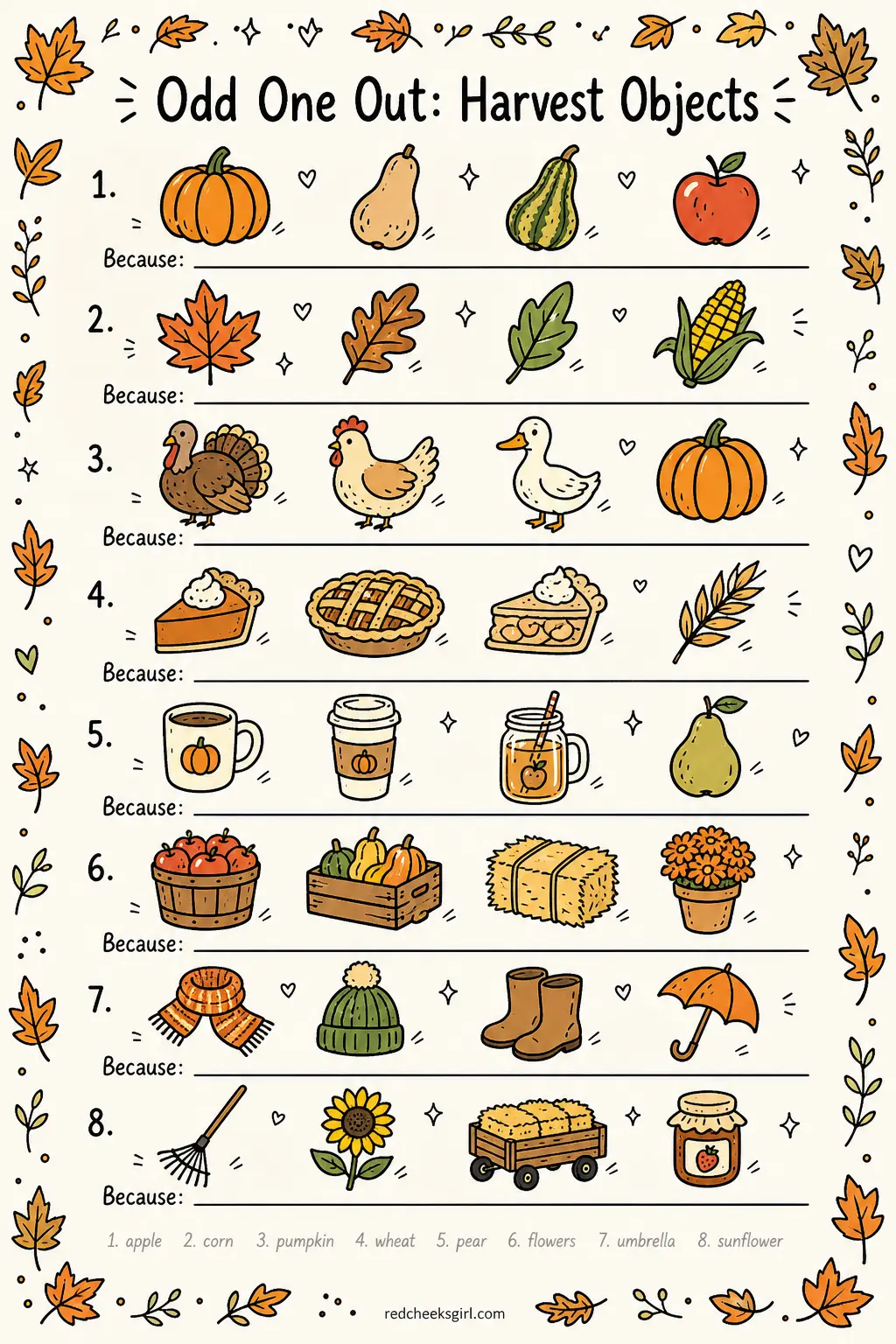
Each row shows four pictures of harvest objects, three of which belong to the same category and one that does not. A child circles the odd one out and, if they want, writes why on the line below. The categories mix size, type and colour so the reasoning changes from row to row and the sheet does not become mechanical.
Print one per child. It runs 10 to 15 minutes for ages 5 and up. A red crayon for circling makes the answers satisfying and easy for a parent to check at a glance. Eight rows gives a child enough to feel accomplished without overstaying its welcome.
Children who finish early can make up their own odd-one-out row on the back of the sheet, which is genuinely harder and will occupy another five minutes without any extra preparation.
- Builds sorting and reasoning without feeling like schoolwork.
- Each row has only one defensible answer, so there is no argument at the table.
6. Spot the Difference: Dinner Table
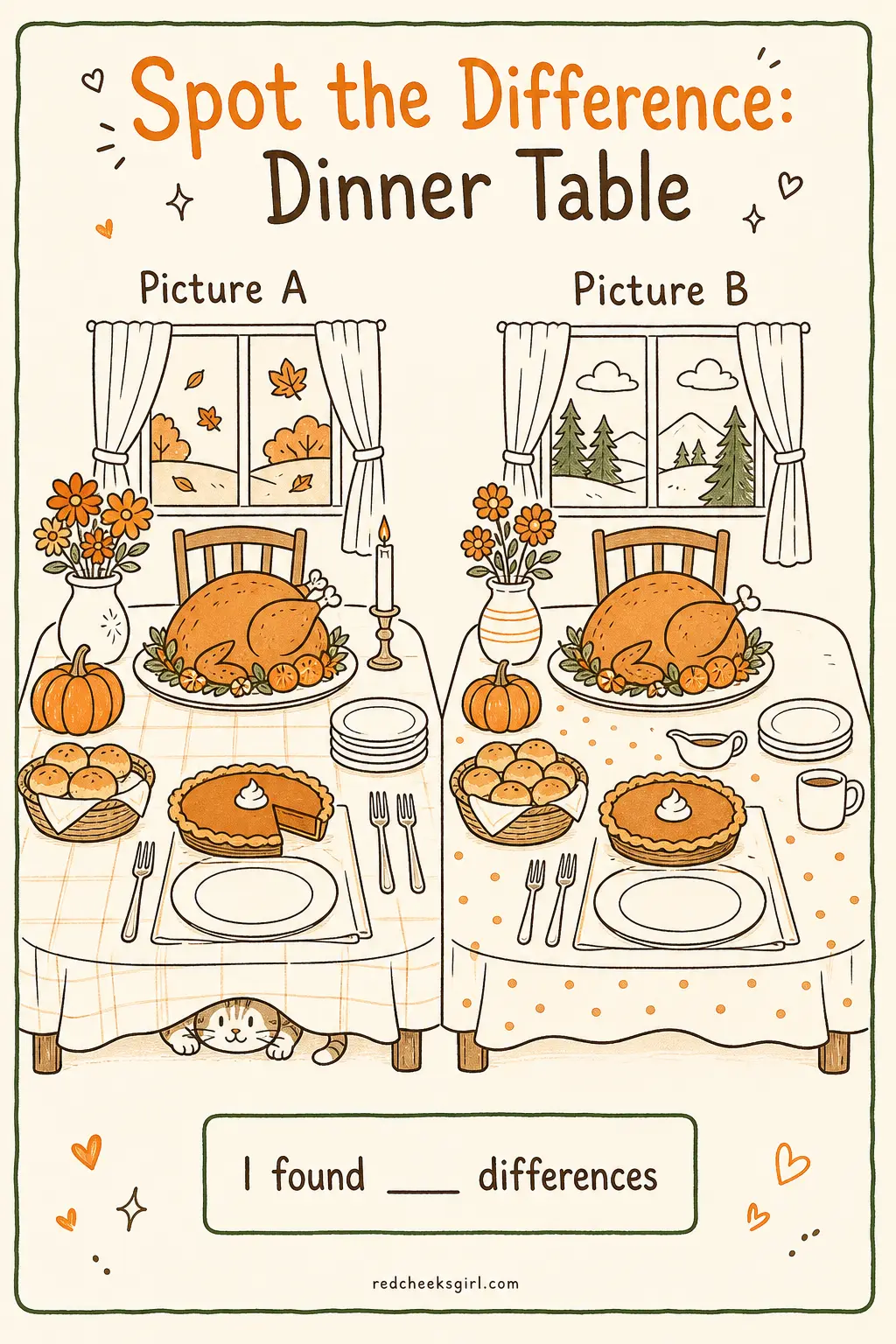
Two almost-identical drawings of a Thanksgiving dinner table sit side by side on the sheet. Ten small details differ between them: a missing candle, an extra roll, a different number of forks, a cat under the tablecloth in one image, and so on. A child circles every difference they find and writes the total in a box at the bottom.
Print one per child. Ages 5 and up manage this well; ages 4 may need a nudge toward the first one or two differences to get started. The sheet keeps a focused child busy for 15 to 20 minutes. A fine-tip marker in a contrasting colour makes the circles stand out clearly.
Turn it competitive between two children: first to find all ten calls out the number, and the other child ticks off the same spots on their own sheet. No prizes needed, the calling-out is enough.
For younger children, reduce the search by telling them the category: ‘find something missing from the table.’
7. Finish the Pattern: Leaves and Acorns
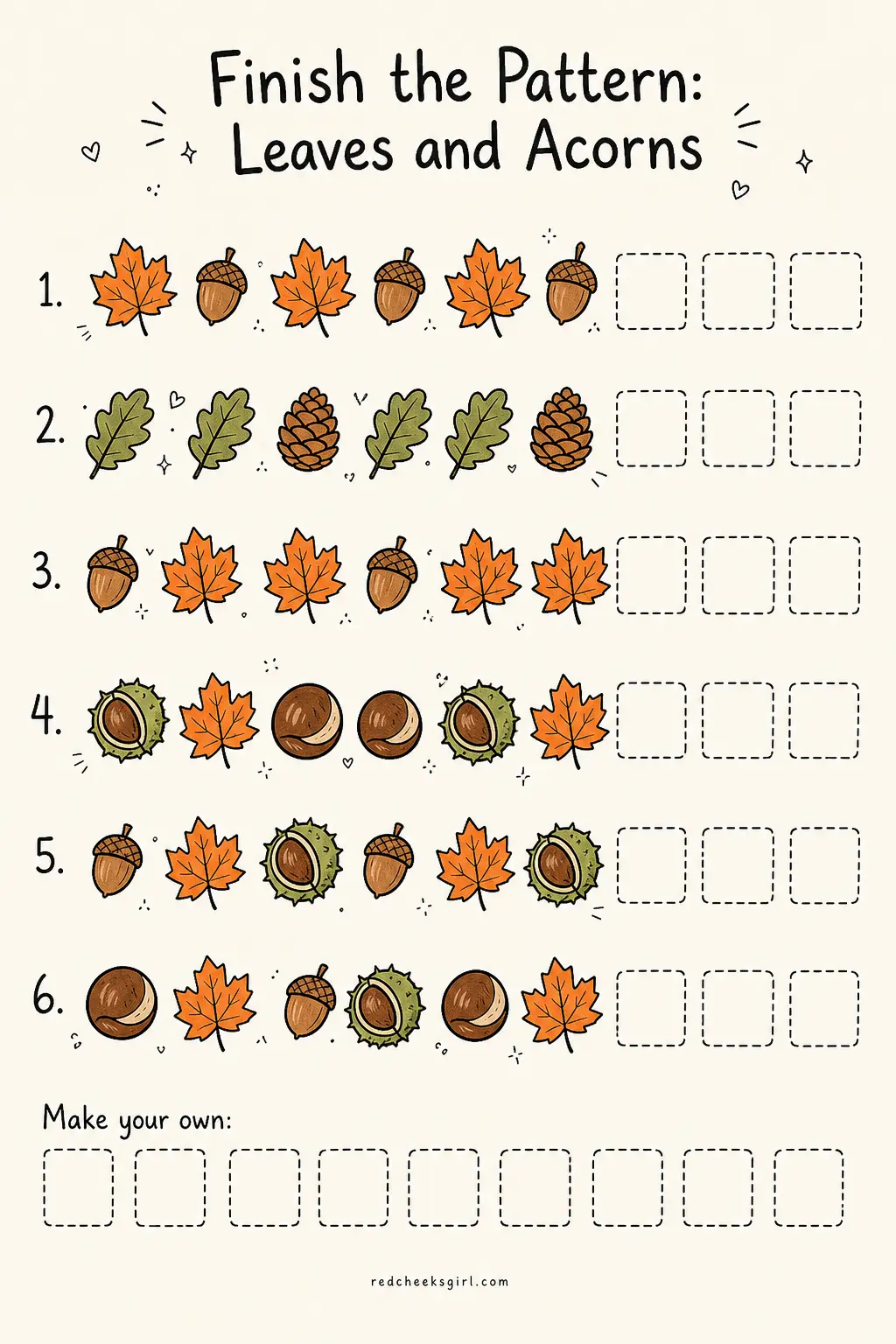
Six rows of repeating patterns run across the page, each using two or three autumn objects: maple leaves, oak leaves, acorns, pinecones and conkers. Each row is complete for the first six items, then leaves three blank spaces at the end. A child draws or stamps the missing items to finish the pattern.
Print one per child. Ages 3 to 5 will handle the simpler AB patterns in the first three rows. Ages 6 and up will work through the ABBC and ABAC patterns in the lower rows, which require more attention. Dot markers work well here: one stamp per blank space. The sheet takes 10 to 15 minutes.
A child who races through it can invent a new pattern on the blank row at the bottom of the sheet. Letting them quiz a parent on it afterwards adds another few minutes and costs nothing.
- Crayons or dot markers to fill in the blanks
- One sheet per child
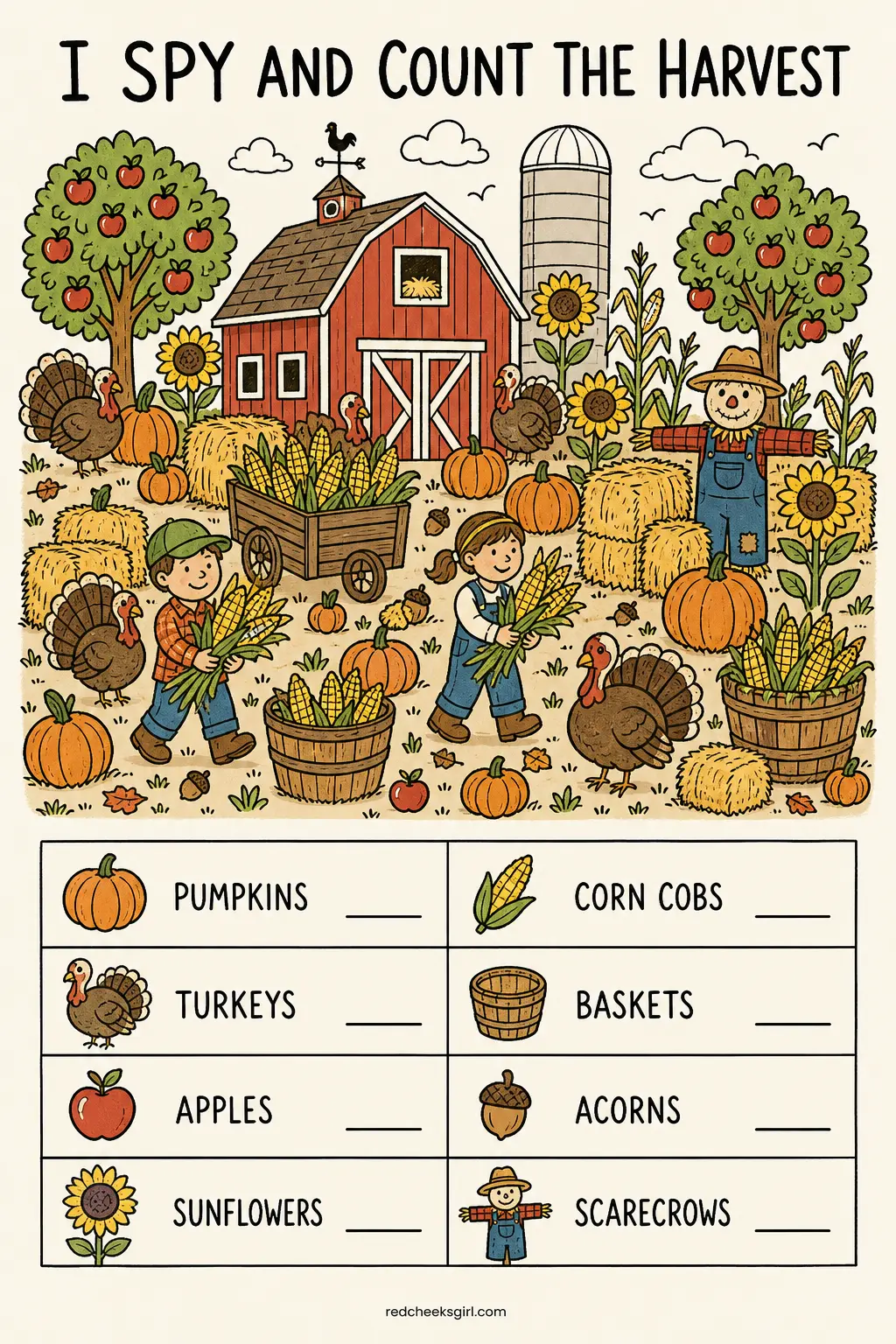
8. I Spy and Count the Harvest
A busy, colourful harvest scene fills the page: a barn, pumpkins, turkeys, sunflowers, baskets, scarecrows, apples, and children carrying corn. Below the scene, a list of eight objects prompts a child to find and count each one, writing the total in a box. The scene is dense enough that some objects are partially hidden, so a child has to look carefully rather than scan once and be done.
Print one per child. Ages 4 to 8 all enjoy this format; younger children may need help reading the object names, so reading them aloud together works fine. The sheet runs 15 to 25 minutes depending on how thorough a child is. A pencil for the count boxes, a finger for pointing.
After finishing, ask a child to name one thing in the picture that is not on the list. Most children will find two or three extras and feel genuinely pleased about it.
- Ages 4 to 8
- Works well as a calm-down activity after something more energetic
- No special supplies beyond a pencil
9. Roll and Cover Turkey Game
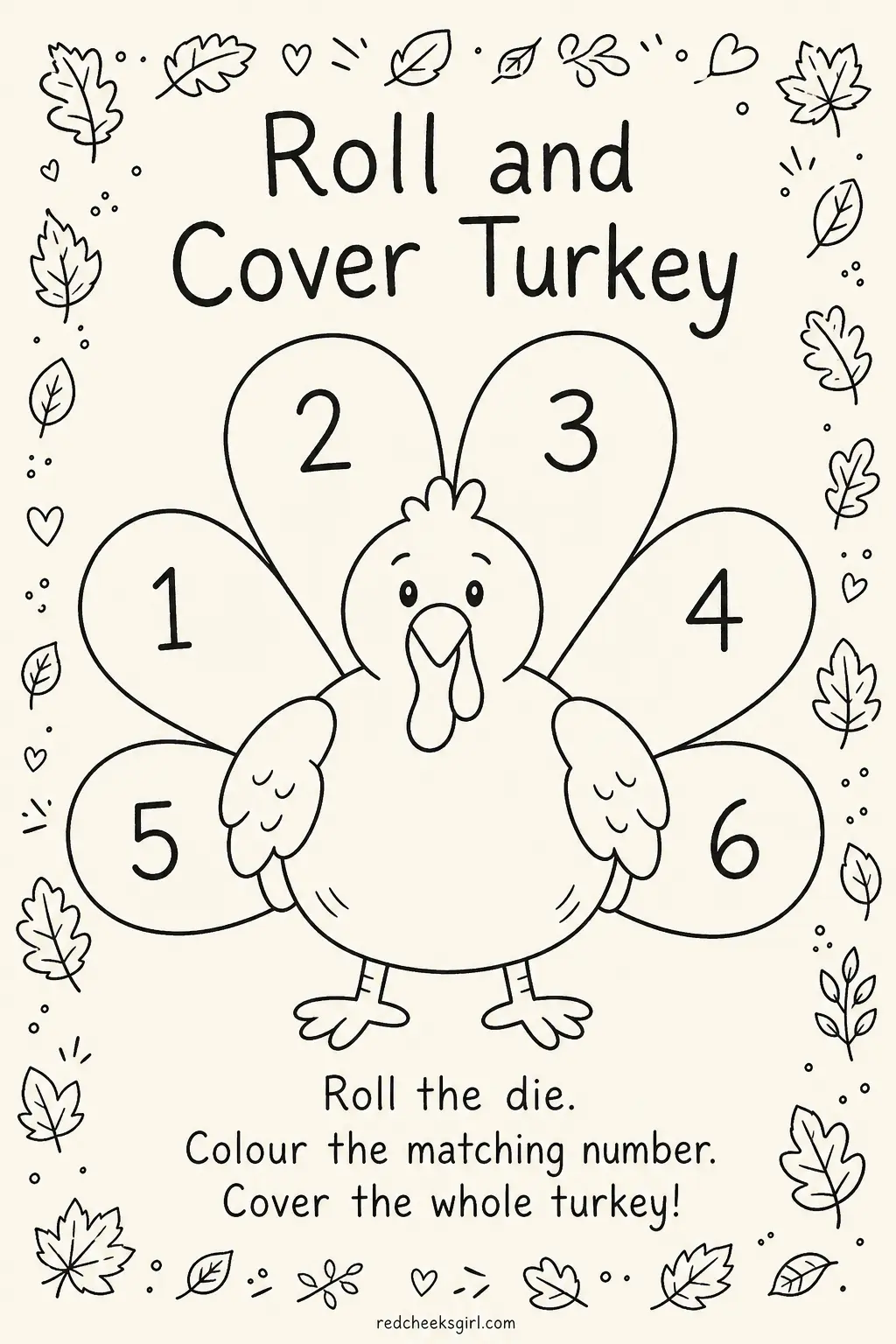
A large outline turkey sits in the centre of the sheet, its body and tail feathers divided into numbered sections from 1 to 6. A child rolls a die, finds the matching number on the turkey, and colours or covers that section with a dot marker. The goal is to cover the whole turkey. Two children can share one sheet and take turns, or one child plays solo against a timer.
Print one sheet per child or pair. The game takes 5 to 15 minutes depending on rolls. Dot markers are the most satisfying tool for this, each section filling with one firm press, but crayons work just as well. Keep a die in a kitchen drawer and this becomes a rainy-day staple.
For a two-player version, use two different marker colours. Each player claims sections in their own colour, and whoever covers more sections when the turkey is full wins. The die does most of the work, which keeps younger and older children evenly matched.
- One standard six-sided die
- Dot markers or crayons
- Printed sheet
🛍 Shopping guide
10. Thanksgiving Bingo
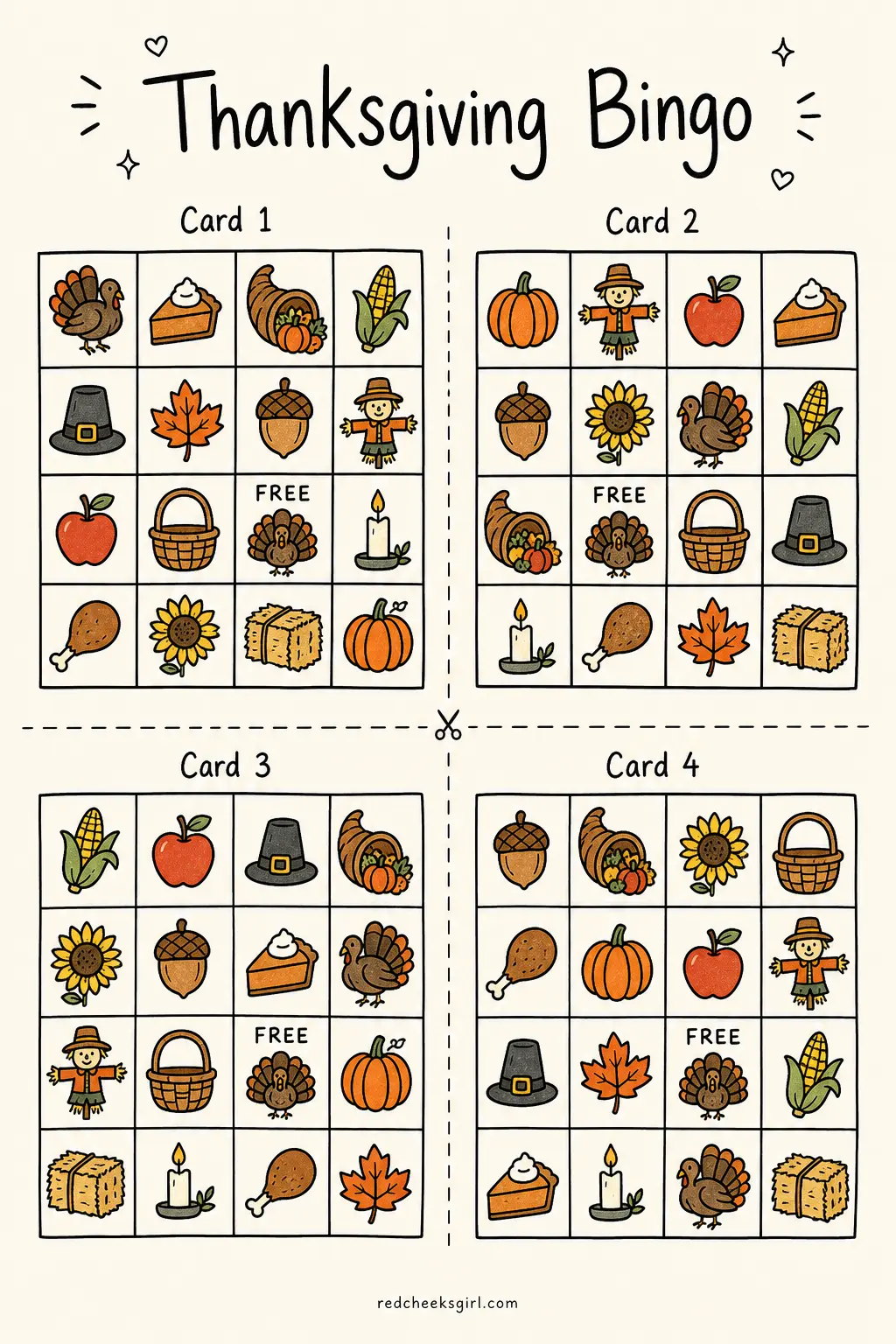
Four different bingo cards fill a single sheet, each card a 4×4 grid of Thanksgiving images: a turkey, a pumpkin pie, a cornucopia, an ear of corn, a pilgrim hat, maple leaves, a roast turkey, acorns, a scarecrow and more. A caller draws image names from a folded list or calls them at random, and children mark their cards with dot markers or torn paper squares.
Print one sheet per family and cut the four cards apart, or print multiple sheets so every child gets a full card each. The free space sits in the centre. A game runs 5 to 10 minutes. More free printable Thanksgiving games pair well with this card set if the group wants a longer session.
If no one is free to call, write the image names on slips of paper, fold them, drop them in a bowl, and let children take turns drawing and calling. That version runs itself and keeps even the youngest child involved in the mechanics.
Cut the four cards apart before handing them out so children are not tempted to compare cards mid-game.
🛍 Shopping guide
11. Leaf Hunt in the Garden
No printing needed for this one. Send a child into the garden or to the front step with a simple verbal mission: find one leaf for every colour they can name. Red, orange, yellow, brown, green, and anything in between all count. A damp autumn garden turns up surprising variety even in a small patch.
The hunt takes 5 to 15 minutes depending on the garden and the child’s enthusiasm for puddles. No basket is needed: a child can carry leaves in their hands or tuck them into a jacket pocket. Boots are the only real equipment requirement.
Back inside, the leaves become their own activity. Lay them on the table in a line from lightest to darkest, or arrange them by size. A child who enjoyed the wider range of Thanksgiving day games will slot this outdoor break in naturally between two quieter sheets.
Give younger children a specific number to find (find 5 leaves) rather than an open brief, so they know when they are done.
12. Sorting the Button Tin
No printing needed for this one. Pull out a biscuit tin or jar of spare buttons, tip them onto a tray, and ask a child to sort them by colour. Once sorted by colour, they can re-sort by size, then by number of holes. Most households have a button collection somewhere and never use it for anything: this is its moment.
The activity suits ages 3 and up. Younger children need supervision around small buttons, and a tray with a rim keeps everything from rolling across the floor. The sorting takes 10 to 20 minutes; the tidying back into the tin takes another five, which is not a bad thing.
Give a child a sheet of paper and ask them to glue their favourite ten buttons into a turkey shape before the tin goes back in the drawer. White school glue works. The result is an actual keepsake and it costs nothing extra.
- Ages 3 and up with supervision
- Pairs well with quiet table activities
- Zero cost if you already own a button tin
13. Turkey Shapes from Playdough
No printing needed for this one. Set out a tub of playdough in orange or brown, or mix colours together for an autumn blend, and challenge a child to build a turkey. The brief is deliberately loose: a flat turkey, a 3D turkey, a tiny turkey family, all count. The only rule is that it has to have feathers.
This runs 15 to 30 minutes and suits ages 2 and up. Toddlers will mainly roll balls and call them turkeys, which is correct. Older children may add corn, pumpkins and a full Thanksgiving scene unprompted. A silicone mat under the playdough keeps the table clean.
Once the turkey is built, photograph it before it gets squished, because it will get squished. That photo takes ten seconds and means the child has something to show at dinner without needing a printer or any paper at all.
- Playdough in orange, brown or yellow
- A silicone mat or parchment paper for the table
14. Counting the Plates While Setting the Table
No printing needed for this one. Ask a child to set the Thanksgiving table and turn it into a maths exercise: count the plates, count the forks, count the glasses, and check that the numbers all match the number of people coming to dinner. If they do not match, figure out together what is missing.
This suits ages 3 to 7 and takes 10 to 20 minutes depending on the size of the table and how carefully a child places each item. It is genuinely useful to whoever is cooking, which children notice and respond to. A child who feels helpful is a child who stays engaged.
Add a small challenge for older children: fold the napkins into a triangle before placing them. A simple fold takes 30 seconds per napkin to learn and keeps a child occupied through the whole table. For even more Thanksgiving ideas to fill the day, the full list of Thanksgiving family games has options that scale up as more family members arrive.
- Turns a chore into a counting game with a real purpose.
- No setup required, and the table ends up set as a bonus.
Frequently Asked Questions
Do I need special paper for printable thanksgiving crafts?
Standard 20lb copy paper works fine for every colouring and activity sheet here. If you want the sheets to feel sturdier, 32lb paper or cardstock holds up better to heavy crayon pressure and dot markers, which bleed slightly on thin paper.
What age are these activity sheets suitable for?
Most sheets work for ages 4 to 8. The tracing sheet and colour-by-number suit ages 3 and up with a little guidance. The spot-the-difference and odd-one-out stretch to ages 9 or 10 before they feel too easy. Each game description notes the best age range.
Can I reuse the bingo cards at a bigger family gathering?
Absolutely. Print as many sheets as you need, cut the four cards apart, and slip them into clear plastic sleeves so children can mark them with a dry-erase marker and wipe clean between rounds. That makes one print run last the whole day.
What if I do not have dot markers?
Crayons, coloured pencils, or even a finger dipped in washable paint all work for the roll-and-cover and bingo sheets. Dot markers are the most satisfying tool for large sections, but nothing on these sheets requires them. A pencil is enough for counting, tracing and odd-one-out.
How do I keep the sheets from sliding around while a child colours?
A clipboard is the easiest fix, especially if children are working at a low coffee table or on the floor. A piece of non-slip drawer liner under the paper works too, and costs less than a dollar from any dollar store.
Are the no-print activities really suitable for indoors on a rainy day?
Three of the four are entirely indoors: button sorting, playdough turkeys and table setting all happen at the kitchen table with no outdoor access needed. The leaf hunt goes outside briefly but the child is back inside in under 15 minutes, so a light rain does not rule it out if you have a covered doorstep or porch.

18 thanksgiving group games built for 15+ players — no waiting, no boredom. Team formats, printabl
15 thanksgiving games for teens that are actually cool, social-media worthy, and zero cringe. They w

18 funny Thanksgiving games guaranteed to crack up your whole table — silly, absurd, and zero awkw
Leave a Reply