


These valentines day games for seniors are built entirely around chairs, memories and songs from the decades that actually matter to the group.
Every printable is large-print ready, every round is designed for gentle hands and unhurried pace, and nothing here requires anyone to jump up, race or mime. Print what you need, set out the chocolates and you are ready.
This post contains affiliate links. If you buy through them, I may earn a small commission at no extra cost to you.
- Love Song Lyric Finish, Classics Only
- Name That Love Song in Three Notes (Song List + Answer Key)
- Valentine Bingo in Large Print (4 Bingo Grids + Call List)
- Songs Sung Together With Sheets (No Printing Needed)
- Match the Film to the Year
- Stories of First Dances, One Each (No Printing Needed)
- Romance Trivia in Two Rounds (2 Quiz Sheets + 2 Keys + Scorecard)
- The Memory Tray Passed Hand to Hand (No Printing Needed)
- How We Met Prompt Cards
- The Photograph Round (No Printing Needed)
- Guess the Chocolate (Tally Card, One Per Guest)
- Wishes for a Friend
- Guess How Many in the Jar on the Table (No Printing Needed)
- A Quiet Card Game at Each Table (No Printing Needed)
- Frequently Asked Questions
1. Love Song Lyric Finish, Classics Only
Each card shows the opening line of a classic love song, cut off at a memorable word, and guests write or say the finish.
Songs come from the 1940s through the 1970s: “At Last,” “Moon River,” “Can’t Help Falling in Love,” “Unchained Melody” and a dozen more. The familiarity is the whole point.
A song that has lived in someone’s memory for sixty years sits right at the tip of the tongue, and finishing the lyric out loud is quietly joyful.
Print on cardstock, cut along the crop marks and place one card face-down at each seat. Give everyone thirty seconds per card, then read the real lyric aloud together. Four cards fit one US Letter sheet, so a group of twenty needs five printed sheets. A fine-tip marker works better than a ballpoint for shaky hands.
If the group is mixed in mobility, skip the writing and run it as a call-and-response: read the lyric opener into the room and let anyone call out the finish. No paper needed for that version, but the printed cards still help people who lip-sync rather than shout.
- printed card sheets on cardstock
- scissors or a paper cutter
- fine-tip markers, one per guest

🛍 Shopping guide
2. Name That Love Song in Three Notes (Song List + Answer Key)
The host hums or plays three notes of a classic love song on a keyboard, phone speaker or even a xylophone, and guests write down their guess. This is ears-only: no lyrics, no hints, just the opening melodic hook.
Three notes is harder than it sounds, and the room tends to fill with competing hums as people try to place it. That communal guessing noise is half the fun.
The printable gives guests a numbered answer sheet with twenty blank lines, large enough to write on without squinting. The host works from a separate song list with the correct title beside each entry.
Plan for fifteen to twenty songs and allow about forty-five seconds between each one. A phone with a piano app costs nothing and covers every song on the list.
If live humming feels awkward, play the first three seconds of each song from a playlist and then pause it. Most streaming services carry every track on the classic list. Run the whole round twice to give late writers a chance to catch up, and read the answers aloud at the end so everyone gets the satisfaction of the reveal.
Rehearse the three-note hook for each song the day before so you hum the right melody under pressure.

3. Valentine Bingo in Large Print (4 Bingo Grids + Call List)
Each grid uses Valentine words instead of numbers: ROSES, KISSES, HEARTS, CANDY, LACE, CUPID, DARLING, WALTZ, RIBBON, LETTER and so on. The caller draws from a shuffled call list and reads each word clearly, once slowly and once normally.
Guests cross off or place a token on their matching square. First to complete a row calls out and wins a small prize, a chocolate heart works perfectly.
Four grids on four separate Letter sheets means a small group plays with one sheet each, and a larger room just prints multiples of each. The FREE centre square carries a printed heart so nobody has to write anything there. Bingo chips are ideal, but wrapped sweets double as markers and make a nice bonus for the winner.
Keep a master call list clipped to a clipboard so the host can verify a winning card quickly. If the group wants more rounds, guests simply slide their markers off and start again with the same card. Running three rounds in a session is common, and the familiarity of the grid actually speeds play after the first round.
Groups of 6 to 40, any cognitive level, and anyone who finds writing tricky since tokens replace pens entirely.

🛍 Shopping guide
4. Songs Sung Together With Sheets (No Printing Needed)
This one needs no printing of game sheets whatsoever: the activity is simply singing classic love songs together as a group, led by whoever has the strongest voice or a willing activity coordinator.
Songs from the American Songbook, old country love ballads and 1950s and 1960s pop classics all work. If the facility has a pianist, this becomes a proper sing-along. If not, a phone and a Bluetooth speaker carry the melody just fine.
Seat everyone in a loose circle or around tables and distribute printed lyric sheets if the group has members with memory difficulties. Lyric sheets are not game printables: they are plain large-print text documents, two columns, 20pt font, printed on regular paper.
The session runs best in three-song sets with a short rest between them. Aim for twenty to thirty minutes total.
The social warmth of this round often surprises first-time organisers. Even residents who rarely speak tend to join in on the chorus of a song they have known for decades.
Start with the most universally recognised song on the list, “You Are My Sunshine” or “Let Me Call You Sweetheart,” to get the room moving together before moving to less familiar titles.
Singing together activates long-term memory differently from speaking and often reaches people who struggle with other formats.
🛍 Shopping guide
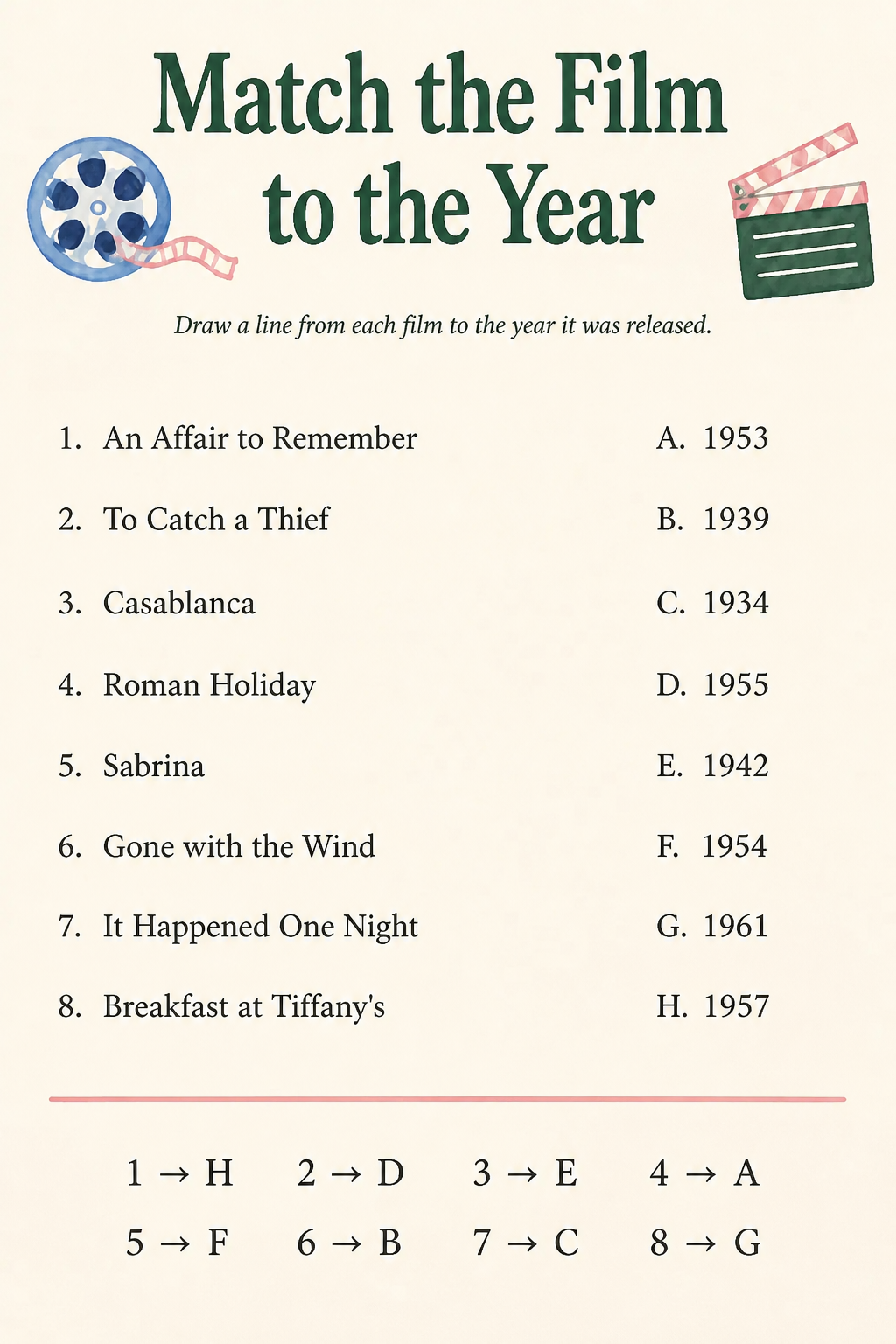
5. Match the Film to the Year
Column A lists fifteen classic romantic films by title. Column B lists fifteen release years, shuffled out of order. Guests draw a line connecting each film to the year it came out.
The titles range from the 1930s to the 1970s: “Casablanca,” “Roman Holiday,” “Breakfast at Tiffany’s,” “An Affair to Remember,” “Doctor Zhivago” and ten more. The challenge is real but winnable for anyone who lived through those cinema eras.
Allow ten minutes and run it individually or as table teams. Table teams reduce pressure on anyone who feels uncertain and make the round sociable rather than competitive. One sheet per table works for team play. Print the answer key separately on a half-sheet and keep it with the host until the reveal.
At the end, read out the correct pairs slowly and let the room react. There is usually a lively discussion about which films people remember seeing on a first date or a Saturday night out.
That conversation is worth as much as the game itself, so leave five minutes for it rather than rushing to the next activity. A link to more memory and trivia games for seniors is worth bookmarking if this round goes well.
Narrow the year column to a ten-year range per era so guests are matching within a smaller window, not across forty years.
6. Stories of First Dances, One Each (No Printing Needed)
No printing needed for this round at all. The host simply invites each person, in turn, to share the story of their first dance: where it was, who it was with, and what song played. No pressure to perform and no timer.
Some stories take thirty seconds. Some unfold into something the whole room leans in to hear. Both are exactly right.
Seat the group in a circle or at round tables so people can see each other’s faces. The host opens with a short model story, fictional or borrowed, to show the tone: warm, brief, specific. Then pass the invitation around the room. Nobody is required to share. A simple “I’ll pass today, thank you” moves the turn graciously.
This is the most low-resource activity in the session and often the most memorable. If the group has a keyboard or speaker available, play a gentle instrumental version of a classic waltz softly underneath the stories. It sets a mood without competing with the voices.
Keep this round to twenty minutes so it does not run into the energy of a printable round.
Write two or three gentle follow-up questions on a card for yourself: ‘Was it a fast song or a slow one?’ or ‘Did you know the person well by then?’ They help anyone who trails off.
7. Romance Trivia in Two Rounds (2 Quiz Sheets + 2 Keys + Scorecard)
Round one covers classic love songs and their original artists. Round two covers famous romantic couples, both real historical pairs and fictional ones from film and literature.
Each round has ten questions in large print, numbered clearly, with four multiple-choice options per question in 16pt font so nobody squints at tiny letters. The two rounds take about twenty-five minutes together with scoring time between them.
Each guest gets their own sheet per round, or tables of four share one sheet and reach a group answer. A simple scorecard at the bottom of the second sheet tracks both rounds with a running total.
Print the answer keys on a separate half-sheet and keep them face-down until scoring.
Reading the answers aloud with a sentence of context about each one, “Yes, Humphrey Bogart and Ingrid Bergman, and this was Bogart’s favourite of all his films,” turns the reveal into a mini history lesson.
If one guest is scoring far ahead of the others, quietly shift to team mode mid-round by pairing high scorers with lower scorers at the same table. The competitive element evaporates and the conversation increases. This works especially well in a memory-care setting where individual scores can feel exposing.
- two printed quiz sheets per player (or per table)
- two printed answer key half-sheets for the host
- pencils with good erasers

🛍 Shopping guide
8. The Memory Tray Passed Hand to Hand (No Printing Needed)
Place twelve small Valentine-themed objects on a tray: a candy heart, a ribbon, a lace doily, a small envelope, a red button, a paper rose, a tea bag, a thimble, a tiny mirror, a stamp, a heart-shaped cookie cutter and a key.
Pass the tray slowly around the room, giving each person thirty seconds to study it. Then cover it with a cloth and ask everyone to recall as many objects as they can, spoken aloud as a group, not written down.
No printing of any kind is required.
This works beautifully as a group activity rather than a competition. One person calls out what they remember, someone else adds another, and the tray becomes a shared memory exercise. Most groups recall nine or ten objects, which feels like a genuine achievement. Reveal the tray at the end by lifting the cloth and letting everyone see what they missed.
Vary the objects slightly each time you run this round in the same facility. If the same group plays it monthly, change half the items so the challenge stays fresh. Objects with a strong tactile quality, smooth, rough, soft, heavy, tend to be remembered better than plain paper items, which is worth knowing when assembling the tray.
Reduce to eight objects for a group with memory difficulties, and allow two full passes around the room before covering the tray.
🛍 Shopping guide
9. How We Met Prompt Cards
Each card carries one open prompt about relationships and meeting stories: “Where did you meet the most important person in your life?” “What was the very first thing you noticed?” “Did you know straight away, or did it take time?”
“What is one thing you wish you had said sooner?” Guests read their card quietly, then share as much or as little as they like with the table. There are no wrong answers and no scores.
Print four cards per Letter sheet, cut apart and place one face-down at each seat before guests arrive. The large-print format, 20pt minimum font, means no reading glasses drama.
The cards are keepsake-quality: a guest who wants to keep theirs and write a longer answer at home absolutely should. This round pairs well with a cup of tea and five minutes of quiet before the livelier games resume.
For a memory-care group, pair each prompt card with a short verbal prompt from the host, said slowly and gently, so the card is a visual anchor rather than the only delivery method. Some prompts will spark long stories. Others will get a smile and a shrug. Both responses are equally welcome, and the host should model that acceptance visibly.
Concrete sensory prompts, ‘What did the room smell like?’ or ‘What were you wearing?’, unlock memories that open-ended questions miss.

🛍 Shopping guide
10. The Photograph Round (No Printing Needed)
No printing needed here. The host collects five to eight photographs in advance, either from the facility’s archives, from families or from public-domain vintage images, and displays them one at a time on a tablet screen or printed enlargements on A4 paper.
Each photograph shows a couple, a wedding, a dance hall or a Valentine scene from the mid-twentieth century. The group discusses each one: what era does it look like, what do the clothes tell you, where might this have been taken.
This round runs entirely as conversation. The host acts as a gentle moderator, not a quizmaster, asking open questions rather than testing recall. “What do you think the occasion was?” works better than “What year was this taken?”
because it invites interpretation rather than demanding accuracy. Run it for fifteen to twenty minutes, moving through the photographs at a comfortable pace.
If any guest recognises a place or a style from personal experience, give that story space. The photograph is a prompt, not the main event. Facilities that have their own historical photographs from community events often find this round generates the richest conversation of the whole afternoon, especially if long-time residents recognise a location.
Laminate printed photographs so they survive multiple sessions and can be passed hand to hand without damage.
🛍 Shopping guide
11. Guess the Chocolate (Tally Card, One Per Guest)
Set out five small dishes, each holding a different type of unwrapped chocolate: dark, milk, white, caramel-filled and a mint truffle. Number the dishes one to five.
Each guest gets a tally card listing the five numbers with a blank beside each one and the instruction to write the type of chocolate they think they are tasting.
Guests taste in their own time, no rush, and write or circle their guess from a small printed word bank at the bottom of the card.
This is one of the gentlest activities in the session: tactile, personal, genuinely fun for people who love chocolate and low-stakes enough that a wrong guess produces laughter rather than embarrassment. Allow ten minutes.
Then reveal the answers verbally, one dish at a time, and ask for a show of hands on each. No grand winner, just the pleasure of being right about chocolate.
For guests with dietary restrictions, prepare a separate small dish set using sugar-free varieties and mark that station clearly. Allergen awareness matters here: check with care staff before the session about nut allergies and other restrictions. Use toothpicks or small spoons rather than fingers for hygiene, and place a small napkin at each guest’s seat.
- 5 numbered small dishes
- assorted chocolates, one type per dish
- toothpicks or small tasting spoons
- napkins

🛍 Shopping guide
12. Wishes for a Friend
Each card is a Valentine keepsake written by one guest for another. The host pre-assigns pairings, or guests choose their own, and each person writes one warm wish, a favourite memory of that friend or a single sentence of appreciation on their card.
The card is then folded and handed to the recipient. No game mechanics, no scores. Just the pleasure of receiving something handwritten from someone who knows you.
The large-print format leaves room for generous handwriting without cramping. Fine-tip felt pens work better than ballpoints for anyone whose grip is weaker. Allow ten quiet minutes for writing, with soft music playing underneath. Some guests will write three lines. Some will write one. One line is enough.
Collect any cards from guests who are uncertain and offer to write the words for them if they dictate. This is not a workaround: it is an act of care, and the card means exactly as much.
Cards printed on light cardstock hold up better than plain paper and can be pinned to a noticeboard or taken home. These make the afternoon feel complete in a way that games alone do not.
For more ideas built around connection and memory, the list of senior activities and games with printables is a practical next stop.
Facilities running a small group of 8 to 20 where guests know each other, or as a closing activity that sends everyone home with something tangible.

🛍 Shopping guide
13. Guess How Many in the Jar on the Table (No Printing Needed)
No printing is needed for this one. Place a clear glass jar filled with small Valentine candies, candy hearts or foil-wrapped chocolates at the centre of each table.
Each guest writes their guess on a small slip of paper, folds it and drops it in a bowl. The host collects the slips, reads the guesses aloud, and announces who came closest.
A simple slip of paper and a pen at each seat is all the setup required.
Count the candies before the event, write the number on a card and keep it in a pocket. Jars that hold between forty and eighty pieces work best: too few and the guessing is trivially easy, too many and nobody can anchor a reasonable guess.
A one-litre mason jar with candy hearts typically holds sixty to seventy pieces, which gives good spread across the guesses.
Award the jar itself to the winner. This is the prize that always gets the loudest reaction, because the winner now has sixty sweets and the room has opinions about that.
If running multiple tables, give each table its own jar with a slightly different candy and run the game simultaneously. The host moves table to table collecting slips and announces all winners at once.
- one clear glass jar per table
- candy hearts or foil-wrapped chocolates
- small paper slips and pens at each seat
🛍 Shopping guide
14. A Quiet Card Game at Each Table (No Printing Needed)
End the afternoon with a round of a familiar card game played at each table independently: Rummy, Snap, Go Fish or a simple trick-taking game the group already knows. No printing needed, no instruction sheets, no new rules to learn.
A standard deck of cards at each table and the knowledge already sitting in the room is all it takes. This winds the session down at a natural pace without an abrupt ending.
Four players per table is the ideal number for Rummy or a trick-taking game. If table sizes vary, Snap works with two to six players at different skill levels.
Large-print playing cards make a genuine difference for anyone with vision difficulties, and they cost very little. Have two or three decks available so a torn card does not stop play mid-round.
This round has a secondary function beyond the game itself: it gives guests a reason to stay and chat after the organised activities finish, and it gives staff a natural window to begin clearing without the room feeling like it is being shut down.
Leave the cards on the tables and let the games run until the natural end of the session. For a whole calendar of activities like this one, the New Year’s Eve games for seniors list carries the same seated, memory-first approach into a different season.
Large-print playing cards with oversized numbers are widely available and change the experience entirely for anyone with macular degeneration or early cataracts.
🛍 Shopping guide
Frequently Asked Questions
Which sheets do you print one per guest and which are shared?
Print one per guest: the Love Song Lyric Finish cards, the Name That Love Song answer sheet, the Romance Trivia quiz sheets (both rounds), the How We Met Prompt Cards, the Guess the Chocolate tally card and the Wishes for a Friend keepsake card.
Print as shared resources: the Valentine Bingo grids (one per player for bingo to work, but four different grids from one print run covers a table of four) and the Match the Film to the Year sheet (one per table for team play, or one per guest for individual play).
The call list for Bingo and both answer keys are host-only copies, printed once and kept at the front.
How do you adapt these valentines day games for seniors with dementia or memory difficulties?
Focus on the singing round, the photograph round and the memory tray, which engage long-term procedural and emotional memory rather than recall of recent facts. Reduce the trivia and matching games to fewer questions and allow group answers rather than individual ones.
The How We Met prompt cards work well with a verbal prompt read aloud by the host alongside the printed card. Always allow passing without penalty and frame everything as shared fun rather than a test.
How long should a Valentine party session run for a care home group?
Ninety minutes is a comfortable maximum for a seated group, with a natural break of ten minutes in the middle. A realistic programme runs two or three printable games, one or two conversation or singing rounds and one quiet closing activity.
Four to six activities total is plenty. Front-load the more engaging games in the first forty-five minutes when energy is highest and close with the card game or the keepsake card writing.
What is the best prize for valentines day games for seniors?
Chocolates, small boxes of biscuits, a single fresh flower or a decorated gift bag of Valentine sweets all land well. Avoid anything requiring dexterity to unwrap or consume safely.
The candy jar from the guessing game is a natural and popular prize because it is already on the table and the contents are the reward.
For keepsake-round winners, a printed certificate or a small card written by the host is often kept longer than any food prize.
How many people do these games work for?
Most of the seated and printable games scale from six to forty guests with no structural changes, just more printed sheets. The singing round and the photograph round work for any size.
The conversation rounds, Stories of First Dances and the How We Met cards, work best with groups under twenty where every voice can be heard without a microphone. For larger groups, run conversation rounds at individual tables simultaneously rather than as a full-room activity.
Can these valentines day games for seniors be run by one person?
Yes, with a little preparation. Pre-cut the card sets the day before. Keep the answer keys, the bingo call list and the chocolate reveal card in a folder in order of play.
A clipboard with the running order on it means the host never has to pause and think about what comes next. The no-printing rounds need no prep at all. One person can comfortably run a ninety-minute session for up to twenty guests working solo.

20 valentine front porch ideas, from a heart wreath and XO sign down to mailbox love notes, ordered
21 valentine desserts that look fancy but stay simple: a piped heart cake, lava cakes for two, panna

Twenty-two fun and easy Valentine class party games that keep a whole classroom of kids laughing, mo
Leave a Reply