

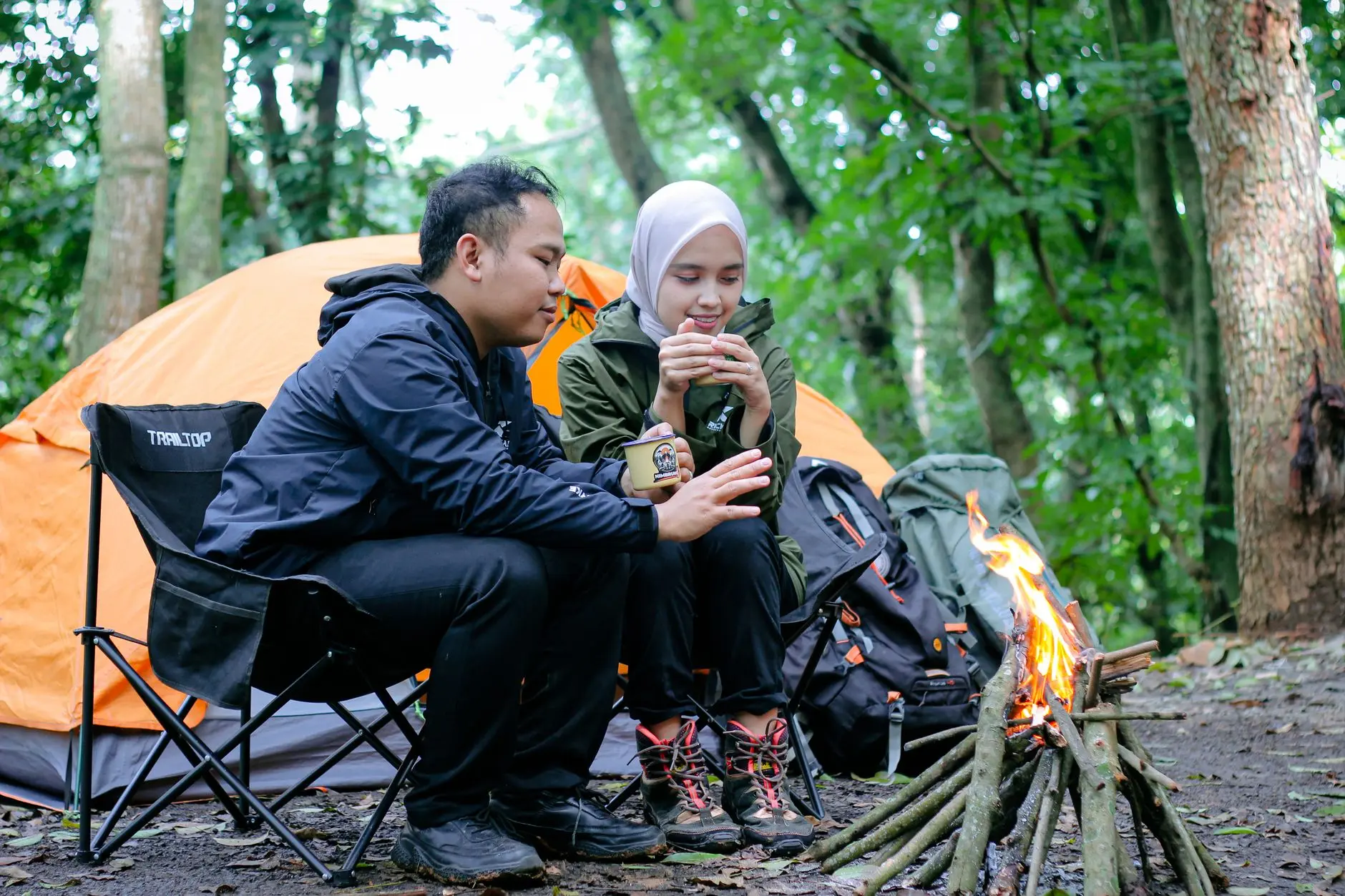
The best camping memories rarely come from the hike or the scenery alone — they come from the ridiculous story someone invented around the fire, the shriek of flashlight tag in the dark, or the argument over whether a cluster of stars really looks like a bear.
Games are the glue that turns a campsite into a shared experience, and the good news is that most of the ones here need nothing more than the people already sitting in your camp chairs.
We’ve put together 18 camping games that cover every mood: loud and chasing, quiet and creative, competitive and cooperative, and everything in between.
The first twelve follow a natural arc from arrival through the fire and into the late-night wind-down, and we’ve added six more that fill the gaps perfectly.
Eight of the games come with a free printable sheet you can grab before you leave home — just tuck them in a folder with a few pencils and you’re set for the whole trip.
This post contains affiliate links — if you buy through them, I may earn a small commission at no extra cost to you.
Table of Contents
- Campfire Story Chain
- Flashlight Tag
- Nature Scavenger Hunt
- Camping Bingo
- Twenty Questions
- Glow Stick Ring Toss
- Guess the Constellation
- Charades by Firelight — Camping Edition
- Would You Rather — Outdoors Edition
- Rock Stacking Contest
- Camp Trivia Rounds — Host Question Sheet
- S’mores Building Challenge
- Campfire Name That Sound
- Emoji Decode — Camping Edition
- Telephone in the Dark
- Fortunately / Unfortunately
- Predator and Prey
- Two Truths and a Lie — Camping Edition
1. Campfire Story Chain
Everyone sits in a circle around the fire, and the first person opens a story with a single sentence — something vivid and slightly strange works best, like “The ranger said we were the only ones on this mountain, but then we found the tent.”
The next person adds one sentence, and play continues around the circle. No one may end the story, contradict a detail already established, or repeat something already said.
The only rule is that each addition must follow logically from what came before, which is both the constraint and the comedy.
You need absolutely nothing except voices and a fire to stare into. The game works beautifully for groups of four to twelve, and a good round lasts fifteen to twenty minutes — longer if someone introduces a plot twist that sends the group into giggles.
It scales perfectly for mixed ages: younger kids love adding monsters or dogs, while adults tend to complicate the plot in ways that loop back hilariously.
Host tip: Before you start, set one secret theme — “the story must end at a diner” or “someone has to find a map” — and whisper it only to the last person in the circle.
The moment they steer the story toward the diner after everyone’s been talking about a haunted forest is always the best moment of the night.
2. Flashlight Tag
This is tag played in the dark, with a flashlight beam doing the tagging instead of a hand. One player is “It” and holds a flashlight. All other players scatter within agreed boundaries — a campsite loop, a clearing, whatever terrain you have.
When It shines the beam directly on another player and calls their name, that player is tagged and becomes the new It. No touching required, which makes this safer and faster than traditional tag on uneven ground at night.
You need one flashlight per game (though giving everyone else a dim light for safety is smart), and the boundaries must be set clearly before darkness falls.
Groups of five to fifteen players work best, and a session typically runs twenty to thirty minutes before everyone is happily exhausted. Keep the playing area free of trip hazards — do a quick walk-through while it’s still light.
Host tip: Give the person who is It a noticeably different flashlight — a headlamp works well — so players can always track where the tagger is. It removes arguments about whether someone “saw you first” and speeds the game up considerably.
3. Nature Scavenger Hunt
Players — solo, in pairs, or in small teams — work through a printed list of natural items and phenomena to find at or near the campsite.
The sheet includes both physical things to collect (a leaf with more than five points, a piece of bark with a pattern on it) and observational challenges (spot a bird, find something perfectly round).
Physical items get brought back to a central spot; observations get checked off with a pencil. The team or player with the most completed items after a set time wins.
This is one of the printable games in the lineup — print the sheet at home and bring it in a zip-lock bag with a pencil per team. It suits groups of any size from two to twenty, divided into teams of two to four.
A round runs thirty to forty-five minutes depending on terrain, and it works just as well in the afternoon as it does as a morning warm-up before breakfast.
Host tip: Walk the area yourself before handing out the sheets and quietly remove or circle items that genuinely don’t exist in your specific environment. Nothing deflates a scavenger hunt faster than kids sprinting around looking for something that isn’t there.

🛍 Shopping guide
4. Camping Bingo
Each player gets a printed bingo card covered with camping-related images or words — things like “owl sound,” “falling star,” “someone burns their marshmallow,” “another camper waves,” and “wind picks up.”
Instead of a caller reading numbers, players watch and listen to the real world around them and mark their card whenever something on it actually happens. First to complete a row calls out and wins that round, then play continues for blackout.
This is a printable game — bring one card per player and a pencil or a handful of small stones to use as markers.
It works for any group size and is especially good for families with young children because it encourages them to pay attention to their surroundings.
A full session can last anywhere from thirty minutes to the whole evening depending on how actively you’re playing, making it a wonderful slow-burn backdrop to a campfire conversation.
Host tip: Print extra cards and laminate them before the trip, then use dry-erase markers — that way you can replay the game on multiple nights without burning through paper, and kids love the satisfying squeak of marking something off.

🛍 Shopping guide
5. Twenty Questions
One player thinks of something — an animal, a plant, a piece of camping gear, a famous landmark, anything at all — and announces only the broad category (“animal,” “place,” “thing”).
The rest of the group takes turns asking yes-or-no questions, trying to narrow down the answer. They have a maximum of twenty questions total, counting out loud as a group. If someone correctly guesses before the twentieth question, they become the next thinker.
If the group uses all twenty without guessing, the thinker wins and goes again.
No materials needed, no setup, no cleanup. The game works for two players or twenty, and a round typically lasts five to ten minutes depending on how tricky the thinker is feeling.
It’s a perfect around-the-fire game because no one has to move, hold anything, or see anything — it runs entirely on conversation and deduction, which means it’s great for the later part of the evening when energy is winding down.
Host tip: Encourage younger kids to pick things visible from where they’re sitting — their camp chair, a nearby tree, a water bottle. It keeps the game moving quickly and teaches them to give accurate yes-or-no answers rather than “sort of” or “it depends,” which is a skill that’s harder than it sounds.
6. Glow Stick Ring Toss
Bend a handful of glow sticks into rings and toss them onto tent stakes, sticks pushed into the ground, or purpose-bought pegs set up in a row.
Each peg is worth a different point value depending on distance — closest pegs score one point, farthest score five.
Players take turns throwing their set of rings from a marked line, tally their score after each round, and the first player to reach a target score (twenty-five works well) wins.
The glowing rings and targets make this easy to run in full darkness and genuinely look spectacular.
You’ll want a pack of glow sticks long enough to bend into eight- to ten-inch rings, plus stakes or pegs to toss onto. Groups of two to eight players work best so turns come around quickly; a game runs fifteen to twenty-five minutes.
This one is especially popular with kids aged five and up, though adults get competitive fast once the scoring starts.
Host tip: Activate and bend all your glow sticks into rings before it gets dark so you’re not fumbling with packaging by firelight. Store them in a cup or bowl at the throwing line so the next player can grab their set instantly.
🛍 Shopping guide
7. Guess the Constellation
Players receive a printed sheet showing a set of star patterns as simple dot diagrams, each labeled with its constellation name alongside a second unlabeled set they have to match by eye.
They take the sheet away from the fire (so their eyes can adjust to the dark), look up at the actual sky, and try to identify which constellation on their sheet is visible above them right now.
Matching real sky to the printed diagram is the challenge — it’s harder and more satisfying than it sounds.
This is a printable game — the sheet shows both a labeled reference panel and an unlabeled answer panel so players can work independently or as a team.
It suits any group size, pairs particularly well as a team game, and runs twenty to thirty minutes before the scoring conversation. Bring a red-light flashlight or a dim headlamp so players can read their sheet without destroying their night vision.
Host tip: Do a quick online check before your trip to know which constellations are actually visible in your region during your specific camping dates. Nothing is more deflating than sending kids outside to find Scorpius when it’s below the horizon all week.

🛍 Shopping guide
8. Charades by Firelight — Camping Edition
This is charades, but every prompt on the printed card is tied to the outdoors — pitching a tent, reeling in a fish, spotting a bear from a distance, applying bug spray in a hurry.
One player draws a card (or tears off a slip from the printed sheet), reads it silently, and acts it out without making a sound while their team guesses. Standard charades signals apply: fingers for syllables, ear-tug for “sounds like,” and so on.
The team that guesses the most prompts in two minutes wins the round.
The printable sheet comes with a full set of camping-themed prompts you can cut into individual slips before the trip and store in a small envelope. Groups of four to twelve work best, split into two teams.
A full game of four rounds runs roughly twenty minutes, making it a great post-dinner game before the fire dies down. All you need besides the sheet is a way to time two-minute rounds — a phone timer or a countdown watch works fine.
Host tip: Pre-cut the slips at home and put them in separate envelopes for each team so there’s no fumbling in the dark. Fold them twice so no one can accidentally read the prompt in firelight while reaching into the pile.

9. Would You Rather — Outdoors Edition
A player reads aloud a printed prompt — “Would you rather sleep in a hammock in a thunderstorm or share a one-person tent with three other people?” — and everyone votes by holding up one finger for Option A or two fingers for Option B.
After the vote, each person who was in the minority has to defend their choice in thirty seconds or less.
There’s no winner or loser; the game runs on laughter, debate, and the revelation that the person you thought you knew well would absolutely choose to sleep with the thunderstorm.
The printed sheet supplies dozens of prompts written specifically for the camping setting, so the scenarios feel real and relevant rather than abstract. Any group size from three to twenty works, and a round of ten to fifteen questions takes about fifteen minutes. It’s an ideal campfire closer — low energy, high conversation, no moving in the dark required.
Host tip: Scan the prompts in advance and pull out three or four that you know will apply directly to something that happened on this specific trip — a prompt about a muddy trail will land completely differently after everyone hiked one that afternoon.

10. Rock Stacking Contest
Each player collects ten rocks from around the campsite — any size, any shape — and brings them to a flat surface or a shared patch of ground.
On a shared countdown, everyone begins stacking their rocks into the tallest, most stable tower they can build. The tower must stand unsupported for a count of ten to win the round.
Players may restart if their stack falls, but the clock is always running — whoever has the tallest standing tower when time is called wins.
You need only the rocks underfoot and a timing method — three minutes per round is a good starting point. Any number of players can compete, from two to however many fit around the patch, and a best-of-three match runs under fifteen minutes.
It’s an excellent quiet-concentration game for the afternoon or early evening, and it has a wonderful cross-generational appeal because intuitive physics knowledge matters more than age or strength.
Host tip: After the contest, let kids spend time trying to break their own record cooperatively — one child holds a rock in place while another adds the next one. The cooperative version teaches patience and spatial reasoning in a way the competitive round doesn’t, and it keeps them occupied far longer than you’d expect.
11. Camp Trivia Rounds — Host Question Sheet
The host reads questions from the printed sheet, which is organized into thematic rounds: nature and wildlife, camping gear and knots, outdoor survival, and “campfire classics” general knowledge.
Players write their answers on a scrap of paper or call them out in a heads-up format for smaller groups. Each round has ten questions, and scores are tallied at the end of each round before moving to the next.
The team or individual with the highest cumulative score after all rounds wins.
The printable is a host-facing sheet with questions, multiple-choice options, and answers clearly marked — no need to Google anything in a spot with no signal. Any group size works: you can play individually or split into teams of two to five.
A full four-round game takes about thirty to forty minutes, making it perfect for that post-dinner stretch when the fire is glowing and no one wants to move yet.
Host tip: Read each question twice — once at a normal pace, once slowly — before accepting answers. In noisy campfire conditions with crackling wood and wind, players miss words constantly, and a second read prevents the endless “wait, what was the question?” that stalls the game.

12. S’mores Building Challenge
Give each player or team the same set of s’mores ingredients — crackers, chocolate, marshmallow — plus a few wildcard extras like sprinkles, peanut butter, fruit slices, or a second type of chocolate.
Set a five-minute build window and a “structural integrity” rule: the finished s’more must hold together for a count of five when held horizontally.
Players are judged in three categories voted on by everyone: most creative, best looking, and one brave volunteer must taste-test for best flavor.
You need s’mores ingredients and whatever creative extras you can pack in, plus skewers or sticks for toasting. Roasting is allowed and encouraged, but the build is the main event.
Groups of four to twelve work well, and the full challenge including judging runs about twenty minutes. It’s a natural campfire game because the fire is already there doing the work.
Host tip: Set a one-napkin rule — each builder gets exactly one napkin, and anything that falls off their s’more during judging is gone. It sounds trivial until someone’s entire chocolate layer slides off and they have to improvise, which is always the funniest moment of the challenge.
🛍 Shopping guide
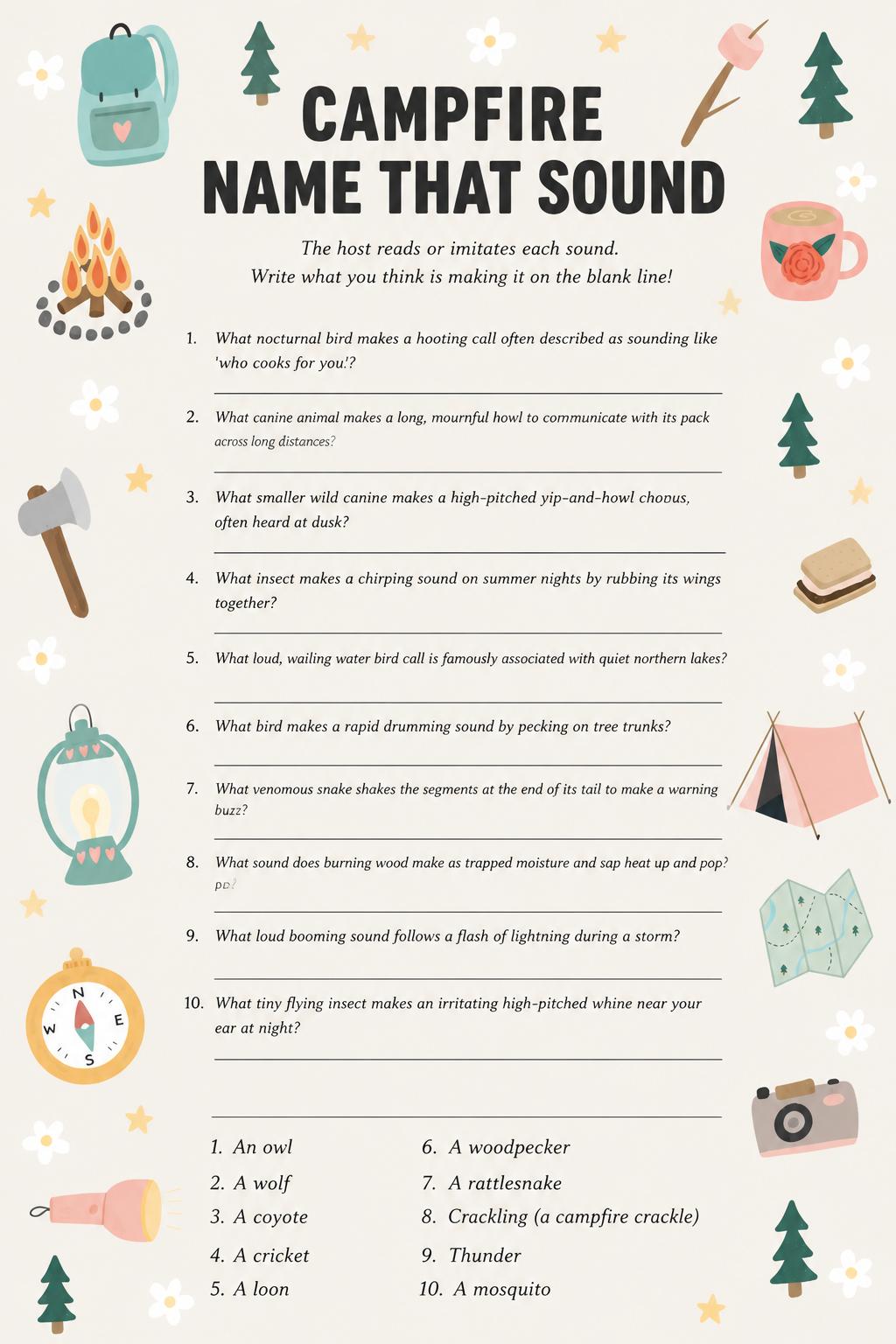
13. Campfire Name That Sound
One player becomes the sound-maker, holding the printed sheet that lists a series of outdoor and camp-related sounds — an owl call, a tent zipper, the crinkle of a foil emergency blanket, water being poured from a canteen.
They recreate each sound using only their voice and whatever objects are at the campsite, while the rest of the group tries to name what the sound is meant to be.
Correct guesses earn a point; the team with the most points after all sounds have been made wins.
This is a printable game — the sheet lists sounds in sequence with space for the host to tick them off and keep score. It works for groups of four to sixteen, split into two teams for maximum energy.
A single sheet covers roughly twenty sounds, and a full round takes fifteen to twenty-five minutes. It’s a brilliant game for the moment when it’s dark and cold and no one wants to move — everyone stays by the fire the whole time.
Host tip: Before the trip, gather two or three real props that are easy to pack and make distinct sounds — a zipper pouch, a small metal spoon, a piece of aluminum foil — and tuck them in your game bag.
A player miming a sound with nothing to work with is much less funny than one who produces a real foil crinkle unexpectedly.
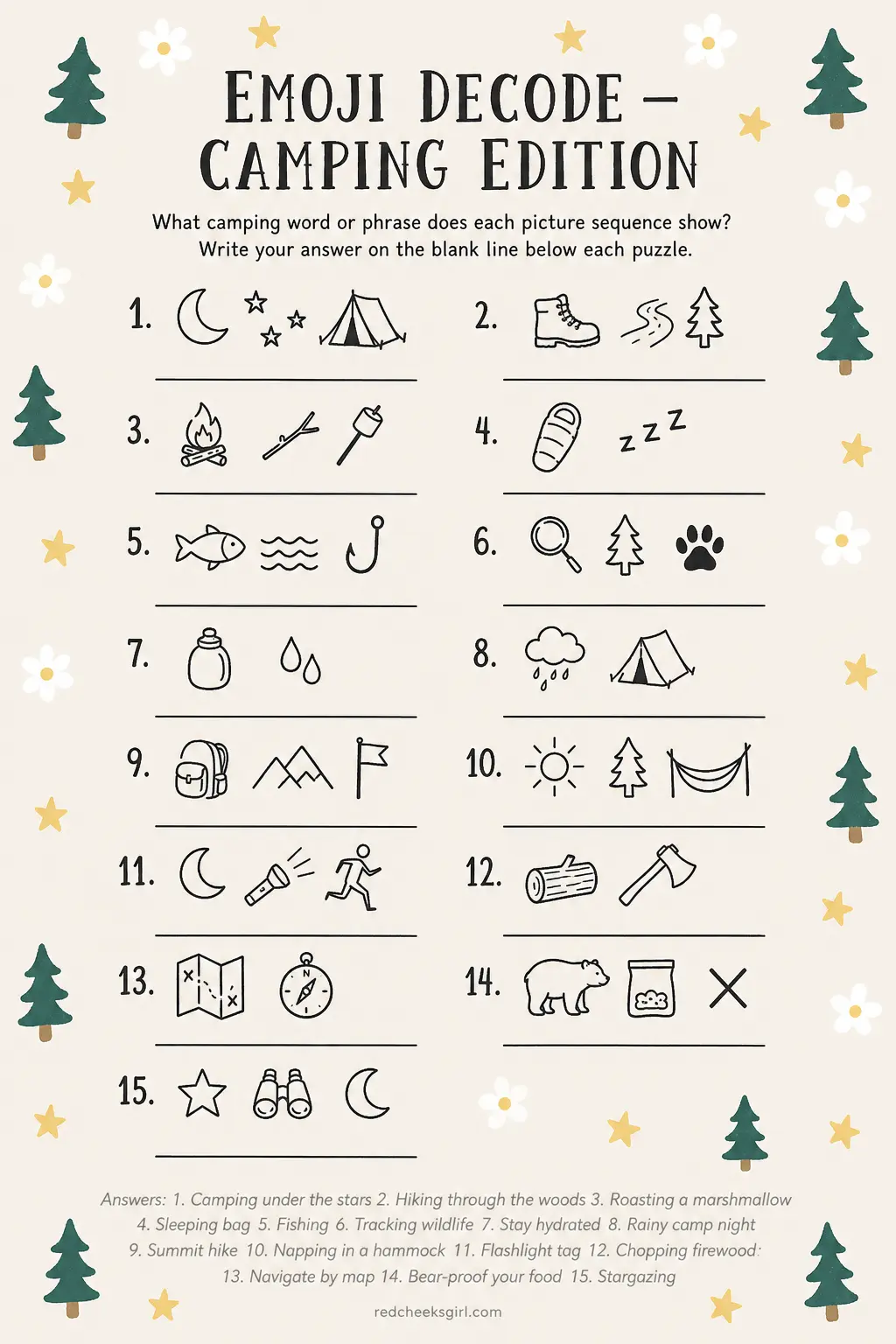
14. Emoji Decode — Camping Edition
Players receive a printed sheet showing rows of emoji sequences, each of which represents a camping-related word, phrase, or scenario — three emoji in a row that together suggest “fishing by the lake at sunrise,” for example.
Players work individually or in teams to write down what each sequence is describing. The sheet includes a full answer key on a separate panel that the host holds back until scoring time. Highest number of correct answers wins.
This is a printable game — bring one sheet per player or one per team, plus pencils. Groups of any size can play, and a sheet of fifteen to twenty sequences takes about fifteen to twenty minutes to work through.
It’s ideal as a quiet around-the-fire game or a tent game by headlamp when the fire has died down and the little ones are almost asleep.
Host tip: Read the sequences aloud for any players who forgot their glasses or are sitting too far from the firelight to see clearly — hearing the emoji described out loud (“tent, moon, three stars”) often triggers a guess faster than staring at the paper, and it keeps everyone in the game together.
15. Telephone in the Dark
Players sit in a circle and the first person whispers a short camping-themed sentence — something specific enough to get mangled, like “The raccoon knocked over the blue cooler at midnight” — into the ear of the person next to them.
That person whispers what they heard to the next, and so on around the circle. The last person says out loud what they received, and then the first person reveals the original sentence. The gap between the two is almost always extraordinary.
No materials required. The game works best with six or more players — fewer and the message doesn’t have time to distort interestingly — and a group of ten to fifteen is perfect.
Each round takes about three minutes, and you can run five or six rounds in an evening easily. It’s one of the best games for mixed ages because the youngest players are often the ones who transform the sentence most dramatically.
Host tip: In a noisy campsite with wind and crackling fire, players will genuinely mishear each other — which is half the fun. Tell players they may only whisper each message once, no repeats allowed. The no-repeat rule is what actually generates the funny distortions; without it, everyone just clarifies and the final message arrives intact and boring.
16. Fortunately / Unfortunately
This storytelling game has a simple alternating structure: the first player begins with a “Fortunately” sentence — “Fortunately, we found a beautiful campsite right by the river.” The next player responds with “Unfortunately” — “Unfortunately, the river was full of alligators.”
The third player swings back to fortunately, and so on around the circle. Each sentence must acknowledge and build on the previous one before flipping the fortune. The tension between hope and disaster is what makes the game endlessly funny.
No materials, no setup. Works for three players all the way up to fifteen or so before the wait between turns gets too long.
A satisfying round runs about ten minutes, and you can reset and start a new scenario instantly — a fresh opening sentence and you’re off again.
It’s one of those campfire games that genuinely gets better with tired people, because exhaustion loosens everyone’s filter in the best possible way.
Host tip: Encourage players to be as specific as possible rather than vague — “Unfortunately, my sleeping bag turned out to be a cheese grater” lands much better than “Unfortunately, things went wrong.” Specificity is the engine of the game, and once one player models it well, the rest of the group usually follows.
17. Predator and Prey
One player is the Predator and is blindfolded at the center of a defined circle — about eight feet in diameter works well, marked with sticks or rope.
All other players are Prey and must move within the circle, trying to get close enough to tap the Predator’s shoulder and score a point without being heard.
The Predator listens and reaches out; if they touch a Prey player, that player is out for the round. The last Prey player still in the game wins and becomes the next Predator.
You need a blindfold (a buff or bandana works perfectly) and something to mark the circle boundary. Groups of five to twelve work best.
A round lasts three to eight minutes depending on how brave or cautious the Prey players are, and you’ll easily run four or five rounds in an evening.
The game is completely silent by rule — no talking once the round starts — which makes it eerie and tense in the best possible way.
Host tip: Make the ground inside the circle deliberately crunchy if you can — scatter a few dry leaves inside the boundary before play starts. Sneaking over leaves in the dark while someone blindfolded listens intently creates a level of suspense that a bare patch of dirt simply can’t match.
🛍 Shopping guide
18. Two Truths and a Lie — Camping Edition
Each player thinks of three statements about themselves, all framed around outdoor or camping experiences — things they’ve done, seen, or survived in the wild. Two statements are true; one is a lie.
They read all three aloud in any order, and the rest of the group votes on which one they think is the lie. After everyone has voted, the player reveals the answer.
Points can be scored (one point for correctly identifying the lie, one point for the teller if no one spots it), or it can simply be played for conversation and laughs.
No materials needed. Works for any group size from three to fifteen, and each player’s turn takes two to four minutes including the reveal and discussion.
A full round of ten players takes about thirty minutes, but the game rarely feels that long because the stories that come out of the “that one is TRUE?!” moments are often the highlight of the whole trip.
It’s one of the most reliable get-to-know-you games that genuinely scales to adults and kids together.
Host tip: Set a camping-specific frame before the game starts — statements must relate to something outdoors, nature, or travel. Without this rule, players default to generic life facts, and the camping setting disappears. “I once shared a trail with a moose for twenty minutes” is infinitely more interesting around a fire than “I have been to fourteen countries.”
Frequently Asked Questions
What camping games work best for young children?
Nature Scavenger Hunt, Camping Bingo, Glow Stick Ring Toss, and Rock Stacking Contest are all strong choices for young children because they require no reading, no complex rules, and no waiting in long turns.
Flashlight Tag and Telephone in the Dark also work brilliantly for younger kids — they’re physical or silly enough to hold short attention spans without any prep from parents.
How many printable sheets are included in this article?
Print them at home before you leave, tuck them in a folder with pencils, and you’re covered for the whole trip.
What do I need to bring to run most of these games?
Most games here need nothing at all beyond the people playing.
For the full lineup, pack the eight printed sheets in a zip-lock folder, a handful of pencils, a bandana for blindfolding, one flashlight designated for Flashlight Tag, and a pack of glow sticks for the ring toss.
Everything else — rocks, sticks, fire, voices — you’ll find at the campsite.
Can these camping games be played without a fire?
Absolutely. Only S’mores Building Challenge genuinely benefits from an active fire, and even that can be adapted with a camp stove or pre-toasted marshmallows.
Games like Twenty Questions, Telephone in the Dark, Two Truths and a Lie, Fortunately/Unfortunately, and all eight printable games work perfectly in a tent, a picnic shelter, or anywhere else you happen to be sheltering if the weather turns.
How do I keep games going when energy drops late at night?
Switch to low-movement games as the evening winds down. Would You Rather, Campfire Story Chain, Twenty Questions, Fortunately/Unfortunately, and Two Truths and a Lie are all played seated and work beautifully when everyone is tired.
The printable games — especially Camping Bingo and Campfire Name That Sound — also work well late because they’re self-contained and don’t require anyone to move around in the dark.
📌 Save These for Later
Loved these? Pin your favorite image below so you can find this list again when you’re planning.
Super bowl party games that run beside the TV so nobody misses a play. 9 free printables plus 7 no-p

25 bachelorette party games that are cheeky, fun, and easy to run at any venue. Print, play, and cel

20 fun road trip games for kids — printables, active games & quiet activities to silence 'are we t
Leave a Reply