

St Patrick’s Day is the perfect excuse to fill your home or classroom with shamrocks, rainbows, and the hunt for hidden gold — and the games on this list make the whole celebration ridiculously easy to pull off. Whether you have four kids or forty, every activity here is designed for children aged four to ten, keeps mess to a minimum, and needs nothing fancier than items you likely already own or a quick print from your home printer.
You’ll find a mix of active games that burn off that green-cupcake energy, calm printable sheets for quieter moments, and silly group challenges that get everyone giggling. Eight of the eighteen games come with ready-made printable sheets, so you can have the whole party planned in an afternoon. Work through them all and you might even convince the kids that a real leprechaun visited — whether you catch one or not is another matter entirely.
This post contains affiliate links — if you buy through them, I may earn a small commission at no extra cost to you.
Table of Contents
- Leprechaun Trap Challenge
- Shamrock Bingo (printable)
- Gold Coin Hunt
- Rainbow Sorting Race
- St Patrick’s I Spy Sheet (printable)
- Pot of Gold Bean Bag Toss
- Leprechaun Freeze Dance
- Shamrock Matching Game (printable)
- Green Balloon Keep-Up
- Rainbow Colour by Number (printable)
- Clover Hop Relay
- Lucky Charms Sorting Game (printable)
- St Patrick’s Day Trivia for Kids (printable)
- St Patrick’s Day Rainbow Mad Libs (printable)
- Leprechaun’s Treasure Emoji Decode (printable)
- Shamrock Ring Toss
- Leprechaun Says
- Pass the Pot of Gold
1. Leprechaun Trap Challenge
Tell the children that leprechauns are notoriously curious creatures who cannot resist shiny objects and the smell of gold. Their mission is to build a trap using craft supplies — cardboard tubes, small boxes, tape, string, foil, and anything green you can round up — that will lure and catch a leprechaun before midnight. Give each child or small team about twenty minutes to design and construct their trap, then hold a group showcase where everyone explains how their contraption works.
The game needs no special equipment beyond a craft supply box: cardboard, tape, foil, pipe cleaners, stickers, and a handful of gold-coloured coins or beads as bait all work perfectly. Groups of two to five children per trap work best, and the full activity runs about forty minutes including the build and the show-and-tell. There is no winner and no loser — every trap is celebrated for its ingenuity, which keeps the mood joyful and inclusive.
Before the party, secretly “visit” each trap and leave a tiny note from the leprechaun saying he almost got caught but dropped some chocolate gold coins as he escaped. Children finding that note the next morning is often the highlight of the entire holiday.
2. Shamrock Bingo (printable)
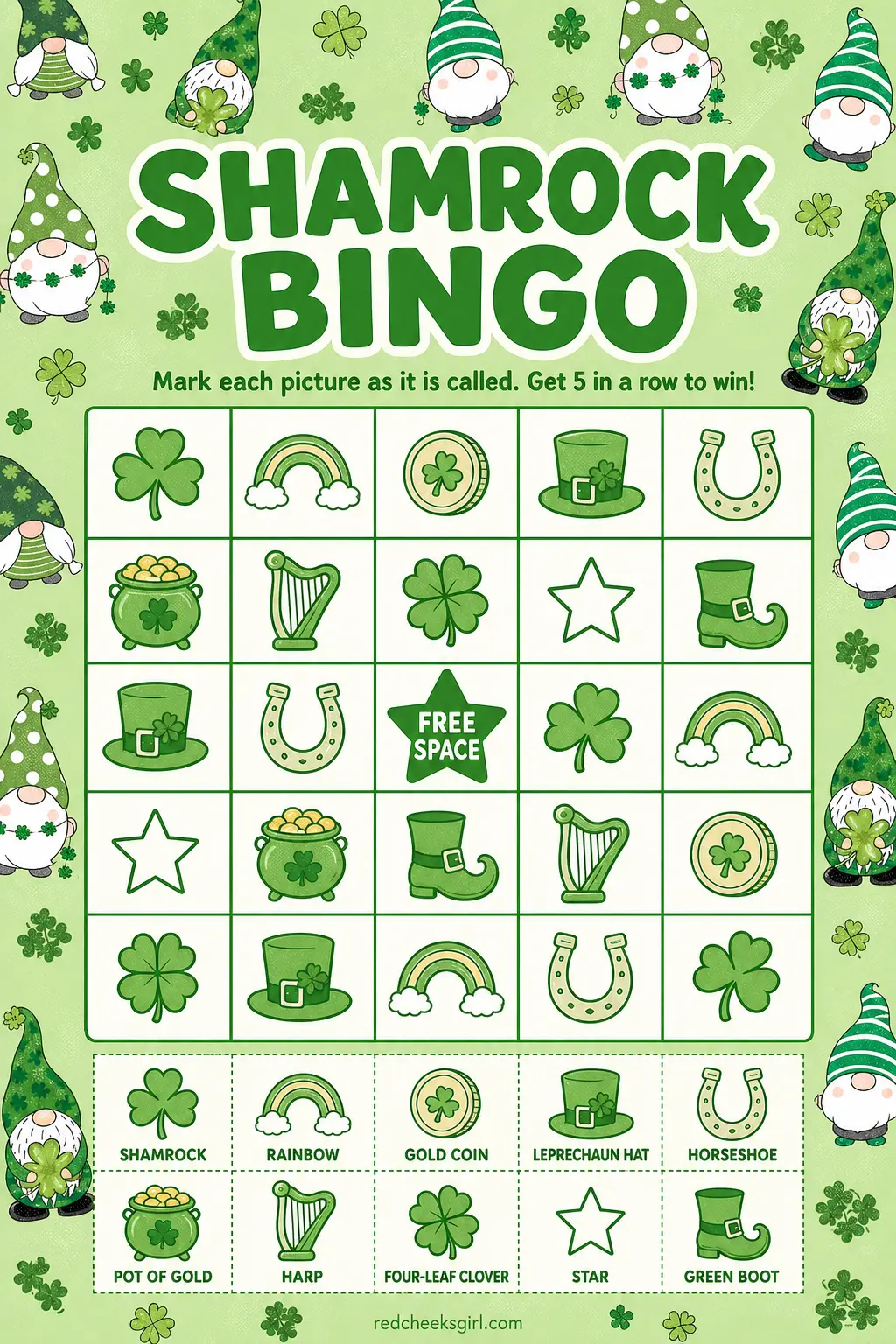
This classic party game gets a St Patrick’s Day makeover with shamrock-themed images and symbols filling the bingo grid instead of numbers. Print one unique card per child — the sheet is already designed so no two cards are identical — and give each player a small pile of markers to cover their squares. A caller (the host or a confident older child) draws picture tiles or calls out St Patrick’s Day words one at a time, and players race to cover five in a row.
All you need are the printed bingo cards, something to use as markers (dried beans, green mini pom-poms, or small pieces of torn green paper all work), and a set of caller cards which can simply be a second printed sheet cut into individual squares and drawn from a bag. The game suits any group from four to thirty players and a single round takes roughly ten minutes, making it ideal for a quick activity between other games or as a calm-down after something more active.
Print a few extra blank cards so latecomers are never left out, and laminate a set if you plan to reuse them year after year — dry-erase markers and a quick wipe make the cards good as new. Offer a small prize such as a green pencil or a coin-shaped eraser to the first three winners so more children feel the thrill of success.
🛍 Shopping guide
3. Gold Coin Hunt
Hide dozens of plastic or foil-wrapped chocolate gold coins around your party space before the children arrive, tucking them under cushions, behind plant pots, inside shoes, and anywhere else a sneaky leprechaun might stash his treasure. Give each child a small green bag or bucket and set them loose to find as many coins as they can within a five-minute time limit. When time is up, everyone counts their haul together and the coins are either kept as treats or pooled for a shared prize.
You need the coins themselves, one collecting bag per child, and a timer. Plastic reusable coins are great for classroom settings where sweets are restricted, while foil-wrapped chocolate coins double as party favours. The hunt works for two children or twenty, and the timed format naturally keeps it from turning into a frantic free-for-all. Plan for about fifteen minutes including hiding, hunting, and counting.
For mixed age groups, give younger children a head start of thirty seconds or designate certain easy hiding spots as “beginner zones” so every child finds at least a handful. Knowing every child walks away with something keeps tears firmly at bay and the leprechaun spirit alive.
🛍 Shopping guide
4. Rainbow Sorting Race
Lay out a long strip of paper or seven labelled cups in rainbow order — red, orange, yellow, green, blue, indigo, violet — at one end of the room. Fill a large bowl at the other end with a jumble of small coloured objects such as pompoms, buttons, coloured craft sticks, or small plastic beads in all seven colours. On “Go,” children take turns running to the bowl, grabbing one item, dashing back, and placing it in the correct colour spot. The team that correctly sorts all their items first wins.
The game needs your coloured objects, the sorting cups or paper strips, and a starting line. Teams of three to six work well, and a full round takes about ten minutes per heat. You can run heats back to back if you have a large group, swapping the colour mixes between rounds to keep it fresh. The activity suits ages four and up — even the youngest children can match colours confidently, which makes everyone feel capable.
Label each cup with both the colour name and a painted stripe so pre-readers can play independently without needing adult help at every turn. A host tip worth knowing: pre-sort about a third of the bowl before guests arrive so the game moves quickly enough to feel exciting rather than endless.
🛍 Shopping guide
5. St Patrick’s I Spy Sheet (printable)
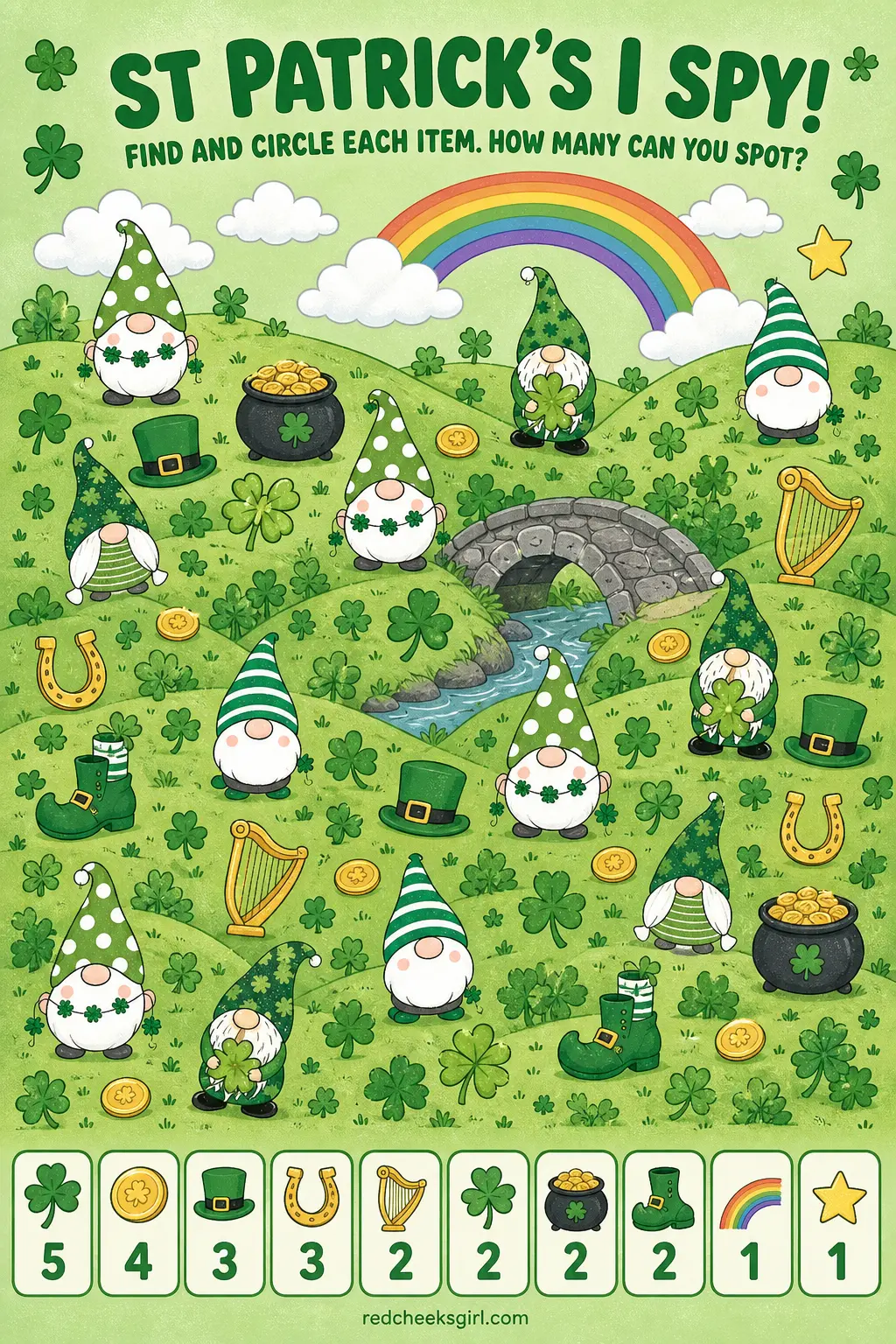
The St Patrick’s Day I Spy sheet is packed with small illustrated St Patrick’s Day icons — shamrocks, top hats, rainbows, gold coins, horseshoes, harps, and more — repeated in different quantities across a busy, colourful scene. Children count how many times each item appears and write or circle their answer in the matching box. It sharpens observation skills and number recognition at the same time, and because every child works independently on their own sheet it suits mixed ability groups brilliantly.
All you need is one printed sheet per child and a pencil or crayon. The game works for groups of any size and is completely self-contained, making it perfect for a classroom morning activity, a quiet corner at a party, or even a car journey on the way to a celebration. Children aged four to seven typically take around ten minutes; careful counters aged eight to ten may spend closer to fifteen enjoying every detail.
Encourage children to use a different colour to circle or dot each type of object as they count it — this simple strategy prevents double-counting and gives the finished sheets a cheerful, rainbow appearance that parents love to take home. Have a small sticker reward ready for children who find every hidden item correctly.
6. Pot of Gold Bean Bag Toss
Set up three to five black plastic cauldrons or dark buckets at increasing distances from a throwing line — the closest worth one gold coin, the farthest worth five. Give each player three green or gold bean bags and let them choose which pot to aim for, building in a fun risk-reward decision for even young children. After everyone has thrown, players total their coin scores and the highest total after two rounds wins a small prize.
You need the cauldrons or buckets, bean bags (or small sandbags in a pinch), and a way to mark the throwing line — a strip of masking tape works perfectly. Label each cauldron with its coin value using a sticky note. Groups of four to twelve players suit this format best, and a full game runs about fifteen to twenty minutes. Set it up indoors against a wall or outdoors on a flat surface — either way works without any assembly beyond placing the pots.
If you do not own bean bags, fill small zip-lock sandwich bags with a handful of dried lentils, press the air out, and seal them with tape — they toss cleanly and cost almost nothing. One thing experienced hosts learn quickly: place a non-slip mat under each cauldron so they don’t skitter away when hit by an enthusiastic toss.
🛍 Shopping guide
7. Leprechaun Freeze Dance
Play any upbeat, cheerful music and let the children dance freely around the room. When the music stops, every child must freeze in their best “leprechaun pose” — hands on hips, one leg up, a cheeky grin — and hold it without wobbling until the music starts again. Any child who moves during the freeze sits out for one round but rejoins automatically on the next, so no one is sidelined for long. The last child standing wins the round, and then everyone dances again immediately.
You need a music source and enough clear floor space for the children to move safely. A Bluetooth speaker and a green-themed playlist set the mood beautifully, but any device will do. The game works with as few as three children or as many as forty and naturally lasts as long as you want it to — simply keep the music going for new rounds. Budget about ten to fifteen minutes for a satisfying set of rounds that lets multiple children experience winning.
Change up the freeze pose each round to keep things hilarious — try “rainbow pose” with arms arched overhead, “gold coin pose” curled into a ball, or “shamrock pose” with three children connecting hands. Announcing the next pose before the music starts gives children something to giggle about while they dance, which doubles the fun.
8. Shamrock Matching Game (printable)
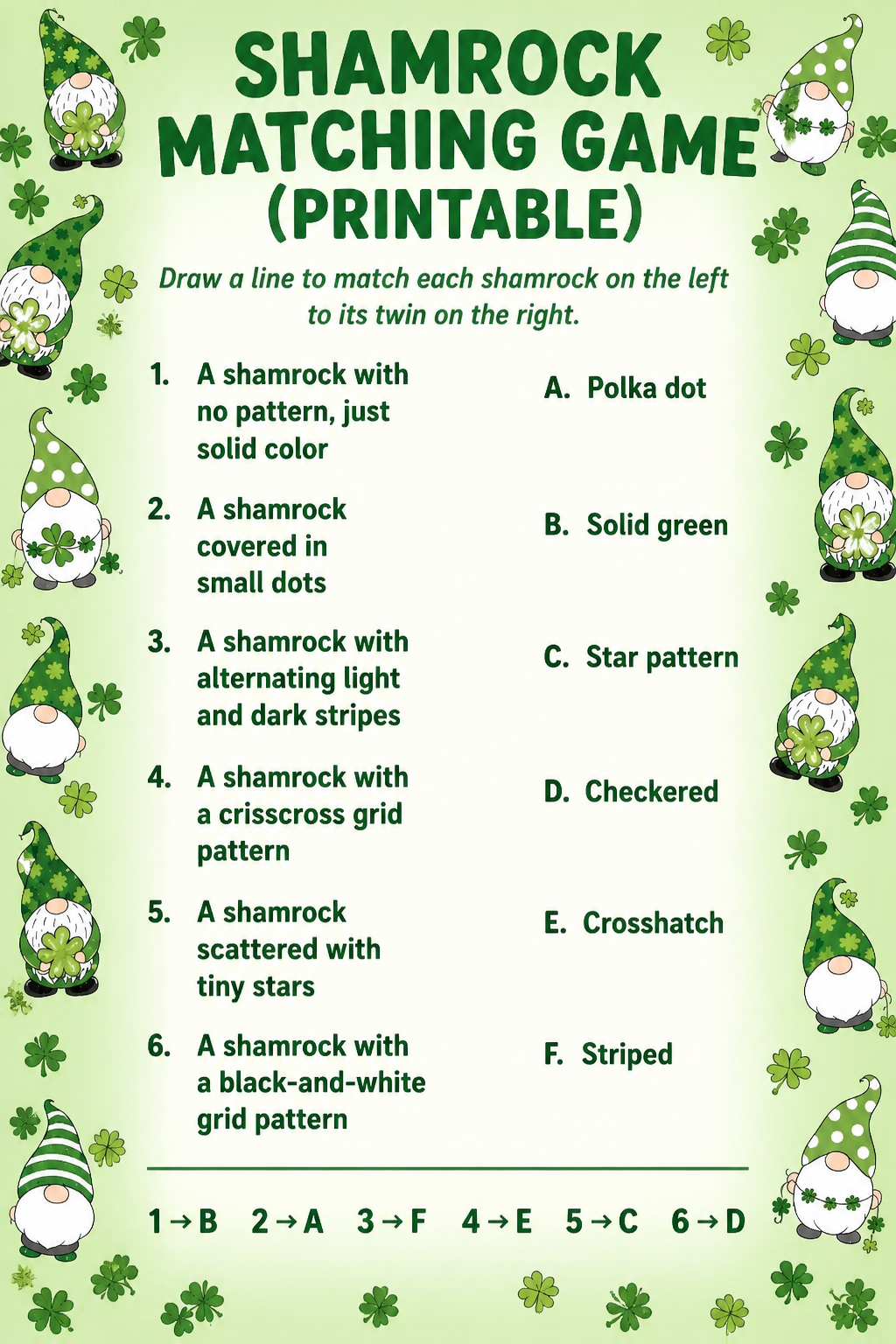
The Shamrock Matching Game sheet presents pairs of shamrocks decorated with slightly different patterns, colours, or details scattered across the page. Children draw a line to connect each shamrock to its identical twin, working through the page to find every match. It trains visual discrimination and sustained attention in a game format that feels far more fun than it does educational, and the shamrock theme keeps it firmly in holiday territory.
Print one sheet per child and provide pencils or thin markers. The activity is completely self-contained, needs no additional materials, and works for any group size. Younger children aged four to six will typically take eight to twelve minutes working through it; older children enjoy the challenge of spotting the trickier pairs with very subtle differences and may race a partner to finish first. Running it as a friendly race between pairs of children adds an energetic edge to what is otherwise a calm activity.
For extra replayability, laminate the sheets and have children use dry-erase markers — wipe clean and the game resets instantly. If you are using this in a classroom, pair a fast finisher with a child who needs support: finding the matches together builds both confidence and cooperation without any child feeling put on the spot.
9. Green Balloon Keep-Up
Inflate one green balloon per two children and challenge pairs — or the whole group — to keep their balloon in the air for as long as possible using only gentle taps, never letting it touch the floor. Start with one balloon per pair for the basic version, then increase the difficulty by introducing a second balloon per pair, or by ruling that players must alternate hands or use only one finger. Count out loud as a group each time the balloon goes up, building toward a class record that children will want to beat next year.
You need green balloons, a clear open space, and nothing else. The game works beautifully indoors in a living room or classroom with furniture pushed to the edges, and suits groups of four to twenty children. A casual keep-up session runs five to ten minutes, but if you frame it as a record-breaking challenge the children will happily play for twenty minutes without realising it. Check for latex allergies before inflating — foil balloons work as a safe alternative.
Blow balloons up slightly less than full capacity so they move more slowly through the air, giving younger children a fighting chance to reach them before they drop. Experienced hosts know that a single deflating balloon mid-game causes a sad distraction, so always have a handful of extras inflated and ready to swap in without missing a beat.
🛍 Shopping guide
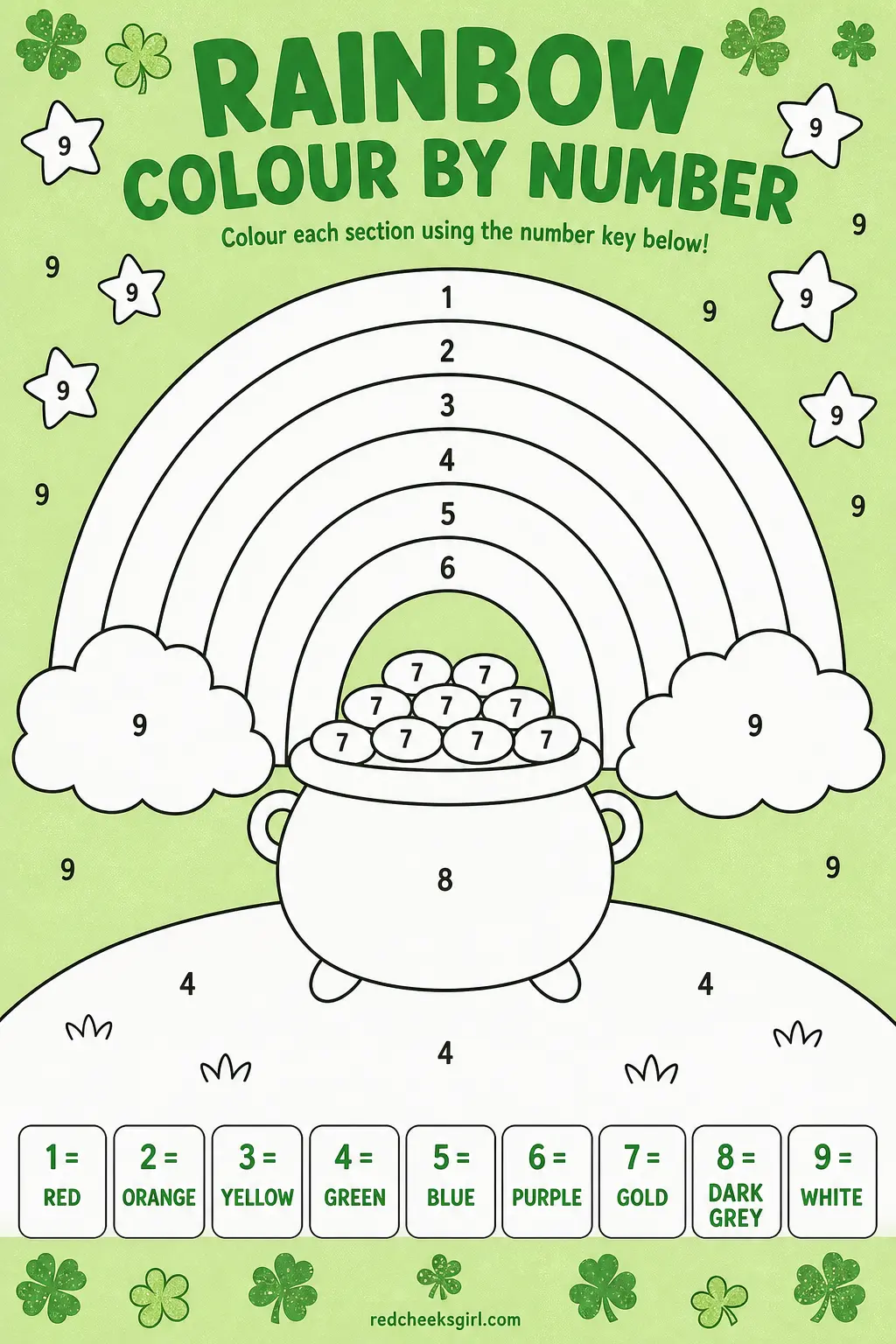
10. Rainbow Colour by Number (printable)
The Rainbow Colour by Number sheet features a detailed St Patrick’s Day scene — a sweeping rainbow, a pot of gold at its end, a rolling green hillside, and a cheeky leprechaun hat — broken into numbered sections. Each number corresponds to a specific colour listed in the key at the bottom of the page, and children colour each section accordingly to reveal the full vibrant picture. The format is wonderfully self-directing: children know exactly what to do the moment they see the numbered key, so even the youngest players can start independently.
All you need is the printed sheet and a set of coloured pencils or crayons. It suits any group size and works as a calm, focused activity at a party table, a classroom art slot, or a quiet moment at home. Most children aged five to eight take twelve to twenty minutes to complete a detailed scene, making it a reliable filler between more boisterous games or a gentle wind-down activity near the end of a party.
Set out the crayons in rainbow order so children can find the right colour quickly without rummaging, which dramatically reduces frustration for younger children and keeps the table tidy. Finished sheets make wonderful take-home keepsakes that parents genuinely appreciate — consider having children write their name on the back before they start so no two sheets get swapped.
11. Clover Hop Relay
Cut out large clover or shamrock shapes from green cardstock or craft foam and lay them in a winding path from a start line to a finish line at the other end of the room — about ten to fifteen clovers per lane works well. Children must hop from clover to clover without stepping on the floor between them, reach the end, pick up a gold coin token, and hop back to tag the next teammate. The team that collects all their coins and sits back in line first wins the relay.
You need the clover shapes (cardstock, foam sheets, or even cut-up green bin bags work), a set of coin tokens per team, and a clear path to hop along. Secure the clovers to the floor with a small loop of masking tape on the underside so they don’t skate away mid-hop. Teams of four to six work perfectly, and the full relay runs ten to fifteen minutes including two or three heats. The game is active, requires balance and coordination, and is naturally very funny to watch — expect plenty of laughter.
Vary the clover spacing for different age groups: place them closer together for younger children and stretch the gaps further apart for confident six-to-ten-year-olds who need more of a challenge. One hard-won host tip: run one practice hop per child before the timed relay starts so everyone understands the route and no one freezes at the starting line under pressure.
🛍 Shopping guide
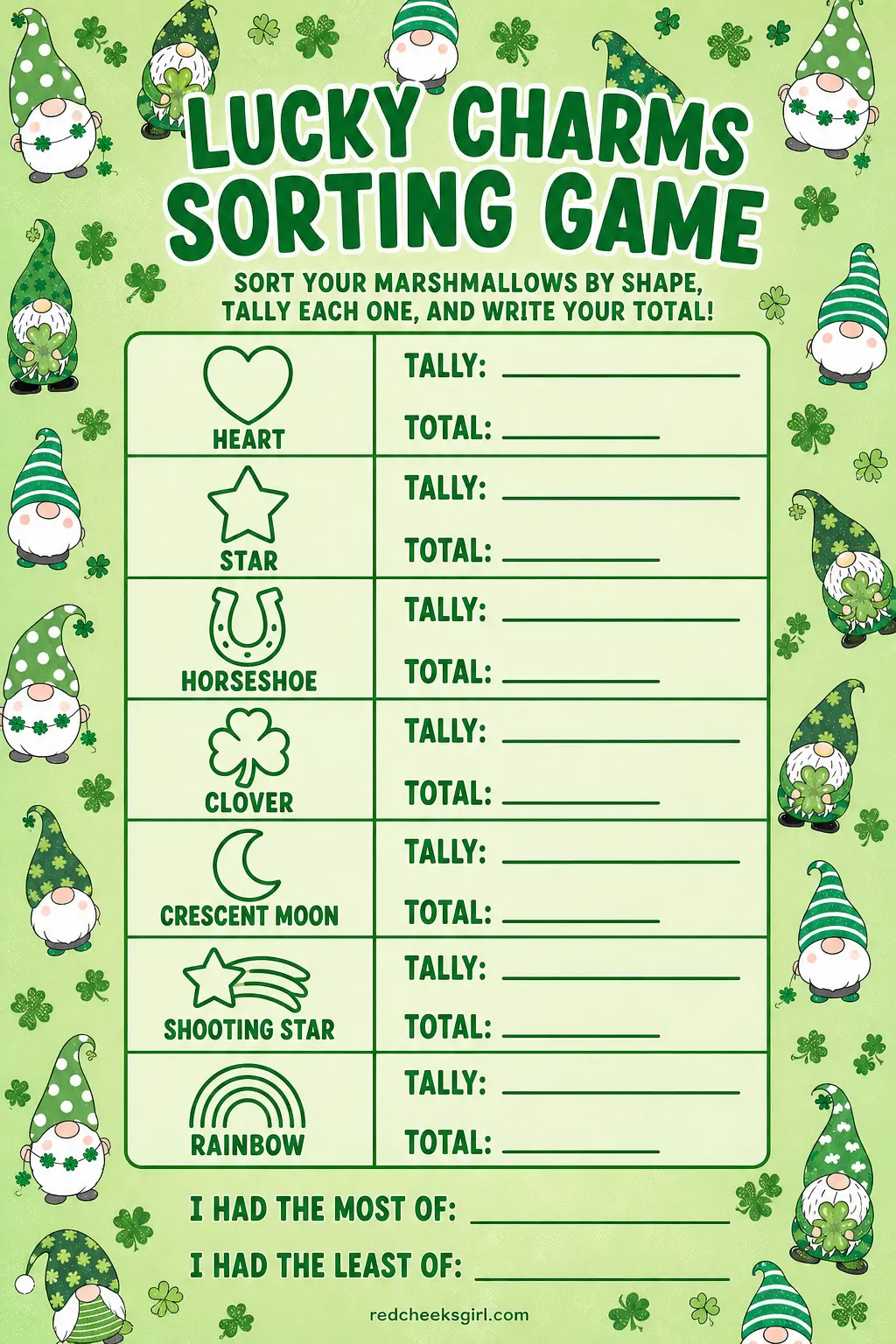
12. Lucky Charms Sorting Game (printable)
The Lucky Charms Sorting Game sheet presents a grid of St Patrick’s Day charm shapes — stars, horseshoes, clovers, moons, hearts, rainbows, and more — in mixed-up rows. Children sort and count how many of each charm appear on the page, writing their totals in the corresponding boxes at the side of the sheet. Older children can add a challenge layer by colouring each charm category a different colour before counting, which also makes the tally more visual and satisfying.
Print one sheet per child and hand out pencils and crayons. The game is entirely self-contained and suits any group from one child to a full classroom. Children aged four to six will typically take eight to ten minutes; children aged seven to ten who take on the colouring-and-counting challenge may spend fifteen to twenty minutes on a careful, complete answer. Use it as a settling activity when children first arrive at a party, or as a quiet interlude between active games.
After everyone has finished, go through the answers together as a group — call out each charm and have children hold up their sheet and shout their total, then reveal the correct number. This quick group check turns a solo worksheet into a sociable moment and gives every child a chance to feel proud of a correct answer without any individual being singled out for a wrong one.
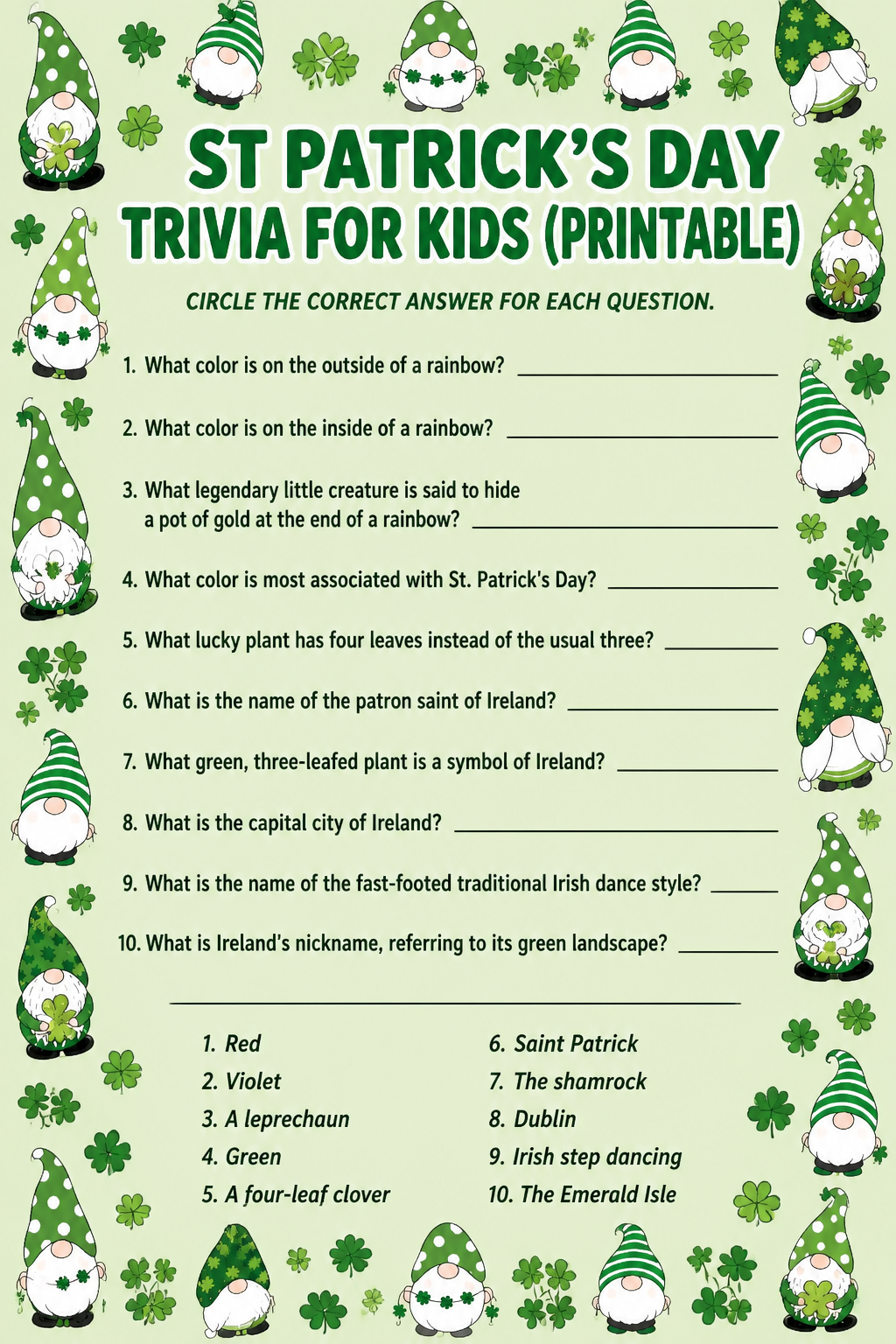
13. St Patrick’s Day Trivia for Kids (printable)
The St Patrick’s Day Trivia for Kids sheet poses a set of age-appropriate questions about the holiday — what colours appear in a rainbow, what a leprechaun is said to hide at the end of it, what country St Patrick’s Day comes from, what a shamrock is, and other friendly facts that children aged five to ten can genuinely answer after a little thought. Children circle or write their chosen answer for each question, working solo or in pairs, and then the host reads out the correct answers for a group reveal that gets everyone cheering.
You need one printed sheet per child or pair and a pencil each. The game works for groups of any size, and a typical round of twelve to fifteen questions takes about ten minutes to complete and five minutes to mark together. Running it in pairs naturally encourages discussion, teamwork, and a little friendly debating over answers — wonderful for mixed age groups where older children can support younger ones without it feeling like tutoring.
Read each question aloud as children work through the sheet so pre-readers are never left behind. After the reveal, give one point per correct answer and celebrate the top scorers with a small prize, but make sure every child receives a sticker or token for participating — the goal is confident curiosity, not competitive pressure, and children who feel good about what they learned will talk about the game long after the party ends.
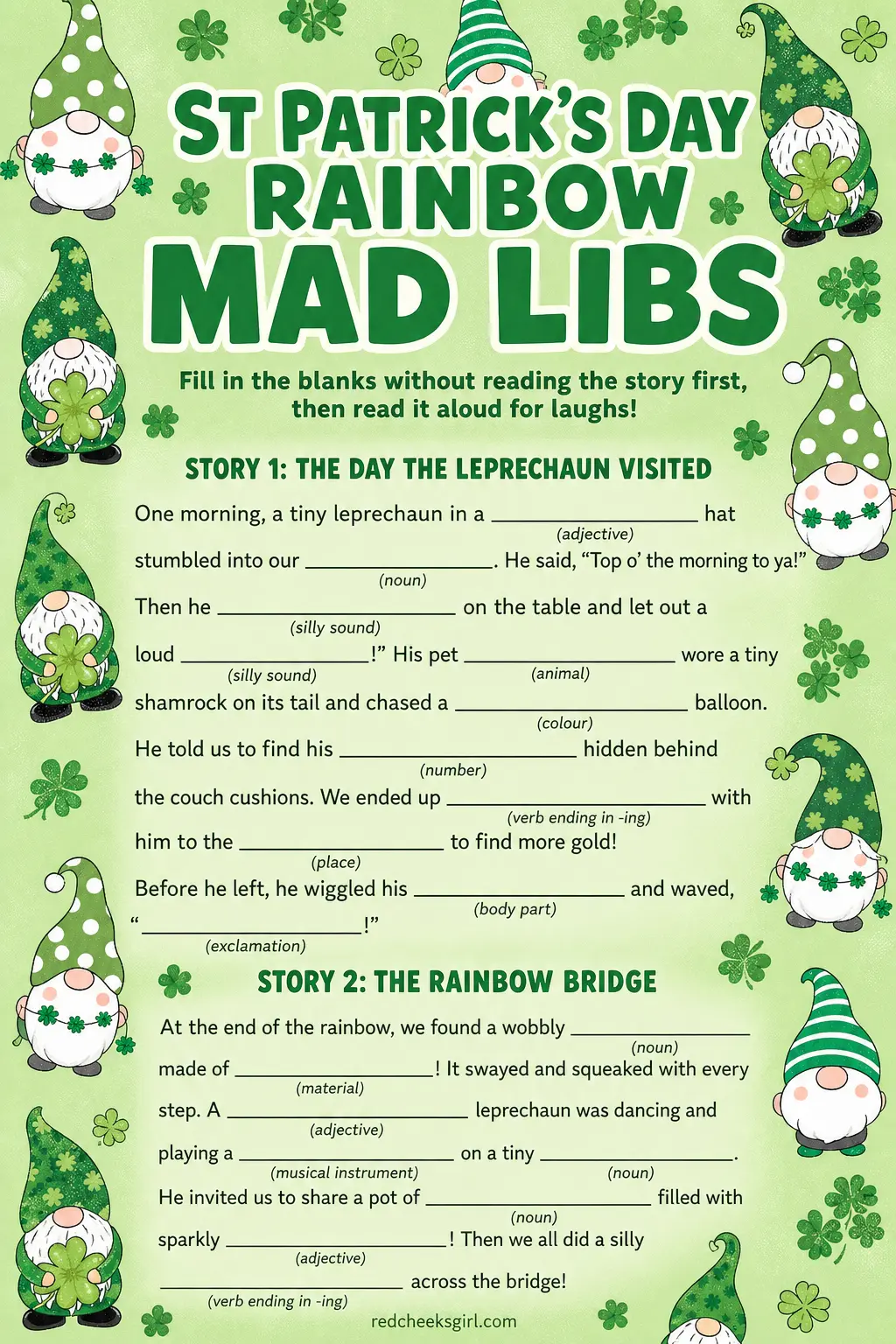
14. St Patrick’s Day Rainbow Mad Libs (printable)
The Rainbow Mad Libs sheet contains a short, funny St Patrick’s Day story with key words blanked out and labelled by type — noun, adjective, verb, colour, animal, and so on. Before reading the story, the host asks each child in turn to call out a word of the requested type without knowing the story, filling in the blanks on the master sheet. When every blank is filled, the host reads the completed story aloud and the resulting nonsense — a leprechaun riding a purple elephant over a crunchy rainbow — sends the whole group into fits of laughter.
You need one printed sheet for the host to fill in as the group calls out words, plus optionally individual sheets so children can follow along. The game works brilliantly for groups of four to twenty and takes just five to eight minutes per round — fast enough to run two or three rounds back to back with the children begging for more each time. It doubles as a sneaky grammar lesson, since children naturally learn what a noun or adjective means when they have to produce one on demand.
Keep a list of prompts ready for children who get stuck when asked for a word: “tell me an animal,” “give me something you find in the kitchen,” or “what’s your favourite silly sound?” unblocks even the most hesitant child instantly. Running a second round where children whisper their words to you rather than announcing them creates extra suspense when the story is finally read aloud.
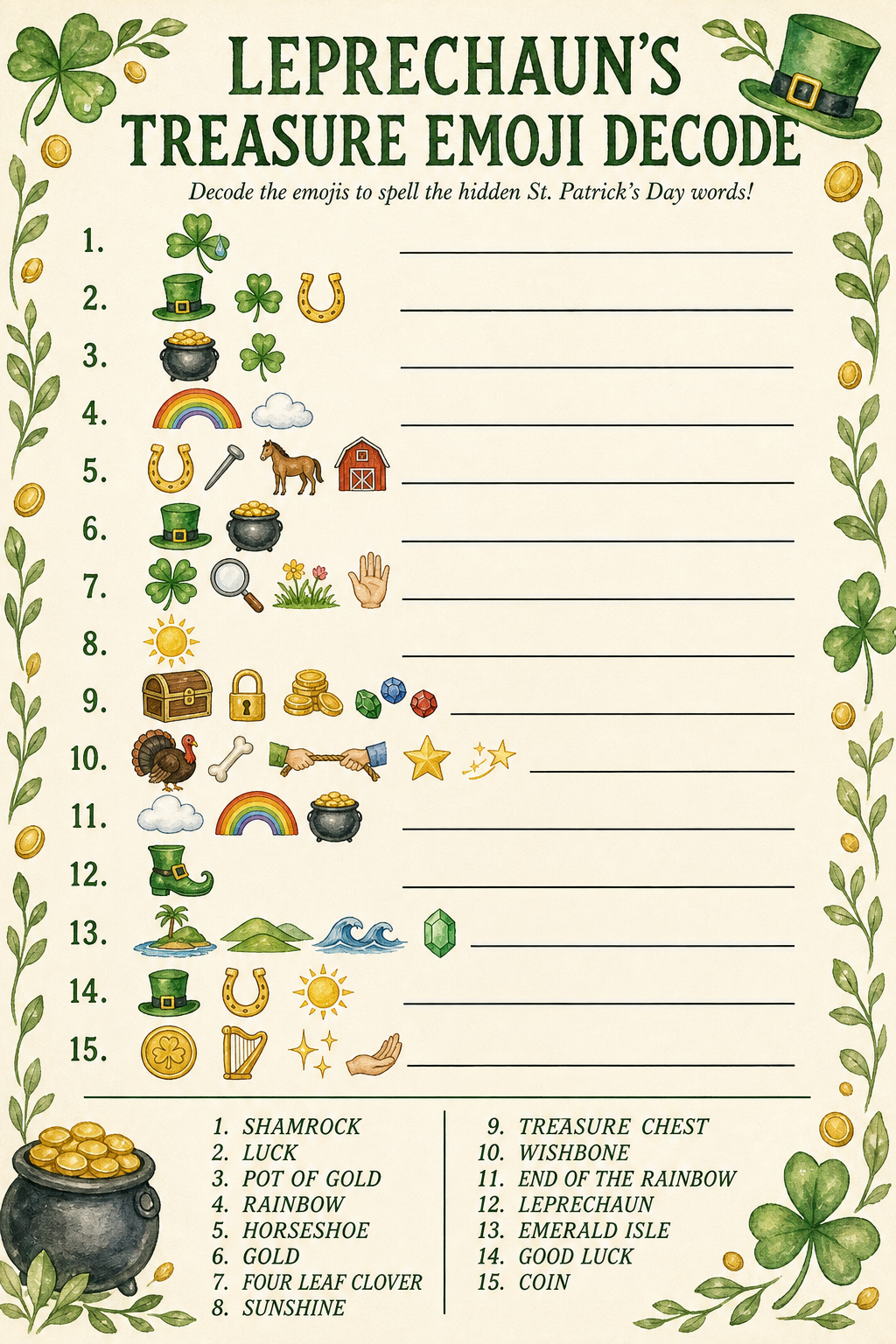
15. Leprechaun’s Treasure Emoji Decode (printable)
The Leprechaun’s Treasure Emoji Decode sheet presents a series of St Patrick’s Day-themed visual clues — illustrated icons of rainbows, coins, clovers, hats, and other holiday images — arranged in short sequences beside numbered answer lines. Each sequence of pictures represents a single St Patrick’s Day word or short phrase, and children write their answer on the line provided. An answer key on the reverse lets children self-check once they have worked through the whole sheet.
Print one sheet per child and provide pencils. The activity is self-contained and suits any group size, working equally well as an independent quiet activity or a paired guessing game where two children debate the answer together before writing it down. Children aged six to ten engage most enthusiastically; younger children enjoy it as a partner activity with an adult helping them sound out possibilities. A full sheet typically takes ten to fifteen minutes to complete.
Before handing out the sheets, spend sixty seconds walking through one example clue together as a group so every child understands the format — this single step prevents the frustrated “I don’t get it” that can derail the activity before it starts. Children who finish early can try to invent their own emoji-style clue on the back of the sheet, which keeps them happily occupied while the group catches up.
16. Shamrock Ring Toss
Stand several green glass bottles or plastic bottles in a cluster and give each child three green glow rings or simple plastic rings to toss from behind a marked line. Each bottle is worth a different number of gold coin points — the smallest or farthest bottle scores the most — and children keep a running tally over three rounds. The player with the highest total at the end wins a gold coin prize, but younger children can simply enjoy the tossing without needing to track scores at all.
You need a set of plastic toss rings (or make your own from cardstock cut into sturdy circles), five or six bottles, and a throwing line. Fill the bottles partway with water or sand so they don’t topple in a breeze if you’re playing outdoors. The game suits two to sixteen players and a full scored round for eight children takes roughly fifteen minutes. Set it up on a table or the floor — both work well in a classroom or living room.
Paint or wrap the bottles with green paper and shamrock stickers the day before to make the setup look festive with almost no effort. An important host tip: place a small strip of coloured tape around the neck of the highest-scoring bottle so children can spot the prize target at a glance rather than having to memorise point values, which keeps the game moving smoothly without repeated questions.
🛍 Shopping guide
17. Leprechaun Says
This is the St Patrick’s Day version of the classic “Simon Says” instruction game, with the host playing the role of the tricky leprechaun. Call out actions — “Leprechaun says stomp your feet like a giant,” “Leprechaun says wiggle your ears,” “hop on one leg!” — and children must only follow commands that begin with “Leprechaun says.” Anyone who moves on a command that doesn’t include the magic phrase sits on their lucky shamrock (a small green square of paper on the floor in front of them) for one turn before rejoining. The last child standing wins the round.
The game needs nothing at all beyond a clear space and an enthusiastic host. It works for groups of four to forty and can run as long or as short as you like — typically three rounds take about ten minutes and leave children pleasantly breathless. Make the commands holiday-specific for maximum fun: “Leprechaun says jump over a rainbow,” “Leprechaun says sneak past the pot of gold,” or “Leprechaun says count to four in a silly voice” keep the theme alive and the laughter constant.
Deliver the trick commands — those without “Leprechaun says” — at exactly the same pace and tone as the real ones, giving children no audio cue that a trick is coming. Speed up the commands gradually as the round goes on: starting slow lets younger children build confidence, and the increasing pace creates genuine excitement as the group shrinks. Children who are sitting out love being appointed as judges watching for sneaky movers, which keeps them engaged rather than bored.
18. Pass the Pot of Gold
Children sit in a circle and pass a small black cauldron or dark-coloured pot filled with folded paper slips around the circle while music plays. When the music stops, the child holding the pot reaches in, draws a slip, and performs the silly St Patrick’s Day challenge written on it — leap like a frog five times, say “top of the morning” in five different accents, do your best jig for ten seconds, or roar like a dragon guarding its gold. After completing the challenge, that child places the slip aside and the music starts again.
You need the cauldron or a dark pot, a music source, and a set of pre-written challenge slips. Write at least twenty slips so the game never runs out of new tasks, and tailor the challenge difficulty so the silliest ones are genuinely doable for a four-year-old. Groups of five to twenty work perfectly, and the game runs as long as you have slips — roughly twenty minutes for a group of twelve. Every child completes a challenge rather than being eliminated, so no one ever feels left out or nervous about taking a turn.
Write the challenges in green marker on gold-coloured card cut into coin shapes — it takes fifteen minutes the evening before and makes the whole activity feel more magical when children draw a “gold coin” from the pot. An essential host tip: always include one group challenge slip, such as “everyone in the circle does the chicken dance together,” which resets the energy and gets even the shyest children moving without any individual spotlight pressure.
🛍 Shopping guide
Frequently Asked Questions
What age group are these St Patrick’s Day games designed for?
Every game on this list is designed with children aged four to ten in mind. Active games like Clover Hop Relay and Leprechaun Freeze Dance work beautifully for the younger end of that range, while printable activities like the Trivia sheet and the Matching Game have enough detail to genuinely challenge eight-to-ten-year-olds. For mixed age groups, most games include a tip on how to adjust the difficulty so older and younger children can play happily side by side.
How many of the games are printable?
Eight of the eighteen games come with a dedicated printable sheet: Shamrock Bingo, St Patrick’s I Spy, Shamrock Matching Game, Rainbow Colour by Number, Lucky Charms Sorting Game, St Patrick’s Day Trivia for Kids, St Patrick’s Day Rainbow Mad Libs, and Leprechaun’s Treasure Emoji Decode. That means printables make up nearly half the list, giving you plenty of calm, seated activities to balance out the more energetic games.
Can I run these games in a classroom without making a mess?
Absolutely. Every game on the list was chosen with low mess in mind. The craft element of the Leprechaun Trap Challenge is the most involved, but even that only requires pre-sorted craft supplies on a protected table. Printable games need only pencils and crayons, the Gold Coin Hunt uses plastic or foil coins that are easy to collect, and games like Leprechaun Says and Shamrock Ring Toss need nothing that could spill or stain. With a quick tidy between activities, the whole party can run in a standard classroom without any specialist cleaning.
How long should I plan for each game?
Most individual games run between ten and twenty minutes, so a two-hour party can comfortably fit six to eight games with transition time between them. Printable activities like the Colour by Number or I Spy sheet tend to run ten to fifteen minutes and make excellent fillers between more active games. Active games like the Relay and Freeze Dance are easy to extend or cut short by simply starting a new round or stopping the music — you’re always in control of the timing.
Do I need to buy lots of supplies?
Most games need very little. A bag of plastic gold coins, a few green balloons, some bean bags, and a printer for the eight printable sheets will cover the majority of the list. Several games — Leprechaun Says, Pass the Pot of Gold, and Leprechaun Freeze Dance — need nothing you wouldn’t already have at home. Where specific supplies do help, you’ll find shopping suggestions beneath the relevant game entries so you can pick up exactly what you need without guesswork.
📌 Save These for Later
Loved these? Pin your favorite image below so you can find this list again when you’re planning.




Nobody told you there were rules against it, but somewhere along the way someone decided that baby s
Someone in my neighborhood threw a sea-themed baby shower last summer and the photos have been livin
Someone close to you is having a baby in the middle of the best season of the year. Warm evenings, f
Leave a Reply