


A great Fourth of July party lives or dies by what happens between the food and the fireworks. You need games that work in the heat, survive a crowd that ranges from restless six-year-olds to competitive uncles, and require nothing more exotic than what you can grab at a dollar store or print at home the night before. That sweet spot — easy to explain, impossible not to laugh at — is exactly what this list is built around.
Below you’ll find 20 Fourth of July party games covering every format a backyard block party demands: water games to cool everyone down, relay races that get genuinely chaotic, printable rounds you can run under the shade tent, and eating contests that always draw a crowd. Dip in anywhere, mix and match, and don’t be surprised if the sack race is still going long after the hot dogs are gone.
This post contains affiliate links — if you buy through them, I may earn a small commission at no extra cost to you.
Table of Contents
- Water Balloon Toss
- Sack Race
- Red White and Blue Relay
- Patriotic Trivia Rounds
- Watermelon Eating Contest
- Flag Ring Toss
- Fourth of July Bingo
- Three-Legged Race
- Sparkler Photo Challenge
- Corn Hole Tournament
- Backyard Scavenger Hunt 4th of July Edition
- Firework Emoji Decode
- Patriotic Would You Rather
- July 4th This or That
- Patriotic Name That Tune
- Patriotic Mad Libs
- Freeze Dance Fireworks
- Lawn Bowling Stars and Stripes
- Stars and Stripes Tug of War
- Bucket Brigade Water Race
1. Water Balloon Toss
Fill a bucket with water balloons before guests arrive — budget about three per pair of players. Line everyone up in two facing rows, partners across from each other about three feet apart. On “go,” each pair tosses their balloon back and forth. After every successful catch, both partners take one giant step backward, stretching the gap. The last pair to still have an intact balloon wins. The game moves fast and produces a satisfying chain of splashes that doubles as crowd entertainment.
All you need are pre-filled water balloons, a bucket, and a flat section of grass. It plays well with as few as six people and scales comfortably to thirty or more. Budget around fifteen minutes including the fill-up time. Make sure pairs are evenly matched in arm strength — mixing a seven-year-old with a teenager rarely ends in a fair contest, so do a quick age-sort when you form teams.
Host tip: Fill balloons the evening before and store them in a cooler with a little ice. They stay cool all afternoon and feel genuinely refreshing on contact, which players appreciate far more than room-temperature water by mid-July.
🛍 Shopping guide
2. Sack Race
Mark a start line and a finish line about twenty-five feet apart on the grass. Each player steps into a burlap sack, grips the top with both hands, and at the signal hops as fast as possible toward the finish. First one across wins their heat. Run heats by age group so younger kids aren’t launched into the turf by a sprinting adult, then hold a grand-final heat with the heat winners for maximum drama.
Burlap sacks are the only real investment, and a pack of six costs very little online. The race works for four players or forty — just add heats. Each heat takes about ninety seconds, so the whole tournament wraps in under twenty minutes. Set up on a level stretch of grass and check quickly for sprinkler heads or any debris that could trip a hopper mid-stride.
Host tip: Spray the inside of each sack lightly with water before the race. It keeps the sack clinging to legs rather than flopping open, and hopping is noticeably more controlled — which perversely makes the falls funnier and the victories more legitimate.
🛍 Shopping guide
3. Red White and Blue Relay
Divide guests into teams of four to six and mark a relay course between two cones or lawn chairs about thirty feet apart. Each leg of the relay assigns a task with a patriotic twist: the first runner carries a red plastic cup balanced on their head; the second dribbles a white ping-pong ball with their nose across the grass; the third walks with a blue balloon pinched between their knees; and the fourth sprints normally but must shout the year the Declaration of Independence was signed as they cross the finish line. Any dropped item sends that runner back to the cone to start their leg over.
You need plastic cups, ping-pong balls, and blue balloons — all dollar-store staples. The relay suits groups of twelve and up, and a full round with three or four teams takes about twenty minutes. Have a few extra balloons on standby because they will pop.
Host tip: Run a quick demo of each leg before the race starts. Players who watch the nose-dribble demonstrated by the host — especially when the host fails the first try — are already laughing before the starting whistle, and a laughing crowd is a generous crowd.
4. Patriotic Trivia Rounds
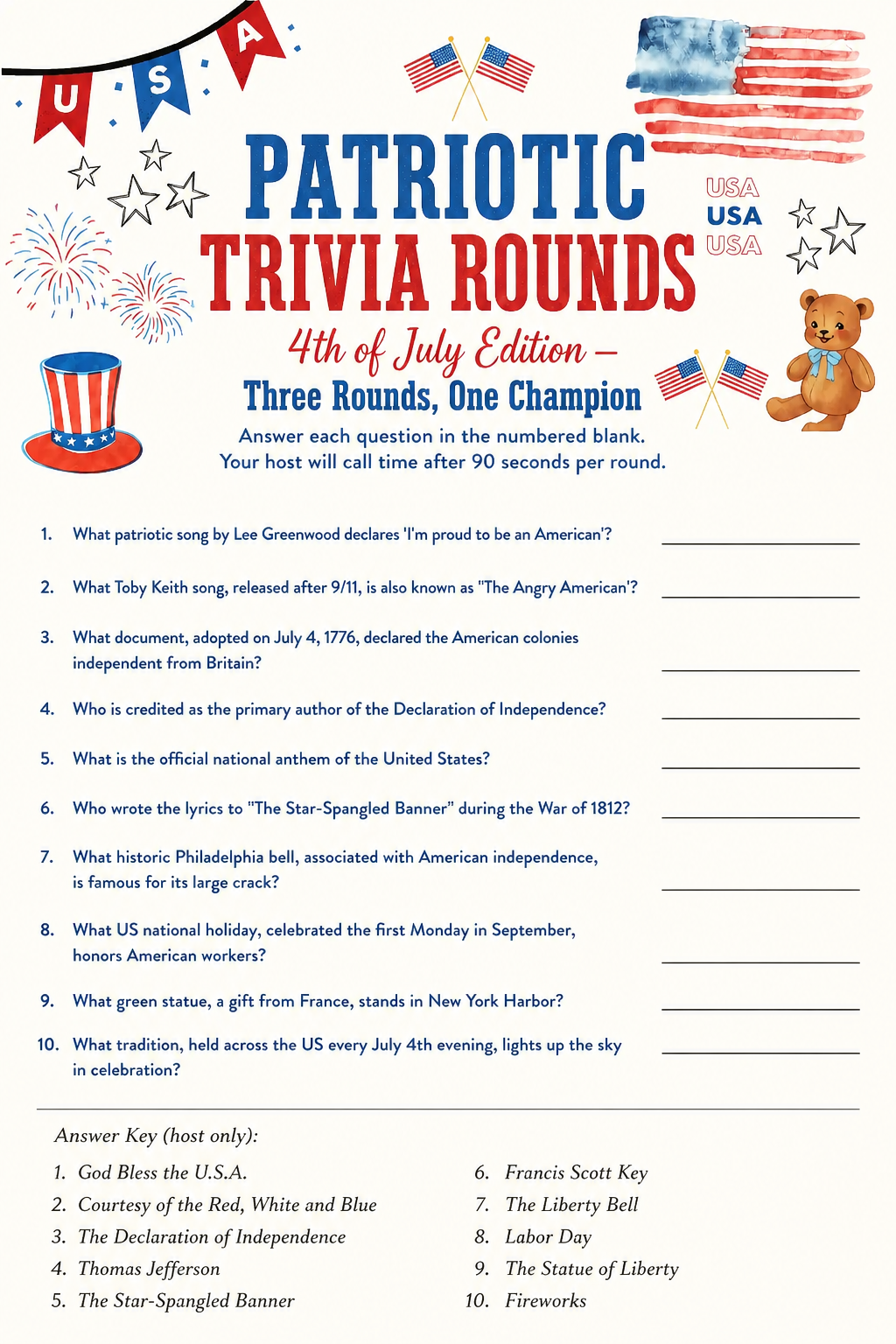
Print out the Patriotic Trivia Rounds sheet, which organizes questions into four themed rounds: American History, Fourth of July Traditions, U.S. Geography, and Pop Culture Americana. Divide guests into teams of three to five and hand each team a blank answer sheet or a scrap of paper. The host reads each question aloud, teams huddle and write their answer, and sheets are swapped between teams for grading at the end of every round. Tally points on a visible scoreboard — a whiteboard or even a paper plate on a stake works fine.
No supplies beyond the printed sheets and pens are required. The game handles any group size comfortably because teams self-organize and larger teams simply discuss answers together. Plan for thirty to forty-five minutes for all four rounds, or run just two rounds as a quick warm-up before dinner. A small prize for the winning team — a bag of sparklers, a patriotic koozie — goes a long way.
Host tip: Read each question twice and pause a full ten seconds before moving on. Groups that feel rushed make careless guesses and feel cheated; groups that have a moment to think get invested in the outcome, argue delightfully with each other, and remember the game fondly afterward.
5. Watermelon Eating Contest
Cut a large seedless watermelon into equal wedges — one per contestant, roughly one-eighth of the melon each. Contestants sit or stand at a table with their hands clasped behind their backs and race to eat as much of the wedge as possible in ninety seconds using only their mouths. The player who has eaten the most watermelon (judged by the size of the remaining rind) when time is called wins. Bonus points in crowd appeal: watermelon juice everywhere is practically a special effect.
All you need is a watermelon, a knife, a table, and a timer. Works perfectly with three to twelve contestants at once; run heats if demand is high. The whole event including setup takes about fifteen minutes. Lay a disposable tablecloth or a sheet of plastic sheeting under the table — watermelon cleanup on raw wood or a nice patio is miserable.
Host tip: Chill the watermelon thoroughly beforehand. Cold watermelon on a hot July afternoon is so refreshing that even contestants who lose leave happy, and the crowd watching has an easier time keeping track of progress against the bright pink flesh.
6. Flag Ring Toss
Set up five small American flags in the ground in a row, spaced about six inches apart. Assign point values — one point for the flag nearest the toss line, up to five points for the farthest. Each player gets five rings per turn and tosses from a marked line about eight feet back. Rings that land cleanly around the flag stake count; rings touching the ground outside the stake do not. Play to twenty-one points, or run a bracket tournament for larger groups.
Plastic ring toss rings and small flag stakes are inexpensive and pack flat for storage. The game works for two players or as a tournament for twenty. Each individual turn takes under two minutes, making it an ideal filler game guests can wander in and out of all afternoon. Drive the flag stakes at least four inches into soft grass so they don’t tip under a near-miss ring.
Host tip: Raise the stakes by designating one flag “the Liberty Flag,” worth ten points but penalizing five if you miss it entirely. Guests who would never play a standard ring toss will queue up happily for the gambling element, and the groans when someone misses the Liberty Flag are worth the extra rule explanation.
🛍 Shopping guide
7. Fourth of July Bingo
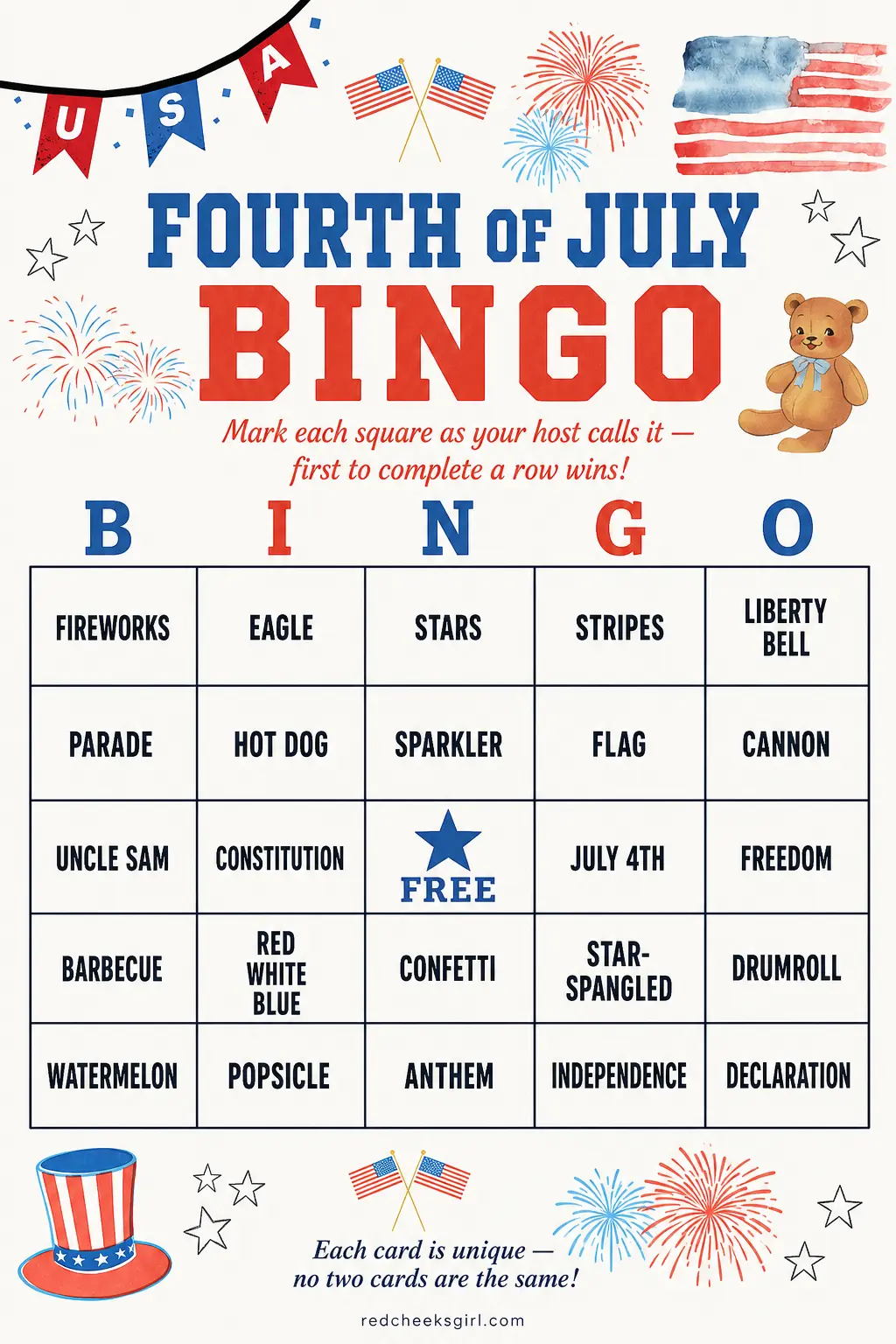
The Fourth of July Bingo printable sheet gives each player a unique five-by-five grid filled with Independence Day images and words — fireworks, hot dogs, eagles, sparklers, stars, and more. The host draws calls from a corresponding call list (included on the master sheet) and announces each one aloud. Players mark off matching squares with a penny, a candy piece, or a marker. First player to complete a row, column, or diagonal shouts “Bingo!” and wins that round.
Print one sheet per player plus the host’s call-list page. Provide small bingo markers — pennies, candy corn, or even torn scraps of paper work. The game scales from five players to fifty without any adjustment. A full game runs ten to fifteen minutes, and running three rounds back-to-back with different win conditions (single line, blackout, four corners) fills a comfortable thirty-minute stretch during dinner.
Host tip: Use individually wrapped candies as bingo markers and tell players at the start that they may eat their markers only after the round ends. It sounds chaotic in theory, but in practice it gives every round a satisfying, slightly frantic finish as players race to confirm their Bingo before snacking.
8. Three-Legged Race
Pair players up and use a soft scarf, bandana, or bungee cord to tie adjacent ankles together — right ankle of the left partner to left ankle of the right. Pairs race from the start line to the finish line, roughly twenty-five feet away, working out their stride together on the fly. First pair to cross wins. The key is that tied ankles don’t help unless partners communicate, which is where the comedy comes from.
All you need are bandanas or fabric strips and a measured course. Pair guests thoughtfully by height and leg length — a six-footer tied to a four-foot child produces a dragging crawl, not a race. Runs beautifully in heats of four to six pairs, with finals for eight to twenty players total. Each heat takes about a minute, so the whole tournament fits inside fifteen minutes.
Host tip: Brief partners for thirty seconds before the race and encourage them to pick a verbal count — “one-two, one-two” — to sync their steps. Pairs that practice even a few steps together beat pairs that don’t almost every time, which rewards communication over raw speed and makes it genuinely skill-based.
9. Sparkler Photo Challenge
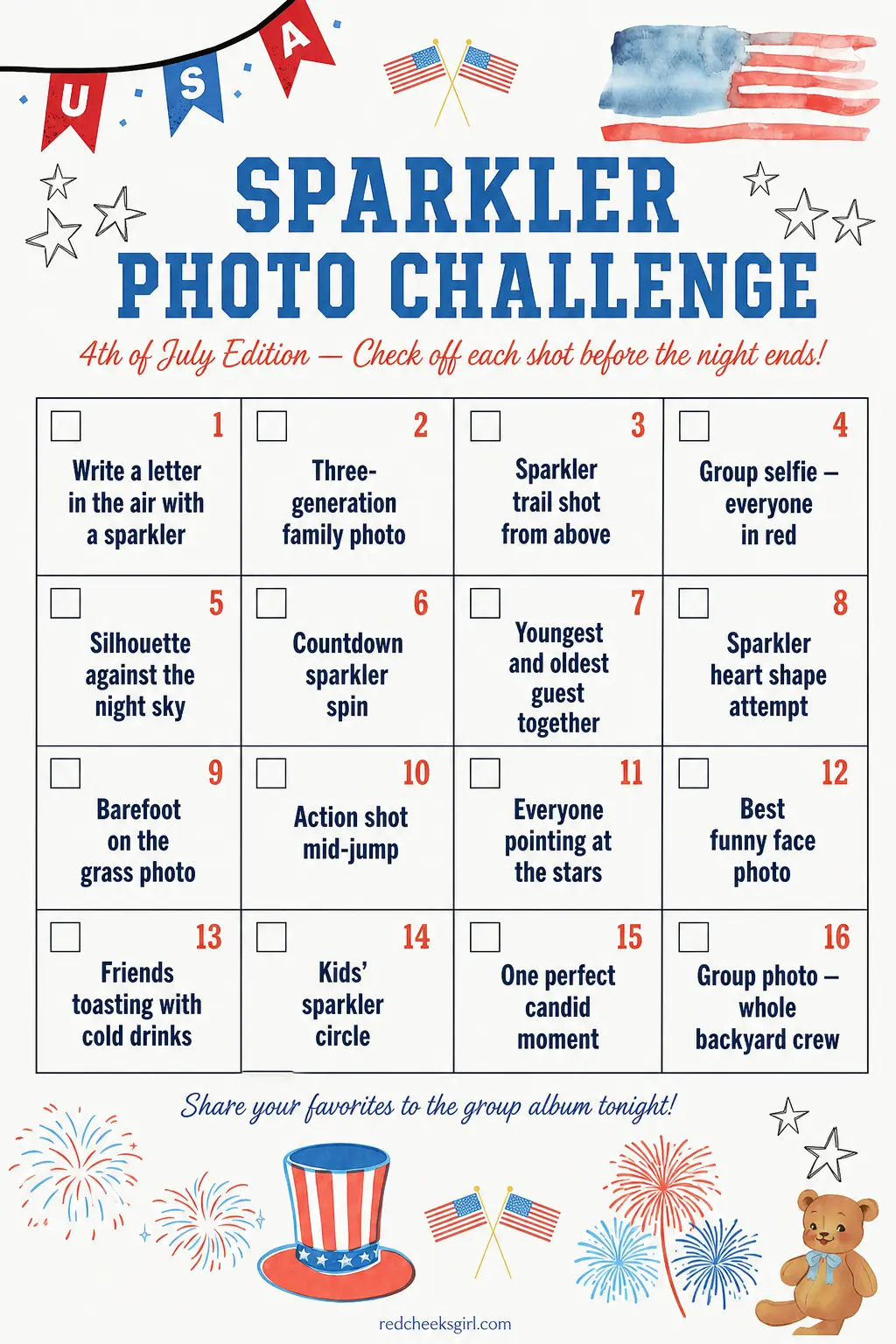
The Sparkler Photo Challenge printable sheet lists twenty creative photo prompts guests must capture during the party — things like “a photo showing three generations laughing together,” “the most patriotic outfit detail,” and “a sparkler light-trail shot after dark.” Guests use their own phones and have until a set deadline (usually right before fireworks) to collect as many photos as possible. At the deadline, teams submit their phones to a judge panel who awards one point per completed prompt.
Print one sheet per team of two to four players. No other materials are needed beyond the phones guests already have. The challenge runs as a background game throughout the entire party, roughly two to three hours, so it doesn’t interrupt other activities. Announce the top team’s total and share a few of the best photos on a connected TV or projector at the end of the night — instant party highlight reel.
Host tip: Add one “mystery prompt” revealed only thirty minutes before the deadline so every team has an equal shot at it regardless of when they started. It creates a late-party surge of energy just as the evening winds down, which is exactly when host energy typically starts to flag.
10. Corn Hole Tournament
Set up two cornhole boards facing each other at the regulation distance of twenty-seven feet (or pull them closer to twenty feet for younger players). Teams of two alternate throws — four bags per person per round. A bag through the hole scores three points; a bag on the board scores one. Games go to twenty-one, and you must win by exactly two points. Run a double-elimination bracket for true tournament drama that can stretch happily across the whole afternoon.
A standard cornhole set includes two boards and eight bags. The tournament structure accommodates four to sixteen teams elegantly. Individual games run fifteen to twenty minutes each, and a full six-team bracket takes around ninety minutes. Assign a scorekeeper per board and post the bracket where everyone can follow it — a whiteboard leaned against the fence works perfectly.
Host tip: Angle the boards slightly toward the shadiest part of the yard in the early afternoon, then rotate them as the shade shifts. Players who are squinting into the sun throw significantly worse, and matching sun exposure between teams keeps competition fair and tempers cool.
🛍 Shopping guide
11. Backyard Scavenger Hunt 4th of July Edition
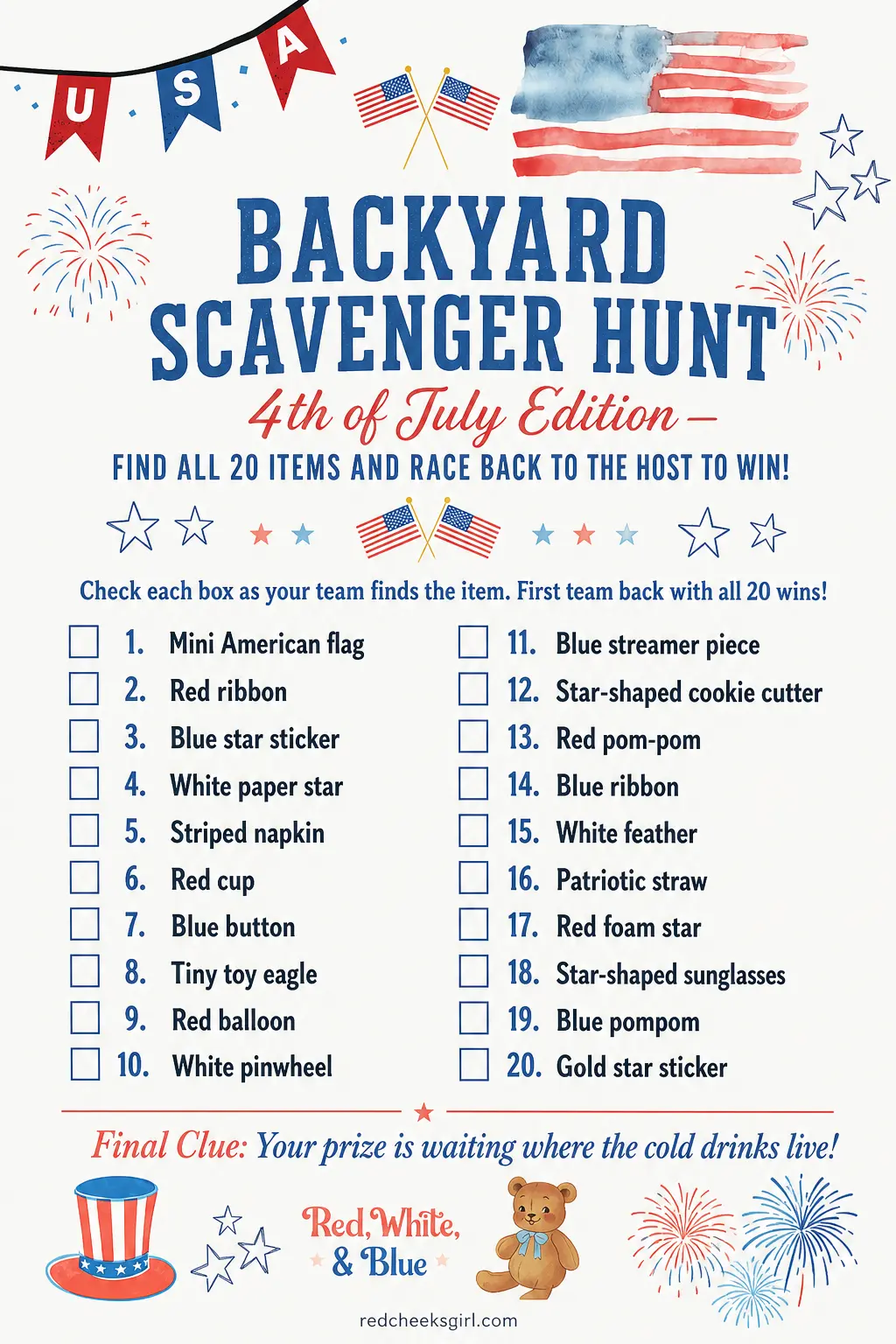
The printable sheet lists twenty-five items and clues hidden around the yard ahead of the party — a folded star made of red paper tucked under a flowerpot, a small flag taped inside the cooler lid, a trivia question written on the back of a paper plate hanging from a tree. Teams of two to four race to find every item and return to the start with their completed checklist and all collected objects. First team to return with a complete set wins.
Print one checklist per team. The host needs to plant all items in the thirty minutes before guests arrive — a task that doubles as a nice, purposeful pre-party ritual. The hunt works best for groups of ten to thirty spread across a large backyard. Budget forty-five minutes to an hour for teams to complete the course. Use bright-colored tape or ribbon on each hidden item so nothing gets accidentally thrown away by a helpful tidying guest.
Host tip: Give each hidden item a code number that matches the checklist rather than writing out the item name in full. It slows down “peeking” — a team that finds item seven without having solved clue six can’t exploit the find because they don’t know what they’re holding yet.
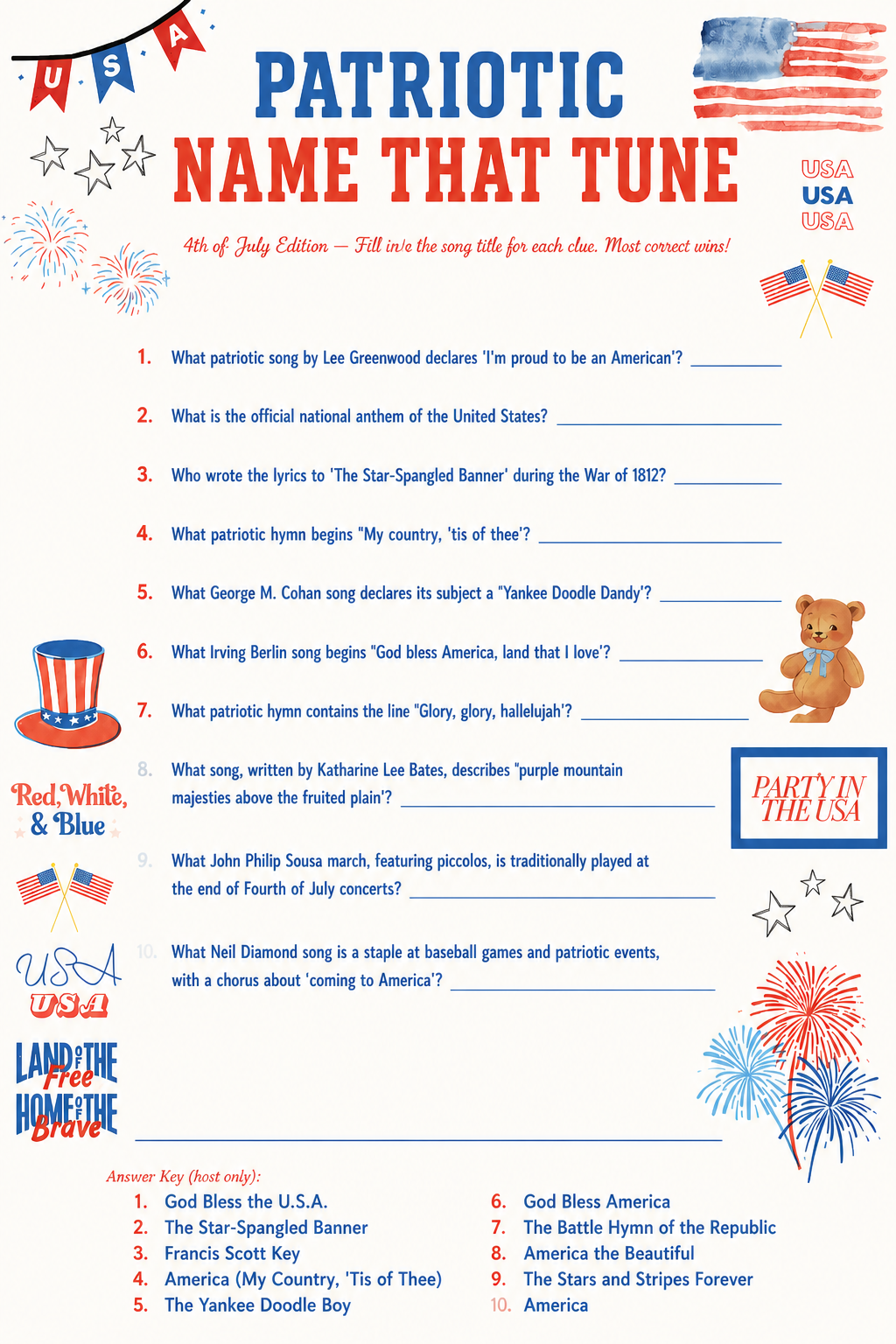
12. Firework Emoji Decode
The Firework Emoji Decode printable sheet presents a series of sequences in which each set of emojis represents a Fourth of July-related word, phrase, sound, or feeling — “BOOM,” “sparkle,” “red white and blue,” and similar concepts rendered through visual symbol chains. Players work individually or in pairs to decode as many as possible in a set time limit of ten minutes. The completed sheet with the most correct answers wins. An answer key is printed on the reverse of the host’s copy for quick grading.
Print one sheet per player or per pair. No other supplies are needed. The game suits any group size from four to forty and fits naturally into a shade-tent break or a post-lunch lull when no one wants to run around. Ten minutes of play plus a quick grading session makes this a fifteen-minute activity that lands perfectly between relay races. Award a small patriotic prize — a flag bandana, a packet of pop rocks — to the winner.
Host tip: Run it as a silent individual challenge rather than a team activity. The quiet focus feels refreshingly different from the shouting chaos of outdoor races, and guests who are less physically competitive often shine here, which is good for whole-party morale.
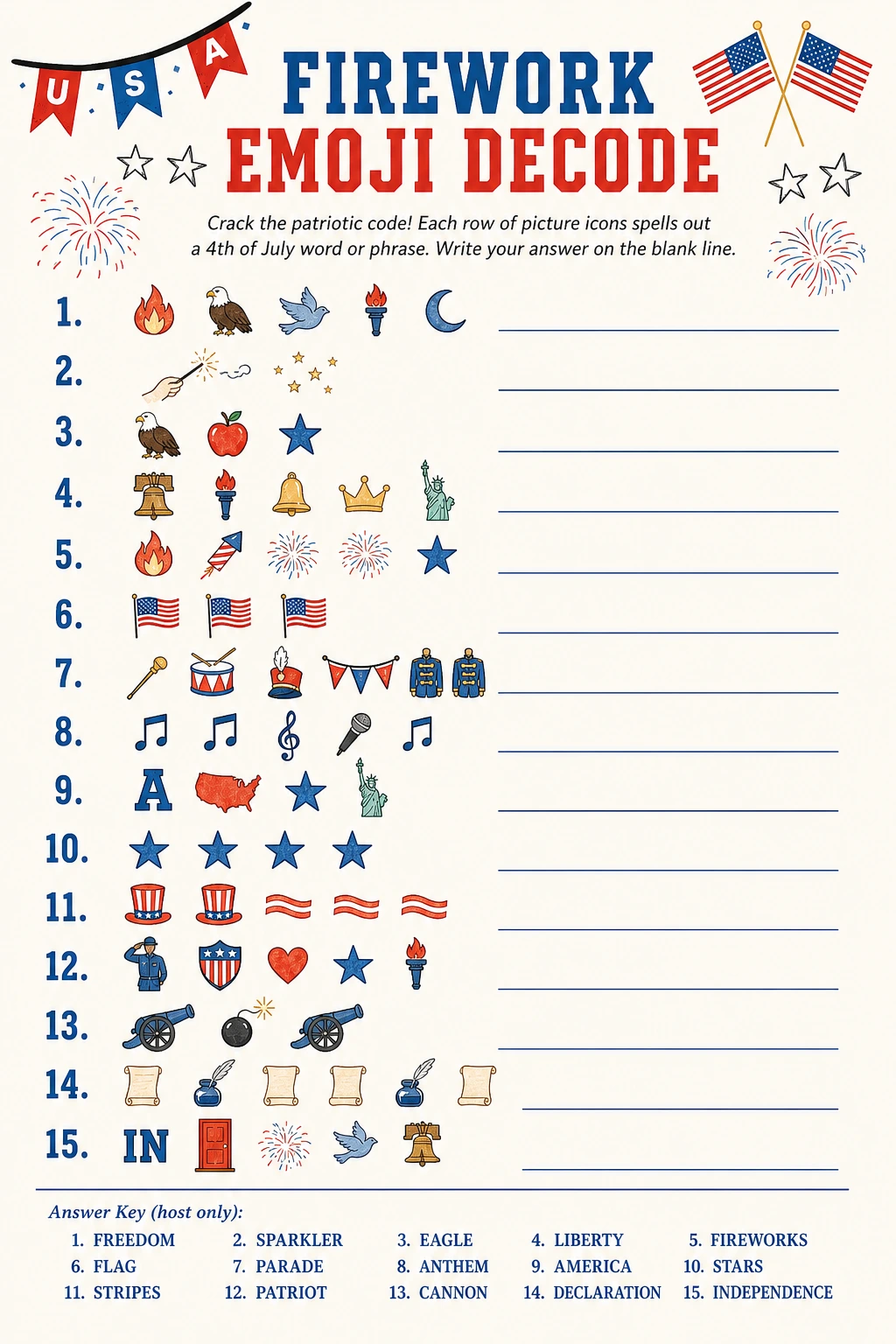
13. Patriotic Would You Rather
The Patriotic Would You Rather printable sheet poses a series of two-choice dilemmas with a red-white-and-blue twist — “Would you rather eat only hot dogs for a year or only watermelon?” or “Would you rather watch fireworks from a rooftop or from a boat?” Players circle their choice on their own sheet, then the host goes question by question, asking people to stand if they chose Option A or stay seated for Option B. The majority answer becomes the “popular pick,” and anyone who chose the minority answer explains their reasoning in thirty seconds.
Print one sheet per player. No other materials are needed. The game works for eight to fifty guests and is particularly good at drawing out quiet attendees, since every question demands a commitment. A full sheet of twenty questions takes about twenty minutes including the explanations, or trim to ten questions for a quick ten-minute icebreaker. Run it during dinner when everyone is seated and the conversation needs a spark.
Host tip: Save the most divisive question for last — something like “Would you rather never see fireworks again or never eat barbecue again?” — because it almost always erupts into a good-natured argument that carries energy into the rest of the evening on its own momentum.
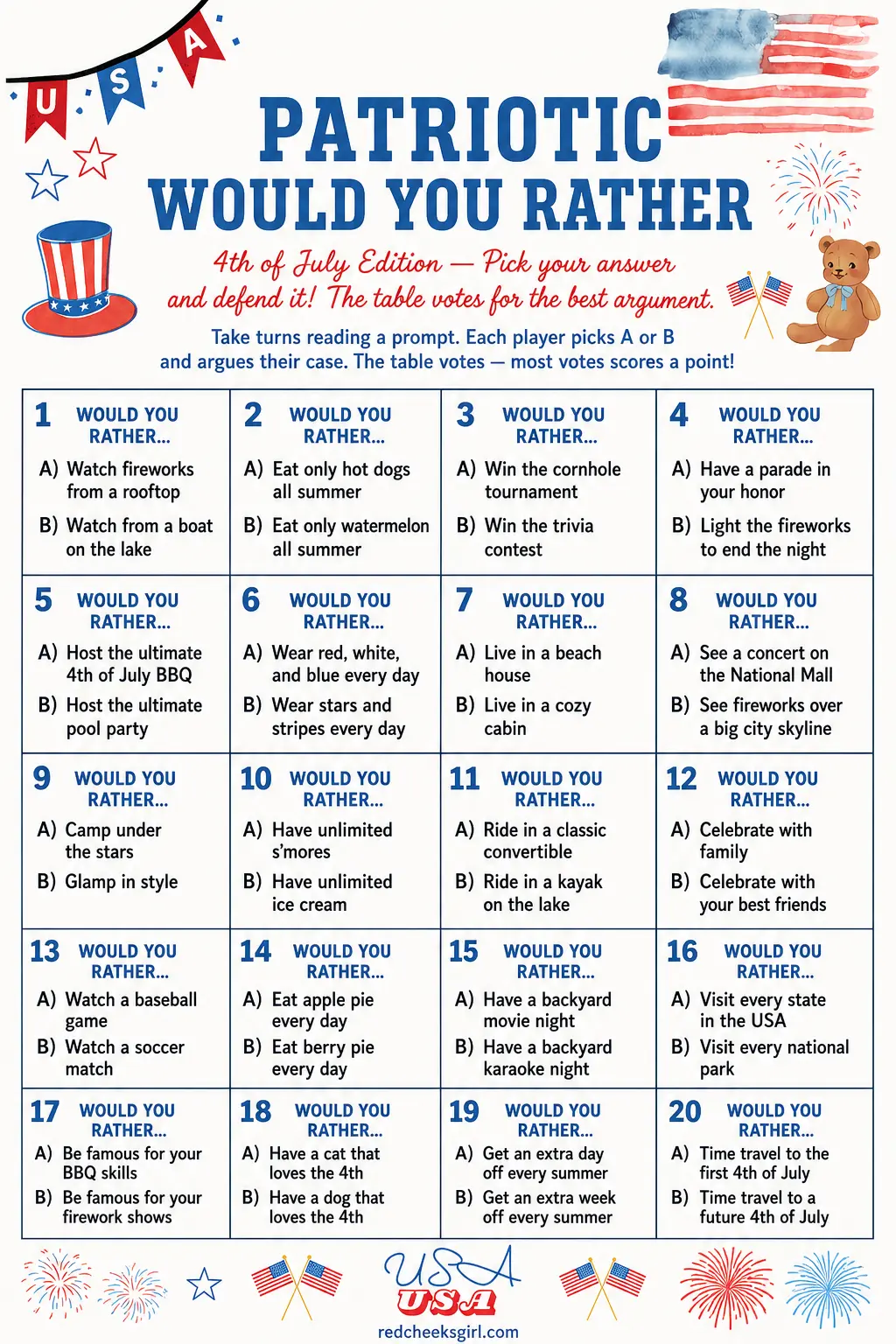
14. July 4th This or That
The July 4th This or That printable sheet gives each player a grid of paired options — “Burgers or Hot Dogs,” “Sparklers or Firecrackers,” “Beach or Backyard,” “Parade or Concert” — and players circle their preference for every pair as fast as possible. After three minutes, the host calls stop and reads out “the American majority vote” answer for each pair, drawn from a pre-tallied popular opinion on the answer key. Players score one point for every answer that matches the majority. Highest score wins.
Print one sheet per player and have pens or pencils ready. Works for any group size; the scoring is self-contained so there’s no complicated math. The whole game including tallying takes fifteen minutes. It pairs well as a warm-up activity right as guests are arriving and still finding their seats, since latecomers can jump in at any point without missing anything critical.
Host tip: After scoring, ask the table to shout out the most surprising majority answers — the questions where almost everyone expected a split but the vote was lopsided. Those moments generate the best table conversation and make the game feel like a genuine social reveal rather than just a worksheet.
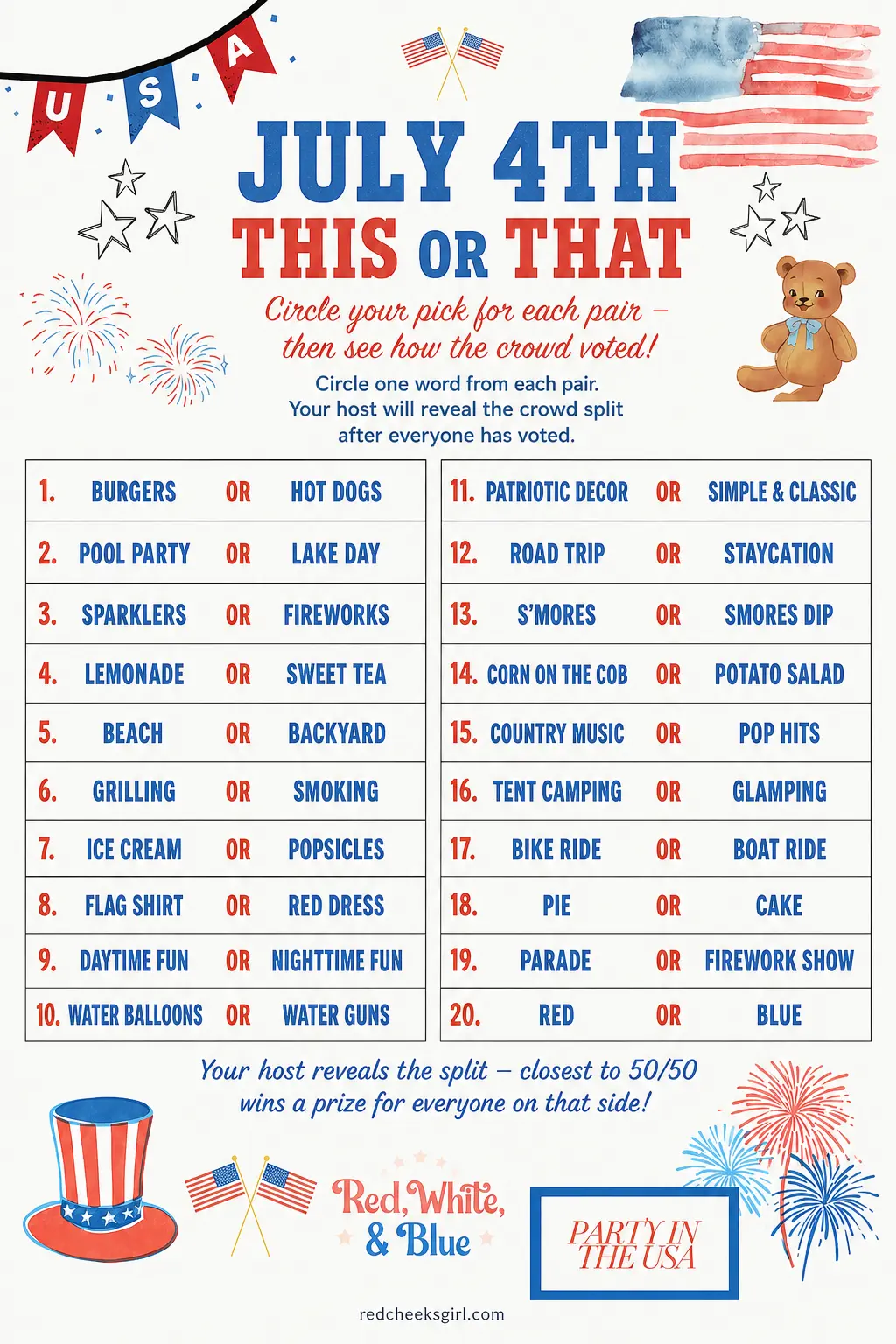
15. Patriotic Name That Tune
The Patriotic Name That Tune printable sheet lists thirty song titles with all identifying words blanked out, replaced by a lyric fragment or a brief musical description of the melody. Players — individually or in teams — write in their best guess for each song title in the time allowed (fifteen minutes). The host also has the option of playing a five-second audio clip of each song from a phone speaker instead of reading the lyric clue, making the game a true listening challenge.
Print one answer sheet per player or per team. A phone with a streaming music app and a small Bluetooth speaker is helpful for the audio version but entirely optional — the printed lyric clues stand alone. Works for groups of four to forty and runs twenty to twenty-five minutes total with grading. The mix of classic patriotic anthems, summer hits, and Americana folk songs means every age group has songs they know and songs they don’t, which keeps the competition level across generations.
Host tip: For the audio version, play each clip twice — once when you announce the question, once after a five-second thinking pause. Guests who mishear a clip on the first play feel robbed rather than challenged, and a second listen loses none of the tension while keeping everyone genuinely engaged.
🛍 Shopping guide
16. Patriotic Mad Libs
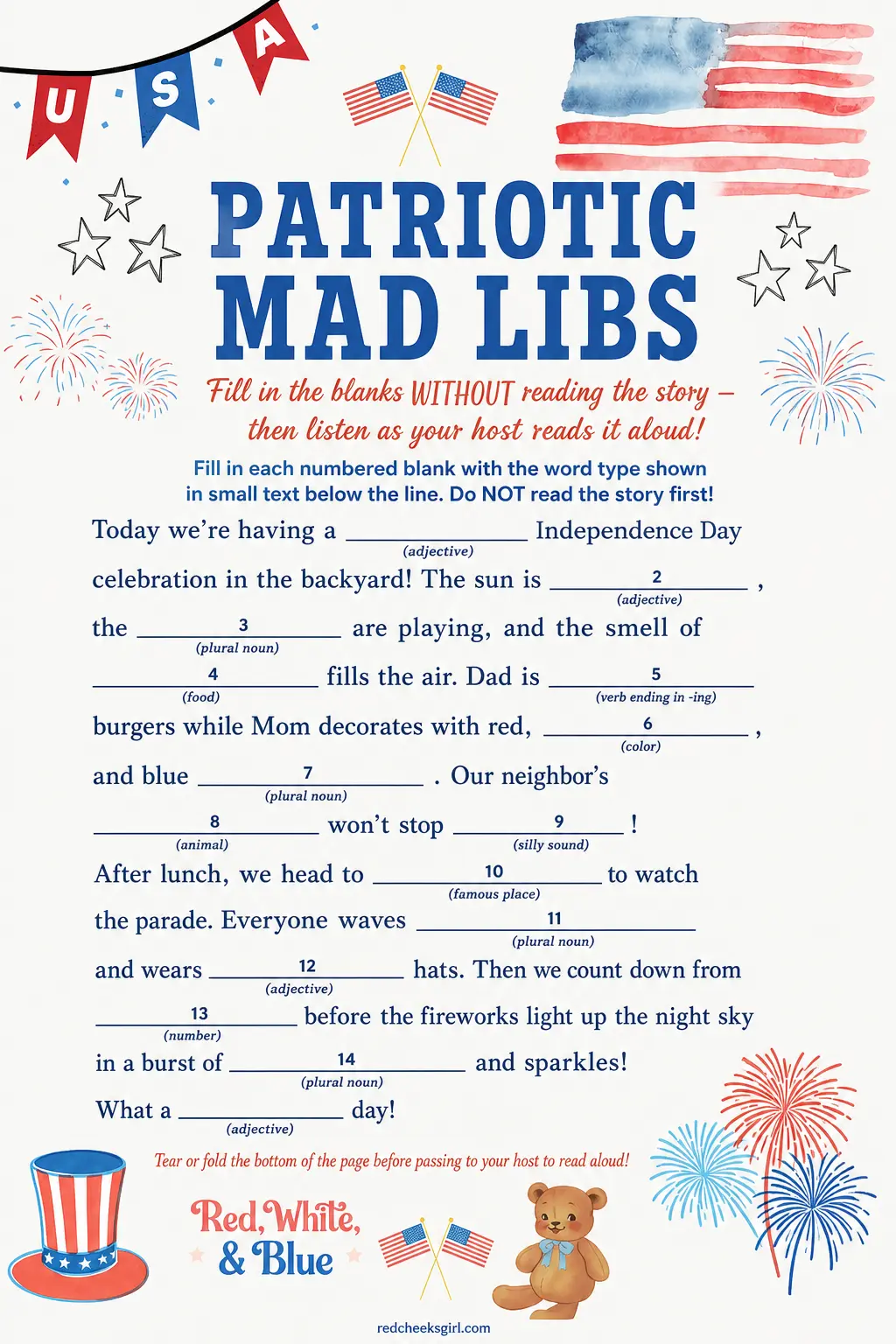
The Patriotic Mad Libs printable sheet contains a short narrative story about a Fourth of July celebration with key words replaced by blanks. Each blank is labeled with a part of speech — noun, verb, adjective, silly sound — and players fill in their words before hearing the story read aloud. The host (or a volunteer) collects the completed sheets and reads each story aloud in full, including the inserted words, to the table. The results range from mildly absurd to genuinely hilarious.
Print one sheet per player. Pens are the only other supply needed. The activity works for any group size and takes about ten minutes to complete plus five minutes per story read aloud. It plays best as a post-dinner activity when people are relaxed, seated, and in the mood to laugh. Accept all answers without editing — the unexpected responses are always the best ones.
Host tip: After reading each story, ask the group to vote on their favorite single word substitution. Award a small prize — a piece of pie, first pick of dessert — to the player whose word gets the most votes. This tiny competitive element makes people think harder about their blank-filling, which consistently produces funnier results.
17. Freeze Dance Fireworks
Connect a phone to a speaker and queue up a patriotic playlist. When the music plays, everyone dances freely in the backyard. When the host pauses the music without warning — ideally mid-beat — every player must freeze instantly in whatever position they’re in. Anyone caught still moving is out and becomes a spotter for the next round. Last player standing wins. The patriotic playlist is the only theme element required; the game mechanic is timeless and universally understood in about ten seconds.
All you need is a speaker, a phone, and open space. Works perfectly for groups of eight to thirty, with children aged four and up joining seamlessly. Each round takes five to eight minutes, and it burns off post-lunch sugar energy in the most efficient way imaginable. Keep rounds moving quickly — the tension between songs is where the game lives, so don’t let the pauses drag.
Host tip: Vary the pause length dramatically — sometimes cut the music after four seconds, sometimes let it run for forty. Players who predict a rhythm get cocky and stop paying attention; unpredictable pauses keep everyone at attention and make the eliminations feel genuinely surprising rather than inevitable.
🛍 Shopping guide
18. Lawn Bowling Stars and Stripes
Set up ten empty plastic bottles filled with an inch of sand (for stability) in a standard bowling triangle at one end of the yard. Paint or wrap the bottles alternately in red, white, and blue crepe paper before the party. Players roll a softball or a bocce ball from a tape line about twenty feet back, trying to knock down as many pins as possible in two rolls. Each player records their score over five frames; highest total wins. Red-painted bottles count double in the final frame for a dramatic finish.
You need ten plastic bottles, sand, crepe paper or spray paint, and a ball — total cost close to zero if you save bottles ahead of time. Works for two to twelve players and takes about twenty minutes for a five-frame game. Set up on a flat section of grass or driveway and ensure the lane is clear of foot traffic on either side — spectators tend to drift into the lane.
Host tip: Bring the bottles inside overnight and fill them with sand that same morning so the sand stays dry and dense. Bottles filled with damp sand from a previous event tip over from a near-miss rather than a real hit, which produces arguments that derail the game far faster than any rule dispute.
19. Stars and Stripes Tug of War
Mark a center line on the grass with a bright ribbon or a cone. Tie a long rope with a bright flag or ribbon at its midpoint over the center marker. Divide guests into two equal teams — roughly balanced by size and age — and position each team on their side of the rope. On the signal, both teams pull simultaneously, and the first team to drag the center ribbon two feet past the center line wins the round. Best of three rounds wins the match, with a brief rest between rounds.
All you need is a sturdy rope at least thirty feet long and something to mark the center. Works best with eight to thirty players split evenly. Each round lasts thirty to ninety seconds of genuine exertion, and the full match including rest intervals takes about fifteen minutes. Check the rope for fraying before play — a snapped rope mid-pull is both dangerous and deeply anticlimactic.
Host tip: Designate an “anchor” at the back of each team before play begins and have that person wrap the rope once around their waist rather than simply gripping it. Anchors pulling with their whole body rather than just their arms stabilize the team’s form and make rounds more about collective coordination than about which team has the single strongest person.
🛍 Shopping guide
20. Bucket Brigade Water Race
Divide players into two or more teams of four to six and line each team up in a straight column. The first player in each line has a full bucket of water; the last player has an empty bucket. On “go,” the first player scoops water into a plastic cup and passes it over their head to the next player, who passes it overhead to the next, and so on down the line. The last player dumps whatever water remains in the cup into the empty bucket. First team to fill their end bucket to a marked line wins.
You need two large buckets, plastic cups, and water — nothing else. The game works beautifully for groups of twelve to forty and takes about fifteen minutes including setup and two or three rounds. It doubles as a cooling activity since water splashing overhead on a hot day is universally welcomed. Use wide-mouthed plastic cups rather than narrow cups — narrow cups lose too much water too quickly and the game becomes a race to see who reaches zero first rather than who moves water best.
Host tip: Mark the finish line on the receiving bucket at three-quarters full rather than completely full. A game that ends when the bucket looks nearly full rather than topped off runs in half the time, and the faster pace means everyone stays soaked and enthusiastic rather than wilting in the afternoon sun waiting for the trickle to top off.
🛍 Shopping guide
Frequently Asked Questions
How many of these 4th of July party games work for mixed ages?
Almost all twenty games on this list are designed with mixed-age crowds in mind. Water Balloon Toss, Freeze Dance Fireworks, Backyard Scavenger Hunt, and Fourth of July Bingo work just as well for a six-year-old as for a sixty-year-old. Games with physical intensity — Tug of War, Three-Legged Race — simply need sensible team sorting by size, which takes about thirty seconds. The printable games like Patriotic Trivia Rounds and Name That Tune naturally level the field across generations because different age groups bring different knowledge to the table.
How early should I set up these outdoor party games?
Plan for at least forty-five minutes of setup time before the first guest arrives. Games like Flag Ring Toss, Corn Hole, and Lawn Bowling need to be positioned and tested. The Backyard Scavenger Hunt requires planting hidden items, which alone can take twenty to thirty minutes. Print all your printable game sheets the night before — never the morning of — so you’re not scrambling with a printer jam while guests are pulling into the driveway.
What if it’s extremely hot? Which games are best in the heat?
Prioritize water games first: Water Balloon Toss and Bucket Brigade Water Race are genuinely cooling rather than just wet. For guests who need a break from the sun, rotate them through shade-tent printable games — Patriotic Trivia Rounds, Fourth of July Bingo, Would You Rather, and Mad Libs all work seated in the shade. Keep a cooler of iced water near every activity and call a mandatory hydration break between active rounds. Scheduling the most physically demanding races — Sack Race, Three-Legged Race, Tug of War — for the cooler late-afternoon hours makes a real difference in everyone’s enjoyment.
Do I need prizes for all 20 games?
No, and trying to prize every game will exhaust your budget fast. Reserve prizes for games with clear individual winners: Watermelon Eating Contest, Corn Hole Tournament, and Patriotic Trivia Rounds. For team relays and races, a simple “victory lap” acknowledgment or a round of applause is genuinely sufficient. The best prizes for Fourth of July are inexpensive and thematic — small bags of sparklers, patriotic sunglasses, star-shaped cookies, or a pack of pop rocks. Keep a prize table visible all afternoon so guests know what they’re competing for.
How do I manage a large group across so many games?
Run simultaneous stations rather than one game at a time. Set up Corn Hole and Lawn Bowling as ongoing drop-in activities, run a structured relay race as the main event each hour, and keep printable games available at a shade table as a constant fallback. Assign one enthusiastic friend or family member as a “game wrangler” who rotates between stations, keeps scores, and recruits bystanders into active play. This structure means guests self-select into what suits them rather than waiting in a long queue for a single activity.
📌 Save These for Later
Loved these? Pin your favorite image below so you can find this list again when you’re planning.

Last July I planned what I thought would be a quick backyard pool party for my daughter’s 7th
My son handed me a folded piece of notebook paper about three months before his seventh birthday. On

One year ago you were in a hospital bed wondering if you’d ever sleep more than 90 minutes in
Leave a Reply