


Icebreaker games for teens have a bit of a reputation problem, tbh.
You say the word ‘icebreaker’ and half the room groans — because most of them have sat through the painfully awkward name-tag-and-handshake routine that feels more like a dentist waiting room than a party.
But here’s the thing: when icebreakers are quick, a little competitive, and actually designed for the way teens think and joke, they work like magic.
I’ve rounded up 20 of my absolute favorites that genuinely land — no groaning, no phone-hiding, just real laughter and real connection.
This list mixes lively active games, low-key quiet moments, and a full deck of printable sheets you can download and bring straight to your next youth group meeting.
Whether you’re kicking off a new school year, welcoming first-timers, or just trying to get a room of strangers talking, you’ll find something here that fits. Print the set, grab some pens, and let’s go.
This post contains affiliate links — if you buy through them, I may earn a small commission at no extra cost to you.
- Two Truths and a Lie
- Would You Rather Round
- This or That Rapid Fire
- Human Knot
- Group Line-Up Challenge
- Teen Human Bingo Sheet
- Would You Rather Teen Cards
- This or That Teen Sheet
- Find Someone Who Sheet
- Get-to-Know-You Question Sheet
- Conversation Starter Cards
- Question Dice Sheet
- Two Truths and a Lie Sheet
- Guess Who Sheet
- Team Name Sheet
- Icebreaker Trivia Sheet
- Riddles Sheet
- Name Tag Templates
- One Word Check-In
- Hopes for the Year Round
- Frequently Asked Questions
1. Two Truths and a Lie
Two Truths and a Lie is the heavyweight champion of icebreaker games for teens for a reason — it does everything right. Each person comes up with three statements about themselves: two that are 100% true and one that is a total lie.
Then the group votes on which one they think is the fake. The wilder the truths, the better the reactions, and trust me, teens always have at least one jaw-dropper hiding in their back pocket.
No materials needed — just a circle of chairs and willing participants. To keep energy high, give everyone 60 seconds to think up their three statements before you start.
Go around the room one by one, and after the vote is in, the person reveals the lie and explains the real story behind their truths. That ‘wait, THAT’S true?!’ moment is where the real connection happens.
This game works because it’s low-pressure storytelling. Nobody is put on the spot in a scary way; they get to control the narrative and choose what to share. Want to crank up the competition? Keep a tally of who successfully fooled the most people — the master bluffer wins bragging rights (and maybe a piece of candy).
Go first yourself and make your lie obviously absurd — it models the game and gets everyone laughing before a single teen has to speak.
2. Would You Rather Round
Would You Rather is the verbal version of a rapid-fire debate club, and teens eat it up. The facilitator reads a dilemma — ‘Would you rather have to hop everywhere you go OR speak in rhymes for a full day?’
— and everyone has to instantly pick a side. No sitting on the fence! Point to the left for option A, right for option B, or have the group physically split and move to opposite walls. The minority has to defend their wild choice.
The magic is in the follow-up. After everyone commits, call on two or three people from each side to justify their answer in 10 seconds or less. This sparks mini-debates and genuine laughs that feel nothing like a forced icebreaker.
Prep 15–20 questions in advance so you can fire them back-to-back without any dead air. Keep them age-appropriate but delightfully ridiculous: food dilemmas, superpower choices, and embarrassing social scenarios tend to land the hardest.
What makes this format shine in a youth group setting is that no answer is wrong. There’s zero social risk — everyone is equally ‘weird’ in their own way — which gives quieter teens permission to participate without feeling judged.
Run 8–10 rounds as a standalone opener or use it as a warm-up before a longer activity. Either way, the room will be buzzing.
- Groups of 6 or more
- First meetings where nobody knows each other yet
- Filling 5–10 minutes between other activities
3. This or That Rapid Fire
This or That Rapid Fire is Would You Rather’s faster, sassier cousin. The premise is even simpler: the facilitator snaps two options at the group back-to-back — ‘Pizza or tacos? Beach or mountains? Morning person or night owl?’ — and everyone shouts their answer simultaneously.
No explaining, no defending, just a split-second gut reaction. The whole point is speed; you want to race through 20 pairs in under two minutes.
To run it well, prep your list beforehand and deliver each pair with zero pause between options. Use a call-and-response rhythm: say ‘This — or — THAT!’ before each pair so teens know when to answer.
You can theme the questions around school life, pop culture, food, travel, or hypothetical scenarios. Mixing light and funny with the occasional surprisingly sincere option (like ‘lead or follow?’) keeps people genuinely thinking even mid-laugh.
The reason this one is such a reliable opener is that it’s completely zero-stakes but still gets every single person in the room making a verbal choice within the first 30 seconds. That first bit of participation — even a shouted ‘TACOS!’
— is the tiny step that opens the door to bigger conversations later. Consider running a second round at the end of the evening with user-submitted pairs for a satisfying callback moment.
Write your pairs on index cards so you never lose your place or repeat a question mid-game.
4. Human Knot
Human Knot is the physical icebreaker that turns a room of relative strangers into a tangled, giggling mess — and that’s entirely the point.
Everyone stands in a circle, reaches both hands into the middle, and grabs the hands of two different people who are NOT directly beside them. You instantly end up with a web of crossed arms and twisted bodies.
The challenge: untangle back into a clean circle without anyone letting go of the hands they’re holding.
For best results, cap each group at 8–10 players — anything bigger gets genuinely impossible, and anything smaller solves too fast to be satisfying.
Make sure players grab hands across the circle rather than from neighbors, and remind them they can adjust grip direction but cannot unclasp entirely. Want to add a competitive spin? Split into two equal groups and race to see who untangles first.
The losing team has to lead the next icebreaker.
This game earns its reputation because it physically forces communication — you literally cannot stay silent when someone’s arm is going over your shoulder. Shy teens who haven’t spoken yet suddenly have to give instructions, ask for help, and problem-solve alongside people they’ve just met.
A quick debrief question afterward (‘What strategy worked?’) turns the laughs into a real team-building moment.
Physical proximity fast-tracks familiarity — teens who untangle a knot together feel like they’ve known each other for years, not minutes.
5. Group Line-Up Challenge
Group Line-Up Challenge is beautifully simple and surprisingly chaotic. The whole group must arrange themselves into a perfectly ordered line based on a category the facilitator announces — without talking.
Categories can include: birthday (month and day, January to December), shoe size (smallest to largest), distance traveled to get here, alphabetical order of middle names, or number of siblings. The catch? Total silence.
No whispering, no mouthing words — only gestures, hand signals, and creative mime.
Once the group thinks they’re in order, go down the line and have each person reveal their answer. The hilarity of watching someone try to mime ‘February 29th’ or signal their shoe size using only finger counting never gets old.
If they get the order wrong, give them 60 seconds to self-correct with voices on — and then verify again. Running two or three rounds with different categories keeps the momentum going and lets quieter teens step into a natural leadership role.
What the Group Line-Up Challenge does brilliantly is surface organic communication styles almost immediately. Who takes charge? Who hangs back? Who invents a genius signing system in 10 seconds flat?
It’s a great activity to run just before splitting into smaller team-based games because it reveals the group’s natural dynamics in a fun, pressure-free way — and everyone ends up laughing at their own mime attempts, which is a great equalizer.
- An open floor space with enough room for the whole group to stand in a line
- A list of 3–4 ordering categories prepared in advance
6. Teen Human Bingo Sheet
Human Bingo is the printable icebreaker that secretly turns mingling into a mission — and teens who would never voluntarily walk up to a stranger will do it the second there’s a bingo card in their hand.
Each square on the 5×5 grid contains a fun fact or trait like ‘Has a pet reptile,’ ‘Can name all seven continents,’ ‘Has stayed up past 3 a.m. for non-school reasons,’ or ‘Knows a second language.’
Players wander the room, find someone who matches a square, write that person’s name in the box, and aim for five in a row.
Print one card per person on regular copy paper — cardstock holds up better if the session runs long.
To keep it moving, add the rule that each person can only sign any individual card once, which forces teens to talk to as many different people as possible.
Set a timer for 10–15 minutes and award a small prize (extra dessert, first pick of seats) to the first few people who call BINGO. Reading out the winning card aloud doubles as a second round of introductions.
The genius of bingo as an icebreaker format is that it gives introverts a script — instead of ‘make conversation,’ the task is simply ‘ask this one specific question.’ That structure removes the most intimidating part of meeting strangers.
If you want to download a ready-made version tailored specifically for youth group, the printable sheet below has 25 teen-specific squares pre-filled and ready to go.
Laminate a master copy and use a dry-erase marker so you can reuse the sheets for future meetings without reprinting.

🛍 Shopping guide
7. Would You Rather Teen Cards
This printable card deck brings the Would You Rather format off the floor and into your hands — literally. Each card features a bold dilemma on the front, formatted as a clean two-option choice with a dividing ‘OR’ in the middle.
Teens take turns drawing a card, reading it aloud, and the group votes. Whoever draws the card has to go first and commit to their answer before the votes come in.
The deck is designed specifically for youth group energy: relatable, funny, and completely clean — no gross-out content, just genuinely tricky picks.
Print the sheet on cardstock and cut along the crop marks — you’ll have a deck of 12 ready-to-go cards. Shuffle and stack them face-down in the center of the table or floor.
You can play in a single big circle or split into smaller groups of 4–6 for a more intimate conversation vibe. A single deck runs about 15–20 minutes; print two or three sets for a longer session or multiple groups playing simultaneously.
Having the questions on physical cards rather than shouted from a phone screen makes the game feel more intentional and less like a quick social media scroll.
Teens lean in, hold the card, pass it around — there’s something tactile about it that actually slows the pace down in the best way.
It also means no leader needs to have their face buried in their phone, which keeps the energy in the room where it belongs: on the people.
- Small groups of 4–8
- Any point in the meeting — opener, mid-session reset, or wind-down
- Youth leaders who want prep-free facilitation

🛍 Shopping guide
8. This or That Teen Sheet
The This or That Teen Sheet turns the rapid-fire shouting game into a personal preference survey teens can fill out on their own — then swap and compare with the person next to them.
Each row presents two options side by side with a bubble or checkbox next to each one. Teens circle their pick down the list, building a snapshot of their personality in about three minutes.
Then pairs swap sheets and find the top three things they agree on and one surprising difference to share with the group.
Print one sheet per person — it doubles as a keepsake since it captures a genuine slice of who they are at this moment in time. Encourage teens to keep their sheets and look back at them in six months.
(Spoiler: their answers will probably shift and that’s a great discussion starter for a future meeting.) The format works beautifully as a settle-in activity while latecomers arrive, because it’s self-directed and doesn’t require a facilitator to get rolling.
What makes this printable particularly valuable is the compare-and-contrast discussion it naturally generates.
Instead of asking ‘tell me something about yourself’ — which is basically a social nightmare for most teens — the sheet gives them a concrete talking point: ‘Okay, you picked mountains and I picked beach, what’s your reasoning?’
Suddenly there’s a real conversation happening, and nobody had to do the scary work of initiating it from scratch.
Structured choices remove the pressure of open-ended self-introduction — teens talk about preferences, not themselves, which feels way less exposed.

9. Find Someone Who Sheet
Find Someone Who is the walking, talking, pen-in-hand icebreaker that gets every single teen out of their seat.
The printable sheet lists 15–18 descriptors — things like ‘plays a sport,’ ‘has a pet,’ ‘can speak two languages,’ ‘has never seen a Star Wars film,’ or ‘has an unusual hidden talent’ — and teens have to wander the room and find a real live human who matches each one.
When they do, they write that person’s name in the blank next to the descriptor. The goal: fill as many blanks as possible before time is called.
Set a timer for 10–12 minutes and let the room buzz. Add a rule that each person can only appear on someone’s sheet twice — this prevents the naturally charismatic extrovert from becoming everyone’s default answer and ensures broader mingling.
When time is up, call out the descriptors one by one and ask who found someone for each. It doubles as a second round of introductions because teens shout each other’s names out loud across the room, which is honestly delightful chaos.
This printable earns its spot in the lineup because it’s one of the most effective tools for getting shy teens to approach people they’d normally never talk to.
The sheet gives them permission and a ready-made conversation starter for every single interaction — no awkward ‘so, um, hi’ required.
Print it on regular copy paper and pair it with a pen or pencil; that’s genuinely all you need for one of the most socially productive 12 minutes of the whole meeting.
Award a small prize to whoever fills the most unique names — it adds a competitive edge that motivates even the most reluctant minglers.

10. Get-to-Know-You Question Sheet
This printable flips the script on the typical ‘go around and introduce yourself’ format by giving every teen a personal interview sheet to fill out before they share anything with the group.
The sheet has 12 open-ended questions — things like ‘What’s a song that always gets you out of your head?’ or ‘What’s one thing you’re genuinely proud of from the past year?’ — with a generous blank write-in space after each one.
Teens fill it in quietly for 5–7 minutes, and then pair up or share with a small group of three.
The write-first-talk-later structure is a game changer for introverted teens. By the time they’re asked to share, they’ve already thought through their answer and written it down — the verbal sharing is just reading something they’ve already composed, which is infinitely less scary.
You can use these sheets as the base for a full discussion session or collect them and post anonymized answers on a display board as a visual collage of who’s in the room.
Pair this printable with the Conversation Starter Cards below for a layered get-to-know-you experience that carries your group through an entire session without any dead air.
The questions are designed to be specific enough to generate real answers but open enough that no two responses will look the same — which makes the share-out genuinely interesting rather than a parade of ‘My name is Jordan and I like soccer.’
Read one question aloud before quiet writing time so even reluctant teens have a starting point and don’t stare at a blank page.

11. Conversation Starter Cards
Conversation Starter Cards are the secret weapon every youth leader needs tucked in their back pocket. This printable sheet produces a deck of 12 cut-out cards, each carrying a single thoughtful but low-stakes question designed to launch a two-minute conversation between any two teens.
Questions range from ‘What’s a movie that made you genuinely emotional?’ to ‘What would your dream Saturday look like?’ — specific enough to get a real answer, light enough that nobody feels interrogated.
Print on cardstock and cut along the dashed lines for a sturdy deck. Distribute one card per person face-down, then on ‘go’ everyone flips their card and finds a partner to discuss it with for 90 seconds.
When time is called, cards get passed one person to the right and the process repeats with a new partner. Run four to six rounds and the room will have had more genuine one-on-one conversations than most people manage in a month of group meetings.
The rotating format means teens get talking time with multiple people rather than staying glued to whoever they arrived with — which is exactly the point. It also means the facilitator can step back and let the room run itself, which is a beautiful thing.
Want a fun variation? At the end, everyone secretly votes on the question that sparked the best conversation, and that question gets answered by the whole group together to close out the session.
- Cardstock sheets for printing
- Scissors or a paper trimmer
- A timer for rotating rounds

🛍 Shopping guide
12. Question Dice Sheet
Question Dice takes the conversation-starter format and makes it wonderfully tactile. This printable sheet is a fold-and-assemble paper dice template: cut out two net shapes, fold and tape into cubes, and each face of the dice carries a get-to-know-you question.
Small groups of 3–5 take turns rolling both dice simultaneously, then answering whichever two questions land face-up. Because the questions are random and double-stacked, every roll produces a different combination — so no two rounds feel the same.
The sheet includes two dice templates, each with six unique questions printed directly on the faces in the flat net layout. Cut carefully along the solid outer lines, fold along the dashed interior lines, and secure with a small piece of tape on each flap.
Regular printer paper works fine, but cardstock makes for a sturdier dice that survives an energetic youth group session.
Label the two dice differently — one with ‘fun/random’ questions and one with ‘deeper/reflective’ questions — so each roll always pairs a light question with a slightly more meaningful one.
This printable is a fantastic centerpiece for small breakout groups because it keeps the activity going independently without a facilitator hovering. Groups naturally develop a rhythm: roll, answer, laugh, roll again.
The physical dice also create a sense of game rather than interview, which makes teens far more willing to answer honestly. It’s a keeper — laminate the assembled dice and reuse them at every meeting.
Pre-assemble one demonstration dice to show teens what the final product looks like before they start folding — it prevents the ‘…how?’ confusion spiral.

🛍 Shopping guide
13. Two Truths and a Lie Sheet
This printable takes the classic verbal game and gives it a writing-first twist that works especially well with bigger groups.
Each teen gets their own sheet with space to write their three statements — two truths and one lie — plus a second section with 12 blank lines to jot down guesses for other players’ statements as the round goes around.
Having it on paper keeps the game organized, lets quieter teens think through their statements more carefully, and creates a tangible record of who fooled whom.
Run the game in two stages: first, everyone writes their three statements in silence (about 3 minutes), then go around the room and play as usual. As each person reads their statements aloud, everyone else notes their guess on the sheet before the reveal.
At the end of the round, count up how many you got right — the person with the best detection rate becomes the official ‘human lie detector’ of the group, which is a title teens absolutely cherish.
The printable format also opens up a fun variation: collect all completed sheets, shuffle them, and redistribute randomly. Now each person has to read out someone else’s statements and guess the lie cold — no prior hearing required.
This works brilliantly as a second-session callback if you run the same group on multiple days, because everyone has forgotten the exact wording and has to re-engage with the game fresh.
- Groups of 8 or more where verbal-only gets hard to track
- Multi-session youth groups where you want a record of responses
- Blending printable and verbal play in the same activity

14. Guess Who Sheet
Guess Who is the mystery-identity matching game that turns a room full of teenagers into amateur detectives.
Before the session, each teen fills out a quick ‘secret profile card’ with three clues about themselves — unusual facts, hidden hobbies, or memorable firsts — and submits it anonymously to the leader.
The leader compiles all the clues into the Guess Who printable sheet, numbered but not named. Teens receive the sheet and race to match each numbered set of clues to the right person in the room.
To gather the clues, email or text a simple form to participants the day before, or collect them on index cards as people arrive.
The more specific and unexpected the clues, the better — ‘Has met a celebrity at a grocery store,’ ‘Owns more than 50 houseplants,’ ‘Once accidentally called a teacher Mom in front of the whole class’ — these are the ones that generate real reactions.
Give teens 10 minutes to mingle and match clues to people, then go through the sheet as a group and reveal the answers one by one.
This game works brilliantly because the reveal moments are genuinely surprising. Teens who thought they knew their friends discover unexpected layers, and brand-new members get to introduce themselves through memorable facts rather than a generic name-and-grade opener. It’s also infinitely replayable — the sheet changes every session based on who submits clues, so it never gets stale.
Ask for clues 24 hours in advance via a group chat message so you have time to compile and print the sheet before the session starts.

15. Team Name Sheet
Before any team-based game can happen, you need teams — and Team Name Sheet turns that admin moment into its own mini icebreaker.
Small groups of 4–6 receive this printable sheet and have exactly five minutes to collaboratively choose a team name, design a quick team symbol or logo in the box provided, write down each member’s name, and answer three rapid ‘team identity’ questions together.
The result is a filled-out card that becomes their team’s identity for the rest of the evening.
The sheet includes prompts like ‘Our team’s unofficial motto is…,’ ‘If we were a snack, we’d be…,’ and ‘Our team’s superpower is…’ alongside the name and logo boxes.
These silly prompts force immediate collaboration and shared laughing — two things that happen to be the fastest routes to actual connection. At the end of the five minutes, each team presents their card to the room in a 30-second introduction.
Team Name Sheet is the rare printable that also serves a logistical purpose: once groups are named and presented, you have clear, memorable team identities to use for every activity that follows. No more ‘uh, group three’ — it’s the Chaotic Nachos vs.
the Sleep-Deprived Geniuses. Trust me, teens will commit to their team name with a loyalty that is both hilarious and completely genuine. Pin the completed sheets on a wall for a subtle but effective visual of who’s in the room.
Giving a group a shared identity (even a ridiculous one) within the first five minutes creates instant in-group belonging — which is the whole point of icebreakers.

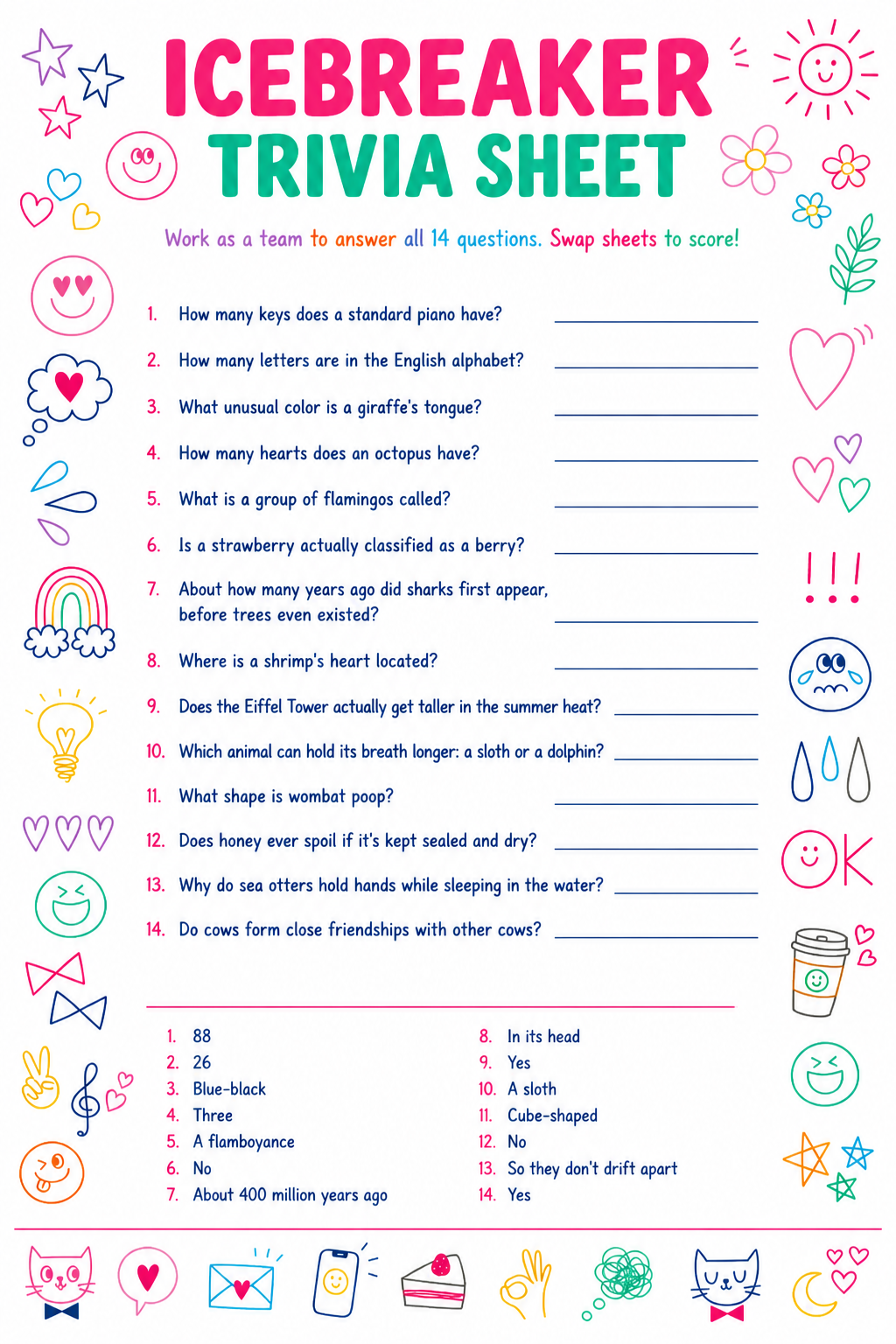
16. Icebreaker Trivia Sheet
Icebreaker Trivia Sheet is the competitive printable that gets teens actually caring about their answers. This 20-question trivia sheet covers fun, teen-relevant categories: pop culture, general knowledge, food facts, science surprises, and ‘most likely to’ style group-knowledge questions.
Teams fill in answers together in pencil, then sheets are swapped between teams for peer grading during the live answer reveal. The team with the highest score wins — and yes, bragging rights count.
Print one sheet per team — four to six people per team is the sweet spot. Give teams 8–10 minutes to work through all 20 questions, encouraging them to discuss and debate before committing to an answer.
During this phase, the conversation IS the icebreaker — teens reveal what they know, what they don’t, who’s surprisingly good at random trivia, and who confidently gives wrong answers with zero hesitation (we all know that person).
The answer key is printed in small italic text at the very bottom of the sheet for easy leader reference.
The trivia format earns its place in the icebreaker lineup because competition naturally lowers inhibition. Teens who are too cool to do a feelings check-in will absolutely argue passionately about whether a tomato is a fruit. Use that energy.
Add a lightning round at the end with bonus verbal questions for extra points, and you’ve got a self-running activity that fills 20 minutes without a single awkward silence.
- One printed sheet per team
- Pencils for answering
- Small prizes for the winning team (optional but highly motivating)
17. Riddles Sheet
The Riddles Sheet is the printable that turns a group of teens into a room full of frustrated, delighted, overly-competitive riddle solvers — which is exactly the vibe you want. The sheet contains 15 classic-but-tricky riddles ranging from easy warm-ups to properly head-scratching puzzles.
Teams have 10 minutes to solve as many as possible, writing their answers on the blank lines provided.
The team with the most correct answers when time is called takes the win — and the smug satisfaction of being the smartest people in the room, at least for tonight.
Print one sheet per team and keep answers strictly on paper — no shouting answers across the room!
This is important both for fairness and for keeping the energy focused within each small group, where the real bonding happens as teens argue over whether ‘the answer is obviously time, wait no—’ Mid-riddle debates are some of the most naturally animated conversations a youth group can have.
The answer key is printed in small italic text at the very bottom of the sheet so the leader can read answers aloud at the reveal.
Riddles work so well as an icebreaker activity because the problem-solving process reveals personality in real time: who leads, who jokes, who goes quiet and then suddenly nails it, who is 100% sure of every wrong answer.
That dynamic plays out in about 60 seconds per riddle, giving teens a fast, funny window into who their group members actually are.
Follow up with a ‘best wrong answer’ award for the most creative incorrect response — it softens the competition and makes everyone feel like a winner.
Read the first riddle aloud to the whole room before starting the timer — it models the format and gives slower readers a head start.

18. Name Tag Templates
Name tags might sound like the most boring item on this list — but these aren’t your standard sticky-label-from-the-dollar-store situation.
This printable sheet produces eight custom name tag cards per sheet, each with space for the teen’s name in bold, plus three quick-fill prompts: ‘Superpower I wish I had:’, ‘Currently obsessed with:’, and ‘Secret skill:’.
Teens fill these in with markers as they arrive, pin them on, and instantly every name tag becomes a conversation starter that does the mingling work for them.
Print on cardstock for durability, then cut along the crop marks. Provide bold markers (Sharpies or similar) so the writing is large enough to read across a room — nobody wants to squint at someone’s chest trying to decipher tiny pencil text.
Safety pins or lanyards work for attaching the tags. Set up a little ‘name tag station’ near the entrance with markers laid out so the activity starts the moment people walk in the door, even before the formal session begins.
The three prompts are carefully chosen to generate conversation without requiring vulnerability: ‘Currently obsessed with’ is breezy and low-stakes; ‘Secret skill’ invites a fun reveal; ‘Superpower I wish I had’ is pure imagination with zero wrong answers.
Together they turn a functional logistics item into the first icebreaker of the evening — and because every name tag is different, curious teens end up reading each other’s badges and starting conversations you didn’t have to facilitate at all. Win.
- Cardstock for printing
- Bold markers or Sharpies for filling in
- Safety pins or lanyards for wearing

19. One Word Check-In
One Word Check-In is the quietest game on this list — and honestly, sometimes it lands the hardest. Everyone in the circle takes a turn sharing just one word that describes how they’re feeling or where they’re at right now. That’s it. One word.
No explanation required, no follow-up question, no pressure to elaborate. Words like ‘tired,’ ‘excited,’ ‘anxious,’ ‘hopeful,’ or the always-relatable ‘hungry’ are equally valid. The leader goes first to model the vulnerability, and then it travels around the circle.
This one works best when placed at the very start of a session before any other activity, or as a bookend at the very end after the energy has naturally settled.
It takes about three minutes for a group of 20, costs nothing, and requires zero materials beyond a willingness to sit in a circle and actually listen. Remind the group of the one rule: no commenting on anyone else’s word.
Just receive it and move on.
The reason One Word Check-In earns its place in an icebreaker lineup full of laughing and competing is that it creates a moment of genuine presence. Teens who just shouted ‘TACOS!’
at the top of their lungs suddenly get to say ‘actually, I’m a bit anxious tonight’ — and the room holds that without judgment. That one quiet minute often becomes the thing teens remember most about the whole evening.
It’s a gift dressed up as a very, very short game.
Normalize a wide range of words by going first yourself and choosing something honest rather than performatively upbeat — it gives the whole group permission to be real.
20. Hopes for the Year Round
Hopes for the Year Round is a reflective close-out activity that turns the final five minutes of a session into something genuinely meaningful.
Each teen takes a turn sharing one thing they’re hoping for in the year ahead — a goal, a wish, a thing they’re working toward, or something they’re simply curious to see unfold.
There are no wrong answers and no minimum ambition level required: ‘I hope to finally finish a book I started’ is just as valid as ‘I hope to start my own business.’ The specificity of each answer is where the magic lives.
Run it as a simple go-around-the-circle activity, or write hopes on small cards and share anonymously for a quieter version.
If you want a tactile element, provide sticky notes and a designated wall or board where hopes get posted and displayed for the rest of the session.
Seeing a wall covered in handwritten hopes from the people around you is genuinely moving — even for teens who are actively trying not to be moved by anything.
Ending your youth group meeting with this activity accomplishes something the energetic games earlier in the evening cannot: it signals that this group is a place where the future matters and where individual voices are heard.
That feeling of being seen — even briefly, even anonymously — is one of the most powerful things a youth group can offer.
And if the hopes posted this session turn into a callback conversation six months from now, that’s community building at its very best.
(If you want to fuel those big-dream conversations with some good morning energy, a cortisol-lowering breakfast before a big day never hurts either.)
Sharing a hope with a group — even a small, silly one — creates a tiny but real moment of accountability and belonging that lingers long after the meeting ends.
🛍 Shopping guide
Frequently Asked Questions
What are the best icebreaker games for teens who don’t know each other?
The best icebreaker games for teens who are strangers tend to be structured, low-stakes, and fast-moving.
Find Someone Who, Human Bingo, and Two Truths and a Lie are top picks because they give every teen a script or task to follow rather than requiring them to start a conversation from scratch.
Printable sheets are especially helpful because they give shy teens something to hold and look at, which reduces the intimidation of walking up to a stranger.
How long should icebreaker games last at a youth group?
Most icebreaker games for teens work best when they run between 5 and 15 minutes each. Shorter games (2–5 minutes) like This or That Rapid Fire or One Word Check-In work well as openers or resets between activities.
Longer games like Human Knot or Human Bingo can run up to 15–20 minutes when used as the main activity. Aim for 20–30 minutes of total icebreaker time at the start of a session before moving into the main program.
What icebreakers work for large teen youth groups?
For large groups, printable formats like Human Bingo, Find Someone Who, and Icebreaker Trivia scale beautifully because you simply print more sheets. Active games like Group Line-Up Challenge and Would You Rather Round work with any crowd size since the whole group participates at once.
For Human Knot with a large group, split into separate groups of 8–10 for the best experience.
How do I get reluctant teens to participate in icebreakers?
The biggest trick is removing the blank-slate pressure. Give teens a structured task (fill in this sheet, circle your answer, write one word) rather than asking open-ended questions cold.
Printable cards and sheets are fantastic for this because they hand every reluctant teen a ready-made conversation starter. Also, starting with low-vulnerability formats like This or That and building toward more personal ones like Get-to-Know-You Question Sheets gives hesitant participants time to warm up gradually.
Can these icebreaker games be used for virtual or hybrid youth groups?
Yes, many of them adapt well. Would You Rather Round and This or That Rapid Fire work over video call using reactions or the chat to vote. Printable sheets can be shared as PDFs for participants to print at home or fill in digitally.
Two Truths and a Lie works perfectly over video. Human Knot and Group Line-Up Challenge are the two that genuinely need in-person play, so swap those for a virtual-friendly alternative like the Question Dice sheet shared via screen.
How many icebreaker games should I plan for a youth group meeting?
A typical 60–90 minute youth group meeting runs best with two to four icebreaker activities: one active game to open, one or two printable games during the main session, and one quiet activity to close.
This list of 20 icebreaker games for teens gives you more than enough variety to mix and match across multiple meetings without repeating yourself for months.
📌 Save These for Later
Loved these? Pin your favorite image below so you can find this list again when you’re planning.


72 truth or dare questions over call, sorted into six escalating rounds. Print the cards, dial a fri

72 funny would you rather questions sorted into 6 wild rounds. Grab the free printable cards and sta

72 truth or dare questions for FaceTime that actually work on camera. Six rounds, printable card dec
Leave a Reply