

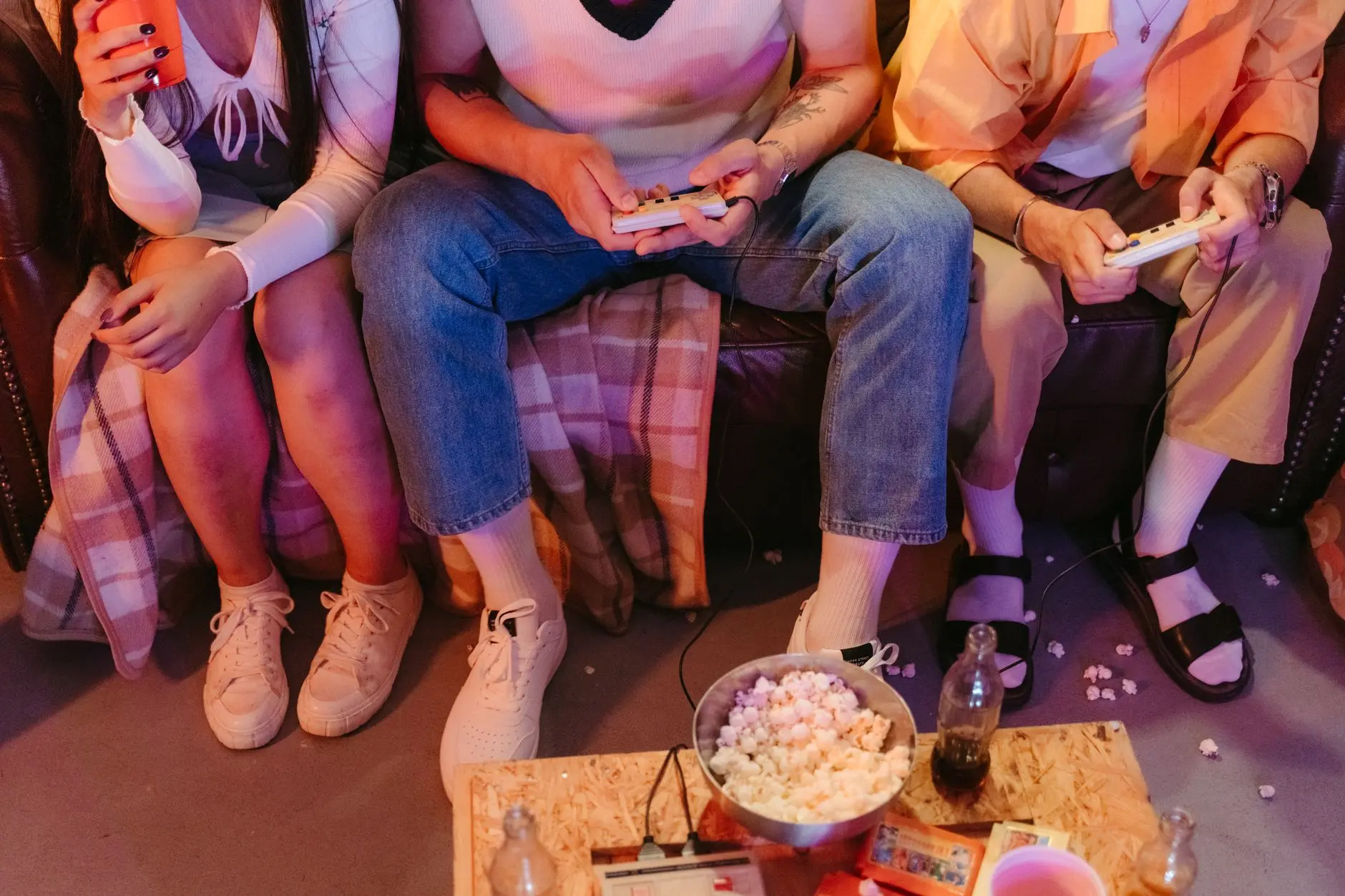
If you’ve ever watched a group of teens stare at each other after the pizza is gone and someone says ‘so… what do we do now?’, this list is for you.
These sleepover games for teens are the ones that actually get everyone off their phones, laughing way too loud at 1 a.m., and still talking about it at school on Monday.
No awkward icebreaker circles, no games that feel like a classroom activity in disguise — just genuine chaos, real talk, and a handful of printable card decks you can download and have ready before anyone even arrives.
We’ve got 20 games arranged in a rhythm that actually works for a real sleepover night: you start with the crowd-pleasers to break the seal, move into some wild active games when the energy is high, work through the printable rounds when everyone needs to sit down with snacks, and finish with the quiet, cozy stuff that feels surprisingly meaningful at 2 a.m.
when the candles are low and no one actually wants to sleep. Whether you’re the host or the parent doing the behind-the-scenes prep, your crew is going to thank you. Let’s go.
This post contains affiliate links — if you buy through them, I may earn a small commission at no extra cost to you.
- Truth or Dare (Clean)
- Pass-the-Phone Confessions
- Would You Rather Round
- Whisper Challenge
- Blindfold Taste Test
- Sleepover Would You Rather Cards
- This or That Teen Sheet
- Truth or Dare Cards (Clean)
- Friendship Quiz Sheet
- Sleepover Bingo
- MASH Sheet
- Movie Bingo
- Dream Journal Page
- Sleepover Trivia Sheet
- Guess the Emoji Movie Sheet
- Best Friend Q&A Sheet
- Sleepover Riddles Sheet
- Morning-After Awards
- Best Friend Q&A Circle
- Wishes for Each Other
- Frequently Asked Questions
1. Truth or Dare (Clean)
Truth or Dare is the OG sleepover game and honestly it still slaps — when you play it right. Everyone sits in a circle, one person spins a bottle (or just points), and the chosen player picks Truth or Dare.
Truth means answering an honest question in front of the group; Dare means doing something silly, harmless, and preferably hilarious.
The ‘clean’ part just means keeping questions and dares firmly in the fun zone: no one should feel embarrassed or pressured, and anything that crosses a line gets a free pass with a ‘skip’ token.
The key to making this feel fresh instead of cringey is having good prompts ready so nobody wastes three minutes thinking of a question. Write 20–30 truths and 20–30 dares on slips of paper and toss them in two bowls before the night starts.
Sample truths: ‘What’s the most embarrassing song on your playlist?’ or ‘Who would you call first in a zombie apocalypse?’
Sample dares: ‘Do your best impression of the last teacher who annoyed you’ or ‘Text someone a random GIF with zero explanation and show the group.’ The bowls do all the heavy lifting.
The reason this game survives every generation of teens is that it hits the sweet spot between vulnerable and silly — and that combo is genuinely bonding.
Pro tip: designate one person as the ‘chaos referee’ who can veto anything that goes too far, which actually makes everyone feel safer and more willing to commit to the dares. One round usually turns into three because nobody wants to stop.
Prepare both bowls (truths + dares) in advance so the game never stalls — dead air between turns is where the energy dies.
2. Pass-the-Phone Confessions
This one is a TikTok-era twist on the classic ‘most likely to’ game and teens absolutely love it because it involves actual phones, which honestly is just meeting them where they are. Everyone sits in a circle.
One person starts a ‘confession prompt’ out loud — something like ‘Confess: the last show you binge-watched in one sitting’ or ‘Confess: the most embarrassing thing in your camera roll right now’ — and then passes their phone to the left.
That person has to answer the prompt out loud about THEMSELVES before passing it on. Nobody is spying through anyone’s phone; the phone is just a prop and a timer.
To keep rounds moving, set a 10-second timer on whatever phone is currently being passed. When it buzzes, the person holding it has to answer immediately with whatever first comes to mind — the faster the answer, the funnier the result.
You can also play a variant where the phone holder silently shows the screen (a photo, a contact name, a playlist) and the group guesses what the confession is.
Great prompts to have queued up: ‘Your most-played song this week,’ ‘A text draft you never sent,’ and ‘The last thing you searched on YouTube at midnight.’
What makes this game work for teens specifically is that it feels current and low-stakes — it’s confessions, not roasts. Nobody is forced to share anything genuinely private; the funniest answers are always about embarrassing music taste or weird late-night snack combos.
It also naturally generates inside jokes that’ll last for months, which is the actual currency of a great sleepover. (Also, tbh, watching someone dramatically ‘confess’ to listening to a kids’ cartoon soundtrack for three hours straight never gets old.)
- Groups of 4–8
- Mid-evening when the energy needs a jolt
- Friends who know each other well enough to roast themselves a little
3. Would You Rather Round
Would You Rather is deceptively simple and wildly effective — especially when the questions are genuinely hard to answer.
The format: one person reads a ‘Would you rather…’ question, everyone answers simultaneously (thumbs up / thumbs down, or hold up a finger for option A vs. option B), and then the group debates. The debate is the whole point.
You’ll learn more about your friends in one round of Would You Rather than you will in a week of school, because people reveal their actual personalities when forced to choose between two equally terrible options.
Go around the circle so everyone gets to be the reader, or just pull prompts from a bowl. Good clean teen prompts include: ‘Would you rather have every song you hear stuck in your head forever, or never be able to remember any song’s lyrics?’
or ‘Would you rather be the funniest person in every room or the most talented?’ or ‘Would you rather never be able to use social media again, or have every post you ever made shown to your whole school?’
The goal is prompts that make people genuinely think — not just obvious answers.
The reason this works so well as a group warm-up or an energy-reset game is that it requires zero supplies, zero setup, and generates natural conversation that can spiral off in all kinds of directions.
If you want to add a tiny competitive edge, keep a tally of how often two people give the same answer — the pair with the most matches at the end of the round are ‘most in sync’ and have to take on a silly mini-dare together.
(Our printable Sleepover Would You Rather Cards version coming up in the list hits even harder, btw.)
Write 30 prompts on index cards before the night so nobody has to think one up on the spot — blank-brain is real at midnight.
4. Whisper Challenge
If you’ve never played the Whisper Challenge, here’s the deal: one player puts on a pair of noise-canceling headphones with music blasting loud enough that they genuinely cannot hear a thing, and another player silently mouths a word or phrase.
The headphone-wearer has to lip-read and guess what’s being said. The gap between what’s being mouthed and what the person thinks they see is where the magic — and the chaos — lives. Think ‘purple elephant’ somehow becoming ‘ferret in a blanket.’
It is never not funny.
You only need one pair of over-ear headphones and a phone to stream music. Set up a simple point system: 2 points for a perfect guess, 1 point for getting the general idea, and 0 points for something hilariously wrong.
Rotate so everyone gets multiple turns on both sides of the headphones. Keep a running list of the funniest misinterpretations on a whiteboard or sticky note — by the end of the night it becomes its own comedy gold artifact of the sleepover.
Great phrase difficulty levels: easy (single common words), medium (short pop culture phrases), hard (tongue twisters or random long sentences).
This game is perfect for the mid-evening energy spike when everyone is hyped but not ready to slow down.
It works brilliantly as a group activity because even the people waiting their turn are losing it watching the lip-reader contort their face trying to figure out what on earth is being said.
Variation: play in teams, relay-style, where the phrase is passed from person to person through a chain of lip-readers. By the time it gets to the last person, the original phrase is completely unrecognizable — guaranteed screaming.
- 1 pair of over-ear noise-canceling headphones
- A phone or speaker for loud music
- A list of phrases ready to go (mix easy, medium, and tricky)
🛍 Shopping guide
5. Blindfold Taste Test
The Blindfold Taste Test is exactly what it sounds like and somehow it is always more chaotic than anyone expects. One person is blindfolded, and the group feeds them mystery snacks one at a time.
They have to guess what they’re eating using only their taste and smell. Keep everything in the realm of normal snacks — chips, candies, fruits, crackers, condiments, cereals — and the variation in texture alone will throw people off completely.
Watching someone confidently declare that pickle chips are ‘definitely watermelon’ is a core sleepover memory experience.
Set up a ‘tasting station’ in advance: lay out 10–15 different snack items in small cups or on spoons, numbered but covered with a cloth so the blindfolded player can’t peek.
Give each player a score sheet to record guesses, then reveal all answers at once for maximum drama. Award 1 point per correct answer, and a bonus point if the guesser can also identify the brand.
Whoever scores highest gets to be the ‘Taste Test Champion’ and picks the next game. Keep a backup blindfold so you can run two players simultaneously if the group is large — doubles the chaos, doubles the content for anyone filming.
The Blindfold Taste Test works so well at sleepovers because it naturally draws the whole group in — everyone is invested in either the blindfolded player getting it right or getting it hilariously wrong, and either outcome is entertaining.
It also doubles as a solid late-night snack-opening moment, which is a bonus. For a fun twist, include one ‘mystery combo’ cup that blends two snacks together (say, a Cheeto dipped in jam) and watch the blindfolded player’s face try to make sense of it.
(My personal highlight: someone once guessed ‘maple syrup on a marshmallow’ — it was just a plain cracker. We still talk about it.)
- Blindfold or sleep mask
- 10–15 snack items in numbered cups
- Score tally sheet for each player
🛍 Shopping guide
6. Sleepover Would You Rather Cards
This printable card deck takes the Would You Rather game you already played verbally and turns it into a proper, pass-around format that keeps the round going all night without anyone having to come up with questions on the spot.
Print the sheet on cardstock, cut along the lines, and shuffle — each card has a unique sleepover-themed dilemma that’s been designed specifically for teens and tweens, so the prompts feel relevant instead of corny.
It’s the version of Would You Rather that actually makes people gasp, debate, and then argue about their answers for ten minutes.
The deck includes 20 cards with two-choice dilemmas across four flavors: social life (‘Would you rather know every person’s honest first impression of you, or never know what anyone thinks?’), comfort (‘Would you rather sleep in total silence or need a podcast to fall asleep every night?’), skills (‘Would you rather be amazing at one thing or decent at everything?’), and chaos (‘Would you rather have your group chat read aloud or your search history shown on a screen for one minute?’).
Print on US Letter cardstock, cut, and stack. No laminating required — though honestly, laminating makes them last for future sleepovers, and future you will be grateful.
The card format also lets you play in rounds: deal three cards to each person, and they choose which one to read to the group.
This keeps everyone equally in the driver’s seat and means the shyest person in the group doesn’t have to perform — they just read from the card, the card does the work.
It’s a quiet confidence booster disguised as a silly party game, which is honestly the best kind. Stack a few decks for groups of 8+ and you’ll have material to last the whole night.
Print on cardstock and cut before guests arrive — doing it the night of always takes longer than you think and there is always one card that goes rogue under the couch.

🛍 Shopping guide
7. This or That Teen Sheet
The This or That Teen Sheet is the chillest printable of the bunch — each player gets their own copy and circles their preference for 30 fast two-choice prompts, all designed around real teen life.
It’s faster and more personal than a group Would You Rather round because everyone answers simultaneously, and then you compare sheets after to find out who’s your ‘This or That twin.’
Finding out your best friend chose all the opposite options from you is simultaneously alarming and hilarious, and leads to genuinely great conversations.
The sheet is divided into five themes (Entertainment, Food, Social Life, Lifestyle, and Random Chaos), with 6 prompts per section.
Each row has two bold options printed side by side — for example: ‘Movies / TV Shows,’ ‘Texting / Calling,’ ‘Coffee / Tea,’ ‘Sleep in / Wake early,’ ‘Group chat / One-on-one talks.’
There’s a small circle next to each option for easy marking, plus a tiny tally box at the bottom of each theme section where players count how many A’s and B’s they chose — this becomes a fun personality mini-profile they keep as a memento.
The This or That Teen Sheet works great as a wind-down activity between louder games because it’s quiet enough to do during snack time but still generates conversation.
It also makes a sweet keepsake — have everyone sign each other’s sheets at the end of the night so you have a snapshot of the whole friend group’s preferences from this exact sleepover.
These are genuinely fun to dig out years later (which your future self will absolutely do). If you’re making breakfast the next morning, our Amish Breakfast Casserole is a crowd-pleasing low-effort win for a post-sleepover crowd.
- A calm snack-time round
- Groups of any size — everyone plays at the same time
- Works for ages 10 and up

8. Truth or Dare Cards (Clean)
This printable gives you a proper, pre-written Truth or Dare card deck so nobody spends five agonizing minutes trying to think of a dare good enough to not be immediately vetoed by the group.
The clean format means everything on the cards is genuinely age-appropriate — fun, occasionally embarrassing, but never mean, never gross, and never the kind of thing a parent would walk in and silently judge.
Print, cut, and split into two stacks (Truths and Dares) — then the game runs itself, which is honestly the best kind of party game.
The sheet prints 30 cards total: 15 Truths and 15 Dares on a single US Letter page, each card color-coded (Truths in one soft shade, Dares in another) so they’re easy to separate and reshuffle mid-game.
Sample Truths: ‘What is the most embarrassing thing your parents have ever done in public?’ / ‘What song do you know every single word to but would never admit?’ / ‘What’s the weirdest dream you remember having?’
Sample Dares: ‘Speak in an accent chosen by the group for the next three turns’ / ‘Do your best catwalk walk across the room’ / ‘Let someone in the group post a caption-only status to your social account (no photo) — then screenshot it after.’
The physical card format changes the energy of the game in a subtle but real way — drawing from a deck feels like more of an event than just answering a question someone made up on the spot.
It also keeps things fair, because nobody can be accused of targeting someone with a mean dare when the cards are randomized.
If someone draws a card they genuinely don’t want to do, institute a ‘swap’ rule: they can trade it for a random new one, but only once per round. This keeps it light and keeps everybody in the game.
Pre-written prompts mean no dead air, no targeting, and no one feeling singled out — the cards take the awkward out so the fun can take over.

🛍 Shopping guide
9. Friendship Quiz Sheet
The Friendship Quiz Sheet is the printable that always gets the most ‘wait, WHAT?’ moments of any game at a sleepover.
Here’s how it works: before the night starts (or at the very beginning), one designated person — let’s say the birthday girl or the host — secretly fills in their own answer sheet.
During the game, everyone else gets a blank copy and has to guess what the host answered for each question. The closer your answers match, the better you know them.
Spoiler: people are always shocked at how wrong they are about things they thought they definitely knew.
The sheet has 20 fill-in and multiple-choice questions: mix of favorites (color, snack, subject, song), personal (‘Which emoji best describes your personality?’), and situational (‘If you could wake up anywhere tomorrow, where would it be?’).
Each player fills in their guesses, then the host reveals their real answers one by one. Players tally a point for each correct match. The player with the most points wins the title of Official Best Friend — a crown-worthy moment.
Include a small ‘I’m shocked you didn’t know that!’ declaration box at the bottom of each sheet for maximum dramatic effect.
The Friendship Quiz works as both a game and a soft icebreaker for groups where not everyone knows each other super well, because it teaches you real things about real people without anyone having to be vulnerable out loud.
The sheet itself becomes a keepsake after the night — the host can collect all the completed sheets and see how well each friend knew them, which is genuinely sweet to look back on.
(Tbh, finding out your closest friend had NO idea your favorite color had changed three years ago is a very specific kind of jarring.)
- Host fills in their OWN answer sheet first and keeps it hidden
- Everyone else fills in THEIR GUESSES on a blank copy
- Reveal answers together — most correct guesses wins

10. Sleepover Bingo
This isn’t your grandma’s bingo. Sleepover Bingo is a prediction-meets-observation game where each square contains something that might realistically happen during the night — and players mark off squares as the night unfolds.
Things like ‘someone falls asleep during a movie,’ ‘the group debates a totally unimportant thing for 10 minutes,’ ‘someone does an impression nobody asked for,’ and ‘phone dies at the worst possible moment.’
It’s a running game that plays in the background all night and creates this hilarious meta-awareness of classic sleepover moments as they happen in real time.
Each player gets a unique bingo card (the sheet prints four different 5×5 card layouts) so nobody can copy-cat a win. Squares are a mix of sleepover-specific events, with a free center square labeled ‘You’re Here! (Surviving the Night).’ Players can call out ‘BINGO!’
at any point during the sleepover when they get five in a row — and the winner gets a silly title like ‘Sleepover Prophet’ and picks the next activity. Print on regular paper and give everyone a highlighter or pen to mark their squares.
The magic of Sleepover Bingo is that it turns the whole night into a game without anyone having to stop and formally play it. It creates shared moments (‘Oh my gosh, that just happened — did everyone mark that?!’)
and makes mundane sleepover situations into comedic gold. It also works as a pacing tool: when the energy dips, someone inevitably checks their bingo card and re-engages the whole group.
Pro tip: announce a ‘bonus square’ at midnight — a wild card that everyone marks simultaneously and which triggers a group mini-challenge like ‘everyone has to do a 10-second dance before they can sleep.’
Print 4 different card layouts so every player has a unique card — this prevents ties and keeps the game competitive all the way to the last square.

11. MASH Sheet
MASH — Mansion, Apartment, Shack, House — is the fortune-telling game that has been a sleepover staple since before most of today’s teens were born, and it hits differently every single time because the ‘predictions’ are always spectacularly unhinged.
If you’ve never played: you fill in lists of options across several life categories (where you’ll live, who you’ll marry, what job you’ll have, how many kids, what car you drive), then use a spiral-counting elimination method to cross off options until one remains in each category.
The result is your ‘destiny’ — which is usually a perfect comedy of contradictions.
The printable MASH Sheet makes this a structured, shareable experience instead of the chaotic scrawling it usually is on notebook paper.
The sheet has pre-labeled category boxes for: Home (MASH options), Partner (write in 4 names — make it spicy), Job, Car, Pet, City, and one wild card category of the group’s choice.
There’s a spiral counting section in the corner and clear step-by-step instructions printed right on the sheet so anyone who’s never played can jump in. Fill one out for yourself or fill one out predicting a friend’s future — both are equally chaotic.
Doing MASH as a group where everyone predicts the host’s future is peak sleepover energy.
Have everyone write in their (often trollish) suggestions for each category box, then the host has to count it out and accept whatever destiny the universe — and their friends — have decided for them.
The truly unhinged results are always the most memorable, and if your MASH destiny includes a pet raccoon, a career as a lighthouse keeper, and an apartment in a city you’ve never heard of, you absolutely write that on the back of the sheet and keep it forever.
The counting mechanic feels like actual destiny unfolding — which makes the ridiculous results feel weirdly meaningful and incredibly funny at the same time.

12. Movie Bingo
Movie Bingo is the game that makes watching a movie a group sport — and honestly it should be mandatory at every sleepover.
Before the movie starts, everyone gets a unique Movie Bingo card, and the squares are filled with things that commonly happen in the type of movie you’re watching: a dramatic slow-motion run, someone says ‘we have to go back,’ an unexpected plot twist in the last 20 minutes, a character makes the obviously wrong decision, the comic relief character saves the day.
When you spot one, you mark your card. BINGO wins a snack prize from the pile.
The printable sheet provides four unique 5×5 Movie Bingo cards designed for a general teen movie night — the squares cover clichés and moments common across action, comedy, and drama movies so it works no matter what you end up choosing to watch.
There’s a free center square labeled ‘Plot Twist (Every Movie Has One)’ and a mini snack-prize tracker at the bottom so the host can note what prize each BINGO winner claims.
Print on regular paper and hand out with a highlighter or pen as everyone gets settled with their snacks.
What makes Movie Bingo great is that it solves the ‘someone always falls asleep during the movie’ problem — everyone is actively watching because they’re hunting for their squares.
It also makes less popular movie choices more fun because even if the movie is mid, the bingo competition isn’t.
Give each winner a small prize from a candy stash (a pack of gummies, a fun-size chocolate bar) and watch how intense people get about their bingo cards during what is supposedly a chill movie night. (Spoiler: it is not chill. It is competitive.
And it is perfect.)
- Printed Movie Bingo cards (4 per sheet)
- Highlighters or pens for marking
- A small snack prize bag for BINGO winners

13. Dream Journal Page
The Dream Journal Page is the one printable that sneaks up on you — it starts as a silly sleepover activity and ends up being something people actually want to keep.
Each person gets a page to fill in about a dream they remember (from last night, last week, or the weirdest one they can recall), using a structured layout with prompts to help them capture the details: the setting, who was in it, the strangest moment, what it might mean, and a space to illustrate one scene.
The illustration section is just a blank box — stick figures are absolutely welcome and encouraged.
The sheet prompts include: ‘Where did this dream take place?’ / ‘Who showed up (real people, random strangers, or someone famous?)’
/ ‘The weirdest part was:’ / ‘On a chaos scale of 1–10, this dream rated:’ / ‘If this dream were a movie genre, it would be:’ / and a big blank box labeled ‘Sketch a scene from the dream (stick figures welcome).’
At the bottom, there’s a shared prompt: ‘My dream interpretation for this one is:’ — which is filled in by a friend as a funny bonus.
Sharing dream journals in a circle is one of those late-night sleepover moments that somehow becomes the most talked-about part of the whole night.
Dreams are inherently weird and funny and oddly revealing, and letting friends ‘interpret’ each other’s dreams turns serious into silly very fast.
Plus, keeping a dream journal is actually a legit self-care practice that teens might actually want to continue after the sleepover — which is a quietly good thing.
For other creative self-expression ideas to explore together, check out these cute scrapbook ideas that transform memory keeping — a perfect follow-up project to the dream pages.
- Late-night wind-down around 1–2 a.m.
- Groups that love creative expression
- Anyone who woke up from a genuinely unhinged dream recently

🛍 Shopping guide
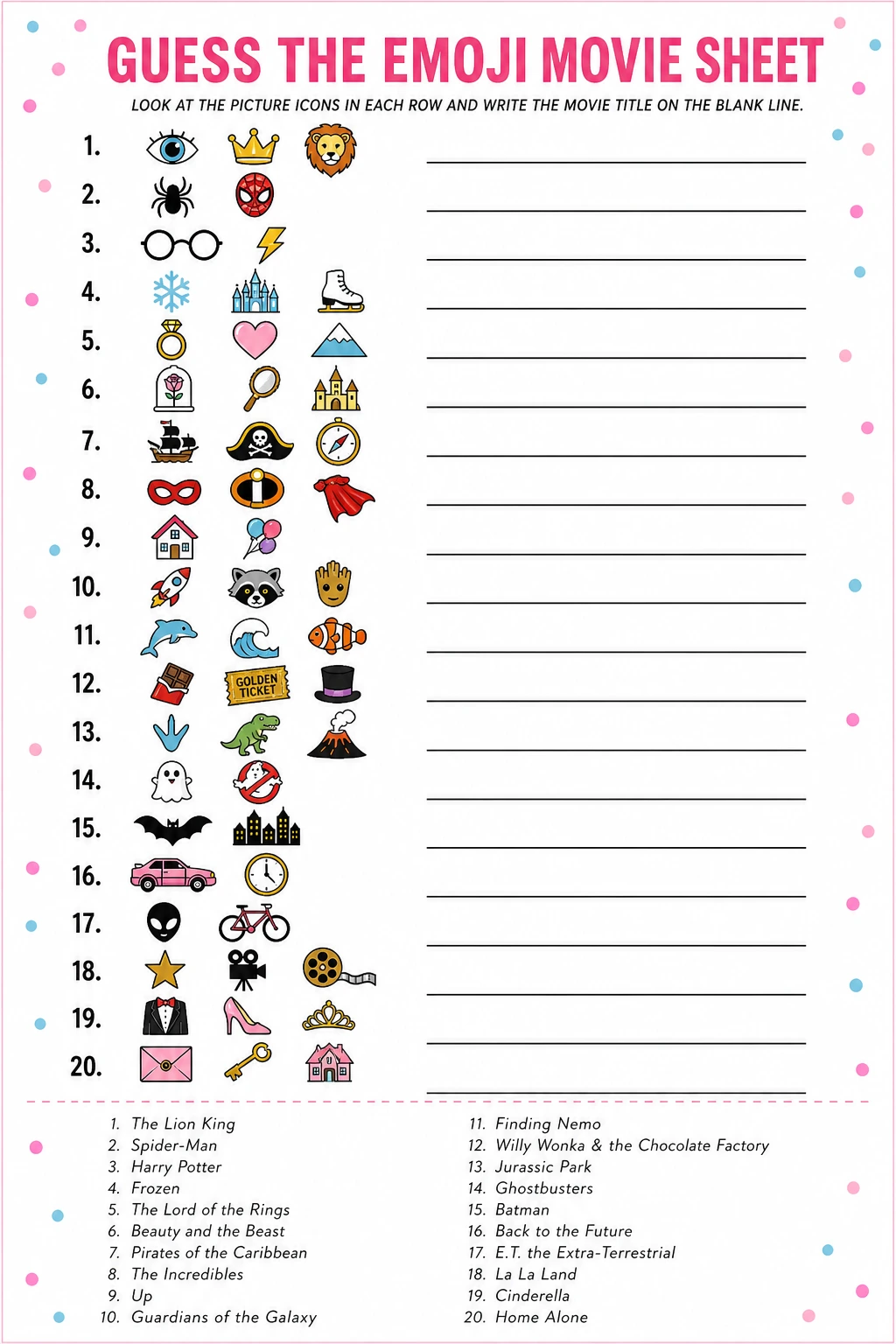
14. Sleepover Trivia Sheet
Trivia is always a hit when the questions are actually interesting — which is the whole key.
The Sleepover Trivia Sheet is a 20-question quiz covering categories that teens genuinely care about: pop culture, movies and TV, music, viral moments, and fun random facts that are surprising enough to make someone go ‘wait, seriously?!’
Everyone fills in their own sheet simultaneously, answers are revealed all at once, and the person with the highest score wins the title of Trivia Champion for the night (which is a title worth having, tbh).
The sheet is divided into 4 categories of 5 questions each, numbered continuously 1–20 across the whole sheet (Category A: Pop Culture = Q1–5, Category B: Movies and TV = Q6–10, Category C: Music = Q11–15, Category D: Random Amazing Facts = Q16–20).
Each question has a numbered blank write-in line for the answer.
A complete answer key with all 20 answers (1–20) is printed in small italic light-grey text at the very bottom of the sheet below the footer line — subtle enough not to spoil the game during play but easy to read when scoring.
The host controls the key reveal so nobody peeks early.
Group trivia at a sleepover works best when you score it together out loud — the host reads each correct answer, everyone groans or cheers, and the running tally builds real competitive tension.
For maximum drama, do a ‘sudden death’ tiebreaker question if two players finish with the same score. The tiebreaker is a speed question: first person to call out the correct answer wins.
This printable also works brilliantly as a ‘Table Activity’ if you’re doing a sleepover with a snack bar setup — guests can fill it in while they graze, which keeps everyone occupied during the chaotic first hour when not everyone has arrived yet.
- Everyone fills in their sheet simultaneously — no calling out answers
- Host reveals correct answers one by one from the key
- Ties go to a sudden-death speed tiebreaker question
15. Guess the Emoji Movie Sheet
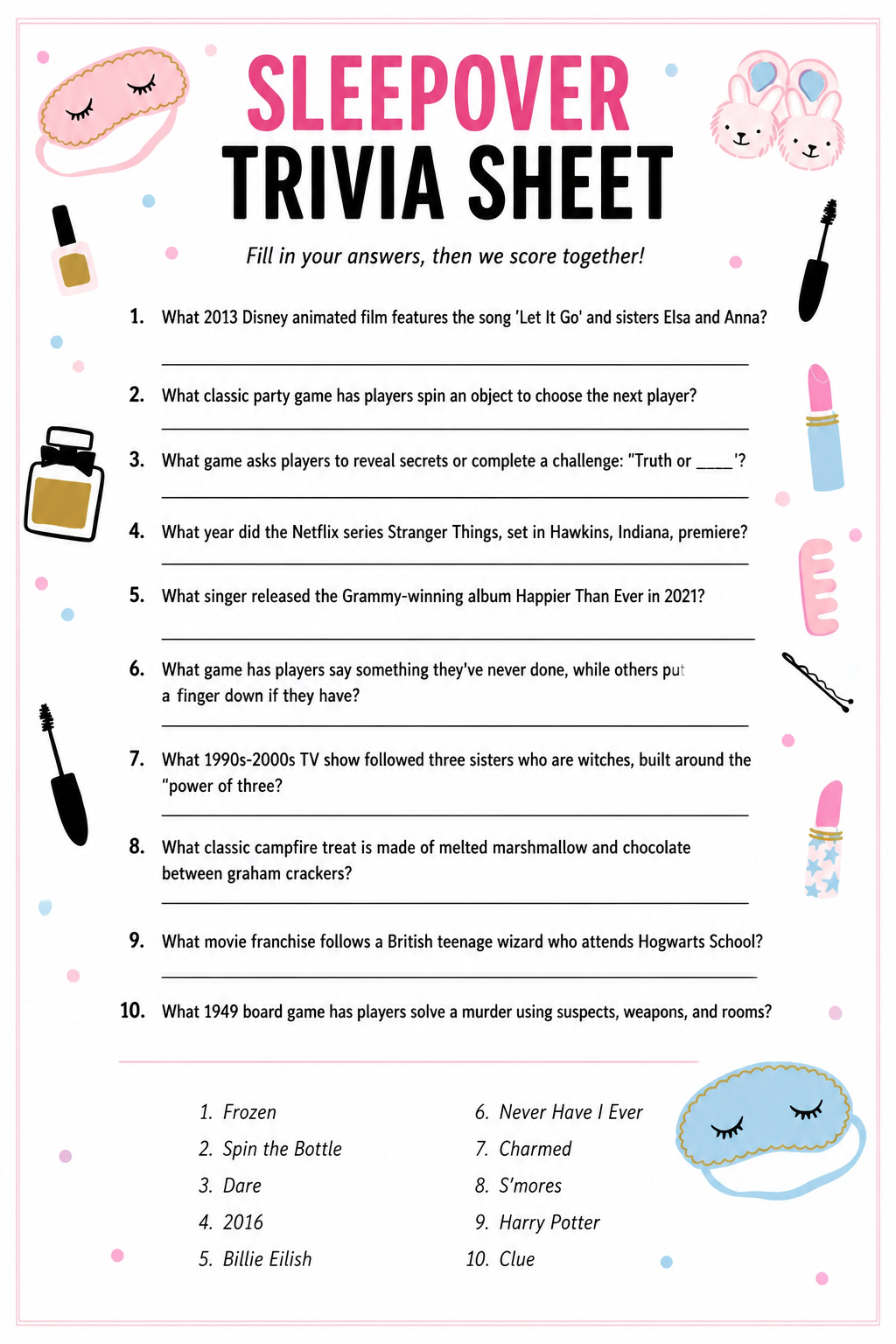
Guess the Emoji Movie Sheet is the printable that tricks people into thinking it’ll be easy and then absolutely humbles them. Each row shows a sequence of small drawn emoji-style picture icons that represent a movie title — no words, no hints, just the icons.
Players look at the icon sequence and write the movie title on the blank line beside it.
The catch is that some combos are genuinely tricky (a movie title that’s a phrase doesn’t always translate cleanly into pictures) and the group will spend a solid ten minutes loudly debating whether a particular sequence means one movie or a completely different one.
The sheet features 20 emoji-picture sequences, each drawn as actual small icon illustrations in a row — a tiny eye icon, a tiny crown icon, a tiny lion icon might spell out a famous animated movie, for example.
Each sequence is followed by a blank write-in line for the answer. The clues show ONLY the picture icons — no words, no bracketed descriptions, no spoilers beside the clue. Questions are numbered 1–20.
A complete answer key with all 20 answers (1–20) is printed in small italic light-grey upright text at the very bottom of the sheet below the footer divider, so the host can score everyone’s sheets at the end without the answers being visible during play.
This printable is a crowd favorite because it’s genuinely collaborative — people naturally start helping each other decode sequences, which means even the quietest person in the group gets drawn into the discussion.
It also rewards both pop culture knowledge and lateral thinking, which means different people in the group will ace different questions. Time it as a 10-minute sprint: set a phone timer, everyone writes down their best guesses, and then score all at once.
The ‘that was OBVIOUSLY that movie — how did you not get that?!’ reactions are peak sleepover content.
The picture-only clues make it collaborative — people naturally start helping each other decode, which pulls the whole group in even if they’re shy.
16. Best Friend Q&A Sheet
The Best Friend Q&A Sheet is a write-and-share printable where each guest fills in answers to 15 personal questions about themselves, then the sheets get shuffled and redistributed so everyone is reading someone else’s answers aloud to the group — and the group tries to guess whose sheet they’re hearing.
It’s the lovechild of the Friendship Quiz and a personality quiz, and it works beautifully because people write more honestly on paper than they’ll say out loud, which means you always get surprisingly real or funny answers.
The sheet’s 15 questions are a mix of light and slightly thoughtful: ‘The thing that makes me laugh every single time is ___,’ ‘My most used phrase is ___,’ ‘The most random thing I’m actually good at is ___,’ ‘If I could be anywhere right now I’d be ___,’ ‘People always think I’m ___ but I’m actually ___,’ and ‘The best thing about our friend group is ___.’
There’s a header blank for the writer’s name — which gets folded over and hidden before shuffling — and the reader reveals the name only after the group has guessed. Scoring: 1 point for correct guesses.
What makes this printable more powerful than a simple quiz is the combination of anonymity-then-reveal — it’s a perfect format for a group that includes both super close friends and people who are newer to the circle.
Writing down ‘the best thing about our friend group’ and then hearing it read aloud without knowing whose it is creates a genuinely warm moment that usually prompts a group ‘aww’ — which at a sleepover is exactly the kind of unexpected cozy energy you want at around midnight.
The junk journal ideas on our site are a great next-morning activity if anyone wants to turn their Q&A sheet into a memory page.
- Everyone fills in their own sheet fully
- Fold your name section over before handing it in
- Sheets are shuffled and redistributed — read aloud and guess whose it is

17. Sleepover Riddles Sheet
Riddles hit differently at sleepovers — especially at that 1 a.m. stage when everyone thinks they’re a genius but their brain is running at about 40% capacity.
The Sleepover Riddles Sheet is a printed challenge with 16 riddles ranging from easy warm-ups to genuinely tricky logic puzzles, all clean and age-appropriate.
Players solve them individually first, then compare answers, and the ensuing debate about who got the right answer and why is always half the entertainment.
The person who solves the most earns the title of ‘Big Brain of the Sleepover’ — which is an honor that should be taken very seriously.
The sheet is organized into two tiers: Tier 1 (Q1–8, labeled ‘Warm Up Your Brain’) features classic wordplay riddles with clear answers, and Tier 2 (Q9–16, labeled ‘Now We’re Talking’) features trickier lateral thinking and logic riddles that require a little more patience.
Questions are numbered continuously 1–16 across the sheet. Each riddle has a blank underline below it for writing the answer.
The complete answer key with all 16 answers (1–16) is printed in small italic light-grey upright text at the very bottom of the sheet below the footer line — not upside down, not rotated, just small and low-contrast enough that it won’t be spotted during play.
Riddles are a perfect sleepover game format because they require zero supplies, generate real discussion, and are naturally competitive without being confrontational.
The ‘I can’t believe I didn’t get that’ moment when the answer is revealed is universally satisfying, and the feeling of being the only one who got a tricky one right is a specific, excellent kind of smug.
For the best results, do the riddles out loud as a group after everyone has had a chance to write their individual answers — this way you get both the solo thinking time and the group reveal energy.
- Late-night play when everyone is half-tired and over-confident
- Groups of any size — works solo or competitive
- A quick 15-minute round between other games

18. Morning-After Awards
The Morning-After Awards are the perfect send-off printable — a set of certificate-style award cards that get filled in and handed out the morning after the sleepover as a way to commemorate the group’s collective chaos.
Each person in the group gets at least one award based on what actually happened during the night, and the host fills in the recipient’s name and the specific reason they won.
Categories include classics like ‘Last One Standing (Did Not Sleep Until Dawn),’ ‘Snack MVP,’ ‘Most Likely to Start a Conspiracy Theory at 2 a.m.,’ ‘Official Unofficial DJ,’ and ‘Best Dramatic Reaction of the Night’ — plus blank award cards for the host to create custom categories.
The sheet prints 8 award certificates per US Letter page, each styled as a proper certificate with a title banner, a name field (‘This award is hereby presented to: ___________’), a reason field (‘For the distinguished achievement of: ___________’), and a small ‘Presented at: Sleepover Night’ footer with a blank date line.
There are 6 pre-named award categories and 2 fully blank certificates for custom categories the host invents.
Print on cardstock for a more official feel, and present them at breakfast with dramatic flair — standing up and reading the citation out loud before handing over the certificate is the correct, mandatory way to do this.
The Morning-After Awards are the kind of printable that becomes a physical memory artifact — people actually keep these, stick them on their bedroom walls or in their journals, and reference them for years.
It wraps up the sleepover on a high note that’s funny, warm, and personal all at once, and it gives the host a structured way to acknowledge every single person in the group so nobody feels left out.
If you’re doing a full breakfast send-off, a batch of our Low Calorie Veggie Breakfast Bake is a surprisingly crowd-pleasing and easy next-morning dish — bonus points for feeding a group of sleepy teens without a lot of effort.
Fill in the awards the night before (when you remember what actually happened) rather than trying to recall specifics in the morning on zero sleep.

🛍 Shopping guide
19. Best Friend Q&A Circle
The Best Friend Q&A Circle is the quieter, in-person version of the printable sheet — a seated circle game where one person at a time is in the ‘hot seat’ and the group goes around asking them questions from a prompt list.
No sheets, no scoring — just real conversation. The host keeps a list of warm, thoughtful questions and picks one to kick off each person’s turn. Questions like ‘What’s one thing you want to do before next year?’
or ‘What’s something you used to love that you’ve kind of outgrown?’ or ‘What’s the nicest thing anyone in this group has ever done for you?’ These aren’t quiz questions — they’re conversation starters that lead somewhere real.
The format is simple: the group sits in a circle (floor, blankets, pillow pile — wherever feels cozy), and the host designates an order. When it’s your turn, the group asks you three questions from the list.
You answer honestly, and then — this is the part that makes it meaningful — each person in the circle adds one word of appreciation or reaction before you move to the next person.
The whole round typically takes 20–30 minutes for a group of six, and it almost always ends with someone saying something unexpectedly sincere that gets everyone quiet in the best way.
This game works best at the quieter, later part of the evening — midnight or beyond, when the energy has softened and people are in that half-tired, lowered-defenses state where they actually say true things.
It’s the game that teens remember weeks later as the part that made the sleepover feel different from just hanging out.
It requires nothing but a list of good questions and a group willing to be a little open — which, at a sleepover that’s gone well, is almost always achievable. The conversations that start here sometimes go until 3 a.m. (just saying).
Prep 20 prompts in advance and let the person in the hot seat choose which three they want to answer — it gives them control and makes the answers more honest.
20. Wishes for Each Other
Wishes for Each Other is the closing ritual that turns a sleepover into a genuine memory — and yes, I know that sounds dramatic, but stick with me.
Each person gets a small slip of paper (or an index card) for every other person in the group.
On each slip, they write one sincere wish for that specific friend: not a compliment, not an inside joke, but an actual wish for something good in their future. ‘I wish you get into the program you’ve been nervous about.’
‘I wish you remember you’re funny on the days you forget.’ ‘I wish you find the perfect playlist for your morning runs.’ Specific, personal, real.
The slips are folded and delivered to each person’s ‘mail pile’ — set up a simple system where each person has a small cup or a corner of the blanket to collect their slips.
After everyone has written and delivered, each person reads their wishes privately, or you can choose to share one aloud if you want.
The host can provide envelopes so guests can take their wishes home sealed, which gives them something to open the next morning when they’re back in their own room and the sleepover is officially over.
It’s a small thing that lands much bigger than you’d expect.
Wishes for Each Other works as the perfect closing game because it ends the night on pure kindness — no competition, no scoring, no phones required.
It also has a way of articulating things friends feel but rarely say out loud, which makes the connections formed during the sleepover feel more permanent.
For a complete self-care and mindset pairing, these self-concept affirmations are a wonderful next-day follow-on — something to read alongside those morning wishes and start the new day feeling genuinely good about yourself and your people.
Ending a sleepover on pure genuine kindness cements the memory of the whole night — it’s the last thing people remember, and it’s a good one.

Frequently Asked Questions
What are the best sleepover games for teens that don’t require any supplies?
The no-supply all-stars are Truth or Dare (Clean), Pass-the-Phone Confessions, Would You Rather Round, Best Friend Q&A Circle, and Wishes for Each Other.
All you need is a group of people and a good list of prompts — which you can prep in five minutes before anyone arrives. These games tend to generate the most natural conversation and the best memories of the night.
How many games should I plan for a teen sleepover?
Realistically, a sleepover from 7 p.m. to 10 a.m. the next day needs about 6–10 games or activities total, but don’t expect to do all of them. Having 20 options means you can read the group’s energy and swap games in and out as needed.
Plan 3–4 active or group games for the early evening, 4–6 printables for the mid-night snack-and-chill phase, and 1–2 quiet games for the wind-down. The rest are backups.
Are these sleepover games appropriate for tweens (ages 10–12)?
Yes — all 20 games are designed to be clean, age-appropriate, and fun for both tweens and teens. Nothing involves anything inappropriate, scary, or exclusionary.
The printable card decks (Truth or Dare Cards, Would You Rather Cards, Trivia Sheet) can be adjusted slightly for younger groups by using the easier question tiers, and games like MASH, Dream Journal Page, and Wishes for Each Other work beautifully for the 10–12 age group.
How do I print the printable game sheets?
Download the sheet, open it in any PDF viewer, and print at 100% scale (not ‘fit to page’) on US Letter paper (8.5 x 11 inches).
For card decks (Truth or Dare Cards, Would You Rather Cards, Best Friend Q&A Sheet), print on 110lb cardstock for sturdiness. For bingo cards and single-play sheets, regular printer paper works perfectly.
A paper trimmer makes cutting card decks much faster and cleaner than scissors.
What’s a good order to run these sleepover games during the night?
Start with the high-energy crowd-pleasers (Truth or Dare, Pass-the-Phone Confessions, Would You Rather Round) to break the ice, then move into the active games (Whisper Challenge, Blindfold Taste Test) when energy is high.
Roll out the printables (Bingo, Trivia, MASH, Emoji Movie Sheet) during the snack-and-sit phase, and save the quiet, meaningful games (Best Friend Q&A Circle, Wishes for Each Other, Dream Journal Page) for late night when the vibe naturally slows down.
What should I do if someone doesn’t want to participate in a game?
Always keep participation optional — a good sleepover has zero pressure. For Truth or Dare, build in a ‘skip’ token each player can use once per round. For printables, anyone can just watch and help score instead of playing.
The Best Friend Q&A Circle and Wishes for Each Other can be done in writing instead of out loud for anyone who’s shy. The goal is that everyone feels included and comfortable, not that everyone does every single thing.
📌 Save These for Later
Loved these? Pin your favorite image below so you can find this list again when you’re planning.

Discover 20 fun back to school party games perfect for primary-age kids, including printable sheets,

28 lavender balloon arch ideas paired with the right second colour so every arch looks considered, n

18 brilliant hen party games for a UK hen do — from rowdy group challenges to sweet quiet moments.
Leave a Reply