

20 Family Game Night Ideas That Get Everyone Laughing (Phones Down)
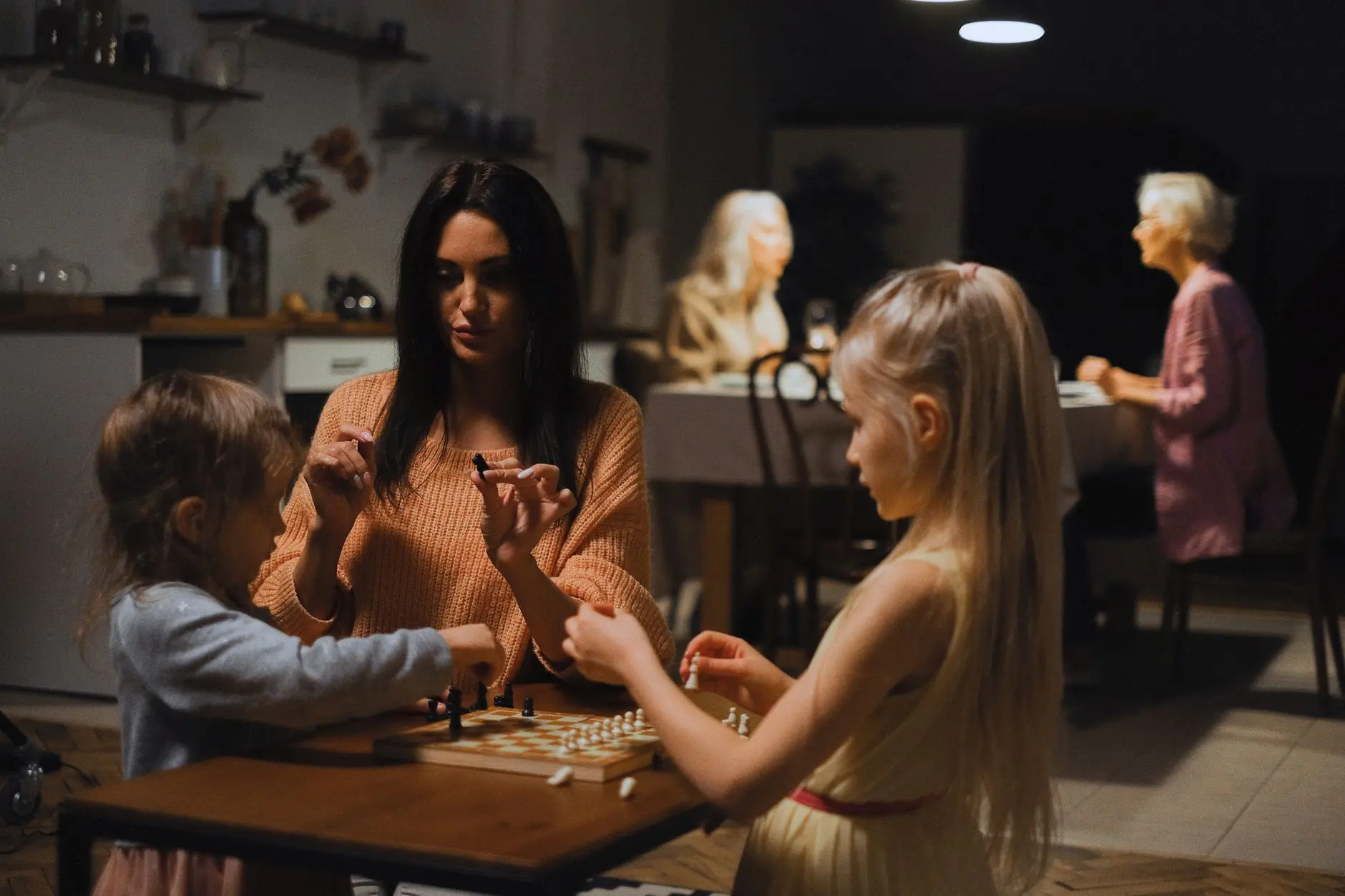
If you’re on the hunt for fun family game night ideas that actually pull everyone away from their screens (yes, including the teenagers), you are in exactly the right place.
I’ve rounded up 20 games that cover everything from full-room chaos to cozy, laugh-until-you-cry moments — all designed for mixed ages, zero awkward silence, and exactly zero phones on the table. We’re talking phones down, snacks out, and everyone genuinely in it together.
The best family game nights I’ve ever hosted didn’t need fancy setups or expensive equipment — they just needed a solid lineup and a little bit of silliness.
So whether your crew is four people or fourteen, this list has a little something for every energy level. Print the printables (there are 12!), queue up the active games, and get ready for a night your family will be talking about all week.
Fair warning: you will laugh so hard you cry at least once. That’s basically the whole point.
This post contains affiliate links — if you buy through them, I may earn a small commission at no extra cost to you.
- Reverse Charades
- Heads Up Family Edition
- Saran Wrap Ball
- Balloon Keep-Up
- Musical Chairs
- Family Talent Show
- Family Bingo
- Funny Would You Rather Cards
- This or That Family Sheet
- Family Riddles Sheet
- Guess the Song Emoji Sheet
- Family Mad Libs Sheet
- Minute to Win It Challenge Cards
- Scavenger Hunt Sheet
- Game Night Score Sheet
- Awards Certificates
- Charades Card Deck
- Guess How Many Jar Sheet
- Two Truths and a Lie
- Best Moment Share
- Frequently Asked Questions
1. Reverse Charades
Reverse Charades is the absolute perfect opener for a fun family game night because it does something magical: it gets the whole team on their feet at once.
Instead of one shy person awkwardly flailing their arms while everyone watches, the entire team acts out the word while just one person guesses. The pressure is shared, the energy is wild, and honestly the chaotic group miming is half the entertainment.
Split everyone into two teams — kids vs. adults works great — pick a guesser for each round, and let the actors go absolutely unhinged trying to mime ‘tornado’ as a unit.
Each round is 60 seconds, and the guesser calls out answers freely the whole time. No talking from the actors — not a peep, not even mouthing — or the team loses a point.
One skip per round is allowed if a word is truly impossible. You can use the official Reverse Charades card game, or just write your own prompts on scraps of paper.
Family-friendly categories like animals, movies, and everyday actions work perfectly for mixed ages and keep everyone in the running.
The reason this game works so well to kick off the night is the instant noise level it creates. Even grandparents who ‘don’t really do games’ end up doubled over laughing watching four people collectively try to act out ‘spaghetti.’
It breaks the ice in about thirty seconds flat, loosens everyone up, and sets the silly tone for every game that follows.
Host tip: have a few rounds where kids and adults are mixed on the same team — the generational miming differences alone will have you in tears.
Mix ages on the same team for the funniest miming combinations — watching a grandparent and a seven-year-old try to act out ‘rollercoaster’ together is unbeatable.
🛍 Shopping guide
2. Heads Up Family Edition
Heads Up Family Edition is one of those games where you look up ‘fun family game night ideas’ and this one is always near the top — and for good reason.
The concept is beautifully simple: one player holds a card (or phone with the app) against their forehead showing a word only everyone else can see, then their teammates shout, act, and give clues until the guesser figures it out.
The family edition keeps categories kid-friendly with things like animals, movies, and famous characters, so a six-year-old and a sixty-year-old can both play competitively. It is genuinely one of the great equalizers.
You can play the official Hasbro card version for a fully phones-down night — just hold the card to your forehead and let the chaos begin. Set a one-minute timer, rotate the guesser each round, and track points with a simple tally on paper.
For larger families, split into two teams and have each team’s guesser compete simultaneously for the same card — whoever gets it first wins the point. It adds a race element that makes the room absolutely erupt.
What makes Heads Up a perennial favorite is how it naturally scales to any group. Little kids love giving the clues (and are surprisingly good at it), teens get competitive, and adults get completely humbled when a nine-year-old knows a pop culture reference they don’t.
Rotate guessers every round so everyone gets their moment in the hot seat, and do NOT skip the round where someone accidentally describes their own face while guessing ‘mirror.’ It always happens. Always.
- Mixed ages 6 and up
- Groups of 4–14 players
- Zero-prep nights — just grab the card deck
3. Saran Wrap Ball
If you have never played the Saran Wrap Ball game, prepare yourself — this one is pure, chaotic, everyone-screaming-at-once fun. The host builds a giant ball of plastic wrap with small prizes, candy, and funny challenge slips hidden between the layers.
Players sit in a circle: one person frantically unwraps the ball with oven mitts on while the person to their left races to roll doubles with a pair of dice.
The second those doubles land, the ball gets passed to the dice roller, who slaps on the mitts and starts unwrapping. Whatever falls out during your turn? Yours to keep.
Building the ball is half the fun for the host. Start with a small solid center — a bouncy ball works great — then wrap outward in long spiraling strips of plastic wrap, tucking in prizes as you go.
Space them a few layers apart so the game lasts at least 10–15 minutes. Good filler ideas: mini candy bars, dollar bills folded small, gift cards, stickers, funny dare cards, and a few ‘wild card’ slips that earn bonus prizes.
Tape every few layers to add satisfying resistance and make those oven-mitt-wearing hands work for it.
The reason this game belongs on every family game night list is the completely unscripted drama it creates. Someone always gets the mitts tangled. Someone else always rolls doubles at the exact wrong moment. The room is always cheering and jeering simultaneously.
For a family-friendly twist, include a few ‘challenge’ slips that make the winner do something silly — a silly dance, a funny face, or a dramatic victory speech — before they can keep their prize. It elevates the chaos from great to legendary.
- 300 ft roll of plastic wrap / cling film
- Two pairs of dice
- Oven mitts (one pair)
- Small prizes: mini candies, stickers, folded dollar bills, dare slips
🛍 Shopping guide
4. Balloon Keep-Up
Balloon Keep-Up is the game that turns your living room into absolute beautiful mayhem, and it requires exactly zero preparation. The rule is devastatingly simple: blow up one balloon and do not let it touch the floor. That’s it. That’s the game.
Except it is somehow never simple at all, because the moment that balloon starts drifting toward the lamp or bouncing off someone’s head, every single person in the room is suddenly sprinting and diving like they’re in the Olympics.
It’s the kind of game that sounds too easy until about fifteen seconds in.
To level it up for a group: add more balloons (two is mayhem, three is full anarchy), or introduce rules like ‘no using your hands’ or ‘you can only tap it with your elbow.’
Another great variation for mixed ages is to assign each player a color — two or three balloons of different colors are in the air simultaneously, and each person can only tap their own color. It gets wonderfully frantic.
You can also play as a true team — set a timer for two minutes and try to beat your collective ‘no-touch’ record each round.
Balloon Keep-Up is one of those rare games where the youngest kid in the room has just as much of a shot as the adults, which makes it a fantastic palate cleanser between bigger rounds.
It burns off energy, gets the giggles going again, and costs about fifty cents in balloons.
Plus — and I say this with love — watching an adult dive across the couch in complete desperation to save a balloon from hitting the rug is some of the best entertainment money can’t buy.
For younger kids, use a larger balloon — it floats slower and gives tiny hands more time to react.
🛍 Shopping guide
5. Musical Chairs
Musical Chairs is a classic for a reason — it is intensely fun, requires nothing but chairs and music, and produces the kind of slow-motion ‘oh no’ panic-face moments that get brought up at family gatherings for years.
For game night, play the traditional version: set up one fewer chair than there are players, play music, everyone walks or dances around the chairs, and when the music stops everyone scrambles for a seat.
The player left standing is out, one chair is removed, and the drama continues. It sounds simple. It is simple. It is also inexplicably tense every single time.
For a family game night spin, try ‘cooperative musical chairs’ — instead of eliminating players, the challenge is to fit everyone onto the remaining chairs. Players pile onto laps and squeeze together until somehow six people are balanced on two chairs.
It’s less about competition and more about collective problem-solving and giggling.
You can also do Musical Chairs with silly poses: whoever is left standing when the music stops has to hold a funny pose chosen by the group (statue, superhero, sleeping — you get the idea) before they’re officially out.
The beauty of Musical Chairs for a mixed-age game night is its zero-explanation learning curve. Kids get it in seconds. Grandparents remember it fondly.
Even the person who ‘doesn’t really play games’ will find themselves sprint-walking toward a chair with alarming determination the moment that music cuts out. Queue up a random playlist and let someone else control the stop button — total power, zero accountability.
They will abuse it. Encourage this.
No reading, no rules to memorize, no teams — pure instinct kicks in and suddenly even the most reluctant player is fully in it.
6. Family Talent Show
The Family Talent Show is the game night event that nobody expects to love and everyone ends up absolutely losing it over. Each person (or pair, or team) gets two to three minutes to perform their ‘talent’ — and I use that word generously.
Official talents welcome, obviously, but the real gold comes from the ‘talents’ like speed-eating crackers, doing an impression of the family dog, or reciting the alphabet backwards while spinning. The bar is low. The entertainment is high. This is the whole point.
Set up a small ‘stage’ — just a clear patch of floor works perfectly — and designate a panel of judges (rotating, so everyone gets a turn critiquing and performing).
Score each act on a scale of 1 to 10 for creativity, execution, and audience reaction. Hand out paper score cards so the judging feels official.
Give people five minutes to ‘prepare’ their talent privately before the show starts, which produces a delightful pre-show energy of whispered scheming and practice runs in the hallway.
The reason a Talent Show belongs on any list of fun family game night ideas is that it creates content — inside jokes and memories that your family will reference forever.
‘Remember when Dad did that magic trick and the coin fell down the heating vent?’ is a story that gets better every year it’s told.
Pair this game with the Awards Certificates printable later in the list and hand out ‘Best Performance,’ ‘Most Creative,’ and ‘Bravest Soul’ certificates at the end of the night for maximum sentimental chaos.
Give a ‘Most Improved’ award too — it lets even the goofiest performance feel celebrated, and keeps the energy warm rather than competitive.
7. Family Bingo
Family Bingo is the printable that earns its place at every fun family game night because it is the one game where absolutely everyone can play at exactly the same time — no waiting for turns, no sitting out.
Each player gets a unique 5×5 bingo card filled with fun family-night scenarios instead of plain numbers: things like ‘someone laughs so hard they snort,’ ‘someone forgets the rules,’ ‘someone blames the dog,’ or ‘a phone buzzes despite the phones-down rule.’
The caller draws prompts from a shuffled pile of matching cards, and the first player to get five in a row wins bragging rights for the entire evening.
Print one card per player on regular printer paper — cardstock holds up better if things get competitive (things always get competitive). Bingo markers can be anything: pennies, dried beans, torn pieces of paper, or M&Ms (which doubles as a snack and a stake).
For a longer game, play ‘full blackout’ instead of a single line: every square must be covered. For younger kids, make it easier by calling out the prompts dramatically and acting them out briefly so everyone’s following along at the same speed.
What makes the family-scenario version of bingo shine over regular bingo is that the prompts are observations happening in real time around the table.
When someone actually does laugh so hard they snort, every person holding that square lunges for their marker simultaneously — and then erupts. It turns passive observation into active game participation, which means everyone is paying attention to everyone else all night long.
That’s the phones-down magic right there.
- All ages 5 and up
- Groups of 4–20 players
- Works as an ongoing background game running parallel to other rounds

🛍 Shopping guide
8. Funny Would You Rather Cards
Would You Rather is one of those deceptively simple games that somehow turns into a forty-five-minute philosophical debate about whether you’d rather have spaghetti for hair or sneeze glitter, and everyone has a strong opinion.
This printable deck brings 20 funny, all-ages dilemmas to the table — the kind that spark instant laughter, wild justifications, and the occasional ‘wait, I need to think about this more seriously than I should.’
Each player draws a card, reads the question aloud, and everyone votes simultaneously — thumbs up for Option A, thumbs down for Option B — before anyone reveals or defends their answer. Then the chaos begins.
Print the sheet on cardstock and cut along the dotted lines to create individual prompt cards. Shuffle the deck and place it face-down in the center of the table. Players take turns drawing the top card and reading it aloud.
After everyone votes, each person gives a one-sentence reason for their choice — this is where the game truly lives, because the reasoning is always wilder than the question. For younger kids, keep it lighthearted (silly superpowers, food choices, funny animal situations).
For bigger groups, add a house rule: the person whose answer is in the minority has to do a ten-second silly dance.
The Would You Rather card format is magic for a mixed-age group because there are no wrong answers, no elimination, and no pressure — just pure opinion-sharing and the joy of discovering that your quiet uncle would absolutely rather fight one horse-sized duck than a hundred duck-sized horses, and he has very detailed reasons why.
It’s also a sneaky conversation-starter that reveals hilarious family personality traits you never knew existed. Pair it with a snack break and prepare for time to disappear.
No wrong answers means no one feels left out — even the youngest player has a fully valid take, and everyone genuinely wants to hear it.

9. This or That Family Sheet
This or That is Would You Rather’s faster, snappier cousin — and it is absolutely perfect for the point in game night when attention spans are getting pleasantly frayed by too many laughs.
Each row on the sheet presents two options side by side and players simply circle their pick. No defending, no debating (unless you want to — you always want to). The family edition keeps it fun and universal: pizza vs. tacos, beach vs.
mountains, morning person vs. night owl, cats vs. dogs. It takes about three minutes to fill out and produces ten minutes of conversation, which is the best return-on-time ratio in game night history.
Print one sheet per player. Set a two-minute timer and have everyone fill it out simultaneously, then go around the table comparing answers one row at a time.
Tally how many people picked each option with a quick show of hands — anything that ends in a 50/50 split becomes a mandatory debate round where each side has 30 seconds to make their case.
Keep score on the Game Night Score Sheet (later in this list) for extra stakes, or just enjoy the chaos of discovering that every single family member has a different answer for ‘fork vs. chopsticks.’
The This or That sheet is also a beautiful keepsake. Date the sheets and keep them — pulling out last year’s answers in a future game night and comparing how people’s opinions have changed is genuinely touching and hilarious in equal measure.
Kids’ answers especially evolve in the best ways. And if your family is anything like mine, someone will have a wildly unpopular opinion that gets brought up at every future gathering as a beloved piece of family lore.
(You know who you are, Team Pineapple on Pizza.)
Save everyone’s completed sheets in a folder each year — reviewing old answers together at future game nights becomes a genuinely sweet tradition.

10. Family Riddles Sheet
A Family Riddles Sheet is the game that makes everyone feel secretly brilliant for about four seconds before the answer is revealed and they realize they should have gotten it immediately.
This printable features 16 all-ages riddles — a mix of classic brain twisters and sillier wordplay riddles — with a small, subtle answer key printed upside-down at the bottom of the sheet.
Players read each riddle silently, write their best guess on the blank line provided, then the group reveals and discusses. The person with the most correct answers wins the round, and the person with the most creative wrong answer wins the crowd.
Print one sheet per player or one per team — teams actually make this more fun because the debate over the answer is half the entertainment.
Set a five-minute timer for everyone to work through all 16 riddles independently, then go through them one at a time as a group. Read each riddle aloud, ask for a show of hands for different guesses, then flip to the answer.
For an extra layer of fun, award a bonus point for the funniest wrong answer — it removes the sting of getting stumped and keeps the energy positive all the way through.
What makes riddles such a great addition to a fun family game night is the beautiful cross-generational leveling they provide.
Some riddles are genuinely easier for kids (their lateral thinking is unfiltered and often exactly right), while others require vocabulary or logic that gives adults an edge.
Nobody dominates the entire sheet, which means the scoreboard stays close and everyone gets at least one glorious ‘I got it!’ moment. That moment of triumph — pointing at the sheet going ‘I KNEW it was a shadow!’ — never gets old.
For younger kids, read each riddle aloud dramatically with big pauses — it gives their brains time to work and makes the whole experience feel like storytime.

11. Guess the Song Emoji Sheet
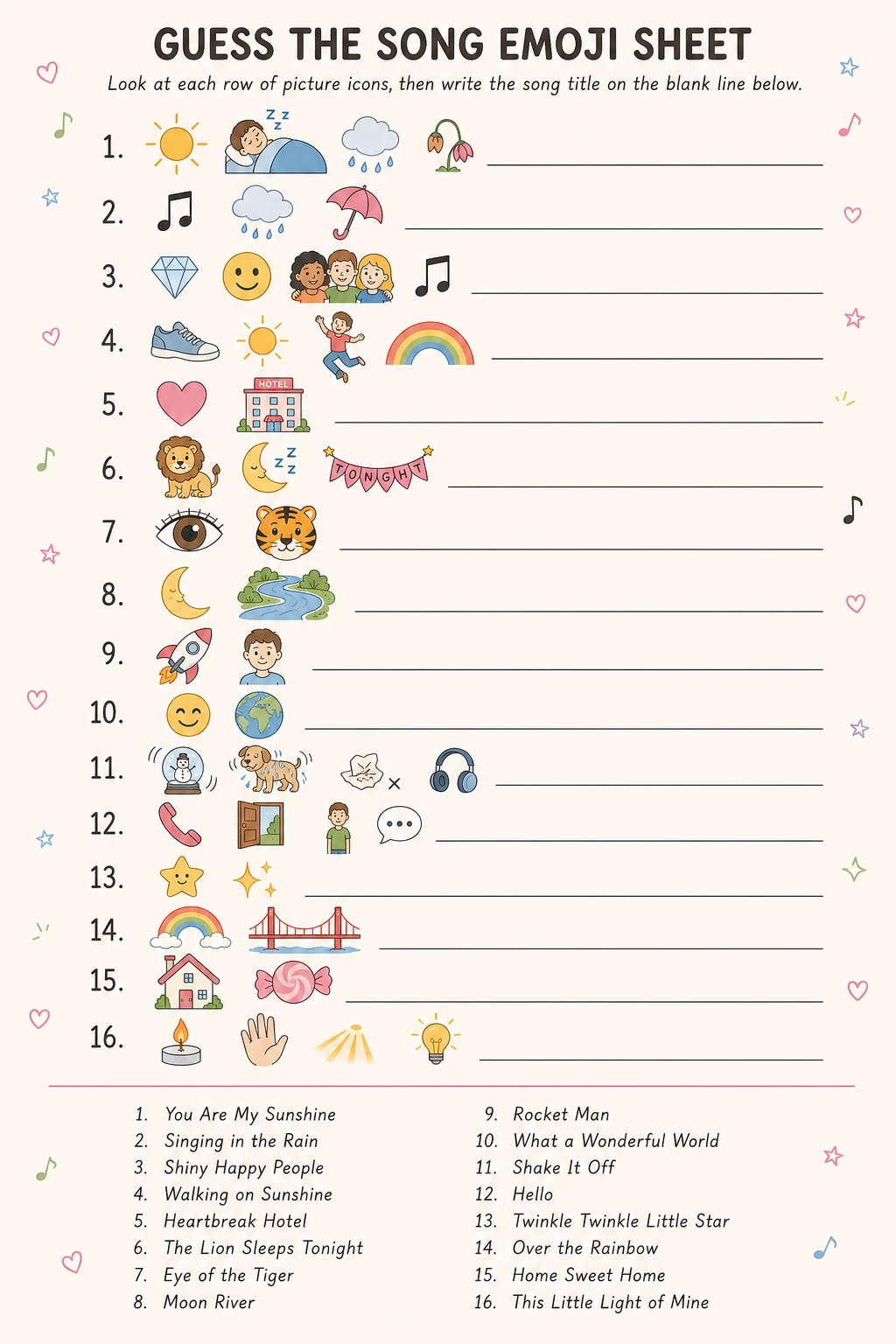
The Guess the Song Emoji Sheet is the printable that causes the most noise, the most arguments, and the most triumphant ‘YES that’s exactly what I meant’ moments of the entire night — and I mean that in the best possible way.
Each of the 16 puzzles on the sheet is a sequence of small picture icons (emoji-style illustrations drawn directly on the sheet) representing a well-known song title.
Players study the icons, write their best song title guess on the blank line below each puzzle, then compare answers as a group. The room will debate. The room will be divided. Someone will absolutely insist a certain combination means a completely different song.
It is wonderful.
Print one sheet per player or per pair. Give everyone five to seven minutes to work through all 16 puzzles independently before the big reveal.
Then go through each one aloud — read the icons dramatically, collect everyone’s guesses, and reveal the answer with appropriate fanfare. Award one point per correct guess.
The subtle answer key lives at the very bottom of the sheet in tiny light text so it’s there if you need it as the host, but it doesn’t spoil the puzzle for players.
Songs span multiple genres and decades so that every generation has at least a few they’ll nail.
The secret genius of the emoji song format for a mixed-age family night is that it genuinely levels the playing field across generations.
A kid who has never heard a classic rock song can still figure out the icons with fresh eyes, while adults might solve the older songs instantly and get totally stumped by a newer one. Nobody has a complete advantage.
For a fun tiebreaker, the person who gets the most right has to hum their favourite winning song while everyone else tries to name the tune within ten seconds.
Spanning multiple decades of music means grandparents ace the classics while kids nail the recent hits — the scoreboard stays genuinely close all round.
12. Family Mad Libs Sheet
Mad Libs is the game that proves a noun, a verb, and an adjective are all you need to produce something so unhinged your family will be quoting it for months.
The Family Mad Libs Sheet features two short fill-in-the-blank story templates: one about a wildly eventful family game night and one about a disastrous family road trip.
Before reading the story, one player asks the group for words by category only — ‘give me an adjective!’ — and fills in the blanks with whatever chaos the group provides. The story is then read aloud in full, dramatic, committed voice. Chaos ensues. Always.
Print one sheet per group or round — you’ll want to play multiple times because the stories get better (more unhinged) with each round. The word-collection phase works best when the asker makes it theatrical: big pauses, raised eyebrows, dramatic pen tapping.
Kids especially thrive in the word-providing role because they have absolutely no filter and will donate the word ‘slimy’ or ‘exploding’ for every single category without hesitation.
Print a few extra copies so different family members can lead a round each — the variations are always wildly different and wildly funny.
What makes Mad Libs a perennial hit for fun family game night ideas is its scalability and zero learning curve. Age three to ninety-three, everyone can participate in some way — even the littlest ones can shout out an animal or a color.
Reading the completed story aloud is a performance in itself, and whoever does the reading with the most commitment (full character voices, dramatic pauses at the absurd bits) always wins the most applause.
Pair this one with the Family Talent Show earlier in the night for maximum theatrical energy.
Designate one person as the dramatic story reader and encourage full commitment — monotone delivery wastes the best Mad Libs moments.

13. Minute to Win It Challenge Cards
Minute to Win It is the game that turns your kitchen table into an athletic arena and your family members into deeply determined, slightly ridiculous competitors — and this printable card deck puts 16 one-minute challenges at your fingertips without any complicated setup.
Each card describes a challenge using items you almost certainly already have at home: move a stack of pennies using only a popsicle stick, keep a balloon in the air using only breath, transfer cotton balls between bowls using a spoon held in your mouth, or balance three cookies on your forehead and get them to your mouth without using your hands.
The rules are simple: you have exactly 60 seconds to complete the challenge or you’re out.
Print and cut out the cards, then shuffle them into a face-down deck. Players take turns drawing a card and performing the challenge while everyone else watches, cheers, and silently judges.
A designated timer-keeper counts down from 60 (or uses a phone timer — the one and only acceptable phone use of the evening). Successful completions earn a point on the Game Night Score Sheet.
You’ll need a small prop kit gathered ahead of time: pennies, cotton balls, plastic cups, ping pong balls, and a few craft sticks cover most challenges on the deck.
The reason Minute to Win It challenge cards are a must-have for any game night printable set is pure, unfiltered entertainment value — both for the player doing the challenge and for the audience watching.
Seeing an adult try to shake a tissue box full of ping pong balls strapped to their back, or watching the most competitive family member absolutely lose it over a cookie-forehead challenge, is the kind of comedy that no screen can replicate.
It’s also the best proof of concept for the whole phones-down philosophy: nothing on any device is funnier than this live.
- Pennies or small coins
- Cotton balls
- Plastic drinking cups
- Ping pong balls
- Popsicle / craft sticks
- 60-second timer

🛍 Shopping guide
14. Scavenger Hunt Sheet
An indoor family scavenger hunt is one of the most genuinely joyful ways to spend 20 minutes of a game night — especially if you have younger kids who need a high-energy break between the sit-down rounds.
This printable Scavenger Hunt Sheet lists 20 items for players to find around the house as fast as possible, ranging from easy classics (‘something blue,’ ‘something that makes a noise’) to trickier creative challenges (‘something that represents your family’ or ‘something older than you’).
The sheet also includes five bonus challenge items for extra points, making it competitive for both the quickest and the most creative hunters.
Print one sheet per player or team. Players race through their own home finding and listing (or collecting and showing) each item.
Set a timer for 10 minutes — shorter if you want more urgency and chaos, longer if you have a large house or want to give younger kids a fair shot. When time’s up, everyone reconvenes to compare lists.
Award one point per correct find, two points for bonus items, and a special bonus point for the most creative interpretation of an open-ended clue. The Game Night Score Sheet from later in this list is the perfect companion to track cumulative points.
The family-specific scavenger hunt format has a gentle surprise up its sleeve: the ‘creative’ clues — ‘something that represents your family,’ ‘something that makes you feel proud’ — tend to produce unexpectedly sweet moments in the middle of all the chaos.
Kids will bring things you didn’t expect; adults will get briefly emotional about the item they chose.
It is simultaneously the silliest and the most quietly meaningful game on this whole list, and it costs nothing but a printer and a good hiding spot for the bonus item clues.
Hide one surprise ‘golden item’ somewhere in the house before game night — the first person to find it earns a bonus prize or gets to choose the next game.

15. Game Night Score Sheet
Every great game night needs a scorekeeper, and the Game Night Score Sheet is the printable that transforms a casual evening into a proper tournament — without requiring anyone to be a mathematician.
This clean, easy-to-use score tracker has columns for up to six players or teams, rows for up to eight game rounds, a running tally section, and a Final Champion line at the bottom with a little celebratory trophy graphic.
It’s the kind of sheet that makes the whole night feel official, and there’s something deeply satisfying about watching the scores shift over eight rounds of wildly different games.
Print one sheet per game night and nominate a willing scorekeeper at the start of the evening — ideally someone with legible handwriting and no strong personal investment in winning (tbh, that second part is negotiable).
Each row corresponds to a game on the night’s lineup. Fill in player or team names at the top and update the scores after each game wraps up.
The running tally column at the right side keeps a live total so there’s always a live leaderboard anyone can check at a glance, which adds a satisfying undercurrent of competition to the whole night.
The Game Night Score Sheet also doubles as a memory — note the date at the top and keep the completed sheets in a folder after each game night.
Looking back at old score sheets is a genuinely lovely time capsule of who beat whom at what, which games were everyone’s favorites, and how much the scores have shifted as kids have grown.
It’s a small thing that becomes a big thing over time, and it costs one sheet of paper. For an extra personal touch, have the champion sign the bottom of the sheet. Power move, honestly.
Laminate one score sheet and use a dry-erase marker — reuse it every game night and wipe clean between sessions.

16. Awards Certificates
Awards Certificates are the grand finale printable of the evening, and they might be the most underrated item on this entire list. At the end of the night, the host hands out personalized award certificates to every single player — not just the winner.
Categories include things like ‘Best Sport,’ ‘Loudest Laugh,’ ‘Most Creative Answer,’ ‘Most Dramatic Loser,’ ‘Comeback Kid,’ ‘Best Snack Contribution,’ and ‘Undisputed Champion.’
The result is that everyone leaves with something, the night ends on a warm and funny note, and the certificates inevitably end up on refrigerators for weeks.
Print the certificate sheet ahead of time and fill in names and award titles by hand during the last game of the evening — it only takes about five minutes and the anticipation of not knowing which award you’re getting is its own little game.
Cut along the dotted lines before the ceremony and present each one with the appropriate level of pomp. Hand them out with a drumroll, a handshake, and a short (completely improvised) speech explaining why this person won this particular award. Yes, this is silly.
That is the entire point.
What the Awards Certificates really do — beyond the laughs — is give every person at the table a moment of being seen and celebrated for something specific about how they showed up that night.
It reframes the entire evening from ‘who won the most games’ to ‘everyone brought something great.’
For families with kids who might get frustrated by losing, this is genuinely powerful: they get a certificate for ‘Best Cheerleader’ or ‘Most Enthusiastic Player’ and suddenly the night is a win for them too.
Keep a set of blank extras ready for impromptu categories you invent on the spot — and you will invent them, I promise.
- Families with kids who need a confidence boost
- Ending the night on a warm, everyone-wins note
- Creating a fridge-worthy keepsake from the evening

17. Charades Card Deck
Every game night needs a Charades Card Deck, and having a printable version means you are never scrambling to think of prompts when it’s someone’s turn and the room is staring at them expectantly.
This deck of 24 cards covers six categories — animals, movies, everyday actions, famous characters, foods, and ‘family favorites’ (things unique to game night culture) — with four cards per category.
The result is a balanced, mixed-difficulty deck that works for ages 5 to 95 and keeps the rounds feeling fresh rather than repetitive. Shuffle the deck, draw a card, flip the timer, and act.
Print on cardstock and cut along the dotted lines for a sturdy, reusable deck — or laminate them for the truly committed game night host (we see you).
The standard charades rules apply: no talking, no pointing at objects in the room to name them directly, and no mouthing the words.
But house rules are encouraged: some families play with sound effects allowed, some play with props, and some play with a ‘help token’ system where the actor can buy one clue word by spending a point.
Make the deck yours and adjust difficulty by separating easy cards (animals, foods) from harder ones (movie titles, abstract actions) for mixed-age rounds.
The Charades Card Deck pairs beautifully with Reverse Charades from earlier in this list — use the same deck for both games to show your family how wildly different the same prompt feels when one person acts vs. the whole team.
It’s a built-in highlight reel of contrast: someone doing their best solo impression of ‘spaghetti’ followed immediately by the entire family acting it out together is the kind of bit that makes game night legendary.
If you also pair these cards with your scrapbook ideas by photographing the funniest acting moments, you’ve got gold content for your family memory book.
- Draw a card, show it to NO ONE
- Set a 60-second timer
- Act it out — no talking, no mouthing, no pointing at the object directly
- Team guesses freely; correct guess = 1 point

18. Guess How Many Jar Sheet
Guess How Many is one of those classic guessing games that sounds almost too simple to be worth including — until everyone is huddled around a jar of gummy bears with deeply intense expressions doing silent math with their hands, and you realize this is the most focused your family has been all evening.
Before the night begins, the host fills a clear jar with small countable items (wrapped candies, dried beans, buttons, mini marshmallows — anything fun) and counts the exact total secretly.
Guests fill in their name and their guess on the Guess How Many Jar Sheet, and the closest guess without going over wins the whole jar. The drama of the reveal is always disproportionate to how simple the game is.
The printable sheet gives each guest a dedicated row with a blank for their name and their guess, plus a ‘reasoning’ column — a fun extra where they write one sentence explaining their strategy.
This column is optional, but it produces some of the most unintentionally hilarious content of the night: ‘I multiplied the circumference by pi and divided by a gummy bear,’ ‘I just felt it in my bones,’ and ‘My answer is 47. Final answer.’
The host can pre-fill the ‘Item in Jar’ field at the top — or leave it blank until reveal time for extra mystery. The actual count is only revealed after everyone has submitted their guess.
Set the jar on the table at the start of the night and let it be a slow-burn game that runs in the background while other rounds happen.
Guests can revise their guess once at any point before the final reveal — but they have to explain why they changed their mind.
Close guesses get honorable mention; the winner claims the jar and ideally shares it with the table (social pressure is a beautiful enforcer).
For a gentle evening wind-down, do the reveal after the Talent Show when energy is still high but the group is ready to sit.
Fill the jar with something everyone loves — wrapped mini chocolates are universally popular and make the prize automatically better than any trophy.

🛍 Shopping guide
19. Two Truths and a Lie
Two Truths and a Lie is the quiet game that somehow ends up being louder than half the active games on this list, because nothing makes people more animated than being absolutely certain they know when someone is lying — and then being completely wrong.
Each player comes up with two genuine facts about themselves and one convincing made-up statement, presents all three in a calm voice (eye contact optional, poker face required), and the rest of the group votes on which one is the lie.
The player whose lie stumps the most people wins the round. Simple structure, endlessly surprising outcomes.
For a family game night, encourage everyone to think of facts the rest of the family might not know — travel stories, childhood memories, secret skills, embarrassing moments.
This is what gives the game its heart: you learn things about the people you thought you knew completely.
Kids especially tend to reveal surprising facts (‘I once ate a crayon’ is both alarming and completely believable), while parents often discover their teenager has done something quietly impressive they never knew about.
Keep a tally of who stumped the most people over multiple rounds using the Game Night Score Sheet.
The quiet, conversational pacing of Two Truths and a Lie makes it the perfect bridge between a high-energy active game and the reflective closer at the end of the night.
It naturally slows the room down, brings everyone to the table in a circle, and produces that rare game night magic where people are genuinely listening to each other.
Pair it with a good snack break — maybe a slice of Amish Breakfast Casserole made the night before for easy evening entertaining — and let the revelations unfold at whatever pace feels right.
- Each player states 3 things: 2 truths, 1 lie — in any order
- Group discusses and votes on which is the lie
- Reveal the answer — stump the most people to win the round
- Play 2-3 rounds so everyone gets multiple turns
20. Best Moment Share
Best Moment Share is the closer that turns a great game night into something your family will genuinely remember — and it is the quietest, gentlest, most unexpectedly powerful game on this entire list.
It works like this: going around the table, each person shares their single favorite moment from the past year (or the past month, or just from tonight — you set the frame). No phones, no interruptions, just listening.
Other players can react, laugh, ask a follow-up question — but the floor belongs fully to each speaker until they’re done. It sounds simple because it is, and it is beautiful because of that simplicity.
You can structure it loosely (just go around the circle) or use the optional prompt cards included on the printable version of this game to spark more specific memories: ‘Best thing that surprised you,’ ‘Moment you were proudest of someone in this room,’ ‘Funniest thing that happened to you,’ ‘Thing you’re most looking forward to.’
Cards give the quieter family members a specific direction to follow, which removes the pressure of coming up with something entirely on their own. Keep it warm, non-competitive, and judgment-free — this is a share circle, not a debate.
What makes Best Moment Share the ideal game night closer is the emotional temperature it sets for the room.
After hours of laughing and competing and diving for balloons, it lands everyone in a space of genuine connection and gratitude — which, if you think about it, is exactly the whole point of a phones-down family game night.
The screens are off, everyone is present, and for just a few minutes, the best moments of real life are the only entertainment anyone needs.
End the night here, then send everyone to bed with a calming evening drink and the warm glow of a genuinely great night.
Ending on gratitude and storytelling shifts the evening from ‘who won’ to ‘what we built together’ — which is the feeling everyone carries home.
Frequently Asked Questions
How many people do you need for a family game night?
Most of the games on this list work perfectly with as few as 3-4 players and scale up to 15+ without losing any fun. Games like Family Bingo, Would You Rather, and Guess How Many work for any group size.
Active games like Reverse Charades and Musical Chairs get better with more players. For a group of 4-6, you can play almost everything on this list without any modifications.
What are the best family game night ideas for mixed ages?
The golden rule for mixed-age groups is to include games where different skills win different rounds, so no single age group dominates all night.
Balloon Keep-Up is physically equal for all ages; Family Riddles Sheet naturally rewards kids’ lateral thinking on some questions and adult vocabulary on others; Two Truths and a Lie relies on storytelling rather than speed or knowledge.
Mixing active, printable, and quiet games across the evening is the most reliable way to keep every age genuinely engaged.
How do I get teenagers to participate in family game night?
Give them a role with power: let a teen control the music for Musical Chairs, be the official scorekeeper, or run the Minute to Win It challenge card rounds. Teenagers engage when they feel ownership rather than obligation.
The Saran Wrap Ball game is almost universally teen-approved because it is competitive and tactile. The Family Talent Show and Two Truths and a Lie also tend to pull reluctant teens in because they reward personality over ‘correct’ answers.
How do I actually keep everyone off their phones during game night?
The single most effective technique is a phone basket at the door — everyone drops their phone in at the start and retrieves it after the closing game.
Framing it as a group challenge (‘let’s see if we can all make it the whole night’) makes it a game in itself rather than a rule.
Having a strong opener like Reverse Charades or Saran Wrap Ball also helps: when the energy is high within the first five minutes, no one is thinking about their phone.
What printables do I need for a family game night?
This list includes 12 printables that form a complete game night pack: Family Bingo, Would You Rather Cards, This or That Sheet, Family Riddles Sheet, Guess the Song Emoji Sheet, Family Mad Libs, Minute to Win It Challenge Cards, Scavenger Hunt Sheet, Game Night Score Sheet, Awards Certificates, Charades Card Deck, and Guess How Many Jar Sheet.
Print everything on standard letter-size paper; cardstock is worth it for cards you’ll cut apart and handle a lot, like the Charades Card Deck and Minute to Win It cards.
How long should a family game night last?
A good family game night runs 2-3 hours — long enough for a full lineup of varied games but short enough that everyone leaves wanting more rather than exhausted.
Plan 10-15 minutes per game on average, with the active games running shorter and quieter ones like Best Moment Share being more flexible.
Ending with a calm closer like Best Moment Share naturally signals the end of the evening without anyone having to say ‘okay it’s getting late.’
📌 Save These for Later
Loved these? Pin your favorite image below so you can find this list again when you’re planning.

20 fun family game night ideas that actually work with little kids — simple, no reading needed, do

72 would you rather questions for kids aged 8-12, sorted into six silly rounds with free printable c

72 kind truth or dare questions for kids, sorted into 6 rounds for sleepovers and birthdays. Safe, s
Leave a Reply