

White Elephant Game Ideas: 18 Twists, Themes and Rule Variations for a Wilder Gift Swap

White elephant game ideas are what separate a gift swap everyone half-watches on their phone from the one people still talk about in January. The classic steal-and-open format gets old fast once the group has played it twice, and nobody wants to be the host explaining the same rules for the fourth year running. What follows are 18 twists, printable sheets and theme shifts you can drop into any adult gathering, whether that is an office party, a Friendsgiving table or a plain old Saturday with friends. Pick three or four, not all eighteen, and the swap runs tighter for it.
This post contains affiliate links. If you buy through them, I may earn a small commission at no extra cost to you.
- The Three-Steal Freeze Rule
- The Wildcard Chaos Deck
- The Wrapped-Until-Reveal Showcase
- The Judges’ Secret Ballot
- White Elephant Trivia-to-Steal
- Dice-Roll Dirty Santa
- White Elephant Gift Bingo
- The Left-Right Story Shuffle
- The Steal History Scorecard
- Two Piles: Nice or Naughty
- Best and Worst Gift Awards
- Silent Auction With Poker Chips
- Two-Truths-One-Lie Gift Tag
- The Sixty-Second Turn Timer
- Gift Bracket Showdown
- Musical Gift Pass
- Gift Origin Story Cards
- Scavenger Steal Tokens
- Frequently Asked Questions
1. The Three-Steal Freeze Rule
This is the version everyone half-remembers and nobody fully agrees on, which is exactly why it is worth saying out loud before a single gift gets unwrapped. A gift is retired after being stolen three times, and the third owner gets to keep it permanently. Say that number before anyone sits down and the arguments at minute forty never happen.
Draw numbers for turn order, set a price limit everyone actually sticks to, and keep a tally sheet or a stack of coasters near the pile so nobody loses count of a gift’s third steal. The player who went first gets the final steal, which rewards them for having had the least information all night. Fifteen to twenty minutes is realistic for eight players.
Where this goes wrong: one popular candle or bottle of something gets stolen back and forth until the room loses patience. If the group is large, cap steals at two per gift instead of three to keep the whole thing moving. A smaller cap is the fix, not a longer game.
Draw numbers, set a price limit, agree the steal cap out loud before gift one is opened
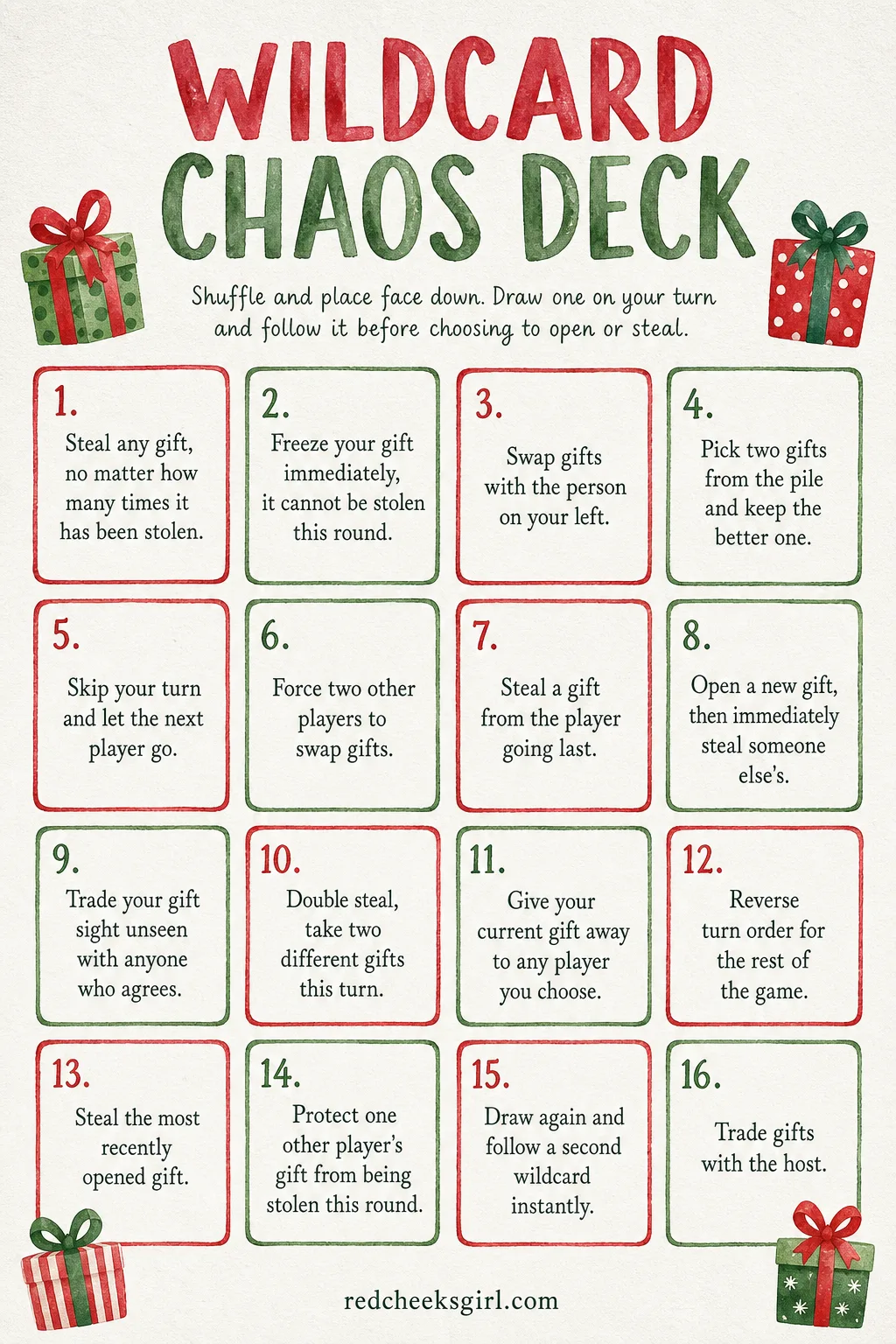
2. The Wildcard Chaos Deck
Handing someone a card instead of a choice takes the decision out of their hands, and that is precisely what makes a quiet swap turn loud. Every turn starts with a draw from the deck, and the instruction on the card is the law for that turn, no negotiating.
Print one deck per eight to ten players on sturdy cardstock, cut the cards apart ahead of time, and shuffle them face down beside the gift pile. A full round through sixteen cards adds roughly ten extra minutes to a standard swap.
The one thing that goes sideways: someone draws a card that forces them to give away a gift they just won, and the room erupts before you have explained the rule. Read all sixteen cards aloud once at the start so nobody argues that a rule was invented on the spot.
🛍 Shopping guide
3. The Wrapped-Until-Reveal Showcase
Nothing is opened. Not one gift, until the very last turn, so every steal is a bet on wrapping paper rather than contents. The rules stay the same as a traditional swap except every gift stays wrapped until the end, and players steal from each other based on the packaging alone, so creative wrapping is encouraged.
Tell guests in the invite that wrapping is part of the gift this time, so a shoebox in plain paper will get ignored no matter what is inside it. Only after the last player picks a present does the whole group unwrap everything together. That final minute is genuinely the best part of the night.
The risk here is a guest who skips the wrapping effort entirely and ends up with a gift nobody fought over, fairly or not. Fix it with a one-line note on the invite: wrapping counts, bows and ribbon are not optional this round.
Mention the wrapped-until-the-end rule on the invite so nobody shows up with a gift bag
🛍 Shopping guide
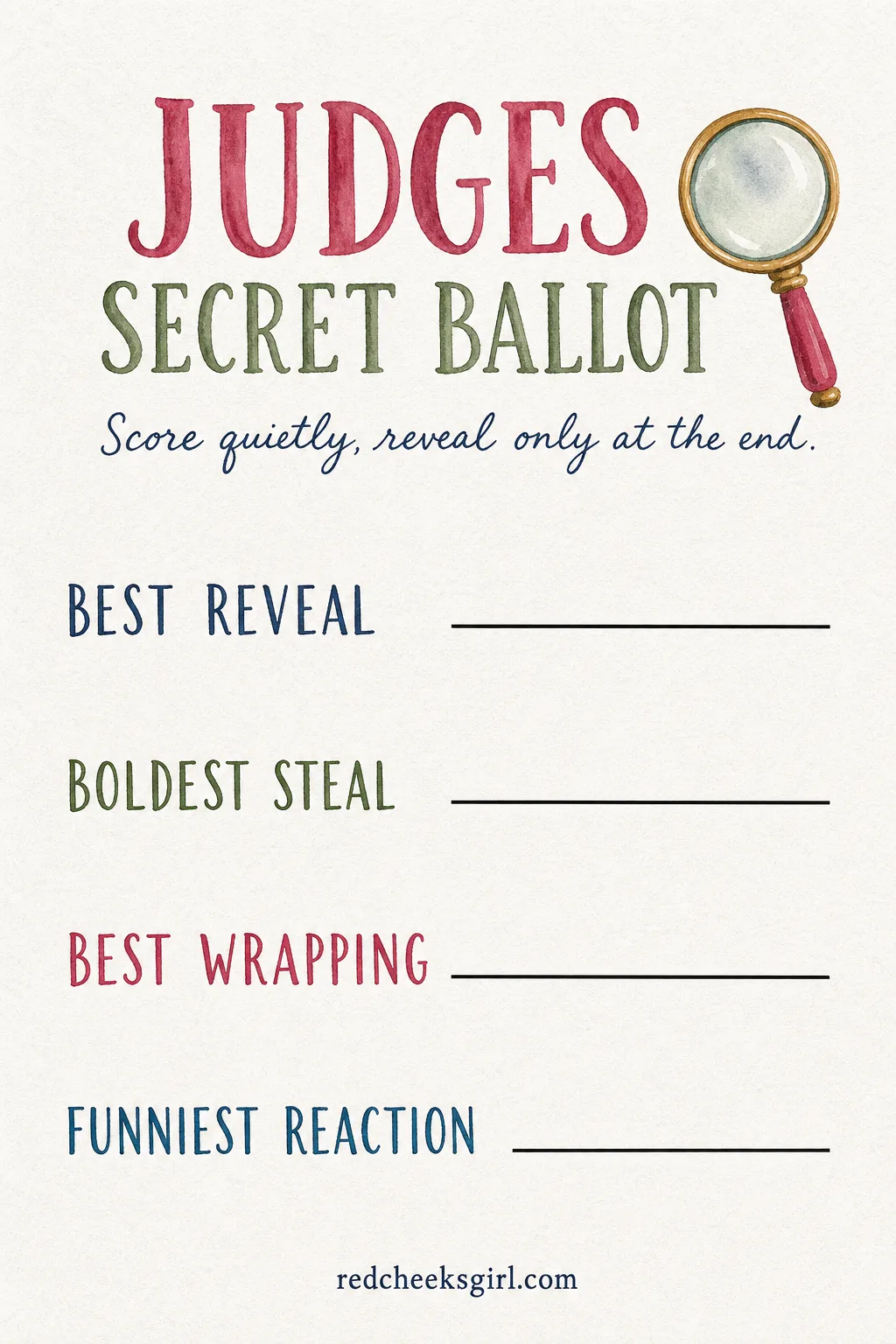
4. The Judges’ Secret Ballot
Two or three guests get pulled aside before the game starts and told, quietly, that they are judging tonight. Nobody else knows, which means every dramatic steal and every groan over a bad gift is being scored somewhere without the room realizing it.
Hand judges a small card each with three or four categories and ask them to jot a name beside each one as the game unfolds, no discussion until the very end. A single small prize for the winning guest, something the host already has on hand, closes the bit nicely.
The trap is picking judges who are also playing the swap themselves and get too distracted stealing gifts to actually watch. Choose the one or two people who arrive early and like sitting back more than diving in.
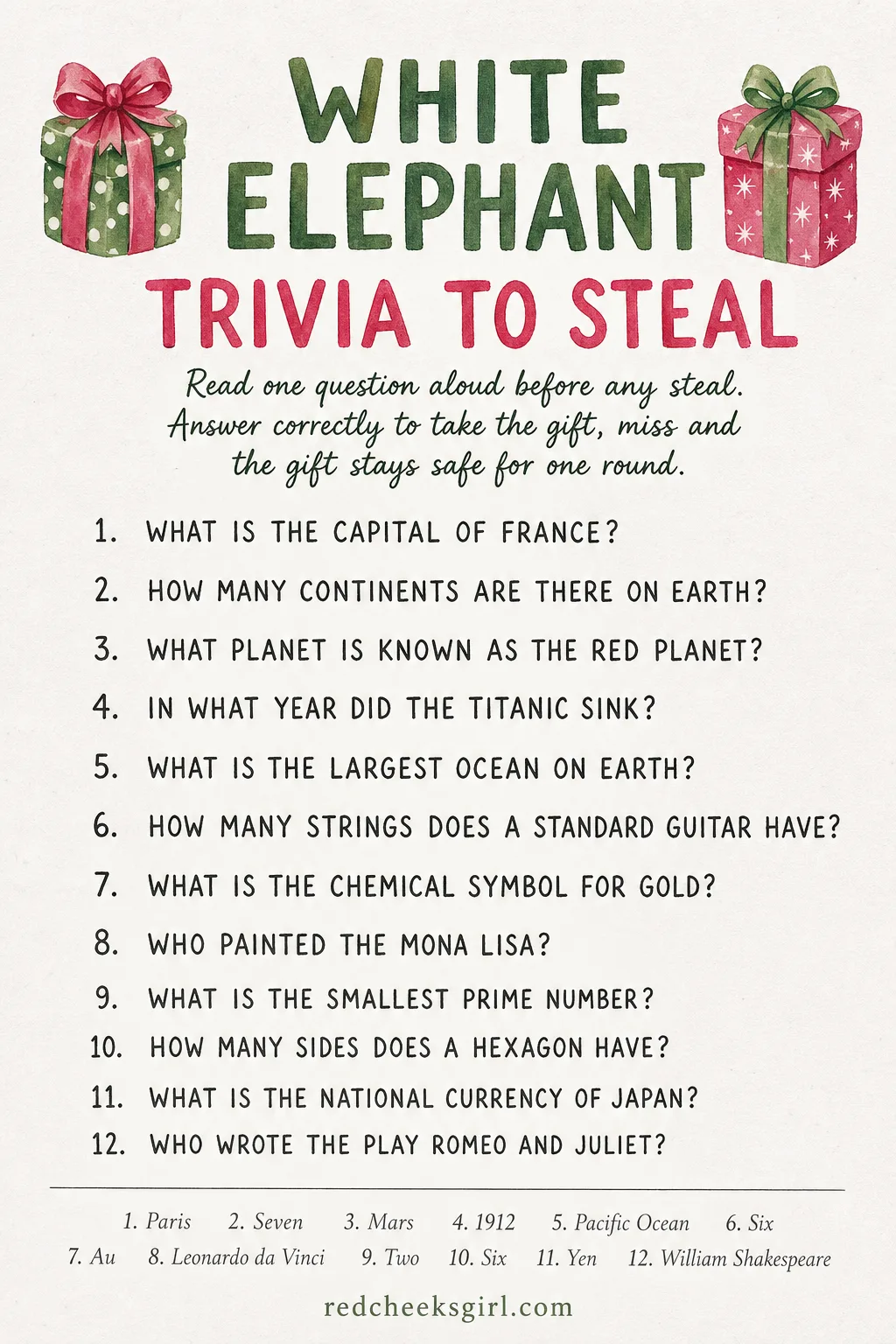
5. White Elephant Trivia-to-Steal
A straight steal is quick. Making someone earn it first slows the game down just enough that people actually watch instead of scrolling. The better approach requires a player to answer a question correctly before they can steal a gift, and if they answer incorrectly the person they are challenging gets a turn to answer and freeze the gift instead.
The host reads one question per steal attempt from the printed sheet, nobody else sees the answers, and a correct guess clears the steal to go through. Twelve questions covers a standard eight to ten person swap with a couple to spare.
Trivia buffs can dominate the whole game if they happen to sit near the top of the turn order, which flattens the fun for everyone else. Let a different guest read the questions each round instead of the same sharp-eyed friend every time.
Groups that already know each other well enough not to mind a little pressure before a steal
🛍 Shopping guide
6. Dice-Roll Dirty Santa
Chance does the deciding here instead of the player, which takes the pressure off anyone who hates being the one to make the call. Every player picks a present and rolls a die to determine what they do next, on top of the standard setup, so you only need a die and a sheet with the rules.
Write six outcomes on a card taped near the gift pile: roll a 1 or 2 and steal, 3 or 4 and open a new gift, 5 and lose your turn, 6 and steal twice. The round keeps going until every gift is unwrapped and every player has rolled. If dice gift-exchange formats are your thing, there is a whole dice gift exchange roundup worth a look too.
A run of bad rolls in a row can leave one guest stuck opening the worst gift in the pile three times over. Let anyone who rolls the same outcome twice in a row re-roll once, just so luck does not feel like a grudge.
🛍 Shopping guide
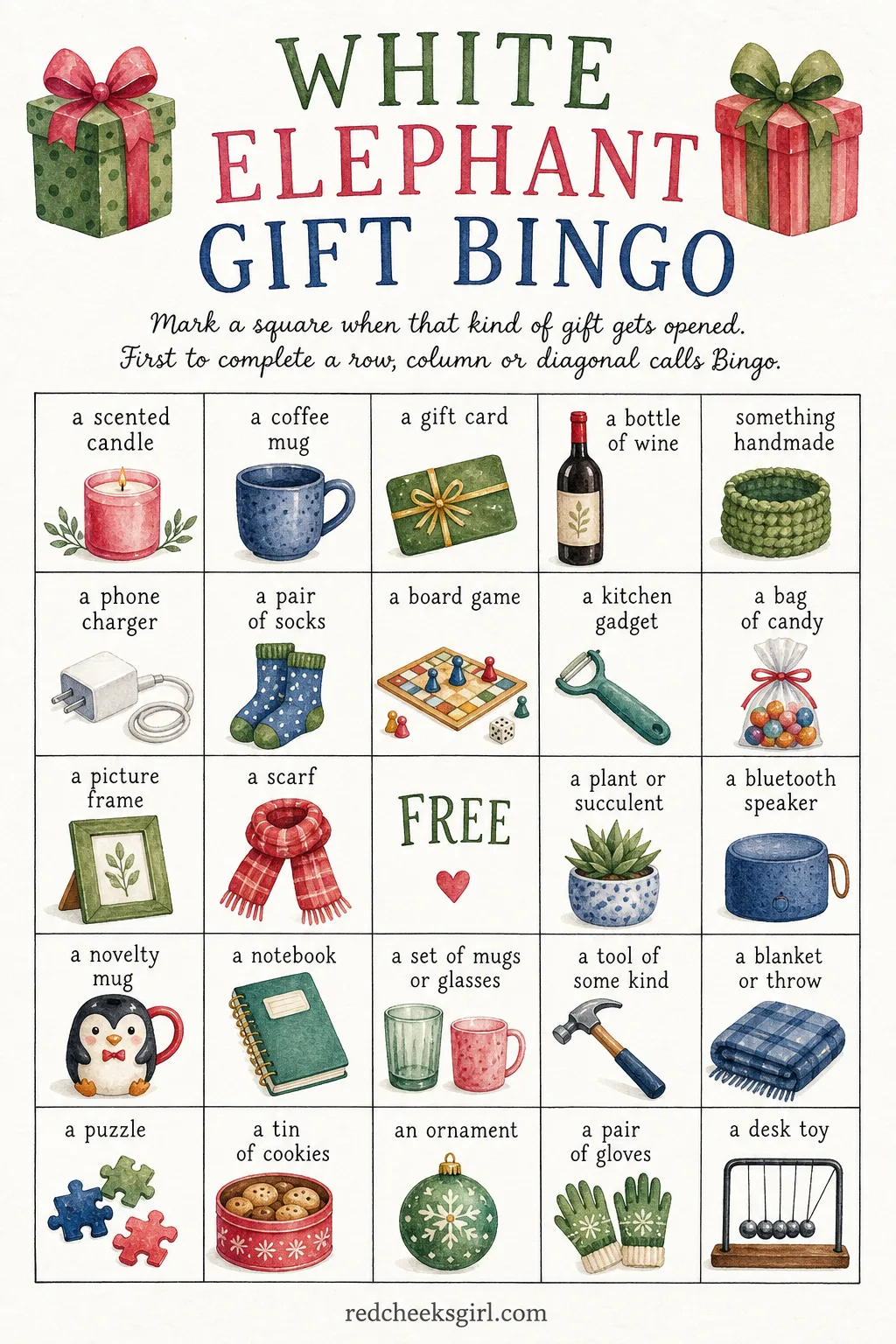
7. White Elephant Gift Bingo
Half the room plays the swap, the other half (or the same half, holding a second sheet) hunts for gift categories on a bingo card as each present comes out of its wrapping. It turns watching into a reason to actually pay attention to what every gift is.
Hand one card and a pen or dauber to each guest before the first gift opens, and call bingo the moment a row, column or diagonal fills up. Works for any group size since the card plays independently of turn order.
With a small group, not every category on the card will come up and someone will sit there with half a sheet marked all night. Build the card from the gift theme you already announced on the invite so the odds line up with what people are actually bringing.
Turns the quiet half of the guest list into active watchers instead of bystanders
🛍 Shopping guide
8. The Left-Right Story Shuffle
Before the actual stealing starts, everyone sits in a circle holding the gift they drew, and the host reads a short, light story out loud. Every time the word left comes up, gifts pass left; every right, they pass right. By the end the gifts have scrambled completely and nobody is holding what they started with.
Write or find a short, generic story loaded with lefts and rights, two to three minutes long, and have the group pass gifts hand to hand as it is read. Once the story ends, the standard open-and-steal round begins from whatever gift each person now holds.
A story that is too short barely scrambles anything and people end up close to their original gift. Aim for one with at least twenty direction cues so the shuffle actually does its job before the real game starts.
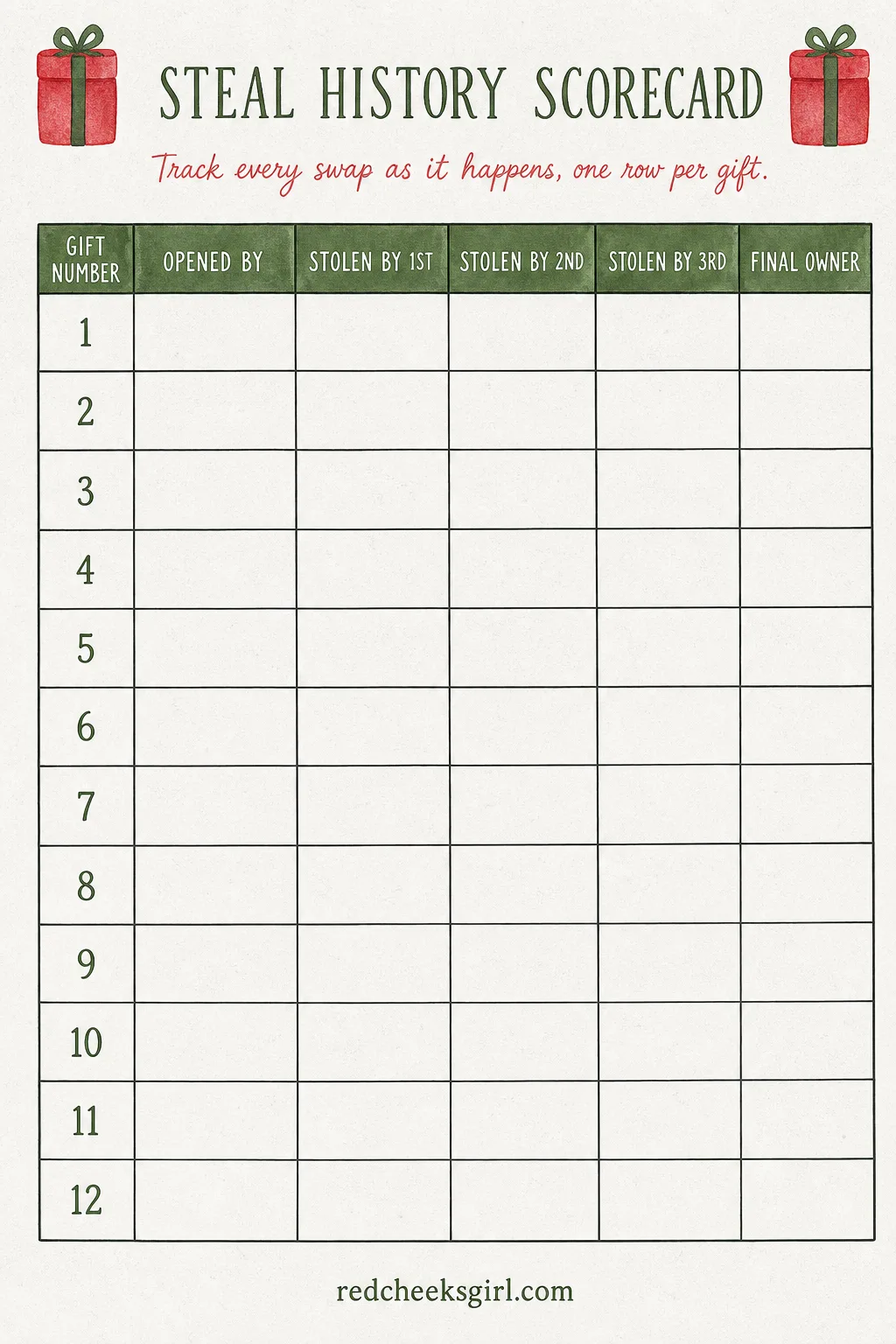
9. The Steal History Scorecard
Half the fun of a swap is the plotline, who stole from whom, whose gift got fought over, who got burned twice. Without a record of it, that story evaporates by the time dessert comes out. This sheet exists purely to keep the receipts.
One guest, usually whoever is not currently in the thick of a steal, keeps the sheet updated row by row as the game runs. It takes nothing away from play since it is filled in on the side, not during a turn.
The only snag is forgetting to update it mid-chaos when three steals happen back to back. Assign the job to one specific person rather than leaving it to whoever has a free hand.
Hand the sheet to one designated scorekeeper rather than passing it around mid-game
10. Two Piles: Nice or Naughty
Instead of one communal pile, the gifts sit split across two tables from the start, one marked nice and one marked naughty, and every player chooses which pile to pull from before they even know what is in it. It adds a decision before the first gift is even opened.
Ask guests in advance to bring one genuinely good gift for the nice table or one properly ridiculous one for the naughty table, so both piles actually have a personality. Steals can cross between piles once the opening round finishes. It is an easy fit for a Friendsgiving table where people already enjoy picking a side.
If everyone brings a nice gift to dodge the naughty pile, the split does nothing. Make the naughty pile mandatory for half the guest list by assigning it on the invite rather than leaving the choice open.
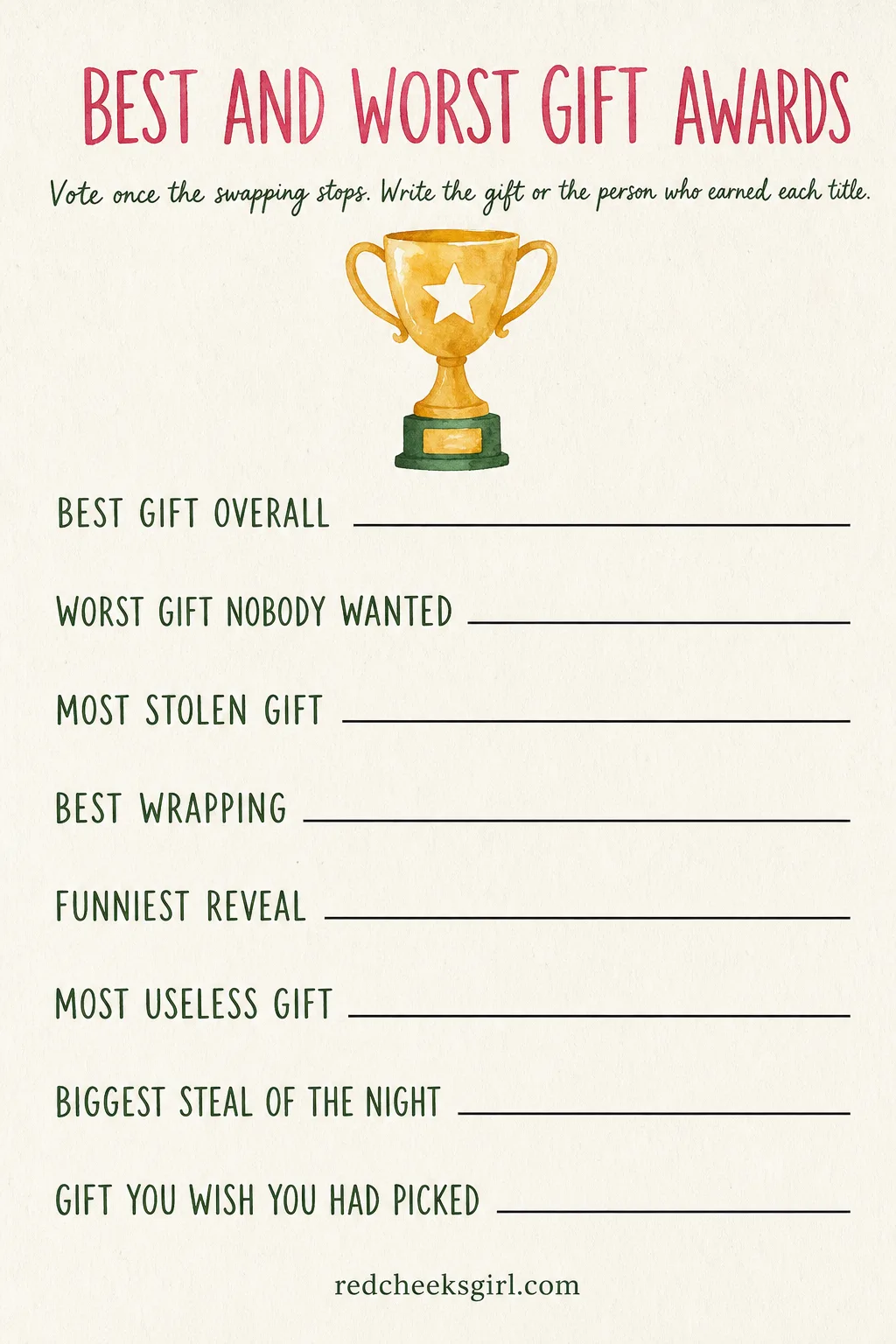
11. Best and Worst Gift Awards
The swap ends, the gifts settle, and this is the five minutes after where the real opinions come out. A quick ballot gives the group a reason to actually debate which gift won the night, instead of everyone just drifting toward the snack table.
Pass the sheet around once all gifts are claimed and ask guests to fill it out solo before comparing notes out loud. Reading the results aloud, category by category, works better than tallying anything formally.
Guests sometimes just write their own gift under every category out of loyalty. Keep it light by reading a few answers aloud for laughs rather than announcing a single official winner.
Read a handful of answers aloud instead of crowning one official winner, it keeps it friendly
🛍 Shopping guide
12. Silent Auction With Poker Chips
Nobody steals outright here, they bid for it. Every player gets an equal stack of poker chips at the start, and when a gift goes up for grabs, guests silently raise fingers or chips instead of calling out, with the highest bidder taking it over.
Give each player ten chips at the start, set a two-chip minimum bid, and have the host hold up each gift for ten seconds of silent bidding before calling it sold. Works best with groups of six to twelve who enjoy a bit of strategy.
A guest who blows through all their chips on the first gift is out of the running for everything after. Cap the max bid on any single gift at four chips so nobody goes broke in round one.
🛍 Shopping guide
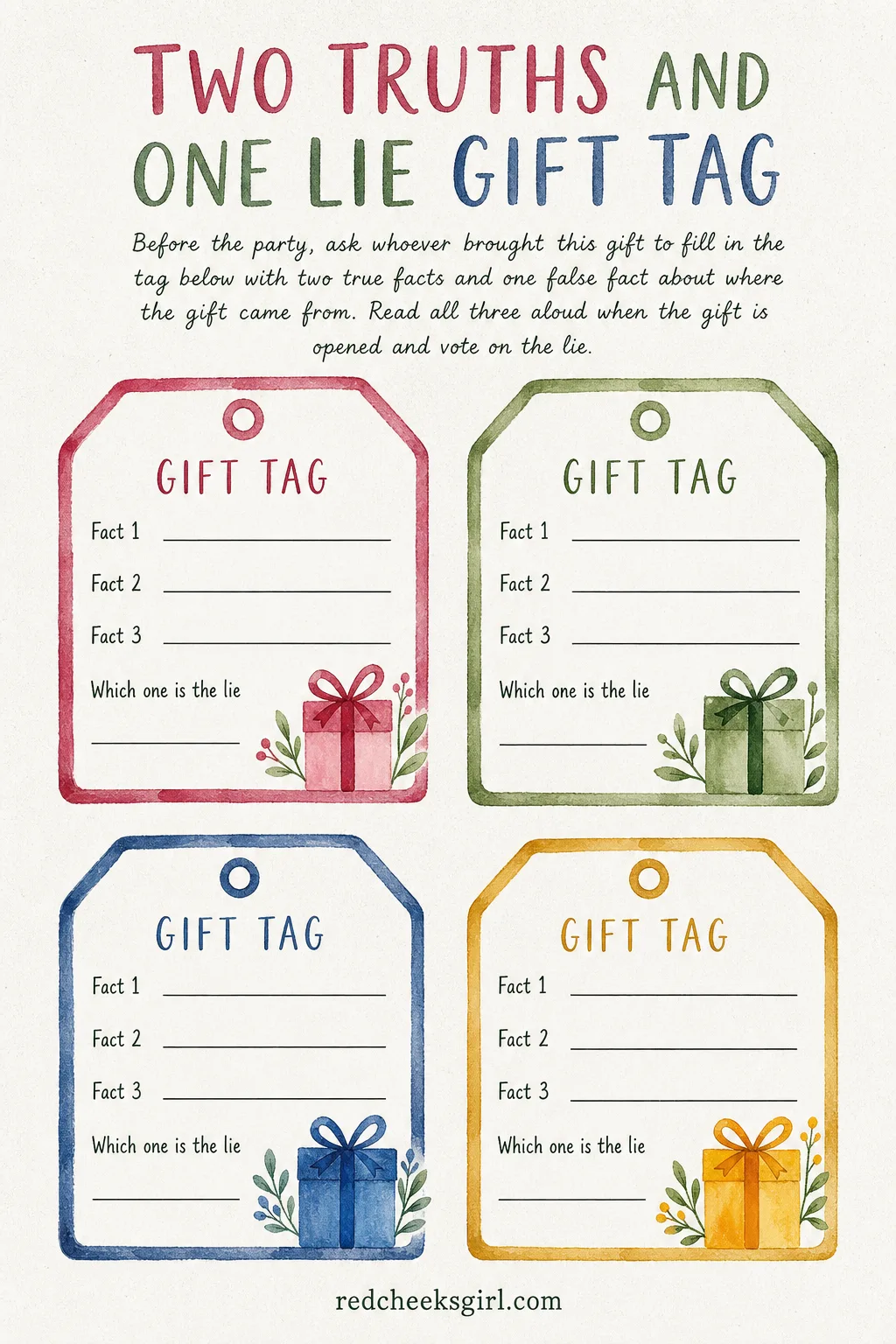
13. Two-Truths-One-Lie Gift Tag
Every gift has a story, where it came from, why it sat in a closet for two years, and this twist makes the group guess which part of that story is made up. The reveal moment becomes a tiny trial instead of just an unwrapping.
Send this sheet out with the invite and ask whoever brings a gift to fill in their own tag at home before the party, writing two true facts and one false one about where the gift came from. When the gift is opened, read all three aloud and let the group vote on the lie.
Skip this one for a group that will not fill the tags out ahead of time, since a blank tag mid-party kills the moment. A short reminder text two days before the swap usually fixes it.
Turns a regular unwrapping into a small guessing game with zero extra prep on the night itself
🛍 Shopping guide
14. The Sixty-Second Turn Timer
A swap can stall badly once a guest starts weighing six gifts like it is a life decision. Giving every turn a hard sixty seconds keeps the whole night moving and, oddly, makes people funnier under pressure.
Set a visible sand timer or a phone timer where everyone can see it, and if a player has not chosen by the time it runs out, their turn passes and they open blind from the pile. Shaves a solid ten minutes off a twelve-person game.
The timer rule flops if the host forgets to actually flip it every turn. Assign the timer to the same guest keeping the steal scorecard, so one person owns the pacing of the whole game.
🛍 Shopping guide
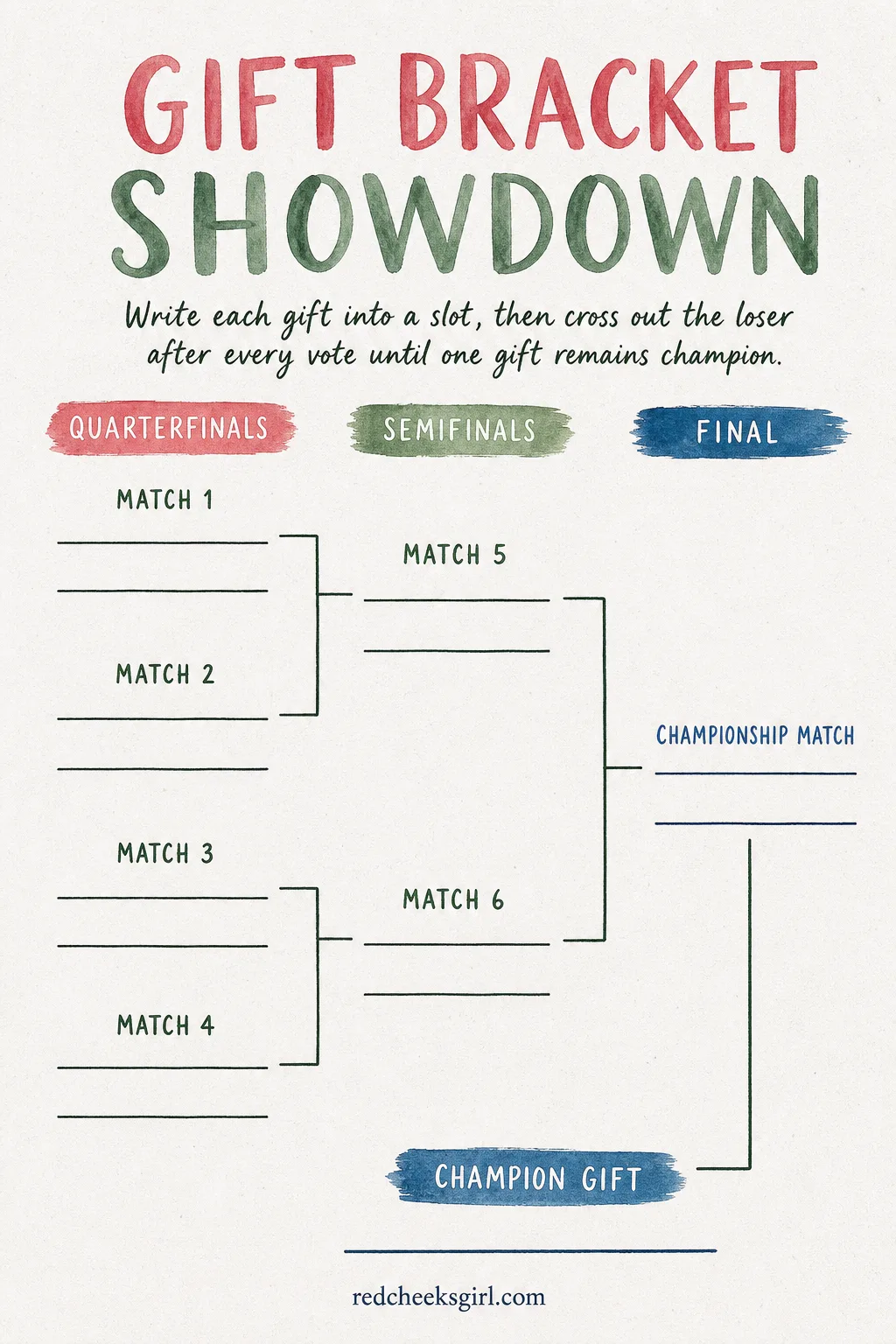
15. Gift Bracket Showdown
Once every gift is unwrapped, the group votes them into a tournament bracket, head to head, until one gift stands alone as the undisputed winner of the night. It gives the swap a proper ending instead of just fizzling out.
Write every opened gift into a bracket slot, then have the whole group raise hands for each matchup, winner advances, loser gets crossed out. Works cleanly for eight gifts and takes about five minutes once the swap itself wraps up. A Thanksgiving table running a swap alongside a full spread of food might print this alongside other Thanksgiving party ideas.
With an odd number of gifts, the bracket gets lopsided fast. Give one gift a bye straight to the semifinal round rather than forcing an uneven matchup.
Groups who want the swap to end on a clear, cheerable winner rather than just stopping
🛍 Shopping guide
16. Musical Gift Pass
This one skips opening and stealing entirely in favor of pure chance. Players simply pass a gift around the circle until a timer dings or the music stops, and whoever is holding it opens it and leaves the circle with that gift. Simple, fast, and brutal in the best way.
Play with multiple gifts moving around the circle at once for a bigger group, since one gift passed to twenty people gets tedious. A playlist with random, short pauses built in keeps anyone from timing the music.
The downside is zero strategy, which some groups genuinely dislike after the drama of a real swap. Mix this in as a warm-up round before the main steal-and-open game, not as a full replacement for it.
🛍 Shopping guide
17. Gift Origin Story Cards
Once every gift has found its final owner, hand each person a small card and ask them to jot down, in a line or two, what they plan to actually do with whatever they ended up walking away with. It is a quieter, funnier close to a loud night.
Keep the cards short and leave them with the host to read aloud if the group is still in the mood, or let people take them home as a small souvenir of the swap. No prep needed beyond printing the cards ahead of time.
Nobody fills these out honestly if they feel rushed, so leave a genuine few minutes once gifts settle rather than squeezing it in while people are already grabbing coats.

🛍 Shopping guide
18. Scavenger Steal Tokens
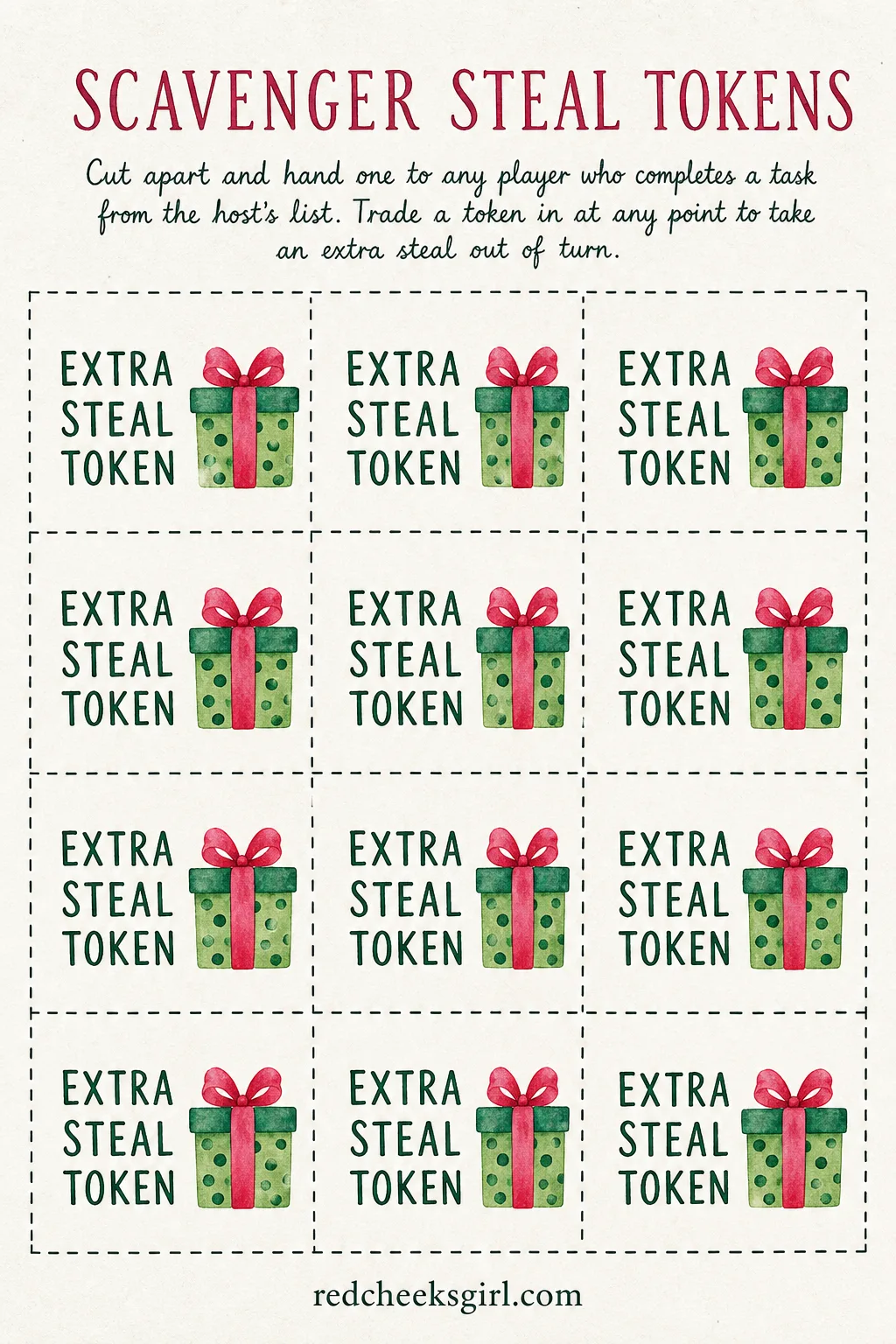
Before the swap even starts, hand out a short list of small tasks, snap a photo with someone wearing an ugly sweater, find a guest who shares your birthday month, and reward each completed one with a token that doubles as an extra steal later. It gives the quieter part of the evening, arrivals and small talk, an actual purpose.
Print one sheet of tokens, cut them apart, and give the host or a helper the job of handing them out as tasks get completed, strictly before the main game begins. A token can be traded in at any point during the swap for one steal, taken out of normal turn order.
Too many tokens floating around and the normal turn order collapses into chaos fast. Cap it at two tokens per guest no matter how many tasks they finish.
Frequently Asked Questions
How many times can a gift be stolen in a white elephant game?
Most groups settle on three steals before a gift is frozen with whoever is holding it, though plenty of parties skip a limit entirely and let it run until people lose interest in that particular gift. Decide the number out loud before the first gift opens so nobody argues about it mid-game.
What is the difference between white elephant and secret santa?
In secret santa each person buys one specific gift for one assigned recipient, while in a white elephant swap every gift goes into one shared pile and players take turns choosing or stealing from it. White elephant tends to run louder and more competitive, secret santa stays more personal and quiet.
Why is it called a white elephant gift exchange?
The name traces back to a legend about the kings of Siam giving sacred, expensive-to-keep white elephants to courtiers they wanted to burden, which is how the phrase came to describe a gift that is more trouble than it is worth. That slightly cursed meaning is most of the fun of the game.
What is a good price limit for white elephant gifts?
Somewhere between 15 and 25 dollars works for most adult groups, high enough that a gift feels worth fighting over, low enough that nobody overthinks it. Put the number on the invite so everyone shops to the same budget.
Does the first player get to steal at the end of the game?
In most versions yes, the player who opened the very first gift gets one final steal at the end since they had the least information when they picked. Some groups let the chain continue after that steal and some stop it there, so it is worth agreeing on beforehand.
Can you steal a gift back right after someone takes it from you?
No, the standard rule blocks an immediate steal-back, so whoever just lost a gift has to open something new from the pile or steal a different already-opened gift instead. They can always try to win the original gift back on a later turn, as long as it has not already been frozen.

21 farmhouse Christmas wreath ideas with galvanized bells, cotton stems and ticking stripe bows, no

18 glam Christmas decor ideas in champagne, silver, blush and black, with mirrored trays and disco-b

Need a diy christmas tree that works in a small flat, survives a puppy, and costs almost nothing? Th
Leave a Reply