

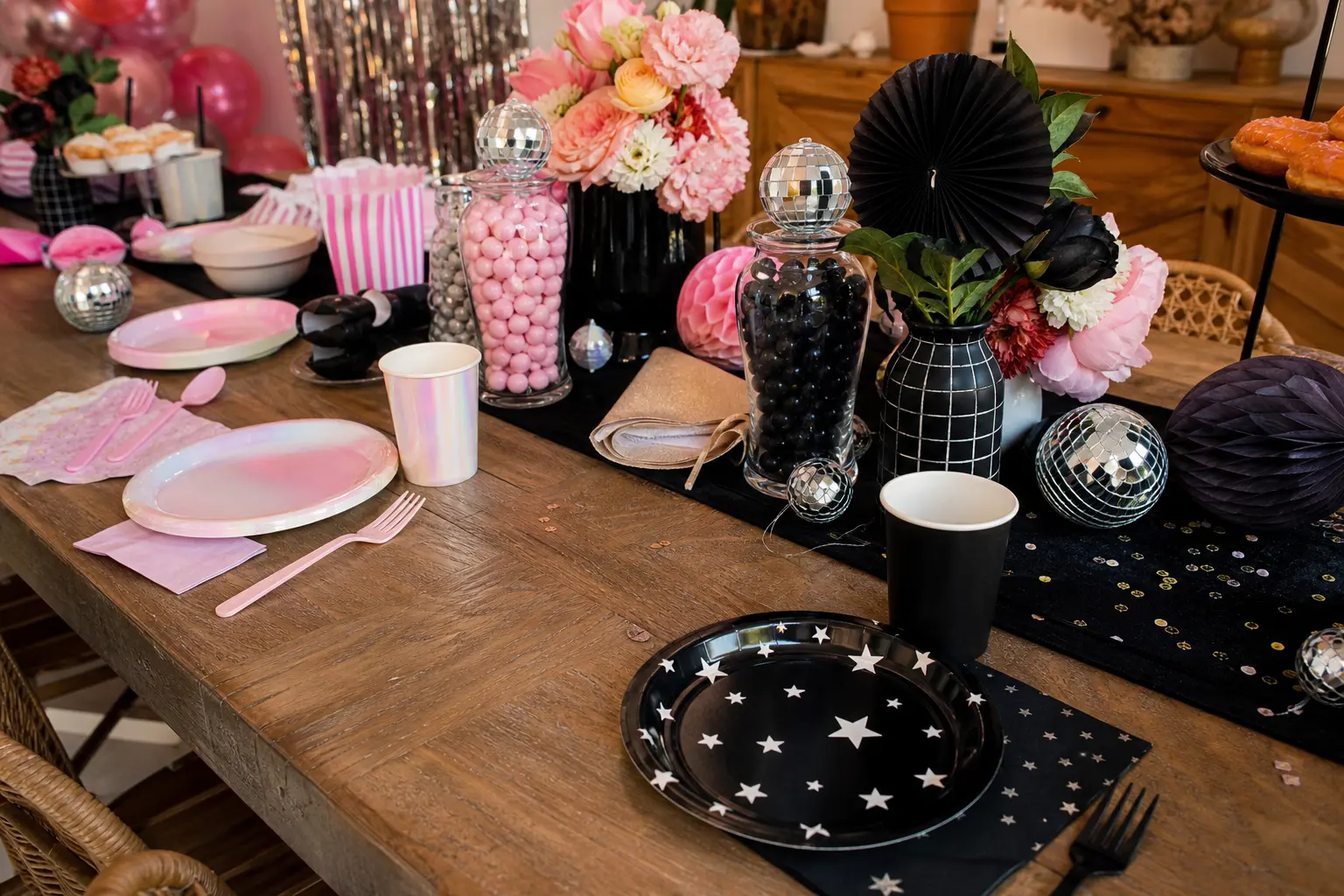
Twins birthday party themes do not have to mean two identical tables, two matching cakes, and one child quietly tolerating the other’s favourite colour. Past the first birthday, two kids means two opinions, and a party that pretends otherwise tends to show it. The ideas here are built around the fact that a shared event can still feel personal to each child.
Every entry below names an umbrella wide enough for both twins to claim a corner of it, or a clear structural rule that tells guests exactly what they are walking into. That second part matters: a two-concept party without any explanation looks like a planning mistake. With a quick framing at the door, it looks intentional and generous. For more on mixing personalities under one roof, see birthday party games for every age and any budget and the full guide to teen birthday party ideas that do not need supervising.
The twelve ideas below range from a single shared theme with two interpretations to a deliberately split space with a meeting point in the middle. Pick the structure that matches how different your two kids actually are this year, and scale the effort to the age.
This post contains affiliate links. If you buy through them, I may earn a small commission at no extra cost to you.
Shared Umbrella Themes
An umbrella theme is the easiest sell to guests and the most flexible for the kids. The party has one name, one colour story, one invitation header, but inside it each twin steers their own subplot. Guests land on a single concept and the kids each feel the theme is theirs.
The Explorer Umbrella
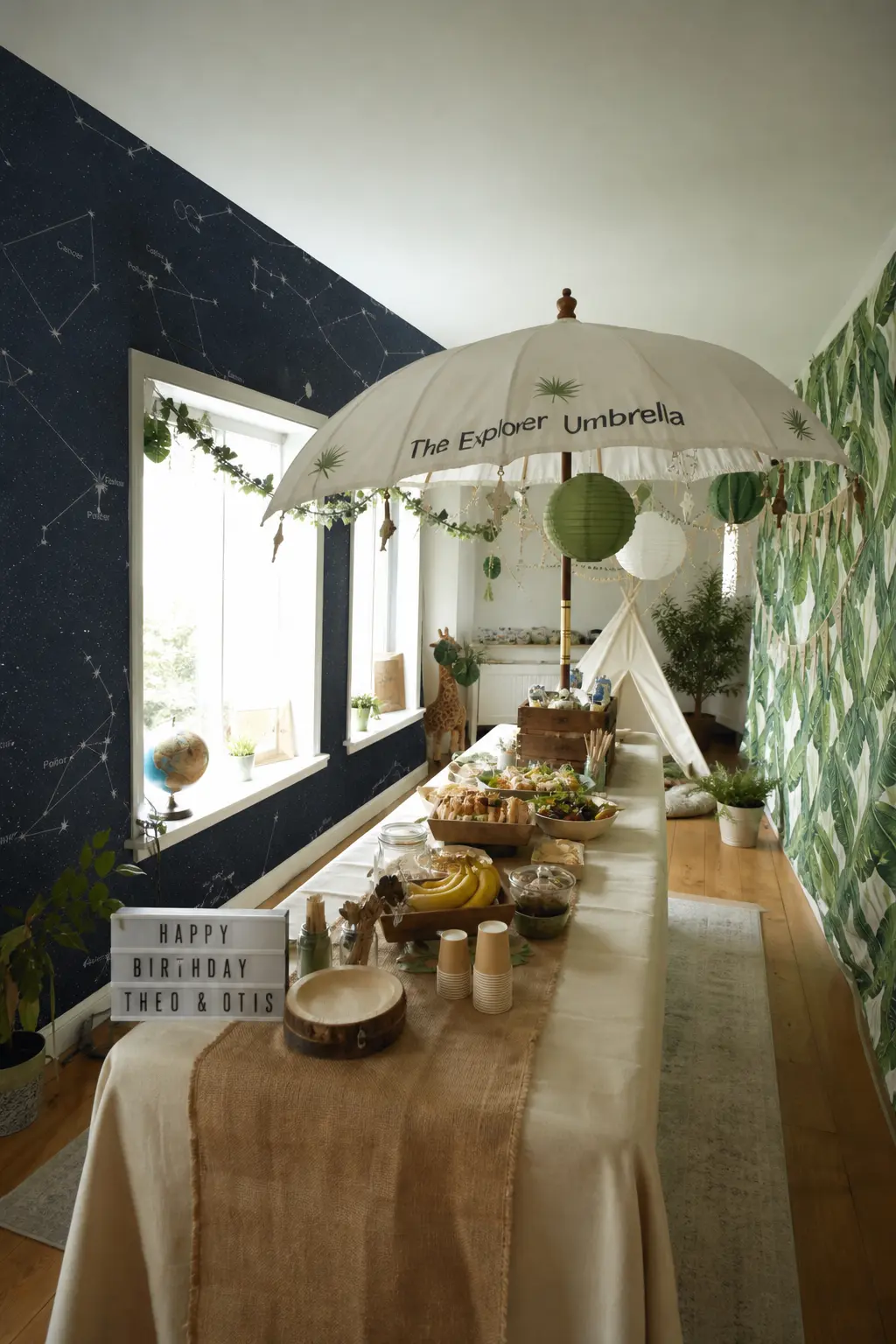
“Explorers” is the party name. One twin is a space explorer, the other a jungle explorer. The invitation says both. The decorations use a shared palette of deep green and midnight blue so the two zones read as one party photographed from above.
Hang a star map on one wall and a large leaf-print fabric on the opposite wall. The food table runs down the centre and belongs to both: “field rations” works for astronauts and jungle guides alike. Guests move between zones freely, and neither child is standing inside the other’s territory.
This structure scales from age two to age ten without changing the bones. Swap the sub-themes as the kids’ interests shift each year and the umbrella still holds.
🛍 Shopping guide
Complementary Themes
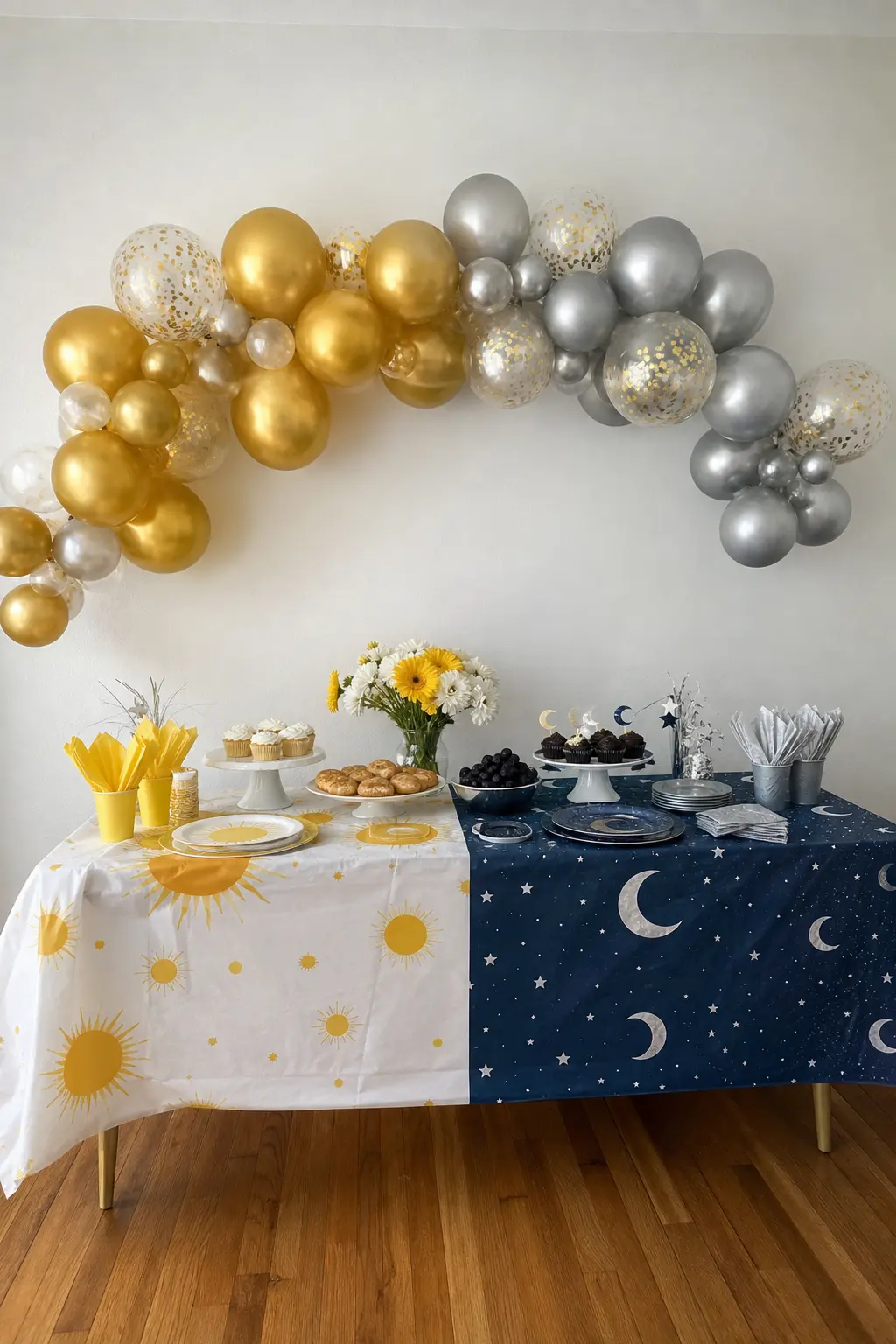
Complementary themes are different but designed to sit together: sun and moon, land and sea, fire and ice. Each twin claims one half of a natural pair, and the visual story of the party is the relationship between the two halves rather than a match.
This works especially well for twins who enjoy being contrasting. The sun-and-moon version is the easiest to source, since the motif already exists across tableware, balloons and cake toppers as a set. The fire-and-ice version suits older kids who want something with a little edge.
Choose one colour from each theme that also appears in the other, gold appears in both sun and moon for instance, and use that shared colour on the centrepiece so the display looks curated rather than divided.
🛍 Shopping guide
One Palette, Two Themes
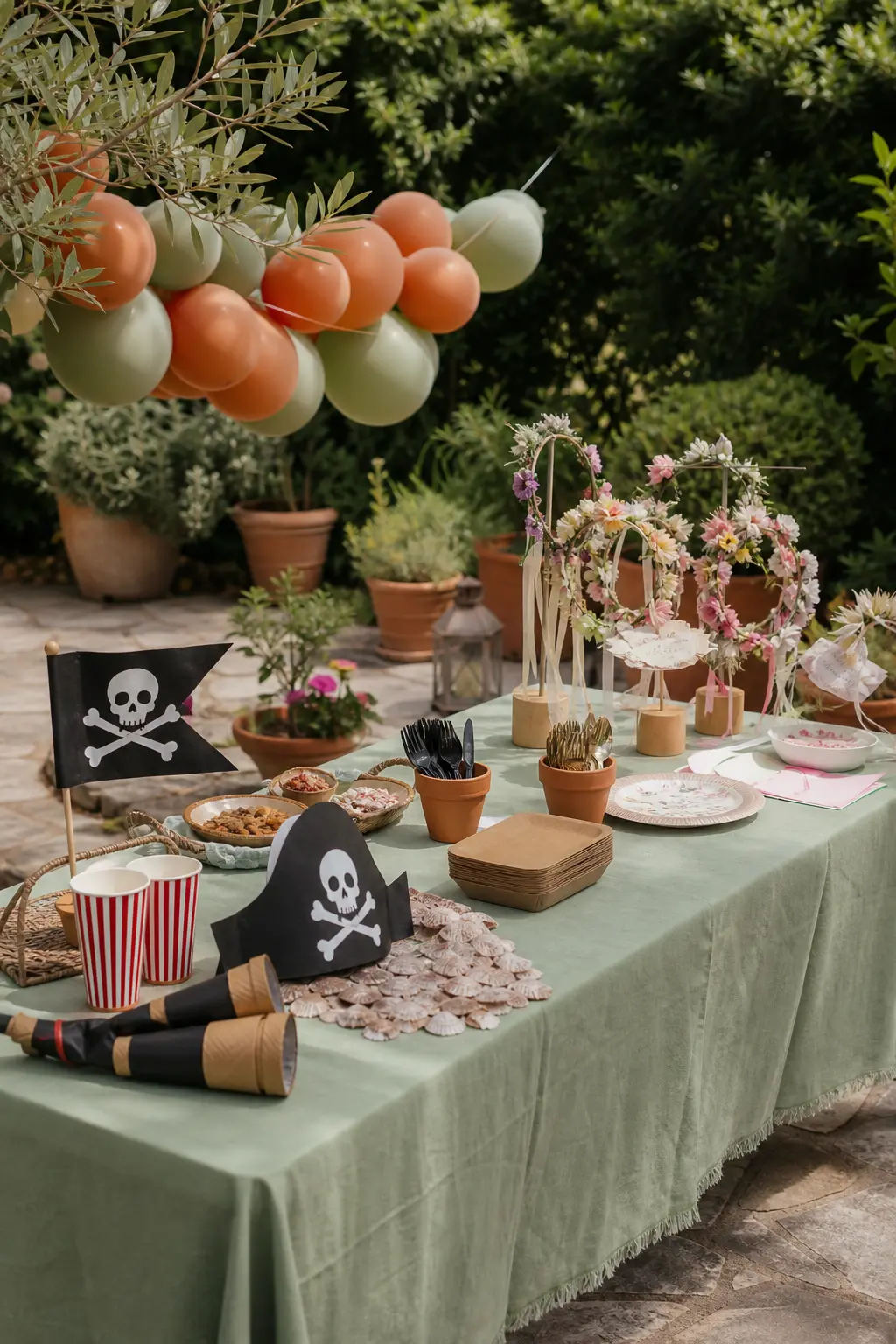
Choose a colour palette first, before either theme is decided. Sage green, terracotta and cream work for a garden party and a construction-site party simultaneously. Burgundy, gold and navy work for a princess theme and a pirate theme without either looking like an afterthought.
The palette is the visual glue. Each twin’s theme then layers inside it using motifs, toppers and printed details rather than base colours. From across the room, the party looks cohesive. Up close, the two stories become clear.
This approach is the most low-effort of the twelve because you buy tableware once, in the shared palette, and then add cheap printed details per twin. One tablecloth, two sets of napkin rings.
🛍 Shopping guide
Two-Sided Space Ideas
When the twins’ interests genuinely do not overlap, divide the room rather than force a compromise. A clear physical boundary, a rug, a length of paper bunting, a change of tablecloth colour, makes the structure legible without a sign explaining it. The middle zone is shared and neutral.
The Two-Sided Room
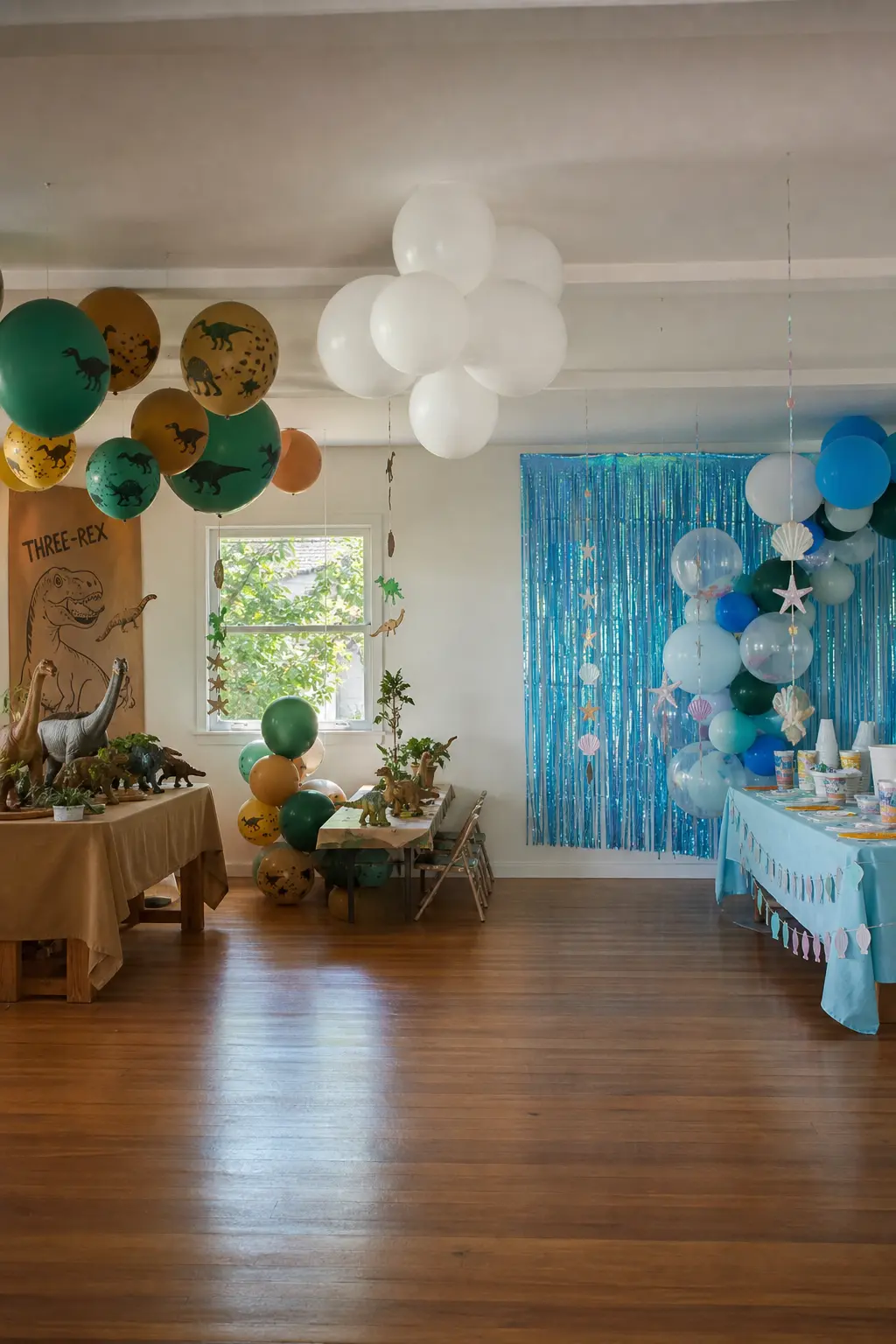
Divide the main party room down the centre with a length of paper bunting at different heights on each side. One half takes its cue from one twin’s preference, say dinosaurs, the other from the second twin’s, say mermaids. The middle metre of the room is deliberately neutral: plain white balloons, a shared snack table, the cake display.
Tell guests at the door with a single line: “left side is Theo’s, right side is Isla’s, middle is for everyone.” That framing turns a potential muddle into a talking point. Children immediately understand it and tend to respect the geography.
The meeting point in the middle is where the birthday candles happen, so both twins stand in shared space for the moment that gets photographed most.
🛍 Shopping guide
Two Separate Photo Backdrops
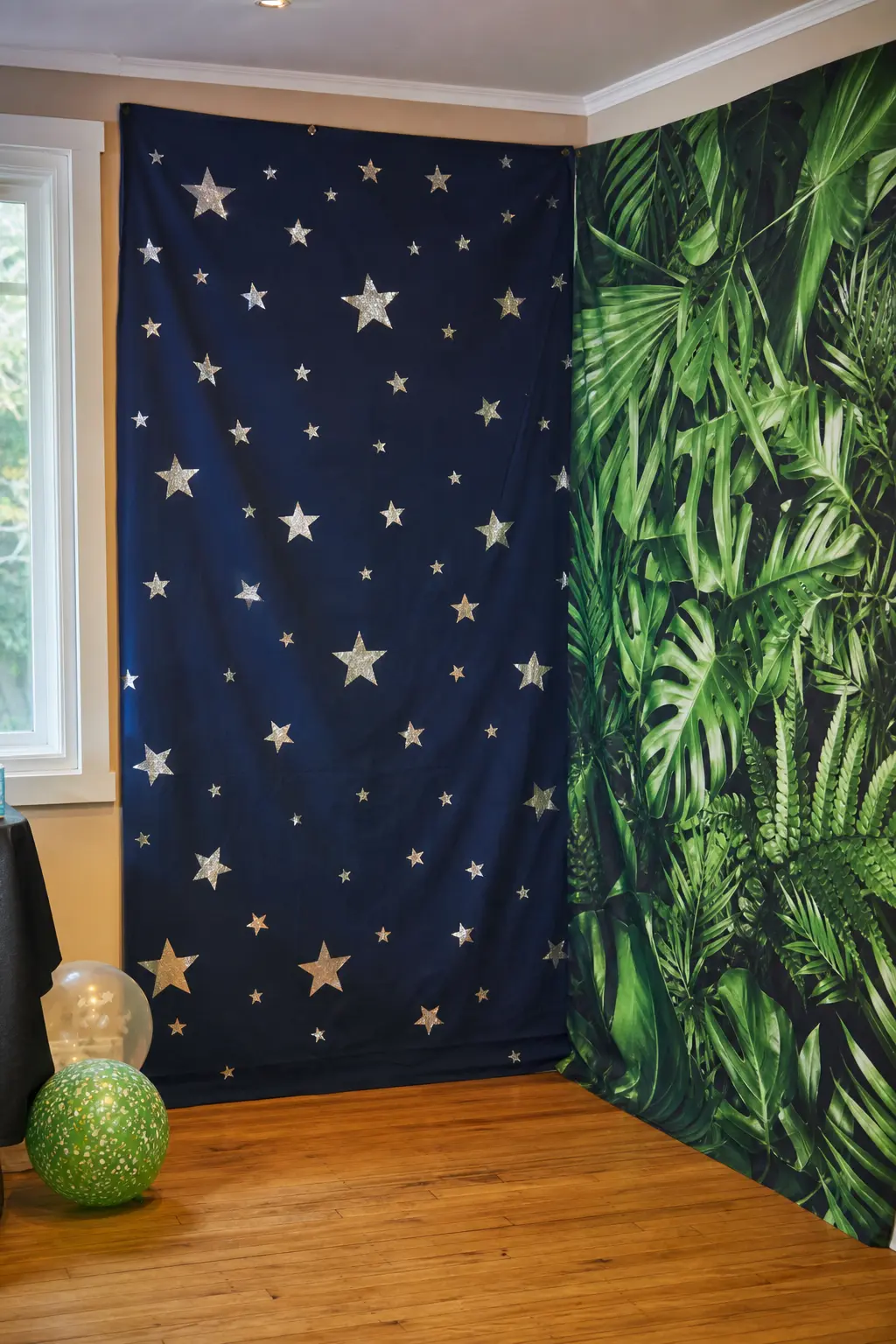
One backdrop per twin, both set up in the same room or hallway for the duration of the party. Each child is photographed in front of their own backdrop, and guests can choose which one to use for their own photos too.
This solves the photo-memory problem neatly: there is no moment later where one twin looks at the party album and sees only the other’s theme. Each child gets a set of images that is clearly theirs.
Keep the backdrops physically close together so the photographer, usually a parent with a phone, does not have to move between rooms. A corner works well: one backdrop on each wall of the corner, both visible in a wide shot if you want a single image that shows the whole concept.
🛍 Shopping guide
Same Party, Different Worlds
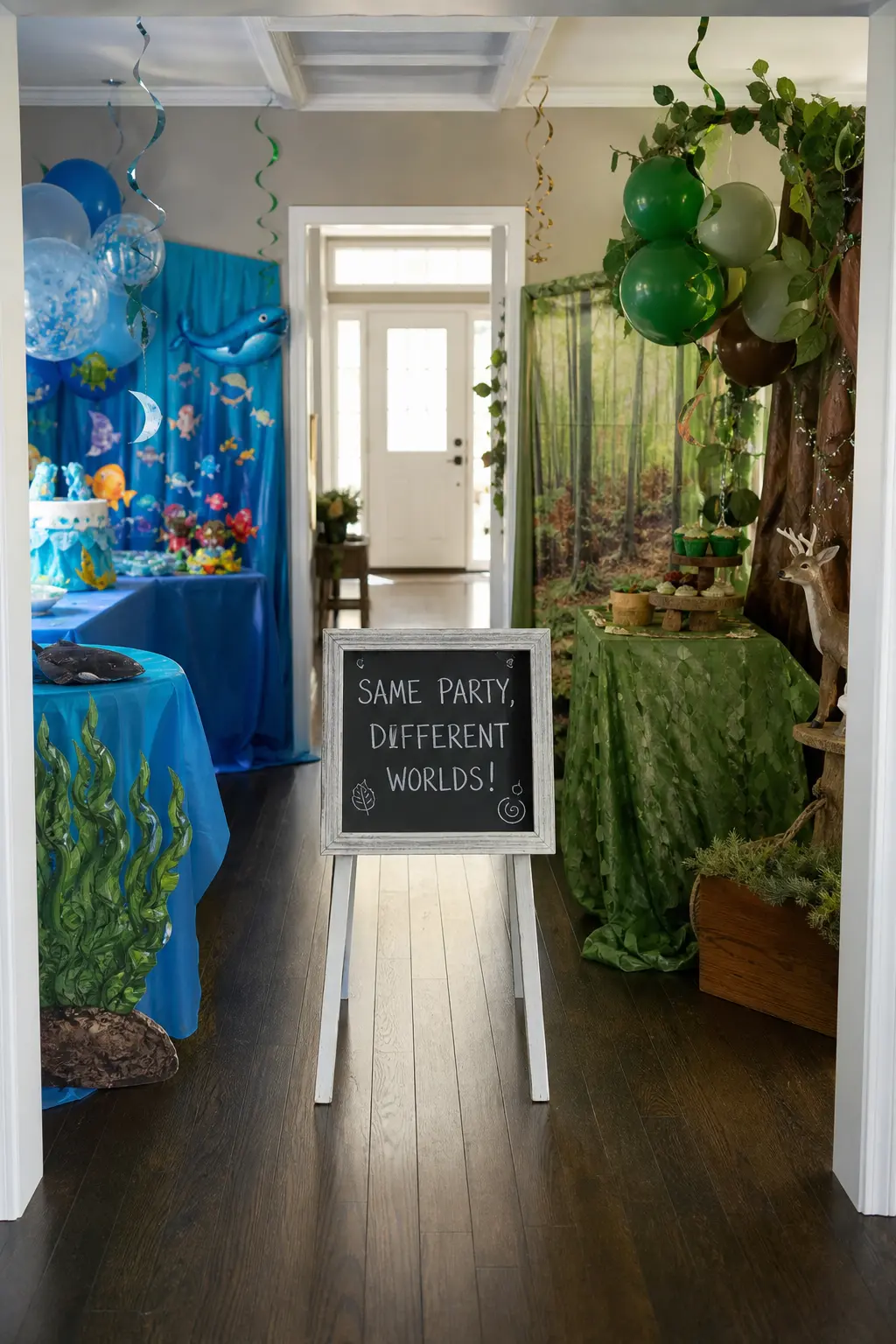
This is the framing, not just the design. Before guests eat or play, someone, a parent or an older sibling, gives a thirty-second introduction: “Welcome to Mia and Jake’s party. Mia’s world is over there, Jake’s world is here, and the food is for everyone.” That sentence makes the whole party make sense.
Without the framing, a two-theme party can feel like a planning accident. With it, the two-theme party has a concept, and guests, especially other children, engage with it as a feature rather than a puzzle. Older kids in particular respond well to being told there is a rule to the space.
Put a small printed sign at the entrance that echoes the same idea in two lines, for guests who arrive late and miss the verbal welcome. A chalkboard leaning against the wall costs nothing and takes five minutes.
🛍 Shopping guide
Shared Activities, Different Outcomes
One table, two very different things coming off it. This format keeps the party feeling unified while giving each child something to point to as their own. It also solves the guest problem: nobody has to choose a side or buy two separate gifts.
The Joint Craft Table
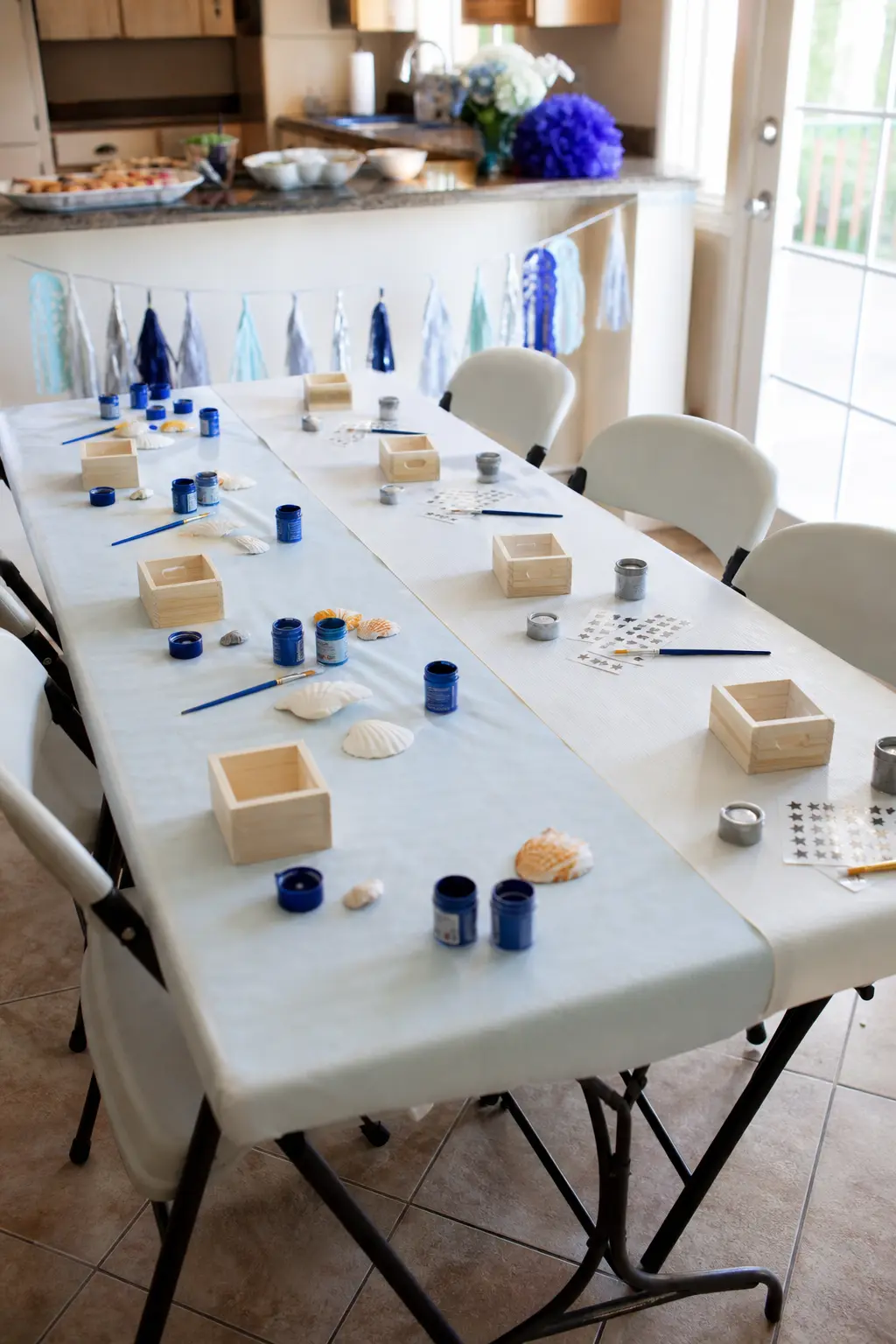
One craft table, two sets of materials, two completely different things coming off it. Both twins decorate a plain wooden keepsake box, but one has ocean-themed stamps, shells and blue paint, the other has rocket stickers, star stamps and silver paint. The activity is identical; the outcome is personal.
This format also solves the guest-gift problem neatly. Guests sit at the table regardless of which twin they came for, and the kids make something they actually keep. No pile of theme-specific toys that the wrong twin ends up with.
Set out the two stations clearly with a small name card so younger guests know which materials belong to which side. It prevents the ocean stamps migrating into the rocket station before the party is ten minutes old.
🛍 Shopping guide
The Coin-Flip Rotation
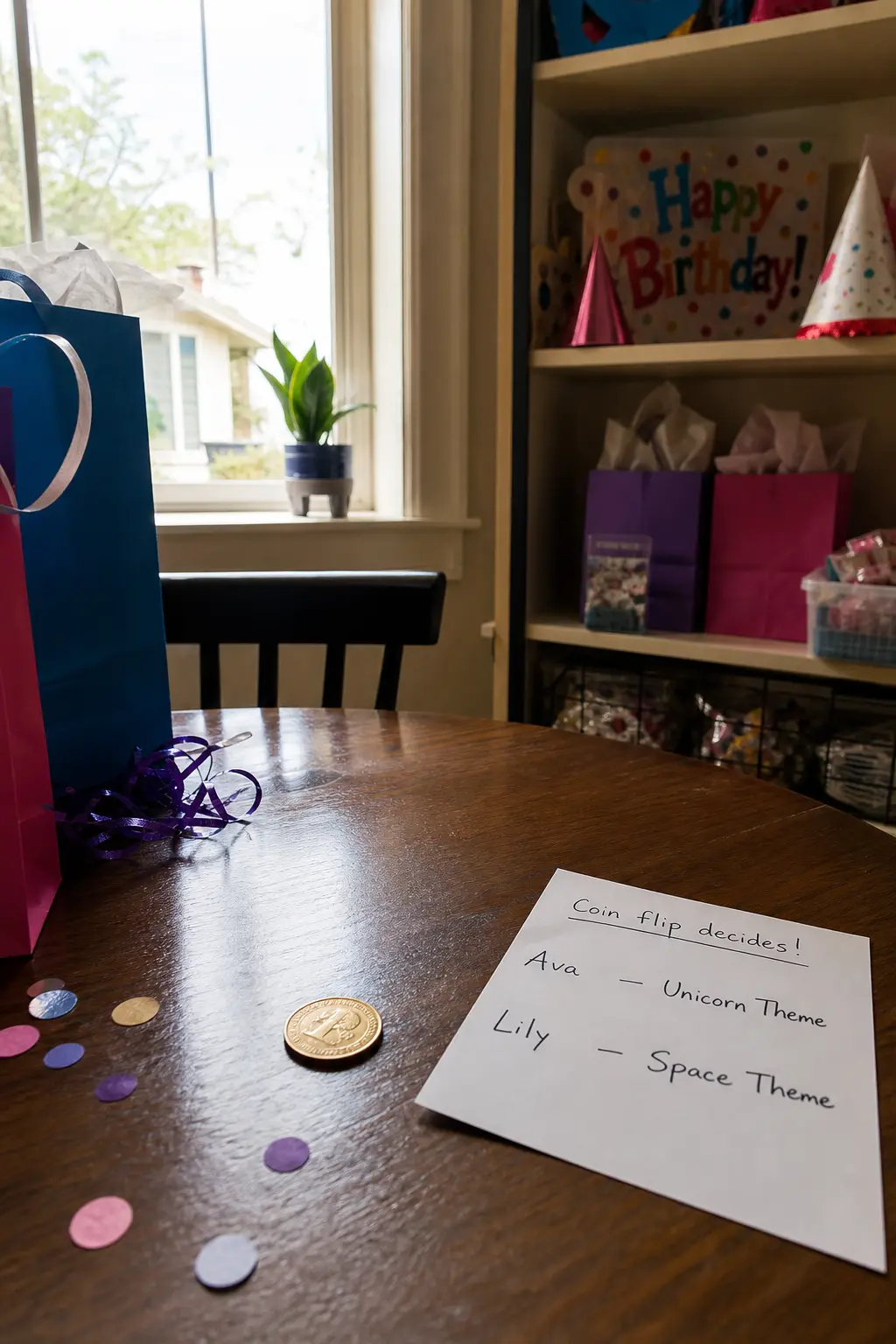
In any year the twins cannot agree, a coin flip decides whose theme leads. The other twin gets a clear, visible concession: their name goes first on the invitation, they choose the cake flavour, or they pick the party game. Write the rule down before the party planning starts and stick to it.
This is not a party theme in the decorative sense. It is a family policy that removes a recurring argument and teaches both kids that fairness across years is still fairness. Next year the roles reverse automatically.
Make the flip itself a small ceremony: a large, novelty coin kept in the party box year to year, flipped in front of both children. It gives the outcome a sense of occasion rather than a sense of defeat for the loser.
🛍 Shopping guide
Cakes and Sweet Tables
Two cakes at one party used to read as a catering error. Now it reads as exactly what it is: a deliberate choice that honours two separate people. Keep the display cohesive by using a matching stand, board or cloth underneath both cakes, so they look like a set rather than leftovers from two different events.
Two Cakes in Two Styles
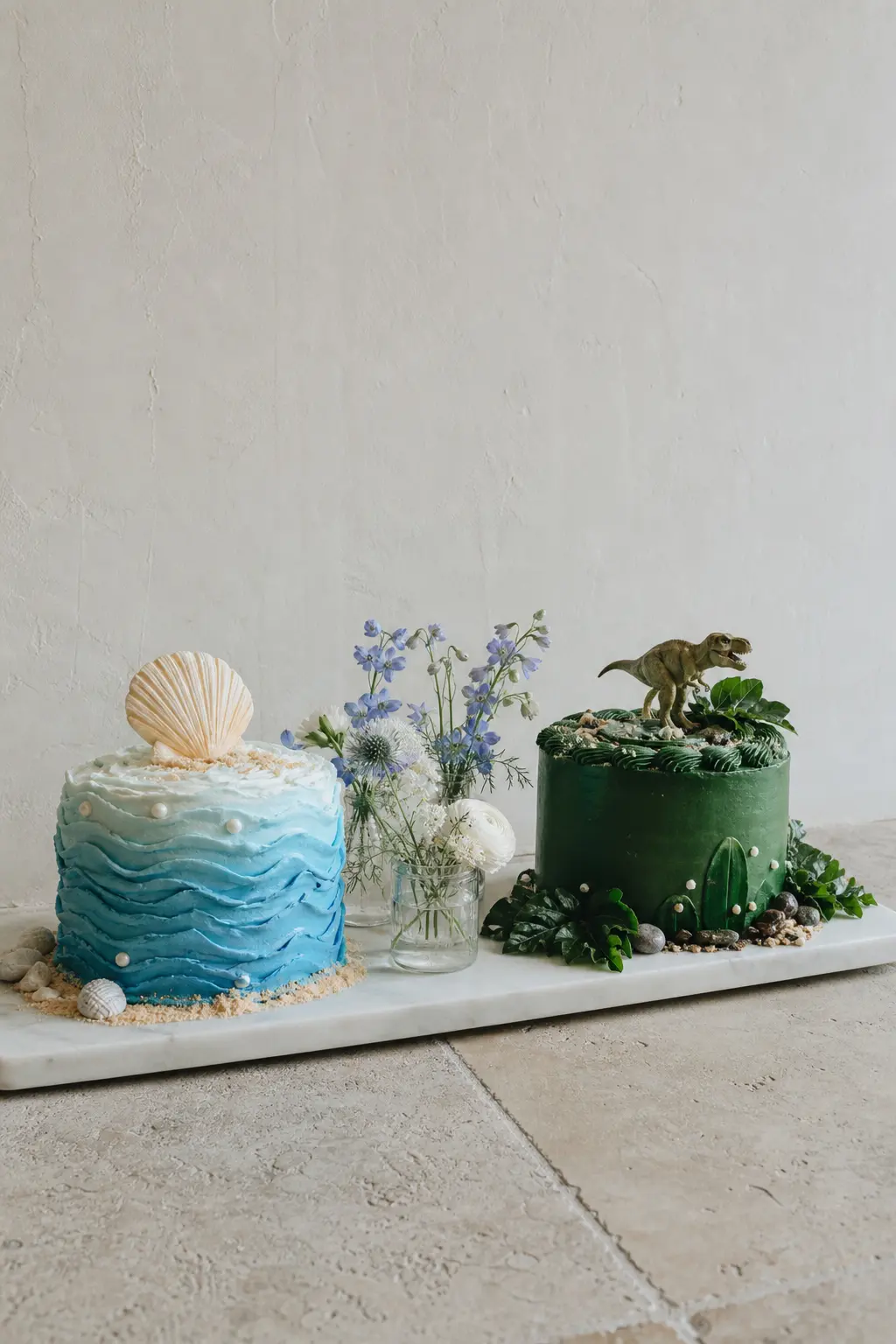
Two separate cakes, one per twin, displayed side by side on a single long board or matching cake stands. The cakes do not need to share a flavour, a frosting colour or a topper. They need to share a display surface so they read as a pair rather than two separate events that collided.
The candle moment works beautifully here: one set of candles on each cake, one song, each twin blows out their own. No negotiation over which topper goes in the freezer.
For very young twins who are still in the smash-cake phase, this is the cleanest version of the shared cake smash: two distinct designs, two high chair trays, one photograph. The side-by-side format makes the image twice as interesting as a single cake would.
🛍 Shopping guide
The Shared Cake Smash, Two Designs
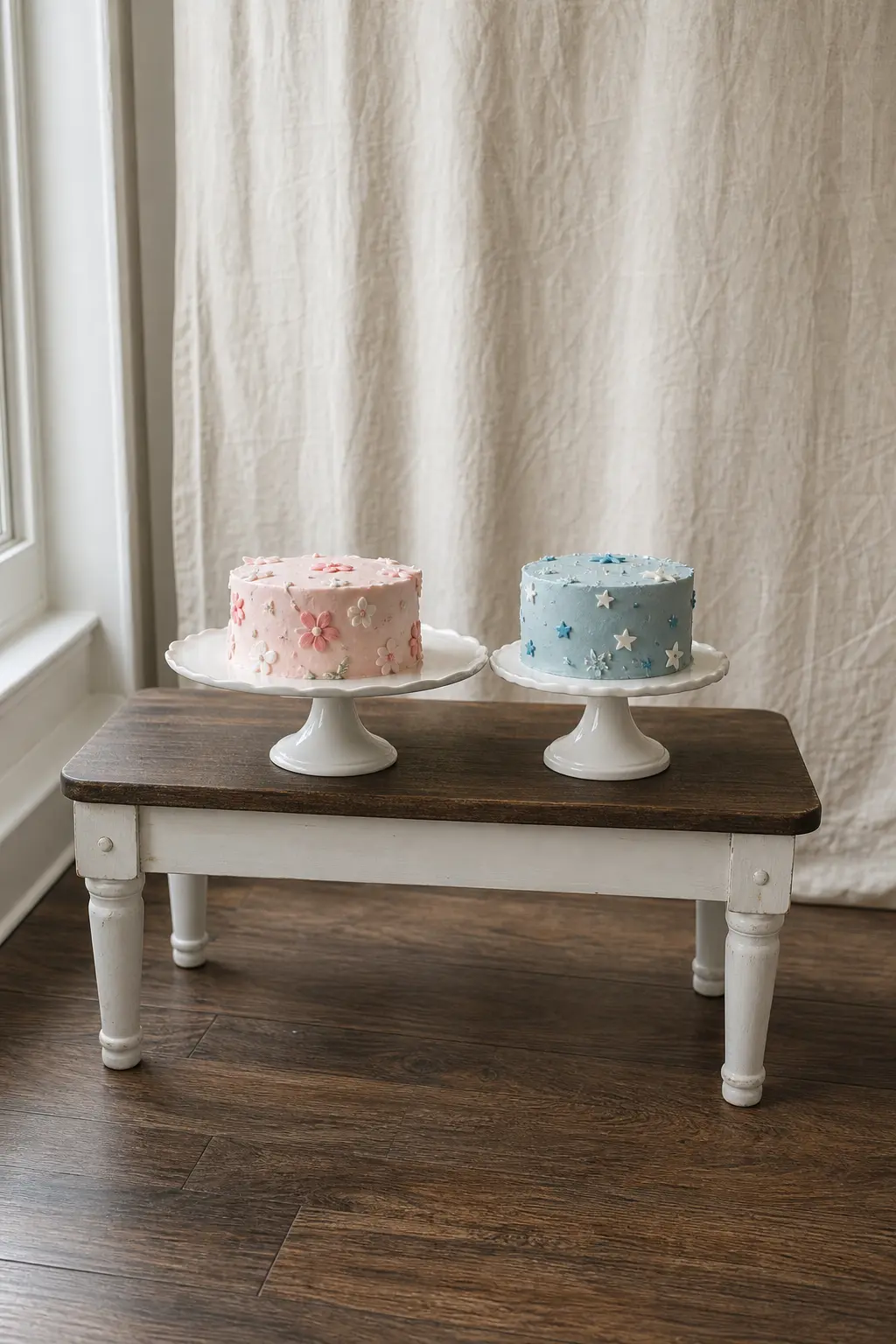
For twins young enough to still be in smash-cake territory, two small cakes placed side by side on the same session backdrop is the version that photographs best. Each cake reflects one twin’s theme. The image reads as a single composed shot rather than two separate sittings.
Ask the baker to keep the height and diameter identical across both cakes so the photograph has visual symmetry even when the decoration is completely different. A matching ribbon around the base of each cake, in the shared palette colour, ties them together without making them match.
This also avoids the practical problem of one smash cake designed for two children simultaneously, which tends to collapse before both children have had a turn. Two separate cakes means each child gets an untouched one.
🛍 Shopping guide
Invitations, Favours and Guest Communication
A two-theme party puts a small burden on the guest: they need to know before they arrive. A joint invitation with a brief line explaining the concept removes all confusion and gives the party a story before it even starts. Favour bags are the bookend, and individual bags per twin are the cleanest finish.
The Joint Invitation, Two Themes Named
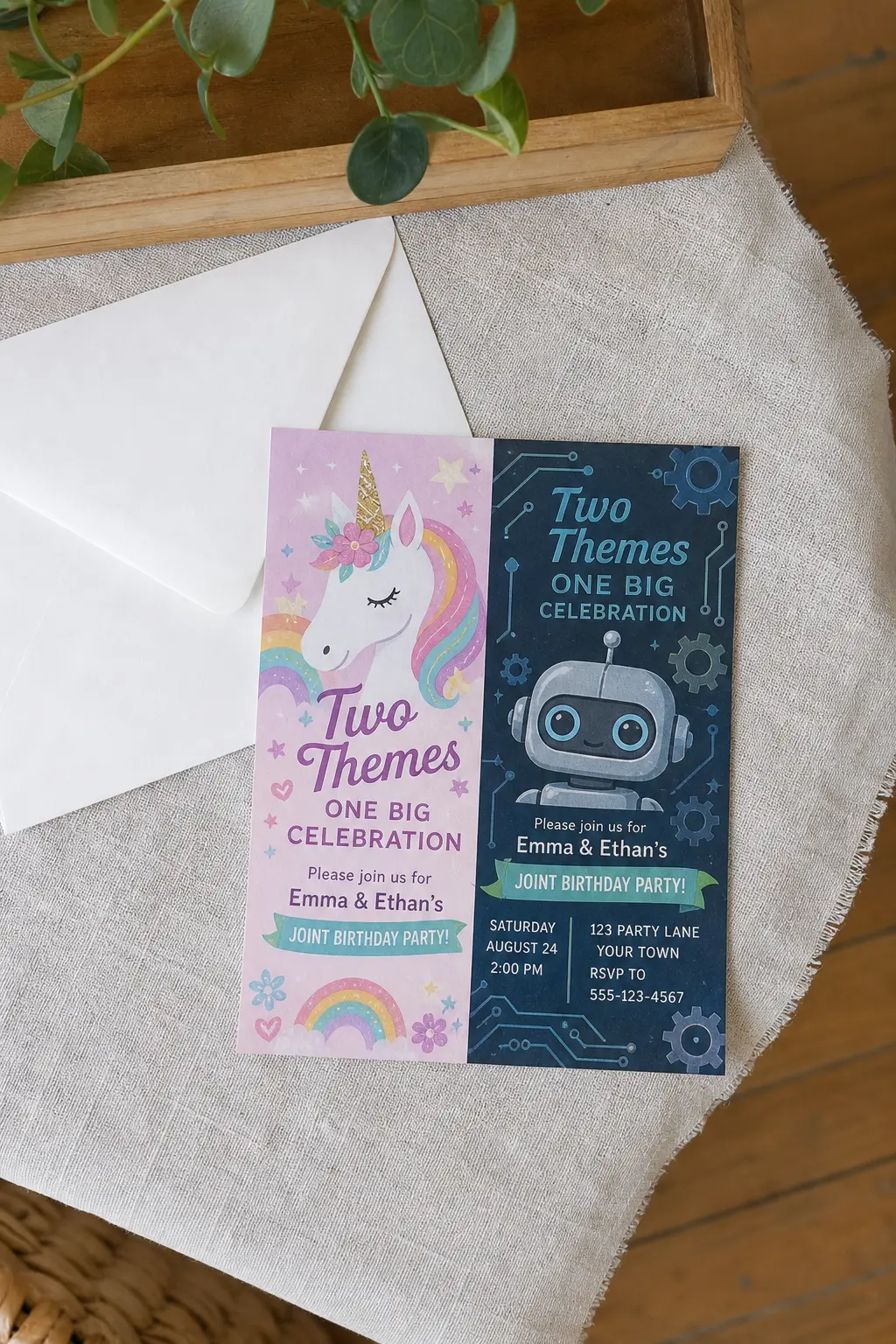
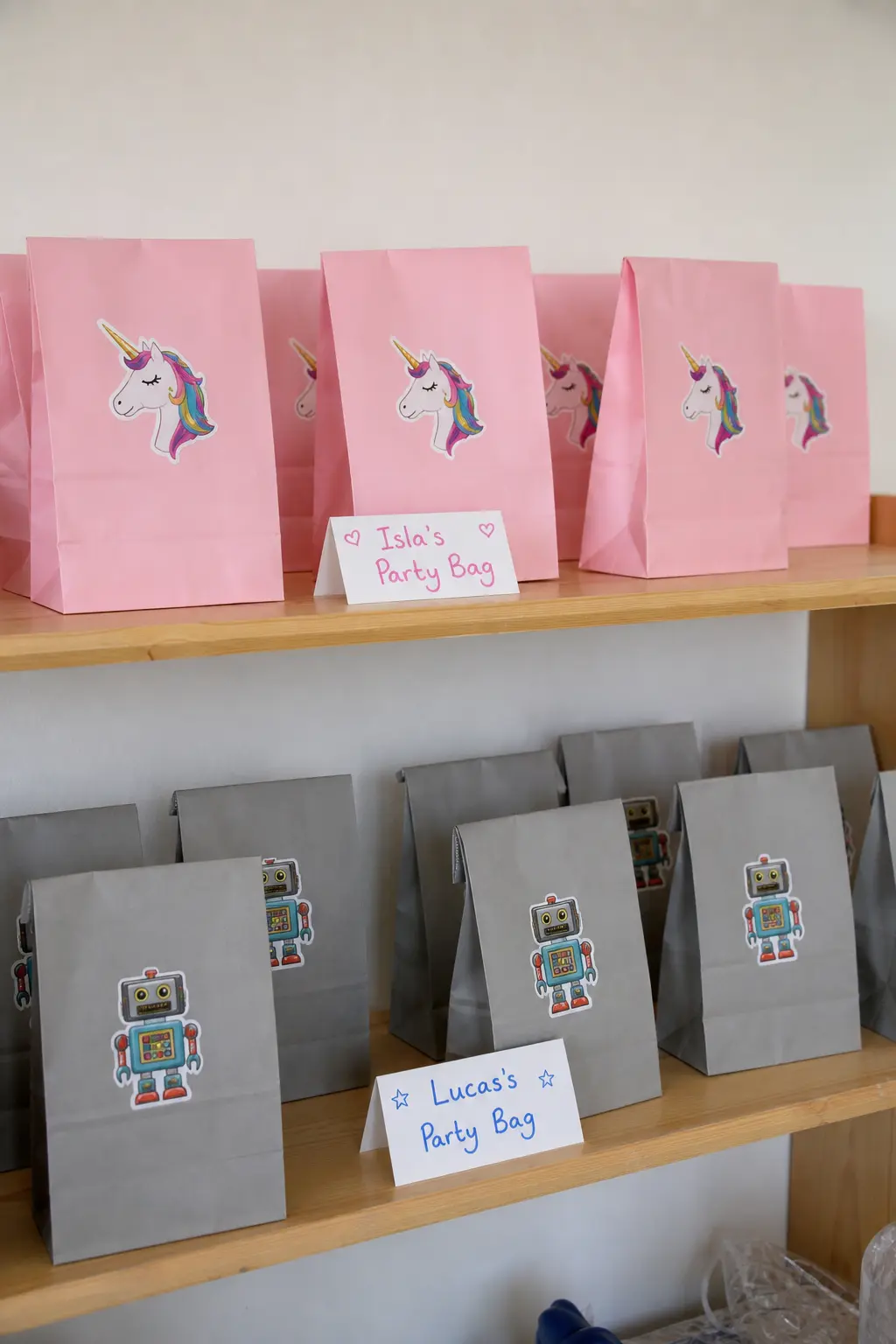
A joint invitation with a line that names both themes removes every guest confusion before the party starts. Something as plain as “Zara is celebrating with unicorns, Eli with robots, come ready for both” is enough. It also signals to guests that both children are equally honoured, which affects how they shop for gifts.
Design-wise, split the invitation layout down the centre or use a top-and-bottom format, one theme per half. The shared information, date, time, address, sits in a neutral strip across the middle. Print one card, not two.
Digital invitations handle this format easily. A printed card takes one extra design pass but reads as more intentional, and parents of young children still tend to put printed invitations on the fridge where the date actually gets remembered.
🛍 Shopping guide
Individual Favour Bags Per Twin
Each twin has their own favour bag design, filled with items that match their chosen theme. Guests take one bag from each twin’s pile, so they leave with two small bags rather than one. Keep the bags the same size and the contents the same value so neither twin’s pile looks more generous.
Label the piles clearly with a small sign: “from Zara” and “from Eli.” Children and adults both find this charming rather than complicated, and it means each twin can genuinely say they gave something to every guest.
The total cost per head is the same as one bag because you are splitting the budget across two smaller bags. A single theme-print bag costs the same as a plain bag with a theme-print sticker added, and the sticker route lets you order one bag style and personalise at home the night before.
🛍 Shopping guide
twins birthday party themes
The through-line in every idea above is the same: a shared occasion does not require a shared identity. Twins birthday party themes work best when they acknowledge two children first and a tidy aesthetic second. Pick one structural rule, tell guests what it is, and let both kids feel the party was made for them.
If you are still deciding on the broader direction, the guide to 16 birthday party themes carried by three objects each is a useful starting point for keeping execution simple. For parties where siblings from different families share a date, combined birthday party sibling themes covers that angle. See also boy birthday party themes, boy 5th birthday party themes, birthday party themes for adults, and girls birthday party themes for adjacent clusters in this series.
The coin-flip rule from idea 6 is worth keeping in your back pocket for every year going forward. It removes the argument, introduces a little theatre, and teaches both kids that fairness sometimes means waiting your turn. That lesson costs nothing and fits in a pocket.
Frequently Asked Questions
How do I choose a birthday party theme?
Start with what the birthday child is genuinely interested in right now, not what photographed well last year. For twins, ask each child separately before you ask them together: their first answers, before they hear each other’s, are the most honest. Then look for an umbrella concept broad enough to hold both interests, or a structural rule like a two-sided room, that lets each answer coexist.
What themes work for a mixed age group of children?
Activity-led themes work best across ages: a craft table, a treasure hunt or a building challenge gives a four-year-old and a nine-year-old something to do at the same table without the older one feeling patronised. Colour-led themes, where the decor carries the concept rather than age-specific characters, also age up or down easily. Avoid themes built entirely around a single media property, since a show beloved by one age group is often completely unknown to another.
How much does a themed birthday party cost to decorate?
A single-theme party can be decorated for under fifty dollars using a matching paper tableware set, a balloon bundle and one printed backdrop. A two-theme party for twins costs roughly the same if you share the tableware colour and add only theme-specific details, stickers, toppers and small props, per child. The budget climbs when you buy full decoration sets for two separate themes independently, which is the approach worth avoiding.
Can siblings share one birthday party theme?
Yes, and it works best when both siblings genuinely like the theme, when there is a clear age gap that makes one child the obvious lead, or when the theme is broad enough for each child to find their own corner of it. For twins specifically, a shared umbrella with individual sub-themes, explorers with one twin as a space explorer and one as a jungle explorer, is the most practical version. Forcing one child’s specific theme onto a sibling who does not share it tends to show in the photographs and in the child’s mood on the day.
21 girls birthday party themes built as a complete package: palette, signature prop, and one activit
36 Lambeth birthday cakes ideas sorted by style, colour and skill level. Every design any bakery or
Fifteen named setups for a fiftieth birthday party, each built around the one element that carries t
Leave a Reply