

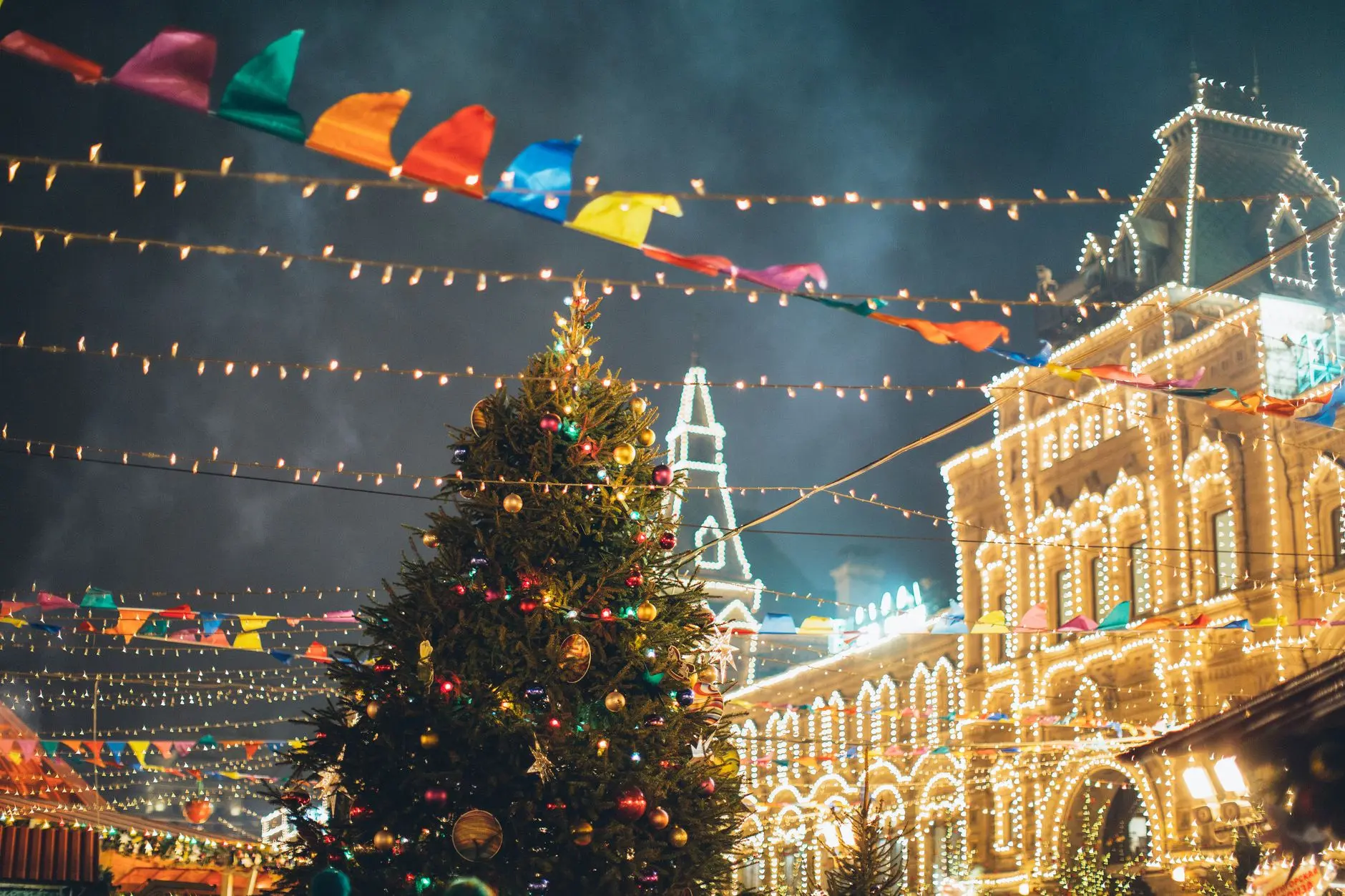
These 28 christmas traditions around the world give every student something to do with what they learn, not just listen to.
Printable sheets come first so the teacher can hand them out and get going immediately, then zero-prep activities follow for the traditions that need nothing but the room.
The list covers 28 countries, runs in roughly forty minutes, and works for a classroom or a home-education table equally well. Every activity is genuinely distinct, no two repeat the same mechanic, and nothing requires a budget.
This post contains affiliate links. If you buy through them, I may earn a small commission at no extra cost to you.
- Sweden and the Straw Goat: Country-Tradition Matching Sheet
- Denmark and the Rice Pudding Almond: Fill-in-the-Blank Fact Sheet
- Colombia and the Candle Night: Candle-Pattern Colouring Sheet
- Switzerland and the Mountain Bells: Trivia Quiz Sheet
- Brazil and the Midnight Supper: This-or-That Card Set
- Russia and the January Celebration: World Calendar Fact Sheet
- Costa Rica and the Ox Cart: Design-Your-Own Ox Cart Sheet
- South Korea and the Cake: Christmas Cake Label Design Sheet
- Lithuania and the Twelve Dishes: Kūčios Menu Planning Sheet
- Iceland and the Book Flood: Silent Book Exchange
- Japan and the Ordered Meal: Tray-Setting Relay
- Mexico and the Nine Nights of Processions: Posada Candle Walk
- Poland and the Extra Place at the Table: Empty Chair Discussion
- Philippines and the Lantern Parade: Giant Star Construction
- Italy and the Gift Bringer on the Sixth of January: La Befana I-Spy Sheet
- Ukraine and the Spider Web on the Tree: Web-Weaving Challenge
- Norway and the Hidden Brooms: Broom Hide-and-Seek
- Ethiopia and the January Date: Timeline Sorting Game
- Germany and the Shoe Left Out: Shoe Scavenger Hunt
- Venezuela and the Early Morning: Rollerskate Sound Walk
- Spain and the Log That Gives Presents: Tio de Nadal Drumming
- Finland and the Sauna: Sensory Description Writing
- Greece and the Boat Instead of a Tree: Paper Boat Flotilla
- India and the Mango and Banana Trees: Leaf-Garland Making
- Portugal and the Meal for the Departed: Empty-Plate Reflection Card
- Netherlands and the Arrival by Boat: Sinterklaas Arrival Debate
- France and the Thirteen Desserts: Dessert Tally Vote
- Australia and the Beach on the Day: Summer-Winter Christmas Comparison Chart
- Frequently Asked Questions
1. Sweden and the Straw Goat: Country-Tradition Matching Sheet
Students read a column of 20 countries and a scrambled column of 20 traditions, then draw a line connecting each pair.
Sweden and the straw goat, Iceland and the book flood, Japan and the ordered meal, Mexico and the nine nights of processions, Poland and the extra place at the table, the Philippines and the lantern parade, Italy and the gift bringer on the sixth of January, Ukraine and the spider web on the tree, Norway and the hidden brooms, Ethiopia and the January date, Germany and the shoe left out, Venezuela and the early morning, Spain and the log that gives presents, Finland and the sauna, Greece and the boat instead of a tree, India and the mango and banana trees, Portugal and the meal for the departed, the Netherlands and the arrival by boat, France and the thirteen desserts, and Australia and the beach on the day are all on this one sheet.
Print one per student on plain paper, no cardstock needed. The activity takes six to eight minutes and works as a warm-up before the class hears any explanations, so students try to use what they already know before the lesson fills in the gaps.
A small answer key runs in light grey italic text at the very bottom of the sheet, numbered 1-20.
After marking their own sheets, students compare with a neighbour. Where two people disagreed, that country becomes the starting point for the class conversation: the dispute earns the discussion, which is far more effective than going through every answer in order.
- Ages 8 and up
- Pairs or solo work
- Runs 6-8 minutes as a warm-up

2. Denmark and the Rice Pudding Almond: Fill-in-the-Blank Fact Sheet
In Denmark, a whole almond is hidden inside a pot of rice pudding served on Christmas Eve. The person who finds it in their bowl wins a small prize, often a marzipan pig.
This fill-in-the-blank sheet gives students eight sentences about the Danish tradition with one or two key words blanked out per sentence, and a word bank at the bottom of the page to choose from.
Print one per student. Students work individually for four minutes, then the teacher reads the completed sentences aloud so the class self-corrects. The word bank contains two extra words that fit nowhere, which keeps students reading carefully rather than filling boxes in order.
A full numbered answer key appears in tiny light-grey italic text at the very bottom of the sheet. If the class has already discussed Denmark, hide the word bank with a folded strip of paper and challenge older students to fill blanks from memory first.
- Fold and tape the word bank for an extra challenge
- Read sentences aloud for younger students before they write

3. Colombia and the Candle Night: Candle-Pattern Colouring Sheet
On December 7, millions of Colombians place candles and paper lanterns outside their homes for Noche de Velitas, the little candles night. The streets fill with light in an event that marks the start of the Christmas season.
This colouring sheet shows a street scene of lanterns, candles in paper bags, and decorated windows, with a short paragraph of facts printed alongside for the student to read while they colour.
The activity occupies the hands while the ears and eyes absorb the text, which research on dual-coding supports as more memorable than reading alone. Allow five to eight minutes. No answer key is needed because this is an open creative sheet.
For an extension, students write one sentence at the bottom of the sheet describing what light means to people celebrating in Colombia. That single sentence produces better discussion than a worksheet full of comprehension questions.
- Coloured pencils or crayons
- One sheet per student

🛍 Shopping guide
4. Switzerland and the Mountain Bells: Trivia Quiz Sheet
In Switzerland, communities ring large cowbells and church bells on Christmas Eve to fill the mountain valleys with sound. The bells are also rung to drive away dark spirits and welcome the light of the season.
This eight-question multiple-choice quiz covers Switzerland’s December traditions, including the bells, the figure of Schmutzli who accompanies Saint Nicholas, and the date the Swiss celebrate.
Four answer options appear under each question, labelled A through D. Students circle their answer. The complete answer key runs in tiny light-grey italic text at the very bottom of the sheet. Allow four minutes for the quiz, then read the answers aloud so students self-mark.
To extend the activity, ask students to write one question of their own at the bottom of the sheet about any country covered in the lesson. Collect the best ones and use them as a class warm-up the next day.
Read questions aloud for younger students while they follow on the sheet

5. Brazil and the Midnight Supper: This-or-That Card Set
Brazilian families gather for a large midnight supper on Christmas Eve called Ceia de Natal.
The table typically holds turkey, ham, rice, farofa (toasted cassava flour), and fresh fruit, and eating begins precisely at midnight when families have returned from Missa do Galo, the rooster mass.
This this-or-that sheet gives students twelve pairs of Christmas foods from around the world and asks them to circle which they would choose, then write the country that eats each food beside it.
The country names appear in a word bank at the top of the sheet so this is a research-and-preference hybrid rather than a quiz. Students need about five minutes. No answer key is needed because food choices are personal.
After completing the sheet, students share one choice aloud with the class and explain why. That single sentence of speaking is more valuable for retention than three minutes of silent reading, and it takes the same time.
Combines geography with personal response, so every student has a valid answer and nobody is wrong

6. Russia and the January Celebration: World Calendar Fact Sheet
Russian Orthodox Christmas falls on January 7 because the Russian Orthodox Church follows the Julian calendar rather than the Gregorian calendar used by most of the world.
The twelve days between Christmas Eve on January 6 and Epiphany are called Svyatki, a time of carolling and fortune telling.
This fact sheet maps eight countries onto a December-January calendar strip and asks students to mark the date each country celebrates, using a colour key.
Students receive the sheet and eight coloured pencils or crayons in different colours. Each country is assigned one colour in a legend at the top. Students shade or mark the correct date for each country on the calendar strip. The activity takes about six minutes and produces a visual reference the student keeps for the rest of the lesson.
The completed sheet makes a useful reference card during the active activities later in the lesson, so ask students not to put it away. The calendar format makes the Julian versus Gregorian distinction concrete and memorable rather than abstract.
- Coloured pencils, 8 colours per student
- One sheet per student

🛍 Shopping guide
7. Costa Rica and the Ox Cart: Design-Your-Own Ox Cart Sheet
In Costa Rica the brightly painted ox cart, or carreta, is a national symbol. During December, decorated ox carts parade through towns as part of Christmas and New Year celebrations.
Each cart is hand-painted with intricate geometric patterns specific to the region it comes from, and the craft is recognised by UNESCO as intangible cultural heritage.
This sheet gives students a plain outline of an ox cart wheel and the side panel of the cart, and asks them to fill it with their own geometric pattern using the traditional mandala-style approach of Costa Rican artisans.
Allow seven minutes. The only materials needed are coloured pencils or felt-tip markers. No answer key belongs on a design sheet.
After students finish, hold the sheets up around the room so the class can see how many different patterns emerged from the same outline. That visual moment, thirty different designs from one template, communicates what cultural variation looks like more effectively than any definition.
- A design activity makes the UNESCO heritage status concrete rather than abstract
- Every child produces something genuinely different from the same starting point

🛍 Shopping guide
8. South Korea and the Cake: Christmas Cake Label Design Sheet
Christmas in South Korea is a public holiday and is celebrated with elaborate cream-and-strawberry cakes, which bakeries produce in ornate seasonal designs. The cake culture there is so significant that Christmas Eve is one of the busiest trading days of the year for Korean bakeries.
This sheet gives students a blank rectangular cake-box label template and asks them to design a label for a fictional Korean Christmas cake, including the cake name in English and Korean script (printed on the sheet in light grey for them to trace), the flavour, and a simple decorative illustration.
Allow five minutes. Students need pencils or fine-tip markers. No answer key is needed because this is a creative design task.
Display the finished labels on a bulletin board under the heading South Korea. Students naturally begin comparing their designs and discussing how different a commercial holiday tradition looks from a religious one, which opens a productive geography conversation without the teacher needing to introduce it.
- Ages 7 and up
- Five-minute creative pause between longer activities

9. Lithuania and the Twelve Dishes: Kūčios Menu Planning Sheet
On Christmas Eve, Lithuanian families serve exactly twelve meatless dishes at a meal called Kūčios, one dish for each apostle or each month of the year. Traditional dishes include herring, mushroom soup, poppy seed milk, cranberry pudding, and dried fruit.
This sheet gives students a blank twelve-section menu card and a list of twelve traditional Kūčios dishes with a short description of each. Students match each dish to one numbered section of the menu card and write it in.
This is a reading-comprehension and sequencing task disguised as menu planning. Allow six minutes. The answer is flexible because the order of the twelve dishes is not fixed, so no key is needed, but all twelve must appear.
After completing the sheet, students discuss which dish they would most like to try and which they would find most challenging. That conversation often surfaces genuine cultural empathy when students realise that a dish unfamiliar to them is completely ordinary to a Lithuanian child on Christmas Eve.
Read the dish descriptions aloud before students begin so the vocabulary is accessible to all reading levels

10. Iceland and the Book Flood: Silent Book Exchange
In Iceland, Jolabokaflod, the Christmas Book Flood, is a tradition in which books are given and received on Christmas Eve and then read that same evening.
Publishers release a rush of new titles in the weeks before Christmas, and gifting books is the primary form of present-giving in many households.
For this activity, every student brings one book from home (any book, any age level) wrapped in a single sheet of newspaper. The books are placed in a pile, each student draws a number, and they collect the book matching their number.
Students then have five minutes of silent reading in whatever position they choose: floor, desk, window ledge. No discussion during the reading. The silence itself is the point, and it lands differently when the class knows they are doing what Icelandic families do on Christmas Eve.
After the five minutes, students pass the book to the person on their left and read for two more minutes. This is genuinely transportive for a class that spends most of the day talking, and the debrief takes thirty seconds: ask one student to describe their book in exactly five words.
- Each student brings one wrapped book from home
- Draw numbers to collect books
- Five minutes silent reading, then pass left for two more
11. Japan and the Ordered Meal: Tray-Setting Relay
In Japan, a Christmas Eve meal at KFC has become a genuine cultural tradition since a 1974 marketing campaign that aligned perfectly with a country that wanted a festive meal but had no deeply rooted Christian feast tradition. Orders are placed weeks in advance.
The meal is served precisely: a set box, a cake, champagne for adults. For this relay, the class divides into four teams.
At a table at the front, five paper plates, five labelled cards (chicken, cake, salad, drink, napkin) and five empty cups sit in a pile.
One student at a time runs to the table, places one item in the correct position on a simple tray outline drawn on paper (the layout is shown on a reference card held by the teacher), and runs back to tag the next student.
The team that assembles the full tray in the correct order first wins. Setup takes two minutes and the relay takes three.
The debrief matters as much as the game. Ask the class: why would a marketing campaign become a real tradition? That question takes the conversation into how traditions are made, which is genuinely more interesting than any single fact about Japan.
- 5 paper plates per team
- Labelled cards (chicken, cake, salad, drink, napkin)
- A tray outline drawn on A3 paper
- Open floor space for running
12. Mexico and the Nine Nights of Processions: Posada Candle Walk
Las Posadas is a nine-night celebration running from December 16 to 24, during which Mexican communities re-enact Mary and Joseph’s search for shelter in Bethlehem.
A procession moves from house to house, those inside singing that there is no room, those outside singing their need for shelter, until the doors open and the celebration begins.
For a classroom version, half the class forms a line and walks slowly around the perimeter of the room holding unlit battery tea-lights while singing or chanting a simple repeated phrase (‘We are looking for shelter, is there room?’).
The other half sits inside a taped square at the centre of the room and responds (‘There is no room’). On the third circuit, the teacher signals and the central group calls out (‘Come in, come in’). The two groups join together and sit. This takes four minutes and needs no materials beyond tea-lights.
The activity is most effective when the teacher explains the nine nights before the walk, not after, so students feel the weight of repetition: they walk three circuits, imagine doing this across nine evenings, and the scale of the tradition becomes physical rather than abstract.
- Battery-operated tea-lights, one per student
- Masking tape to mark the central square
🛍 Shopping guide
13. Poland and the Extra Place at the Table: Empty Chair Discussion
In Poland, one extra place is always set at the Christmas Eve table, called Wigilia. The empty seat is for any stranger or traveller who arrives without a home that night, or for the memory of a family member who has died during the year.
The tradition is ancient and carries a meaning of radical hospitality.
For this activity, the teacher places one empty chair at the front of the room and gives the class two minutes to write a single sentence on a slip of paper about who they would want that seat to be for, without putting their name on the paper.
Slips are collected and read aloud by the teacher, anonymously. No discussion is required after each reading. The cumulative effect of hearing twenty different answers in the same quiet room is enough. Allow six minutes total.
This is a quiet activity that works best placed after an active one. It gives the class a genuine moment of stillness and introduces the idea that a tradition does not need to be loud or colourful to be powerful. No materials needed beyond paper slips and pencils.
- Anonymous writing removes social pressure and produces more honest responses
- The quiet format contrasts well after a relay or walk activity
14. Philippines and the Lantern Parade: Giant Star Construction
The Giant Lantern Festival in San Fernando, Philippines, features enormous parol lanterns, traditionally star-shaped, made from bamboo and paper and lit from within. The festival is held on the Saturday before Christmas Eve and draws crowds from across the country.
For a classroom version, each table group of four to six students receives two sheets of card, a stapler, and a strip of tissue paper. They have five minutes to construct a star shape large enough to hold above their heads.
At the end of five minutes, every group raises their star simultaneously and the class takes thirty seconds to observe every group’s interpretation. No judging, no winner. The variety of shapes and sizes from the same materials and the same brief is the point.
The teacher then explains the scale of the real lanterns, which can reach five metres across and use thousands of light bulbs, and the contrast between the classroom stars and the festival lanterns communicates scale more effectively than any number alone. Christmas crafts preschool pages have simpler star templates if the group needs a guided starting point.
- 2 sheets of card per group
- Stapler per group
- Strips of tissue paper for fringing
- Scissors
🛍 Shopping guide
15. Italy and the Gift Bringer on the Sixth of January: La Befana I-Spy Sheet
In Italy, gifts are traditionally brought not by Father Christmas on December 25 but by La Befana, a kind old woman who flies on a broomstick on the night of January 5 and delivers sweets and gifts to children’s stockings on the sixth, the feast of the Epiphany.
Good children receive sweets and small gifts; children who have misbehaved receive coal (now usually black candy). La Befana is one of the most beloved figures in Italian culture and predates many other gift-giving traditions in longevity.
This I-spy sheet shows a detailed illustrated scene of La Befana’s sack open on the floor, surrounded by fifteen different objects. Students find and circle each object from a list of fifteen printed beside the image. Ten objects are genuinely in the scene; five on the list are not. Students circle only the ones they can actually see.
Allow four minutes. No answer key is needed because this is a visual-search task with clear right-or-wrong visibility: students either see the object or they do not, and comparing with a neighbour resolves any dispute immediately.
- Ages 6 and up
- A calm four-minute activity between active games

16. Ukraine and the Spider Web on the Tree: Web-Weaving Challenge
Ukrainian Christmas trees are decorated with an artificial spider web and a spider ornament, based on a folk tale about a poor family whose tree was bare until spiders spun it with silver and gold webs overnight.
The tradition is that finding a spider web on your tree brings good luck. For the classroom version, each group of four students receives a ball of white yarn and four chairs arranged in a rough square.
One student holds the ball, throws it across to another student, who catches it and holds the strand, then throws the ball onward, building a web between the chairs over two minutes.
At two minutes the teacher calls stop. Each group holds their web up. The group with the most crossings (strands that intersect) has the most intricate web and, by the tradition’s logic, the most good luck. Count intersections quickly by eye, not precisely.
Cut the yarn into short pieces afterward and let students tie one piece to their wrist as a bracelet, a direct link to a Ukrainian folk craft that takes ten seconds and costs nothing. For a fuller set of craft-based activities, christmas crafts preschool has additional yarn ideas.
- One ball of white yarn per group of 4
- Four chairs per group, arranged in a square
🛍 Shopping guide
17. Norway and the Hidden Brooms: Broom Hide-and-Seek
In Norway, brooms and mops are hidden on Christmas Eve. The tradition holds that witches and mischievous spirits come out on the longest nights of winter to ride household brooms, so Norwegians tuck them away in cupboards and closets to protect them.
For the classroom game, the teacher hides five small paper broom cut-outs (prepared in advance, five minutes to make from a sheet of brown paper) around the room before students arrive or during a brief transition.
When the activity begins, students have three minutes to find as many paper brooms as they can without moving any furniture. Each found broom is returned to a central spot. The student who finds the most is the witch-who-missed-her-broom, a title that lands with humour without mocking the tradition.
Before the hunt, the teacher gives a sixty-second explanation of why Norwegians hide brooms, so the hunt has context. Without that sixty seconds, it is just a hunt. With it, the hunt is geography.
- Hide 5 paper broom cut-outs around the room before class
- Students search for 3 minutes without moving furniture
- The student with the most brooms wins
18. Ethiopia and the January Date: Timeline Sorting Game
Ethiopian Orthodox Christmas, called Genna, falls on January 7 and is marked by church services, traditional food including injera and doro wat, and a game resembling field hockey also called Genna, which gives the holiday one of its names.
The celebration is colourful and community-centred, and the January date reflects the Ethiopian Orthodox calendar rather than being a later or secondary celebration.
For this game, the teacher pre-writes eight country names on separate cards and eight dates on separate cards (ranging from December 6 through January 19, covering Saint Nicholas Day, Christmas, Epiphany, Ethiopian Genna, and Russian Orthodox Christmas).
Teams of four receive a shuffled set of cards and race to arrange them in chronological order on their desk, matching country to date. First team done and correct wins. This takes three minutes and builds calendar literacy alongside geography.
After the game, ask the class: if you were born in Ethiopia, would Christmas feel like January or December? That question shifts the frame from ‘different’ to ‘normal for someone’, which is the single most important concept in any global traditions lesson.
- 8 country name cards per team
- 8 date cards per team (pre-written)
- Flat desk space per team of 4
19. Germany and the Shoe Left Out: Shoe Scavenger Hunt
On the night of December 5, children across Germany leave a clean shoe outside their bedroom door or on the windowsill. Saint Nicholas visits overnight and fills it with sweets, fruit, and small toys.
Children who left a dirty or worn shoe may find a switch of twigs instead, left by Knecht Ruprecht, Nicholas’s companion.
For the classroom scavenger hunt, the teacher hides twelve small paper shoe cut-outs around the room (or the corridor, with permission), each labelled with a number on the back.
Students collect as many shoes as they can in three minutes.
When time is called, each student reads the number on the back of one shoe and finds the matching clue card held by the teacher, which gives one fact about a country covered in the lesson.
Students read their fact aloud to the group in the order of their shoe number. This means the scavenger hunt doubles as a fact review. For a broader set of hunt formats, the christmas scavenger hunt article has adaptable templates for classrooms.
Allow four minutes for the hunt and two minutes for the fact-reading. The total time cost is six minutes for a full review of twelve countries.
- 12 paper shoe cut-outs, numbered on the back
- 12 matching fact clue cards
- Blu-Tack or tape to place shoes around the room
20. Venezuela and the Early Morning: Rollerskate Sound Walk
In Caracas, Venezuela, it is traditional to attend early morning Mass on the nine days before Christmas, called Misa de Aguinaldo, and in much of the city people travel to church on roller skates.
The streets are closed to cars from early morning so that skaters can move freely.
Children often tie a piece of string to their big toe the night before, hang it out the window, and let passing skaters tug it to wake them in time for Mass.
For a classroom version with no skates needed, students walk a circuit of the room to a rhythm tapped by the teacher on a desk.
When the rhythm stops, students freeze and balance on one foot. Anyone who touches down sits out for thirty seconds. Three rounds, each lasting ninety seconds, with the rhythm getting slightly faster each round. The movement mirrors the energy of the early morning tradition without requiring equipment.
Before the game, share the string-and-toe detail with the class. It is genuinely joyful and will be the detail they remember weeks later, which is exactly what a memorable tradition does.
- Walk to a rhythm tapped on the desk
- Freeze and balance on one foot when rhythm stops
- Three rounds, rhythm speeds up each time
21. Spain and the Log That Gives Presents: Tio de Nadal Drumming
In Catalonia, Spain, the Tio de Nadal is a hollow log with a painted smiling face, small legs, and a blanket over its back end.
Children feed the log small treats each night from December 8, and on Christmas Eve they beat it with sticks while singing a traditional song, then lift the blanket to find sweets and small gifts underneath.
The log is a beloved family figure, not a comic prop, and the ritual of feeding it nightly is taken seriously by children who genuinely care for their Tio.
For the classroom version, the teacher places a cardboard box (the log) covered with a cloth at the front of the room.
Students line up and each taps the box three times with a ruler or pencil while the class chants a simple phrase the teacher writes on the board: ‘Tio, Tio, give us presents, don’t give us salted herring.’
(The traditional song ends with a request not to receive herring or onion.) Under the cloth are small wrapped sweets, one per student.
Allow four minutes total. The activity is brief but the ritual quality of tapping, chanting and lifting the cloth makes it stick. Students remember doing something, not just hearing something.
- One cardboard box covered with a cloth
- Small wrapped sweets, one per student
- Ruler or pencil per student for tapping
🛍 Shopping guide
22. Finland and the Sauna: Sensory Description Writing
In Finland, Christmas Eve includes a visit to the sauna, which is considered a place of peace and reverence.
The sauna is central to Finnish culture year-round but takes on particular significance at Christmas, when even the spirits of ancestors are said to visit the sauna on Christmas Eve night. Families bathe together in the quiet heat before the evening meal.
For this writing activity, the teacher describes the sauna in sensory terms: the smell of cedar, the sound of steam, the weight of heat on the skin, the silence.
Students have three minutes to write three sentences: one about what they would hear, one about what they would feel, and one about what they would think about in the quiet. No correct answer exists. The prompts are on a card at the front of the room, visible to all.
This activity works because it asks students to inhabit a tradition from the inside rather than describe it from the outside. The distinction between observer and participant is the real geography lesson.
- Sensory writing builds empathy more effectively than factual description
- Three sentences is achievable for any age in three minutes
23. Greece and the Boat Instead of a Tree: Paper Boat Flotilla
In Greece, especially in coastal and island communities, homes are decorated with a small model boat rather than, or alongside, a Christmas tree, reflecting the country’s deep seafaring history.
The karavaki (little boat) is lit with lights and placed in the living room as the central Christmas decoration.
For the classroom activity, students each fold a simple origami boat from a single sheet of paper in three minutes (the teacher demonstrates the six-step fold slowly at the front).
Boats are placed on a sheet of blue paper on a central table to form a flotilla. Each student writes the name of a Greek island in small letters on the sail of their boat using a pencil.
The teacher provides a list of ten island names on the board. The flotilla stays displayed for the rest of the lesson as a reference map of Greek geography.
The origami fold is genuinely learnable in three minutes for ages seven and up. If a student’s boat does not float correctly (this is a dry flotilla on paper), it still counts. The point is the fleet, not the individual vessel.
- One sheet of paper per student
- Blue paper or cloth for the central table
- Pencil to write the island name
24. India and the Mango and Banana Trees: Leaf-Garland Making
In India, where Christmas is celebrated by Christian communities across the country, homes and churches are decorated with mango leaves and banana leaves rather than pine or spruce, which do not grow in the local climate.
Oil lamps replace candles in many regions, and the decorations are made from whatever grows nearby, giving the celebration a distinctly local visual character while sharing the same date and meaning as celebrations elsewhere.
For the classroom activity, students cut leaf shapes from green paper (two cuts each: one broad mango-leaf shape, one wide banana-leaf shape) and punch a hole in the stem end.
Leaves from the whole class are threaded onto a long piece of string to make one garland, which is hung across the front of the room. Total time: five minutes including hanging.
The garland represents the same idea as the star and the tree: marking the space as special. Ask the class why the materials differ from country to country and whether the meaning differs too. The garland already answers the question visually.
- Green paper, 2 sheets per student
- Scissors
- Hole punch
- Long piece of string for threading
25. Portugal and the Meal for the Departed: Empty-Plate Reflection Card
In Portugal, the Christmas Eve meal is called Consoada and traditionally includes an extra place set at the table for deceased family members. Food is left on their plate.
The tradition is called consoda dos finados, the meal for the dead, and reflects a deeply held belief that the spirits of ancestors return to share the family feast. It shares a quiet hospitality with the Polish empty seat but carries a specifically memorial character.
For this activity, students receive a small card (quarter of an A4 sheet) with an illustration of a simple table setting: plate, fork, spoon.
Students write one sentence on the back of the card about someone or something they would want to remember at a special meal. No names are shared unless the student volunteers. Cards are folded and kept by the student, not collected.
This is a two-minute activity placed deliberately near the end of the lesson when the class is calmer. It asks nothing difficult and returns something private to each student, which is the right register for a tradition about remembrance.
- A private card that is never collected gives students genuine ownership of their response
- Pairs naturally with the Polish empty-seat activity if the lesson covers both
26. Netherlands and the Arrival by Boat: Sinterklaas Arrival Debate
In the Netherlands, Sinterklaas arrives by steamboat from Spain in mid-November, a figure distinct from Santa Claus: he wears bishop’s robes, carries a staff, and travels with a book in which he has recorded every child’s behaviour during the year.
His arrival is broadcast live on national television and watched by millions. Gifts are exchanged on December 5, his eve, not on December 25.
For this classroom activity, students receive a simple two-column comparison card with Sinterklaas on one side and the gift-giver from any other country they have studied in the lesson on the other.
In pairs, students have two minutes to fill in three rows: how he travels, when he arrives, and what he brings. Then each pair shares one difference they found most surprising.
The activity is structured enough to give students something to do but open enough that each pair finds different comparisons depending on which country they choose to compare. No answer key exists because every comparison is valid. For a ready-made framework, check the christmas trivia questions and answers free printable for additional comparison prompts.
- Work in pairs
- Fill in 3 comparison rows in 2 minutes
- Share one surprising difference aloud
27. France and the Thirteen Desserts: Dessert Tally Vote
In Provence, southern France, Christmas Eve ends with thirteen desserts served on the table simultaneously, one for each of Jesus and his twelve apostles. The thirteen items traditionally include dried figs, walnuts, almonds, raisins, nougat, quince paste, dates, and various fruits.
All thirteen must remain on the table until December 27. For the classroom activity, the teacher writes the thirteen traditional dessert names on the board and gives each student three sticky dots.
Students walk to the board and place their dots beside the three desserts they would most like to try. When everyone has voted, the class reads the results together.
The teacher then reveals which three are almost always left with zero dots (dried figs and quince paste usually lose) and asks why certain flavours win in a British or American classroom that never would in Provence.
This takes four minutes and opens a genuine conversation about how taste is shaped by what you grow up eating, which connects to every tradition in the lesson.
- Sticky dots, 3 per student (or dot stickers)
- Board space to write 13 dessert names
🛍 Shopping guide
28. Australia and the Beach on the Day: Summer-Winter Christmas Comparison Chart
Christmas in Australia falls in midsummer: temperatures can reach 40 degrees Celsius, and many families celebrate on the beach with barbecues, cold seafood, and pavlova. Carols by Candlelight events are held outdoors under summer stars.
The images of snow and fir trees in Christmas decorations are imported from the northern hemisphere and sit alongside a lived experience that is nothing like them.
This comparison chart gives students two columns, one for a northern-hemisphere December and one for an Australian December, and twelve weather, food, activity and decoration prompts.
Students fill in one entry per prompt per column based on what they know or can reason out. No answer key is needed because many answers are inference and experience rather than fact. Allow five minutes.
After completing the chart, ask: which version feels more like Christmas to you, and why? The answer is always shaped by where each student grew up, which makes the question itself a lesson in how tradition becomes personal. Christmas games for kids has additional summer-Christmas activity ideas for Australian classrooms specifically.
- Ages 8 and up
- Works well as a closing sheet that students keep

Frequently Asked Questions
What are Christmas traditions around the world?
Christmas traditions around the world vary enormously by country, calendar, climate and religion. Some countries celebrate on December 25, others on January 7 following the Orthodox calendar.
Gift-givers range from La Befana in Italy to Sinterklaas in the Netherlands to the Tio de Nadal log in Catalonia. Decorations include straw goats in Sweden, spider webs in Ukraine, and boats in Greece.
Food ranges from thirteen desserts in Provence to a midnight supper in Brazil. What the traditions share is a community gathering around a marked moment in the year.
How do you teach Christmas around the world?
Teach Christmas around the world by giving students one active thing to do with each tradition rather than a fact to record. Matching activities, construction challenges, short walks, and sensory writing tasks each take under eight minutes and produce stronger recall than listening alone.
Use printable sheets for traditions with visual content and movement-based activities for traditions with a ritual character. Sequence them so quiet activities follow active ones, and always explain the context before the activity, not after.
Which countries do not celebrate on the twenty-fifth?
Several countries celebrate Christmas on a date other than December 25. Russia, Ethiopia, Serbia, and Egypt celebrate on January 7, following the Julian or Orthodox calendar. Armenia celebrates on January 6.
In the Netherlands, the main gift-giving day is December 5, Saint Nicholas Eve, with December 25 observed as a quieter religious day. Japan celebrates Christmas culturally on December 25 but it is not a public holiday.
In many predominantly non-Christian countries, December 25 passes without public observance.
What is a good class activity about world Christmas traditions?
A country-tradition matching sheet is the most efficient opener: students attempt to match twenty countries to their traditions before the lesson begins, which surfaces existing knowledge and creates genuine curiosity about the answers they got wrong.
Follow it with one active activity (a posada walk, a broom hunt, or a web-weaving relay) and one quiet activity (a sensory writing prompt or a comparison chart) and the lesson covers geography, cultural empathy, and literacy in forty minutes without requiring any special materials beyond paper and pencils.
22 luxury Christmas decor ideas that turn a whole house into a five-star hotel lobby, room by room,
18 easy Christmas party games with zero prep stress — set up in minutes using things you already h

Christmas party games for groups of 30 that keep everyone playing at once. 10 free printables plus 1
Leave a Reply