

16 Valentine Games With Free Printables for Children Who Are Full of Sugar
These valentines day games for kids are built for the exact situation you are in right now: school bags on the floor, candy wrappers already multiplying, and a group of small people with nowhere to put all that energy. Half the games here are printable and ready to hand out, and the other half need nothing but the room you are standing in.
This post contains affiliate links. If you buy through them, I may earn a small commission at no extra cost to you.
- Valentine Bingo (4 Bingo Grids + Call List)
- Heart Toss Into a Bucket
- Heart Match Up
- Musical Statues With Love Songs
- Count the Conversation Hearts (Tally Card, One Per Child)
- Balloon Keepy Uppy in Red and Pink
- Follow the Line: Envelope to Postbox
- The Compliment Circle
- Colour the Heart Pattern (Colouring Page, One Per Child)
- Pass the Heart
- Spot the Difference
- Freeze Dance
- Guess the Chocolate by Smell
- The Card to Make for Someone at Home
- The Sticker Hunt Around the Room
- Would You Rather for Children
- Frequently Asked Questions
1. Valentine Bingo (4 Bingo Grids + Call List)
Each child gets one of four different bingo grids filled with Valentine images: hearts, arrows, envelopes, roses, candy boxes, and more. The host reads from the call list one image at a time, and players mark off each match. First to complete a row, column, or diagonal wins.
Print the four grids on cardstock and cut apart if needed. Players mark squares with small conversation hearts, which doubles as a second use for the candy already on the table. The call list prints on a separate half-sheet and the host keeps it.
With four grids in rotation, two children will sometimes share a grid at a bigger group. Rotate which grid each child gets round by round so the same person does not win back to back. Stickers or bingo daubers work as markers too if you would rather not put more sugar in reach.
- 4 printed bingo grids
- conversation hearts as markers
- printed call list for host

🛍 Shopping guide
2. Heart Toss Into a Bucket
Set three buckets or mixing bowls at different distances across the room and label them 1 point, 2 points, and 3 points. Each child gets five pink or red pom-poms to toss, one at a time. Total the scores after every child has had a turn, then reshuffle the throwing line and go again.
No printing needed. Pom-poms are the tossable hearts and they are light enough to be safe indoors. Painter’s tape on the floor marks the throwing line. The whole setup takes under three minutes.
Sugar-fuelled aim is wildly inaccurate, which is part of the fun. If the 3-point bucket is too easy, push it back. If a child is frustrated, let them step closer and count it. The goal here is movement, not competition, so keep the scoring light.
Use a kitchen mixing bowl as the hardest target so it is narrow and satisfying to land in.
🛍 Shopping guide
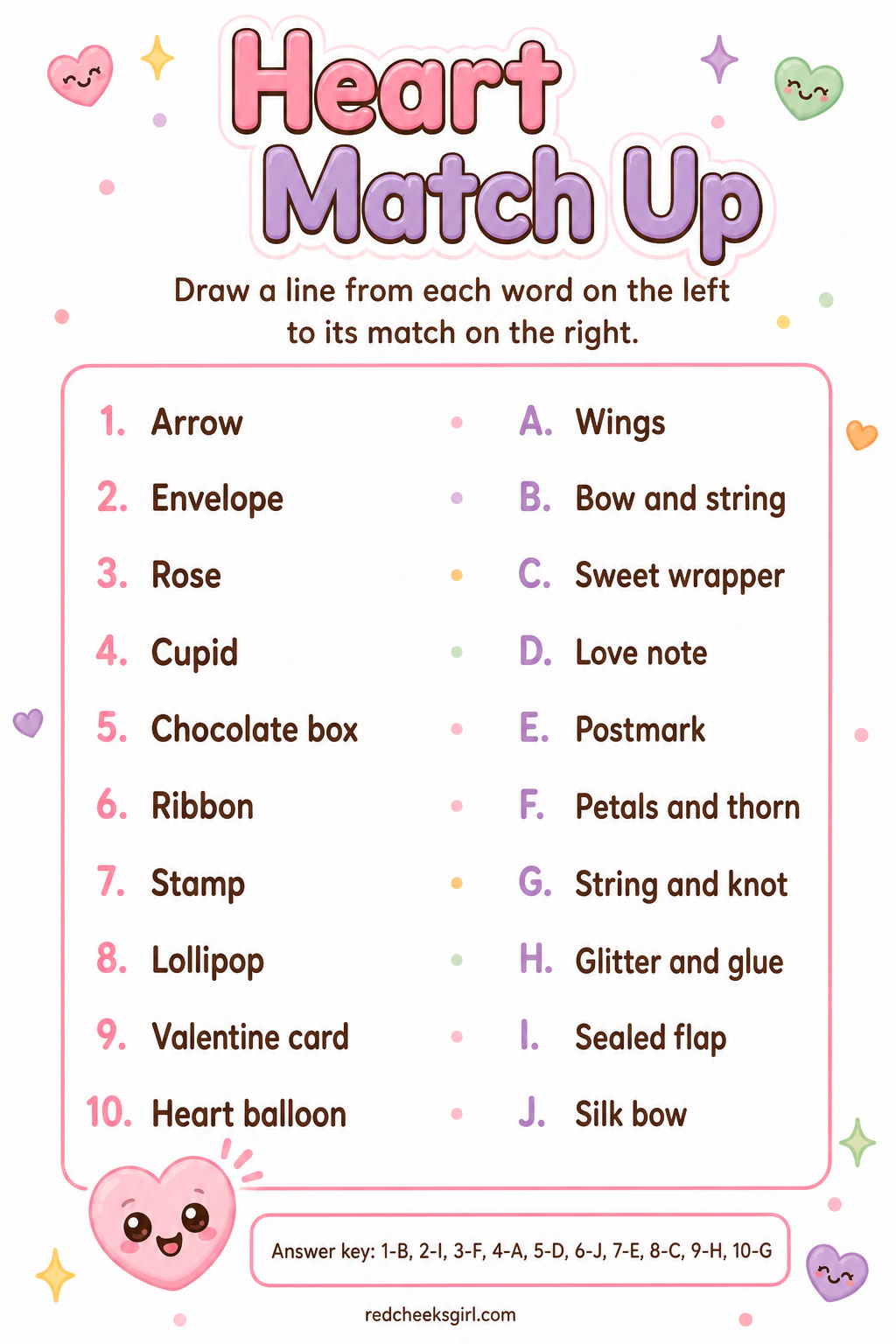
3. Heart Match Up
The left column shows ten Valentine images or words and the right column shows ten definitions or matching pairs in a scrambled order. Children draw a line connecting each left item to its match on the right. Pairs include things like: arrow matches bow, envelope matches stamp, rose matches thorn, and so on, all at an age-appropriate level.
One sheet per child, pencils only. It works for ages five and up and takes about four minutes, which is perfect for settling the group after a running game. Print one-sided on regular paper.
The answer key prints at the bottom of the same sheet in tiny italic text, so the host can check answers without a separate page. Fold the bottom up before handing out sheets to keep the key hidden until reveal time.
- Ages 5 and up
- 4 minutes of calm after a running game
- Groups of any size
4. Musical Statues With Love Songs
Play a Valentine playlist of well-known pop love songs or kid-friendly tracks and pause the music at random. When the music stops, everyone freezes. Anyone who moves is out and becomes a judge, helping spot future movers. Last child standing wins.
No printing needed. A phone and a small speaker are the only equipment. Use songs the children already know so the dancing is enthusiastic rather than awkward. A thirty-second clip per song keeps the pace sharp.
Children who are out tend to get bored fast. Keep them active by giving them a foam heart to hold up as a red card when they spot a mover. It keeps them invested and stops the host from having to argue about who flinched.
Burns a full burst of energy in under ten minutes and needs zero setup.
5. Count the Conversation Hearts (Tally Card, One Per Child)
Each child gets a small bag or handful of conversation hearts and a tally card. They sort their hearts by colour, count each colour group, and record the total in the matching box on their card. When everyone is done, compare who had the most pink, the most yellow, and who had the most hearts overall.
One tally card per child, printed on regular paper. Younger children can group by colour without counting, while older ones can add a total at the bottom. The hearts are the only other supply needed.
The counting goes sideways fast if children start eating before they finish tallying. Tell them they can eat everything after the final number is written down. That single rule is usually enough to make it work.
Pre-portion hearts into small paper cups before the party so no one argues about who got more.

🛍 Shopping guide
6. Balloon Keepy Uppy in Red and Pink
Blow up a mix of red and pink balloons and release them all at once. Every child keeps as many balloons in the air as possible using only their hands. No balloon touches the floor. If one lands, pick it up immediately and keep going.
No printing needed. Aim for at least one balloon per child plus two or three extras. Tie off the balloons before the party so there is no delay. Clear a space of any breakables first.
A quieter variation: each child is responsible for only one balloon and the group tries to keep all of them up simultaneously without anyone touching another child’s balloon. Harder than it sounds and genuinely cooperative rather than competitive.
- Red and pink latex balloons
- Open floor space
🛍 Shopping guide
7. Follow the Line: Envelope to Postbox
Each sheet shows six envelopes on the left and six postboxes on the right. From each envelope, a curling, looping path threads through a tangle of other paths across the page. Children trace each line with a pencil or crayon to find which postbox each envelope reaches.
One sheet per child, pencils or fine crayons. Ages four and up can manage this. It takes about five minutes, longer for careful tracers, which is useful when you need the group occupied during a transition.
The answer key numbers appear at the bottom of the sheet in small italic print, so fold the page up before handing it out. The paths genuinely cross and loop, so children cannot guess without actually tracing, which prevents the sheet from being over in thirty seconds.
For younger children, use only three envelope-to-postbox paths instead of six.

8. The Compliment Circle
Children sit in a circle. One child holds a foam heart and says one genuine compliment to the child on their left, then passes the heart. The compliment must be specific: not just ‘you are nice’ but ‘you always share your crayons’. Every child gives and receives one compliment before the heart returns to the start.
No printing needed. One foam heart is the only prop. This works best as a five-minute wind-down between active games, or right before the card-making activity when the mood needs to soften a little.
Some children freeze when put on the spot. Give them a prompt quietly: ‘What is one thing you like about what she did at school today?’ That is almost always enough. Never skip a child who is stuck, just wait a moment and help them quietly.
Drops the room temperature after two running games and takes less than five minutes.
9. Colour the Heart Pattern (Colouring Page, One Per Child)
The sheet shows a large decorative heart filled with a repeating pattern of smaller hearts, arrows, flowers, and stars arranged in rows. Children colour it in whatever way they like, following the pattern or ignoring it entirely. There is no wrong version.
One sheet per child, crayons or washable markers. This is the calm-down activity, placed deliberately after a high-energy game. It keeps hands busy without requiring any instruction from the host.
Offer a second sheet to children who finish quickly and want to make one for a sibling or parent. That feeds directly into the card-making activity later and keeps fast finishers occupied without disrupting the children still colouring.
Set crayons in the centre of the table in a single cup so children share without crowding each other.

10. Pass the Heart
Children stand in a circle and pass a large foam or felt heart around as fast as possible while music plays. When the music stops, whoever holds the heart does a quick Valentine forfeit: name three things you love, give the person next to you a high-five, or do five jumping jacks. Then the music restarts.
No printing needed. One foam heart and a phone with music covers everything. Keep forfeits short and positive so no child dreads being caught. Prepare five or six forfeits in advance on a small slip of paper the host reads from, so there is no pause for thinking.
This moves faster than Hot Potato because the forfeits are fun rather than punishing. Children who were previously caught often start hoping they get caught again. That is the sign the forfeit list is calibrated correctly.
- Pass the heart as fast as possible
- Music stops: holder does a forfeit
- Forfeits should be silly and kind, never embarrassing
🛍 Shopping guide
11. Spot the Difference
Two almost-identical Valentine scenes sit side by side: a table set with cards, balloons, hearts, and a vase of roses. Eight small differences are hidden across the right-hand image. Children circle each difference they find on the right picture.
One sheet per child, pencils or fine-tipped pens. Ages six and up will find all eight without much help. Younger children typically find four or five, which still feels like a win. Budget about six minutes.
The most common host mistake with Spot the Difference is making the answer key visible before everyone has tried. Hand out sheets face down and say ‘go’ at the same time so faster children do not call out answers across the table. The answer key sits at the bottom of a separate host sheet only.
- Ages 6 and up for all 8 differences
- Ages 4-5 for a partial win at 4 differences
- Works at any table size

12. Freeze Dance
Put on the Valentine playlist and let every child dance freely. When the music cuts, everyone freezes in whatever position they land in. Hold the freeze for a count of five, then the music starts again. No one is ever out: this is pure movement, no elimination.
No printing needed. This runs for as long as the playlist and the children’s stamina last, which is usually eight to ten minutes before it naturally winds down. Clear a generous space and remind children to stay in their own area so there are no collisions.
No-elimination Freeze Dance works better than the competitive version at this age and energy level, because taking children out when they are already over-stimulated creates meltdowns rather than fun. Keep everyone dancing and the room stays happy.
No one sits out, so the energy stays high and no child ends up on the sofa sulking.
13. Guess the Chocolate by Smell
Unwrap five or six different chocolates or Valentine sweets and place each one inside a small paper cup covered with foil. Poke small holes in the foil so the smell escapes. Each child sniffs each cup in turn and writes or whispers their guess for what is inside. Reveal all at once and see who got the most right.
No printing needed. Paper cups, foil, and a selection of chocolates are all that is required. Use clearly distinct smells: a mint chocolate, a plain milk chocolate, a strawberry cream, a caramel, and a coffee or orange truffle. Avoid anything with a nut allergy risk and check with parents first.
Children try to peek through the foil holes if the holes are too large. Use a toothpick to make the holes, not a pen. One small hole per cup is enough for the scent to come through without giving a visual clue.
Run this while children are seated after colouring: it keeps hands busy and the noise level manageable.
🛍 Shopping guide
14. The Card to Make for Someone at Home
The sheet prints four quarter-page blank-inside Valentine cards on one A4 or Letter sheet. Each card has a Valentine illustration on the front, space for a message inside after folding, and a small ‘To:’ and ‘From:’ line on the back. Children cut apart, fold, and decorate with crayons before writing a message to a parent, sibling, or pet.
Print one sheet per child on regular paper, though cardstock holds up better when small hands fold it repeatedly. Supply scissors, crayons, and a glue stick if you have heart stickers to add. This is the craft and the keepsake in one, and it takes about ten minutes.
Children who finish their card early will immediately want to make a second one for someone else. Print a few extra sheets for this reason. It keeps the fast workers occupied and you will not hear a single complaint about it.
- Cardstock or regular paper
- Scissors
- Crayons or markers
- Heart stickers (optional)

🛍 Shopping guide
15. The Sticker Hunt Around the Room
Before the party, hide fifty or more small heart stickers around the room at child height: on chair legs, tucked under cup edges, on the back of a door, on the skirting board. Each child gets a sheet of plain paper and a pencil and hunts for stickers to collect and press onto their sheet. Most stickers found in five minutes wins.
No printing needed. Heart stickers from any craft or party supply aisle are the only cost. Decide in advance whether the stickers are peeled off surfaces or just spotted and tallied, because peeling stickers off painted walls can lift paint. Tally-only is simpler to manage.
Hide some stickers at adult eye level too, just above the children’s reach. Tell them the whole room is fair game. That sends them looking up and down instead of only at table height and adds another thirty seconds of genuine searching.
- Hide 50+ heart stickers before guests arrive
- Children hunt for 5 minutes and tally what they find
- Most found wins a small prize
🛍 Shopping guide
16. Would You Rather for Children
The sheet prints six Would You Rather question cards, each with two Valentine-themed options. Questions are silly and age-appropriate: ‘Would you rather eat a heart-shaped pizza or a heart-shaped cake?’ or ‘Would you rather get 100 valentines or give 100 valentines?’ Children cut apart the cards and the host reads one aloud at a time. Players race to one side of the room for option A, the other side for option B.
Print one sheet per group, or one per child if you want each child to take a set home. Cut the cards before the party to save time. The active version with sides of the room burns energy and doubles as a movement break, and no materials are needed during play beyond the printed cards.
The room-crossing version works best after a seated activity. Children who share an answer end up on the same side and that consistently creates little bursts of delighted bonding, which is a pleasant moment in the middle of an otherwise chaotic afternoon. As a next step, check out 25 Birthday Party Games for Kids That Burn Off the Sugar for more crowd-splitter games that work the same way.
- Host reads a card aloud
- Players run to the A side or B side of the room
- No wrong answer, debate is encouraged

Frequently Asked Questions
Which of these valentines day games for kids work for mixed ages?
Heart Toss, Balloon Keepy Uppy, Freeze Dance, and Pass the Heart all work for ages four and up with no adjustment. For printables, Count the Conversation Hearts and Colour the Heart Pattern are the most age-flexible: younger children can count or colour without reading, while older ones can add totals or create patterns.
How many games should you plan for a two-hour after-school party?
Six to eight games is a realistic number for two hours when you account for transitions, snacks, and the card-making activity. Alternate one active game with one printable or quiet game throughout so the energy level rises and falls rather than peaking once and crashing.
What is the easiest game to set up with no advance prep?
Musical Statues and Freeze Dance both need only a phone and a speaker. The Compliment Circle needs nothing at all. If you want to grab one thing on the way home, a bag of conversation hearts gives you both the Count the Conversation Hearts printable game and a small prize to hand out.
How do you handle a child who does not want to join in?
Give them a small job instead: holding the call list for Bingo, controlling the music for Freeze Dance, or timing the Chocolate Smell game. Children who opt out of participation almost always engage through a role. Never force it, and never single them out.
Can these games work at school as a class party?
Yes. The printable games (Bingo, Spot the Difference, Match Up, Tracing, Colouring) all work at desks. Active games like Heart Toss and the Sticker Hunt adapt easily to a classroom if furniture is moved to one side. Skip Balloon Keepy Uppy in a small classroom unless there is clear overhead space.
What is a good prize for valentines day games for kids that is not more candy?
Small foam heart stamps, a sheet of novelty heart stickers, a mini colouring pencil set, or a single Valentine pencil are all under a pound or dollar per child. Sticker sheets in particular are consistently more exciting to this age group than you would expect.
20 toddler valentine crafts using 3-5 easy supplies, no small parts, grown-up does the cutting. Hand

20 valentine front porch ideas, from a heart wreath and XO sign down to mailbox love notes, ordered
18 station-by-station valentine class party ideas for kids, from a photo booth backdrop to a card ex
Leave a Reply