

21 Christmas Games With Free Printables for a Room With Too Many People In It

The best christmas party games for groups are the ones where all thirty people are doing something simultaneously, not watching two people guess while everyone else refreshes their drink. Every game here works in one living room, most run in parallel teams or at individual stations, and the ten printables are ready to download and print before anyone arrives.
This post contains affiliate links. If you buy through them, I may earn a small commission at no extra cost to you.
- Split the Room Into Four Teams and Keep Score All Night
- Christmas Bingo in Four Layouts
- Wrapping Paper Relay in Heats
- Find the Guest Christmas Edition
- The Guessing Jar by the Door
- Christmas Trivia in Teams
- Pass the Parcel With Two Parcels Going Opposite Ways
- Carol Lyric Finish
- Musical Statues for Adults
- The Sweepstake Everyone Fills In on Arrival
- Christmas Would You Rather
- The Memory Tray Passed Around
- Guess the Scent Station
- Human Christmas Tree, Teams of Three
- Movie Quote Quiz
- Charades With the Whole Room Guessing
- Christmas Charades Cards
- The Carol Sing Off, Two Halves of the Room
- Table Trivia, One Sheet per Table
- Snowball Sock Toss Into Buckets
- The Standing Quiz Where Wrong Answers Sit Down
- Frequently Asked Questions
1. Split the Room Into Four Teams and Keep Score All Night
Before the first guest grabs a mince pie, divide everyone into four named teams, something suitably terrible like Tinsel, Baubles, Eggnog and Sprouts.
Every competitive game that follows feeds points into a single running scoreboard on a whiteboard or a large sheet of paper taped to the wall.
The team with the most points at the end of the night wins a prize, a bottle of something or a box of chocolates works perfectly.
No printing needed. All you need is a whiteboard or flip-chart paper, a marker, and a list of which games award points. Announce it at the door so people bond with their team from the first minute. Works for any group size but shines with 24 to 40 people split into roughly equal teams.
The thing that goes wrong most often: people forget which team they are on after the first hour. Fix it with a simple coloured wristband, a sticker dot on a name badge, or a folded card tucked into a pocket. Designate one enthusiastic person per team as the captain and score-watcher.
Announce the teams before any game starts so the competitive energy builds from minute one.
2. Christmas Bingo in Four Layouts
Four different bingo grids mean thirty people can all hold a card without duplicates causing a three-way tie in the first two minutes.
The caller reads from a master list of 30 Christmas words and images, players cross off matches on their card, and the first to complete a line shouts something embarrassing instead of bingo, Jingle Bells at volume works well.
Print the four grid layouts on cardstock and cut them apart. Each A4 or Letter sheet holds one 5×5 grid. Hand out pens or give each player a small pile of wrapped sweets as markers. The game runs in about 15 minutes and works as a warm-up before dinner or a filler between rounds of the team competition.
Four layouts are not always enough for 30 players. The easiest fix: print each layout multiple times and simply tell players that ties are settled by whoever shouts first. Award team points rather than individual prizes and the problem vanishes entirely.
- Cardstock for printing
- Scissors or a paper trimmer
- Small sweets or counters as markers
- A bag or bowl to draw call words from

🛍 Shopping guide
3. Wrapping Paper Relay in Heats
Each team races to wrap a box using only the supplies on their table, a sheet of paper, one strip of tape, and one bow. No scissors.
The rule that makes it chaotic: at least two people from the team must be touching the paper at all times. The box that is most plausibly gift-shaped at the end of 90 seconds wins the heat.
No printing needed. Run heats of four teams simultaneously so nobody waits. You need one cardboard box per team (shoe-box size is perfect), a single sheet of wrapping paper per round, one piece of tape pre-torn and stuck to the table edge, and one peel-and-stick bow. Clear a small floor space or push a table back.
Tearing the paper mid-wrap is almost inevitable. Make it a rule before the start: torn paper costs the team five seconds added to their time. A clear penalty keeps the competition honest and gets a laugh every single time.
Teams of 5 to 8 people, run heats of two teams head to head so the room is always watching a race
🛍 Shopping guide
4. Find the Guest Christmas Edition
Every guest gets a bingo card where each square describes a person rather than a word: ‘Has watched Home Alone this year’, ‘Owns an ugly Christmas jumper’, ‘Has worked a retail job in December’, ‘Can name all nine of Santa’s reindeer’.
Players circulate and find a real person who matches each square, writing that person’s name in the box. First to fill a line wins.
One card per guest, printed on plain paper is fine. The game runs entirely on its own for 20 to 30 minutes while guests are arriving and drinks are being poured. It doubles as an icebreaker for groups where half the room barely knows the other half. No host management needed once the cards are handed out.
The game stalls when guests cluster with people they already know. A simple fix: add one rule to the card, the same name can only appear twice on your grid. That forces people to keep moving and talking to strangers.
It runs itself during the awkward arrival window so the host can actually answer the door and pour drinks.

5. The Guessing Jar by the Door
A large glass jar filled with wrapped chocolates or sweets sits near the entrance. Every guest writes their name and their guess on a slip of paper and drops it into a bowl beside the jar. The closest guess without going over wins the entire jar at the end of the night.
No printing needed. Set it up before the first guest arrives and it runs entirely without supervision. Use a jar that holds somewhere between 80 and 200 sweets so the guessing range is wide enough to create genuine spread. Precount the sweets yourself before filling and write the number down somewhere only you can see.
Going over is the most common rule confusion. Write ‘closest without going over’ on a small card propped against the jar. A secondary rule for ties: the person who arrived closest to the correct time wins, which rewards punctuality and gets a laugh when announced.
- Large clear glass jar
- Wrapped sweets or chocolates
- Slips of paper and a pen beside the bowl
- Small card with the rules written on it
🛍 Shopping guide
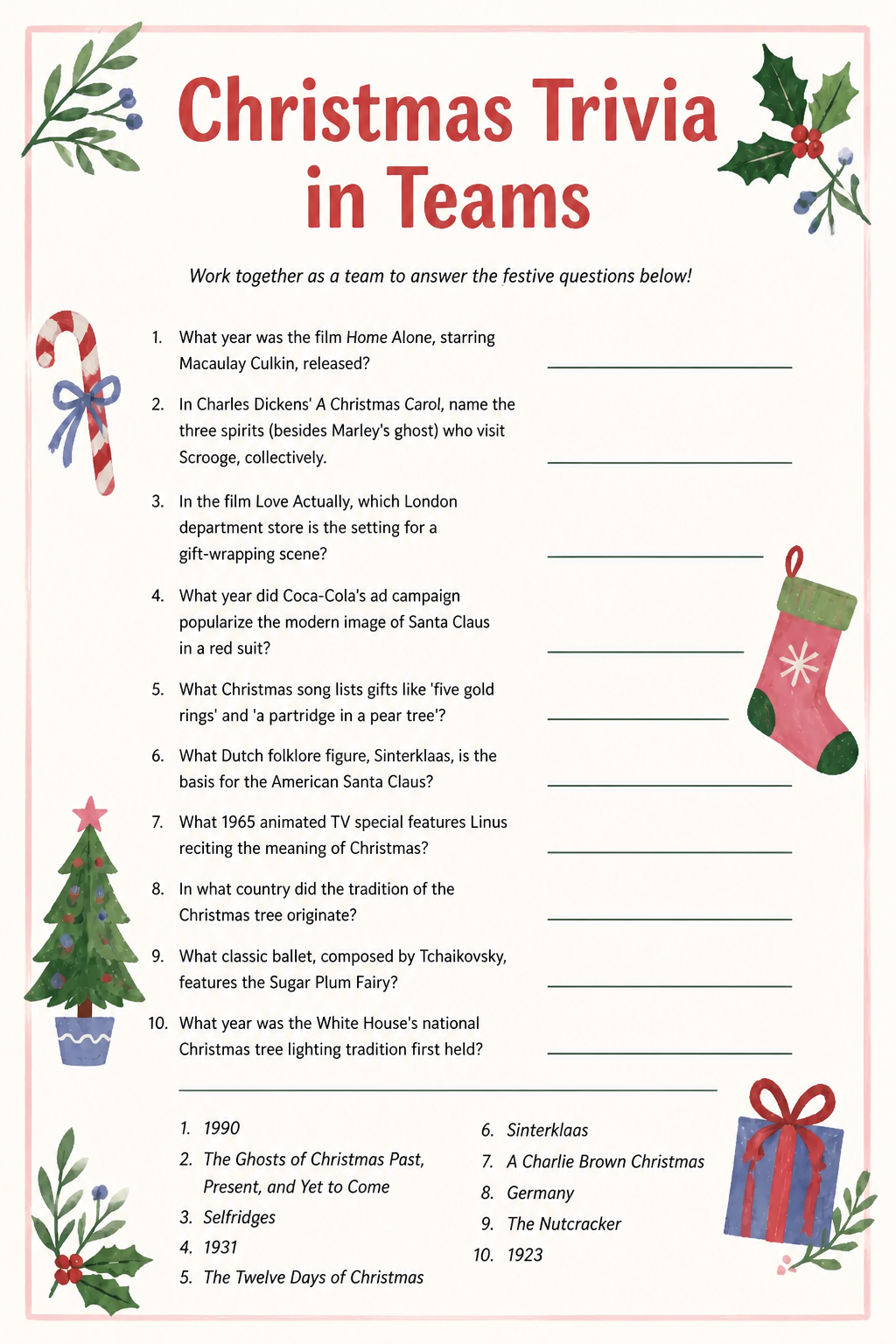
6. Christmas Trivia in Teams
Three quiz sheets, one per team table, each with the same 20 questions covering Christmas films, music, history, food and traditions. Teams huddle, argue quietly, and write their answers together. A separate answer key sheet lets the host read out correct answers round by round, and a shared scorecard tracks each team’s running total across all rounds.
Print three copies of the quiz sheet, one answer key for the host, and one scorecard. Questions work in four rounds of five: Films, Music, Food and Traditions, and General Christmas Knowledge. Allow ten minutes per round, then pause for answers before the next.
The whole game takes about 45 minutes and fills nicely after a meal when nobody wants to move.
Teams where one person dominates the answers get boring fast. Introduce a rule before round two: a different team member must write each round’s answers. That alone distributes the fun and stops the one trivia expert from steamrolling everyone else.
Pre-assign a quiz master from each team so you are not reading answers to a noisy room alone.
7. Pass the Parcel With Two Parcels Going Opposite Ways
Two parcels wrapped in ten layers each start at opposite ends of a seated circle and travel in opposite directions simultaneously. Music plays and everyone passes. When the music stops, the two people holding parcels unwrap one layer each.
Inside every other layer is a small forfeit card: do a Christmas impression, sing five seconds of a carol, tell a Christmas cracker joke.
No printing needed. Write forfeits on slips of paper and tuck them between layers while wrapping. Use music from a phone and have someone off to the side control it so they cannot see who is holding the parcel. Works best with 15 to 30 seated players in a rough circle.
Two parcels meeting in the same hands at a stop is genuinely funny but creates a dispute about which one to open. The rule: open both, one layer each, and the player picks which forfeit to do. Having two parcels also halves the waiting time and keeps the energy up across a larger group.
- Two boxes wrapped in 10 layers each
- Forfeit slips between every other layer
- A phone and a speaker for music control
🛍 Shopping guide
8. Carol Lyric Finish
Cards printed six to a sheet show the opening line of a well-known Christmas carol with the last word or phrase blanked out. Players grab a card, fill in the blank from memory, and pass it on. It sounds easy. It isn’t.
The game works as a quick table activity or as a timed team round where the team with the most correct answers wins.
Print several sheets on plain paper, cut into individual cards, and scatter them across tables or load them into a basket for grabbing. For the team version, each team gets ten cards face-down and has 60 seconds to fill in as many as possible.
The host then reads the answers from a separate key sheet. No special materials beyond paper and pens.
Some carols have regional lyric variations that cause genuine arguments. Avoid ambiguous ones and stick to universally known lines, the chorus of Deck the Halls or the opening of O Christmas Tree leave no room for dispute. Print the source version on the key so you can settle it on the spot.
Cut the cards before the party. Loose cards on a table get guests talking immediately when they arrive.

9. Musical Statues for Adults
Exactly the children’s game, but the music is exclusively Christmas bangers and the statue poses must be Christmas-themed: a Christmas tree, an angel, a snowman mid-melt. A panel of three judges (rotating each round) eliminates the least convincing statue when the music stops. The last person standing wins a point for their team.
No printing needed. Clear a section of floor about three metres square. You need a phone, a speaker, and someone not playing to control the music. Runs in about five minutes per round so it fits neatly between other games. Works for any number but gets more chaotic and more fun above 15 players.
Adults are self-conscious. The trick to breaking that is making the first elimination painless: give the first person out a small chocolate and have them join the judging panel immediately. Suddenly elimination is a promotion, and the reluctant players relax.
Announce the required pose category before the music starts so nobody freezes in confusion when it stops.
10. The Sweepstake Everyone Fills In on Arrival
One large poster near the entrance has a grid of predictions for the Christmas season: who will eat the most on the day, which film will be on television first, whether it will snow on Christmas Day, how many minutes late the host’s family will arrive for dinner.
Every guest signs their name in the column of their chosen answer when they walk in. Results are announced at the end of the night or after Christmas.
Print the poster on A3 or tape two A4 sheets together for a larger surface. Hang it at eye level with a pen on a string beside it. The game requires zero hosting after setup.
It sparks conversation at the door and gives the room something to call back to all evening. Collect the poster at the end so you can announce winners.
Predictions that are too personal can make guests uncomfortable. Keep every question light, silly or genuinely unknowable rather than targeting anyone specifically. ‘Who will fall asleep first on Christmas afternoon’ works. ‘Which couple will argue first’ does not.
It starts working the second the first guest walks in and creates callbacks all evening with zero effort from the host.

11. Christmas Would You Rather
Cards printed six to a sheet pose two Christmas-specific dilemmas: ‘Would you rather eat only Brussels sprouts for Christmas dinner or only Christmas pudding for a week’, ‘Would you rather have Mariah Carey follow you everywhere singing All I Want for Christmas or spend Christmas Day trapped with the Grinch’.
Players grab a card, read it aloud at their table, and everyone in earshot has to answer and defend their choice.
Print several sheets, cut into cards, and pile them in a bowl or scatter across tables. No host required once they are out. Works as a conversation starter, a between-rounds filler, or a dedicated ten-minute table game. The debate format means nobody needs to be right: everyone plays at once and the conversation does the work.
The best cards are specific and slightly absurd. Generic ‘would you rather be hot or cold’ questions die immediately. Every dilemma should have a clear Christmas hook and enough edge to provoke a genuine split in the room.
Table conversation during a meal or drinks, no host required, no scoring, just talking

12. The Memory Tray Passed Around
A large tray holds 15 to 20 Christmas objects: a cracker, a sprig of holly, a candy cane, a small bauble, a miniature Santa, a piece of tinsel. Every guest studies the tray for 45 seconds as it is passed around the room.
The tray then disappears into a back room and everyone writes down as many items as they can remember. Most correct answers wins a point for their team.
No printing needed. Use plain slips of paper and pens. The tray takes about eight minutes to pass around a room of 30 if you run it in two groups simultaneously with two trays. Remove two or three items between groups so even people who overheard someone else’s list are caught out.
The most common cheat: people whispering to their team while the tray is still circulating. A simple rule fixes it, during the study phase nobody speaks. That silence makes the game feel genuinely tense and gives quieter guests a fair shot.
- Large tray or shallow box
- 15 to 20 small Christmas objects
- Slips of paper and pens for everyone
🛍 Shopping guide
13. Guess the Scent Station
Six small jars or cups sit on a table, each numbered and covered with a cloth or lid with a small hole.
Inside each jar is a cotton ball soaked in a Christmas scent: cloves, cinnamon, orange peel, pine essential oil, peppermint, and mulled wine spice mix. Each guest sniffs, records their guess on their own tally card, and moves on.
Answers revealed at the end of the game.
One tally card per guest, printed on plain paper. The station runs continuously as a side activity throughout the party so people visit whenever they like. Set it up near the drinks table. Plan for about 20 minutes of activity but leave it running longer.
The station needs six small opaque or covered containers and the scent materials, all inexpensive and easy to source.
Guests with strong perfume on their wrists struggle with subtler scents. A small bowl of coffee beans beside the station acts as a palate cleanser between sniffs, the same trick used in perfume shops. It sounds fussy but costs almost nothing and genuinely helps.
- 6 small jars with lids or cloth covers
- Cotton balls
- 6 Christmas scents: cloves, cinnamon, orange peel, pine oil, peppermint, mulled spice
- Coffee beans as palate cleanser

14. Human Christmas Tree, Teams of Three
One person in each trio stands still with arms slightly out.
The other two decorate them using only the materials on the table: tinsel, paper star stickers, a paper chain draped over the shoulders, a headband with a star on top, and strips of green crepe paper. Three minutes on the clock.
A panel of judges awards points for best-dressed human tree.
No printing needed. Prepare one decoration kit per trio in a bag or box before guests arrive. With 30 guests you need ten kits and ten sets of judges scores (a simple show of hands works). Run all teams simultaneously and then do a catwalk lap of the room for judging. Takes about ten minutes total and produces excellent photos.
The person being decorated usually stands rigid with embarrassment. Brief them before the timer starts: they can gesture and pose but cannot help with the decorating. Giving them a role, they are the tree, they do not move, stops the awkwardness immediately.
- Tinsel lengths per kit
- Star headbands
- Paper chain strips or pre-made paper chains
- Green crepe paper strips
- Star stickers
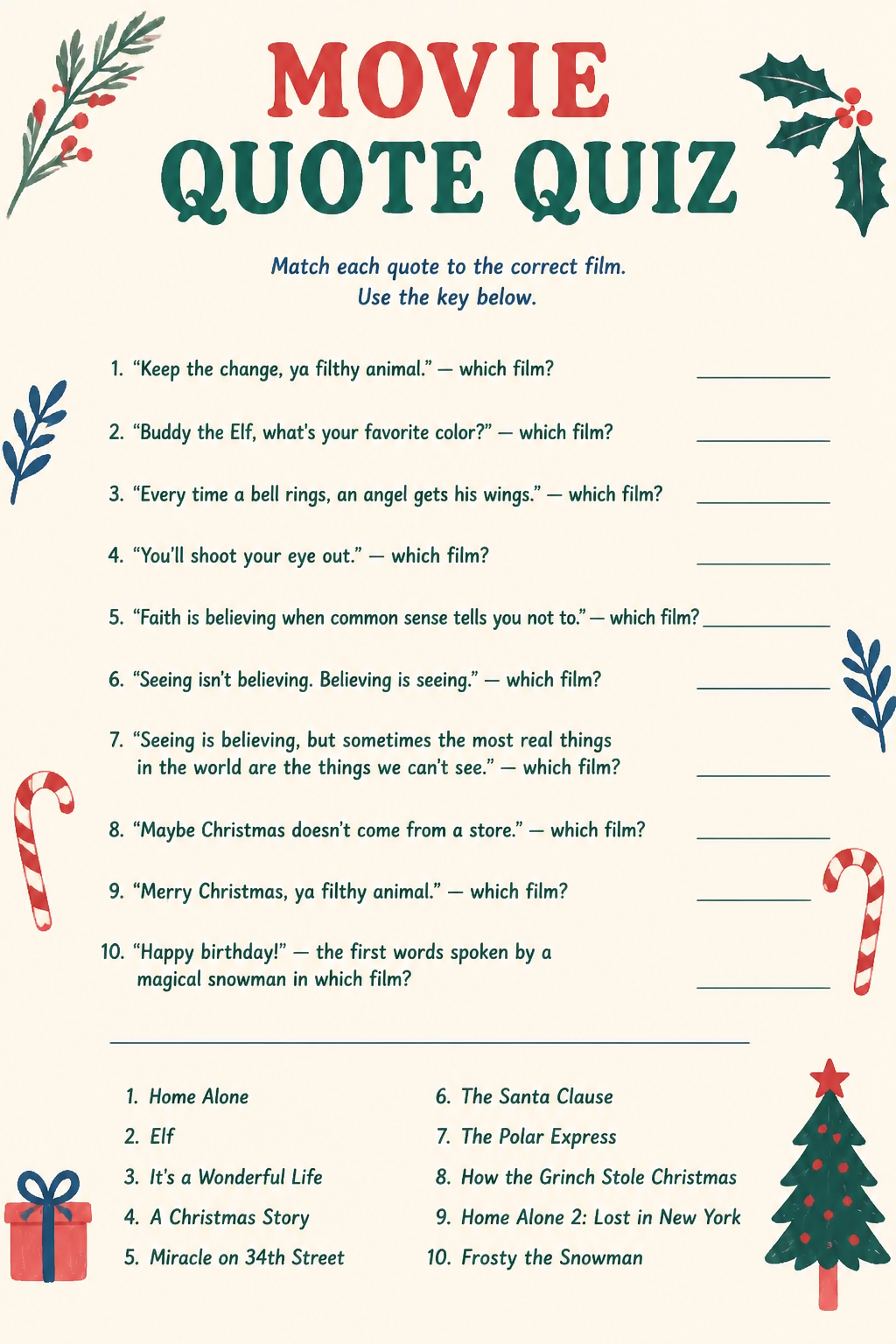
15. Movie Quote Quiz
A single quiz sheet lists 15 famous lines from Christmas films without naming the film. Players match each quote to the correct film title from a word bank at the bottom of the sheet. The answer key is printed separately for the host or included as a tiny footer key on the sheet itself, revealed only after everyone has finished.
One sheet per guest or per team table. Works well as a quiet ten-minute individual game run alongside noisier activities, or as a timed team round. The word bank prevents pure guessing and means even guests who have not seen every film can reason their way to a few correct answers.
The quotes that cause the most disputes are lines that appear in multiple adaptations. Specify the year or actor in a bracket after the quote if the line exists in more than one version. That small clarification prevents a five-minute argument and keeps the game moving.
Run this one individually during drinks so competitive guests are not anchored to a team.
16. Charades With the Whole Room Guessing
One player acts out a Christmas film, song, or festive phrase. Every other person in the room is guessing simultaneously, shouting answers out loud. No teams for the acting, only the person whose team gets the correct answer first earns the point.
With 30 people shouting guesses at once the energy is completely different from the polite two-team version, genuinely chaotic and genuinely fun.
No printing needed, though the Christmas Charades Cards in this list (printed, eight to a sheet) work perfectly as the source material. Run five rounds of one actor each so five different people get a turn. Keep a timer at 90 seconds per round. The actor can pass if they are completely stuck.
The problem with whole-room charades is that the loudest person always gets heard first. Add a rule: guess by raising your hand and the host points to someone, or the actor points to whoever they see first. That keeps it fair without slowing the game down.
A high-energy moment after dinner when the room needs waking up but nobody wants to move far
17. Christmas Charades Cards
Cards printed eight to a sheet give the actor a specific Christmas title, phrase or character to perform without speaking. Categories include Christmas films, carols, festive phrases, and Christmas characters. The category is printed in small text above the title so the actor knows whether they are miming a film, a song or a concept before they start.
Print two or three sheets on plain paper and cut into cards. Shuffle them and keep them in a bowl or hat. Works with the Charades With the Whole Room Guessing game above, or as standalone card rounds at any point in the evening. No other materials needed beyond the cards.
Actors who freeze at complex titles need a way out. Include a ‘pass’ rule from the start: each player gets one pass per turn and the card goes to the bottom of the pile. That removes the dread of getting an impossible card and keeps everyone willing to take a turn.
- Actor draws a card
- Reads category silently
- Mimes with no sounds or mouthing words
- Room guesses, first correct answer wins the point

18. The Carol Sing Off, Two Halves of the Room
Divide the room into two halves. One half sings the first line of any Christmas carol they choose.
The other half must immediately respond with the next line, or if they do not know it, sing a different carol whose first word matches the last word the other team sang.
A panel of three judges eliminates the side that hesitates for more than five seconds.
No printing needed. This is a pure vocal game that works brilliantly after a meal when everyone is relaxed and the alcohol has loosened the room. The linking-word variant keeps it moving even when people run out of carols they know in full. Rounds last three to five minutes and the whole game fits in 15 minutes.
The game dies when both sides only know two carols each. Warm it up with one practice round where everyone sings the same carol together first. That reminds people of lyrics they forgot they knew and the real game runs much more confidently.
No materials, no setup, no host management: the room runs itself and the judges have all the power.
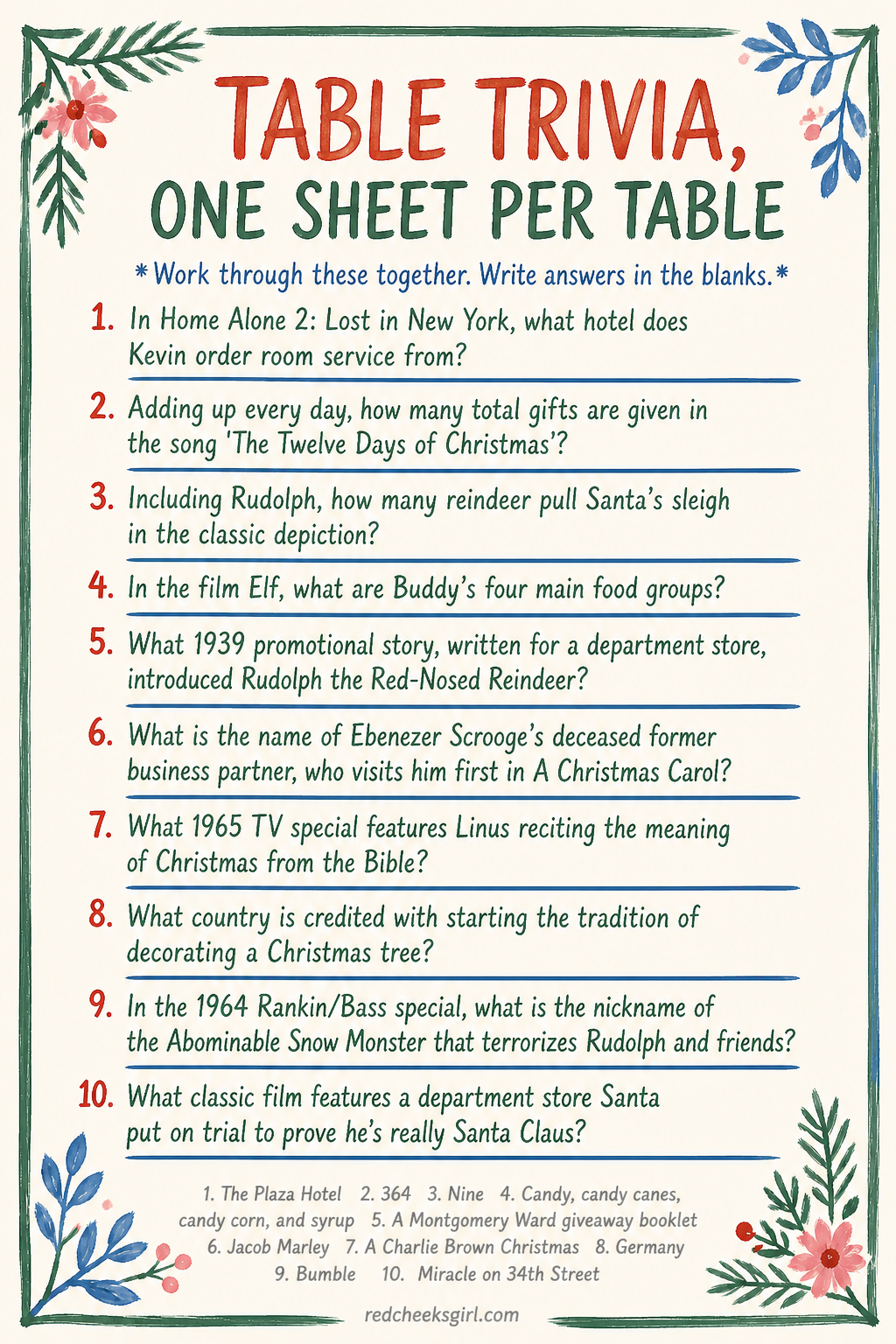
19. Table Trivia, One Sheet per Table
Each table gets its own quiz sheet with ten Christmas questions and works through them independently during the meal. Tables mark their own answers, total their score, and write it on a scorecard that gets collected at the end of dinner.
No host needs to manage this: it runs quietly alongside eating and talking, and tables can go at their own pace.
One sheet per table of four to eight guests, one host answer key kept back for scoring. Questions cover a different mix from the team trivia game: focus here on Christmas traditions from around the world, obscure Christmas facts, and date-based knowledge. Collect score sheets before dessert and announce results with the pudding.
Tables that finish early sit in silence waiting. Add a tiebreaker question at the bottom sealed with a strip of paper: they only open it if they tie with another table. That keeps the completed tables busy and gives you a clean way to break any tie without drama.
Seal the tiebreaker question under a folded flap so tables only open it if they need it.
20. Snowball Sock Toss Into Buckets
Roll white socks into balls to make snowballs. Line up three buckets at increasing distances from a throwing line: one metre, two metres, three metres. Each player on a team gets five throws per turn.
One point for the nearest bucket, three for the middle, five for the farthest. Teams add their scores and the highest total after all members have thrown wins the round.
No printing needed. This works indoors with no risk of breakage because white socks are soft and light. You need about 30 rolled sock pairs in a laundry basket beside the throwing line, and three clearly labelled buckets or large bowls.
Run all four teams simultaneously with their own set of buckets, or run it as a timed relay with one set and the clock running per team.
Buckets that slide on hard floors turn a precise game into a chaotic one. Put a non-slip mat under each bucket or tape them lightly to the floor before the game starts. Worth the 30 seconds it takes.
- 30 rolled white sock pairs
- 3 buckets or large bowls per set
- A clear throwing line (painter’s tape on the floor)
- Non-slip mat under each bucket
21. The Standing Quiz Where Wrong Answers Sit Down
Everyone stands. The host reads a Christmas question with two possible answers. Players who think the answer is A step to the left, players who think it is B step to the right. Anyone on the wrong side sits down.
The last person standing wins a point for their team. Run five questions per round and the game takes under ten minutes.
No printing needed, though you can use the Table Trivia or Team Trivia question sets as source material to avoid writing fresh questions. Works in any size room as long as there is enough floor space to take a step in either direction.
The physical movement keeps energy high and means even people who get answers wrong are laughing rather than sulking.
Some guests will wait to see which way the majority steps before committing. Call a three-second countdown before anyone moves and enforce it with a visible countdown on your fingers. The split-second decision is half the fun and stopping the copycat move makes it genuinely competitive.
- Everyone stands in a central space
- Host reads question with A or B answers
- Players step left for A, right for B
- Wrong side sits down
- Last standing wins the round for their team
Frequently Asked Questions
How do you run christmas party games for groups of 30 without chaos?
Divide guests into four named teams at the start of the evening and route every competitive game through the same scoreboard. That structure means 30 people always know what they are doing and who they are rooting for. Simultaneous team play, where all four teams do the same thing at the same time, cuts waiting to almost nothing.
Which games work best when guests arrive at different times?
Station games and self-running activities are the answer. The Guessing Jar, Find the Guest bingo card, the Sweepstake Poster, and the Guess the Scent station all start working the moment someone walks in and require zero hosting. Guests join at their own pace and the game is already in progress.
Do the printable sheets need to be laminated or printed on special paper?
Plain printer paper works for every game here. For bingo cards and charades cards that get handled repeatedly, plain cardstock adds durability but is not essential. Laminating is only worth the effort if you plan to reuse the same sheets at multiple events.
How many points should each game be worth in the running team competition?
Keep it simple: three points for a win, one point for a tie, zero for a loss. Bonus points of one each for particularly impressive moments, best human tree, fastest wrapping, loudest carol, keep the scoreboard feeling alive without overcomplicating the maths mid-party.
What is the best order to run these games in?
Start with self-running arrivals games (Guessing Jar, Find the Guest, Sweepstake Poster) while people trickle in. Move to active warm-ups (Wrapping Paper Relay, Human Christmas Tree) once numbers are full. Save the quiz games for after food when sitting quietly makes sense. End with high-energy finishers like the Standing Quiz or Snowball Toss to close the night on a high.
How many games is too many for one afternoon?
For a three-hour party, four to six structured games is the realistic limit once you account for setup, scoring, toilet breaks and the natural drift of conversation.
For a five to six hour evening with dinner, eight to ten is workable if several are self-running station games that do not need announcing.
The list here is a menu, not a schedule: pick the games that suit your crowd and your timing, and leave the rest for next time. Running out of games is rarely the problem.
Running a game with a room that has mentally moved on is.

25 Christmas paper crafts for mantels, windows, trees and gift wrap, with full materials, timings an

22 Ralph Lauren Christmas decor ideas for a whole house: hunter green, oxblood and brass, carried fr

Grinch christmas party games kids will actually play: 8 free printables plus 6 no-prep activities bu
Leave a Reply