

15 Christmas Class Party Games With Free Printables a Teacher Can Run in Thirty Minutes

These christmas class party games cover a full thirty-minute classroom party for up to twenty-five children, with eight printables you can run off before the bell and seven activities that need nothing but the kids themselves. Every game fits between desks, costs nothing, and can be handed to a parent helper with two sentences of explanation.
- Christmas Bingo
- Musical Statues With Carols (No Printing Needed)
- Reindeer Match Up
- Pass the Parcel (No Printing Needed)
- Christmas Would You Rather for Children
- Freeze Dance With Red and Green Cards (No Printing Needed)
- Spot the Difference, Christmas Scene
- The Memory Tray Under a Tea Towel (No Printing Needed)
- Colour the Jumper (Colouring Page, One Per Child)
- Snowball Sock Toss (No Printing Needed)
- Guess How Many in the Jar (Tally Card, One Per Child)
- Reindeer Antler Ring Toss (No Printing Needed)
- Christmas Maze
- Silent Night, First to Speak Sits Down (No Printing Needed)
- Kindness Certificates (Certificate, One Per Child)
- Frequently Asked Questions
1. Christmas Bingo
Each child gets one of four different bingo cards packed with Christmas pictures and words: a stocking, a star, hot cocoa, Rudolph, candy cane, and fifteen more.
The caller reads from the included call list, children mark their squares with a pencil X, and the first to complete a row calls out “Christmas.”
With four grid variations, up to six children share a card version, which keeps the game running for a satisfying two or three minutes before someone wins.
Print one sheet per child on plain paper. No daubers needed: a pencil works fine. The call list prints on a separate half-sheet the teacher keeps. The whole game, including crowning a winner and playing a second round, fits in eight minutes.
If two children call out at the same moment, ask each to read back their row. Both can win. The bigger problem is children who have not marked correctly, so do a quick rules run-through before you start: show them one sample square on the board.
Print the call list on a half-sheet and cut it off before distributing cards so children cannot read ahead.

2. Musical Statues With Carols (No Printing Needed)
The teacher plays a Christmas carol from any phone or laptop, and every child dances in their own floor space. The moment the music stops, everyone freezes. Move even a finger and you step to the side to become a judge, watching the remaining players.
No one sits out for long: judges re-enter after two rounds, which keeps twenty-five children engaged rather than bored on the sidelines.
No printing needed for this one. Push desks to the edges or let children stand at their spots. A playlist of five carols shuffled on random is enough. Run it for five minutes total: two or three rounds gives everyone a fair go. Judges standing at the side make good spotters and feel useful rather than eliminated.
The classic problem is children who freeze dramatically for a second and then immediately start giggling and moving. Set the rule before you start: if you move after the music stops, you move to the judges’ panel, no debate. The judges vote by raised hands on any close calls, which the children love.
- A phone or laptop with a Christmas playlist
- A clear floor space, even just the aisle between desk rows
3. Reindeer Match Up
The left column lists all nine of Santa’s reindeer by first name only. The right column lists nine clues about each one: things like “the one with the glowing red nose” or “the smallest and fastest” or “named after a type of dancing.”
Children draw a line from each reindeer name to the correct clue. It takes about four minutes and rewards children who actually know their Christmas lore.
Print one per child on plain paper. Children use any pencil or pen. The answer key prints at the foot of the teacher’s copy only, not on the children’s sheet. This works well as a settle-down game at the very start of the party while latecomers arrive, because children can start independently the moment they sit down.
Some clues will spark debate, which is a feature rather than a bug. If a child genuinely cannot place Dancer or Prancer, let them work with a neighbour. Pair-working on this one is fine: the goal is festive engagement, not a test. Collect sheets at the end and read the key aloud so everyone finds out how they did.
- Ages 7 and up who know their Christmas stories
- A calm two-minute stretch at the start while the room settles

4. Pass the Parcel (No Printing Needed)
Wrap a small treat or a folded joke in many layers of newspaper or scrap paper before the party. Children sit in a circle on the floor or on chairs pushed together.
A carol plays, the parcel passes hand to hand, and whoever holds it when the music stops unwraps one layer. The child who removes the final layer keeps what is inside.
No printing needed. Wrap the parcel the night before using newspaper, old worksheets, or any scrap paper.
Tuck a joke or a fun fact on a strip of paper between every few layers so there is a small moment for each child who unwraps a layer. Run the game for six to eight minutes.
Twenty-five children in a circle move the parcel around at a good clip.
Control the music yourself rather than handing it to a helper: teachers are better at pausing at unpredictable moments so the same child does not unwrap twice in a row.
If a shy child keeps passing without unwrapping, let the pause land on them on purpose at least once. Put a forfeit card (“do your best reindeer impression”) in one middle layer to add a laugh without needing a prize.
Tuck a printed Christmas joke strip between every third layer so every child gets a moment, not just the winner.
5. Christmas Would You Rather for Children
Six would-you-rather questions print on one sheet, then cut into individual cards. Questions are genuinely festive and child-friendly: “Would you rather slide down a snowy hill or build the world’s tallest snowman?”
or “Would you rather have elf ears for a day or a reindeer nose that glows in the dark?” Children hold up a finger for option A or two fingers for option B, and the teacher reads out the room’s split.
There are no right answers, so no one feels stuck.
Print one sheet per pair of children and cut along the dotted lines. A parent helper can run this with zero preparation beyond the cards in hand.
Use it as a five-minute wind-down between active games, or as a full circle-time activity where children justify their choice in one sentence. The cards also work taped to a wall for a gallery-style vote using sticky dots if you want to slow the pace.
The one thing that derails this game is children shouting both options or switching after seeing what their friends chose. Set the rule that fingers go up on the count of three, all at once.
If the class is too large for everyone to see each other’s fingers, ask children to stand for A and stay seated for B instead. That makes the tally instant and visual.
Ask children to stand for option A and stay seated for option B: tallying twenty-five answers takes three seconds.

6. Freeze Dance With Red and Green Cards (No Printing Needed)
The teacher holds up a red card and the children dance. The teacher swaps to a green card and every child freezes. No music needed: the visual signal is the whole game.
The twist is that children must freeze in a specific Christmas pose called out before the card swap: “freeze like a Christmas tree,” “freeze like Rudolph landing on a roof,” “freeze like a present being opened.” The class votes on whose pose is best.
No printing needed. Cut two pieces of coloured paper, red and green, before the party, or use two sheets of construction paper from the art cupboard. The whole game runs without a phone or speaker, which makes it perfect if tech fails. Five minutes is plenty. Rotate the pose category every round to keep children thinking.
Children who struggle to freeze are almost always just over-excited rather than deliberately difficult. Give a countdown: “Freeze in three, two, one.” That two-second warning lets their bodies catch up with the instruction. If the room is small, mark a circle of tape on the floor and keep dancers inside it so freeze poses do not collide.
- One red sheet of paper
- One green sheet of paper
- A clear aisle or open floor patch
7. Spot the Difference, Christmas Scene
Two nearly identical Christmas living-room scenes sit side by side on one landscape sheet. Eight details differ between them: a missing bauble on the tree, a stocking that changed colour, an extra present on the floor, a clock showing a different time, and so on.
Children circle each difference they find on the right-hand image. Finding all eight takes most children three to five minutes, so it works as both a quick filler and a slightly longer focus activity.
Print one per child on plain paper, landscape orientation. Children use a pencil or any pen. The answer key prints on the teacher’s copy only, with the eight differences numbered and labeled.
This is one of the quietest games in the set: the room drops to a concentrated hush the moment sheets go out, which is useful if the party has been high-energy and you need thirty seconds of calm.
The common frustration is children who find six differences and then stall. Build in a rule that after two minutes they may compare with the child next to them and discuss any they missed. That turns the stall into a conversation rather than a defeat.
Avoid this game immediately after lunch when concentration dips: use it in the first ten minutes while children are still sharp.
It drops the room to a calm hush instantly, ideal after two active games in a row.

8. The Memory Tray Under a Tea Towel (No Printing Needed)
Place ten small Christmas items on a tray: a bauble, a candy cane, a small bell, a piece of tinsel, an eraser shaped like a star, a mini pinecone, a wrapped sweet, a pencil with a festive pattern, a paper snowflake, and a sprig of holly or similar.
Children study the tray for sixty seconds. Cover it with a tea towel and ask children to write every item they can remember on a scrap of paper. Whoever names the most wins.
No printing needed: children write on scrap paper torn from the recycling tray. Use any ten items from the teacher’s desk, the art cupboard, or a small bag brought from home. The game takes about six minutes total and needs no technology.
It works beautifully as the settling game right after lunch while the room is half-full and arriving children can join at any point.
Vary the difficulty by time: give younger children ninety seconds of study time and older ones forty-five. If two children tie, call a tiebreak: whoever correctly identifies the item hidden under the towel first (lift it briefly to reveal just one) wins.
The memory tray is also a useful game to repeat at the end of the party with slightly different objects to see if scores improve.
- A small tray or dinner plate
- Ten small Christmas items from around the classroom
- A tea towel or folded sheet of paper large enough to cover the tray
- Scrap paper and pencils already on desks
9. Colour the Jumper (Colouring Page, One Per Child)
A boldly outlined Christmas jumper fills most of the page, printed with a fair isle-style pattern of snowflakes, reindeers, and zigzags waiting to be coloured.
There is a name line at the top so children can claim their creation, and a small “My design theme” line at the bottom where they write one or two words describing their colour choices.
Children colour freely with whatever pencils or crayons are already at their desks.
Print one per child. No scissors or glue needed. This is the party’s quiet moment: a five-to-ten-minute stretch where children focus on their own sheet without competing. Display finished jumpers on the classroom wall or let children take them home.
If you want a gentle competition element, ask the class to vote for their favourite design by holding up three fingers.
The only issue is children who rush through in ninety seconds and then disrupt neighbours. Give them a second sheet to design a matching hat, or ask them to add a background scene behind the jumper.
A slow finisher who is genuinely absorbed in the colouring should never feel rushed: this game adapts naturally to different speeds without any host intervention.
Tape finished jumpers to the window before the party ends: the display takes ten seconds and makes the classroom look instantly festive.

10. Snowball Sock Toss (No Printing Needed)
Roll five or six white socks into tight balls. Mark three lines on the floor with strips of masking tape or chalk: a close line worth one point, a middle line worth two, and a far line worth three.
Children take turns tossing their sock-snowballs from behind the closest line into a laundry basket or a cardboard box placed at the far end of the aisle. The class splits into teams and tallies their score on the board.
No printing needed. Use socks from lost-property or ask children to donate one sock each at the start. A cardboard box from the recycling is the target.
Run three rounds of two throws per child per round, keeping teams to five or six so the wait is short. The whole game takes about eight minutes. Tape lines can go down in thirty seconds and peel off without damaging floors.
The biggest logistical snag is retrieval: socks roll under desks. Assign one child per team as the official snowball collector who returns socks to the throwing line after each round. That child rotates every round so everyone gets a turn throwing.
Keep the target box weighted with a textbook inside so it does not tip when a sock misses and hits the side.
- 5-6 white socks rolled into balls
- A cardboard box or laundry basket
- Masking tape or chalk for floor lines
11. Guess How Many in the Jar (Tally Card, One Per Child)
A clear jar filled with wrapped sweets, mini baubles, or gold coins sits at the front of the room. Each child writes their name and their guess on the tally card, then folds it and drops it into a second container.
At the end of the party, the teacher counts the jar, reads out the answer, and the child with the closest guess wins the jar. Everyone else gets a small handful as a consolation prize if there are sweets inside.
Print one card per child: each card has a name line, a guess line, and a dotted fold line so it becomes its own sealed slip. No additional paper needed. Fill the jar the night before.
It takes three minutes to distribute, fill in, and collect cards, making it the fastest printable in the set. Run it at the very start so the jar sits tantalising on the desk for the whole party.
Accuracy varies wildly: guesses will range from 12 to 4,000. That range is part of the fun, not a problem. Avoid giving children time to count layers or measure the jar diameter: the point is the instinctive guess.
If two children land on the exact number, split the prize or let them share the jar. For non-edible jars (baubles, pencil toppers), the winner simply gets to keep the contents.
Running at the very start so the jar sits in view and builds anticipation all party long.

12. Reindeer Antler Ring Toss (No Printing Needed)
One child sits in a chair wearing a headband with two pipe-cleaner antlers bent upright. Classmates take turns tossing paper rings (made from strips of A4 paper taped into loops) onto the antlers from a set distance. Score one point per ring that stays on.
Rotate the child in the chair every five throws so multiple children get to be the reindeer. The class counts scores aloud, which adds to the noise and energy in a good way.
No printing needed. Make the rings by cutting A4 paper into strips about 3cm wide and taping the ends into loops: a parent helper can prepare twenty rings in five minutes.
A headband with pipe-cleaner antlers is one of those items already in most teachers’ party boxes, or bend two pipe cleaners into a rough Y-shape and tape them to a strip of card worn as a headband.
The game runs in six minutes for the whole class.
Rings that bounce off the antlers and land on the child’s head do not count, or count double, depending on your house rules. Clarify before the first throw. The throwing distance matters: half an arm’s length is too easy and two metres too hard.
Test it yourself before the party and mark the line with a piece of tape so children do not inch forward. Sitting children cheer their teammate, which keeps the room engaged even when it is not their turn.
Pre-cut the paper strips the night before so ring-making takes thirty seconds per ring during the party.
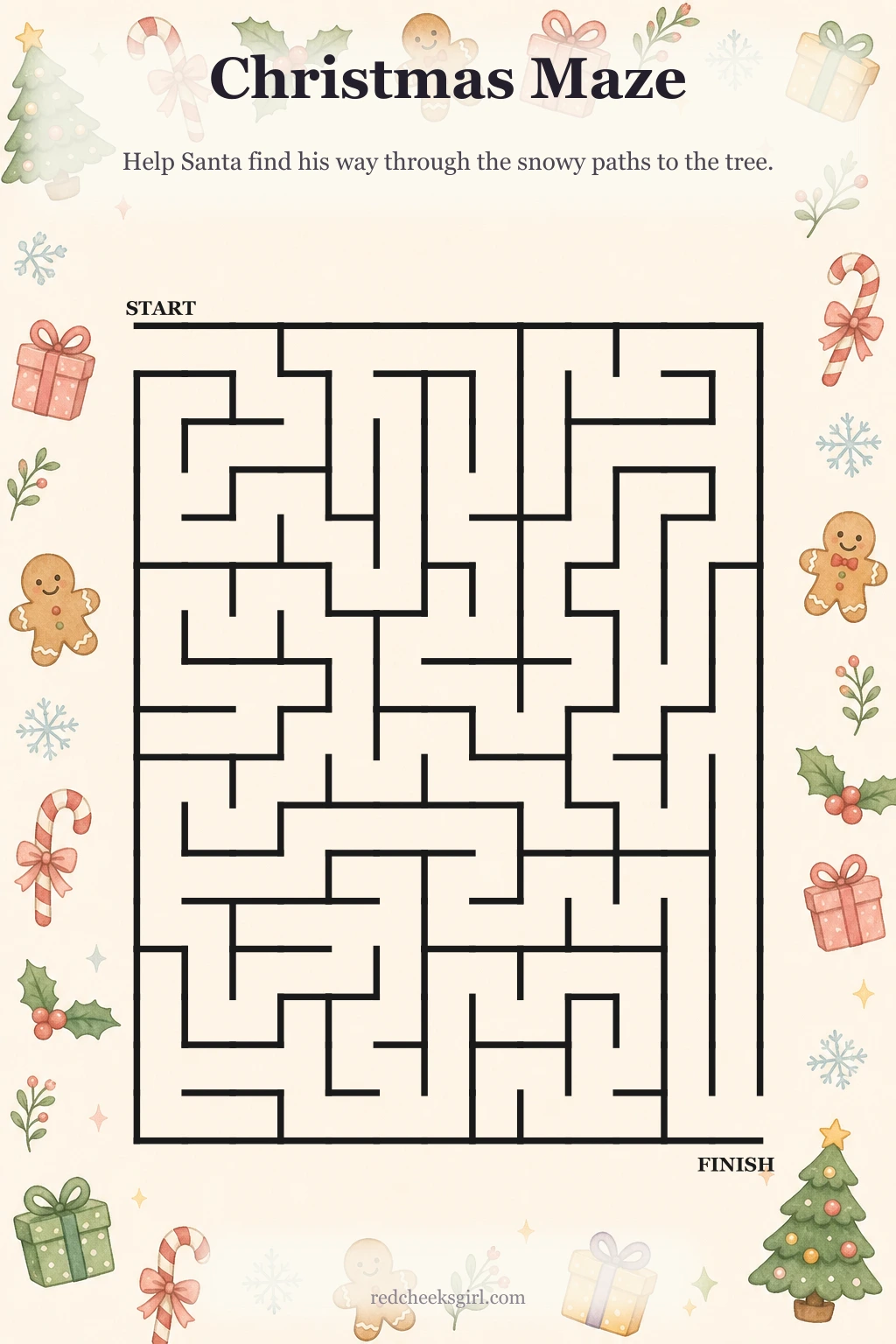
13. Christmas Maze
Santa needs to find his way through a winding maze to reach the chimney at the other end.
The path has four dead ends and one correct route, illustrated with Christmas details along the way: a lost elf, a pile of presents, a sleeping polar bear. Children trace the route with a pencil.
The maze is designed to take most children two to three minutes so it is neither trivially easy nor frustratingly long for a party context.
Print one per child on plain paper. The answer key is on the teacher’s copy only, showing the correct path highlighted. Use the maze as a five-minute focus break after a loud active game. Children who finish quickly can decorate the border of their sheet with Christmas doodles, which keeps them occupied without disrupting others still working through the maze.
The maze occasionally trips children up at the second dead end, which loops back convincingly before stopping. If half the class gets stuck at the same point, draw the first two correct turns on the board as a hint.
That saves the game from turning into a twenty-minute ordeal. Collect sheets at the end or let children take them home: parents always notice a completed maze pinned to the fridge.
Draw the first two correct turns on the board if most children stall at the same junction: a class hint is faster than twenty individual explanations.
14. Silent Night, First to Speak Sits Down (No Printing Needed)
Everyone stands. The teacher sets a one-minute timer. No one is allowed to speak, laugh out loud, or make any deliberate sound.
The teacher (or a designated child) walks slowly around the room making funny silent faces, holding up ridiculous Christmas props, or miming unwrapping an enormous invisible present. Anyone who laughs, giggles audibly, or speaks sits down. The last child standing wins.
No printing needed. This game costs nothing and takes no setup. It works as an instant five-minute filler anywhere in the party order, particularly after a noisy game when the teacher needs the room to quiet down fast.
The irony is that demanding silence produces more focused attention than any instruction to “calm down” ever does. Children who sit down early often watch the remaining players with fierce concentration.
The teacher walking the room is the whole engine of this game, so commit to the performance: put on a novelty headband, mime riding an invisible reindeer, hold up a whiteboard with a ridiculous drawing. Half-hearted miming loses the crowd in forty seconds.
Set a strict rule on what counts as a disqualifying noise: a full laugh counts, a tiny involuntary noise through the nose does not, to keep it fair for younger children who find silent breathing harder than they expect.
Demanding total silence is the fastest way to get twenty-five children to focus: it works better than any instruction to settle down.
15. Kindness Certificates (Certificate, One Per Child)
Each child receives a certificate with their name written at the top (pre-filled by the teacher before printing, or left blank for children to fill in themselves).
The body of the certificate names one specific kind act: “for always sharing art supplies,” “for cheering up a classmate,” “for being a brilliant listener this term.” Each certificate is unique to its recipient.
Children read theirs quietly, then the teacher invites anyone who wants to share their certificate to read it aloud.
Print one per child: the certificate has a decorative Christmas border, a bold heading, space for the name and the kind act, and a line for the teacher’s signature.
Pre-write each act on a separate list and hand that to the office printer the night before with names filled in, or write them by hand in the name and act fields using a marker. This is the party’s closing moment.
It takes five minutes and leaves children holding something genuinely personal.
The only preparation it needs is thought: a teacher who knows twenty-five children well can list a specific kind act for each one in ten minutes the evening before.
Avoid generic phrases like “for being kind”: specific acts (“for helping pick up the spilled paint without being asked”) land with far more warmth.
Children often re-read these certificates years later, which makes the few minutes of preparation the best use of time in the entire party.
Write one specific kind act per child the night before. Vague praise is forgotten. A real detail is kept.

Frequently Asked Questions
How do you organise christmas class party games for 25 children in thirty minutes?
Pick three games maximum, not fifteen. A good thirty-minute party runs one active game (eight minutes), one printable settled at desks (seven minutes), one final active or quiet game (ten minutes), with five minutes of buffer for transitions and certificate handing.
Print everything the day before and lay it on desks before children arrive so you lose no time distributing sheets.
What printable games work best for a classroom christmas party?
Spot the Difference, the Christmas Maze, and Bingo are the strongest classroom printables because children can start independently the moment the sheet lands in front of them. Would You Rather cards require no reading before use and need no pencil. Avoid anything with complex instructions that the teacher has to explain twice.
Do children need prizes for every game?
No. In a class of twenty-five, chasing prizes for every game turns into a logistics nightmare and almost always ends with someone crying. One prize for the full party (the Guess How Many in the Jar winner keeps the jar) is enough.
Applause, a star on the board, and the Kindness Certificate matter more to most children than a small plastic toy.
What is the best order to run christmas class party games?
Start settled: hand out the Guess How Many jar cards or Reindeer Match Up while the room fills. Move into one active game once everyone has arrived. Drop back to a printable to reset the energy. End with something warm and quiet, like the Kindness Certificates, so children leave in a calm and happy state rather than wound up.
How do you handle children who finish a printable game early?
Build an extension into the brief before you hand out sheets. Tell children who finish the maze to decorate the border, tell children who finish Spot the Difference to write what they think the difference was hardest to spot. That keeps fast finishers occupied without the teacher needing to intervene and without making slower finishers feel rushed.
Can a parent helper run these games without the teacher in the room?
The printable games, yes, with no briefing beyond the sheet instructions. The active games need one clear rule-setter at the start: write the two or three rules on a sticky note per game and hand it to the helper before you leave.
Silent Night is the easiest for a helper to run because the rules are one sentence. Pass the Parcel needs the helper to control the music, which takes a phone and a playlist ready to go.

16 christmas ornament wreath ideas grouped by look, from classic glass baubles to miniature bell clu

21 farmhouse Christmas decor ideas in white, cream and black accents with fresh green, room by room
12 Christmas ribbon crafts that turn leftover spools into tree, table and gift details that look bou
Leave a Reply