

17 Funny Christmas Party Games With Free Printables, No Slapstick Required

The best funny christmas party games do not rely on anyone falling over or wearing a reindeer headband they hate. These 17 games pull the comedy from what people say: bad opinions, worse singing, and the kinds of family dinner quotes that haunt you until February. Eight come with a free printable you can run off on cardstock; the other nine need nothing but the people already in the room.
This post contains affiliate links. If you buy through them, I may earn a small commission at no extra cost to you.
- Bad Christmas Gift Confessions
- Describe the Gift Without Naming It
- Christmas Would You Rather, Absurd Edition
- The Accent Round
- Guess Who Said It at Last Year’s Dinner
- Charades Where Nobody Speaks
- Christmas Film Plot in Five Words
- Guess the Christmas Song Hummed Badly
- The Terrible Cracker Joke Quiz
- The Worst Present You Ever Received, Told Aloud
- Rewrite the Carol Lyric
- Sing It Until Someone Laughs
- Christmas Trivia, Obscure Round
- Whisper Down the Christmas Line
- Two Truths About the Host
- The Impression Round
- One Word Story Around the Table
- Frequently Asked Questions
1. Bad Christmas Gift Confessions
Cut the deck, hand each guest a card, and ask everyone to fill in the prompt: the worst gift they ever gave, why they gave it, and one completely invented excuse they told the recipient. Players read their confessions aloud, and the table votes on which excuse they would have actually believed. The winner is whoever told the most convincing lie.
Print one sheet per six guests, cut along the dashed lines, and hand the cards out before dinner. A fine-tip marker writes more neatly than a biro on cardstock. Five minutes of writing, ten of howling.
If the group is shy at first, the host reads one card cold without saying whose it is, and the guessing loosens everyone up. Variation: collect all cards face-down, shuffle them, and have a volunteer read them aloud as if they are their own confessions.
Shuffle cards before reading so no one knows whose is whose until the very end.

🛍 Shopping guide
2. Describe the Gift Without Naming It
One person thinks of a real gift they either gave or received, then describes it to the group using only abstract nouns and adjectives: no brand names, no function words, no miming. ‘Disappointingly beige. Practical in theory. Optimistic about someone’s hobbies they do not have.’ The group fires guesses until someone lands it.
No setup, no printing, no timer required, though two minutes per turn keeps things moving. Works for any group size from six up. The describer scores a point for every wrong guess before someone gets it right, so vagueness is rewarded.
The game collapses into laughter fastest when the gift is something genuinely grim, like a foot spa or a personalised mug with a spelling mistake. Remind players that the gift must be real. That rule alone does most of the work.
- Groups of 6 to 16
- After dinner when no one wants to move
- Guests who love to talk
3. 3. Christmas Would You Rather, Absurd Edition (Card Set, 6 Up)
Each card pairs two genuinely horrible Christmas scenarios and asks the guest to circle one and write one sentence defending their choice. The comedy is not in the questions: it is in the earnest justifications people produce under social pressure. Reading those defenses aloud is the game.
Print one sheet per six guests and cut. Questions should be properly absurd: ‘Would you rather narrate your own family Christmas dinner like a wildlife documentary, or receive every gift wrapped in a single layer of cling film?’ A good set has ten to twelve pairings on the card.
If two people give the same answer, have them debate each other. Keep a loose leaderboard for the most persuasive argument rather than the most popular choice. The game plays best when the host picks questions calibrated to the actual group, since familiarity raises the stakes of every answer.
- Printed card set, one per guest
- Pens or fine-tip markers
- A volunteer to read answers aloud

4. The Accent Round
The host deals out slips of paper, each naming an accent or regional dialect, and a short Christmas-themed sentence printed on a second slip. Each player must read their sentence aloud in their assigned accent. The group scores them on conviction, not accuracy, so a catastrophic attempt scores higher than a timid one.
No printing needed beyond two small lists prepared in advance on your phone. Good sentence options: ‘The turkey is underdone but I said nothing,’ or ‘I specifically asked for the large one.’ Keep accents broad and fun: Hollywood pirate, 1940s newsreel, daytime television presenter, very enthusiastic German tourist.
The round ends when every player has gone once. Bonus round: the two highest scorers must repeat their sentence simultaneously while holding eye contact. The first to break loses.
Avoid real accents that might feel pointed at someone in the room. Fictional and exaggerated registers land cleanest.
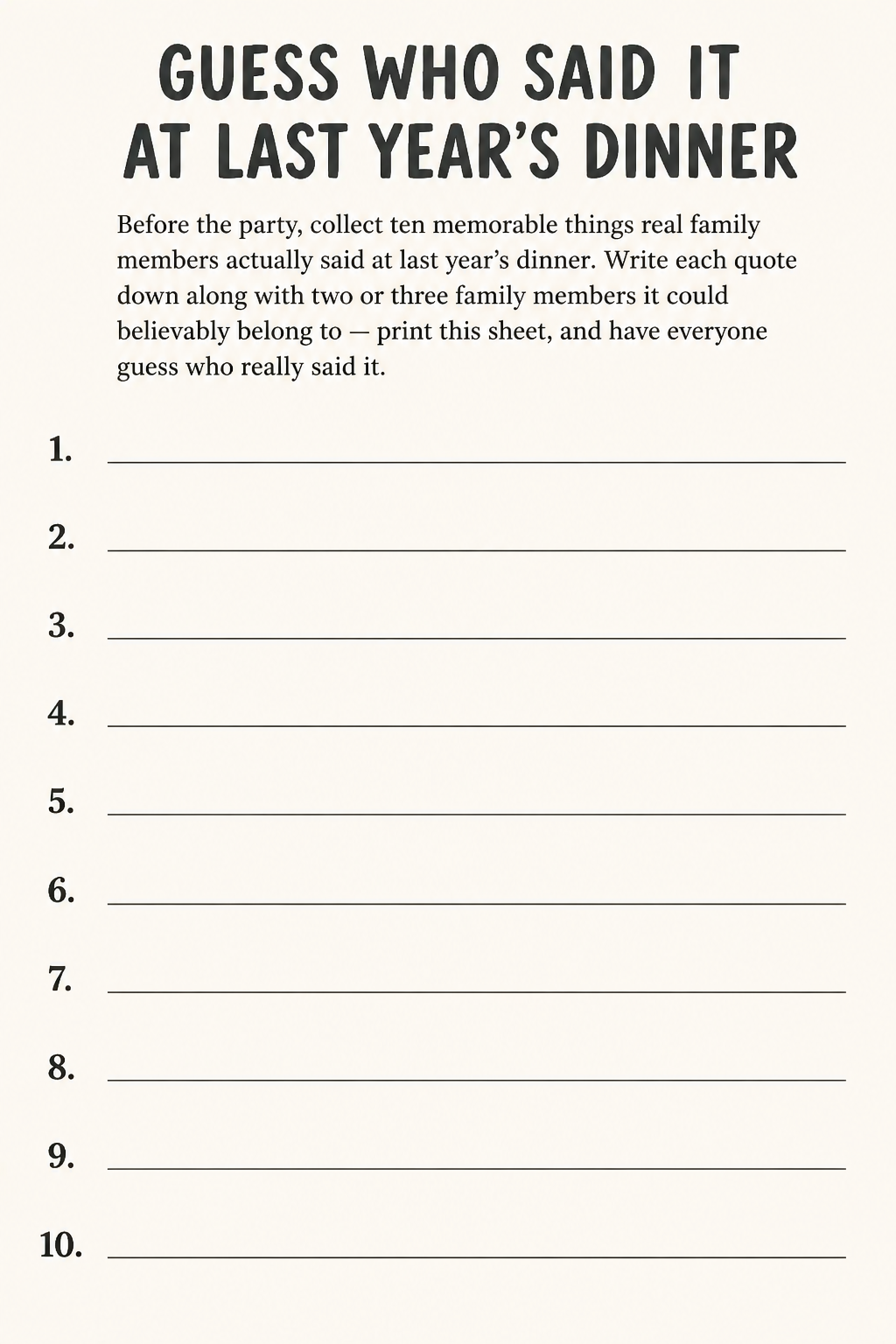
5. Guess Who Said It at Last Year’s Dinner
The host collects ten real quotes overheard at previous Christmas gatherings, strips the names, and prints them as a numbered quiz. Guests match each quote to the person in the room they think said it. The host reveals the answers one by one, and the person who said it gets to either confirm, deny, or explain themselves.
This one requires host homework: spend ten minutes before the party jotting down genuine lines from past years. ‘I actually prefer Brussels sprouts cold’ and ‘That was not the plan, technically’ are the kind of material that lands. Print one sheet per guest, one answer key for the host.
The answer key lists only the matched pairs. If a quote genuinely cannot be attributed, cut it. Never leave a blank on the key: every question has a real answer or it comes off the sheet entirely.
Warn guests the quotes are real before you start. The anticipation of being caught saying something memorable is half the game.
6. Charades Where Nobody Speaks
Standard Christmas charades, but with one rule change: the person acting cannot make any sound at all, including mouthing words, clicking, or humming. The group guesses aloud as normal. The silence rule sounds small and makes the game genuinely funnier, because people realize how much they rely on sound cues to signal ‘you are close.’
Write Christmas films, carols, and festive phrases on folded slips of paper and drop them in a bowl. Two teams, two minutes per turn, standard point-per-correct-guess scoring. No materials needed beyond the paper slips.
The rule breaks down when someone starts aggressively mouthing every syllable. Call it: mouthing is speaking. A ten-second penalty (frozen in position) keeps people honest and is its own source of comedy.
- Folded paper slips with prompts
- A bowl or hat
- A phone timer
7. Christmas Film Plot in Five Words
Each card gives a guest a blank space to write a Christmas film title and then reduce the entire plot to exactly five words. The constraint forces creativity: ‘Elf’ becomes ‘Sugar-high man finds dad.’ ‘Love Actually’ becomes ‘Everyone loves someone, mostly badly.’ Players read their five-word summaries aloud and the table shouts the film title.
Print one sheet for eight guests, cut and distribute. Give five minutes for writing, then go around the table. A bonus round lets guests describe a film they hated in five words that sound like a positive review.
The game occasionally produces genuine summaries so accurate they are funnier than the film. Keep a tally of summaries the table cannot guess, those go into a second-round ‘mystery pile’ for extra points at the end.
- Film lovers and people who hate Christmas films equally
- Groups of 8 to 20
- The post-dinner lull

8. Guess the Christmas Song Hummed Badly
One player hums a Christmas song as badly as they genuinely can: off-key, wrong tempo, occasionally the wrong tune mid-hum. The rest of the group guesses. The humming stops the moment someone gets it right. The hummer scores points for every wrong guess before the correct answer, so incompetence is a competitive strategy.
No materials needed. Go around the table until everyone has hummed once, then open a lightning round where two players hum simultaneously and the group identifies both. The chaos of two terrible hums at once is a reliable closer.
The game requires one firm rule: no words, no mouthing, no conducting yourself with your hands. Just the hum. People who think they are good at humming are almost always worse than they believe, which is where the comedy lives.
The laughs come from effort, not embarrassment. Nobody is singled out, everyone hums.
9. The Terrible Cracker Joke Quiz
Fifteen classic Christmas cracker jokes with the punchlines removed. Guests fill in what they think the actual punchline is, not the correct one: the goal is the most convincing wrong answer. The host then reads the real punchline and the made-up versions side by side. The table votes on which fake punchline is funnier than the original, and they nearly always win.
Print one sheet per guest and one answer key for the host. Allow four minutes for filling in. The jokes should be genuinely terrible originals: ‘What do you call a snowman with a six-pack?’ The real answer is ‘An abdominal snowman.’ Whatever the guests invent will be worse, which somehow makes it better.
Score one point for guessing the real punchline correctly, and two points if the table votes your fake punchline funnier than the original. Most guests will chase the two-point option immediately.
Read one joke aloud as an example before guests start writing, so they understand the format.

10. The Worst Present You Ever Received, Told Aloud
No cards, no scoring, no teams. Going around the table, each guest tells the story of the worst Christmas gift they ever received, with as much context as they can manage. The rule: the person who gave it cannot be named if they are currently in the room. Everything else is fair.
This needs nothing printed, nothing set up. It works best after the main course when people are settled and willing to talk. Allow two minutes per person, enforced gently with a phone timer if the group runs long.
The stories that land hardest are never the expensive disasters: they are the gifts that reveal a fundamental misunderstanding between two people. A host who goes first and chooses a genuinely baffling story sets the tone and gives permission for everyone else to be honest.
Go first yourself. A story that is genuinely funny at your own expense opens the room faster than any icebreaker.
11. Rewrite the Carol Lyric
Each guest gets a worksheet printed with six well-known carol lyrics, one line blanked out per carol. The task: write a replacement line that fits the meter and rhyme scheme but describes something completely mundane, modern, or seasonally inappropriate. Read them aloud in order, singing the line if possible.
Print one sheet per guest. Give five minutes of quiet writing before anyone reads aloud. The best results come from guests who take the meter seriously: a replacement line that actually scans to the original tune is funnier than one that does not.
The game has a natural difficulty gradient. ‘Silent Night’ is easy to rewrite. ‘Good King Wenceslas’ requires effort, and that effort is audible when someone sings their version badly at the right tempo. Do not skip the harder carols.
- One printed worksheet per guest
- Pens
- Willingness to sing badly

12. Sing It Until Someone Laughs
One player is assigned a Christmas carol and must sing it with complete sincerity and full commitment while everyone else tries not to laugh. The rest of the group maintains straight faces. The singer continues until either someone breaks or two minutes pass. Anyone who laughs is out; the last stoic standing wins the round.
No materials needed. The game rotates the singer each round, so the same person does not carry the whole evening. Works for any group size; larger groups make the ‘keep a straight face’ challenge harder because someone always cracks first.
The rule that makes it work: the singer must commit fully. A half-hearted performance lets everyone stay composed. A genuine, earnest rendition of ‘O Holy Night’ at full volume in someone’s living room is where the game earns its place on this list.
Commitment is the mechanic. The harder someone tries to be sincere, the funnier it becomes.
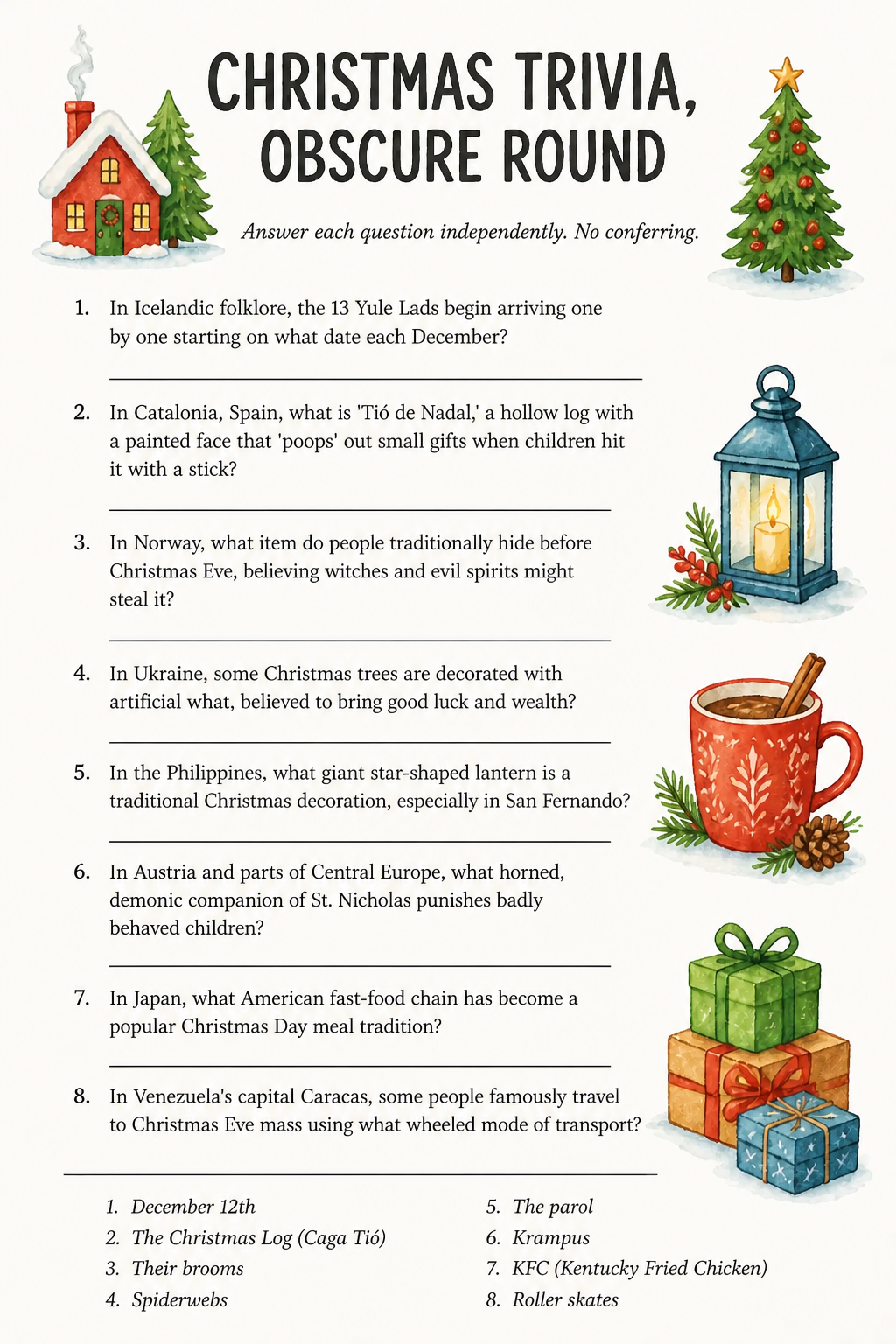
13. Christmas Trivia, Obscure Round
Twelve trivia questions about Christmas that no one expects to know: the origin of the Christmas cracker, which country introduced the Christmas tree to Britain, what ‘figgy pudding’ actually contains. The questions are obscure enough that guessing becomes part of the game, and wrong answers said with confidence are genuinely entertaining.
Print one sheet per guest and one answer key for the host, who reads questions aloud while guests write their answers independently. Score after all twelve, then go around the table asking people to share their most confident wrong answer. A mixed-age group often surprises itself with who knows what.
Resist the urge to make questions too easy. The obscurity is the point. If three people get question seven right, something has gone wrong with question seven.
Read each question twice and pause. Guests who rush their first guess will change their minds on the second read, which is where the comic hesitation lives.
14. Whisper Down the Christmas Line
The host whispers a very specific, slightly absurd Christmas instruction to the first player, something like ‘The turkey has been replaced by a decorative gourd and nobody is mentioning it.’ It travels down the line as a whisper. The last player says what they heard aloud, and the host reads the original. The gap between the two is the game.
No materials needed. Play three rounds minimum, rotating who starts. The starting message should be long enough to distort but short enough to remember: two sentences is the sweet spot. Shorter messages survive intact and that is disappointing; longer ones fall apart in the first three people and never recover.
The messages work best when they are plausible enough to seem like instructions but strange enough to feel wrong when they come out the other end. ‘Remind Grandma that the good towels are not for guests’ travels beautifully.
Write the starting message down and keep it. Reading the original aloud verbatim at the end lands harder than paraphrasing.
15. 15. Two Truths About the Host (Card Set, 6 Up)
Before the party, the host writes down ten true statements about themselves related to Christmas: past disasters, genuine opinions, things they have done or refused to do. At the party, each card presents two of those statements and one total fabrication. Guests circle which one they believe is the lie.
Print one sheet per six guests, cut along the dashed lines. This version is specifically about the host, not the guests, which removes any anxiety about being exposed. The host controls what goes on the cards and can calibrate the revelations to the room.
The best fabrications are boring enough to be plausible. ‘I have never seen It’s a Wonderful Life’ is a better lie than ‘I once delivered a Christmas speech dressed as a badger,’ because the boring one actually makes people doubt themselves. This is a game about the host’s credibility, and that is a surprisingly personal and funny dynamic.
Write the cards a week before the party. Fresh lies are better lies.

16. The Impression Round
Each player draws a slip of paper naming a famous person (fictional or real, no politicians) and must describe a Christmas scenario entirely in character. Not an impression of their voice necessarily, just their manner, their priorities, their vocabulary. The group guesses who is being channeled.
No materials needed beyond prepared slips. Keep the characters broad enough that someone who does not watch much television still has a fighting chance: Mr. Bean, the Queen, Sherlock Holmes, and a film director having a bad day all work without specialist knowledge.
The game rewards people who commit to the character’s worldview rather than their accent. Someone doing a passable impression of how Sherlock Holmes would react to a Christmas jumper gift is funnier than a perfect voice with nothing to say. Family groups often find this one especially revealing about who has been watching what all year.
- Groups who share at least some cultural references
- After dinner, when people are relaxed
- 8 to 20 players
17. 17. One Word Story Around the Table
Going around the table, each person adds exactly one word to a collective Christmas story. No planning, no passing, no hesitation longer than three seconds or the person is out. The story begins with ‘One Christmas Eve’ and goes wherever the group takes it, which is almost always somewhere structurally incoherent and occasionally brilliant.
No materials needed. The host keeps a loose running transcript on their phone if anyone wants to hear the finished story read back aloud, which is genuinely worth doing. A story that takes seven minutes to build takes about forty-five seconds to read back and is funnier for the speed.
The three-second rule is load-bearing. Without it, people think too carefully and the story becomes almost coherent, which kills the game. With it, the instinctive choices are stranger and the whole thing collapses into comedy faster. Easy-to-run games like this one earn their place precisely because the players do all the work.
No skill required. The constraint (one word, fast) is the entire game mechanic, and it works on the first try with any group.
Frequently Asked Questions
How many funny christmas party games should you play in one afternoon?
Three to five games is a realistic afternoon. More than five and people stop recovering between rounds, the laughs get thinner, and the last game feels obligatory. Plan five, run three, and treat the extras as backup if energy stays high.
Which of these games works best as an icebreaker before people know each other well?
Bad Christmas Gift Confessions or Describe the Gift Without Naming It. Both give people something to say rather than something to reveal about themselves, which lowers the social stakes at the start of the evening.
Do you need a host to run these games, or can they run themselves?
Most of these need a host to start each round, read answers aloud, and keep the three-second rule honest. That is not complicated hosting, but someone needs to be in that role or the games drift. The printable ones are the most self-contained once cards are dealt.
What is the right order to play the games across an evening?
Start with something social and low-stakes (Bad Christmas Gift Confessions, Describe the Gift), move into quiz rounds mid-evening when people are focused, and end with performance games (Sing It Until Someone Laughs, Impression Round) when the room is warm and unselfconscious. Never end on a trivia quiz: it finishes the night on a score, not a laugh.
Can these funny christmas party games work for a work Christmas party?
Yes, with two adjustments. Drop anything that requires real stories about family members (Worst Present Told Aloud works but Guess Who Said It at Last Year’s Dinner needs adapting to a work context). Lead with the printable games, which give quieter colleagues something to engage with before committing to performing.
How do you handle guests who refuse to play?
Make them the judge. Most of these games benefit from someone keeping score or reading cards aloud, and a guest who nominates themselves for that role is often the most useful person in the room. Never push someone into performing: the laughs come from willingness, not conscription.

12 TV stand Christmas decor ideas that dress the screen, the surface and the floor around it, groupe

22 christmas wreaths diy ideas for every skill level and every room, with full materials, timing, ag

15 Christmas tray decor ideas for coffee tables, kitchen counters and ottomans, each with its own co
Leave a Reply