


A great Bible trivia night does more than test knowledge — it sparks conversation, builds community, and gives people of every age a reason to crack open the scriptures again.
Whether you’re planning a youth group lock-in, a multigenerational family night, or a mid-week church gathering, the right mix of rounds and games keeps energy high from the opening question to the final tie-breaker.
This collection of 20 Bible trivia games is designed to do exactly that, blending printable question sheets, team challenges, creative memory activities, and a few surprises that will catch even your most seasoned Bible scholars off guard.
The first twelve items are the backbone of a complete, structured trivia night — printable rounds, a score sheet, an answer key, and a few bonus formats that round out the evening.
Items thirteen through twenty add fresh formats you can rotate in depending on your group’s size, energy level, and age range. Mix and match, run them all in sequence, or pull individual games for a shorter session.
A host tip at the end of each entry gives you the kind of practical advice that only comes from actually running these games in a room full of excited (and occasionally very competitive) people of faith.
This post contains affiliate links — if you buy through them, I may earn a small commission at no extra cost to you.
Table of Contents
- Old Testament Round (Printable)
- New Testament Round (Printable)
- Bible Characters Round – Who Am I? (Printable)
- Parables Round (Printable)
- Picture Round – Bible Places (Printable)
- Memory Verse Round (Printable)
- Bible Numbers Round (Printable)
- Kids’ Easy Round (Printable)
- Lightning Round
- Team Score Sheet – Bible Trivia Night (Printable)
- Tie-Breaker Question
- Answer Key – Old Testament Round (Printable)
- Emoji Bible Stories
- Bible Mad Libs
- Bible Charades
- Bible 20 Questions
- Sword Drill Challenge
- Bible Bingo
- Books of the Bible Relay
- Bible Trivia Showdown (Head-to-Head Finals)
1. Old Testament Round (Printable)
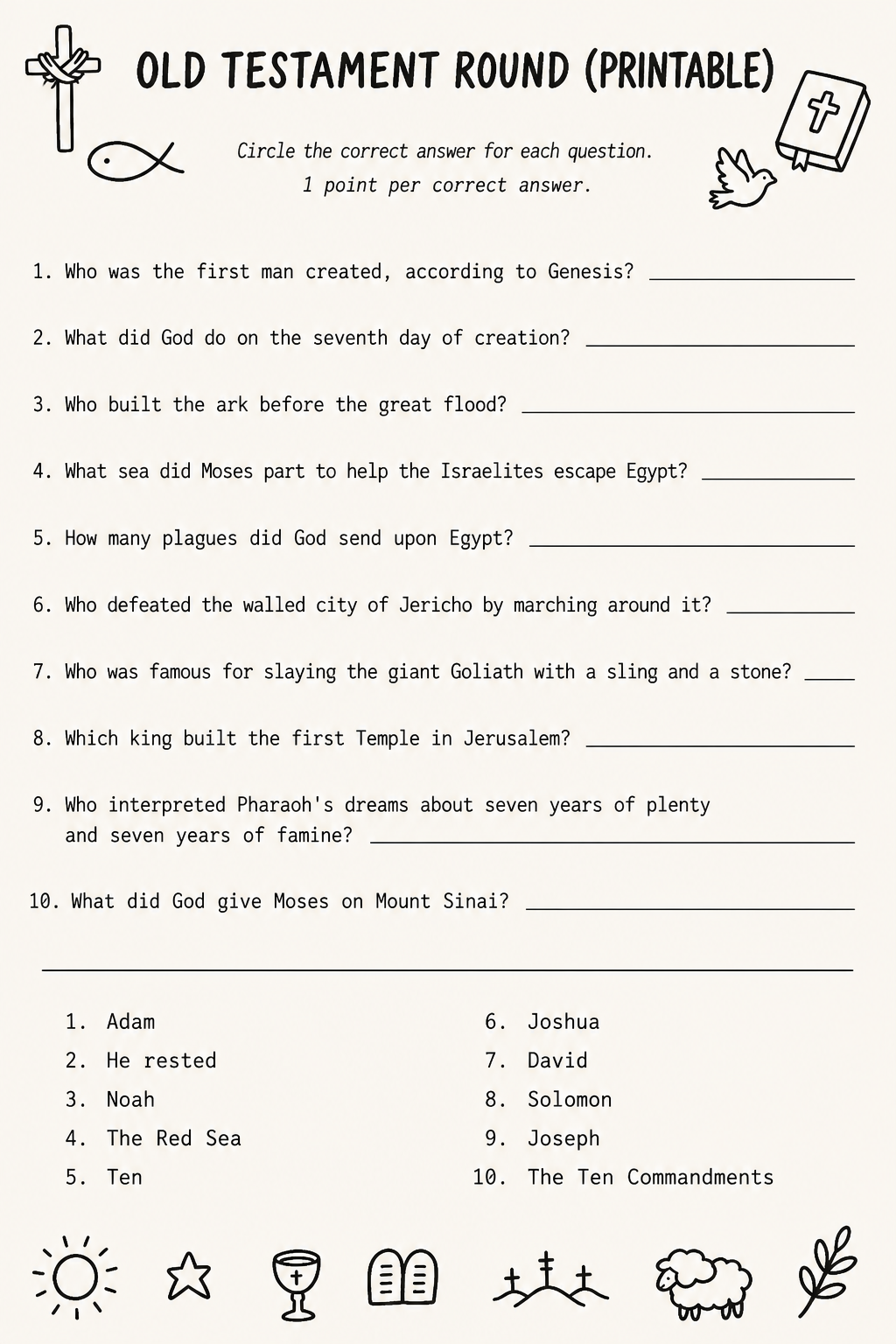
This printed question sheet covers the full sweep of the Old Testament — creation, the patriarchs, the exodus, the judges, the kings, the prophets, and everything in between.
Print one sheet per team and give everyone three to five minutes to huddle and fill in answers together. Because the questions are tiered from straightforward (“Which book comes first in the Bible?”)
to genuinely challenging (“Which prophet saw a valley of dry bones?”), every team member has a moment to shine regardless of how long they’ve been attending church.
You’ll need a printer, cardstock or plain paper, and pens for each team. The round works best with four to eight teams of three to six players and takes about fifteen minutes including discussion time.
After the round, read each answer aloud and let teams self-score — that announcement moment is where the real energy lives, especially when a team that guessed confidently discovers they were one letter off on a tricky name.
Host tip: Number your questions clearly and leave generous blank lines for answers. Groups with mixed ages tend to write in very different handwriting sizes, and a cramped answer line creates unnecessary confusion at scoring time.
🛍 Shopping guide
2. New Testament Round (Printable)
The New Testament round shifts focus to the Gospels, the Acts of the Apostles, the letters, and Revelation. Questions range from the birth narratives and Jesus’s miracles to Paul’s missionary journeys and the letters to the early churches.
Because so many participants will have strong Sunday school memories of this material, this round often produces the most spirited table debates — teams that can’t quite agree whether a detail came from Matthew or Luke will spend every second of their three-minute huddle time arguing it out, which is exactly the kind of engagement you want.
Like the Old Testament round, print one sheet per team on cardstock and supply each team with a pen. Plan for about twelve to fifteen minutes.
This round pairs beautifully with the Parables Round later in the evening — running them back-to-back creates a full New Testament block that gives your more knowledgeable players a chance to build momentum heading into the trickier themed rounds.
Host tip: Include at least two questions from the book of Revelation. Most groups underestimate how well they know it, and those questions reliably produce both correct surprise answers and gloriously wrong ones that get the whole room laughing.

🛍 Shopping guide
3. Bible Characters Round – Who Am I? (Printable)
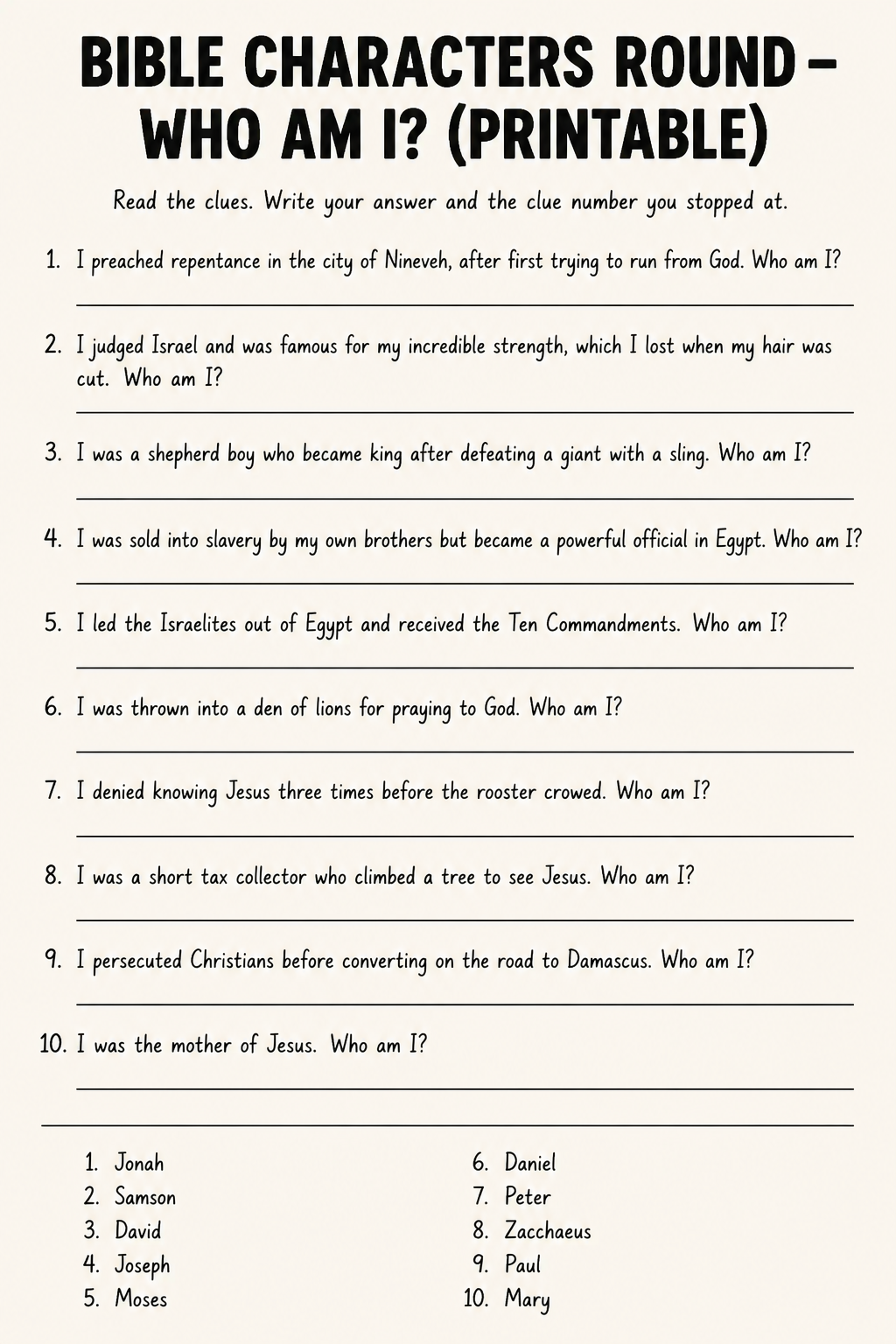
This printable takes a clever twist on standard trivia: instead of a direct question, each entry gives three progressively more obvious clues about a Bible character, and teams score more points the earlier they guess correctly.
“I led a great army and the walls fell down — who am I?” is worth three points if a team answers after the first clue, two after the second, and one after the third.
The descending point structure rewards confident biblical knowledge while still giving newer believers a way to earn points by the final clue.
Print one sheet per team. Teams write their answers and the clue number at which they committed, then reveal everything at the end of the round. You’ll need about fifteen minutes and it works well for groups of any size.
Characters should range from obvious picks like Moses and Mary to less-familiar names like Rahab, Ananias, or Onesimus — that variety is what makes this round feel genuinely rewarding rather than just a warm-up.
Host tip: Read each set of clues aloud one at a time before teams look at their sheets, pausing dramatically between clues. The auditory delivery builds suspense the printed sheet alone cannot create, and it gives teams who struggle with reading speed an equal shot at the big points.
🛍 Shopping guide
4. Parables Round (Printable)
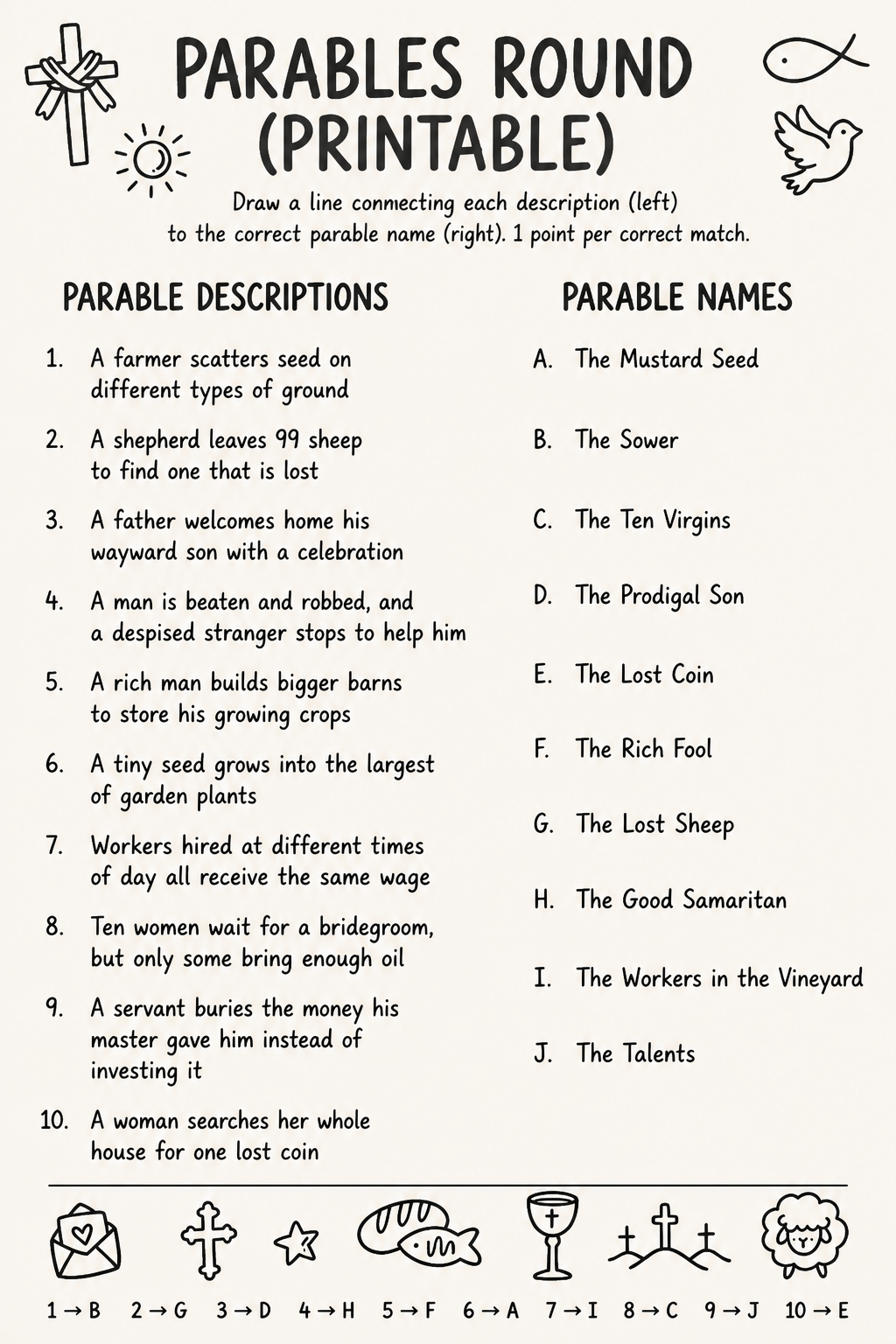
The Parables Round centers entirely on the stories Jesus told — the prodigal son, the sower, the ten talents, the lost sheep, the good Samaritan, and more.
Questions might ask teams to identify which parable is being described, recall a specific detail within a parable, or name which Gospel records a particular story.
Because parables are narrative, they tend to lodge in memory differently than straight facts, and this round has a wonderful way of drawing out quieter team members who may not know chapter-and-verse details but remember stories vividly.
Print one sheet per team and allow about twelve minutes. This round works especially well as a mid-evening reset after higher-intensity competitive rounds — its storytelling nature naturally slows the pace and invites reflection before the trivia competition heats back up.
Pairs of tables can even be encouraged to briefly discuss why a particular parable resonates with them after scores are revealed, turning a game moment into a brief devotional one.
Host tip: Add one “trick” question that describes a popular story people often call a parable but isn’t technically classified as one in the text. It sparks exactly the kind of curious, engaged conversation that makes a Bible trivia night more than just a game.
🛍 Shopping guide
5. Picture Round – Bible Places (Printable)
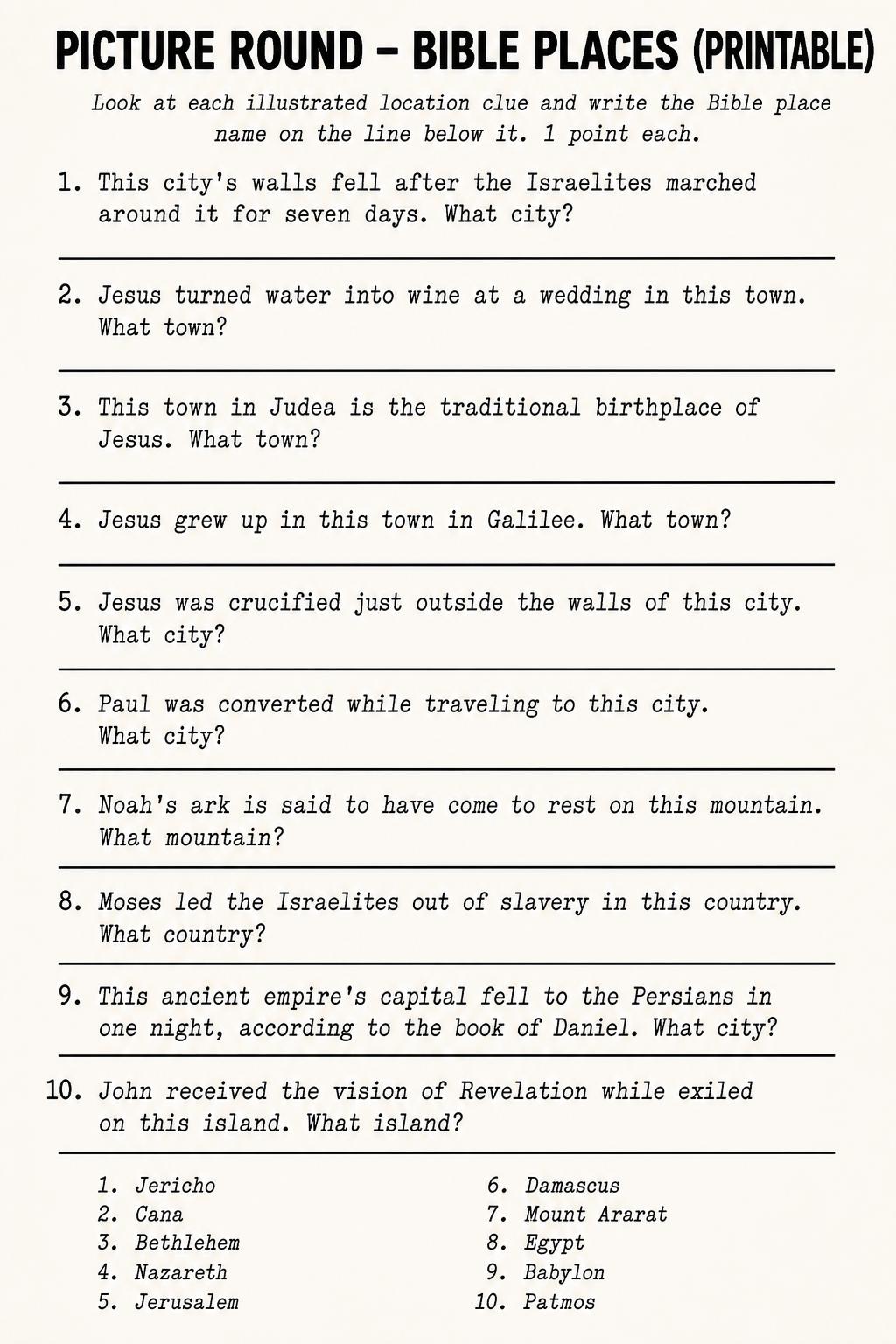
This printable sheet displays photographs or illustrations of real geographic locations connected to biblical events — the Jordan River, the hills of Galilee, the Nile delta, the ruins of Jericho, the road to Damascus — and teams must identify each place and, for bonus points, name the biblical event associated with it.
The visual format breaks up the evening beautifully and tends to be a particular favorite with younger players and visual learners who might feel left behind during pure question-and-answer rounds.
Print one sheet per team in color if possible, though black-and-white prints still work well for illustrated maps and line drawings. Allow ten to twelve minutes.
This round can open a broader conversation about the historical and geographic reality of the Bible, reminding participants that these are real places that can be visited today — a detail that often surprises and delights younger attendees.
Host tip: Include one image of an everyday Middle Eastern landscape with no obvious landmarks and ask simply, “What region of the biblical world does this terrain remind you of?” There are no wrong answers to that question, but the discussion it opens is always rich and warm.
🛍 Shopping guide
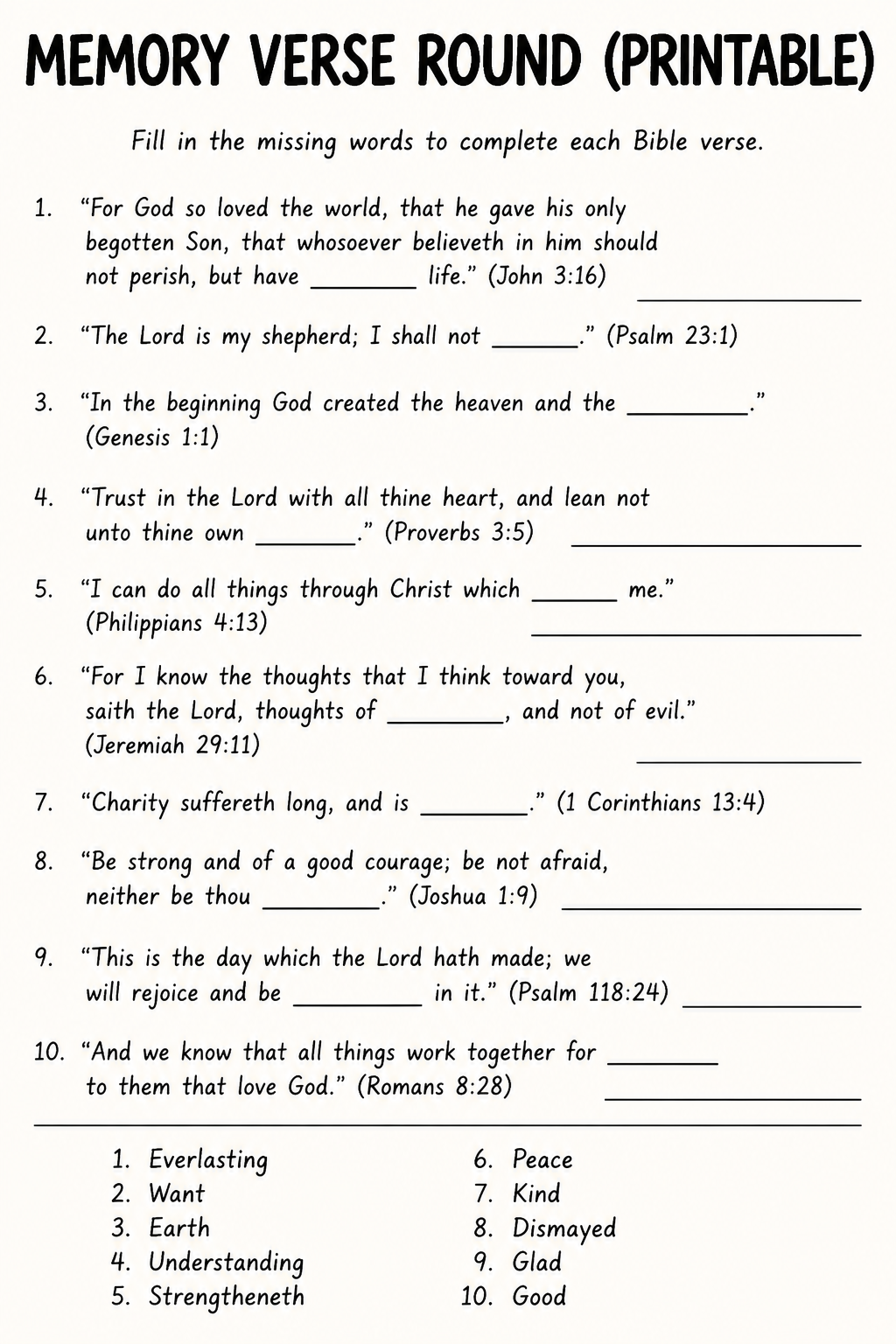
6. Memory Verse Round (Printable)
Rather than asking where a verse is found, the Memory Verse Round presents partial scripture passages — with key words blanked out — and asks teams to fill them in from memory.
The emphasis is on the words themselves, not the reference, which levels the playing field between lifelong churchgoers and newer visitors.
Because the blanked-out words are always meaningful ones (a noun, a verb, or a name) rather than filler words, even a team that doesn’t know the verse cold can often reason their way to a thoughtful answer.
Print one sheet per team and allow about ten minutes. Choose verses that span a range of familiarity — one or two that almost everyone knows, several that regular attendees will recognize, and one or two that will stump even your most studied participants.
The scoring reveal at the end of this round often prompts spontaneous recitation attempts from team members who suddenly remember more than they thought they did.
Host tip: After scoring, read each complete verse aloud slowly and ask the room to repeat it once together. That brief, unplanned moment of communal recitation is often the most spiritually meaningful two minutes of the entire evening.
🛍 Shopping guide
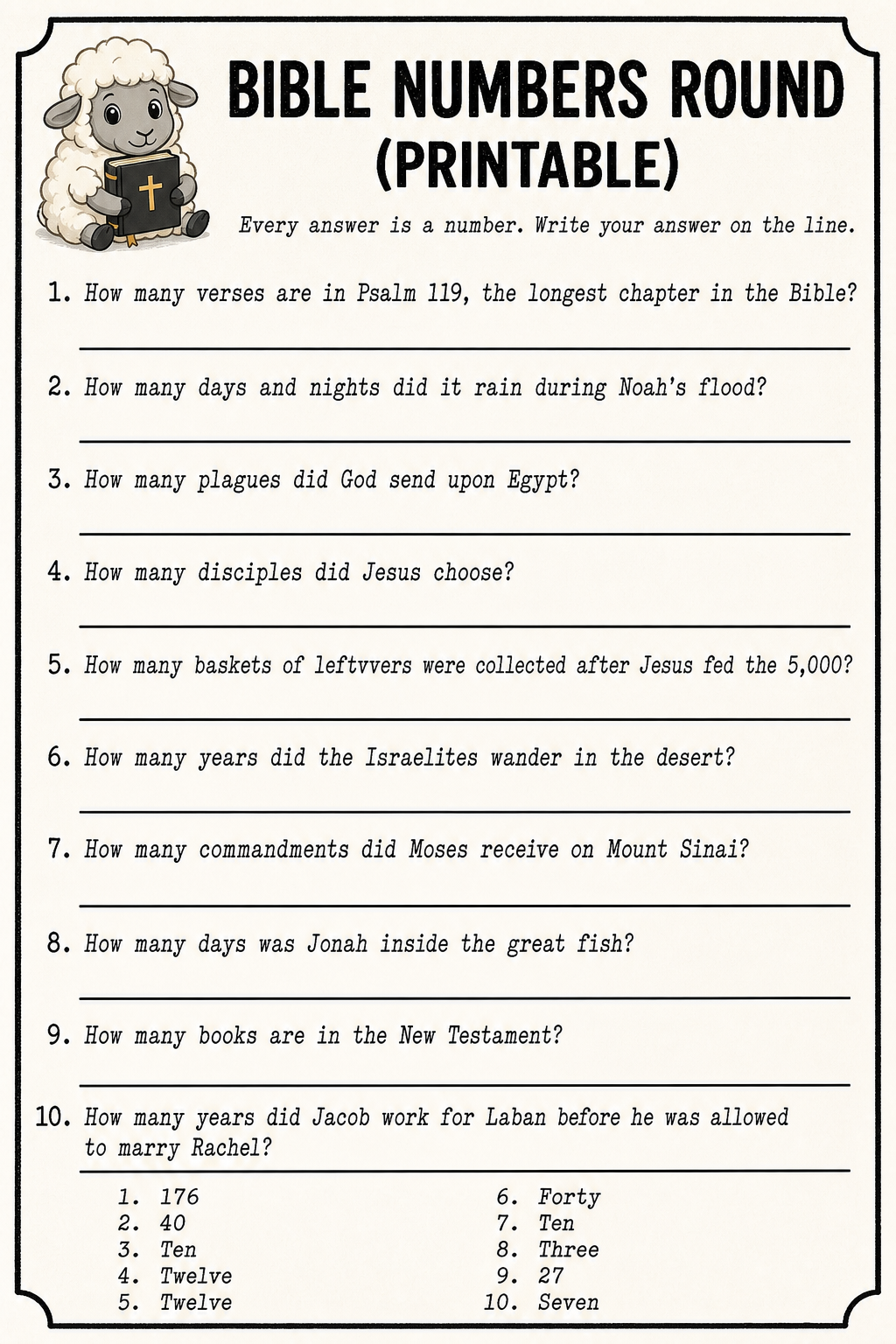
7. Bible Numbers Round (Printable)
Numbers are everywhere in the Bible — forty days in the desert, twelve disciples, seven days of creation, 153 fish, 144,000 sealed from the tribes — and this printable round turns those figures into a fascinating category all on their own.
Teams are given either the number and must name the event, or the event and must supply the number.
The format feels fresher than a standard Q&A because numbers are specific and unambiguous: either you know that Solomon had 700 wives or you make your best guess and brace for the reaction.
Print one sheet per team and allow ten to twelve minutes.
This round tends to produce the loudest whole-room reactions of the night — the numbers are often more surprising than people expect, and the gap between a team’s confident guess of “40” and the correct answer of “153” (or vice versa) is reliably comic.
It’s also a gentle nudge toward deeper reading, since the specific details that numbers represent are almost always connected to larger, fascinating stories.
Host tip: Include the question about how many books are in the Bible — and make it worth double points. It sounds easy until teams start debating Old Testament canon differences between traditions, and that good-natured debate keeps the energy alive while you prepare for the next round.
🛍 Shopping guide
8. Kids’ Easy Round (Printable)
Designed specifically with younger players in mind, this printable round features clear, joyful questions about the most beloved Bible stories — Noah’s ark, baby Moses in the basket, David and Goliath, the Christmas story, and the feeding of the five thousand.
The language is simple, the questions are confidence-building rather than stumping, and every correct answer gives a child a genuine, earned moment of pride.
Running a dedicated kids’ round signals to families that their youngest members are real, valued participants in the evening rather than passengers along for the ride.
Print one sheet per family or per kids’ team and allow eight to ten minutes. For the best results, let children on mixed-age teams answer these questions first before adult teammates weigh in.
You might even award a small prize — stickers, bookmarks, or a simple ribbon — specifically for the team with the highest kids’ round score, encouraging the adults to step back and let the children lead.
Host tip: Read these questions aloud to the whole room, not just the kids’ tables. Watching confident adults pause and furrow their brows at a question a seven-year-old answers instantly is one of the most delightful moments a Bible trivia night can produce.

🛍 Shopping guide
9. Lightning Round
The Lightning Round ditches team huddles entirely. The host asks rapid-fire questions one at a time and the first individual in the room to raise their hand and answer correctly earns a point for their team.
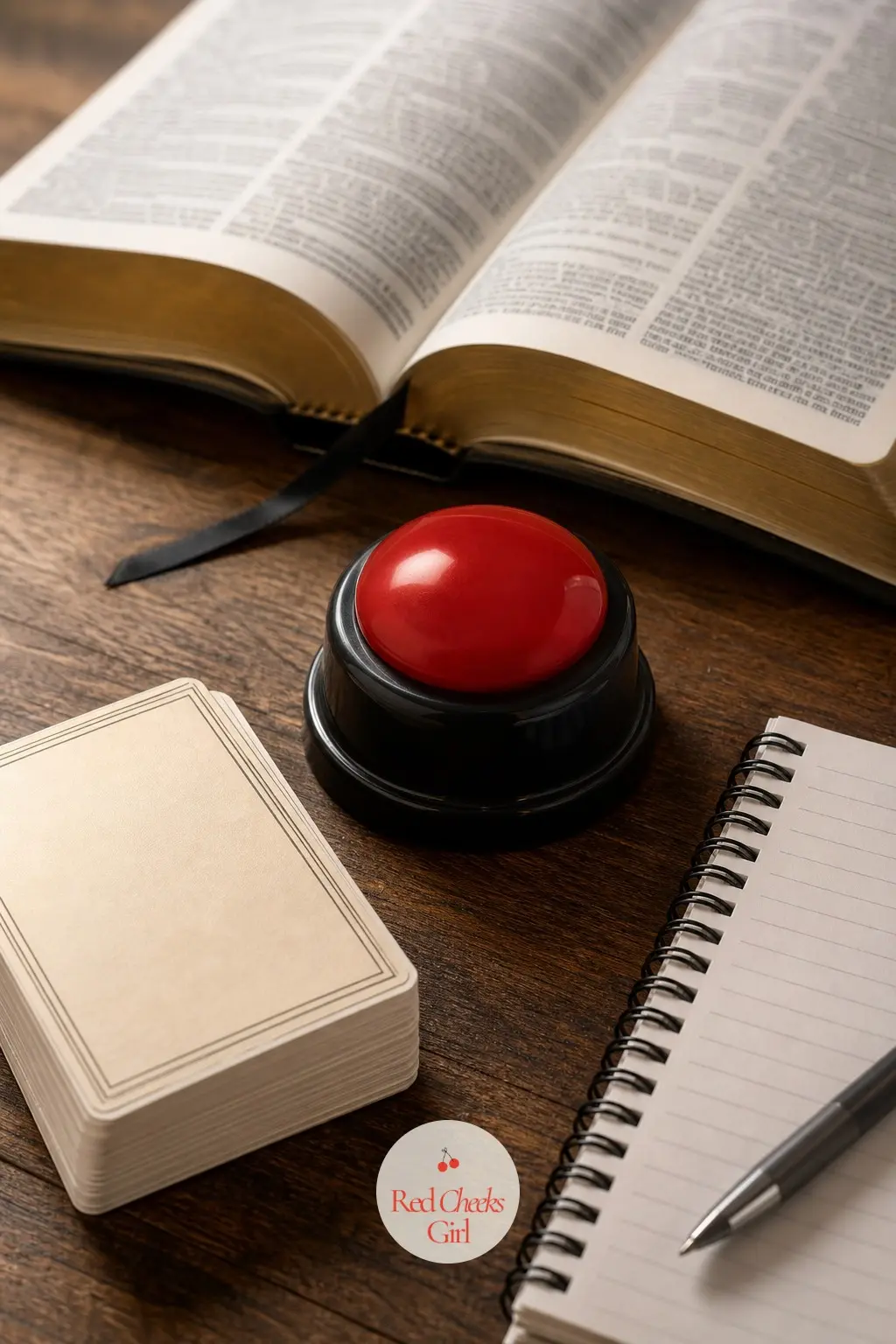
Questions should be short, punchy, and answerable in three words or fewer — “Who built the ark?” “How many disciples did Jesus have?” “What sea did Moses part?” — delivered at a pace that keeps everyone on the edge of their seat.
This format rewards quick recall and a competitive spirit, and the standing-up, hand-raising physicality of it shifts the room’s energy dramatically after several seated rounds.
No printed sheets needed — just your question list, a confident voice, and a visible tally on a whiteboard or large notepad. Run twenty to thirty questions at pace and allow ten to fifteen minutes total.
The Lightning Round works best placed two-thirds of the way through the evening, when teams have a sense of their standings and a tight scoreboard makes every point feel critical.
Host tip: Designate a separate scorekeeper so you never have to pause to update the tally yourself. The momentum of a Lightning Round dies the moment the host stops talking, so keeping your own attention entirely on the questions and the room is essential.
🛍 Shopping guide
10. Team Score Sheet – Bible Trivia Night (Printable)
A well-designed score sheet is the organizational spine of any trivia night, and this printable does real work. Each team receives one sheet at the start of the evening, listing every round with space to record raw scores, bonus points, and running totals.
Having a physical document that teams manage themselves accomplishes two things simultaneously: it keeps participants actively engaged between rounds rather than passively waiting, and it dramatically reduces the host’s administrative load during the event itself.
Print one sheet per team and encourage teams to designate a dedicated scorekeeper — someone who genuinely enjoys the bookkeeping role and won’t be distracted by the competition.
The sheet should include space for the team name at the top, which is worth requesting creatively (“pick a Bible character or location as your team name”) because imaginative team names add personality and warmth to the evening from the very first moment.
Host tip: Ask teams to pass their score sheets to an adjacent team for verification after each round rather than self-reporting totals. That single step eliminates the accidental (and occasionally intentional) arithmetic errors that can make a final scores announcement feel anticlimactic or contested.

🛍 Shopping guide
11. Tie-Breaker Question
No trivia night ends cleanly — someone is always tied, or one team disputes a point and suddenly everything is within reach again. The Tie-Breaker Question is a single, carefully chosen question delivered verbally to the tied teams in front of the whole room.
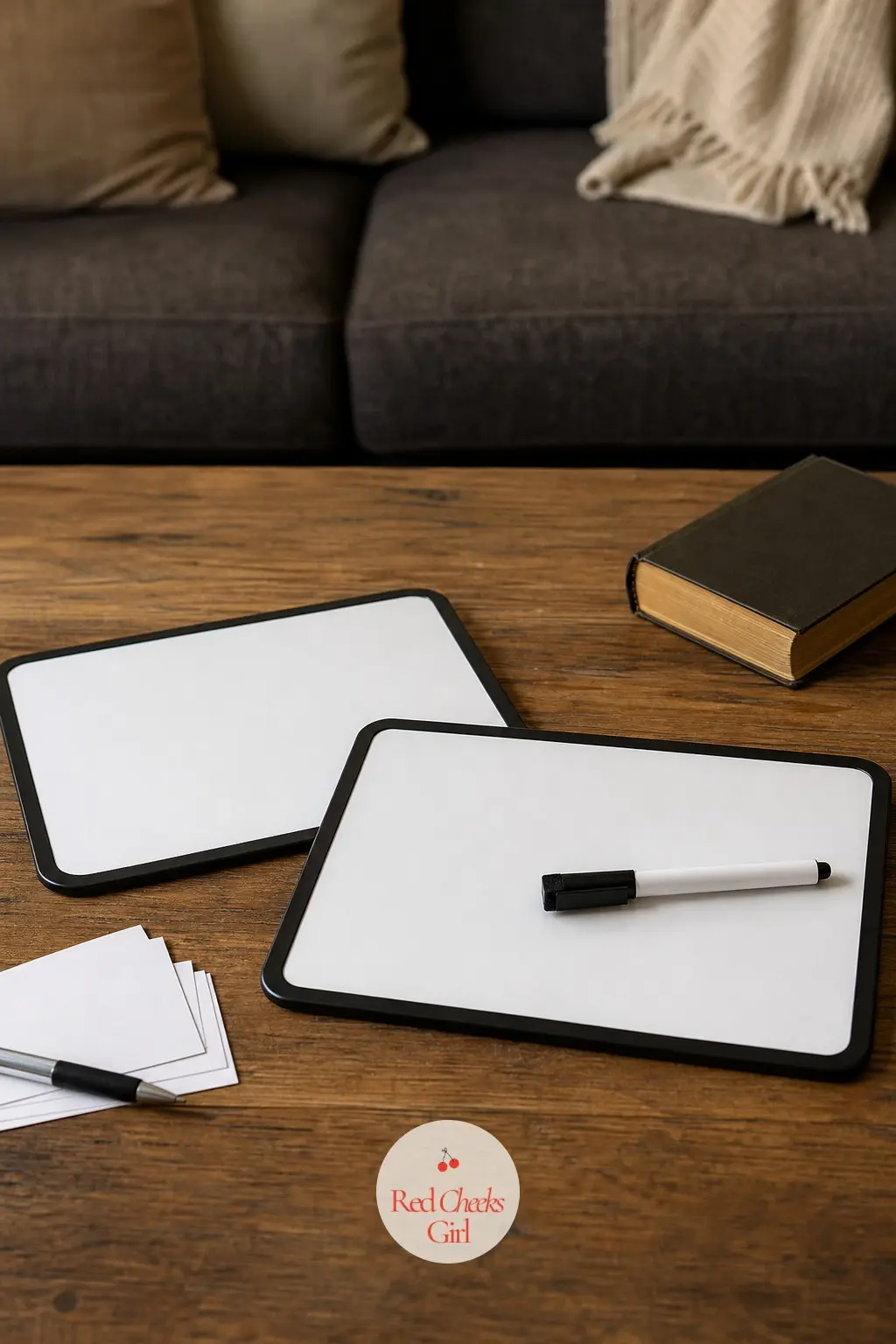
Representatives from each tied team approach the front, and the first to write their answer on a small whiteboard or piece of paper and hold it up correctly wins.
The public, physical format turns a potential administrative headache into the most theatrical moment of the evening.
No printable needed — just prepare three or four strong tie-breaker questions in advance and keep them in your back pocket.
Good tie-breakers are specific enough that guessing is unlikely but don’t require years of seminary training to answer — a question about a well-known but detail-specific moment in a familiar story is ideal.
Allow only thirty to sixty seconds maximum, and encourage the rest of the room to remain silent so the tension can build properly.
Host tip: Prepare your tie-breakers with a range of difficulty so that if the first question produces a simultaneous correct answer, you have a harder one ready immediately. Running out of tie-breakers mid-drama is the one hosting failure that is genuinely difficult to recover from gracefully.
🛍 Shopping guide
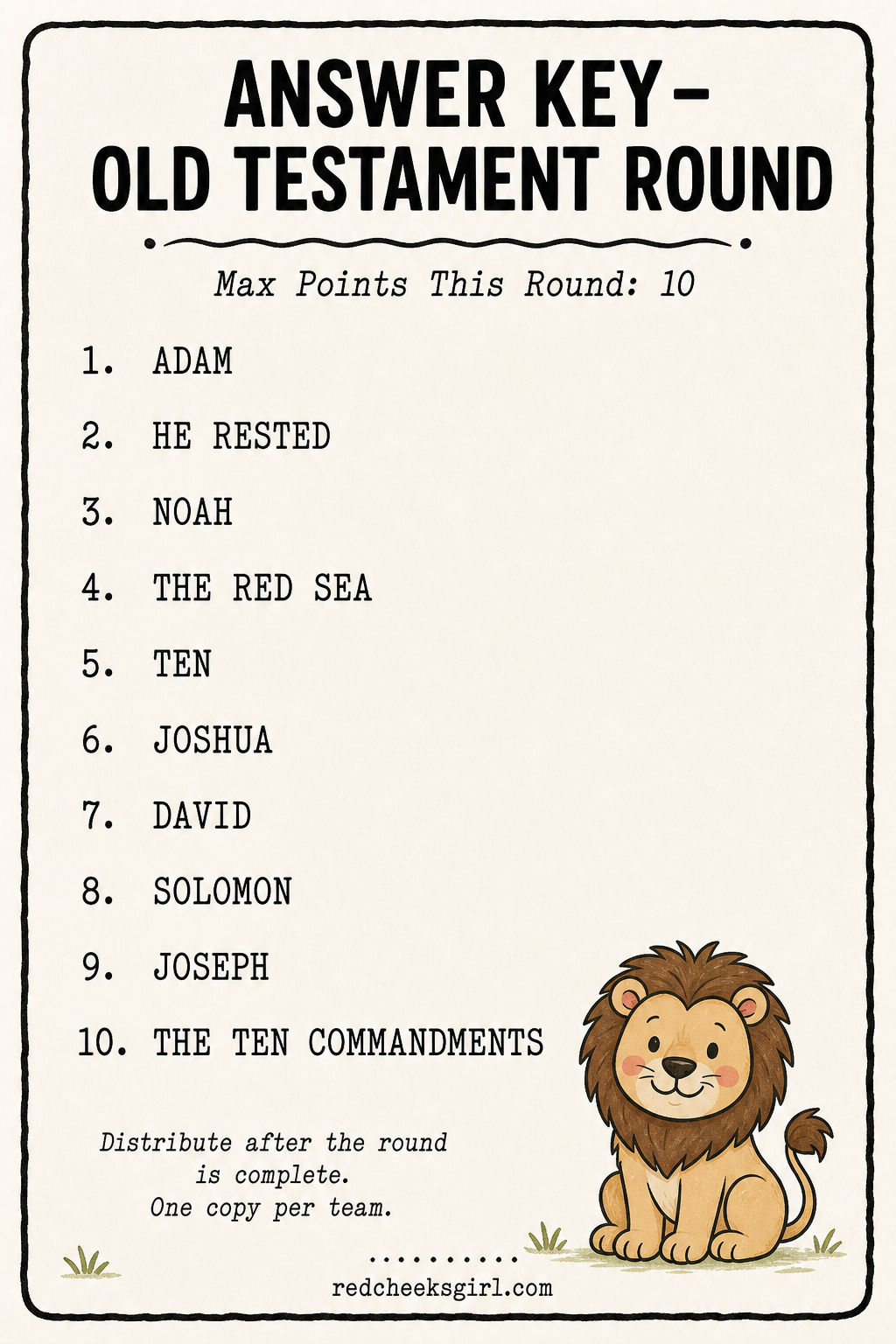
12. Answer Key – Old Testament Round (Printable)
The answer key for the Old Testament Round is a printable sheet intended exclusively for the host or designated answer-checker — it lists every question alongside its correct answer, a brief explanatory note for context, and the point value for each entry.
Having a printed, authoritative answer key in hand is what allows a host to manage the scoring reveal with confidence and speed, rather than fumbling with a phone or laptop during the highest-energy moments of the evening.
It also settles disputes immediately, because a printed key feels more official than a verbal assertion, even when both are equally correct.
Print one copy and keep it face-down on the host table throughout the Old Testament Round.
The explanatory notes alongside each answer are genuinely valuable — if a team challenges an answer, the context note allows the host to explain the reasoning calmly and completely without derailing the evening.
Plan to spend about three minutes on the Old Testament scoring reveal, reading each answer clearly and pausing for reactions before moving to the next.
Host tip: Highlight any questions that are most likely to generate challenges before the evening begins. A quick mental rehearsal of your explanation for those specific answers means you can deliver them smoothly and authoritatively, keeping the room’s trust and momentum fully intact.
🛍 Shopping guide
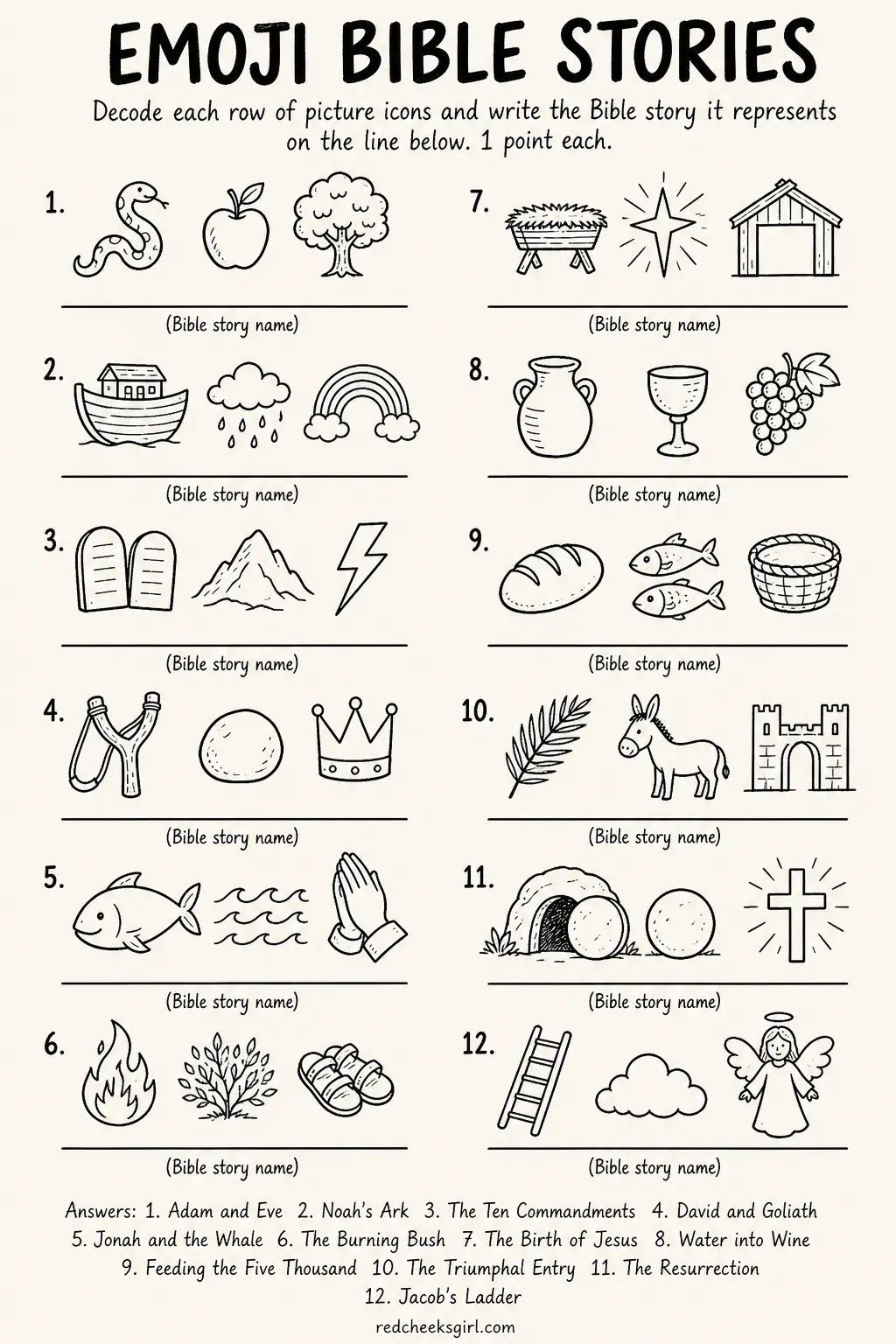
13. Emoji Bible Stories
This creative printable presents sequences of simple emoji-style icons — a dove, waves, an olive branch; a star, a baby, some animals — and teams must identify the Bible story each sequence represents.
Unlike rebus or word-guess formats, the sequences here point to complete narrative stories rather than phrases or words, so there’s no linguistic trick to resolve. The question is simply: “Which Bible story does this picture sequence remind you of?”
and the answer is a story title like “Noah’s Ark” or “The Birth of Jesus.” The result is a format that sparks lively visual thinking and rewards narrative memory rather than factual recall.
Print one sheet per team in color if available, and allow ten to twelve minutes. This round is particularly popular with younger players and visual thinkers who might feel overshadowed in pure Q&A rounds.
Because the sequences are suggestive rather than literal, a team might reasonably argue for more than one answer on an ambiguous entry — build in one intentionally open-ended sequence and award points to any team that gives a well-reasoned story identification.
Host tip: After revealing answers, ask each table to create their own three-icon sequence for a story and challenge the table next to them to guess it. That spontaneous extension takes less than five minutes and almost always becomes the part of the evening people talk about afterward.
🛍 Shopping guide
14. Bible Mad Libs
Bible Mad Libs hands each team a printed story with key words removed and replaced by blank lines labeled with a part of speech — “noun,” “verb,” “name of a Bible character,” “number,” “place.”
Teams fill in the blanks without seeing the surrounding story, then the host reads the completed narrative aloud with the teams’ substitutions in place.
The results are almost always hilarious and, at their best, accidentally profound — which is exactly the combination that makes this format unforgettable at a mixed-age gathering.
Print one sheet per team on plain paper and allow five to seven minutes for teams to fill in their words. This works as a palate-cleanser between heavier trivia rounds or as a closing activity that ends the evening on a note of shared laughter.
The underlying story should be a familiar one — the creation narrative, Jonah’s journey, or the Christmas story — so that the contrast between the original and the teams’ additions lands with full comedic effect.
Host tip: Read every team’s completed version aloud, not just the funniest one. The act of hearing each table’s creation and responding to it together builds a sense of communal warmth that purely competitive formats can’t replicate, and it gives every team a moment in the spotlight regardless of their trivia score.

🛍 Shopping guide
15. Bible Charades
Bible Charades follows the classic no-talking format: one player draws a card, reads the Bible story, character, or location written on it, and acts it out silently while teammates guess within sixty seconds.
The category cards should cover a healthy range — dramatic physical stories like Samson and Delilah or Daniel in the lions’ den translate brilliantly into mime, while more abstract moments like “the still, small voice” push creative performers to genuinely inventive solutions.
Rotate the performer role after each card so everyone gets a turn in front of the group.
You’ll need a set of prepared category cards — write them on index cards before the evening — and a timer.
This game works for groups of six to thirty players, requires no printing during the event, and can run for twenty to thirty minutes depending on how many rounds you play.
It fits beautifully as a standalone station at a larger event where different games run simultaneously at different tables.
Host tip: Include a few locations alongside character names and story titles. “The Garden of Gethsemane” or “Mount Sinai” push performers in completely different directions than character-based cards, and the variety prevents the game from feeling repetitive even in a long session.
🛍 Shopping guide
16. Bible 20 Questions
One player thinks of a Bible character — real, well-known, from either testament — and the group asks yes-or-no questions to identify them within twenty questions. Classic questions like “Are you in the Old Testament?” “Are you a king?” “Did you perform miracles?”

narrow the field quickly, while trickier characters like Zacchaeus, Lydia, or the woman at the well can survive fifteen or sixteen questions before someone finally pieces together enough clues to guess correctly.
The game requires nothing but a list of characters for inspiration and works for any group size.
No materials needed, though a simple list of suggested characters posted at the front of the room helps players choose figures that are genuinely guessable rather than impossibly obscure.
Run three to five rounds with different players taking the “mystery character” role, and allow about five minutes per round.
Bible 20 Questions works especially well as a warm-up before the formal trivia rounds begin, because it activates biblical knowledge without the pressure of scored competition.
Host tip: Set a rule that the mystery character must appear in at least two passages of scripture. This prevents someone from choosing an extremely minor, single-verse figure that no yes-or-no question can realistically uncover, and it keeps the game engaging rather than frustrating for the guessing team.
17. Sword Drill Challenge
The Sword Drill is a beloved tradition in many church communities: the host calls out a scripture reference, and participants race to find it in a physical Bible as quickly as possible.
The first person to locate the passage, stand up, and read the first full sentence aloud wins the point for their team.
The name comes from the metaphor of scripture as a sword, and the competitive speed element makes it genuinely thrilling — a room full of rustling pages and the sudden triumphant leap of a winner creates an energy unlike any other game format.
Every participant needs a physical Bible of the same translation for fairness. Run twelve to fifteen references in a session and allow about fifteen to twenty minutes total.
The Sword Drill works best for participants who already have some familiarity with how the Bible is organized, so position it after the Kids’ Easy Round when younger players have already had their confident moment and the group is ready for a faster, more experienced challenge.
Host tip: Use the same translation for everyone if at all possible, and announce this in advance so participants can bring their preferred copy. The page number difference between translations is significant enough that mixed translations create an unfair advantage, and the logistics of borrowing church Bibles for everyone is almost always worth the effort.
18. Bible Bingo
Bible Bingo replaces the traditional letter-number calls with Bible terms, character names, books of the Bible, or key words from famous passages.
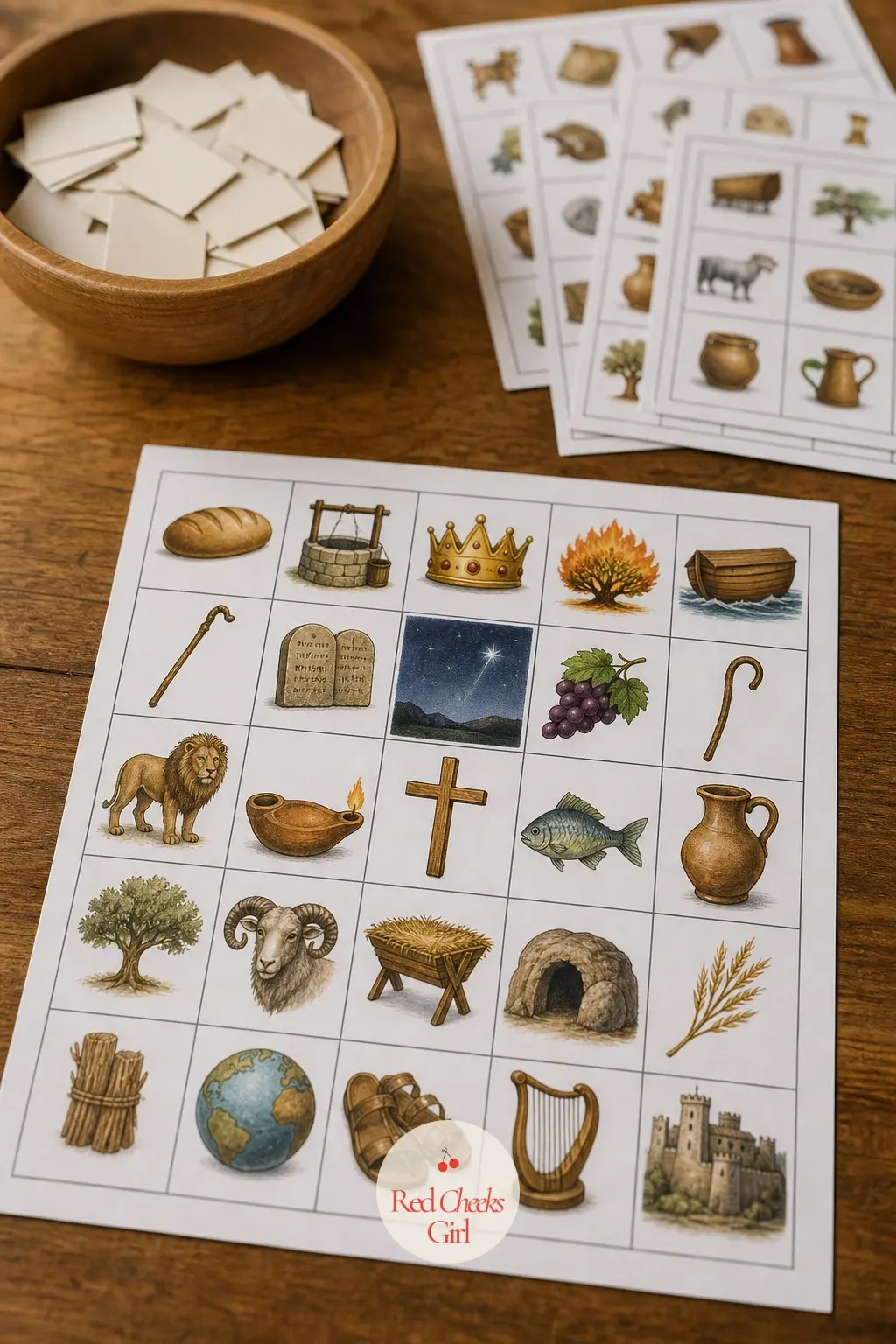
Each player receives a bingo card with a five-by-five grid filled with these terms, and the host draws cards from a shuffled deck and reads them aloud. First player to complete a row, column, or diagonal in the classic pattern calls out — perhaps “Hallelujah!”
or “Amen!” instead of “Bingo!” — and wins a small prize. The format is immediately familiar to almost everyone, which eliminates explanation time and lets the fun begin within moments.
You’ll need pre-made bingo cards (easily generated with a free online grid tool and printed on cardstock), a call deck of matching terms, and small markers — dried beans, poker chips, or torn paper squares all work perfectly.
This game scales beautifully from six players to sixty or more, and a single session of twelve to fifteen winners takes about twenty to twenty-five minutes.
Bible Bingo is an especially strong opener for a larger church event where latecomers may still be arriving — the drop-in format means no one misses a critical setup.
Host tip: Prepare at least three different card layouts so no two players at the same table have identical grids. A room where multiple people win simultaneously is fun; a table where everyone wins at the exact same time because their cards are identical is suspicious and deflating.
🛍 Shopping guide
19. Books of the Bible Relay
Teams line up relay-race style, and the first player in line must name one book of the Bible, then tag the next player, who names another, and so on without repeating any title.

Any player who hesitates for more than five seconds, repeats a book, or names something that isn’t a canonical book is “out” and that round ends with the other teams still standing winning the points.
Running multiple short rounds keeps everyone engaged even after they’ve been eliminated, because watching their teammates try to maintain the chain under pressure is genuinely suspenseful.
No materials needed beyond a list at the front of the room for verification purposes — you want at least one person checking answers so disputed entries can be ruled on quickly.
This game works for groups of twelve to fifty players and takes about fifteen to twenty minutes for three or four rounds.
It functions well as a physical break in the middle of a trivia night, since the standing-up, relay-race format gets people out of their seats and moving without requiring any equipment or setup.
Host tip: Appoint a neutral judge from outside the competing teams — a youth leader, a parent, or another adult — to rule on disputed titles. The moment you try to judge and host simultaneously, the relay’s momentum collapses, and a disputed call without a clear authority can briefly fracture the room’s good humor.
20. Bible Trivia Showdown (Head-to-Head Finals)
The Bible Trivia Showdown is the grand finale: the two highest-scoring teams from the evening’s rounds face off in a direct head-to-head challenge in front of the whole room.
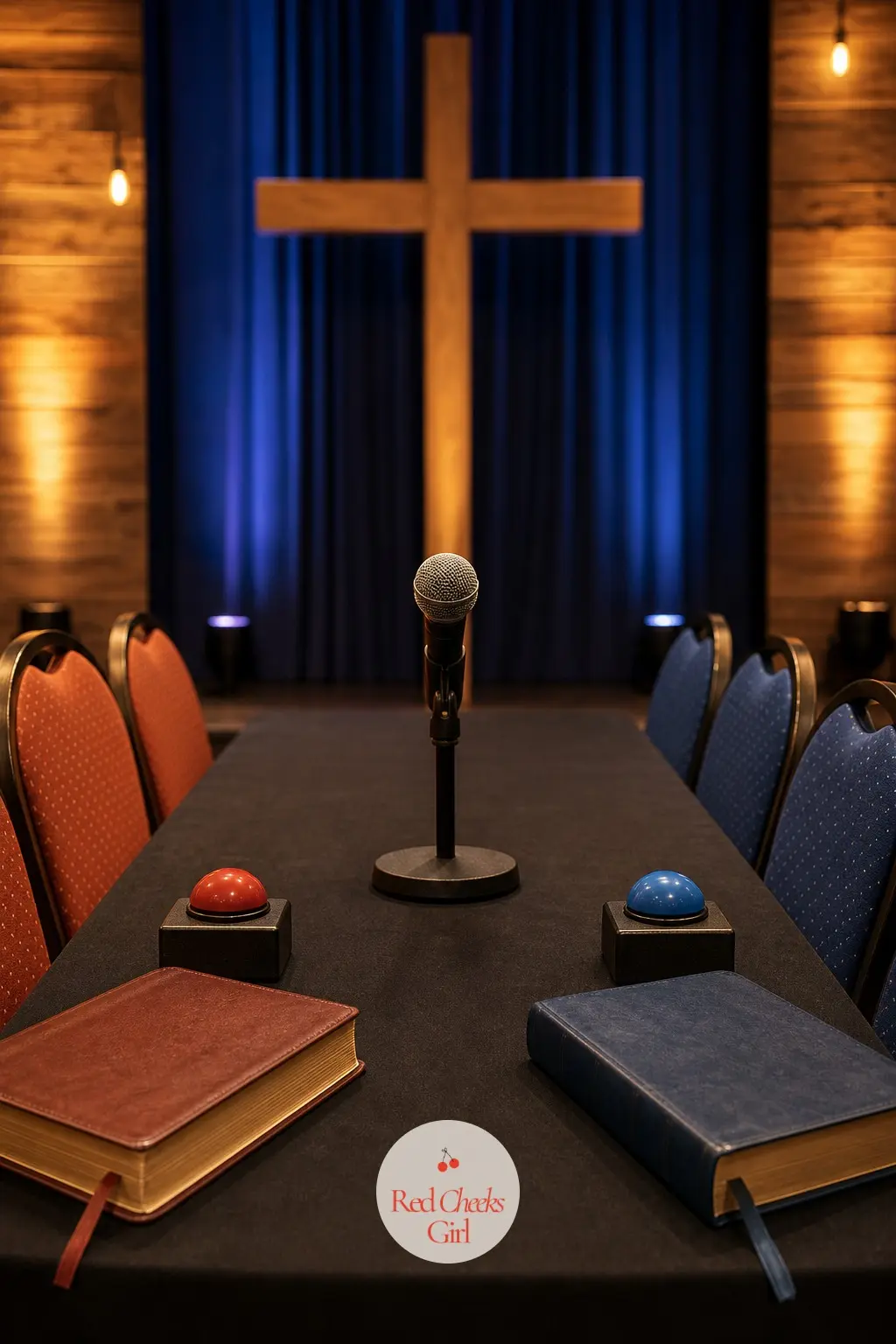
Representatives from each team sit at a table facing each other, and the host asks questions alternately to each side. A correct answer earns the team a point; an incorrect answer passes the question to the other team.
First team to reach ten points wins the evening. The whole-room-watching format turns the final minutes into a genuine event, with the rest of the attendees cheering and groaning in all the right places.
No printed materials needed — just your prepared questions, a clearly visible scoreboard, and the confidence to manage the crowd. Allow fifteen to twenty minutes for the showdown.
Choose questions for this round that are slightly harder than anything used earlier in the evening, since these are your two best-performing teams and they deserve a challenge that actually tests the limits of what they know, not a repeat of easier material they have already answered correctly.
Host tip: Invite the eliminated teams to submit one question each for the showdown round — collected on slips of paper during the previous rounds. Vetting them for accuracy takes two minutes, and incorporating participant-generated questions creates a sense of shared ownership in the finale that makes the whole room cheer louder, regardless of which team they’re supporting.
Frequently Asked Questions
How many people do you need for a Bible trivia night?
Bible trivia games work well with as few as six players and scale comfortably to one hundred or more.

The key is organizing participants into teams of three to six people rather than playing individually — smaller groups keep quieter players engaged and prevent any single “expert” from dominating the whole evening.
For very large groups, assign a table host to each cluster of four to six teams to help manage answer collection and scoring at the local level.
How do you make Bible trivia fair for mixed ages and knowledge levels?
The best approach is to include rounds specifically designed for different knowledge levels — a Kids’ Easy Round for younger players, a Lightning Round that rewards quick recall over deep study, and creative formats like Bible Mad Libs or Bible Charades that draw on narrative memory rather than encyclopedic knowledge.
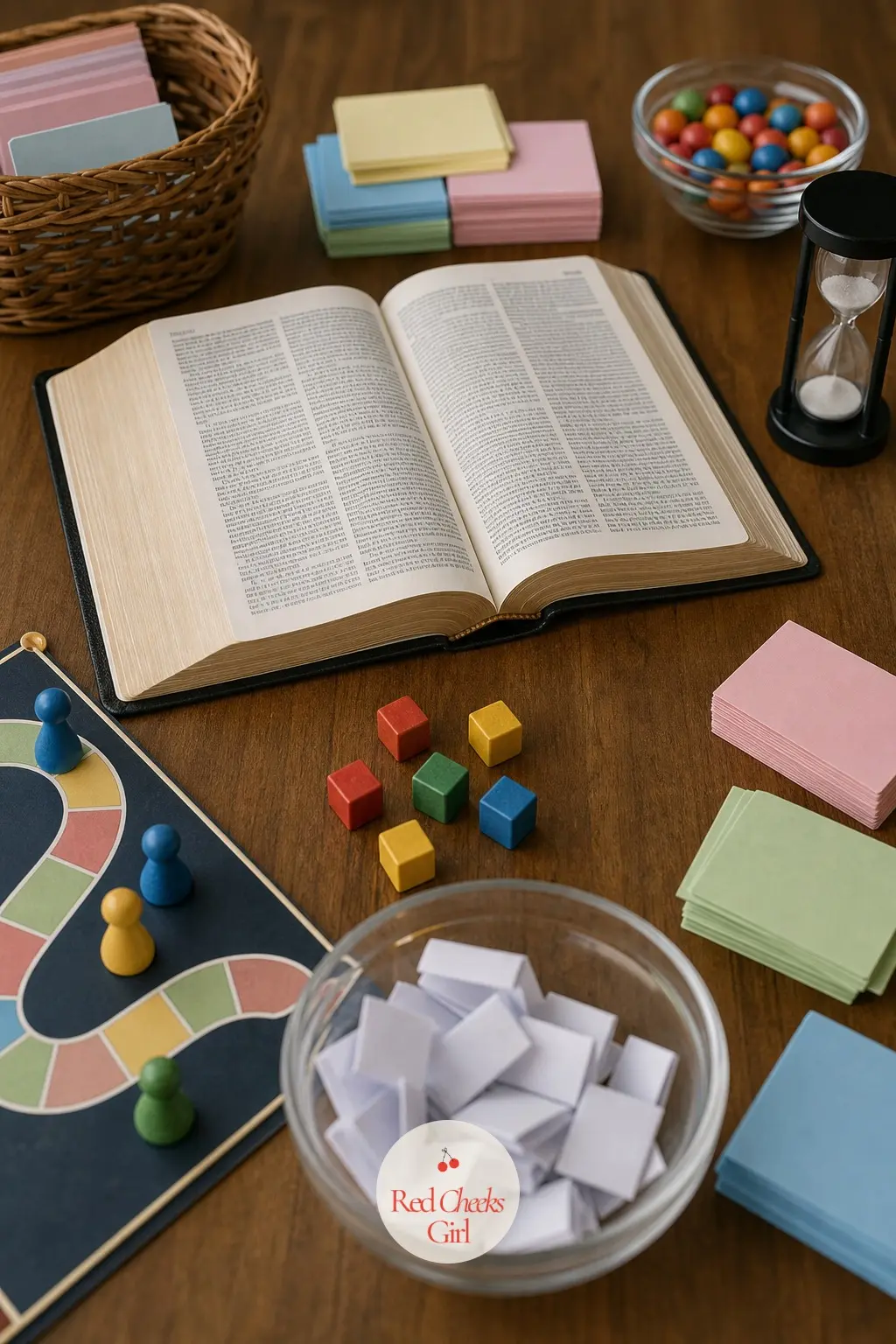
Within mixed-age teams, encourage families to assign questions strategically: let the children answer the stories-based questions first, then let adults tackle the more detail-oriented rounds. That division of labor makes every team member feel genuinely useful.
What prizes work well for a church Bible trivia night?
Keep prizes simple, meaningful, and non-competitive in spirit — the goal is celebration rather than status. Good options include devotional bookmarks, small journals, gift cards to a local bookshop, or custom certificates printed at home.
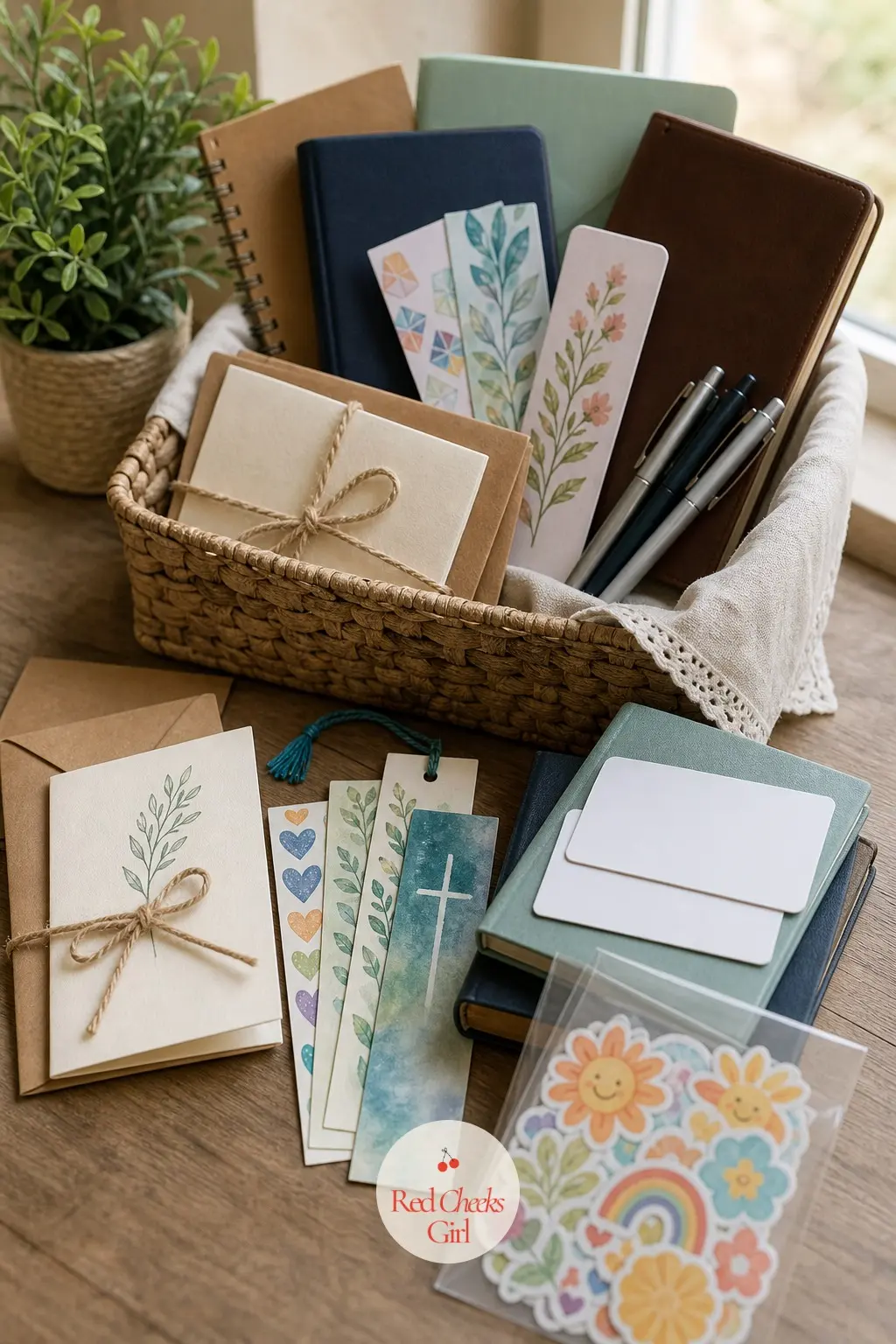
For children’s prizes, sticker packs, colorful bookmarks, or age-appropriate devotional books land particularly well.
If your budget is very limited, a hand-signed certificate of “Bible Trivia Champion” and the genuine applause of the room is more than enough — the recognition matters far more than the object.
How long should a full Bible trivia night last?
A complete evening using all twenty games in this article would run three to four hours, which is ideal for a lock-in or a dedicated church event night.
For a typical two-hour gathering, choose six to eight rounds from this list, including at least one printable question round, one physical or creative format, the Lightning Round, and the Team Score Sheet to tie everything together.
Always build in ten to fifteen minutes of buffer time — trivia nights almost always run longer than planned because the conversations they spark are worth having.
Can these games be used for homeschool families or small groups?
Absolutely. Most of these games adapt easily to groups of two to three families or even a single family playing together.
For very small groups, skip the team competition structure entirely and simply work through printable rounds together as a shared learning activity, pausing to discuss answers and look up passages together.
The Bible Charades, Bible 20 Questions, and Books of the Bible Relay all work particularly well with small groups because they don’t require the critical mass of a large crowd to generate energy.
📌 Save These for Later
Loved these? Pin your favorite image below so you can find this list again when you’re planning.
21 fun bible study games for small groups — printable sheets, trivia, discussion starters & more.
Christian christmas activities for kids that tell the nativity story through cutting, building and p

18 whole-evening youth group activities built from supermarket and church cupboard supplies, from a
Leave a Reply