


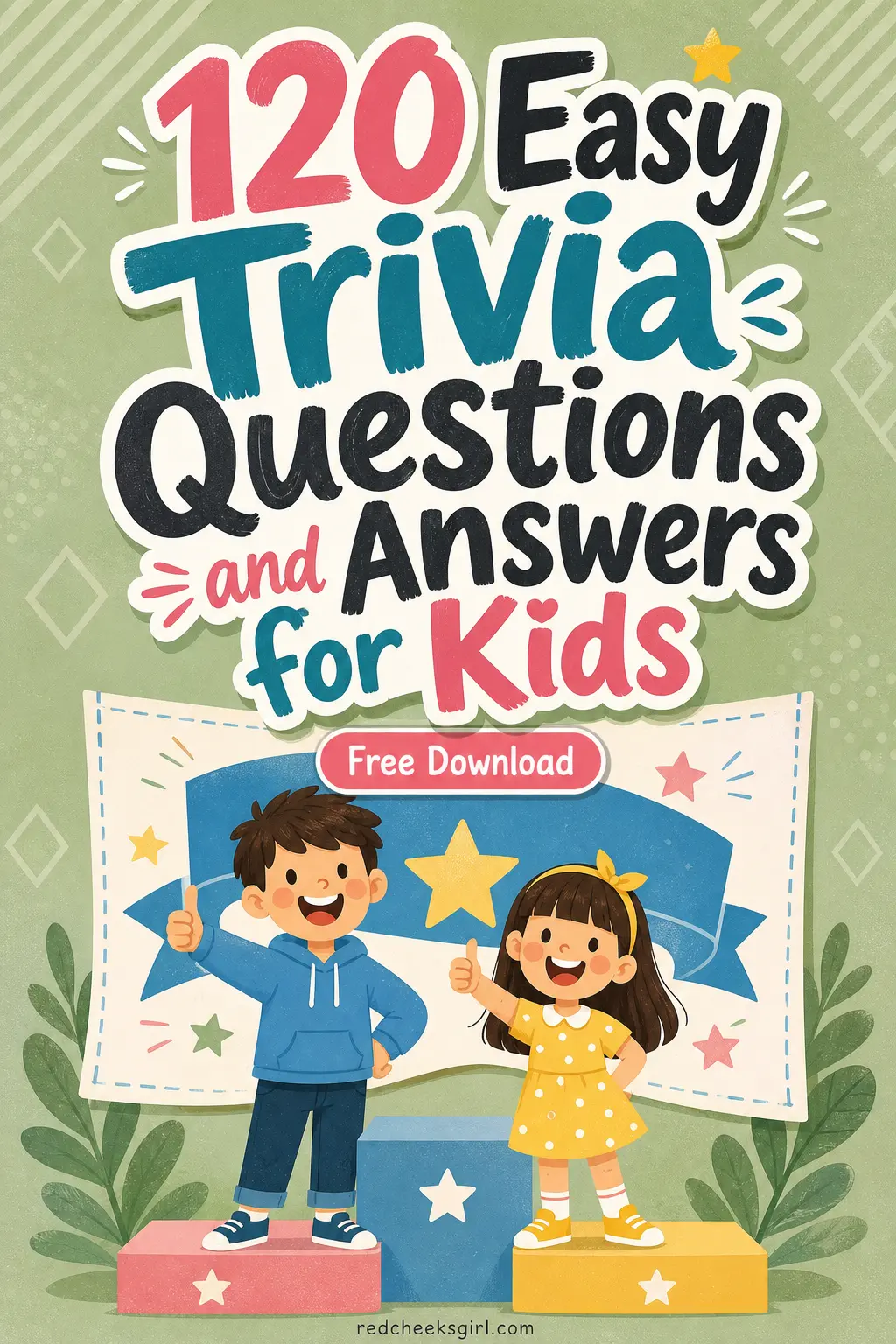
If you have been hunting for the ultimate set of trivia questions and answers for kids, you just found it — 120 questions sorted into six ready-to-play rounds covering animals, nature, our world, simple science, food, and fun facts. Whether you are hosting a cosy game night at home or turning a classroom afternoon into something memorable, this is the pack that does all the heavy lifting for you. Print the sheets, grab some snacks, and let the friendly chaos begin!
Affiliate disclosure: This post contains affiliate links. If you click through and make a purchase, I may earn a small commission at no extra cost to you — thank you for supporting this site!
This post contains affiliate links — if you buy through them, I may earn a small commission at no extra cost to you.
How to Play
Pick a host (the grown-up, the oldest kid, or whoever yells ‘me first!’ the loudest), divide everyone into teams of two to four players, and work through one round at a time. The host reads each question aloud from the Questions sheet — phones away, please — while teams jot their answers on a scrap of paper. When all 20 questions in a round are done, the host reads from the Answer Key sheet and teams swap papers to mark each other. Award one point per correct answer, tally the scores after all six rounds, and crown the Trivia Champion with something suitably dramatic (a paper crown works brilliantly, tbh). Ties? One sudden-death bonus question settles it fast.
Round 1: Animals
Kick things off with everyone’s favourite topic — the animal kingdom is full of surprises, and a few of these will definitely catch even the keenest nature lover off guard!
- What is the largest animal on Earth? – Blue whale
- How many legs does a spider have? – Eight
- What do you call a group of lions? – A pride
- Which bird is known for repeating words it hears? – Parrot
- What is the fastest land animal? – Cheetah
- Which animal carries its home on its back? – Tortoise (or snail)
- What is the only mammal that can truly fly? – Bat
- How many arms does an octopus have? – Eight
- What is a baby kangaroo called? – Joey
- Which animal is known as the ‘King of the Jungle’? – Lion
- What do caterpillars turn into? – Butterflies or moths
- Which sea creature has three hearts and blue blood? – Octopus
- What is a group of wolves called? – A pack
- Which animal has black and white stripes? – Zebra
- What is the tallest animal in the world? – Giraffe
- Which bird lays the largest eggs? – Ostrich
- What do you call a female deer? – A doe
- Which animal sleeps standing up? – Horse
- What colour is a polar bear’s skin under its fur? – Black
- What is the name for a baby swan? – Cygnet


🛍 Shopping guide
Round 2: Nature
From towering trees to rumbling volcanoes, the natural world is absolutely wild — and these questions prove it. Print these on a crafty afternoon and laminate them to keep forever!
- What do we call the process by which plants make their own food using sunlight? – Photosynthesis
- How many seasons are there in a year? – Four
- What is the name of the layer of gases that surrounds the Earth? – The atmosphere
- What type of rock is formed from cooled lava? – Igneous rock
- What is the tallest type of grass in the world? – Bamboo
- What do we call a scientist who studies earthquakes? – Seismologist
- Which part of a plant absorbs water from the soil? – The roots
- What is the name of the process when water turns into vapour and rises into the sky? – Evaporation
- What is the centre of the Earth called? – The core
- Which type of cloud is fluffy and white and looks like cotton wool? – Cumulus cloud
- What do we call a very long period with no rain? – A drought
- What is the name of the natural satellite that orbits the Earth? – The Moon
- What type of tree loses its leaves in autumn? – Deciduous tree
- What is the name for a river of ice that moves very slowly? – Glacier
- What do flowers use to attract bees and other pollinators? – Their colour, scent and nectar
- What is the name of the imaginary line that divides the Earth into the Northern and Southern hemispheres? – The equator
- What gas do plants breathe in that humans breathe out? – Carbon dioxide
- What is the name for the natural home of a wild animal? – Its habitat
- What are the tiny grains that flowers produce to help make new plants? – Pollen
- What do we call it when a caterpillar wraps itself in a cocoon and transforms? – Metamorphosis


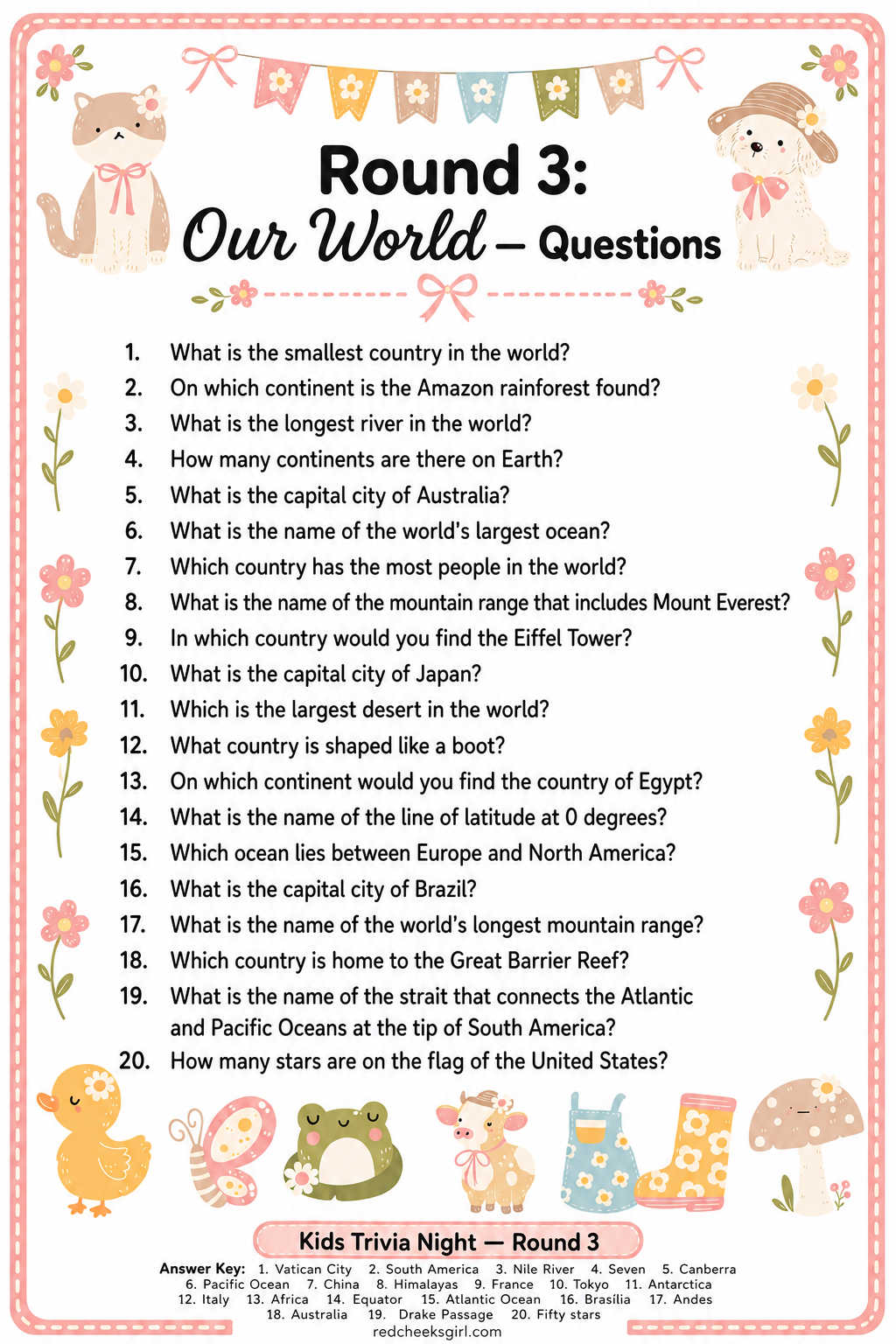
Round 3: Our World
Geography, countries, landmarks and oceans — this round is a mini trip around the world without leaving your seat, which is honestly the best kind of travel.
- What is the smallest country in the world? – Vatican City
- On which continent is the Amazon rainforest found? – South America
- What is the longest river in the world? – The Nile
- How many continents are there on Earth? – Seven
- What is the capital city of Australia? – Canberra
- What is the name of the world’s largest ocean? – The Pacific Ocean
- Which country has the most people in the world? – India
- What is the name of the mountain range that includes Mount Everest? – The Himalayas
- In which country would you find the Eiffel Tower? – France
- What is the capital city of Japan? – Tokyo
- Which is the largest desert in the world? – The Sahara Desert
- What country is shaped like a boot? – Italy
- On which continent would you find the country of Egypt? – Africa
- What is the name of the line of latitude at 0 degrees? – The equator
- Which ocean lies between Europe and North America? – The Atlantic Ocean
- What is the capital city of Brazil? – Brasília
- What is the name of the world’s longest mountain range? – The Andes
- Which country is home to the Great Barrier Reef? – Australia
- What is the name of the strait that connects the Atlantic and Pacific Oceans at the tip of South America? – The Drake Passage
- How many stars are on the flag of the United States? – 50

Round 4: Simple Science
No lab coat required for this round — just a curious brain and a willingness to guess boldly, because science is basically just asking ‘what if?’ and seeing what happens!
- What are the three states of matter? – Solid, liquid and gas
- What gas do humans breathe in to stay alive? – Oxygen
- What is the hardest natural substance on Earth? – Diamond
- What force keeps us on the ground and stops us floating away? – Gravity
- What does a thermometer measure? – Temperature
- What is the smallest unit of life? – A cell
- What planet is known as the Red Planet? – Mars
- How many planets are in our solar system? – Eight
- What is the chemical symbol for water? – H₂O
- What colour does a red cabbage juice turn when you add vinegar to it? – Pink or red (it is an acid indicator)
- Which planet is the largest in our solar system? – Jupiter
- What is the name of the force that makes a rubber duck float in a bath? – Buoyancy
- How many bones are in the adult human body? – 206
- What organ pumps blood around your body? – The heart
- What do we call a push or a pull on an object? – A force
- What is the name of the bright band of colours you see when light shines through water droplets? – A rainbow
- What is the process called when liquid water freezes and becomes ice? – Freezing (or solidification)
- What part of the eye controls how much light enters? – The pupil
- What is the unit we use to measure electrical power? – Watt
- What is the name of the closest star to Earth? – The Sun


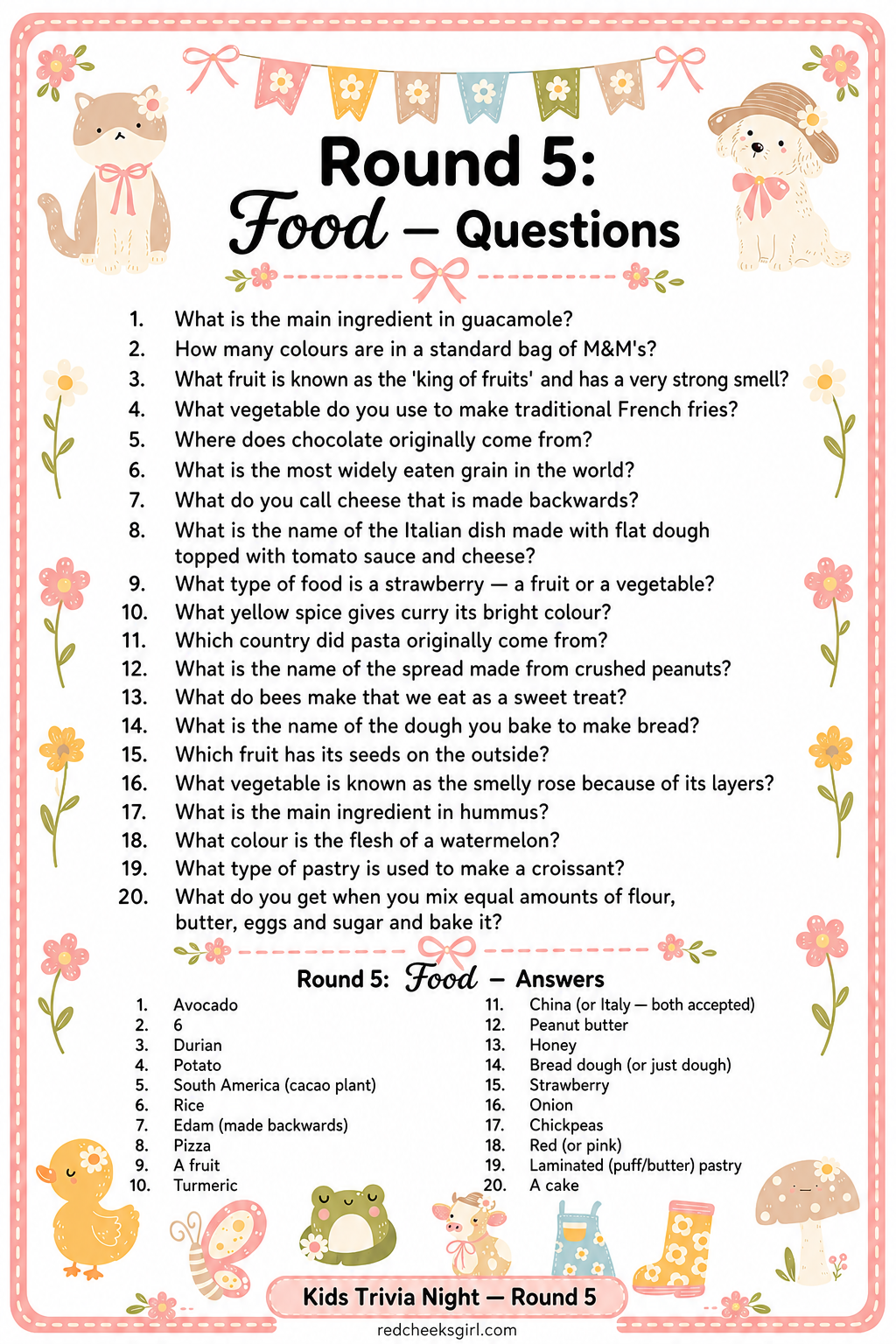
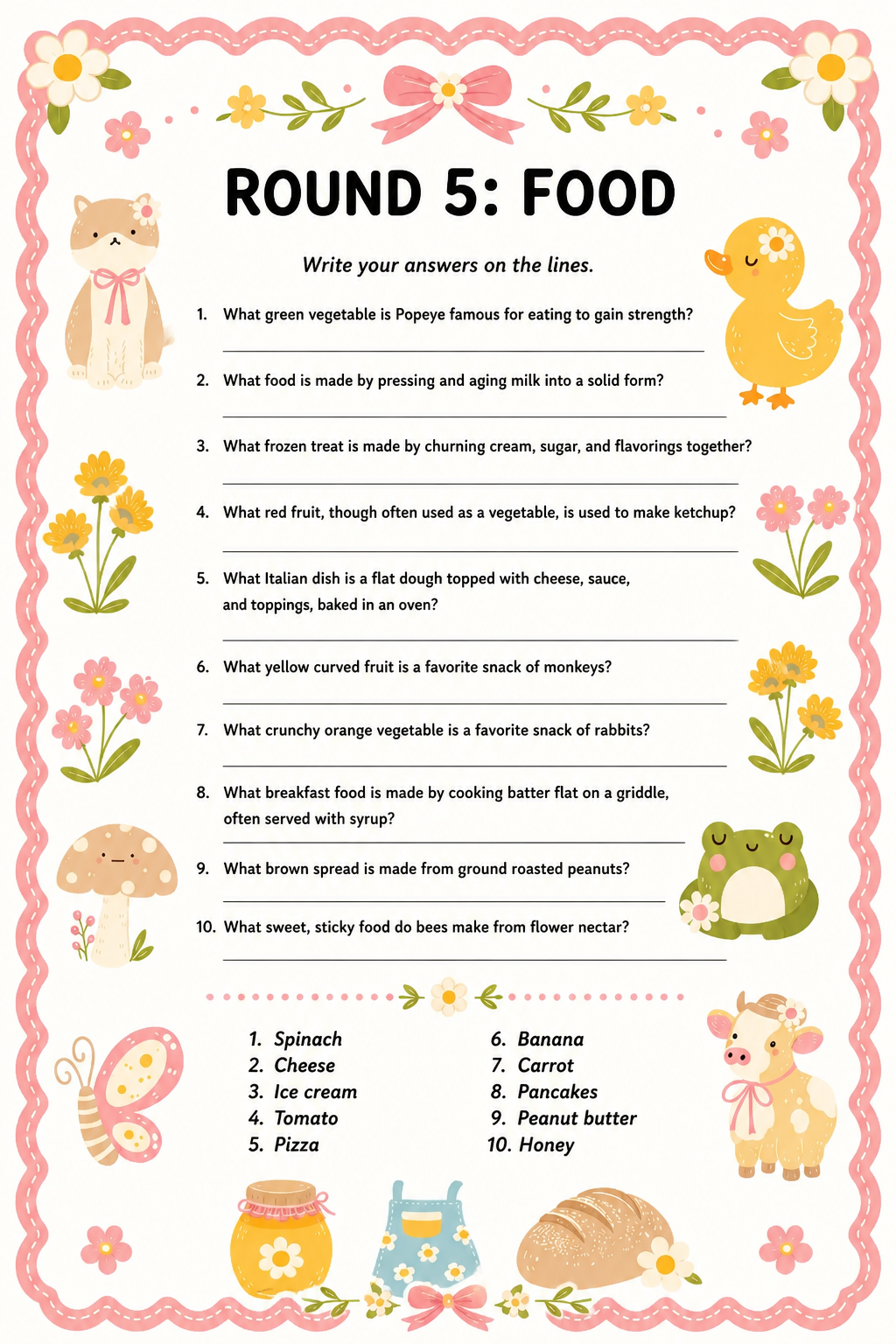
Round 5: Food
Warning: this round may cause sudden snack cravings — don’t say I didn’t tell you! If you love food-themed fun, you might also enjoy browsing our easy 5-minute breakfast ideas after the game.
- What is the main ingredient in guacamole? – Avocado
- How many colours are in a standard bag of M&M’s? – Six
- What fruit is known as the ‘king of fruits’ and has a very strong smell? – Durian
- What vegetable do you use to make traditional French fries? – Potato
- Where does chocolate originally come from? – Cacao beans (from the cacao tree)
- What is the most widely eaten grain in the world? – Rice
- What do you call cheese that is made backwards? – Edam
- What is the name of the Italian dish made with flat dough topped with tomato sauce and cheese? – Pizza
- What type of food is a strawberry — a fruit or a vegetable? – Fruit
- What yellow spice gives curry its bright colour? – Turmeric
- Which country did pasta originally come from? – Italy (though it has ancient Chinese roots — either answer scores a point!)
- What is the name of the spread made from crushed peanuts? – Peanut butter
- What do bees make that we eat as a sweet treat? – Honey
- What is the name of the dough you bake to make bread? – Bread dough (or yeasted dough)
- Which fruit has its seeds on the outside? – Strawberry
- What vegetable is known as the ‘smelly rose’ because of its layers? – Onion
- What is the main ingredient in hummus? – Chickpeas
- What colour is the flesh of a watermelon? – Red (or pink)
- What type of pastry is used to make a croissant? – Puff pastry (or laminated dough)
- What do you get when you mix equal amounts of flour, butter, eggs and sugar and bake it? – A cake
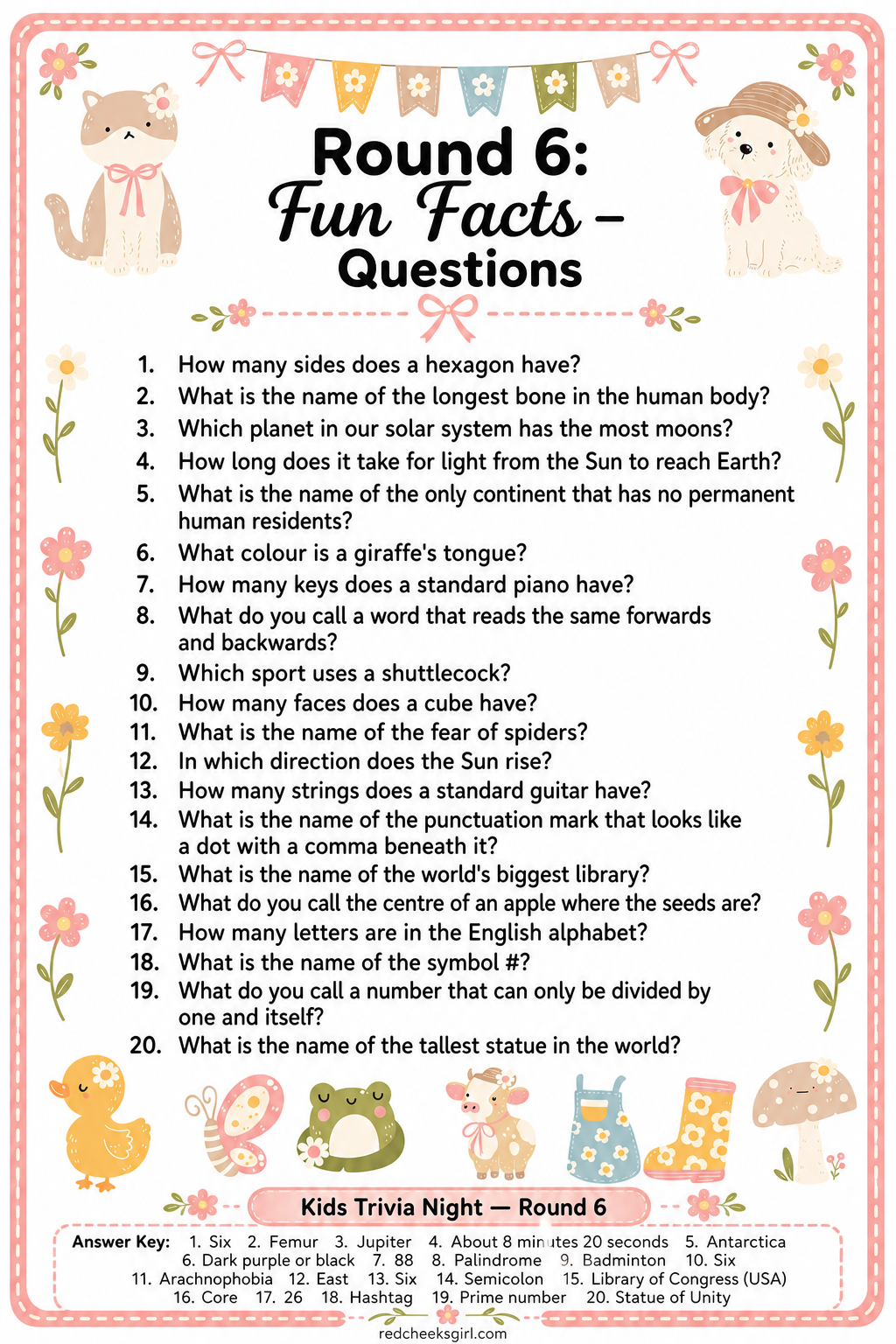
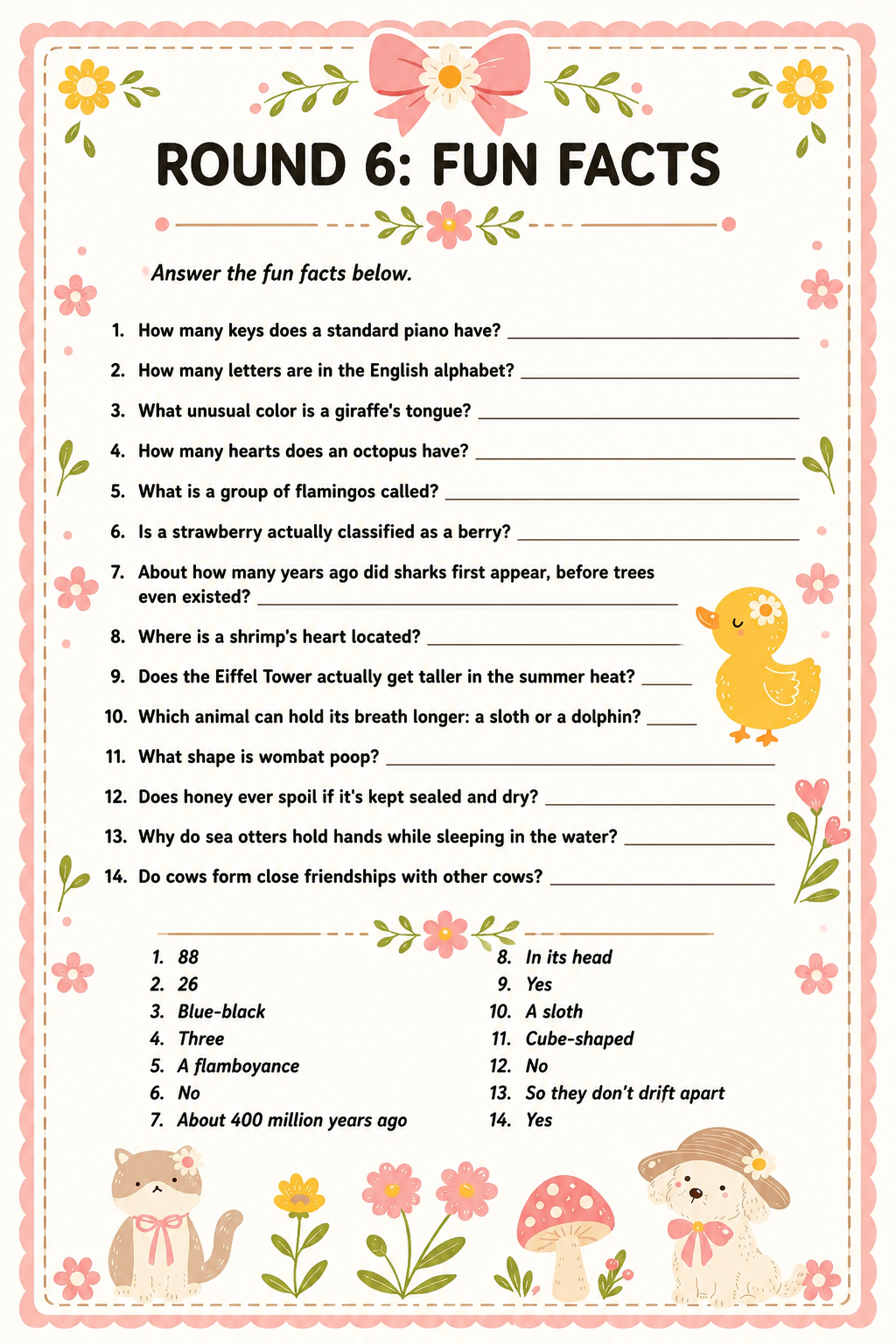
Round 6: Fun Facts
The final round is packed with the kind of random, mind-blowing facts that make you say ‘No way!’ — perfect for ending trivia night on a high note. If the kids want more creative printable fun to go with this pack, our scrapbook ideas guide is a great next stop for using up all that lovely cardstock!
- How many sides does a hexagon have? – Six
- What is the name of the longest bone in the human body? – The femur (thigh bone)
- Which planet in our solar system has the most moons? – Saturn
- How long does it take for light from the Sun to reach Earth? – About 8 minutes
- What is the name of the only continent that has no permanent human residents? – Antarctica
- What colour is a giraffe’s tongue? – Dark purple or blue-black
- How many keys does a standard piano have? – 88
- What do you call a word that reads the same forwards and backwards? – A palindrome
- Which sport uses a shuttlecock? – Badminton
- How many faces does a cube have? – Six
- What is the name of the fear of spiders? – Arachnophobia
- In which direction does the Sun rise? – The east
- How many strings does a standard guitar have? – Six
- What is the name of the punctuation mark that looks like a dot with a comma beneath it? – A semicolon
- What is the name of the world’s biggest library? – The Library of Congress
- What do you call the centre of an apple where the seeds are? – The core
- How many letters are in the English alphabet? – 26
- What is the name of the symbol ‘#’? – A hashtag (or pound sign or octothorpe)
- What do you call a number that can only be divided by one and itself? – A prime number
- What is the name of the tallest statue in the world? – The Statue of Unity (in India)
Frequently Asked Questions
How many questions are in this kids trivia pack?
There are exactly 120 trivia questions and answers for kids, split into six rounds of 20 questions each: Animals, Nature, Our World, Simple Science, Food, and Fun Facts.
What age group are these trivia questions suitable for?
These questions work best for children aged roughly 6 to 12, though younger kids can play in teams with an older sibling or grown-up, and older kids will still find the later rounds genuinely challenging!
How do I print the question and answer key sheets?
Print each Questions sheet on a separate piece of blank cardstock for durability. Print the matching Answer Key on a second sheet and keep it with the host. Laminate both sheets and clip them with a binder ring so you have a tidy, reusable trivia pack stored in a small tin.
How many players do I need to run trivia night?
Trivia works with as few as two players going head-to-head, but it really comes alive with teams of two to four people. A group of eight to sixteen players (two to four teams) is the sweet spot for friendly competition.
Can I use this as a classroom activity?
Absolutely — that’s exactly what this pack is designed for! Give each team a blank answer sheet, read the questions aloud, and use the Answer Key sheet to score quickly. One round fits neatly into a 15–20 minute lesson break.
What if two teams tie at the end?
Pick one sudden-death bonus question from any round, read it aloud, and the first team to write down the correct answer wins. Simple, fast, and gloriously tense!
📌 Save These for Later
Loved these? Pin your favorite image below so you can find this list again when you’re planning.

120 NYC and fashion trivia questions for girls night — 6 rounds, printable sheets and answer keys

120 family trivia questions and answers for all ages — 6 rounds, free printable sheets, and an ans

120 trivia questions and answers for seniors — 6 nostalgic rounds plus free printable question she
Leave a Reply