

If you have ever sat around a holiday table with older loved ones and watched their whole face light up the moment a familiar song came on — you already know the magic that senior trivia questions and answers can create.
There is something genuinely special about a well-placed question that unlocks a memory nobody knew they still had tucked away, and that is exactly what this collection is built around.
Whether you are planning a Christmas gathering, a New Year’s Eve dinner, or just a cozy winter get-together, these 20 memory and reminiscing games will give your group hours of laughter, stories, and the kind of warmth no Spotify playlist can manufacture.
And yes, if you are also shopping for the guest of honor, check out this guide on what to buy parents for Christmas — it pairs beautifully with a game night plan.
The lineup below mixes lively group games, gentle circle activities, and a seriously big stack of printable sheets — 13 in total — so guests can grab a pencil and play along at their own pace. Honestly, the printables alone are worth pinning this page.
Half the fun is spreading the sheets out on the table before anyone arrives and watching people gravitate toward the ones that call their name.
So grab a cup of something warm, scroll through, and pick your favorites — your holiday party guests are going to thank you.
This post contains affiliate links — if you buy through them, I may earn a small commission at no extra cost to you.
- Name That Tune
- Guess the Decade
- Memory Match Live
- Decade Trivia Sheet
- Reminiscing Circle
- Music Trivia Sheet
- Word Association Round
- Classic Film Trivia Sheet
- Memory Match Cards
- Guess the Year Sheet
- Picture Bingo
- Reminiscing Prompt Cards
- Proverb Finish Sheet
- Name the Classic Star Sheet
- This or That Sheet
- Would You Rather Sheet
- Category Lists Sheet
- Riddles Sheet
- Favorite Memory Share
- Life Story Prompt Circle
- Frequently Asked Questions
1. Name That Tune
Name That Tune is the ultimate icebreaker for a senior holiday party, and it never fails to get the room going within about thirty seconds flat.
A host or volunteer plays the opening five to ten seconds of a classic song — think holiday classics, golden oldies from the 1950s through 1970s, or iconic big-band numbers — and guests race to shout the title first.
The first person to name it correctly earns a point, and whoever racks up the most points by the end of the playlist wins a small prize. Keep rounds short and sweet so the energy stays high the whole way through.
To set it up, build a playlist in advance using a streaming service or YouTube, sorting songs into themed rounds: holiday carols, classic country, old Hollywood soundtracks, and classic rock.
Play through a laptop or Bluetooth speaker turned up nice and loud (this is not the time to be shy about the volume).
Write the song titles and artists on a separate answer sheet so the host can confirm correct answers quickly without stalling the momentum.
Teams of two or three work beautifully if the group is large, and they give quieter guests a comfortable way to join in without feeling put on the spot.
What makes Name That Tune such a reliable hit with seniors is the muscle memory involved — studies consistently show that musical memories are among the most deeply embedded we have, meaning even guests who struggle with other recall tasks will often surprise themselves by knowing the answer the moment they hear the opening notes.
For a fun variation, reverse the game: read out the artist and year, and have guests hum or sing the melody. The results are equal parts impressive and hilarious, and the laughter that follows is absolutely worth any off-key moments.
Print a simple scorecard so guests can track their own points — it adds friendly competition without any pressure.
🛒 What you’ll need
2. Guess the Decade
Guess the Decade is one of those games that sounds simple on paper but generates surprisingly passionate debate around the table — in the best possible way.
A host reads out a clue: a famous news headline, a pop-culture moment, a slang phrase, a best-selling product, or a notable event.
Players must decide which decade the clue belongs to, writing their answer on a slip of paper or calling it out in buzzer style.
The clues work best when they span the 1940s through the 1990s, hitting the eras your guests actually lived through and remember with genuine affection.
Prepare twenty to thirty clues in advance grouped by difficulty — start with easy softballs (‘Which decade saw man first walk on the moon?’) and build toward trickier cultural references.
If you want to keep it fully paper-free, write clues on index cards and hold them up one at a time. Award one point for the correct decade, and give a bonus point if someone can name the specific year.
You can also do a team format where each table collaborates on a single answer, which naturally sparks the kind of ‘oh wait, was that the sixties or seventies?’ conversations that are half the fun.
The beauty of Guess the Decade as a senior trivia questions and answers game is that it meets every guest exactly where they are.
Someone who grew up in the 1950s has an edge on those clues, while another guest might shine on questions from the 1980s — so the wins get spread around the table in a satisfying, inclusive way.
For a festive holiday spin, mix in a few holiday-themed clues: ‘Which decade saw the first televised Macy’s Thanksgiving Day Parade?’ or ‘When did Rudolph the Red-Nosed Reindeer first air on TV?’ Pure nostalgia gold.
- Groups of 4 to 20 players
- Mixed-age tables where multiple generations are present
- Holiday dinner parties with a competitive streak
3. Memory Match Live
Memory Match Live takes the beloved card-matching concept and turns it into a whole-room experience — no cards, no table, just people.
Before the party, write nostalgic words or images on large index cards in pairs: a vintage car brand and its logo description, a classic TV show and its catchphrase, a holiday carol and its opening lyric.
Shuffle all the cards and tape them face-down to a large board, a wall, or a folding table.
Players take turns flipping two cards and trying to find a matching pair from memory, calling their choices out loud so the whole room can follow along and (quietly) root for them.
Aim for twenty to thirty pairs, which gives you a satisfying game length without tiring anyone out.
Use large, clearly printed font on each card so every guest can read from their seat — this is one of those details that makes all the difference at a senior party (good lighting nearby helps too).
Organise the cards in a numbered grid so players simply call out two numbers rather than getting up and reaching.
A volunteer helper who physically flips the cards is a nice touch that keeps the game moving smoothly and gives someone a built-in helpful role at the party.
Why does Memory Match Live work so well beyond just being fun?
Because it gently exercises visual memory, focus, and recall in a completely social, zero-pressure setting — guests are cheering, joking, and gasping when a match is nearly found, rather than sitting in anxious silence.
For a holiday twist, theme the pairs around Christmas and winter: ‘Jingle Bells’ paired with ‘James Lord Pierpont’, ‘It’s a Wonderful Life’ paired with ‘1946’. The combination of friendly competition and nostalgic content makes this one of the warmest games on the list, tbh.
- Large index cards or cardstock
- Thick black marker for big, readable text
- Numbered sticky tabs for the grid
- A helper to flip cards during play
🛒 What you’ll need
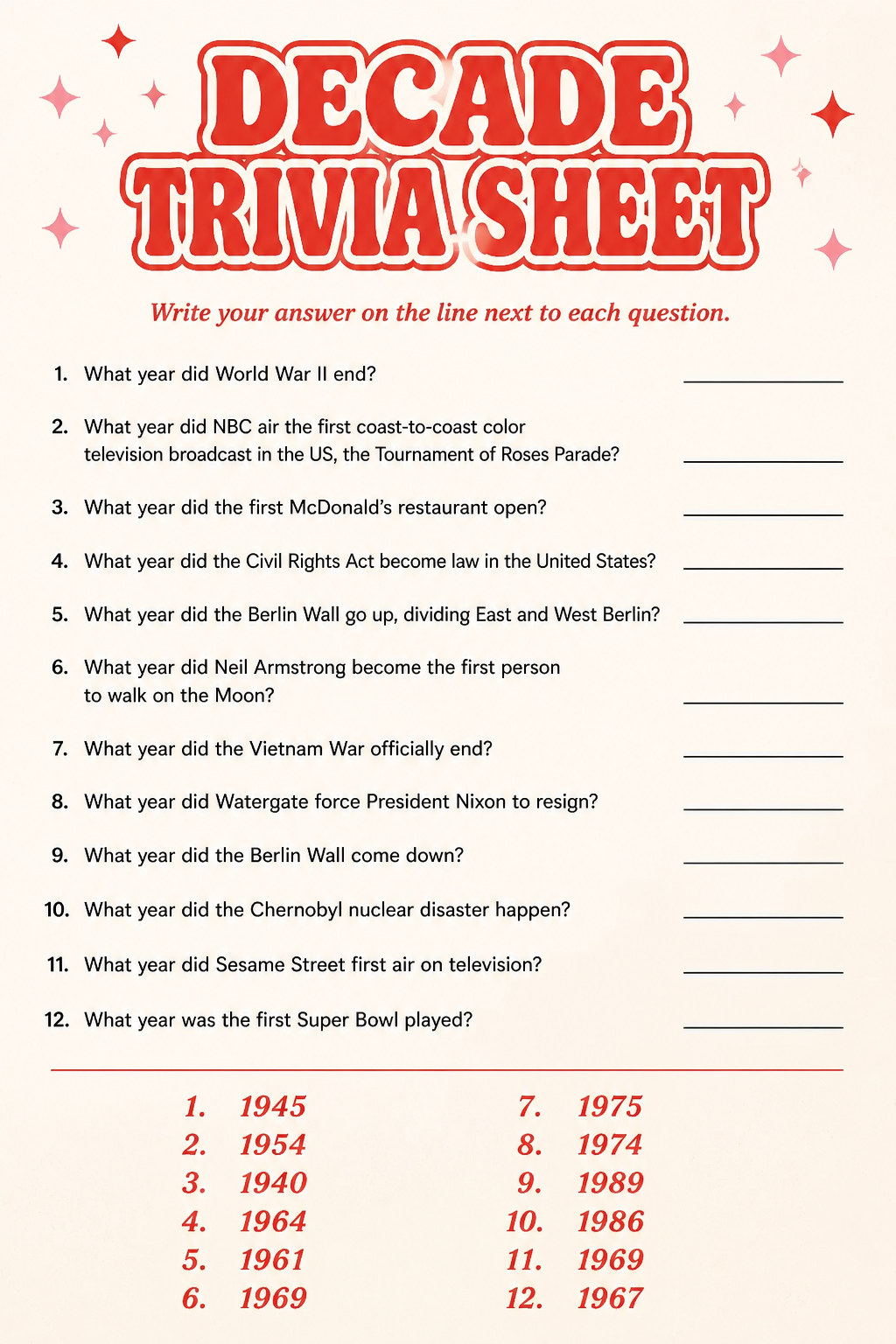
4. Decade Trivia Sheet
This is the anchor printable of the whole set — a proper sit-down senior trivia questions and answers sheet covering the decades your guests know best. The sheet features twenty questions arranged in four colour-coded rounds of five: the 1950s, 1960s, 1970s, and 1980s.
Questions span pop culture, music, film, news events, and everyday life, hitting the sweet spot between ‘easy enough to feel good’ and ‘tricky enough to make you think.’
Every guest gets their own sheet, works through it independently or with a neighbour, and then you go over the answers together as a group — which is when the real stories start pouring out.
Print the sheet double-sided on standard cardstock for a sturdy, handsome feel, and set out pencils or fine-tip pens at each place setting before guests arrive.
The answer key lives in small italic print at the very bottom of the sheet, so the host can confirm answers without having to look anything up mid-party.
If you are serving food, these sheets make wonderful table conversation-starters — guests can quietly work through a question or two while waiting for the next course, and nobody has to feel idle or awkward.
A huge part of what makes a printable trivia sheet land with seniors is the layout: generous font size, clear question numbers, and plenty of blank writing space so nobody is squinting and cramping their hand.
This sheet is designed with all of that in mind.
For an extra holiday-party touch, encourage tables to compare answers at the end and award a small ribbon or chocolate prize to whoever scored highest — but frame it as ‘the most experienced historian in the room’ rather than a competition, and you will get warm laughs instead of wounded pride.
Read the answers aloud after everyone has finished so the reveal becomes a group conversation, not just a score-check.
🛒 What you’ll need
5. Reminiscing Circle
Reminiscing Circle is a gentle, deeply enjoyable group activity that feels less like a ‘game’ and more like the best part of a dinner party — where everyone leans in and someone starts a sentence that sends the whole table down a wonderful rabbit hole.
Guests sit in a circle and the host draws a prompt card from a deck (you can use the Reminiscing Prompt Cards printable later in this list for a perfectly matched set).
Each prompt asks something open-ended and positive: ‘What is your favourite holiday tradition from your childhood?’ or ‘Tell us about the first car you ever owned.’
The speaker shares for a minute or two, and then the next person responds — either with their own memory or a follow-up question.
There are no right or wrong answers, no points, and no timer pressure. The host simply keeps things moving gently — if someone finishes and the group falls quiet, a light ‘Does anyone else remember something like that?’ almost always opens the floodgates.
Keep the prompt deck to fifteen or twenty cards so the game can wrap up in twenty to thirty minutes without anyone running out of steam.
Seat people comfortably, make sure drinks are topped up, and let the room do the rest — this one has a way of running itself once it gets going.
The reason Reminiscing Circle belongs at every senior holiday party is that it validates experience. Every guest has a story worth hearing, and this game makes space for those stories in a structured, unhurried way that a noisy trivia round simply cannot.
Research consistently shows that reminiscence activities support emotional wellbeing and social connection for older adults, and the holiday setting makes the memories feel especially warm and meaningful.
Plus — and this is the part nobody tells you — younger family members who are present often leave having learned something completely new about the people they love most.
- Smaller gatherings of 6 to 12 people
- Mixed generations where grandkids can hear family stories
- Post-dinner, when the pace naturally slows
6. Music Trivia Sheet
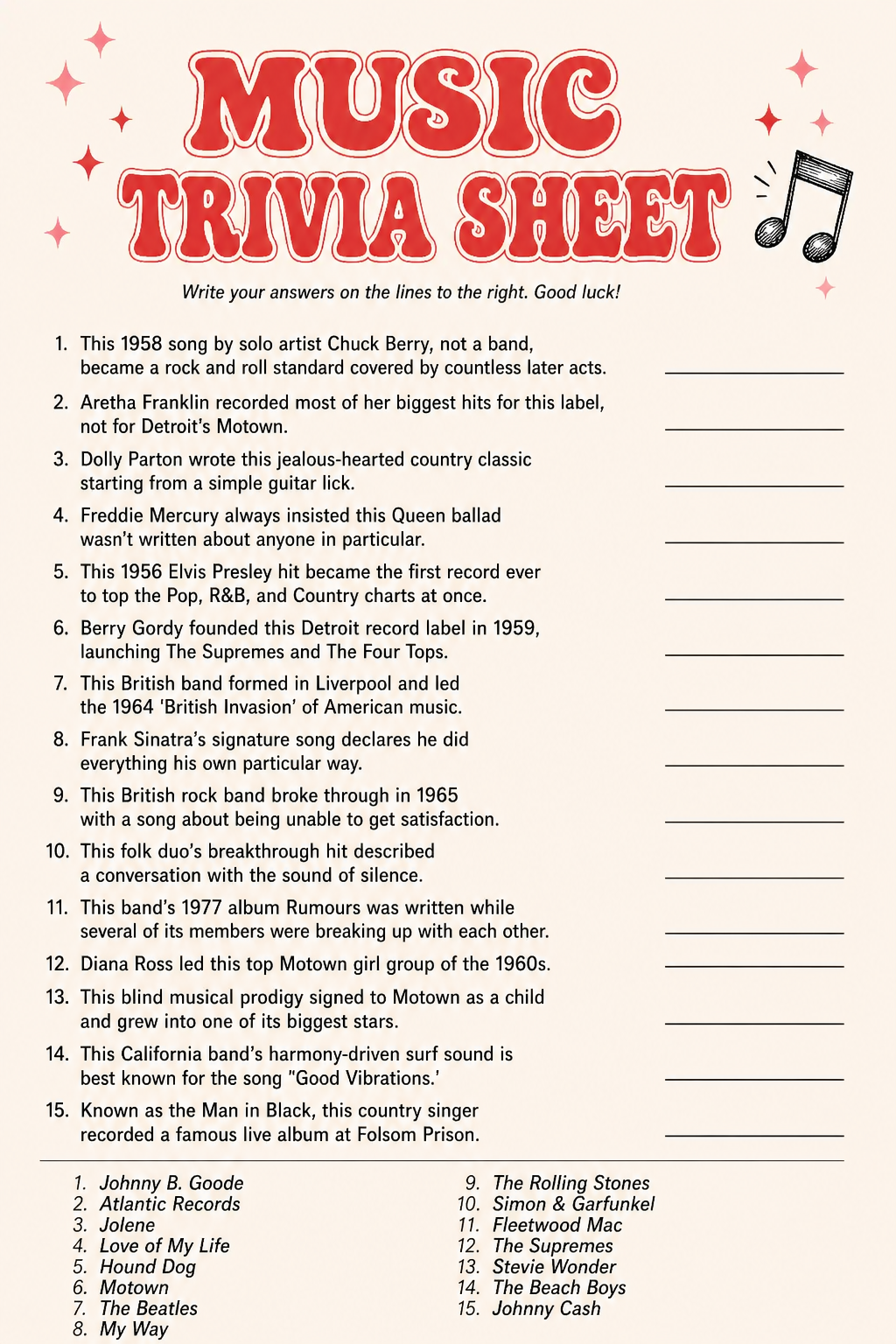
Music is the fastest shortcut to memory — which is exactly why this printable Music Trivia Sheet is one of the most popular items in the set.
It presents twenty music-focused senior trivia questions and answers covering classic artists, iconic albums, chart-topping singles, and memorable music moments from the golden decades of popular music.
Questions mix recognition (‘Who is known as the King of Rock and Roll?’), history (‘What year did The Beatles arrive in America?’), and lyric-based prompts (‘Finish the lyric: You ain’t nothin’ but a ____’).
The variety keeps every type of music lover engaged, whether they were a dedicated record collector or just someone who always had the radio on.
Each question has a clearly printed blank line for guests to write their answer, and the layout gives enough breathing room that nobody feels cramped.
The answer key sits in small italic text at the bottom of the sheet, out of eyeline during play but easy to check afterward.
This sheet works brilliantly as a standalone game, but it also pairs like a dream with the Name That Tune active game earlier in the party — use the audio round to warm everyone up, then hand out the sheets for a quieter, reflective follow-up.
Print one per guest plus a few extras; people always want to take them home.
For the host, the real gift of a printed trivia sheet is that it gives guests something to do with their hands during the naturally slower moments of a party — arriving, waiting for food, or settling in after a long journey.
Seeing everyone quietly bent over their sheet, occasionally mouthing ‘oh, I know this one’ to themselves, is honestly one of the coziest sights at a winter gathering.
Encourage guests to compare answers with their neighbour before the group reveal; the mini-debates that result are half the entertainment.
Musical memory is one of the most resilient forms of long-term recall, meaning even guests who struggle with other trivia categories often shine on music questions — boosting confidence and joy for the whole room.
7. Word Association Round
Word Association Round is quick, loud, and wonderfully unpredictable — the perfect palate cleanser between longer games.
The host calls out a nostalgic word or phrase (‘sock hop’, ‘drive-in’, ‘rotary phone’, ‘TV dinner’, ‘Christmas Eve mass’) and guests go around the circle as fast as they can, each saying the first related word that pops into their head without repeating anything already said.
If someone hesitates too long or repeats a word, they are gently out of that round. The last person standing wins the round, and a quick five-round game is more than enough to get everyone laughing.
Prepare a list of about forty starter words before the party, mixing everyday nostalgia, holiday vocabulary, and pop-culture references from the decades your guests remember most fondly. Keep the words warm and inclusive — nothing too obscure, nothing that might make someone feel left out.
If the group is large, split into two teams and run the rounds in parallel, with a neutral judge listening to each team and declaring a winner per round.
Smaller groups can play as one circle, which keeps the intimacy and makes the associations funnier when you can see everyone’s faces.
Part of what makes Word Association so delightful for a senior holiday party is the surprise factor: you never know what word will unlock a whole cascade of memories.
Someone says ‘tinsel’ and suddenly three guests are laughing about the year the cat ate the Christmas tree decorations in 1967.
That is the whole magic right there — this quick, zero-setup game somehow generates more spontaneous storytelling than almost any structured activity on the list. No materials needed, no prep beyond your starter word list, and it works with absolutely any group size.
Allow guests to pass once per round without penalty — it removes any anxiety about being put on the spot and keeps the energy warm rather than competitive.
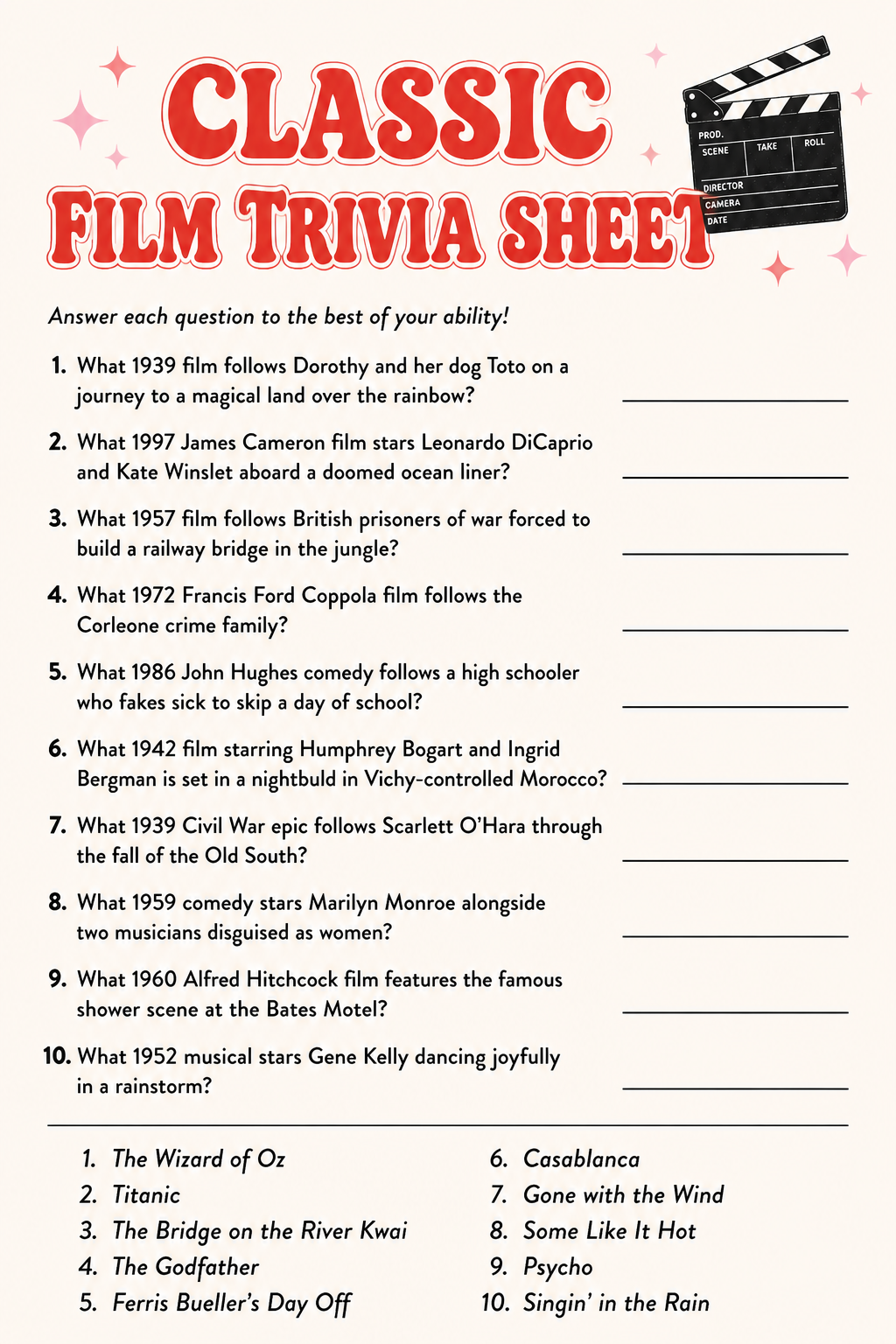
8. Classic Film Trivia Sheet
Hollywood’s golden age belongs to seniors in a way that no other generation can quite claim — they watched these films in the cinema when they first came out, argued about them at the diner afterward, and can still quote the lines decades later.
This Classic Film Trivia Sheet taps straight into that love with twenty questions about iconic movies, legendary directors, unforgettable performances, and memorable movie moments from the 1930s through the 1970s. Questions cover a range of difficulty: ‘What 1939 film followed Dorothy over the rainbow?’
sits alongside ‘Which director made Vertigo?’ so every guest has a moment to shine and a moment to be pleasantly stumped.
The sheet is formatted with numbered questions and a clear blank writing line after each one, making it easy to complete at the table or pass around the room.
An answer key in small italic text at the bottom lets the host check answers accurately without anyone peeking mid-game.
This sheet pairs especially well with the Name the Classic Star Sheet later in this collection — run the film trivia as a scored quiz first, then pull out the star-matching sheet as a bonus round.
Together they make a mini classic-Hollywood themed game block that film lovers will absolutely rave about.
One genuinely lovely hosting tip: after you go through the answers, invite anyone who wants to share a memory about the film to do so — ‘Does anyone remember seeing this one at the cinema?’
opens a door to stories that no trivia question alone can access. That blending of the game’s structure with unscripted personal storytelling is the real sweet spot for senior trivia questions and answers at a holiday party.
The printable does the work; the conversation is the reward.
After revealing answers, ask ‘Who saw this film at the cinema?’ — you will get wonderful stories and the trivia sheet becomes a conversation launchpad rather than just a quiz.
9. Memory Match Cards
This printable set turns the classic Memory Match game into something guests can take home and keep playing long after the holiday party is over.
The sheet features a grid of vintage-illustrated card pairs — twelve pairs in total, printed on a single US Letter sheet — covering nostalgic imagery that seniors will recognise and adore: a rotary telephone, a jukebox, a drive-in movie screen, a classic vinyl record, a bobby soxer silhouette, a milk bottle, a penny-farthing bicycle, a Christmas pudding, a snow globe, a transistor radio, a roller skate, and a retro television set.
Guests cut the cards apart, shuffle them, and play the traditional face-down matching game in pairs or small groups.
Print on cardstock rather than regular paper so the cards have enough body to shuffle and flip comfortably. A paper cutter gives the cleanest edges, but scissors work perfectly well too.
For longer-lasting cards, a quick pass through a home laminator is a wonderful upgrade — these make charming little gifts for guests to take home in a small envelope, especially for anyone who enjoys a gentle brain game between parties.
Include a simple instruction line at the top of the sheet: ‘Cut apart, shuffle face-down, find the pairs!’ — that is all the explanation anyone needs.
The printable Memory Match Cards work brilliantly as both an active table game during the party and a quiet solo activity for any guest who arrives early or prefers a calmer moment away from the group.
Unlike digital versions, physical cards have a satisfying tactile quality that resonates especially well with seniors — the act of reaching out, picking up, turning over, and finding a match is genuinely pleasurable in a way that clicking a screen never quite replicates.
Stack these sheets with the Decade Trivia Sheet and the Music Trivia Sheet for a full printable activity pack every guest will want to carry home.
Start face-up for one full look, then turn them over — this quick preview helps guests with memory challenges feel confident from the very first turn.

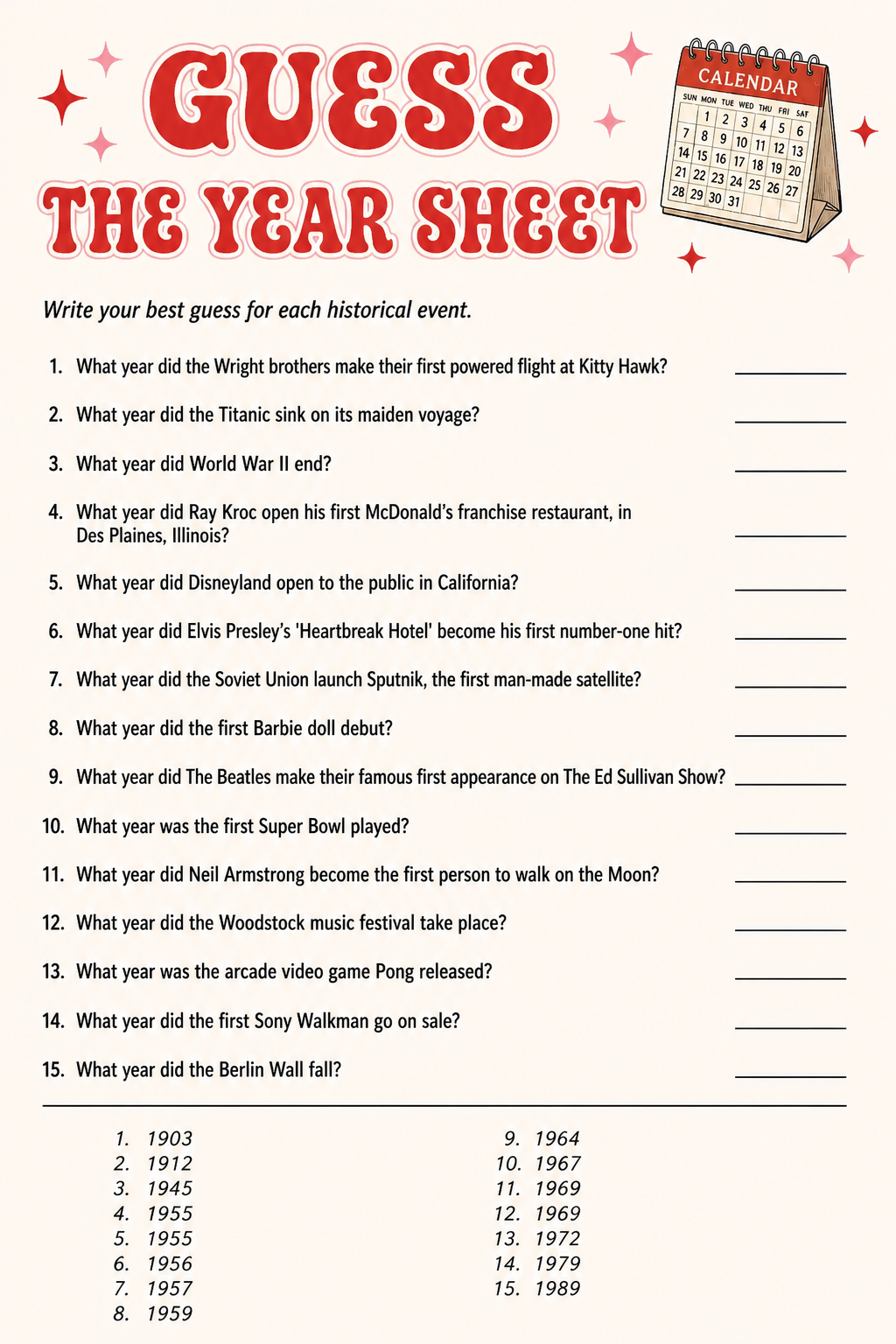
10. Guess the Year Sheet
Guess the Year Sheet is exactly what the title promises and so satisfying to play: each question describes a famous event, invention, film release, or cultural moment, and guests must write down the year they think it happened.
The trick is that every answer is a year, which removes the pressure of needing to recall a name or fact — guests just think about time, and their gut instinct is often right.
Questions range from ‘The first McDonald’s restaurant opened in San Bernardino, California — what year?’ to ‘Neil Armstrong walked on the moon — guess the year!’ with fifteen to twenty prompts in total covering a wide spread of decades.
The sheet is formatted with a short event description on the left and a blank line on the right for the guest’s year guess, giving it the clean look of a quiz answer sheet without feeling intimidating.
The answer key at the bottom lists each correct year next to its event number, so scoring is instant.
Award points for exact matches, and optionally give half-points for guesses within two years — that grace margin reduces frustration and keeps the game generous and fun rather than picky.
You can run this simultaneously with the Decade Trivia Sheet for a complete quiz-night feel, or use it as a standalone ‘table activity’ that guests work through at their own pace over dinner.
What makes Guess the Year so compelling as a senior trivia game is the ‘aha!’
moment that hits when someone who was quite sure an event happened in 1962 discovers it was actually 1958 — the resulting mini-debate (‘No, I remember it clearly, it was during the summer of…’)
is exactly the kind of warm, animated conversation this whole game night is built around. It sparks reminiscing without explicitly asking people to reminisce, and that indirect approach often draws out the richest stories of the evening.
Guessing a year feels low-stakes compared to recalling a name or title, so even guests who are shy about trivia lean in comfortably — which means everyone plays and everyone wins socially.
11. Picture Bingo
Bingo is already a beloved classic at senior gatherings, and this nostalgia-themed Picture Bingo takes the familiar format and makes it feel genuinely fresh and personal.
Instead of numbers, each square on the 5×5 bingo card contains a small vintage illustration: a record player, a rotary phone, a drive-in movie, a Christmas stocking, a sock-hop dance, a candy cigarette, a milk float, a home radio, an ice cream parlour, a telegram, and more.
The host draws a card or calls an item name, and guests mark their matching square with a coin, a button, or a small candy. First to get five in a row calls ‘Bingo!’ and wins a small prize.
The printable includes four unique bingo card layouts (so guests seated together have different cards and no two neighbours get Bingo at the same time), plus a separate caller-reference sheet listing all the images with their names, ready to be cut into individual calling cards.
Print on cardstock and hand out a small bowl of coins, dried beans, or wrapped holiday candies to use as markers — the candy markers always get a laugh when someone sneaks one into their mouth between turns (you did not hear that from me).
This sheet is ideally sized to sit comfortably at a place setting without crowding the table.
Picture Bingo is one of those games that works for absolutely every ability level in the room — the visual format means guests with any degree of word-recall difficulty can still participate fully and joyfully, which makes it one of the most inclusive options in this entire collection.
For a holiday party, theming the images with a mix of vintage everyday nostalgia and seasonal imagery (Christmas puddings, snow globes, carollers) gives the card a wonderfully festive feel that guests will want to keep as a little souvenir of the evening.
- Small counters, coins, or wrapped candies as markers
- A bowl or small bag to hold the calling cards
- A prize for the winner — a small treat or a festive keepsake works beautifully

12. Reminiscing Prompt Cards
These printable Reminiscing Prompt Cards are the gentle heart of the whole game night — a set of beautifully simple question cards that invite guests to share a memory, a feeling, or a favourite moment from their life.
Each card carries one open-ended, warmly worded prompt: ‘Describe the home you grew up in,’ ‘What holiday tradition do you look forward to most?’ ‘What song always takes you right back to your youth?’ ‘Tell us about your first job.’
‘What is the best meal you have ever eaten?’ The cards are designed to be drawn one at a time, either during the Reminiscing Circle game or set out in a basket for guests to pick at their leisure throughout the evening.
The printable sheet fits sixteen cards on a single US Letter page in a four-by-four grid, each card separated by thin cut lines.
Print on cardstock, cut them apart, and store them in a decorative box or a small gift bag on the table — it immediately becomes a conversation centrepiece that guests reach for organically, even before any game has officially ‘started.’
No answer key is needed because these are entirely personal, open-ended prompts with no right or wrong responses. Leave the cards blank of any names or personal details; the host simply distributes them and the stories do the rest.
What makes Reminiscing Prompt Cards so quietly powerful is the permission they grant. Many seniors are delighted to share stories but do not want to seem like they are dominating the conversation — having a card to hold gives them a natural, structured invitation.
And for family members who have always wanted to ask Grandma about her childhood but never quite knew how, these cards do the asking on their behalf.
Pair them with the Life Story Prompt Circle at the end of the evening for a beautiful, unhurried close to the whole celebration.
Set the basket of cards on the table before guests arrive — people will start picking them up and reading them as they settle in, which naturally starts conversations before any game officially begins.

13. Proverb Finish Sheet
There is a particular kind of delight in hearing an older adult finish a proverb before you have even gotten halfway through it — they just know, the way you know the words to a song you have not heard in forty years.
This Proverb Finish Sheet leans into that lovely phenomenon by presenting the first half of twenty classic English proverbs and inviting guests to complete them on the blank line provided. From ‘A stitch in time saves…’ to ‘Every cloud has a…’
to ‘The early bird catches the…’, the prompts are all well-known enough to feel achievable while still offering a few that make guests pause and think.
The layout is clean and generous: each proverb beginning occupies its own line with a clearly visible blank underline for the completion, and a small numbered list makes scoring easy if you choose to run it as a quiz.
The answer key at the bottom of the sheet lists the traditional completions so the host can compare answers — though part of the fun is that many proverbs have regional or family variations, and the gentle debate about ‘which version is correct’ is entirely welcome.
Print one per guest and set them out before the party, or hand them out as a focused five-minute activity between games.
Proverb Finish Sheet doubles as a light cognitive workout that feels zero percent like work — it is the kind of activity that leaves guests feeling sharp and pleased with themselves, which is exactly the tone you want for a senior holiday party.
For a festive bonus round, slip in a few holiday-flavoured sayings: ‘Make hay while the sun shines… but in December, make mulled wine while the…’ (okay, that one you can make up yourself). Your guests will groan and love it in equal measure.
Completing well-known proverbs activates long-term procedural memory, so even guests who find open-recall trivia challenging often nail these — which creates a genuinely confidence-boosting moment for the whole room.

14. Name the Classic Star Sheet
This one is pure joy for classic Hollywood and golden-era TV fans — a matching sheet where guests pair famous celebrity names on the left with their most iconic role or signature achievement on the right.
Think: Lucille Ball matched to ‘I Love Lucy,’ Humphrey Bogart to Casablanca, Audrey Hepburn to Breakfast at Tiffany’s, Frank Sinatra to the Rat Pack, Elvis Presley to Jailhouse Rock.
The Name the Classic Star Sheet features twenty pairings drawn from film, music, television, and sport across the mid-twentieth century, with a numbered column on one side and a lettered column on the other for easy matching.
The format is a classic two-column matching layout — names numbered 1 through 20 on the left, achievements or roles labelled A through T shuffled on the right. Guests draw lines or write the letter beside each number.
The answer key lives at the bottom in small italic print. This format works wonderfully because it gives guests a visual cue on both sides, so even if a name does not immediately ring a bell, seeing the achievement column often triggers the recognition.
It is collaborative memory rather than pure recall, and it suits a wide range of ability levels beautifully.
Name the Classic Star Sheet is a standout printable for a holiday party specifically because the names and achievements it features are genuinely beloved by the age group — these are not obscure trivia questions, they are cultural touchstones that guests feel a personal connection to.
When someone matches a name correctly and says ‘Oh, she was just wonderful — I saw that film three times at the cinema,’ the whole table benefits from that story. That is the real prize: not the points, but the conversation the sheet unlocks.
- Classic film and TV lovers
- Groups with a strong nostalgic streak for golden-era celebrities
- Works beautifully as a solo quiet activity or competitive team round

15. This or That Sheet
This or That is one of those delightfully simple games that somehow generates enormous amounts of laughter and reveals surprising things about people you thought you knew inside out. The sheet presents twenty pairs of nostalgic choices — ‘Elvis or The Beatles?’
‘Audrey Hepburn or Marilyn Monroe?’ ‘Summer holidays or Christmas?’ ‘Jukebox or radio?’ ‘Drive-in movie or cinema?’ — and guests circle or tick their preference for each one.
There are no right or wrong answers, which immediately takes away any competitive pressure and makes this the most relaxed, inclusive sheet in the whole printable pack.
Once everyone has finished, go through the sheet as a group and ask for a show of hands on each pairing — the splits are always more surprising than expected, and the good-natured defending of choices (‘How could you pick The Beatles over Elvis?!’)
becomes a running comedy throughout the rest of the evening. The sheet is formatted in a clean two-column layout with each ‘This’ and ‘That’ side clearly printed, and a bold dividing line or ‘OR’ between them.
Print one per guest, and leave a few blank lines at the bottom for pairs the host wants to add based on their specific group.
This or That Sheet is the ideal warm-up for a table that has not all met before — it gives guests an immediate, low-stakes topic of conversation, and the choices are nostalgic enough that seniors immediately have something personal and genuine to say about each one.
It also works beautifully as a post-dinner activity when people want to stay engaged but the energy for a full trivia round has mellowed.
This is the sheet that goes fastest at the table, so print a few spares — guests tend to grab extras for people they think should try it.
Add two or three personalised ‘This or That’ pairs specific to your group — inside jokes and shared memories make the sheet feel custom-made and guests absolutely love that extra touch.

16. Would You Rather Sheet
Would You Rather is the printable equivalent of a great dinner-party conversation — except someone has done all the heavy lifting of thinking up the questions in advance, so you just sit back and enjoy the delightful chaos.
This senior-friendly version keeps every scenario warm, nostalgic, and gently humorous rather than wild or uncomfortable. Think: ‘Would you rather attend a Frank Sinatra concert or a Beatles concert?’ ‘Would you rather spend a week in 1950s Paris or 1960s New York?’
‘Would you rather have dinner with Cary Grant or James Dean?’ The pairings are designed to feel genuinely tempting — two wonderful options, no bad choice — which is the secret to making Would You Rather feel celebratory rather than silly.
The sheet presents fifteen scenarios, each with a clear ‘Would You Rather…’ header and two options side by side, each with a small tick box for the guest’s selection.
Once filled in, guests share their answers one round at a time with the group, and the host tallies which option got more votes overall — the running count posted on a whiteboard or simply called out adds a satisfying communal dimension to what is otherwise an individual activity.
No answer key is needed; every choice is perfectly valid, and the conversations triggered by ‘Okay, but why would you pick…’ are the actual payoff.
Would You Rather Sheet is a particularly good fit for a holiday party because it invites guests to think about their favourite things and the life they have lived, but through a playful hypothetical lens that feels light and easy rather than weighty.
For a festive spin, include a few seasonal scenarios: ‘Would you rather spend Christmas Eve singing carols in the snow or curled up by the fire with a classic film?’ — honestly, I could not choose either, and that is exactly the point.
It is the kind of question that makes a whole table pause, smile, and then cheerfully argue for five minutes.
- Mixed-ability groups where everyone can participate equally
- Holiday dinners where the conversation needs a nudge
- Works beautifully alongside the This or That Sheet as a two-sheet conversation starter bundle

17. Category Lists Sheet
Category Lists Sheet is the most creatively engaging printable in the pack — the one that makes guests put down their eggnog and pick up a pencil with genuine focus.
The sheet presents eight themed categories, each with a prompt asking guests to list as many items as they can think of: ‘Name as many classic Christmas films as you can,’ ‘List every US President you can remember,’ ‘Write down every car model you can name from the 1950s,’ ‘Name every classic TV western you can remember.’
Each category has five to six blank lines for answers, giving a clear visual target without cutting anyone off who is really on a roll. Set a five-minute timer and let guests fill in as many as they can.
Once time is up, go around the table and have each guest read out their answers for one category at a time — the host keeps a tally of how many unique answers the group collectively produced, which adds a team-discovery element that feels joyful rather than competitive.
Guests regularly surprise themselves and each other (‘I cannot believe you remembered that one!’). The categories are chosen to span different areas of knowledge and personal history so every guest has at least one or two where they shine brightly.
Category Lists Sheet is cleverly versatile as a senior trivia questions and answers format because it asks for breadth rather than precision — guests do not need to recall an exact answer, just anything in the category, which dramatically lowers the stress barrier.
It works as a solo activity, a timed group sprint, or a collaborative team effort depending on how the host frames it. And the post-game conversation when everyone compares lists — ‘Oh, you wrote Bonanza! I completely forgot Bonanza!’
— is genuinely warm and animated in the best possible way.
- Set a five-minute timer
- Each guest fills in as many answers as possible per category
- Read lists aloud after time is up
- Count unique answers across the group for a collective team score

18. Riddles Sheet
A well-crafted riddle is one of the most purely satisfying puzzles there is — the moment the answer clicks, there is a little rush of pleasure that no trivia question quite matches.
This Riddles Sheet presents sixteen classic-style riddles pitched at a gentle, senior-friendly level: clever enough to make you think, warm enough that guessing wrong still feels fun. Riddles cover wordplay, logic, and gentle trick questions — nothing mean-spirited, nothing that requires modern pop-culture knowledge.
Examples: ‘The more you take, the more you leave behind. What am I?’ (Footsteps.) ‘I have hands but cannot clap. What am I?’ (A clock.) ‘What gets wetter the more it dries?’ (A towel.)
The sheet lists each riddle with a blank line beneath it for the guest’s answer, and the answer key is printed in small italic text at the very bottom of the page below a thin dividing line.
Guests can work through the sheet solo, challenge a neighbour to race them, or the host can read riddles aloud one by one as a group activity with hands-up answers — the sheet works equally well for all three formats.
Either way, the moment someone gets an answer and the rest of the table groans ‘Of course! Why did I not get that?’ is a guaranteed crowd-pleaser.
Including the Riddles Sheet in a senior holiday party game pack is a smart move because it engages lateral thinking rather than memory recall, which means it plays to a completely different cognitive strength than the trivia sheets.
Guests who find memory-based questions difficult often excel at riddles — and vice versa — so together the two formats ensure that everyone in the room has at least one sheet where they feel brilliantly clever.
That confidence boost is the real gift this evening is giving, wrapped up in a printable page.
Riddles engage lateral thinking rather than pure recall, so they complement the trivia sheets perfectly — together the two formats mean every guest has a category where they shine.

19. Favorite Memory Share
Favorite Memory Share is the softest, warmest activity in this entire collection — a gentle pause in the middle or end of the party where the room quietly gathers and each guest shares one favourite memory connected to the season or to the people in the room.
The host sets a welcoming tone by going first, sharing something brief and heartfelt, and then inviting each person around the circle to contribute if they wish.
Nobody is required to share, and passing is always welcomed with a warm smile — but in practice, once the first two or three stories come out, almost everyone leans in to share their own.
No materials are needed beyond perhaps a small talking prop — a vintage ornament, a family photo, or a wrapped holiday gift that guests hold while speaking, which gives nervous sharers something to do with their hands and signals whose turn it is.
Keep a gentle time suggestion of about two minutes per person so the activity flows without anyone feeling rushed.
If your group is large, use the Reminiscing Prompt Cards (from earlier in this list) to give each guest a written prompt to respond to, which makes the activity feel a little more structured without losing any of its warmth.
Favorite Memory Share works its quiet magic by reminding everyone in the room of something important: that the real reason to gather at the holidays is each other.
It brings the whole evening full circle — after the trivia sheets, the bingo, the riddles, and the laughter — to something genuinely tender.
Guests consistently say afterward that this was their favourite part of the night, which surprised them because it sounded the least like a ‘game.’ Sometimes the best games are the ones where nobody keeps score.
Go first and keep your share brief and warm — it sets exactly the right tone and shows guests that no story is too small or too ordinary to be worth sharing.
20. Life Story Prompt Circle
Life Story Prompt Circle is the beautiful, unhurried close to the whole evening — a quiet group activity where each guest answers one single prompt about their own life story, drawn from a curated set of cards.
Unlike the Reminiscing Circle earlier in the evening (which uses short nostalgic prompts and quick responses), this one invites a slightly longer, more reflective share — three to five minutes per person, with the room in comfortable listening mode.
Prompts are deeper and more personal: ‘Describe a moment in your life that changed everything,’ ‘What is the piece of wisdom you are most glad you learned?’ ‘What would you want the people in this room to know about you that they might not already?’
Prepare the prompt cards in advance using the same format as the Reminiscing Prompt Cards printable, or simply write five to eight prompts on index cards and place them face-down in a small box.
Each guest draws one card, takes a moment to think, and then shares when ready. The host gently timekeeper the shares with a soft ‘thank you so much’ to transition between speakers, and ensures the tone stays appreciative and unhurried.
Candles lit, music softly playing in the background, drinks warm — the atmosphere does a lot of the work here.
There is something quietly profound about ending a holiday party with Life Story Prompt Circle.
It acknowledges that the guests in the room carry extraordinary histories, earned through decades of living, loving, working, and showing up — and it gives those histories a moment of proper ceremony.
Families who have tried this activity consistently describe it as one of the most memorable parts of any gathering they have ever hosted. If you are looking for the one game on this list that will genuinely move people, this is it.
And if you are also searching for meaningful gift ideas to go alongside this evening, this Christmas gift guide for parents has some lovely, thoughtful picks that pair beautifully with a night like this.
- Small, intimate gatherings of close family or friends
- Post-dinner when the pace is slow and the room is warm
- Multigenerational groups where younger members can hear stories from older loved ones
Frequently Asked Questions
What are the best senior trivia questions and answers for a holiday party?
The best senior trivia questions and answers for a holiday party blend nostalgic topics — classic films, golden-era music, decade history, and holiday traditions — with familiar formats like multiple choice and fill-in-the-blank.
Aim for a mix of easy confidence-builders and a handful of trickier questions to keep everyone engaged.
The sheets in this collection (Decade Trivia, Music Trivia, Classic Film Trivia, and Guess the Year) are all specifically designed for this purpose and come with answer keys included.
How do I make trivia games accessible for seniors with memory challenges?
Choose visual formats (like Picture Bingo and Memory Match Cards), use large clear print on all sheets, and allow guests to work in pairs so nobody feels put on the spot.
Games like Proverb Finish and Riddles engage long-term procedural memory, which is often more intact than short-term recall — meaning guests who struggle with trivia questions can genuinely shine at those activities.
Always frame every game as celebratory rather than competitive, and make passing or skipping completely comfortable.
How many games should I plan for a two-hour senior holiday party?
For a two-hour party, plan four to six activities: one or two lively group games (Name That Tune, Guess the Decade), two or three printable sheets guests can work through at their own pace (Decade Trivia, This or That, Riddles), and one quiet closing activity (Favorite Memory Share or Life Story Prompt Circle).
Keep each game to fifteen to twenty minutes and allow natural conversation to flow between them — the reminiscing that happens between the structured games is often the best part of the evening.
Can these games work for a large group or a senior centre event?
Absolutely. Most of the printable sheets scale to any group size — simply print one per guest. For large groups, divide into tables of six to eight and have each table work through the sheets together, then share highlights with the room.
Games like Picture Bingo work especially well for large groups, while Name That Tune and Guess the Decade can be run as whole-room events with a microphone for larger venues.
Do I need to buy anything to run these games?
Most of the games in this collection require only printed sheets, pencils, and a pair of scissors. For Name That Tune you will need a speaker and a prepared playlist. Memory Match Live benefits from large index cards and markers.
Picture Bingo needs small counters or candies as markers. The shop lists on individual games point you toward anything worth purchasing — but the majority of the activities, especially the quiet and printable ones, are genuinely zero-cost beyond printing.
What is the best order to run these games during the party?
Start with an energetic icebreaker (Name That Tune or Guess the Decade) to warm the room up, then move into the printable trivia sheets during a natural pause like dinner or dessert.
Alternate between active games and quieter activities throughout the evening, and save the most personal, reflective games — Favorite Memory Share and Life Story Prompt Circle — for the end of the night when the room is warm, comfortable, and ready to slow down together.
📌 Save These for Later
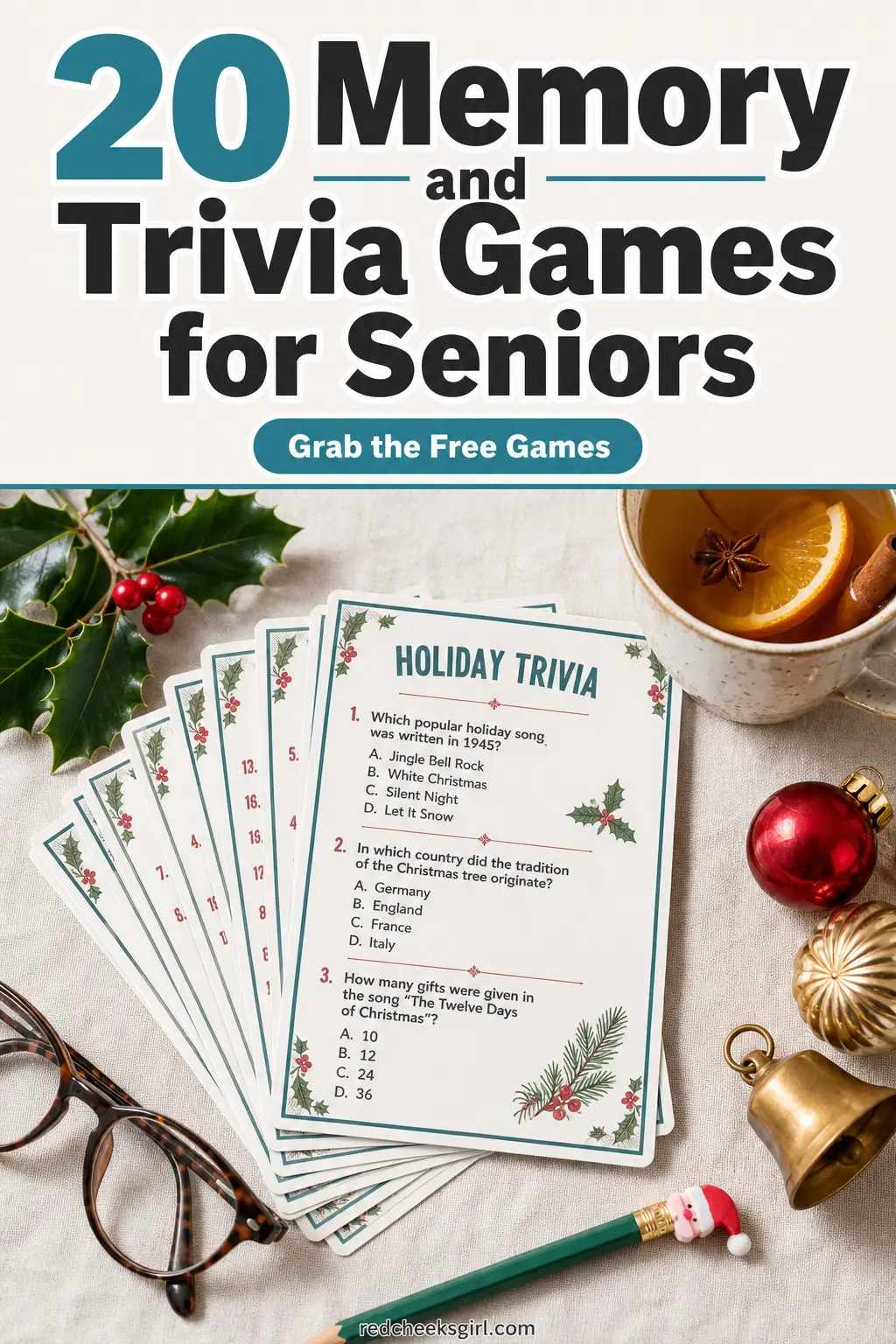
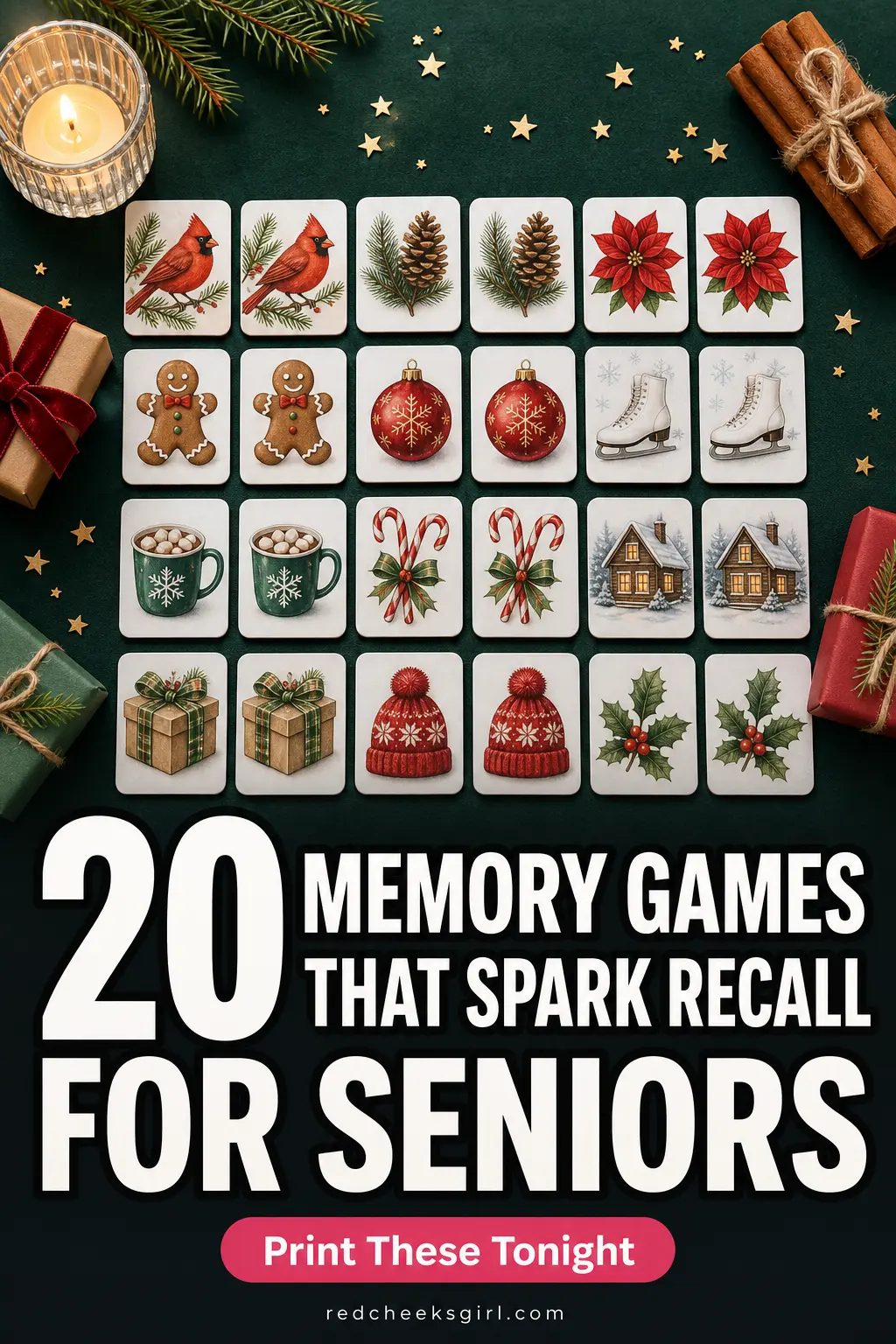
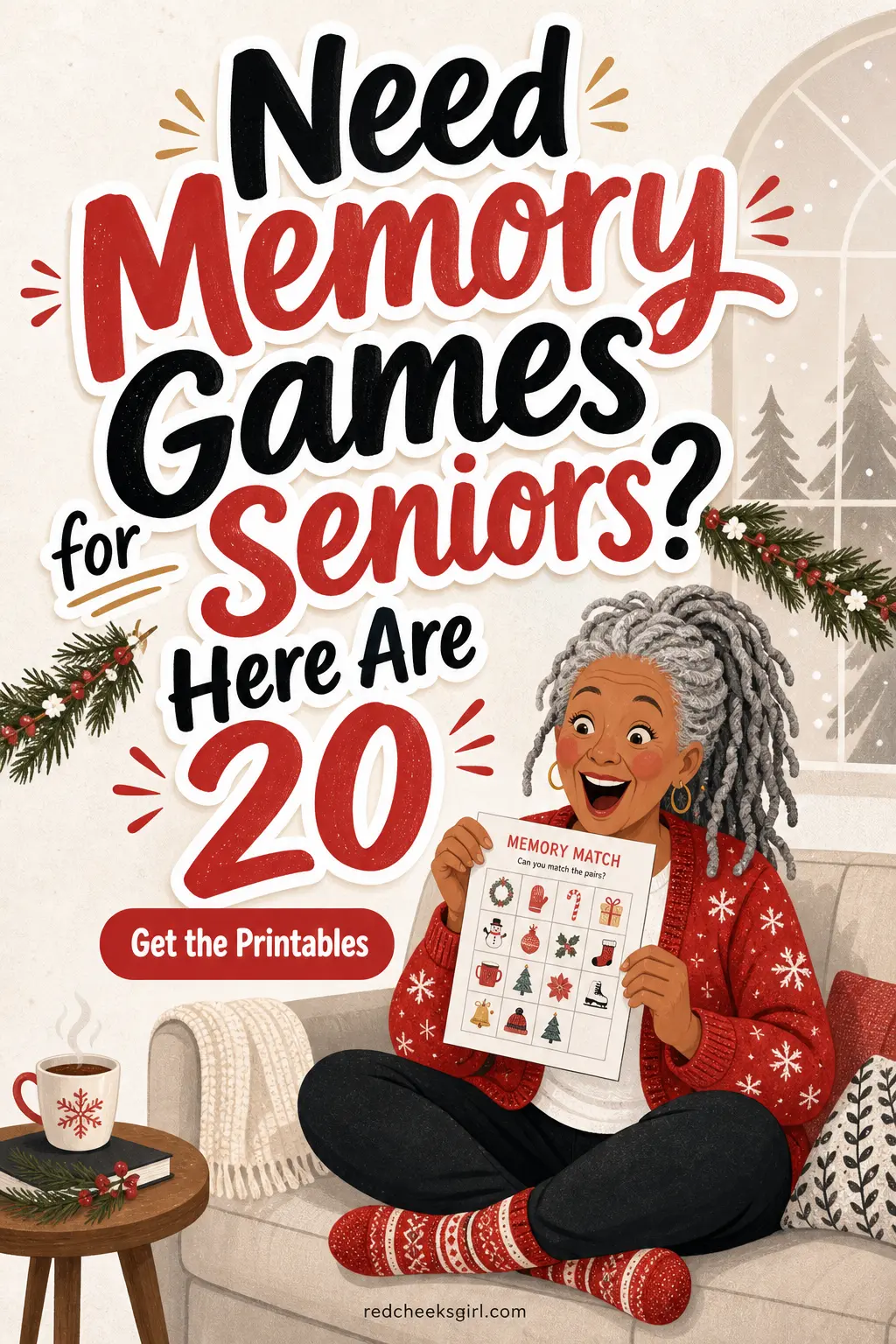
Loved these? Pin your favorite image below so you can find this list again when you’re planning.

72 crazy truth or dare questions sorted into 6 escalating rounds. Loud, absurd, printable cards incl

72 truth or dare questions for FaceTime that actually work on camera. Six rounds, printable card dec
18th birthday party ideas activities that run alongside the music, no awkward pauses. 10 free printa
Leave a Reply