


If you have ever hosted a dinner party and watched the conversation die somewhere between the main course and dessert, you already know the secret weapon every host needs: a handful of genuinely fun dinner party games that nobody has to stand up for.
No scavenger hunts around the living room, no charades poses with a glass of Merlot in hand — just seated, zero-mess fun that slides right in between courses like it was always part of the plan. That is exactly what this list delivers.
Every single game here is designed to be played right at the table, prop-free or paper-only, with food and wine already present.
Whether you are hosting an intimate holiday dinner or a big festive gathering (and maybe hunting for last-minute gift ideas for everyone on your list while you are at it), these 17 picks will keep the energy up, the conversation flowing, and the groaning to a minimum.
Mostly.
This post contains affiliate links — if you buy through them, I may earn a small commission at no extra cost to you.
- Two Truths and a Lie (Adults)
- Dinner Party Trivia
- Blind Wine Tasting
- Would You Rather (Dinner)
- Guess Who Said It
- Guess the Dish Sheet
- Table Topics Debate
- Conversation Card Deck
- Hot Takes Roundtable
- Guess the Secret Ingredient
- Dinner Trivia Card Deck
- Paper Plane Distance
- Unpopular Opinions
- Guess the Price Showdown
- Best Meal You’ve Ever Had
- Coin Spin Duel
- Dream Trip Share
- Frequently Asked Questions
1. Two Truths and a Lie (Adults)
Two Truths and a Lie is the dinner party game that has been earning its keep at tables for decades, and for very good reason — it requires absolutely nothing except a willingness to be mildly deceptive to your friends.
Each person around the table states three things about themselves: two are completely true, one is a carefully crafted lie. Everyone else listens, debates, and then votes on which statement they think is the fabrication.
The storyteller reveals the answer, someone is smugly right, someone is embarrassingly wrong, and the whole table erupts. Then the next person goes.
The adult version of this game really shines when you encourage guests to make their truths just as outrageous as the lie.
The more specific the detail — a real city, a real job mishap, a real semi-humiliating vacation story — the harder it is to tell what is invented.
A good host tip: do a quick mental warm-up round yourself before guests arrive so you have a truly devious lie ready to go. Nothing kills momentum like a too-obvious fib.
This is the perfect icebreaker game to kick off while everyone is still on appetizers because it does not require full attention and works naturally around a table where people are still arriving and settling in.
It also has a sneaky way of surfacing the most unexpectedly fascinating facts about people you thought you already knew well — which is honestly half the appeal. Play it early and you will spend the rest of dinner talking about what you just learned.
Go around twice — the second round, guests have to make their lie something plausible about the person to their LEFT, not themselves. Much harder, much funnier.
2. Dinner Party Trivia
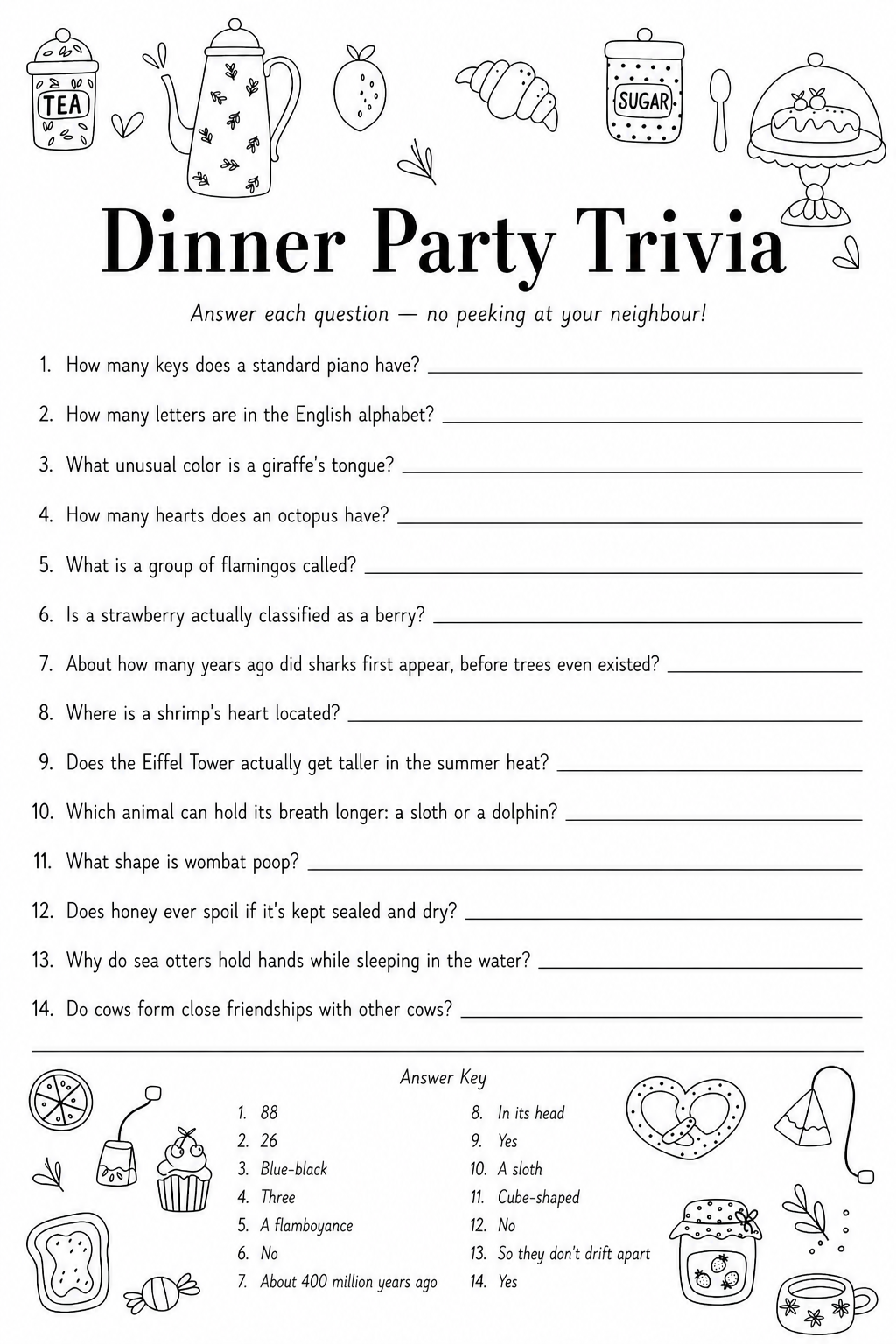
Dinner Party Trivia is the printable game that turns your table into a proper pub quiz — no pub required. Print one sheet per guest and let everyone answer 20 multiple-choice and short-answer questions spanning food and drink history, pop culture, geography, and general knowledge.
You can play individually or split into two teams, tallying points as you go. The host (that would be you) reads each question aloud, guests write their answers, and you reveal the correct ones after everyone has committed — no peeking!
Setup is genuinely effortless: print the sheets before guests arrive, tuck one under each place setting, and hand out pens when you are ready to play. Aim to run three to five questions between courses so it never eats into actual eating time.
The answer key lives at the bottom of the sheet in small italic text, so you can read it without announcing it to the whole table until the big reveal moment.
Trivia works brilliantly at holiday dinners because it gives guests something to focus on during the slightly awkward lull when you are in the kitchen sorting the next course — and it generates the best kind of table debate. (‘Wait, that cannot possibly be right.’)
Mix the categories so every guest has at least one question where they feel like the smartest person in the room. Your dinner party guests will genuinely thank you for this one.
- Groups of 4–10
- Holiday dinner parties and festive gatherings
- Playing across two to three courses
🛒 What you’ll need
3. Blind Wine Tasting
Blind Wine Tasting is exactly what it sounds like — and it is so much more fun than it sounds. The host wraps three to five bottles in brown paper bags or foil before guests arrive, labelling each one only with a number.
Guests pour and sip each numbered wine, jot quick notes (flavour, body, whether it tastes like ‘a forest’ or ‘a gas station slushie’) and then write down their best guess at grape variety, region, or price.
The big reveal at the end of the main course is genuinely one of the most satisfying moments a dinner table can produce.
The trick to making this work beautifully is to pick a focused theme rather than a random assortment — for example, three different price points of the same grape variety (a budget Pinot, a mid-range, and a splurge bottle), or red wines from three different countries.
That structure gives guests a framework for comparison rather than leaving them flailing. Keep the pours small — you are tasting between courses, not obliterating your palate for dessert. A notepad or the trivia sheet from this very list works perfectly for jotting impressions.
What makes this game so brilliant at a holiday dinner is that it generates genuinely passionate debate without anyone needing to know much about wine at all. In fact, the guests who claim to know nothing often guess best, which delights them to no end.
‘People are fascinated by blind tasting because they see it as a parlor trick,’ and honestly, let them think that — the mystique is half the fun.
End the round by revealing prices: the moment guests discover their favourite bottle cost less than a fancy cocktail is priceless.
- 3–5 bottles of wine wrapped in foil or brown paper bags
- Numbered labels (1, 2, 3…) for each bottle
- Small notepads or scrap paper for tasting notes
🛒 What you’ll need
4. Would You Rather (Dinner)
Would You Rather is a dinner table classic, and the Dinner Edition takes it somewhere genuinely interesting by keeping every question food, travel, lifestyle, or holiday themed — so it never accidentally derails into territory that kills the festive vibe.
Each guest gets a printed sheet with 15 ‘Would You Rather’ prompts, they circle their answers individually, and then the host reads each one aloud and everyone reveals their choice at the same time. Instant conversation. Instant mild outrage. Perfect.
The magic of having a printed sheet rather than just asking questions verbally is that guests can read ahead, secretly agonise over their choices, and feel genuinely committed before the reveal — which makes their reasoning so much more entertaining to hear.
Tuck the sheets under dessert plates so they double as a between-courses activity when the main has been cleared.
The questions work especially well at holiday dinners because you can layer in festive scenarios: ‘Would you rather cook the entire Christmas dinner solo or wash up every single dish alone?’
Why it works at a seated dinner: nobody has to move, there is no right answer, and even the quietest guest at the table suddenly has an opinion they will defend vigorously.
(Tbh, watching someone passionately justify why they would rather eat only one food forever is the best entertainment money cannot buy.)
This is also a great game to run in parallel with dessert since it requires zero mental overhead — just fork in one hand, pen in the other.
Zero prep time beyond printing, and the debate it sparks outlasts the game itself by at least two courses.

5. Guess Who Said It
Guess Who Said It is one of those dinner party games that sounds simple right up until you realise you have absolutely no idea which of your friends said something completely unhinged.
Before dinner, the host sends each guest a text or email asking for one anonymous confession, opinion, or outrageous fact about themselves — think ‘I have never eaten a salad voluntarily’ or ‘I once got kicked out of a karaoke bar in Tokyo.’
Collect all the submissions, print or read them at the table, and let everyone try to match the quote to the person. The group debates, points fingers, and usually gets it gloriously wrong.
Running this game is almost no effort on the night itself — the prep happens via a group text a few days before, and the host simply compiles and numbers the submissions.
You can read them aloud one by one, giving the table sixty seconds to debate before revealing the answer, or hand out a simple list and let everyone guess all at once before a big group reveal. Either format works beautifully between courses.
The reason this game hits differently from other icebreakers is that the quotes are real. They come from actual people sitting at the table, which means every reveal is followed by a story, an explanation, or a defensive ‘okay, hear me out.’
Long-time friends discover things they never knew; newer guests get fast-tracked into the group’s history. It also quietly rewards the funniest and most self-aware people at the table, which is always satisfying.
Plus, you get to watch someone try to maintain a poker face when their wildest secret is being read aloud. Excellent television.
Collect submissions at least two days before dinner so you have time to remove anything that might make things awkward between specific guests — you know your crowd best.
6. Guess the Dish Sheet
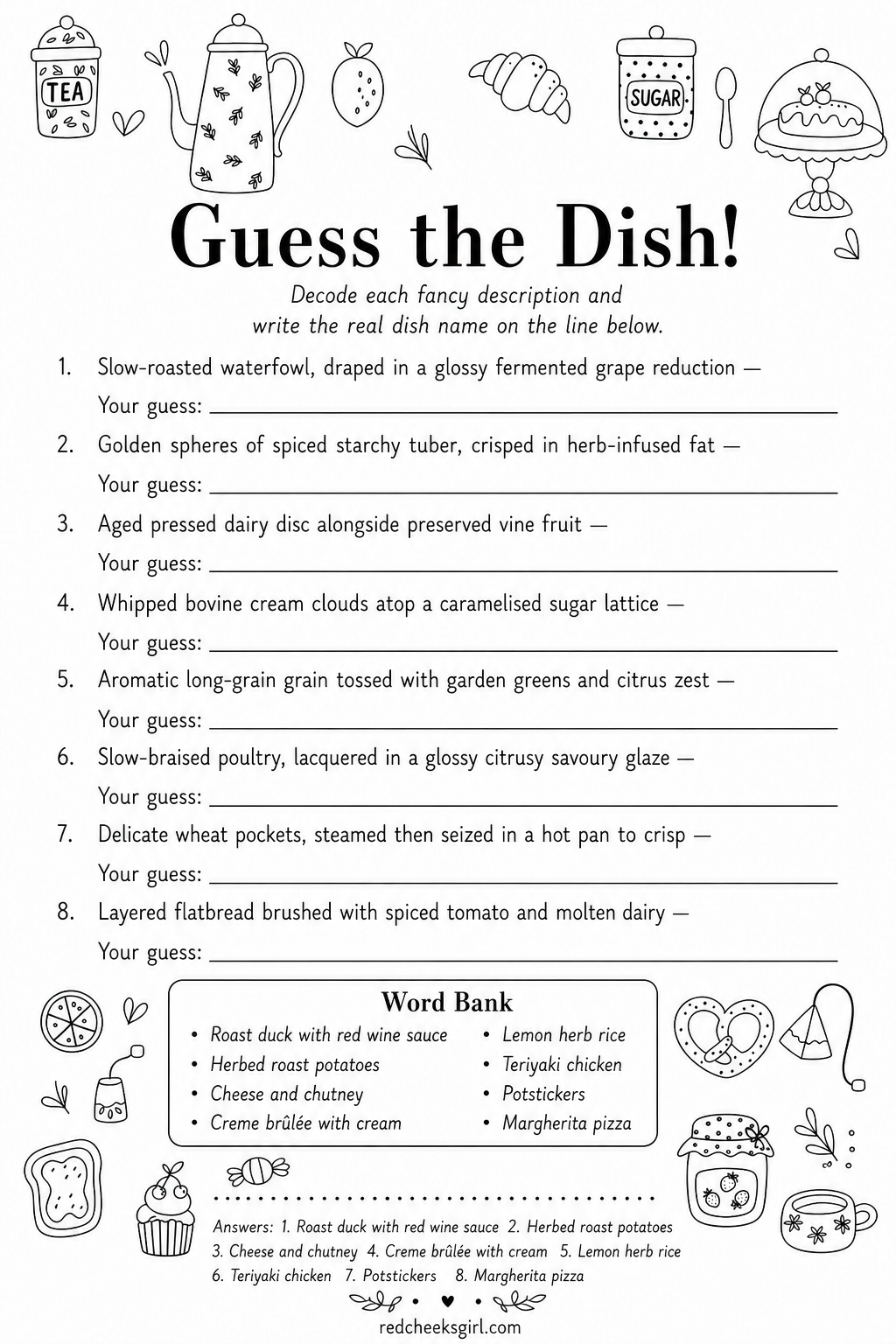
Guess the Dish Sheet is a printable game that turns your own menu into the entertainment — and it is honestly one of the cleverest dinner party games for the host because it does double duty as a conversation piece and a menu reveal.
Before guests arrive, you print one sheet per person.
Each sheet lists the night’s dishes with their key ingredients scrambled or described in cryptic, poetic, or overly dramatic language — think ‘slow-kissed stone fruit draped in fermented grape reduction’ instead of ‘roast duck with red wine sauce.’
Guests try to decode what they are actually eating before the dishes arrive.
To set it up, write your menu descriptions in deliberately fancy or misleading language — the more ridiculous the better — and create a fill-in-the-blank section where guests write their best guess at each dish’s real name.
You can theme the descriptions to match your dinner vibe: ultra-formal and pretentious for comedic effect, or cryptic and ingredient-focused as a genuine culinary puzzle.
Place the sheets at each setting before guests sit down so they can study them before the first course even lands.
This game is particularly wonderful at holiday dinners because it builds anticipation for the meal itself, and guests who guess correctly feel genuinely smug in the best possible way.
It also gives the host a brilliant excuse to show off the menu without it feeling like a brag — you are just playing a game. (Totally.)
As a bonus, guests who are foodies will love debating their guesses aloud, which fills any lull between courses effortlessly. Print on nice cardstock and it doubles as a keepsake menu.
Offer a word bank at the bottom of the sheet listing all the real dish names in shuffled order — guests match rather than freeform guess, which keeps the pace light.
🛒 What you’ll need
7. Table Topics Debate
Table Topics Debate is the dinner party game for the group that loves a good argument — the fun kind, not the Thanksgiving kind.
One person (or the host) reads a juicy but low-stakes debate topic aloud, and the table splits organically into two sides to defend their position for two minutes each.
Topics can range from the genuinely divisive (‘Pineapple belongs on pizza: defend or destroy’) to the surprisingly philosophical (‘Is a hot dog a sandwich?’) to the festive and seasonal (‘Is Die Hard a Christmas movie?’).
The ‘winning’ side is voted on by anyone who stayed neutral.
The host does not need to prepare anything formal — just a list of ten or so topics written on your phone, or you can pull them spontaneously from the moment.
A simple timer (your phone works perfectly) keeps rounds snappy, ideally two minutes per side maximum. The key is choosing topics with genuine split opinion in the room, which you can calibrate by starting with a safer food debate before moving into anything more spicy.
Keep alcohol nearby; it helps.
What makes this game work so brilliantly at a seated dinner is that debaters do not have to move or perform — they just talk, which is what dinner guests are already doing.
The structured format (argue THIS side for two minutes) actually liberates quieter guests who might not spontaneously hold court, because suddenly they have a role and a position.
Some of the most reserved people at a table become the most passionate debaters when given a prompt to anchor them.
Speaking of passionate debates — if the conversation turns to budgeting for the holidays, maybe send them to our best tips for budgeting for Christmas afterwards.
Prepare 10 debate topics in advance and rank them from safest to spiciest — start with food debates and save the ‘Is gift-giving about the giver or receiver?’ topic for after wine.
8. Conversation Card Deck
The Conversation Card Deck is the printable game that feels least like a game — and that is exactly its superpower. Print and cut a set of beautifully designed prompt cards before dinner, then scatter them face-down along the centre of the table.
Any time conversation slows (or any time someone says ‘so, how is work going’ for the third time), anyone can flip a card and read the prompt aloud. Prompts range from nostalgic (‘What is the best meal you ever ate as a kid?’)
to playful (‘What is the most ambitious dish you have ever attempted to cook?’) to thought-provoking (‘If you could invite any historical figure to this dinner, who and why?’).
Printing tip: use a slightly heavier cardstock if you can, and cut the cards to roughly playing-card size so they look intentional on the table rather than like homework.
You can arrange them in a neat fan near the centrepiece or tuck one under each side plate so every guest already has one to flip.
For holiday dinners, theme a portion of the prompts around the season — favourite holiday traditions, the best gift they ever received or gave, and so on. The sheet prints 12–16 cards per page, so you will have more than enough for a long evening.
The magic of a physical printed card (rather than just asking questions aloud) is the ritual of flipping it — it signals ‘this is a new conversation, not just a follow-up question,’ and that small psychological shift really works.
Guests who would never spontaneously launch a deep topic feel perfectly comfortable reading one off a card. Hosts love it because it takes zero facilitation on your part: lay them out, let the table do the work, and enjoy your own dinner for once.
If you want to send guests home with a little extra gift, pair the card deck with something sweet from the women’s Christmas wish list — trust us, it lands well.
- Running passively all evening as a self-serve conversation tool
- Mixed groups where not everyone knows each other well
- Holiday dinners where you want meaningful moments, not just trivia

9. Hot Takes Roundtable
Hot Takes Roundtable is the dinner party game that feels like an organic conversation right up until someone says something that makes the whole table pause mid-bite.
The concept is beautifully simple: going around the table, each guest delivers one genuinely held but low-stakes unpopular opinion — a ‘hot take’ — and the rest of the table rates it on a 1–5 scale from ‘mildly spicy’ to ‘absolutely incendiary.’
Nobody argues for longer than two minutes per take. The person who collects the highest average ‘heat’ score across the table wins the title of Most Unhinged Opinions at the table. An honour, truly.
The host’s job is to set the tone by going first with a hot take that is confident but not alienating — something like ‘cheese does not belong on seafood pasta’ or ‘breakfast food is objectively the best food at any time of day.’
Once people see that the bar is genuinely fun and not a values referendum, they open up fast.
You do not need any materials at all — just a verbal scoring system and a table of adults who have had at least one glass of wine. It runs beautifully in about twenty minutes across two rounds.
What makes this game so satisfying at a holiday dinner specifically is that it generates exactly the kind of lively, slightly ridiculous conversation that carries a table through that post-main-course, waiting-for-dessert lull.
It also works as a pressure valve for groups that might otherwise creep toward genuinely controversial topics — by funnelling opinions into a fun format with explicit low-stakes framing, you keep the energy festive rather than fractious.
Tbh, it is one of the most reliably entertaining dinner party games in this entire list, and it requires zero prep.
- Close friend groups or colleagues who know each other well
- The period between main course and dessert when energy needs a boost
- Groups of 4–8 for the best back-and-forth
10. Guess the Secret Ingredient
Guess the Secret Ingredient is arguably the most host-flattering game on this entire list because it turns your own cooking into the entertainment.
Before dinner, the host hides one unexpected or unusual ingredient in at least two of the dishes — something that adds flavour but is not the obvious star, like white miso in the mashed potatoes, espresso in the beef stew, or smoked paprika in an otherwise plain butter sauce.
During the meal, guests eat, sniff suspiciously, and try to identify what that elusive extra note is. Everyone writes their guess on a scrap of paper before the reveal.
The key to making this game genuinely challenging is choosing ingredients that add background complexity rather than a dominant flavour — things that make people say ‘there is something in this I cannot quite place’ rather than ‘this tastes like miso.’
You can do one secret ingredient per course, ramping up the difficulty as the evening goes on. At the end of dinner, tally who guessed the most correctly and give that person the wholly unofficial title of Table Palate Champion.
No prizes needed — the bragging rights are sufficient.
This game works so well at a holiday dinner because it makes guests actively engage with what they are eating rather than just consuming it while talking — which, as the cook, is honestly the highest compliment.
It also gives you a built-in excuse to talk about your cooking process during the reveal, which guests genuinely love (‘Wait, you put anchovies in the gravy?’). The reaction to the anchovy reveal alone makes the whole evening.
So if you are still planning your holiday menu and looking for something to send impressive appetisers that cost almost nothing, that article pairs perfectly with this game.
Keep the secret ingredient savoury and subtle — fishy, umami, or spiced additions work better than sweet ones because they are harder to isolate.
11. Dinner Trivia Card Deck
The Dinner Trivia Card Deck is the printable game that lives permanently in your hosting toolkit once you have printed it once.
Unlike the full trivia sheet that runs as one formal game, this deck is a set of individual question-and-answer cards designed to be used as a slow-burn, self-serve trivia challenge throughout the evening.
Scatter them face-down across the table, and any guest can flip one at any moment, read the question aloud, and let whoever answers first claim the card. The person with the most cards at the end of the night wins.
Questions range across food, culture, geography, history, and festive trivia.
Print on cardstock and cut along the card borders before your guests arrive — this takes about ten minutes and is absolutely worth it for the elevated feel.
Each card has the question on the front and the answer printed in small text on the back (or at the bottom in a discreet key format), so whoever flips the card can confirm the answer without it being a free-for-all of people checking their phones.
Aim for 24–30 cards per session so the deck lasts comfortably across multiple courses without running dry.
What sets this apart from the full trivia sheet is the relaxed, spontaneous format — there is no ‘game mode’ switch; it just flows naturally into the conversation.
A guest reaches for a card between sips; someone answers while refilling wine; a debate breaks out over whether the answer is actually correct and everyone quietly wishes there was a Google referee. (There is not. The card is the law.)
For holiday gatherings, mix in a generous helping of seasonal trivia — Christmas food traditions, NYE customs around the world, and Thanksgiving history questions always land brilliantly with a mixed crowd.
Self-serve format means the game never interrupts the meal — guests dip in and out naturally without needing a host to facilitate every round.

🛒 What you’ll need
12. Paper Plane Distance
Before you scroll past this one thinking ‘that is not a seated game’ — hear me out, because the table version of Paper Plane Distance is entirely seated and thoroughly chaotic in the best way.
Each guest gets one square of paper (a single torn corner of a napkin works, or the back of a spare menu card) and has sixty seconds to fold their best paper plane.
On the host’s count, everyone launches their plane from their seat simultaneously — distance judged purely by where the plane lands, measured from the edge of the table. No standing, no running, just a catastrophic aerial display from a seated position. It is absurd.
It is wonderful.
The host needs to supply nothing but scrap paper or napkins — which are already on the table — and maybe clear a small landing strip at one end by pushing the centrepiece aside for sixty seconds.
Set a timer for the folding phase so nobody has a chance to engineer a masterpiece, and emphasise that everyone launches at the same moment. Judging is purely positional: wherever the plane rests (or crashes) after launch, that is its score.
If it hits a wine glass, that guest buys the next round. House rules.
Paper Plane Distance earns its spot among dinner party games precisely because it is so brief and so physical without anyone leaving their chair — it lasts maybe four minutes total, creates an enormous amount of noise, and then disappears as fast as it arrived.
It is the ideal mid-dinner energy reset between a heavy main course and dessert, the equivalent of a palate cleanser but for the group’s mood.
And there is something deeply satisfying about a table full of elegantly dressed adults earnestly folding paper planes between the main course and tiramisu. Deeply, wonderfully silly.
If anyone claims not to know how to fold a plane, declare that all planes must be folded using the same basic dart fold — a quick 30-second tutorial counts as part of the sixty-second window.
13. Unpopular Opinions
Unpopular Opinions is the quieter, more reflective cousin of Hot Takes Roundtable — and it hits differently because the format encourages genuine personal honesty rather than performance.
Each guest thinks of one thing they actually believe that they know most people around the table probably do not agree with. Not politics, not values — think lifestyle, food, culture, and leisure. ‘I think thank-you cards are completely unnecessary and mildly passive aggressive.’
‘I genuinely prefer cheap wine to expensive wine.’ ‘I have never once enjoyed a holiday movie.’ They share it. The table listens. No debate. Just acknowledgement and a vote: relatable or truly unpopular?
The no-debate rule is what makes this game special. Unlike a debate format, guests simply state their opinion and receive the group’s ‘relatable / unpopular’ verdict — a simple show of hands.
This keeps the game warm rather than confrontational, which matters enormously at a dinner table where you want people to feel safe enough to be honest.
The host should make the no-pile-on rule explicit at the start: ‘We rate it, we move on, no prosecuting anyone for their terrible opinions.’ (Even if the opinion is genuinely terrible.)
At a holiday dinner especially, Unpopular Opinions has a way of surfacing the funniest and most surprising sides of people you already know well. The colleague you thought was entirely conventional turns out to hate Christmas music with a ferocity that borders on clinical.
The in-law who seemed quiet all evening has strong feelings about gravy that the whole table rallies around. It is a game that rewards honesty and creates intimacy without anyone needing to be vulnerable about anything truly personal.
Low stakes, high return — exactly what a great dinner party game should be.
Go first as the host with an opinion that is funny and clearly personal (‘I think appetisers are a scam and we should go straight to mains’) — this sets a safe, light tone for the whole round.
14. Guess the Price Showdown
Guess the Price Showdown is the dinner party game that turns everyone at the table into an extremely confident economist for approximately four minutes.
The host picks five items from the dinner — a bottle of wine, a specific cheese, the truffle oil, a bunch of flowers on the table, the fancy sparkling water — and guests write down their best guess at the retail price of each one.
No conferring, no Googling, no smug knowing looks allowed if you actually bought it. After everyone has committed their numbers to paper, the host reveals the real prices one by one and guests total their margin of error. Smallest total error wins.
Setup is effortless because you are literally just noting the prices of things you already bought for the dinner. Keep a small list on your phone before you head to the checkout, or just remember the rough numbers.
For maximum comedic effect, include at least one item that was much cheaper than it looks and one that was genuinely eye-watering — the contrast in guest reactions is half the entertainment.
You can run this game during the wine course or as a break between starters and mains.
What makes Guess the Price Showdown a standout among seated dinner party games is that it is rooted in the real objects on the table, which gives it an immediacy that abstract trivia lacks.
Guests physically pick up the wine bottle, study the flowers, turn the cheese label over (no peeking), and feel suddenly uncertain about everything they thought they knew about grocery pricing.
The person who confidently wrote £4.50 for the olive oil that cost £22 will be hearing about it for the rest of the evening. And probably the next time they see you. That is the gift that keeps giving.
Zero prep beyond remembering what you paid — and the more expensive your taste, the more delightfully shocked your guests will be at the reveal.
15. Best Meal You’ve Ever Had
Best Meal You’ve Ever Had is the dinner party game that is barely a game at all — and that is precisely why it works so perfectly as a quieter moment at the table.
Going around, each guest describes the single best meal of their life: where it was, who they were with, what they ate, what it cost, and why it has never been matched since. No voting, no judging, no competition — just pure, genuine storytelling.
The rule is you cannot say a meal at a family member’s table (too easy and slightly unfair to the restaurant industry). Everything else is fair game.
The host starts by sharing their own best meal story to set the tone and the length — aim for about two minutes per person, which gives enough room for a real story without letting anyone give a 20-minute TED talk about a single pasta dish (no matter how good the pasta).
You can prompt guests to include one specific sensory detail: a smell, a sound, the texture of something, the light in the room. Sensory details are what make food stories viscerally transportive, and they always get a reaction from the table.
This is the game you save for after the main course, when guests are full and satisfied and already in exactly the right headspace to reminisce about great food.
It generates the most unexpected travel recommendations, restaurant tips, and shared memories — and almost always leads to someone planning a trip based on a story they just heard.
If your guests get bitten by the travel bug mid-story, you can always nudge them toward the Dream Trip Share round coming up later in the evening.
(And if the conversation turns to holiday gift ideas for the foodies at the table, our gifts for him guide has some brilliant options they will actually use.)
- Post-main-course, pre-dessert lull
- Groups of friends or family who love to travel or eat out
- Intimate dinners of 4–8 where everyone gets time to share
16. Coin Spin Duel
Coin Spin Duel is the most gloriously low-fi game on this list, and it generates a completely disproportionate amount of tension for something that involves nothing but a coin and a flat surface. Two players each spin a coin simultaneously on the dinner table.
Last coin still spinning wins the duel. The winner stays, a new challenger spins, and the table rotates through until one undefeated champion emerges.
There is a surprising amount of technique involved in a good spin — the angle, the initial flick, the surface of the table — which means practice rounds produce immediate, delightful overconfidence.
All you need is one coin per player, ideally a larger denomination coin that spins more predictably.
The table should be clear of too many obstacles for the spin zone, which gives you a perfect excuse to actually clear the main course plates before starting — brilliant hosting, honestly.
You can run this as a pure head-to-head tournament bracket or as a round-robin where everyone spins at once and the last standing wins the round.
Either format takes about five minutes and fills that specific energy gap after dessert when nobody is ready to leave but everyone has run out of conversation.
Coin Spin Duel earns major points as a dinner party game because the barrier to entry is zero: no rules to explain, no teams to form, no supplies to produce.
Every human over the age of about six understands how to spin a coin and grasp that longer is better.
Yet somehow it transforms even the most dignified table of adults into extremely invested competitors who will dispute the exact millisecond a coin technically stopped spinning. A judge is strongly recommended. The host, obviously, is above reproach.
Use a quarter or a 50p coin — larger, heavier coins spin longer and create much more dramatic finishes than thin small ones.
17. Dream Trip Share
Dream Trip Share closes out the evening in the best possible way — with everyone at the table briefly, vividly transported somewhere they have never been.
The game is simple: each guest describes their single ultimate dream trip in two minutes or less, with as much specificity as they can muster.
Not just ‘Japan’ — the specific prefecture, the ryokan with the particular view, the market they want to eat through, the season they have been researching obsessively on Reddit at midnight.
The table listens, asks one follow-up question each, and then votes on which dream trip sounds most irresistible. The winner gets absolutely nothing except the satisfaction of having the best taste.
The host can add a gentle structure prompt to help guests get specific: ‘Tell us the destination, the food you plan to eat, and one thing you would do that you have never done before.’
Three anchors are enough to keep stories focused without scripting them.
This works especially well as the very last game of the night — after dessert, with coffee or a nightcap — because the relaxed pace and reflective tone land perfectly when people are full, comfortable, and not ready to go home yet but also not looking for another competitive round.
Dream Trip Share has a way of revealing sides of people that dinner conversation rarely reaches: the deeply researched ambitions, the long-held fantasies, the places people return to in their imagination.
It also reliably produces the most genuine cross-table connections of the evening — two guests discover a shared obsession with a particular region of Portugal, someone’s dream trip sparks a travel tip from across the table, and suddenly the dinner party has generated an actual plan.
Which is arguably the highest possible compliment a dinner party game can receive. So if the gift-giving season is approaching and someone at the table clearly needs a travel fund boost, quietly bookmark our New Year budget goals guide for them.
Save this one for last — it is the perfect send-off game that leaves guests floating out the door on a cloud of wanderlust rather than scrabbling for their coats mid-trivia.
Frequently Asked Questions
What are the best dinner party games for adults that don’t require getting up?
The best seated dinner party games for adults are ones that run between courses without disrupting the meal — think Two Truths and a Lie, Blind Wine Tasting, Coin Spin Duel, and printable sheets like Dinner Party Trivia or the Guess the Dish Sheet.
How many dinner party games should I plan for one evening?
For a typical three-course dinner of around two to three hours, three to five games is the sweet spot. Pick one icebreaker for the appetiser stage, one or two between courses, and one quieter game for after dessert. More than five and it starts to feel like a game show rather than a dinner party.
What are good dinner party games for groups where not everyone knows each other?
Two Truths and a Lie, Guess Who Said It, and the Conversation Card Deck are your best bets for mixed groups — they actively surface personal stories and facts in a low-pressure way. Would You Rather is also a brilliant icebreaker because there are no wrong answers, so even the shyest guest has something to contribute immediately.
Do I need to buy anything to play these dinner party games?
Almost none of these games require purchasing anything. The active and quiet games need zero supplies. The printable games only need cardstock paper and a printer — both of which you likely already have. Blind Wine Tasting uses wine you are already serving, and Coin Spin Duel literally just needs coins from your wallet.
When during the dinner party should I introduce games?
A good flow is: a lively icebreaker (Two Truths and a Lie or Guess Who Said It) during appetisers, a fun challenge (Blind Wine Tasting or Guess the Secret Ingredient) around the main course, a printable game mid-evening, and something quieter and reflective (Best Meal You’ve Ever Had or Dream Trip Share) after dessert.
Avoid trying to run a full-structure game when guests have just sat down — let people settle first.
Can I play these dinner party games with a large group of 10 or more?
Yes, most of these games scale well. Trivia sheets, Would You Rather, Guess the Dish, and the Conversation Card Deck all work for large groups with no modification.
For games like Two Truths and a Lie or Dream Trip Share, split into two tables of five to six if you have more than ten guests so nobody waits too long for their turn.
📌 Save These for Later
Loved these? Pin your favorite image below so you can find this list again when you’re planning.





19 road trip games for teens that actually work — printable card decks, laugh-out-loud rounds, and

18 toddler party games that are safe, simple, and fun for ages 1–3. No reading, no small parts, no
Discover 20 fun wedding reception games that keep guests of all ages entertained, from printable tab
Leave a Reply