


So the weather has officially cancelled your outdoor plans, the neighbour downstairs has thin ceilings, and your living room is the size of a generous walk-in wardrobe. Been there. The good news?
Some of the most legendary nights I’ve ever hosted happened entirely on a sofa, a coffee table, and a slightly wobbly dining chair — which is exactly why I pulled together this list of 20 party games for adults indoor that genuinely deliver.
No garden required, nothing gets thrown across the room, and the only noise complaints you’ll get are from people laughing too hard.
Whether you’re planning a holiday party on a budget or just need a solid game night that works in a flat, this lineup covers every mood: strategic team games, hilarious active rounds, printable sheets you can download tonight, and quiet conversation games that somehow end up being the highlight of the evening.
I’ve noted group size and noise level for every single one, so you can pick and mix to suit your crowd. Let’s get into it.
This post contains affiliate links — if you buy through them, I may earn a small commission at no extra cost to you.
- Codenames Live
- Indoor Trivia Night
- Werewolf
- Music Trivia Sheet
- Fishbowl
- Guess the Movie Quote
- Poker Night Tournament
- Would You Rather for Adults
- Blind Beer Tasting
- Guess the Sound Sheet
- Escape Room in a Box
- Indoor Charades Card Deck
- Charades (Quiet Edition)
- Murder Mystery Dinner
- Pictionary Tournament
- Unpopular Opinions
- Board Game Marathon
- Card Tower Challenge
- Confessions Circle
- Best Story You’ve Never Told
- Frequently Asked Questions
1. Codenames Live
Codenames Live is the word-association team game that consistently tops every ‘best party games for adults indoor’ list — and honestly, the hype is deserved.
Two teams each appoint a Spymaster who can see which of the 25 words on the grid belong to their team. The Spymaster gives a single-word clue plus a number (e.g.
‘Ocean, 3’) and their teammates try to tap the right cards without landing on the opposing team’s words or — worst of all — the black Assassin card that ends the game instantly.
The tension is genuinely unreal, and the arguments that break out when someone picks the wrong card? Priceless. Group size: 4–10 players. Noise level: moderate — heated but contained.
Setup takes about two minutes: shuffle the word cards, lay out a 5×5 grid, and deal the secret key card to the Spymasters only.
The beauty of the ‘Live’ format is that you can play with the physical board game or — completely free — via codenames.game in a browser, which means zero cost and instant access even at midnight when the idea strikes.
If you want thematic holiday flair, the Codenames Deep Undercover adult edition swaps in cheekier vocabulary that tends to get louder and funnier as the night goes on.
What makes Codenames work so brilliantly for indoor parties is that it takes up zero floor space, runs in 15–30 minutes, and rewards the kind of lateral thinking that gets more creative (ahem) after a drink or two.
Rotate the Spymaster role each round so everyone gets a crack at giving clues — it’s a very different experience on each side of the key card, and by round three your group will have developed enough in-jokes to fuel the rest of the evening.
- 4–10 players
- Low noise — whispered strategy and sudden gasps
- Zero setup cost if you play free online
🛒 What you’ll need
2. Indoor Trivia Night
Indoor Trivia Night is the anchor game of any party games for adults indoor lineup — it keeps everyone seated, sparks competitive energy, and requires nothing more than printed sheets, pens, and a host willing to read questions aloud with a little drama.
Divide your group into teams of two to five, hand out the answer sheets, and work through five rounds of ten questions covering pop culture, history, food and drink, sport, and a wildcard round.
Teams write answers silently, swap sheets with another team to mark, and the highest score after all rounds wins — ideally a bottle of something nice.
Print one answer sheet per team before guests arrive (cardstock holds up better than printer paper when someone inevitably spills a drink on it).
The host reads each question once, gives 20 seconds, then moves on — no repeats, that’s the rule and it’s non-negotiable, even when someone’s aunt shouts ‘what was that?’ from the back of the sofa.
Keep the answer key for yourself and only reveal it after each full round so teams can’t change their answers.
Trivia nights work for any group size from 6 to 20-plus, making them one of the most scalable party games for adults indoor you can run. A sneaky host tip: include one hyperlocal question about your host city or neighbourhood.
It levels the playing field for the less pop-culture-savvy guests and causes disproportionate celebration when someone gets it right. Want to extend the fun?
Add a lightning tie-breaker round — first team to shout the correct answer wins the point — which ramps the noise level up just enough to feel like a proper finale.
Print one sheet per team the night before so you’re not frantically printing when guests arrive.

🛒 What you’ll need
3. Werewolf
Werewolf is a social deduction masterpiece that turns your living room into a paranoid little village where nobody can be trusted — and it is absolutely, chaotically brilliant. Players are secretly dealt role cards: most are innocent Villagers, but a hidden few are Werewolves.
Each ‘night’ phase, everyone closes their eyes while the Werewolves silently point to a victim to eliminate. Each ‘day’ phase, the group debates, accuses, and votes to banish a suspect. The catch? The Werewolves look and sound just like everyone else.
Lies, gut feelings, and spectacular betrayals make every round feel completely different. Best with 8–15 players. Noise level: medium-high — a lot of passionate arguing.
You need at least 7 players and one person willing to be the Moderator (the referee who runs the night/day cycle and keeps their eyes open throughout). The Moderator doesn’t play as a character, so rotate the role between games to keep it fair.
Role cards include the Seer (peeks at one player’s card each night), the Doctor (can protect one player per night), and the Werewolves themselves. You can write roles on slips of paper for free, or pick up a proper card deck for a smoother game.
Set a five-minute time limit per day phase to keep arguments from running forever — a gentle countdown from the Moderator works wonders.
Werewolf requires zero floor space and barely any props, making it one of the top party games for adults indoor when you’ve got a bigger crowd jammed onto sofas. The magic is entirely in the conversation: who’s too quiet? Who’s deflecting suspicion onto someone else?
Who just gave themselves away by accidentally knowing too much? By the second or third game, your group will have developed genuine playing styles — the aggressive accuser, the silent observer, the chronic bad liar — and calling each other out becomes half the entertainment.
- 7–15 players (odd number ideal)
- Role cards or paper slips
- One confident Moderator
- A 5-minute phone timer per day round
🛒 What you’ll need
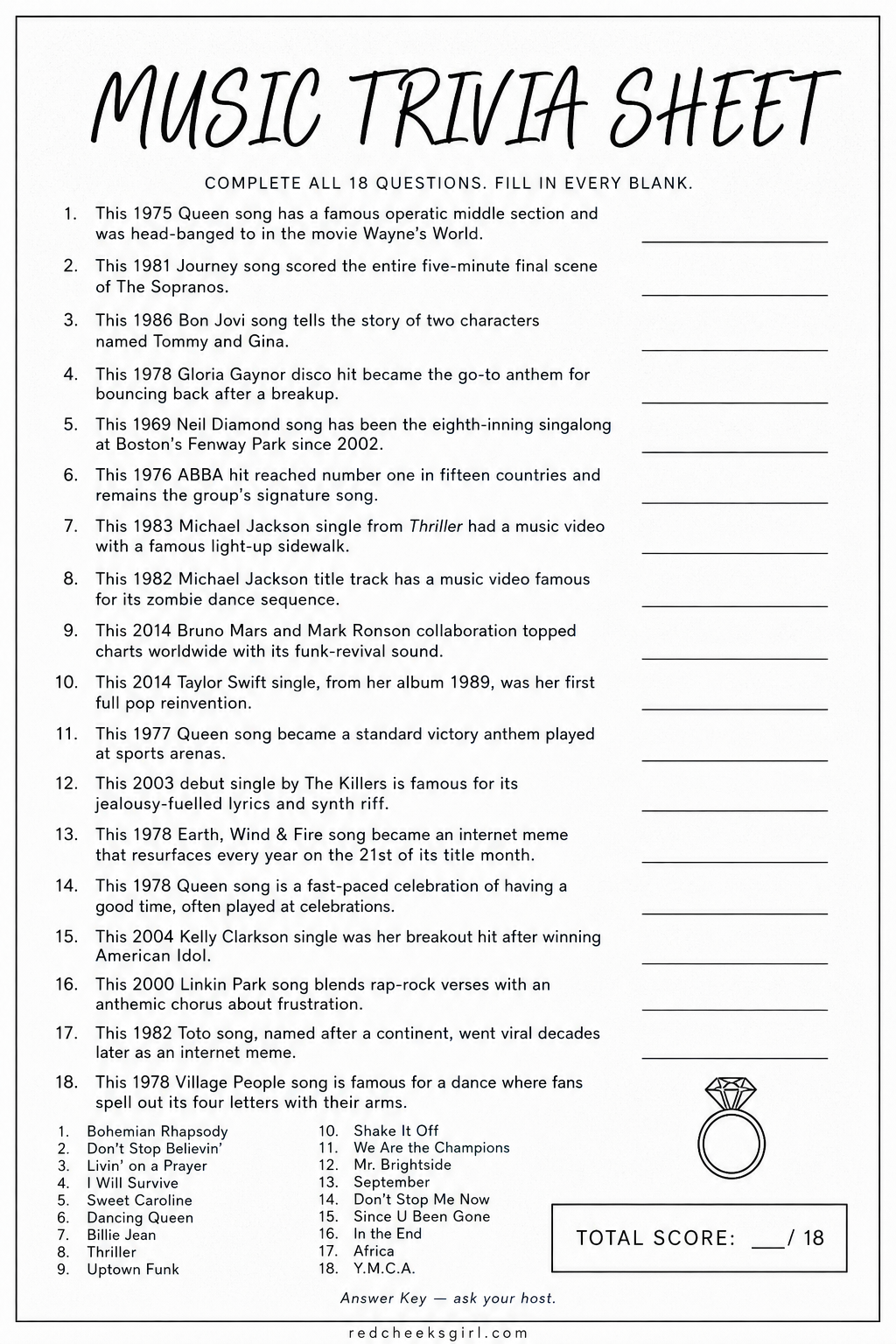
4. Music Trivia Sheet
Music Trivia Sheet is the printable game that separates the self-proclaimed music fans from the people who just have strong opinions about Spotify playlists.
Each player gets a sheet with 30 questions split into three themed rounds: artist and band trivia, song release years, and lyrics fill-in-the-blank (the printed line shows the song title and artist, and players complete a missing line from memory — no lyric reproduction needed since the answers are already in guests’ heads, not on the sheet).
It works equally well as a solo answer sheet or with teams, and the reveal moment when someone swears they knew an answer but wrote the wrong decade is absolutely golden. Group size: 4–20 players. Noise level: low during play, loud at the reveal.
Print one sheet per player (or one per team if you want a collaborative vibe). Give everyone 15 minutes to work through all 30 questions independently, then mark together as a group using the answer key at the bottom of the host’s copy.
For the lyrics round, print the song title and artist as the clue, then have guests write their answer on the blank line below — the host confirms correct answers verbally rather than printing them on the sheet, which keeps the game honest and the answers surprisingly tricky even for people who swear they know every word of every song they’ve ever loved.
The secret weapon of Music Trivia Sheet as one of your party games for adults indoor is how personal it gets — someone will inevitably get a question right that nobody else can explain, sparking a ten-minute detour about their questionable music phase in their early twenties.
Build your question set around your crowd: mix mainstream chart hits with cult classics and at least one question that references a decade before most of your guests were born. The generational gap on those questions is comedy gold, tbh.
- 6–20 players
- Works solo or in teams
- Low noise during play — chaos at the scoring reveal
5. Fishbowl
Fishbowl is the lovechild of Taboo, Password, and Charades — and it might just be the most consistently hilarious party game for adults indoor that requires nothing but a bowl, paper, and pens.
Everyone writes three to five words or phrases on slips of paper (celebrities, objects, movie characters, inside jokes — anything goes), folds them up, and drops them into the bowl.
Teams then compete across three progressively harder rounds using the same set of slips: Round 1 is verbal clues (describe without saying the word), Round 2 is acting (charades-style, no talking), and Round 3 is one-word-only clues.
The genius is that by Round 3, everyone has heard all the phrases before, so single words spark instant recognition — and often total chaos. Group size: 6–20 players. Noise level: moderate — escalates hilariously by Round 3.
Setup takes about three minutes. Hand out slips of paper and pens, let everyone write their phrases, collect everything in the bowl, then split into two teams.
Each turn is 60 seconds, and the active player draws slips one at a time, getting their team to guess as many as possible before time runs out. Unguessed slips go back in the bowl for the next team’s turn.
When all slips are guessed, that round ends — tally the scores, put everything back in the bowl, and begin Round 2 with the same slips but new restrictions. The bowl can literally be any large bowl from your kitchen.
Fishbowl earns its place in every great indoor party because it scales effortlessly from six people to twenty-plus and rewards both creativity and memory equally.
A host tip worth stealing: encourage guests to include a couple of very specific inside jokes or shared references your group actually knows — those slips cause the most laughter in Round 3 when one word somehow unlocks the entire memory and the guesser screams the answer before the clue-giver has even finished thinking.
It also pairs beautifully as a warm-up before something more structured like Codenames.
- A large bowl or hat
- Slips of paper — 3–5 per person
- Pens
- A phone timer set to 60 seconds
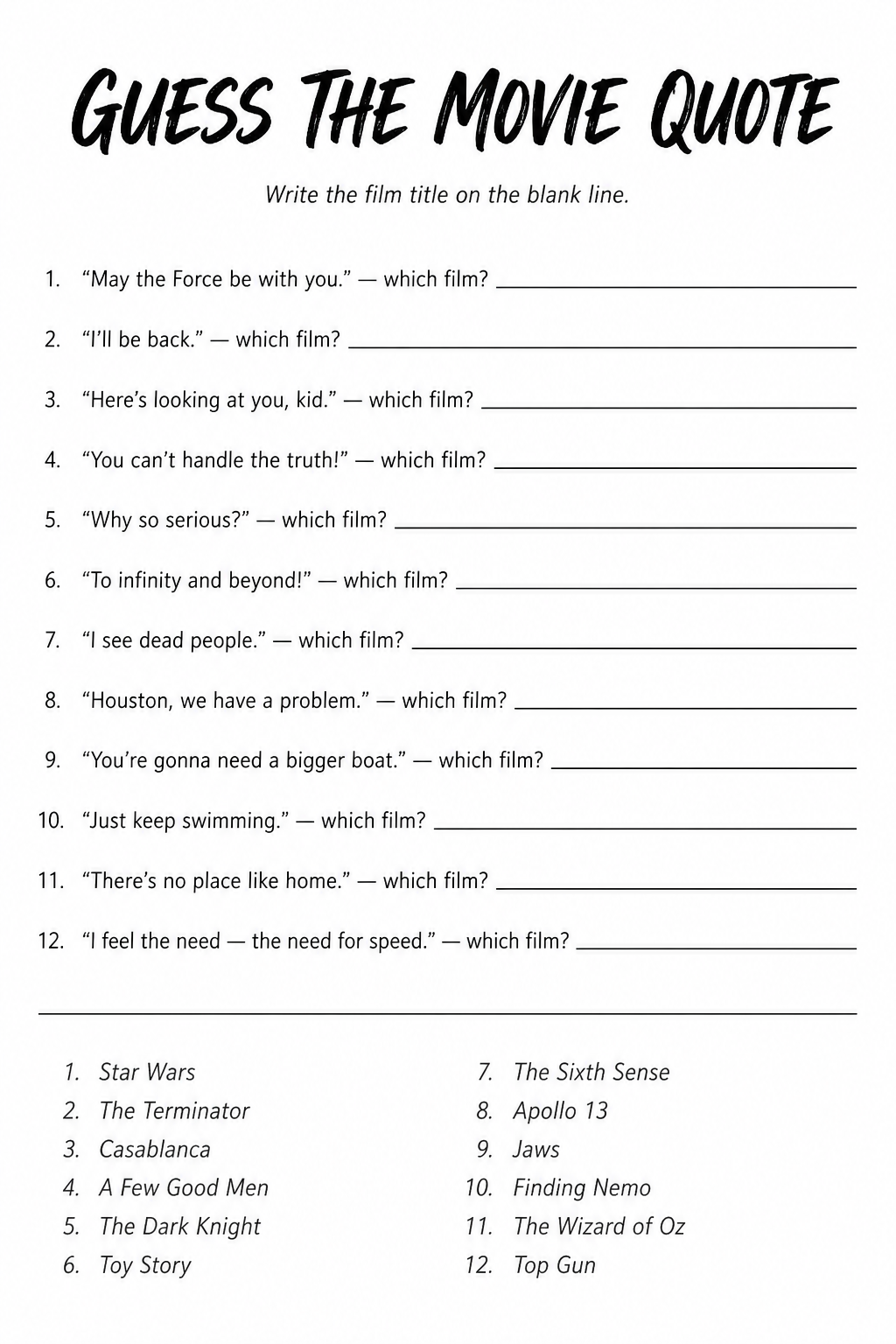
6. Guess the Movie Quote
Guess the Movie Quote is the printable game that sorts every adult party into two camps: the people who claim they ‘barely watch films’ but somehow nail 14 out of 20, and the self-described cinephiles who inexplicably blank on everything.
Each player gets a sheet with 20 famous movie quotes printed in full — no context, no genre hint, just the line itself. Players write the film title (and optionally the character name for bonus points) on the blank answer line next to each quote.
The sheet covers a deliberately broad mix of decades and genres, so no single taste dominates, and that one guest who only watches animated films suddenly becomes a legend. Group size: any size. Noise level: library-quiet during play, rowdy at the reveal.
Print one sheet per player (or team) before the party. Give everyone 10 minutes to work through the sheet in silence — yes, silence, it’s part of the fun, because you will absolutely see someone mouthing a quote to themselves while trying to place it.
Then reveal answers one by one as a group, letting anyone who got it right read the quote aloud in their best impression of the original actor.
Award a bonus point for any impression that earns applause — this is entirely subjective and should absolutely be adjudicated by the loudest person in the room.
What makes Guess the Movie Quote one of the best quiet party games for adults indoor is how it generates conversation naturally: every wrong answer sparks a ‘wait, are you serious?!’
and every correct answer comes with a story about where and when they first saw the film.
It’s a wonderful middle ground between competitive trivia and pure socialising, and it tends to keep going well past the official ‘end’ of the game as people argue about quotes you didn’t even put on the sheet.
If you want to step it up, offer an extra sheet of harder quotes for anyone who finishes early — film buffs will be insufferably smug about it.
Add the film’s release decade as a hint below each quote to help guests who aren’t heavy moviegoers.
7. Poker Night Tournament
Poker Night Tournament is the party game for adults indoor that turns a living room into a convincing casino with almost zero effort — just a deck of cards, some chips, and someone willing to be the dealer.
Texas Hold’em is the go-to format: each player gets two face-down hole cards, five community cards are dealt progressively to the table, and the best five-card hand from any combination of the seven wins the pot.
Play tournament-style with a fixed chip buy-in so nobody loses actual money — winner takes a prize or simply the bragging rights that will be referenced at every party for the next two years. Group size: 4–10 players.
Noise level: low to medium — intense silence punctuated by occasional ‘seriously?!’ moments.
Set up one table with enough seating for all players, distribute equal chip stacks, and agree on blind levels before you start (small blind, big blind, and when they increase).
You do not need a felt-top table or a professional chip set — any flat surface and a standard deck of cards works perfectly, and cheap plastic poker chip sets are available for next to nothing.
Rotate the dealer button clockwise each hand so the blind positions shift fairly. Set a timer for blind increases (every 20–30 minutes works well for a party pace) to keep the tournament moving and prevent it stretching into a four-hour marathon.
What elevates Poker Night from a card game to a proper party experience is the table talk.
Encourage it — bluffing, misdirection, and theatrical tells are half the fun, and watching someone try to maintain a poker face after getting a royal flush is a party memory in itself.
For guests who aren’t poker players, run a five-minute crash course before you start: hole cards, community cards, hand rankings, and the concept of folding. Most people pick it up within two hands. And honestly?
The people who ‘don’t know how to play’ often end up winning because they have no idea what they’re doing and accidentally bluff everyone out of the pot.
Use chocolate coins or candy as chips for a zero-stakes version that’s just as competitive but friendlier for mixed groups.
🛒 What you’ll need
8. Would You Rather for Adults
Would You Rather for Adults is the printable game that starts conversations you absolutely did not expect to be having at a holiday party and yet somehow becomes the longest game of the night.
Each sheet presents 20 genuinely difficult dilemmas — not the easy ‘would you rather have a million dollars or fly’ type, but the ones that reveal something weirdly real about a person’s values, priorities, and secret dealbreakers.
Players circle their answer, then the host reads each prompt aloud and asks anyone who wants to defend their choice to do so. The defences are where the magic happens. Group size: 4–20 players.
Noise level: conversational — occasional loud disagreement when someone’s choice baffles the room.
Print one sheet per player before the party and hand them out after a livelier game to bring the energy down to a warm, chatty level — Would You Rather sits perfectly between a high-energy round and a quieter wind-down.
Give everyone about five minutes to circle all 20 answers independently before the group discussion begins.
The host picks any question to start (ideally the most divisive-looking one based on a quick glance around the room) and invites people to share their answer and their reasoning. No time pressure, no score — this one is purely about the conversation it generates.
The reason Would You Rather for Adults earns its spot in any party games for adults indoor collection is how effectively it cuts through surface-level small talk.
Within three or four prompts, guests who barely know each other are passionately debating life choices they’ve never articulated out loud before — and the people who give the same answers are suddenly bonded in a way no icebreaker game achieves.
Keep one rule firm: no judgment. The whole point is that both options are genuinely hard, which means there are no wrong answers — just fascinating ones.
- Needs zero energy from guests — great after a loud active game
- Generates real conversation rather than just laughter
- Works with complete strangers or lifelong friends

9. Blind Beer Tasting
Blind Beer Tasting is the party game for adults indoor where everyone confidently insists they know their craft IPA from their lager — and then gets absolutely humbled by a can of something from a service station.
The setup is simple: the host (or a designated ‘blind pourer’) wraps each bottle in brown paper or a bag numbered 1 through 5, pours small samples into matching numbered cups, and challenges each guest to identify the beer style, brand, or both.
Players write their guesses on scorecards, the labels are revealed, and the person closest to correct across all five beers wins — usually with insufferable enthusiasm. Group size: 4–12 players. Noise level: low to medium — collaborative tasting, loud at the reveal.
Pick five beers that cover meaningfully different styles: an IPA, a lager, a stout, a wheat beer, and a wildcard (a sour, a cider, or whatever you think will throw people).
Pour small 2–3 oz samples so the tasting stays manageable — you want people tasting five times, not finishing five full drinks before the reveal. Use a printed or handwritten scorecard with five rows: one per beer, columns for ‘Style Guess’, ‘Brand Guess’, and ‘Points’.
Award one point for the correct style and two for the correct brand — or go all-in and award max points to anyone who names the exact brewery and beer.
Blind Beer Tasting works so brilliantly as an indoor party game because it is inherently social: people sip, compare notes, look around suspiciously, and change their minds based on what others are saying — then loudly deny doing so when the labels come out.
It also brilliantly equalises the room: the person who ‘doesn’t really drink beer much’ frequently outperforms the self-declared craft beer enthusiast, which is comedy that runs for the rest of the evening.
If you want a non-alcoholic version, this works perfectly with sparkling waters, artisan sodas, or juice blends — same blind reveal, same chaos, zero hangover.
- 5 different beers (IPA, lager, stout, wheat, wildcard)
- Brown paper bags or wrapping to hide labels
- Small pour cups — one set per person
- Printed or handwritten scorecards
🛒 What you’ll need
10. Guess the Sound Sheet
Guess the Sound Sheet is the printable game that causes more genuine bewilderment per square foot than almost anything else on this list.
The host pre-records or streams 20 short audio clips — anywhere from 5 to 10 seconds each — of everyday and unusual sounds: a specific kitchen appliance, a particular animal, a sound effect from a film, a sports crowd, a natural environment, and several that are genuinely ambiguous and designed to divide the room.
Players listen to each clip and write what they think the sound is on their numbered answer line, then scoring happens as a group reveal. Group size: 4–20 players. Noise level: quiet during play, genuinely loud during the ‘wait, THAT was a whale?!’
moments at the reveal.
Before the party, build your playlist of 20 sounds in sequence on your phone — YouTube has excellent royalty-free sound effect compilations, or use a dedicated sounds app.
Play each clip twice through a Bluetooth speaker so everyone can hear clearly, give guests 10 seconds to write their answer, then move on.
The answer sheet has a simple numbered list of 20 blank lines, one per sound, and a small clue category printed in tiny text underneath each line (e.g. ‘Animal / Machine / Nature / Film’) to help guests narrow it down without giving it away.
The host reads out the answer after all 20 sounds are complete.
Guess the Sound Sheet is one of those party games for adults indoor that works because it requires zero prior knowledge — it’s all about listening carefully and trusting your instincts, which levels the playing field completely.
The truly fantastic moment arrives when a sound that seems obvious to one person (a specific kitchen appliance, say) is completely unidentifiable to someone else, and the resulting explanation of how they use kitchen equipment becomes funnier than the game itself.
Include one or two sounds that are everyday-object recordings from unusual angles or distances — those trip up everyone and produce the most spectacular wrong answers of the night.
Pre-load all 20 sounds into a numbered playlist the night before so there’s no awkward scrolling during the game.

🛒 What you’ll need
11. Escape Room in a Box
Escape Room in a Box brings the full escape room experience to your living room without the eye-watering venue prices or the mild panic of being literally locked in a room with your coworkers.
The best-known version — The Werewolf Experiment — gives 2–6 players exactly 60 minutes to solve 19 interconnected puzzles and crack three physical combination locks before a fictional mad scientist’s plan succeeds.
There are 2D paper puzzles, 3D physical challenges, hidden clues, and the optional Alexa integration that adds timed audio narration if you want the full cinematic atmosphere.
It is cooperative, meaning everyone wins together or fails together — which, remarkably, produces both excellent teamwork and extraordinary moments of blame redistribution. Group size: 2–6 players. Noise level: low to moderate — focused, urgent, and occasionally very stressed.
Setup takes around ten minutes: read the host guide, arrange the puzzle components on a flat surface (your kitchen table works perfectly), set a 60-minute timer, and go.
Everything needed is in the box — no additional props required, though pens and a notepad for jotting codes and observations are genuinely useful and often forgotten until about puzzle four.
The puzzles range from satisfyingly logical to the kind of lateral thinking that makes someone stare at a piece of card for four minutes before someone else solves it in ten seconds and immediately becomes insufferable about it.
Escape Room in a Box earns its status as one of the standout party games for adults indoor because it creates a shared narrative memory — the specific puzzle that cracked it, the wrong code that cost you three minutes, the moment someone finally connected two clues everyone else had missed.
Those stories get retold for months. If your group burns through it in one night and wants more, the EXIT: The Game series by Thames & Kosmos offers a dozen+ similarly sized puzzles at various difficulty levels and the equally beloved Unlock! series.
Stock a couple and you have three separate party nights sorted.
- 2–6 players (sweet spot is 4)
- 60-minute commitment — ideal as an event in itself
- Very low noise — pure focus energy
🛒 What you’ll need
12. Indoor Charades Card Deck
The Indoor Charades Card Deck is the printable version of a beloved classic, and it solves the perennial problem of the person who is supposed to be giving clues spending 45 seconds trying to think of something to act out while everyone stares at them in increasingly disappointed silence.
Each card has a prompt printed on it — players draw a card, read it privately, then act it out for their team using no words, no sounds, and ideally no props (this is the indoor version, after all — nothing is getting knocked over).
Prompts span three difficulty levels: Easy (a household appliance), Medium (a famous person), and Hard (an abstract concept or film title). Group size: 4–16 players. Noise level: moderate — whispering, clapping, and occasional frustrated ‘IS IT A PENGUIN?’ outbursts.
Print the card deck double-sided on cardstock before the party, then cut along the dotted border lines to create individual cards. Shuffle them and keep them face-down in a pile.
Teams take turns nominating an actor who draws a card and has 90 seconds to get their team to guess correctly. Keep a tally of points — one per successful guess — across five rounds, and the team with the most points wins.
The three difficulty columns on the printed sheet make it easy to grade difficulty by round: Easy cards in Round 1 to get everyone warmed up, Hard cards saved for the final round when people are less inhibited.
What makes this printable version better than shouting suggestions at each other is the breadth and variety of prompts — 24 cards covering pop culture, everyday objects, animals, emotions, and actions.
The indoor-friendly twist is that all prompts are physically achievable in a small space: no diving, no sprinting, no mime that requires more than arm’s-length of clearance.
A host tip that genuinely improves the game: add a ‘Director’s Cut’ rule where the team can spend one saved point to make the actor mime one word of their choosing — it sounds unfair but produces the funniest rounds of the night.
Sort cards by difficulty before the party so you can control which level each round uses — saves shuffling mid-game.

🛒 What you’ll need
13. Charades (Quiet Edition)
Charades (Quiet Edition) is what you play when the neighbours’ lights are already on and you’re not trying to push your luck — it’s charades with the volume dialled to a whisper, and it’s honestly funnier for the constraint.
All the standard rules apply: one player acts out a word or phrase with no sounds and no mouthing of words, and their team tries to guess correctly within 90 seconds.
The Quiet Edition twist is that guesses are written on a small notepad or whiteboard rather than shouted aloud, which means the energy is intense and focused rather than cacophonous.
Category signals — one finger for film, pulling an ear for ‘sounds like’, holding up fingers for word count — stay the same. Group size: 4–12 players. Noise level: near-silent — this is the neighbour-safe version.
You need literally nothing to play this version: generate prompt ideas in your head or use the Indoor Charades Card Deck printable from earlier in this list, a small notepad or mini whiteboard per team, and a 90-second timer.
Split into two teams, nominate an actor per round, and have them pick a prompt from the pile.
The acting is identical to standard charades but the guessing team writes their answers quickly and holds up the notepad to show the actor — who can nod yes or shake their head to keep guessers on the right track without making a sound.
The first correct written guess stops the clock.
The reason Charades (Quiet Edition) stays on the list alongside the printable card deck is that they serve different moments.
The card deck is a structured game with scoring and rounds; this version is a spontaneous low-prep activity you can launch at any point in the evening with no setup whatsoever.
It’s also genuinely brilliant late at night when guests are relaxed but still want to play something — the silent intensity creates a funny, focused atmosphere that feels completely different from a noisy game of the same thing.
Keep a running ‘hall of shame’ notepad where the worst written guesses get immortalised. Trust me on this one.
- Zero noise — genuinely neighbour-safe after 10pm
- No materials required — start within 60 seconds
- Funnier than regular Charades because silence raises the stakes
14. Murder Mystery Dinner
Murder Mystery Dinner is the party games for adults indoor option that turns an ordinary evening into an event people plan outfits for weeks in advance.
Each guest receives a character card and a brief backstory before or on arrival: they are now a specific person with a motive, a secret, and a role in an unfolding fictional murder.
Over the course of dinner (or drinks, or a buffet — the format is flexible), clues are revealed, characters are interrogated, and everyone tries to work out who committed the crime before the final accusation round.
Most commercial kits accommodate 6–14 players, and downloadable PDF versions mean you can organise one with a week’s notice. Group size: 6–14 players. Noise level: medium — dramatic, immersive, surprisingly committed.
Choose a kit that matches your group size and vibe: cosy 1920s drawing room mystery for a more elegant crowd, a chaotic 1970s disco murder for a sillier group, or a festive holiday-themed whodunit if you’re running this as a Christmas party centrepiece.
Print and distribute character booklets in advance so guests can read their backstory before they arrive — this makes the evening run much more smoothly than handing everyone a dossier at the door and waiting while they frantically catch up.
Set aside a ‘clue table’ (a coffee table or sideboard) where revealed evidence can be reviewed throughout the evening.
What makes Murder Mystery Dinner one of the most memorable indoor party experiences is that it is simultaneously a game, a dinner party, and a piece of improvised theatre — and the people who swear they ‘can’t act’ always end up being the most committed characters in the room.
Plan for 90–120 minutes for the core mystery, plus additional time for dinner.
A small prize for the player who correctly identifies the murderer (a bottle of wine, a box of chocolates — anything tangible) amplifies the competitive energy just enough to keep everyone genuinely invested. Looking for other ideas to make the night special?
Check out this Christmas gift guide for little prizes that work perfectly as winner rewards.
- A downloaded or boxed murder mystery kit
- Character booklets distributed before the party
- A clue display area (coffee table or sideboard)
- A small prize for the solver
🛒 What you’ll need
15. Pictionary Tournament
Pictionary Tournament is the drawing game taken up a competitive notch — instead of a single casual game, you run it as a bracketed head-to-head tournament across three or four rounds, with each round getting progressively harder and the prompts shifting from concrete objects to abstract phrases.
One player draws on a large notepad or whiteboard while their team guesses within 60 seconds — no words, no letters, no numbers in the drawing.
The tournament format means early rounds have easy prompts (a household object, an animal, a simple action), and the semifinal and final rounds feature two-word phrases, film titles, or concepts like ‘jealousy’ or ‘the morning after a party’ that require genuinely creative visual thinking.
Group size: 4–16 players. Noise level: medium-high — guessing teams are vocal.
You need a large notepad (A3 or bigger) or a small whiteboard, a set of markers, and a list of prompts divided by difficulty — generate these in advance or print them from a prompt list online.
Split into teams of two to four, run a group stage where every team draws against every other team once, then take the top two scorers into a final round.
The 60-second timer is non-negotiable — enforce it strictly and the time pressure is what generates both the terrible drawings and the inspired ones.
Keep all the drawings on display throughout the evening for a running exhibition of increasingly abstract art that guests can roast later.
What elevates Pictionary Tournament above a casual round is the competitive structure: teams start taking it seriously around the semi-final, and the player who discovers they are secretly a gifted drawer becomes an unexpected hero.
For an indoor-friendly modification, use a whiteboard app on a shared tablet instead of physical paper — it means no paper waste and the drawings can be screenshotted for a genuinely funny photo album of the evening.
The host tip that nobody ever thinks of in advance: keep a ‘best drawing of the night’ vote at the end and award a special prize — this usually goes to the drawing that was simultaneously terrible and somehow correct, which is its own art form.
- A3 notepad or whiteboard
- Thick marker pens
- Prompt list sorted by Easy / Medium / Hard
- 60-second timer
🛒 What you’ll need
16. Unpopular Opinions
Unpopular Opinions is the conversation game that starts quietly and ends with someone dramatically defending a position they only half-believed when they said it.
The premise is beautifully simple: going around the circle, each player states one genuine unpopular opinion — something they actually believe but know will get pushback.
The rest of the group votes thumbs up (they secretly agree) or thumbs down (they genuinely disagree), and if more than half the group votes thumbs up, the opinion wasn’t actually that unpopular and the player must reveal another one.
The game continues until everyone has successfully landed a truly unpopular take. Group size: 4–14 players. Noise level: low to medium — contemplative, then argumentative in the best possible way.
No materials needed whatsoever — this is a pure conversation game that can be launched spontaneously at any point in the evening.
The only rule worth establishing upfront is the ‘no politics, no religion’ guideline if your group is mixed or you want to keep the atmosphere light.
Within those guardrails, opinions tend to cover food preferences, pop culture, social norms, and life choices — which is fertile enough ground to keep things interesting for a full hour.
The host can seed the game with a good opener if the first player is shy: ‘Pineapple on pizza is actually fine’ is a reliable icebreaker that will generate immediate passionate disagreement and set the right chaotic tone.
Unpopular Opinions earns its place in the quiet games section of party games for adults indoor because it generates real, genuine conversation in a way that very few structured games achieve.
People reveal things about themselves — their actual tastes, their real preferences, the mild contrarian positions they’ve held for years but never said aloud — and the group’s reaction to each reveal tells you almost as much about them as the opinion itself.
It tends to run for longer than anyone expects because once one person admits something genuinely surprising, everyone else wants a turn to be the most controversial person in the room.
- 4–14 players
- Zero noise — perfect after 10pm in a flat
- No materials, no setup — starts instantly
17. Board Game Marathon
Board Game Marathon is not one game — it’s a structured format for running three to five board games back-to-back across an evening, each one acting as a ‘heat’ in a running points championship.
Pull out your three to five favourite boxed games, assign a points value for winning each one (first place: 3 points, second: 2 points, third: 1 point), and track cumulative scores on a whiteboard or notepad throughout the night.
The final standings after all heats crowns an overall champion. Good heat selections for indoor adult parties typically mix something strategic (Ticket to Ride, Catan), something fast and silly (Dobble, Sushi Go), and something wordy or creative (Dixit, Codenames). Group size: 4–10 players.
Noise level: varies by game — plan the schedule so the noisiest game isn’t the last one.
The key to a Board Game Marathon that actually works is pacing. Keep each heat to 30–40 minutes maximum — if a game is running long, institute a ‘sudden death’ rule where the next completed round ends the game and you score from there.
Keep all the boxes accessible, transitions fast, and snacks replenished between heats. A short five-minute break between games allows people to refill drinks, stretch, and passionately relitigate what happened in the last heat before the next one begins.
Announce the running scores after each game to keep competitive tension alive throughout the evening.
What makes Board Game Marathon a standout indoor party option is how it keeps everyone engaged even when individual games have widely varying player counts — you can stagger who sits out which game (if any) and rotate observers into the next heat, so nobody feels sidelined for long.
It also rewards breadth over depth: the person who wins the trivia game might tank the strategy game, keeping the overall championship genuinely contested until the final heat.
If you’re looking for a gift idea to stock your game collection before the party, the gift guide for him has several board game options that translate beautifully to marathon format.
Write the running score tally on a whiteboard or large piece of paper everyone can see — it makes the marathon feel like a proper championship.
18. Card Tower Challenge
Card Tower Challenge is the dexterity game that turns a standard deck of playing cards into a nail-biting engineering competition — and it is absolutely devastating to attempt and hysterical to watch.
Each player (or team) gets one standard 52-card deck and has exactly 10 minutes to build the tallest freestanding card tower they can using only the cards themselves — no tape, no glue, no folding, no leaning against anything.
The classic technique is the A-frame: two cards leaned against each other to form an arch, with a flat card bridging the top, repeated and stacked upward. The tower that is still standing at the end of the 10 minutes wins.
Collapsed towers must be rebuilt before time runs out. Group size: 2–10 players (individual or teams). Noise level: near-silent — concentrated focus and occasional sharp intakes of breath.
Setup takes 30 seconds: hand out decks, clear a flat table surface, set a 10-minute countdown, and go.
The rules are simple but the execution is brutally difficult — even one draft from a passing person, a slight vibration, or an overly confident extra card placement can collapse a tower that took seven minutes to build.
For team play, give one deck per pair and watch two adults try to agree on structural decisions in absolute silence to avoid disturbing the tower. This is simultaneously the most cooperative and the most tension-filled 10 minutes in party game history.
Card Tower Challenge earns a spot in any party games for adults indoor list specifically because it requires almost nothing (one card deck per player), takes up minimal space (one clear table), and generates disproportionate amounts of both concentration and comedy.
The moment someone’s tower collapses at the nine-minute mark and takes their neighbour’s tower down with it is the kind of shared experience that makes a party night unforgettable.
Run multiple rounds if the group gets obsessed — which they will, because nobody accepts losing a game of card stacking gracefully.
Use slightly older, more flexible cards — brand new stiff cards are actually harder to balance than a broken-in deck.
🛒 What you’ll need
19. Confessions Circle
Confessions Circle is the game that takes the classic ‘never have I ever’ format and elevates it from a drinking game into something genuinely warm and revealing — perfect as a wind-down after livelier rounds or as a mid-party temperature change.
Seated in a circle, one person reads a confession prompt aloud: something like ‘Confess if you’ve ever pretended to be busy to avoid plans you agreed to six months ago.’
Everyone who has done it raises their hand — and anyone who raises their hand must share one specific detail about their version of the experience. No vague ‘yeah, guilty’ responses allowed: a real anecdote, however brief, is the entry fee for confessing.
Group size: 4–12 players. Noise level: very low — intimate and conversational.
You can run Confessions Circle with a pre-written list of prompts (print 20–30 before the party and fold them into a hat or bowl for someone to draw), or use a free browser tool like psycatgames.com/app/confession-game to generate prompts on the fly from chosen categories.
The categories are worth calibrating to your group: a mix of work, relationships, food, and social awkwardness covers most adult parties without straying into territory that makes anyone genuinely uncomfortable.
The rule about specific details is the most important one — it’s what transforms a hand raise into a story, and stories are what make the game memorable.
Confessions Circle works as a party game for adults indoor because it requires zero materials, zero floor space, and generates exactly the kind of authentic, funny, occasionally touching moments that no structured game can manufacture.
The moment someone confesses something that three other people also raise their hands for — something they all thought was their own weird secret — is one of those genuine party memories.
It’s also completely neighbour-safe: it’s quiet, it’s seated, and the only thing getting revealed is that everyone in your group has faked being sick at least twice this year. (It’s fine. We’ve all done it.)
- Zero noise — the most apartment-friendly game on the list
- Genuinely connects people across three rounds
- No materials if you use a phone for prompts
20. Best Story You’ve Never Told
Best Story You’ve Never Told is the quiet game that routinely becomes the moment people remember months later — not because of a competitive mechanic or a winner, but because of what gets said.
The premise: each person thinks of the best story from their life that they have never told this particular group of people. It can be funny, embarrassing, surprising, dramatic, or quietly profound.
They have up to three minutes to tell it — no notes, just talking — and when they’re done, the group votes on one word that best describes how the story made them feel.
There are no points, no winner, and absolutely no pressure to share anything uncomfortable. Group size: 4–10 players. Noise level: nearly silent during storytelling — warm, attentive, occasionally interrupted by genuine laughter.
The only preparation needed is warning guests when they arrive that this game is coming later in the evening, so they have time to think.
This is genuinely important — the stories that get told when someone has had a couple of hours to remember something specific are far better than the ones conjured on the spot under pressure.
Once the game begins, establish one ground rule: no phones, and no interrupting the storyteller until they’ve finished.
The host goes first to model the tone — pick something that is funny or surprising rather than heavy, which sets the right energy and gives shyer guests a low-pressure benchmark.
Best Story You’ve Never Told is one of the most quietly powerful party games for adults indoor precisely because it is not really a game at all — it’s a structured excuse to share something real.
By the end of the round, guests who arrived as acquaintances often feel like proper friends, and the host who suggested it will be credited as a genius.
It pairs beautifully with Confessions Circle as a late-night wind-down double, and it works for any group dynamic from work colleagues to long-term friends who thought they already knew everything about each other. (They don’t. Nobody does. That’s the entire point.)
Tell guests at the start of the evening this game is coming so they have time to recall a great story — it makes an enormous difference to the quality of what gets shared.
Frequently Asked Questions
What are the best party games for adults indoor with a small group?
For small groups of 4–6, the strongest picks are Codenames Live (4–6 players, strategy-focused and compact), Escape Room in a Box (2–6 players, fully cooperative and deeply immersive), Card Tower Challenge (individual or pairs, requires only a deck of cards), and Confessions Circle or Best Story You’ve Never Told for a warmer, conversation-based alternative.
All of these work on a single table or in a living room with no floor space needed.
Which indoor party games are neighbour-friendly and low-noise?
The quietest options on this list are Charades (Quiet Edition) — where guesses are written rather than shouted — Card Tower Challenge, Confessions Circle, Unpopular Opinions, Best Story You’ve Never Told, and all the printable games (Indoor Trivia Night, Music Trivia Sheet, Guess the Movie Quote, Would You Rather, Indoor Charades Card Deck, Guess the Sound Sheet).
These are all well-suited to flats, thin-walled houses, or late-night sessions where volume matters.
What indoor party games work for large groups of 10 or more adults?
The best scalable options for large groups are Werewolf (ideal at 10–15 players), Fishbowl (6–20+ players), Indoor Trivia Night (any size — works beautifully in teams), Guess the Sound Sheet (20+ players possible in teams), and Board Game Marathon if you have multiple tables and can run heats simultaneously.
Murder Mystery Dinner can also accommodate large groups with an expansion kit.
Can I run a full party game night with only printable games?
Absolutely — this list has six printable games (Indoor Trivia Night, Music Trivia Sheet, Guess the Movie Quote, Would You Rather for Adults, Indoor Charades Card Deck, and Guess the Sound Sheet) that together cover roughly three to four hours of structured entertainment.
Print everything the night before, and the only live prep is playing the audio for Guess the Sound Sheet and reading questions aloud for Trivia Night.
Add Confessions Circle and Unpopular Opinions as free, no-print conversation games between rounds and you have a complete party games for adults indoor evening.
What party games for adults indoor need no materials at all?
Werewolf can be played with paper slips instead of cards. Charades (Quiet Edition) needs only a notepad. Confessions Circle and Unpopular Opinions and Best Story You’ve Never Told need nothing at all — just people and conversation.
Fishbowl needs only a bowl, paper, and pens you already have at home. These are your go-to games when you decide to play something at 9pm on the night itself with zero preparation.
How do I keep energy levels up across a long indoor party game night?
Interleave game types throughout the evening: start with something active and team-based like Codenames or Fishbowl to get energy up, follow with a quieter printable round like Indoor Trivia Night, then a physical challenge like Card Tower Challenge or Pictionary Tournament, then wind down with Confessions Circle or Best Story You’ve Never Told.
Keep snacks and drinks accessible between games, keep transitions fast (five minutes max between activities), and don’t be afraid to read the room — if a game is flagging, end it early and pivot to something fresh.
📌 Save These for Later
Loved these? Pin your favorite image below so you can find this list again when you’re planning.


Soup party ideas that dress the table, load the pot and keep guests lingering long after the bowls a
Super bowl party games that run beside the TV so nobody misses a play. 9 free printables plus 7 no-p

120 clean truth or dare questions for teenagers — funny, embarrassing, crush, social-media & silly
Leave a Reply