

If you are hunting for christmas games for toddlers that won’t end in tears, a choking hazard panic, or a full toddler meltdown — you’ve landed in the right place. I’ve been there, friend.
I once showed up to a holiday playdate with a ‘cute’ game involving small jingle bells and approximately twelve tiny pieces, and let’s just say the other parents were not thrilled. Live and learn!
Every single game on this list uses soft or large props, runs under five minutes, requires zero reading or competition, and can be repeated again and again (because toddlers will absolutely ask you to do it again seventeen times).
Whether you’re hosting a cozy Christmas morning with cousins, a holiday playgroup, or a low-key party for a bunch of one-to-three-year-olds, these games will keep the whole crew giggling without anyone losing a small piece to the carpet.
And hey — while you’re in full festive-planning mode, check out this 2025 Christmas Gift Guide for some seriously great present inspo too. Now, let’s get to the good stuff!
- Christmas Freeze Dance
- Christmas Big-Picture I-Spy
- Jingle Bell Shake and Dance
- Roll the Ornament (Soft)
- Christmas Sticker Scene
- Pass the Present (Hot Potato)
- Pom-Pom Drop in the Bucket
- Waddle Like a Penguin
- Feed Rudolph Soft Toss
- Cotton Ball Snow Scoop
- Peekaboo Santa
- Big Bubble Snow Chase
- Stack the Soft Blocks Tree
- Color Sort the Pom-Poms
- Twinkle Lights Calm-Down Circle
- Frequently Asked Questions
1. Christmas Freeze Dance
Christmas Freeze Dance is the MVP of toddler party games for a reason — it is dead simple, burns energy fast, and is genuinely hilarious to watch a two-year-old try to hold a frozen pose.
Play a cheerful Christmas song (think ‘Jingle Bells’ or ‘Rudolph’) and let the little ones wiggle, stomp, and shimmy to their heart’s content. The moment the music stops, everyone freezes like a little Christmas statue.
Then the music starts back up and the dancing begins again. That’s it. That’s the whole game.
All you need is a phone or speaker and a festive playlist — no props, no setup, no stress. The key for toddlers is to skip the ‘you’re out’ rule entirely. Just freeze, giggle at each other’s poses, and start dancing again.
Keep each round short (30–45 seconds of music max) so tiny attention spans stay engaged, and pause more often than you think you need to — the freezing is the funniest part anyway.
This game is a fantastic opener because it gets wiggles out immediately and sets a joyful, no-pressure tone for the whole party. It also builds body awareness and listening skills without anyone knowing they’re ‘learning’ — sneaky, right?
Pro host tip: make your own freeze pose extra dramatic. When a grown-up freezes like a startled penguin mid-dance, every toddler in the room loses their mind with laughter.
- A phone or Bluetooth speaker
- A Christmas playlist (Spotify has loads of free ones)
- A clear open floor space
2. Christmas Big-Picture I-Spy
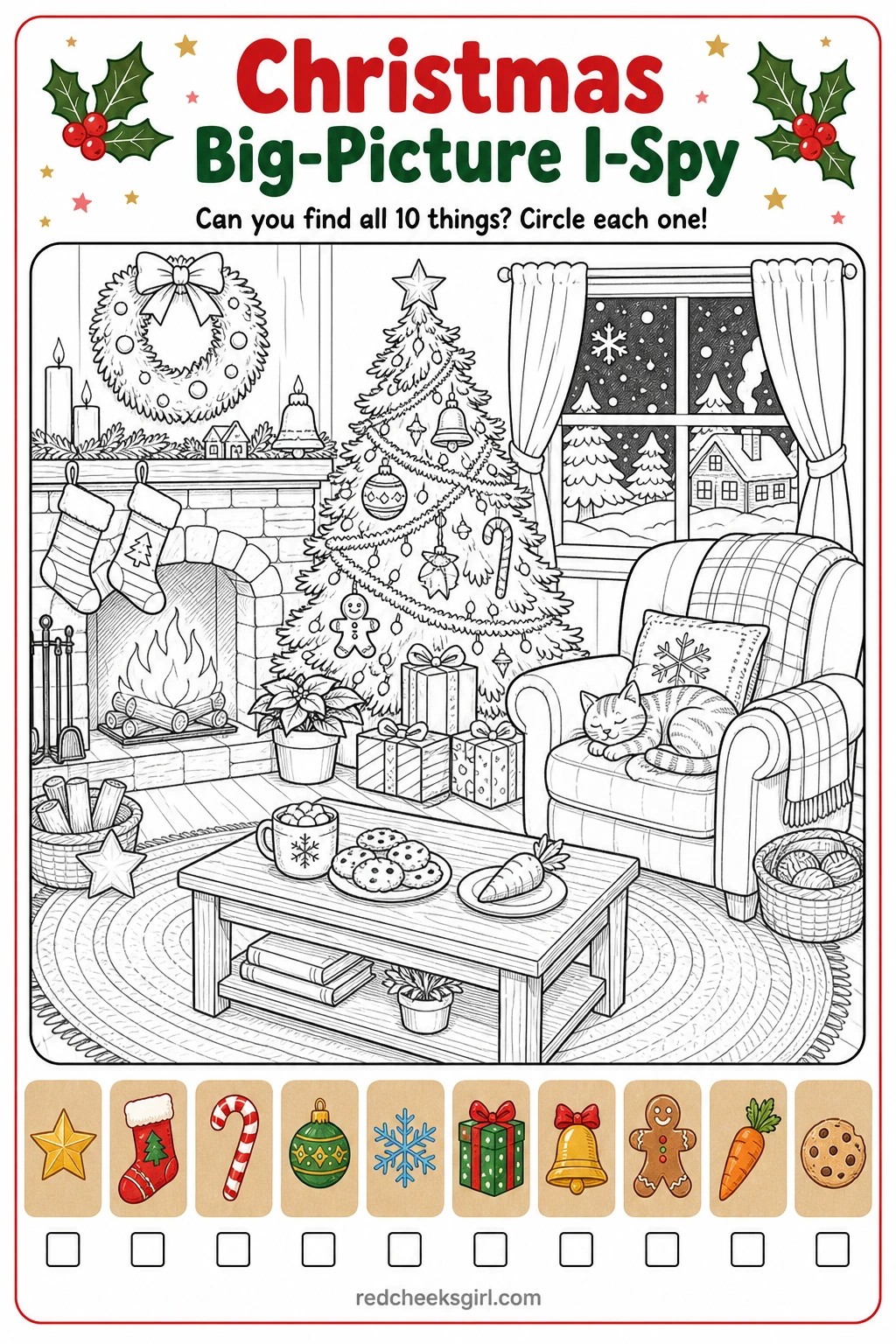
This printable is basically a gift to every grown-up at the party — pop a sheet in front of a toddler and watch them quietly search a cheerful Christmas scene for hidden objects for a solid five minutes.
The Big-Picture I-Spy sheet features one large, detailed Christmas illustration (a cozy living room full of holiday details) packed with easy-to-spot items like a star, a stocking, a candy cane, a reindeer, a snowflake, a gift, a bell, a gingerbread man, a carrot, and a cookie.
Because toddlers can’t read, each search item is shown as a bold picture icon in a row at the bottom of the sheet so they just match what they see.
Print one sheet per child on regular US Letter paper — no laminating required, no special ink. Hand each toddler a chunky crayon and ask them to circle each item they find.
The picture icons along the bottom act as a visual checklist: when they spot the star, they circle the star icon. Older toddlers (closer to three) will want to do this independently; younger ones love doing it on a grown-up’s lap, pointing and shouting ‘there!’
at the top of their lungs (very on brand for age two).
This game is pure gold for transitional moments — that awkward ten minutes while you wait for everyone to arrive, or right after snack when energy is crashing.
It also works brilliantly as a quiet activity alongside the livelier games so kids who need a sensory break can decompress without feeling left out. Stack the sheets in a little Christmas folder and they double as a cute party favor to take home!
- Ages 2–3 independently, 1–2 with a grown-up
- Transition time or calm-down moments
- Small or large groups — one sheet each
3. Jingle Bell Shake and Dance
Hand every toddler a large ribbon wand or a soft fabric shaker decorated with jingle bells (think the big sewn-on craft-store kind, not loose small bells — safety first!) and let them go absolutely wild to Christmas music.
The game is simple: shake the bells when the music plays, hold them still and listen when it stops. Bonus: the sound they make is deeply satisfying and toddlers will be obsessed. This one never gets old, tbh.
You can make DIY shakers ahead of time by sewing large decorative bells onto a felt mitten shape or tying them securely to a wide ribbon wand — just double-knot everything and check for loose parts before handing them out.
Alternatively, grab a set of toddler-safe fabric maracas from the dollar store and tie a jingle bell ribbon around the handle for the festive touch. The key is that nothing detaches and nothing is small enough to swallow.
Give the shakers a firm tug test before the game starts.
Beyond being wildly fun, this game sneaks in some serious developmental goodness. Shaking to a beat builds rhythmic awareness, the stop-and-listen mechanic supports impulse control, and gripping the shaker strengthens little hands.
Let toddlers take turns being the ‘music leader’ who decides when to shake and when to stop — even the shyest kiddo lights up when they get to be in charge for a moment. Your tiny guests will beg to play it again and again.
Check every shaker for loose bells before the game — give each one a firm two-handed tug. Safety check takes 30 seconds and saves a lot of stress!
4. Roll the Ornament (Soft)
This is one of those games that sounds almost too simple — and then you watch a room full of toddlers absolutely lose their minds over it and you understand.
Each child gets one large soft fabric or foam ornament (the kind sold in holiday craft packs, about the size of a tennis ball) and rolls it gently across the floor toward a big cardboard ‘tree’ target taped on the ground.
No throwing, no competing, just rolling. That’s the whole wonderful, chaotic, glorious game.
Set up a large green triangle shape on the floor using painter’s tape or a piece of green felt — that’s your Christmas tree target. Each toddler takes a turn crouching down and rolling their soft ornament toward the tree.
Cheer wildly no matter where it lands. Then everyone runs to collect their ornament and brings it back for another turn.
You can loosely count how many land ‘in’ the tree, but honestly toddlers at this age just love the rolling and collecting loop and will happily play indefinitely.
The crouching-and-rolling motion is fantastic for gross motor development, and choosing which ornament to use (offer a few colors) gives toddlers a tiny sense of agency that feels huge to them at this age.
Host tip: keep three or four extra soft ornaments on hand because one will definitely end up under the couch within the first ninety seconds.
Also, soft fabric ornaments double as a safe alternative to the glass ones on your actual tree — so consider this a win all around.
- 4–6 large soft fabric or foam ornaments (no glass, no hooks)
- Painter’s tape or green felt for the floor target
- Clear open floor space at least 6 feet long
5. Christmas Sticker Scene
Give every toddler a printed scene and a sheet of Christmas stickers and watch the magic happen.
The Christmas Sticker Scene sheet features a large, simple, cheerful outline illustration — a big Christmas tree with empty branches, presents beneath it, and a fireplace beside it — with labeled empty zones showing exactly where each type of sticker goes.
Toddlers peel and place stickers independently, decorating the scene their own way. There is no wrong answer, no competition, and no reading required. It is genuinely one of the most peaceful five minutes of any toddler party.
Print the sheet on regular US Letter paper, one per child. Pick up a pack of large Christmas sticker sheets from the dollar store — stars, ornaments, snowflakes, and gifts all work beautifully.
The empty zones on the printable are labeled with a tiny picture icon (a star icon above the treetop zone, an ornament icon above the branch zone) so toddlers understand where each type goes without needing any words.
Peel-and-stick is a perfect fine-motor workout for this age group, and the finished sheet makes an adorable keepsake or refrigerator art moment.
This activity works especially well as a paired station alongside an active game — set up a little table with printed sheets and stickers in the corner so kids who need a break from movement can drift over and get absorbed in stickering.
It’s also a lovely way to keep older siblings or early-arriving guests occupied while you finish setting up.
Pro tip: buy stickers with a slightly larger size than you think you need — the jumbo ones are so much easier for chubby toddler fingers to peel!
- Printed Christmas Sticker Scene sheet (one per child)
- Large Christmas sticker sheets from the dollar store
- Optional: crayons for extra coloring fun after stickering

6. Pass the Present (Hot Potato)
This is the Christmas take on Hot Potato that toddlers genuinely understand because it involves a wrapped present, which they are already very emotionally invested in.
Sit all the little ones in a circle on the floor and pass one soft, lightweight wrapped box around the circle while Christmas music plays.
When the music stops, whoever is holding the present gets to shake it, squeeze it, or just hug it for a moment — and then you start the music again. For toddlers, there’s no ‘out’ mechanic. Everyone just passes and giggles the whole time.
Wrap an empty lightweight box (or stuff it with a few crinkly tissue paper layers for that satisfying rustle sound) in bright Christmas paper with a big bow.
Make sure the bow is the kind that sticks on and is large enough that it won’t detach and become a choking hazard.
Sit kids close together in a tight circle so the passing is easy — toddlers at 18 months may need a gentle hand-over-hand prompt from a grown-up sitting nearby to get the passing rhythm going. By age two and a half, they’ll have it nailed.
The anticipation of the music stopping is genuinely thrilling for toddlers — you’ll see their faces light up when the present lands in their lap. You can play multiple short rounds (90 seconds each) with different music speeds to keep it fresh.
Speed it up to a frantic pace for giggles, then slow it waaay down for dramatic effect. The whole thing takes about four minutes and costs exactly zero dollars if you have a box and some leftover wrapping paper.
Honestly one of the best christmas games for toddlers on this list for sheer bang-for-your-buck fun.
- For very young toddlers (12–18 months), have a grown-up sit behind each child to help with passing
- Keep the circle small — 4 to 6 kids max — so wait time between turns is short
7. Pom-Pom Drop in the Bucket
Simple. Satisfying. Endlessly repeatable. This game involves toddlers standing over a large bucket or plastic bin and dropping chunky pom-poms (the extra-large craft store kind — about 2 inches across) one by one into the bucket below. That’s literally it.
And yet — and I cannot stress this enough — toddlers are obsessed with it. There’s something about the dropping motion, the soft thud sound, and seeing the pom-poms pile up that is just deeply compelling to the under-three brain.
Add a red-and-green color theme and suddenly it’s a Christmas masterpiece.
Grab a bag of jumbo red and green pom-poms from a craft store (they come in packs of 50 or 100 for just a few dollars) and set a large plastic bucket or laundry basket in the middle of your play space.
Have toddlers stand right next to it at first, then take small steps back as their confidence grows. Give each child a small pile of pom-poms and let them drop away.
When the bucket is full, everyone dumps it out together and starts over — this is, apparently, the most exciting part of the whole game. You’re welcome.
This activity is fantastic for hand-eye coordination and the concept of cause and effect (‘I drop it — it goes in!’). It’s also completely mess-free, requires zero competition, and naturally encourages turn-taking when kids share the bucket.
For a fun variation, place two buckets side by side — one for red poms and one for green — and gently encourage toddlers to sort by color as they drop. Boom: color recognition practice smuggled into a party game.
Your guests’ parents will think you’re an absolute genius.
- Jumbo pom-poms in red and green (2-inch size, not small)
- 1 large plastic bucket or deep laundry basket
- Optional: a second bucket for color-sorting variation
8. Waddle Like a Penguin
This game is exactly what it sounds like and it is absolute gold.
Toddlers waddle across the room like penguins — knees together, arms flat at their sides, shuffling their feet — from one side to the other and back again, while Christmas music plays in the background. No props, no winners, no losers.
Just a room full of tiny humans waddling around looking completely unhinged in the best possible way. If you’ve ever needed visual proof that toddlers are the funniest people on earth, this is it.
Call out ‘Waddle like a penguin!’ and demonstrate the move yourself (knees together, arms stiff, small shuffling steps) — toddlers are natural mimics and will copy you instantly.
Play this as a back-and-forth relay from one side of the room to the other, or just let everyone waddle freely around the space for 60-90 seconds.
You can add a soft ‘snowball’ (a white pom-pom or crumpled white tissue paper ball) that toddlers try to hold between their knees as they waddle — it never stays there, which is somehow even funnier, and it’s totally soft and safe when it drops.
Movement games like this one are important for toddler parties because they channel big physical energy in a structured, safe way without any competitive pressure.
The penguin walk also strengthens inner thigh muscles and improves balance — again, zero chance the toddlers know this and that’s fine. Rotate between a few different animal walks (reindeer stomping, elf tiptoeing) to extend the game naturally if the crowd is loving it.
Honestly though? They’ll just keep asking for the penguin.
- Channels physical energy safely with no competition
- Toddlers copy what they see — just demonstrate and they follow instantly
- Optional soft snowball between knees adds challenge without any risk
9. Feed Rudolph Soft Toss
Set up a large felt or cardboard Rudolph face on the wall or propped on a chair, with a wide open mouth (think: a big enough hole that a soft pom-pom glides right through it).
Toddlers stand close — really close, like two feet away — and gently toss a large soft ball or jumbo pom-pom into Rudolph’s mouth to ‘feed’ him. Every successful toss (and every wild miss) gets celebrated with cheers.
Rudolph is always hungry, so this game loops seamlessly for as long as kids are interested.
You can DIY the Rudolph face from a large piece of brown craft foam or cardboard, cut a circular mouth hole about 5–6 inches wide, add googly eyes (the big kind, glued securely by an adult), felt antlers, and a red circle nose.
Mount it on the wall low enough for toddlers to aim at it comfortably, or prop it against a sturdy chair. Use jumbo craft pom-poms or soft fabric balls for tossing — nothing hard, nothing small.
Start with toddlers standing very close and gradually move the toss line back only if older kids in the group are ready for more challenge.
The beauty of this game for toddlers is that the target is large, the props are soft, and there is literally no way to ‘fail’ — every toss is a chance for a cheer.
That no-failure structure is so important for this age group, where frustration tolerance is still developing. Plus, the throwing motion is a genuine gross motor milestone for one-to-three-year-olds.
Host tip: make a big theatrical ‘nom nom nom’ sound every time a pom-pom goes through Rudolph’s mouth. The toddlers will absolutely lose it every single time. Trust me on this one.
- Large Rudolph face cutout with a 5-inch mouth hole (DIY from cardboard or craft foam)
- Jumbo soft pom-poms or small fabric balls
- Painter’s tape to mark the toss line on the floor
10. Cotton Ball Snow Scoop
Scatter a big pile of cotton balls across a tray or the center of a table and give each toddler a large serving spoon or a small plastic ladle. Their mission: scoop up the cotton balls (‘snowballs!’)
and transfer them one at a time into a festive red or green bowl in front of them. The cotton balls are incredibly light, they drift and bounce in ways that are endlessly surprising to a toddler, and scooping them feels like actual magic.
This game keeps little ones focused and busy for a solid five minutes, which in toddler-time is basically an eternity.
Set up one tray or low table in the center with a big mound of cotton balls. Give each child their own bowl and spoon — thrift store or dollar store finds work perfectly.
Large spoons are easier for younger toddlers; if you have a mix of ages, give the one-year-olds a wider, flatter spoon for easier scooping success. The cotton balls won’t spill dramatically when dropped, so this is a genuinely low-stress setup.
When the bowl is full, toddlers can dump it all back on the tray and start again — a very important feature of any good toddler game.
This is one of those quietly wonderful christmas games for toddlers that looks simple but is doing a lot of heavy developmental lifting. Scooping and transferring builds the fine motor control that will eventually help kids write and draw.
It also teaches spatial reasoning (‘will this fit on the spoon?’) and basic cause-and-effect. The ‘snow’ theme lands perfectly with toddlers because they can connect it to the real thing they’ve seen outside or in books.
For an extra festive touch, sprinkle a tiny bit of silver glitter on the cotton balls — just seal it in with a light mist of hairspray first so it doesn’t come off on little hands.
- Use wide, flat serving spoons for 12–18 month olds
- Skip the glitter for very young babies who mouth everything
- Place a felt mat under the tray to catch dropped cotton balls easily
11. Peekaboo Santa
This one is basically a turbo-charged game of peekaboo with a festive twist, and if you’ve spent any time with a toddler in the last five minutes you already know that peekaboo is the greatest game ever invented as far as they’re concerned.
One grown-up or older helper wears a large Santa hat and hides behind a big piece of red felt or a festive blanket. They slowly pull it down and pop up with a big ‘Ho ho ho!’
— toddlers can also take turns ‘hiding’ behind the felt and popping out as Santa. Repeat until everyone has had a turn (and then repeat seventeen more times because they won’t want to stop).
You just need a large Santa hat (available everywhere for a dollar or two in December), a big piece of red fleece or felt cut to about the size of a bath towel, and a low chair or the floor.
Keep the hiding and popping-up gentle and slow for the littlest ones — the buildup is where all the excitement lives for toddlers, so stretch that ‘pulling the felt down slowly’ moment as long as possible before the big reveal.
Let toddlers help hold the felt up and then dramatically lower it on the count of three for extra participation.
What makes this game so perfectly suited to the toddler brain is that it plays directly into the developmental concept of object permanence — the understanding that things still exist when they’re out of sight.
This is a concept toddlers are literally wired to practice over and over between ages one and three, which is exactly why they never get bored of peekaboo no matter how many times you do it.
Leaning into that natural drive with a festive Santa spin means you’ve got an endlessly repeatable activity that costs approximately nothing. Genius, honestly.
Go slow on the reveal — the slower you pull the felt down, the more toddlers giggle in anticipation. Speed is not the goal here!
12. Big Bubble Snow Chase
Pop out the bubble wand and blow big, slow bubbles across the room — toddlers run around trying to pop every single one before it hits the ground.
Call them ‘snowballs’ or ‘snow bubbles’ and watch even the shyest kiddo turn into a tiny, determined bubble-chasing machine. This game requires zero setup, zero props beyond a bottle of bubble solution and a wand, and produces an almost supernatural level of toddler joy.
The combination of visual tracking, unpredictable movement, and the satisfying pop is basically crack for the under-three crowd.
Use a wide wand for large, slow-moving bubbles that are easier for little arms to reach and pop. Stand in one spot and blow gently so bubbles float at toddler height — around two to three feet off the ground.
Indoors works fine on a non-carpeted floor; if you’re near hard floors, put down a non-slip mat for running safety.
Keep the bubble solution out of toddler reach between blows (they will absolutely drink it given the opportunity, and while modern bubble solution is non-toxic, it is not delicious). A supervising adult beside you can help redirect littles who get too excited.
The ‘snow’ reframe is genuinely magical for toddlers at this age — they don’t question it for a second, they just fully commit to the idea that they are chasing snowflakes and it’s the best day of their lives.
You can extend the game naturally by switching between a giant wand (one huge bubble at a time, very dramatic) and a normal wand for a flurry of smaller ones. The change in bubble size resets toddler attention spans perfectly.
No winner, no timer, no score — just pure joyful chaos for exactly as long as you want it to last.
- Bubble solution (non-toxic, large bottle)
- A wide bubble wand for big slow bubbles
- Non-slip mat if playing on hard floors
13. Stack the Soft Blocks Tree
This is a toddler classic with a Christmas costume.
Bring out a set of large soft foam or fabric building blocks — the big squishy kind designed for babies and young toddlers — and challenge everyone to stack them up as high as they can into a ‘Christmas tree’ shape (wide at the bottom, narrowing toward the top).
When the tower inevitably topples, everyone cheers, and you start again. There is no competition, no timer, just the endlessly satisfying loop of building and joyful demolition that toddlers are literally biologically programmed to love.
You don’t need a full fancy block set — even a collection of large empty cereal boxes wrapped in festive paper work perfectly. Aim for at least eight to ten blocks so the stacking challenge is real enough to hold attention.
Show toddlers how to place a wide base first and then stack smaller blocks on top — a very early introduction to balance and engineering concepts, delivered via the medium of Christmas chaos.
Keep the blocks large enough that they absolutely cannot be swallowed (aim for at least 3 inches on every side) and soft enough that when the inevitable flying block moment happens, nobody gets hurt.
This is a fantastic group game because multiple toddlers can build simultaneously or take turns adding one block each to a communal tower — either approach works, though the communal tower tends to produce more dramatic collapses and therefore more screaming laughter.
For a festive variation, place a foam star or a star-shaped sticker on one block and tell toddlers that block has to go at the very top — giving them a mini goal within the open-ended play.
Check out the Non-Scary Halloween Activities for Toddlers post for more great soft-prop game ideas that work year-round with this crowd!
- Groups of 2–5 toddlers building together
- Ages 18 months and up for stacking independently
- Also perfect as a free-play station between structured games
14. Color Sort the Pom-Poms
Dump a big pile of jumbo red, green, and white pom-poms into the center of the play area and set out three matching bowls or boxes — one red, one green, one white (wrap plain boxes in colored tissue paper if you don’t have colored containers).
Toddlers sort the pom-poms by color into the matching bowl. That’s the whole game — and it is genuinely absorbing for this age group in a way that feels almost impossible until you witness it.
Kids as young as 18 months will dive in and sort with absolute focus, because categorizing and matching is something the toddler brain is actively hungry to do.
Jumbo craft pom-poms (the two-inch size) are ideal here — big enough to handle easily, soft, and impossible to choke on.
Lay out the three labeled bowls on a low table or the floor, with a small picture of the color painted or taped to each bowl as a visual cue.
Let toddlers work at their own pace without correction — if a red pom-pom goes in the green bowl, just celebrate the attempt.
The independence and self-direction this game gives toddlers is genuinely rare at a group party, and kids who need a quieter moment will gravitate to it naturally between louder activities.
This game doubles as a brilliant winding-down activity after something high-energy like Freeze Dance or Bubble Chase — the focused, repetitive sorting motion is actually calming to the toddler nervous system, like a reset button in pom-pom form.
For a festive boost, stir a handful of silver and gold pom-poms into the mix and add a ‘sparkle’ bowl — suddenly it’s a four-color sort and the older toddlers in the group have a slightly harder challenge.
And if you’re looking for great gifts to go alongside these party activities, this Christmas gift guide for parents has some seriously lovely ideas.
- Sorting by color is a core developmental milestone for ages 18 months–3 years
- Soft jumbo pom-poms are completely safe and endlessly reusable
- Works as both a group game and a calm independent station
15. Twinkle Lights Calm-Down Circle
Every good toddler party needs one moment where everyone just… breathes. The Twinkle Lights Calm-Down Circle is that moment, and it is genuinely beautiful.
Gather all the little ones into a cozy circle on a soft rug or blanket, dim the room lights slightly, and drape a string of large warm LED fairy lights across the center of the circle (the battery-operated kind that don’t get hot — very important for toddler safety).
Play a gentle instrumental Christmas lullaby softly in the background. Toddlers sit, watch the lights twinkle, and just exist peacefully for a few minutes. It’s like a snow globe moment for tiny people.
Keep the LED lights out of grabbing range by draping them loosely across a low basket or coiling them in the center of the circle — battery-operated, warm white, large-bulb LED strings are totally safe but you still want them supervised and not tangled around little fingers.
Sit in the circle yourself and model slow, calm breathing: breathe in while the lights twinkle, breathe out slowly. You don’t need to explicitly teach breathing — toddlers will just naturally sync to the calm energy around them.
You can also gently pass a soft fabric star or a small stuffed polar bear around the circle for toddlers to hold while they watch the lights.
This game earns its place on the list because it does something none of the other activities do: it actively regulates toddler nervous systems after a run of exciting games.
Sensory overload is real for kids this age, and a two-to-three-minute calm circle prevents the meltdown that might otherwise happen around the forty-five-minute mark of a party. It also creates a magical, quiet memory that’s genuinely different from the chaos of the other games.
Parents will love you for it, and so will the toddlers — even if they don’t have the words to tell you so yet.
- Use battery-operated LED lights only — they stay cool to the touch and are completely safe near toddlers
- Keep this activity to 3 minutes max — it’s a reset, not a nap!
- Play it between two high-energy games for the best calming effect
Frequently Asked Questions
What are the best christmas games for toddlers at a party?
The best christmas games for toddlers are ones that use large, soft props, run under five minutes, require no reading or competition, and can be repeated easily. Games like Christmas Freeze Dance, Pom-Pom Drop in the Bucket, and Peekaboo Santa hit all those marks perfectly.
The key is keeping rules non-existent (toddlers do not care about rules) and celebration constant (toddlers absolutely care about being cheered for).
What age are these toddler Christmas games suitable for?
Every game on this list is designed for ages 1–3, with notes on how to adapt for the youngest end (12–18 months) versus the older toddlers (2.5–3 years). Younger toddlers will need a grown-up nearby for hands-on help; older ones can participate more independently.
Games like the Christmas Sticker Scene and Color Sort the Pom-Poms work especially well for the youngest group, while Freeze Dance and Waddle Like a Penguin are great for confident walkers of any toddler age.
How long should each christmas game for toddlers last?
Aim for three to five minutes per game — toddler attention spans are genuinely short and that’s completely normal and developmentally appropriate. The magic is in the variety: cycling through several short games keeps energy high and meltdowns low.
If toddlers are loving a game and begging for more, repeat it! Repetition is actually how toddlers learn and play, so running the same game twice in a row is a feature, not a bug.
Are there any Christmas games for toddlers that are safe with no small parts?
Yes — every single game on this list is specifically designed with zero small parts. We’re talking jumbo pom-poms, large soft blocks, fabric ornaments, big bubble wands, and battery-operated LED lights (kept out of reach).
Before any game starts, do a quick sweep of your play space for anything small that a toddler could pick up and mouth. The golden rule for toddler props: if it can fit through a toilet paper roll, it stays out of the game.
How many games should I plan for a toddler Christmas party?
For a one-hour toddler party, plan around six to eight games but have your full list ready as backup.
With five-minute games you have plenty of buffer, and some activities (like Cotton Ball Snow Scoop or the printable sheets) work as open-ended stations that toddlers can drift in and out of.
Always end with a calm-down activity like the Twinkle Lights Circle — it brings energy levels down gently and sets up a smooth transition to snacks or home time.
Can I use these Christmas toddler games for a playgroup or classroom?
Absolutely — every game on this list works beautifully for playgroups, daycare Christmas parties, and preschool classroom celebrations. The printable games (Christmas Big-Picture I-Spy and Christmas Sticker Scene) are especially great for classrooms because one adult can supervise multiple kids doing them simultaneously.
For larger groups, set up two or three activity stations running at the same time and rotate small groups of toddlers through every few minutes.
And there you have it — 15 christmas games for toddlers that are safe, simple, and genuinely fun for every little one in the room, from your fearless two-year-old who runs everywhere to the shy one-year-old who prefers to observe from a safe lap distance (we see you, buddy).
Print out the game sheets, grab your jumbo pom-poms, charge up that speaker, and you are officially ready for the most adorable Christmas party of the season.
Pin this list for later, share it with your playgroup parents, and come back to it every December — these games are so repeatable that they’ll be just as magical next year. Want more festive fun ideas?
Check out these Simple Halloween Games for Kids’ Parties to keep the party inspiration going all year long!
📌 Save These for Later
Loved these? Pin your favorite image below so you can find this list again when you’re planning.

Browse 20 Christmas decorations guides by color and style, from red velvet to pastel blush, each giv

21 gold christmas decorations carried room by room, from the front door to the bedside table, in cha
40 Christmas gift ideas for kids, sorted by the kid you actually have: builder, reader, mover, scien
Leave a Reply