

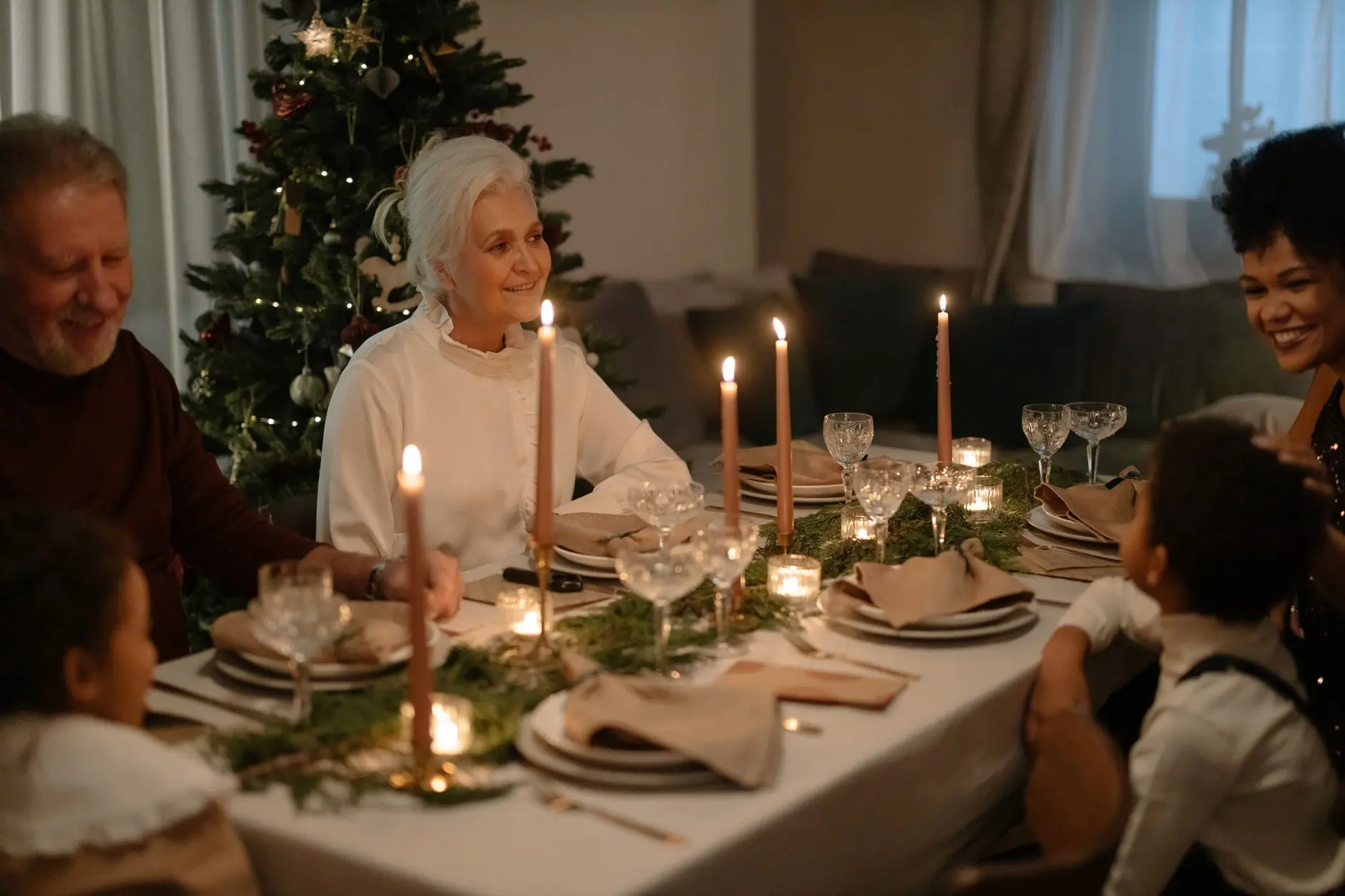
If you’ve ever watched Grandpa politely sit out a game while the teenagers dominate and the toddlers melt down, you already know the struggle of finding christmas party games for family that actually work for every single person in the room.
I’ve been that host — sweating through the appetizers, praying my game lineup doesn’t turn into a generational standoff — and I promise you, it doesn’t have to go that way.
These 22 games were hand-picked specifically because they mix ages beautifully, keep the energy up without exhausting anyone over 70, and give the five-year-olds just as much to cheer about as the competitive uncles.
So whether your crew is 6 people or 60, whether you’ve got toddlers rolling around on the floor and grandparents in armchairs, this list has you covered from the first carol to the last candy cane.
Every game below includes a note on how to adapt it for your youngest and oldest guests, because nobody deserves to sit on the sidelines at Christmas.
Grab a cup of cocoa, pull up the 2025 Christmas Gift Guide for prize ideas, and let’s plan the most multigenerational Christmas party your family has ever had.
- Christmas Lip Sync Battle
- Christmas Movie Emoji Quiz
- Left Right Christmas Gift Pass
- Christmas Riddles
- Christmas Charades
- Christmas Family Trivia
- Guess the Decade Christmas Ad
- Christmas Coloring Contest
- I’m Packing Santa’s Sleigh Memory
- Musical Chairs (Carol Edition)
- Christmas Jeopardy
- Guess How Many Candy Canes
- Pin the Nose on Rudolph
- Generations Christmas Q&A
- Christmas Scavenger Hunt
- Christmas Pictionary
- Ornament Spoon Relay
- Favorite Christmas Memory Share
- Carol Karaoke
- Guess the Christmas Song Intro
- Gingerbread House Contest
- Cotton Ball Snowball Toss
- Frequently Asked Questions
1. Christmas Lip Sync Battle
This one is trending hard in 2026 and honestly, once you see your dad lip-syncing Mariah Carey into a hairbrush, Christmas will never be the same.
Split everyone into teams of two or three — pairing a grandparent with a grandchild is basically guaranteed chaos and guaranteed magic — and assign each team a classic Christmas banger.
They get five minutes to rehearse their performance, then take the ‘stage’ (your living room rug) for a full dramatic lip sync-off while the rest of the family judges on categories like Most Dramatic, Best Costume Prop, and Most Convincing Vocals.
All you need is a Bluetooth speaker, a playlist of Christmas hits (think ‘All I Want for Christmas,’ ‘Rockin’ Around the Christmas Tree,’ ‘Feliz Navidad’), and whatever props people can grab from around the house — scarves, Santa hats, wooden spoons as microphones.
The host acts as emcee and keeps the scoring on a whiteboard or piece of paper. Award points after each performance, then crown the winning team with a paper-plate trophy that someone decorated during setup.
The whole thing runs about 25-30 minutes and the laughter is absolutely unhinged.
For the youngest kids: let them pick the song and be the ‘hype person’ dancing behind their older partner — they get all the spotlight with none of the pressure.
For grandparents or anyone who’d rather not perform: give them the coveted judge role with a scoring paddle made from a paper plate on a chopstick. Host tip: record every performance. You will watch these videos every Christmas for the next decade, I promise.
- Bluetooth speaker + Christmas playlist
- Santa hats, scarves, or any goofy props
- Scoring paddles (paper plates work great)
- Paper-plate trophy for the winners
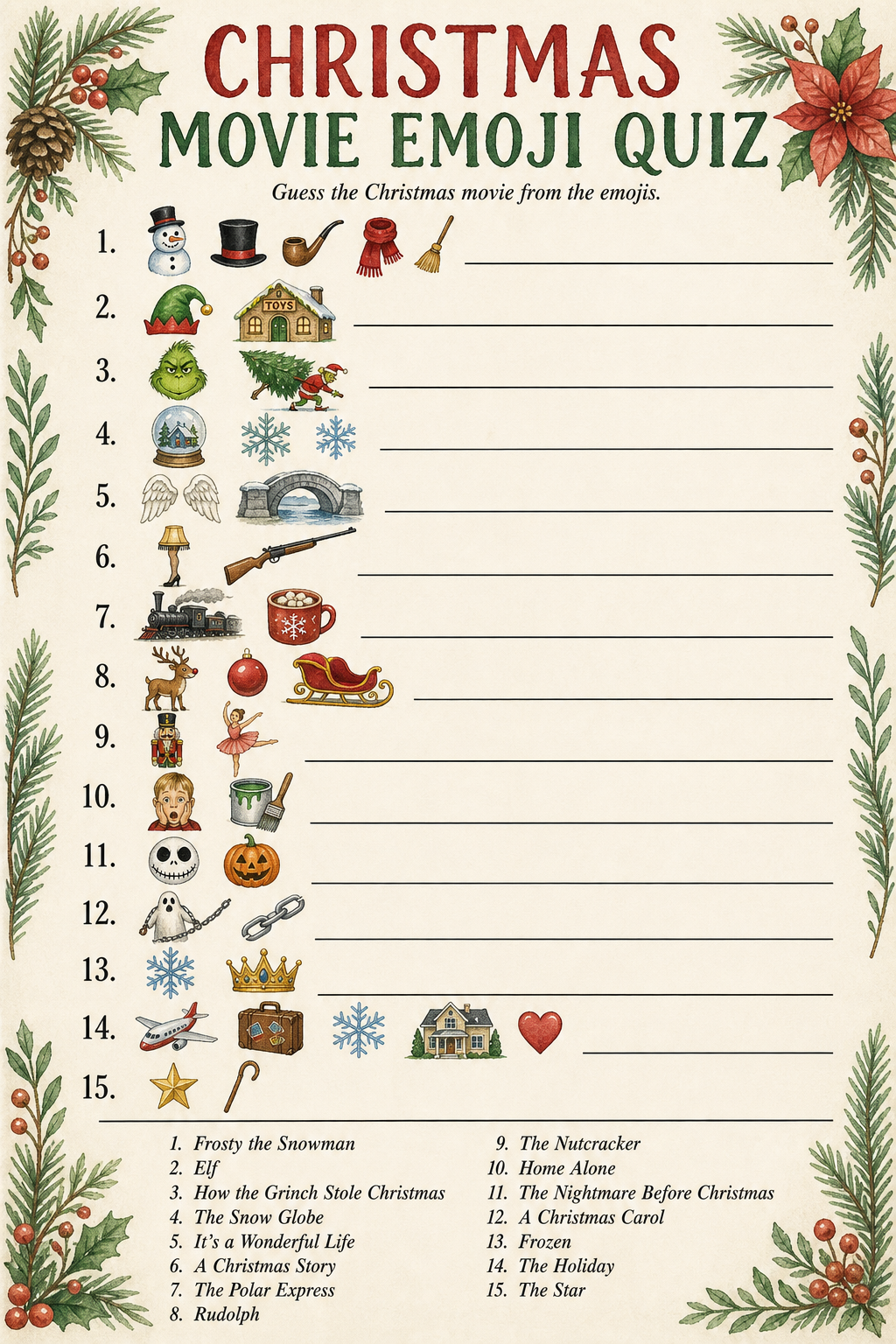
2. Christmas Movie Emoji Quiz
This is the printable game that absolutely wrecks the family know-it-alls in the best possible way.
Each guest gets a sheet featuring 15 rows of actual picture-icon emoji illustrations — tiny drawn symbols like a snowflake, a deer, a red nose, a lamp — and their job is to decode each row into a Christmas movie title.
No words are given, only the emoji pictures, so players fill in their answer on the blank write-in line beneath each clue row. It’s one of those games where a 10-year-old can absolutely crush a 45-year-old, which makes it deeply satisfying for the kids.
Print one sheet per guest before the party (black-and-white prints just fine).
Set a timer for 8-10 minutes and let everyone work independently or in pairs — pairing a young kid with a grandparent works wonderfully here because the grandparent knows the older classics and the kid knows the newer ones.
When time’s up, read out the answers together and have guests tally their own scores. The person with the most correct movie titles wins a small prize like a bag of holiday chocolates or a fun ornament.
For the youngest players: let them work as a team with a grown-up and focus on drawing the pictures they recognize rather than writing — just saying the answer out loud counts.
For grandparents: the sheet intentionally includes a mix of era-spanning movies from ‘It’s a Wonderful Life’ all the way to newer hits so there’s something everyone knows.
Variation: make it a team game where the whole table collaborates and sees if they can get a perfect score together — it gets surprisingly competitive.
- All ages 6 and up
- Groups of 4–30 guests
- Works great as an arrival activity while people trickle in
3. Left Right Christmas Gift Pass
This is the gift exchange game that replaces awkward White Elephant standoffs with pure, chaotic joy — and it works for literally every age from 4 to 94. Everyone sits in a big circle, each person holding a wrapped gift they brought.
The host (or a dramatic volunteer) reads aloud a Christmas story or poem that has the words ‘LEFT’ and ‘RIGHT’ peppered throughout.
Every time the word ‘left’ is spoken, everyone passes their gift one person to the left; every time ‘right’ is heard, it goes right. When the story ends, you keep whatever gift is in your hands and open it right there in the circle.
You can find free printable Left Right Christmas stories and poems online — look for ones based on a ‘Night Before Christmas’ rewrite or a funny Santa courtroom drama (yes, those exist and they are unhinged and perfect).
Print the story in large font for easy reading, and color-code the lefts in green and the rights in red so the reader can really dramatically emphasize each word while watching the room scramble. The whole game takes about 10-15 minutes once everyone is seated.
Budget around $10-$20 per gift and keep them gender-neutral so no one ends up stuck with something awkward.
For the youngest kids: seat them next to a parent or older sibling who can guide the passing direction — they’ll catch on fast and love the chaos of watching gifts fly around the circle.
For grandparents: this game requires zero physical effort beyond passing a package sideways, making it completely accessible for anyone with mobility limitations. Best part?
There’s no stealing, no hurt feelings, and the laughter when someone nearly passes their own gift back is absolutely priceless every single time.
Have the reader stand outside the circle so they can watch the room without juggling a gift — the chaos is so much funnier from that vantage point.
4. Christmas Riddles
Don’t underestimate how fiercely competitive a Christmas riddle sheet can get — I watched a 68-year-old grandmother absolutely demolish her grandchildren at this and she has never let any of them forget it.
Each guest gets a printed sheet of 12 holiday riddles, ranging from easy (‘I have branches but no leaves and I stand in your living room — what am I?’)
to genuinely tricky (‘I fall but never get hurt, I cover the ground without a shovel, and kids build armies out of me — what am I?’).
Guests write their answers on the blank line beneath each riddle, working solo or in pairs, with a 7-minute timer running.
Print one sheet per person or per team.
The riddles are designed to have something for every age — the easier ones reward young children who know their Christmas basics, while the trickier ones require a bit more lateral thinking and give adults a fair challenge.
When time is up, the host reads out the answers (printed in small text at the bottom of the sheet) and guests mark their own papers. Highest score wins a little Christmas prize.
For extra fun, have everyone read their funniest wrong answer out loud before revealing the correct one.
For the youngest players: pair them with an older family member and let them tackle the illustrated, simpler riddles together — or let them just draw what they think the answer might be on the back.
For grandparents: riddle knowledge is genuinely timeless, and older guests often have a huge advantage here because they approach clues from unexpected angles.
Variation: turn it into an oral game around the dinner table — the host reads each riddle aloud and the first person to call out the right answer gets a point, no paper needed at all.
Read the riddles aloud around the table instead of handing out sheets — works perfectly for non-readers and those who prefer not to write

5. Christmas Charades
Christmas Charades is one of those timeless christmas party games for family that somehow gets funnier every single year, especially when someone tries to mime ‘Frosty the Snowman’ and it looks more like a collapsing building.
Divide into two teams — and here’s the key for multigenerational fun: deliberately mix the ages on each team, so every team has at least one little kid, one teenager, one middle-aged adult, and one grandparent-level player.
Write Christmas words, phrases, song titles, movies, and characters on slips of paper and pop them in a Santa hat. Teams alternate sending one player up to act out their slip without speaking, while the rest of their team shouts guesses.
Set a one-minute timer per turn and keep a running tally on a whiteboard or chalkboard.
Categories to include on your slips: Christmas movies (Elf, Home Alone, A Christmas Carol), characters (the Grinch, Rudolph, the Elf on the Shelf), songs (‘Jingle Bells,’ ‘Deck the Halls’), and holiday activities (wrapping presents, decorating the tree, building a snowman).
Aim for about 40-50 slips so the game runs a solid 30-40 minutes. The team with the most correctly guessed words wins.
For little ones: give them simple, highly visual words — ‘snowball,’ ‘Santa,’ ‘reindeer’ — and whisper a quick acting hint in their ear before their turn so they feel confident and not put on the spot.
For grandparents: they can absolutely play the full game, but if someone prefers to be the ‘official timekeeper’ with a phone timer, that’s a completely respected role too.
Variation: add a ‘sounds-like’ round where players can mime a rhyming word — this one gets wonderfully chaotic and keeps even the most seasoned charades players on their toes.
- Slips of paper with Christmas words/phrases
- A Santa hat or bowl to draw from
- Whiteboard or paper for scoring
- A phone timer set to 60 seconds
6. Christmas Family Trivia
Nothing reveals more about your family’s Christmas knowledge — or lack thereof — than a good trivia sheet.
This one is built across four clearly labeled categories: Christmas Traditions (general holiday customs), Christmas Movies, Christmas Songs, and Holiday History, with four questions per category for 16 total questions.
The genius of the category format is that every generation tends to dominate a different section: kids clean up on recent movies, grandparents own the history and songs, and the middle generation thinks they know everything until they absolutely do not.
It is humbling and hilarious in equal measure.
Print one sheet per person or one per team — either format works well. Give everyone 10 minutes to fill in their answers on the blank line below each numbered question.
When time’s up, the host reads the correct answers (printed subtly at the bottom of the sheet) while guests score themselves — one point per correct answer, 16 possible total.
Award a small prize to the top scorer, but honestly the real prize is watching someone confidently write the wrong answer and then try to argue with the answer key.
For the youngest players: let them join a grown-up’s team and be in charge of circling multiple-choice style answers if you verbally offer A, B, or C options for the harder questions.
For grandparents: steer them toward the Christmas Traditions and Holiday History sections where their long memories give them a serious competitive edge.
Host tip: read a few of the funnier wrong answers out loud after scoring — it’s always the most memorable part of the whole game and gets everybody laughing together.
- Teams of 2–4 guests mixed across ages
- Works as a dinner-table game with answers called out verbally
- Great for groups of 10–40 people

7. Guess the Decade Christmas Ad
This is one of 2026’s most talked-about party games and it is an absolute knockout for multigenerational groups — primarily because the grandparents will completely annihilate everyone else and they deserve that win.
Before the party, compile a playlist of 10-12 classic Christmas TV commercials from different decades: a Coca-Cola polar bear ad from the 1990s, a department store ad from the 1970s, a tech toy commercial from the 2000s, something from the 1950s black-and-white era.
Play each clip (30-60 seconds) on your TV and give every player a card to write down which decade they think it’s from.
You’ll need a TV or laptop for playback, and the videos are easy to find on YouTube by searching things like ‘vintage Christmas commercials’ by decade. Print simple answer cards — just a row of numbered blanks — or have everyone write in a notebook.
After all clips play, reveal the correct decade for each one and tally up points. One point for the right decade, bonus point if someone can name the brand or product being advertised.
The whole thing plays out in about 20-25 minutes and generates a surprising amount of nostalgic conversation.
For little ones: give them a simplified version where instead of the decade, they just guess whether the ad is ‘old’ or ‘new’ — still earns them a point and keeps them fully engaged.
For grandparents: this is genuinely their moment to shine, because they lived through most of these commercials and can often identify the exact year by the hairstyles alone (impressive and slightly terrifying).
Variation: add a bonus round where players buzz in to name the jingle or tagline — it turns into something between trivia and a memory competition.
Cue up your video playlist before guests arrive so there’s zero fumbling with YouTube in front of everyone — we’ve all been that host and it is not a good look.
8. Christmas Coloring Contest
Here’s the game that levels the playing field completely — a Christmas coloring contest is one of the rare activities where a five-year-old and an 85-year-old start from exactly the same place.
Every guest gets a printed coloring sheet featuring a detailed Christmas scene — think Santa’s workshop packed with elves, toys, a roaring fireplace, stockings, and a beautifully decorated tree. Everyone gets the same set of colored pencils or crayons and 15 minutes on the clock.
The results will range from masterpiece to total disaster and all of them will be displayed with equal pride.
Set up a dedicated coloring station before guests arrive with pencils, crayons, fine-tip markers, and even a few gel pens for the detail-obsessed.
When the timer ends, tape all the finished sheets to a wall or prop them on the mantle and do a gallery walk.
Then vote: give every guest three sticky dots and let them place them on their favorites across whatever categories you choose — Most Festive, Most Realistic, Most Creative Use of Color, and Wildest Interpretation.
The sheet with the most dots in each category wins a small prize.
For toddlers and very young children: give them a simpler version of the sheet with thicker lines and larger spaces — or just let them color freely outside the lines and enter the ‘Most Creative’ category by default (they almost always win it).
For grandparents or anyone with limited fine motor dexterity: offer thicker crayons and a bolder-lined sheet and remind everyone that this is about fun, not perfection.
This game works beautifully as a background activity during cocktail hour when people are still arriving and you need something immediate for everyone to do.
- Printed coloring sheets (one per guest)
- Colored pencils, crayons, and markers
- Sticky dots for voting (3 per guest)
- Tape or clips to display finished art on the wall

9. I’m Packing Santa’s Sleigh Memory
This one is a slow-burn, genuinely magical game that has been played around campfires and kitchen tables for generations — and it works just as beautifully at a Christmas party.
Everyone sits in a circle, and the first person starts with: ‘I’m packing Santa’s sleigh and I’m bringing…’ followed by one Christmas item of their choice. The next person repeats that item and adds their own.
By the time you get five or six rounds in, the list is absurdly long, people are losing their minds trying to remember the order, and the table is in complete chaos — the beautiful, festive kind.
No materials are needed beyond willing participants and a circle of chairs. The host can kick off the game and set the pace, reading out the accumulated list at the end of each round to help anyone who gets stuck.
Set a gentle house rule: if someone forgets an item, the group can give them one collective hint — this keeps the game inclusive rather than eliminating people, which matters when you have a mix of ages and memory abilities at the table.
The game ends when everyone has had a turn adding an item, or when someone gets to 15+ items and the list collapses spectacularly (which is the best possible outcome).
For the youngest kids: give them a prompt before their turn — whisper ‘what’s your favorite Christmas thing?’ so they always have something ready, and seat them early in the rotation when the list is still short and manageable.
For grandparents: this is actually a game that often plays to older adults’ strengths, since memory for lists and sequential information is well-practiced.
Seat grandparents a few spots in so they get to enjoy watching the younger players struggle with the early rounds first — they will find this extremely satisfying.
Zero prep, zero materials, works anywhere — even at the dinner table between courses when you need five minutes of structured fun without getting up
10. Musical Chairs (Carol Edition)
You already know how Musical Chairs works, but the Carol Edition adds a twist that makes it genuinely better for multigenerational groups: instead of random music, you only use Christmas carols, and every time the music stops, the person left standing has to name the carol that was just playing before they’re officially ‘out.’
Get the name right and they earn a seat back — it’s a second-chance mechanic that keeps even the eliminated players engaged and gives music-lovers of all ages a fighting chance.
Set up chairs in the classic inward-facing circle and start with one fewer chair than players.
You’ll need a speaker, a playlist of classic Christmas carols (mix in some trickier ones like ‘Good King Wenceslas’ alongside the obvious ones), and a quick-fingered host on the pause button.
As rounds progress and chairs shrink, the remaining players get into increasingly fierce chair-sprinting competition — which is where you’ll want to implement the adaptation rules below so nobody gets hurt.
Keep the playlist varied and don’t always stop the music at the same length of time — irregular pauses keep everyone on their toes.
For young children: let them be paired with an adult partner who ‘shares’ a chair — the pair is out when there’s no longer a chair for both of them, which means they stay in longer and the toddler never has to solo-sprint.
For grandparents or anyone with mobility considerations: designate one or two ‘reserve chairs’ against the wall that they can play from without rushing — they still participate in the carol-naming bonus round and their musical knowledge often wins them extra seats back.
This game runs about 15-20 minutes and ends with a genuinely exciting final showdown.
- Set up one fewer chair than players in a circle
- Play Christmas carols and stop the music randomly
- Last person standing names the carol for a chance to win a seat back
- Eliminate one chair each round — last person seated wins
11. Christmas Jeopardy
Christmas Jeopardy is the 2026 trending party game that feels impressive to set up but is genuinely pretty easy once you’ve got your categories sorted — and the payoff is enormous.
Create a board with five Christmas-themed categories (Christmas Movies, Carol Lyrics, Holiday Foods, Santa’s Workshop, Christmas Around the World) and four point values per category ($100, $200, $300, $400).
You can build this on a poster board with sticky notes, draw it on a whiteboard, or use a free Jeopardy template on your TV via PowerPoint or Google Slides.
Divide into family teams — mixing ages, as always — and let teams take turns choosing a category and point value.
The host reads the clue in proper Jeopardy format (the answer is given, teams respond with the question — ‘What is…’). Give teams 10 seconds to confer and buzz in with a hand raise or a bell.
Correct answers earn the points; wrong answers lose them. Include one ‘Daily Double’ hidden somewhere on the board for maximum drama.
A full game with 20 clues runs about 25-30 minutes, plus the Final Jeopardy round where everyone bets their accumulated points on one last category reveal — this is always the moment that ends friendships and starts legends.
For little ones: write a few extra ‘bonus’ $50 clues on separate cards covering very simple Christmas knowledge (‘What color is Rudolph’s nose?’) that young kids can answer independently when their team is up — this makes them feel like genuine contributors.
For grandparents: the ‘Christmas Around the World’ and ‘Carol Lyrics’ categories are specifically chosen because they reward long-term cultural knowledge and memory over fast reflexes. Best tip: assign a kid as the official ‘scorekeeper’ — they take the job incredibly seriously and it’s adorable.
- Whiteboard or poster board for the game grid
- Sticky notes or printed category cards
- A bell or buzzer for answers
- Score tracking paper per team
12. Guess How Many Candy Canes
Simple, classic, and somehow still causes an extraordinary amount of debate — Guess How Many Candy Canes is a Christmas party staple that works for absolutely every age from two to ninety-two.
Before the party, fill a large clear glass jar (mason jar, apothecary jar, whatever you have) with candy canes — regular size, mini, or a mix — and count exactly how many went in. Don’t tell anyone.
Set the jar somewhere prominent where guests can examine it throughout the evening and make their official guess on the printed sheet, which also asks for their name and their reasoning (tbh the reasoning section is the funniest part of the whole thing).
Print one guess-and-entry sheet per guest and set up a dedicated ‘Guess Station’ near the jar with a cup of pens.
Guests can return to examine the jar as many times as they like during the party — walking around it, squinting at it, debating strategy with each other — before the guessing sheet is collected.
At the end of the evening, the host reveals the true number and the closest guess (without going over, if you want the Price is Right edition) wins the entire jar of candy canes. This is a genuinely coveted prize at any family Christmas party.
For the youngest players: let them make their guess out loud and a parent writes it down for them — getting to announce a big number is extremely exciting for small children.
For grandparents: experienced candy jar guessers often use calculation methods (layers times rows) that quietly devastate the competition; give them a moment to explain their strategy after the reveal because it’s always fascinating.
Variation: use ornaments in the jar instead of candy canes and the winner gets to pick their favorite from the tree as a prize — an unexpectedly elegant touch.
- Large clear glass jar filled with candy canes (count them!)
- Printed guess-and-entry sheets + pens at the station
- A small prize label or ribbon for the winner

13. Pin the Nose on Rudolph
Pin the Nose on Rudolph is the Christmas party game for family that no age group can resist — and I say this as someone who has watched a 72-year-old man take this game deeply personally.
Hang a large poster of Rudolph the Red-Nosed Reindeer on the wall (drawn on butcher paper or printed and taped together from multiple sheets).
Cut out red circle ‘noses’ from red construction paper or foam, one per player, with a rolled piece of tape on the back.
Players take turns being blindfolded, spun gently three times, and then guided toward the poster to place their nose as close to the correct spot as they can manage.
Mark each nose with the player’s name or initials before they go, so you can measure afterward and see who got closest.
The host should be standing by to guide younger children safely by the shoulders without steering them — just making sure no one walks into furniture. Play upbeat Christmas music during each person’s turn for atmosphere.
After everyone has had a go, compare the results together: closest nose to Rudolph’s face wins a small treat, and award a special ‘Most Creative Placement’ ribbon for the wildest miss (there’s always at least one nose on an antler).
For toddlers and very young children: skip the spin and just do the blindfold, or let them peek a little — the goal is laughter and participation, not precision.
For grandparents: this game requires only standing in one spot and extending an arm forward, making it genuinely accessible even for guests with limited mobility; the chair-based version (poster at seated height) is a completely valid adaptation.
This game runs about 15 minutes and the comparison reveal at the end — where you see all the noses scattered across poor Rudolph — is its own comedy event.
- Large Rudolph poster (DIY on butcher paper works perfectly)
- Red construction paper or foam circles for noses
- A blindfold or bandana
- Tape and a marker to label each nose
14. Generations Christmas Q&A
This is the quiet, deeply meaningful game at the heart of any truly great multigenerational Christmas party — the one that gets referenced in family stories for years afterward.
The concept is simple: a set of specially designed conversation cards with questions that are specifically crafted to be answered differently by different generations, creating a natural, fascinating cross-generational dialogue. Questions range from ‘What was the best Christmas gift you ever received as a child?’
to ‘How did your family celebrate Christmas when you were young — what was different from today?’ to ‘If you could go back to one Christmas from your past, which would it be and why?’
Deal three cards to each person around the table or living room circle. Going around, each person reads one card aloud and answers it — but before the next card, anyone in the group can respond to the same question from their own generational perspective.
The host gently facilitates, making sure quieter guests get space to share and encouraging follow-up questions (‘Wait, Grandma — you had to make your own decorations? Tell us more about that.’).
This game has no winner and no loser, which makes it genuinely the most inclusive activity on this entire list.
For young children: include age-appropriate questions like ‘What is your favorite Christmas food?’ and ‘What is the best thing about Christmas morning?’ so they have comfortable entry points into the conversation.
For grandparents: these questions are genuinely designed for them — their answers are often the richest, most vivid contributions to the conversation, and other family members’ reactions to hearing stories from decades past is one of the most beautiful things that can happen at a Christmas gathering.
Tip: have someone quietly write down the best answers — they make wonderful keepsakes and holiday letter material.
No right or wrong answers means nobody feels excluded — the grandparents’ stories and the toddlers’ answers are equally celebrated, which is exactly what Christmas is about.
15. Christmas Scavenger Hunt
A Christmas Scavenger Hunt is one of the best christmas party games for family when you have a big age range, because you can design the clues to play to each generation’s strengths and assign roles so everyone contributes.
Divide into mixed-age teams of three to five people, then send them off to find a list of 15-20 Christmas-themed items hidden or naturally occurring around the house and yard: a red ornament, a candy cane, something that jingles, a holiday card with a reindeer on it, a wrapped gift with a bow, a piece of tinsel, and so on.
First team to collect all items (or the most within a time limit) wins.
Write the clue list in advance and print one per team. For indoor/outdoor safety, create a boundary map — stick to specific rooms inside or a defined area outside — and brief all guests before starting.
Designate a ‘home base’ where teams return items for verification. Use a 15-minute timer to keep things moving.
You can do two variations: a collection hunt (actually bring the item back) or a photo hunt (photograph it on a phone and show the host) — the photo version works better for large, fragile, or attached items like the Christmas tree star.
For toddlers: assign them the ‘official carrier bag holder’ role so they’re physically involved even if they can’t read the list yet, and point them toward easy-to-spot items like a red ornament or a candy cane.
For grandparents: give them the ‘decoder’ role — they read the list and direct teammates where to look, staying comfortably seated while the younger members sprint around the house.
This game creates wonderful cross-generational collaboration and you’ll hear phrases like ‘Grandpa, where do you think the tinsel is?’ which is frankly delightful.
Hide a few extra ‘bonus’ items with clue cards attached — the team that finds a bonus item gets an extra point and it keeps faster teams engaged while slower teams catch up.
16. Christmas Pictionary
If you thought Christmas Charades was funny, wait until you watch someone try to draw ‘Elf on the Shelf’ under a 60-second timer while their team collectively loses their minds.
Christmas Pictionary works exactly like the classic game: teams take turns sending one artist to the board to draw a Christmas-themed word or phrase while teammates guess, no speaking or writing letters allowed.
Split into mixed-age teams — again, the age-mixing is essential — and use a whiteboard, chalkboard, or large paper pad propped on a chair. Write Christmas clues on folded slips of paper: movie titles, characters, Christmas activities, song titles, holiday foods.
Set a one-minute timer for each drawing round. The drawing player picks a slip from the hat, gets five seconds to think, then draws. If the team guesses correctly within the minute, they get a point.
If not, the other team gets a chance to steal by making one guess. Keep score on the board and play until every team member has drawn at least twice.
The game typically runs 30-35 minutes and produces a truly astonishing collection of drawings that you’ll want to keep.
For young children: let them pick from a simplified slip pile with easy visual concepts — ‘snowball,’ ‘Christmas tree,’ ‘present,’ ‘candy cane’ — so their drawing turn feels just as successful as the adults’.
For grandparents: they are sometimes the most unexpectedly gifted Pictionary artists, particularly for classic concepts, and their teammates’ reactions to realizing Grandma can draw a really excellent sleigh are priceless.
Variation: play ‘team Pictionary’ where two people draw together simultaneously, which doubles the chaos and laughter and is especially good for mixed-age pairs.
Separate the clue slips into ‘Easy,’ ‘Medium,’ and ‘Hard’ piles so young kids always draw from Easy and can still contribute without feeling overwhelmed
17. Ornament Spoon Relay
This is the game that starts orderly and absolutely dissolves into joyful mayhem within thirty seconds, which is exactly what a Christmas party needs.
Set up two identical relay courses across the living room or down a hallway: a starting cone (or pile of ornaments) on one end and a basket or bowl on the other.
Players must carry a round Christmas ornament balanced on a large serving spoon from the starting point to the basket and drop it in — without using their hands to steady it.
Teams race each other in relay format, with each team member completing the course before handing the spoon to the next.
You’ll need large serving spoons (one per team), a handful of round plastic ornaments per team — plastic, not glass, please, for obvious dropped-ornament reasons — and two identical baskets or bowls as the drop zone.
Set up the course about 8-10 feet long so it’s a genuine challenge without being a marathon. If an ornament falls off the spoon, the player must go back to the start of their leg and try again.
The team that gets all players through the course first wins. Play three rounds for maximum chaos.
For toddlers: let them use a wider, flatter spoon and a slightly shorter course — or pair them with an older sibling who holds the spoon while the toddler carries the ‘official cheer flag.’
For grandparents or anyone with balance concerns: offer the seated relay option, where they sit in chairs positioned along the course and hand the spoon sideways to the next team member — they’re still an essential link in the relay chain and their cheering is half the fun anyway.
This game is best played with socks on hard floors for maximum hilarious slipping (supervised, of course).
- Large serving spoons (one per team)
- Plastic round Christmas ornaments (not glass!)
- Two baskets or bowls as drop zones
- A clear 8-10 foot relay course in a safe open space
18. Favorite Christmas Memory Share
This one isn’t really a ‘game’ in the competitive sense, but it is one of the most powerful things you can do at a multigenerational Christmas gathering — and I’d argue it’s more valuable than any game on this list.
Set up a simple talking-stick format: pass around a meaningful object (a special ornament, a wrapped candy cane, a bell) and whoever holds it shares their single favorite Christmas memory.
It could be from childhood, last year, or something that happened when their own kids were small. The only rule is that everyone listens without interrupting, and applause is encouraged after each share.
You can run this during dessert when everyone is already seated and full and happy — the mood is perfect.
The host starts to break the ice and model the vulnerability it takes to share genuinely (‘My favorite Christmas memory is the year my dad stayed up all night assembling a bike and fell asleep under the tree’).
Keep the object moving around the circle without pressure — anyone can pass if they want to, though most people won’t once they hear a few stories. Budget about 20-25 minutes for a group of 10-15 people.
For young children: prompt them with ‘What is your favorite thing that happened at Christmas?’ so the question is age-accessible and their answer — usually something gloriously specific like ‘when the dog ate the wrapping paper’ — gets the biggest laugh of the evening.
For grandparents: these shares are often the most vivid and moving, and younger family members hearing stories from 50 or 60 years ago is an irreplaceable gift that no bought present can replicate.
Consider having someone jot down highlights discreetly — you’ll want these stories later, I promise.
This game creates real emotional connection between generations — grandchildren hearing their grandparents’ childhood Christmas stories is the kind of memory that outlasts any gift.
19. Carol Karaoke
Carol Karaoke is the Christmas party game for family that requires almost zero setup and produces a completely disproportionate amount of joy — I’m talking ‘strangers becoming best friends’ levels of joy.
Queue up a Christmas karaoke playlist on YouTube (there are hours of free content available) or use a karaoke app on your phone mirrored to the TV, and let guests sign up to perform their carol of choice solo, in pairs, or as a full group singalong.
No singing ability required — in fact, the worse you are, the more everyone loves you for it. This is the game where the shy family members who’ve never performed tend to absolutely steal the show.
Set up a designated ‘stage’ area with a microphone (a toy mic, a real mic plugged into a speaker, or a dramatically held remote control), and keep a sign-up sheet going through the party so people can add their name and song at any point in the evening.
Run Carol Karaoke in the background during the party’s second half when people are loosened up and ready to commit to a full performance of ‘O Holy Night’ with zero self-consciousness.
Award fun handmade certificates for categories like ‘Best Vibrato,’ ‘Most Festive Hand Gestures,’ and ‘Bravest Key Change.’
For young children: let them pick any carol they know — even just the chorus of ‘Jingle Bells’ — and have the whole room sing backup for them so they feel like a superstar.
For grandparents: classic carols they’ve known for decades are genuinely their forte, and a grandmother belting ‘Silent Night’ with total sincerity is the kind of moment that makes the whole party stop and smile.
Variation: add a ‘group medley’ finale where the entire family sings one carol together as a closing act — it sounds cheesy until you’re actually doing it and someone starts crying, in the best way.
- TV or laptop with Christmas karaoke playlist
- A microphone (toy, real, or a dramatic remote control)
- Sign-up sheet for song and performer names
- Handmade certificates for fun categories
20. Guess the Christmas Song Intro
This game is deceptively simple — play the first 3-5 seconds of a Christmas song intro and watch your family absolutely lose their minds trying to be the first to name it.
It’s basically a Christmas version of ‘Name That Tune’ and it is wildly competitive across all ages because music memory is one of the most persistent forms of recall; grandparents and grandchildren are genuinely on equal footing here.
Prepare a playlist of 20-25 Christmas song intros beforehand, ranging from instantly recognizable (‘Jingle Bell Rock’) to genuinely tricky instrumental versions of lesser-known carols.
Play the intro through your speaker, and the first person to raise their hand and correctly name the song earns a point — play it like a buzzer game with hand-raises as the buzz-in. Keep a running scoreboard on paper.
Include a mix of time periods: classic traditional carols, 1970s-1980s pop Christmas hits, 1990s chart-toppers, and a few contemporary songs so every generation has their moment of glory. If nobody gets it within five seconds, extend to 10 seconds for a half-point opportunity.
Run about 20-25 songs total for a 20-minute game.
For young children: let them work as a team with a parent and whisper their guesses, then raise a hand together — this way they’re fully in the game without the pressure of solo recall competing against adults.
For grandparents: include a healthy selection of pre-1980 carols and classical arrangements where their musical memory genuinely dominates — it’s satisfying to watch a grandparent slam their hand down first on ‘O Christmas Tree’ before any of the younger players even process the notes.
Award a small prize per song correct, or tally for a grand total winner at the end.
Test your playlist before the party with the exact speaker you’ll be using — some intros that sound obvious on headphones are genuinely unrecognizable through a small Bluetooth speaker at party volume.
21. Gingerbread House Contest
The Gingerbread House Contest is where quiet people become architecture visionaries and perfectionists become gingerbread dictators — and it is one of the most beloved christmas party games for family precisely because it gives everyone something to do with their hands while also being viciously competitive.
Set up a crafting station for each team with a pre-assembled gingerbread house kit (the pre-baked ones from the grocery store work perfectly), a generous bowl of royal icing, and a big pile of mixed candy: gumdrops, M&Ms, candy canes, pretzels, sprinkles, and whatever else you can find.
Give each team 20-25 minutes to create their masterpiece.
Divide into multigenerational teams of three to four — and I cannot stress this enough, put at least one grandparent and one child on every team.
The grandparents tend to have the structural instincts (‘that wall needs support before you put the roof on’) while the kids have the decorating vision (‘but what if we put ALL the sprinkles on the chimney’).
The result of this collaboration is both architecturally sound and completely unhinged, which is perfect. After the timer, do a judging walk-around: categories can include Most Festive, Most Structurally Sound, Most Creative, and a crowd-favorite vote.
For toddlers: give them their own small section of a shared house to decorate with big candies that are easy for small fingers to place — they’re incredibly proud of ‘their corner’ and it keeps them safely busy.
For grandparents: some find the fine motor work of detailed candy placement tiring, so assign them the ‘Chief Structural Officer’ role — they plan the layout and supervise while younger team members execute — which is honestly the most important job anyway.
Variation: skip the kits and use graham crackers + frosting for a budget-friendly version that’s actually more unstable and therefore funnier to build.
- One gingerbread house kit per team (pre-assembled kits save time)
- Royal icing or thick frosting for ‘glue’
- Assorted candy decorations: gumdrops, M&Ms, candy canes, pretzels
- Paper plates as bases and plastic knives for spreading icing
22. Cotton Ball Snowball Toss
This game is pure, undiluted Christmas party chaos — the indoor snowball fight that nobody gets cold or wet from, which makes it a universal hit.
Divide into two teams and set up a center line in the room using a piece of tape or a length of ribbon. Dump an equal pile of cotton balls (‘snowballs’) on each side.
When the host yells ‘GO,’ teams have 90 seconds to throw as many cotton balls as possible onto the other team’s side of the line.
The catch: the other team is also throwing them back at the same time, which creates a delightful blizzard situation where nobody is entirely sure what is happening.
When time’s up, the host calls ‘FREEZE’ and everyone must stop immediately — no sneaky last-second throws. Count the cotton balls on each side: the team with the fewest snowballs on their side wins, because they successfully lobbed the most to the other team.
You’ll need at least 50-80 cotton balls for a proper blizzard effect, plus the center line marker. Clear a decent amount of floor space beforehand and check for tripping hazards because the pickup phase gets wonderfully chaotic.
For toddlers: give them their own designated ‘throwing zone’ slightly closer to the center line so their shorter arms can reach — they are absolutely relentless cotton ball throwers and will have the time of their lives.
For grandparents or seated guests: set them up in chairs behind the team line and let them be the ‘defense’ — catching incoming cotton balls and lobbing them back is just as integral as the offensive throwing and they can do it completely from a seated position.
Play two or three rounds in a row because one round is never, ever enough.
- 60-80 cotton balls (the ‘snowballs’)
- Tape or ribbon to mark the center line
- A clear open floor area — move the coffee table out of the way
- A loud timer or phone alarm for the 90-second rounds
Frequently Asked Questions
What are the best Christmas party games for all ages?
The best christmas party games for family span a mix of active, printable, and quiet formats so every age has something they shine at.
Games like Left Right Christmas Gift Pass, Christmas Charades, and Cotton Ball Snowball Toss work brilliantly because they require no reading or special skill — just participation.
Pair those with printable games like Christmas Movie Emoji Quiz and Christmas Family Trivia, and quiet connection games like Generations Christmas Q&A, and you have a lineup that genuinely includes everyone from toddlers to grandparents.
What Christmas games can kids and adults play together?
Almost all of the games on this list are designed for exactly that!
The key is choosing formats where different strengths win: Guess the Christmas Song Intro rewards musical memory (grandparents often dominate), while Cotton Ball Snowball Toss rewards enthusiasm and energy (kids win this one every time).
Team games like Christmas Jeopardy and Gingerbread House Contest work especially well because mixing ages on each team creates natural collaboration rather than competition between generations.
What are some easy Christmas party games that require no prep?
I’m Packing Santa’s Sleigh Memory Game requires literally nothing — just people and a circle of chairs. Favorite Christmas Memory Share needs only a talking object like an ornament or bell.
Christmas Charades needs just a hat and some slips of paper you can write on the spot. Guess the Christmas Song Intro only needs your phone and a speaker.
These four games could be set up in under two minutes and would carry a party for hours.
How do you play White Elephant at a Christmas party?
White Elephant (also called Dirty Santa or Yankee Swap) works like this: everyone brings one wrapped, anonymous gift within an agreed price range. Players draw numbers to determine turn order. The first person unwraps any gift from the pile.
Each subsequent person can either unwrap a new gift or ‘steal’ an already-opened gift from someone else — if your gift gets stolen, you get to unwrap a new one. Most versions allow each gift to be stolen a maximum of three times.
The last person to go gets one final chance to steal any gift in the room.
What are fun outdoor Christmas party games for families?
If you have outdoor space and weather cooperating, the Christmas Scavenger Hunt adapts beautifully to a yard or neighborhood with nature-based clues (find a pinecone, find something red, find something that jingles).
Cotton Ball Snowball Toss can move outdoors with real lightweight snowballs for a wilder version. Ornament Spoon Relay works on a patio or driveway.
If you actually have snow, add a classic snowman-building contest or a snow fort relay race — these need no prep at all and every age can participate.
What Christmas games can you play without buying anything?
Quite a few! I’m Packing Santa’s Sleigh Memory, Favorite Christmas Memory Share, Generations Christmas Q&A, and Christmas Charades (with handwritten slips of paper) all cost exactly nothing. Guess the Christmas Song Intro uses your phone’s YouTube app — free.
Carol Karaoke uses free YouTube karaoke videos. Musical Chairs (Carol Edition) just needs chairs and a phone.
If you’re looking to keep the <a href=’https://redcheeksgirl.com/ways-to-budget-for-christmas/’>Christmas budget tight</a> this year, you can run a full 2-3 hour party game lineup without spending a single dollar on games.
What are good Christmas party games for large groups of family?
The Left Right Christmas Gift Pass scales to any group size and is especially fun with 20+ people because the gift chaos gets delightfully out of control. Christmas Lip Sync Battle works for large groups because the audience reaction is half the game.
Cotton Ball Snowball Toss, Christmas Scavenger Hunt, and Gingerbread House Contest all work in team formats that accommodate 30-50+ guests. Printable games like Christmas Family Trivia and Christmas Movie Emoji Quiz also scale infinitely — just print more sheets.
How do you play Christmas charades with family?
Divide everyone into two or more teams, mixing ages on each team intentionally. Write Christmas-themed words, phrases, movie titles, characters, and songs on small slips of paper and fold them into a hat or bowl.
Teams alternate turns: one player draws a slip, reads it silently, then acts out the clue without speaking, mouthing words, or writing anything. Their team has 60 seconds to guess correctly. A correct guess earns the team one point.
After everyone has drawn at least once, the team with the most points wins. For young children, whisper a simple acting suggestion before their turn so they feel confident. For grandparents who prefer not to act, designate them as official timekeeper or scorekeeper.
What are the most popular Christmas family game night ideas?
The most popular formats combine at least one active game (Charades, Pictionary, Ornament Spoon Relay), one printable game everyone can work on simultaneously (Christmas Trivia, Emoji Quiz, Christmas Riddles), and one quieter bonding activity (Memory Share, Generations Q&A).
Adding a gift-exchange game like Left Right Christmas Gift Pass doubles as both game and present-opening ceremony.
For a complete family game night, pick one from each category and you’ll have a 2-3 hour evening that moves through different energy levels without anyone getting bored or exhausted.
What Christmas games are good for mixed ages including toddlers and grandparents?
The secret is choosing games with flexible participation roles. Cotton Ball Snowball Toss lets toddlers throw from a shorter distance while grandparents play from chairs. Christmas Scavenger Hunt gives toddlers the ‘bag carrier’ job and grandparents the ‘decoder’ role.
Left Right Christmas Gift Pass requires only passing a package sideways. I’m Packing Santa’s Sleigh lets little ones go early (short list) and grandparents go later (full memory challenge).
Gingerbread House Contest pairs a grandparent’s structural wisdom with a toddler’s decorating enthusiasm — and the results are architecturally questionable and completely wonderful.
There you have it — 22 christmas party games for family that will keep everyone from the tiniest toddler to the wisest grandparent laughing, competing, creating, and connecting all night long.
Print the game sheets, queue up the karaoke playlist, fill that candy cane jar, and get ready for the most fun your family has had together in years.
Merry Christmas and may your games be loud, your memories be vivid, and your cotton balls be plentiful. 🎄
📌 Save These for Later
Loved these? Pin your favorite image below so you can find this list again when you’re planning.


22 christmas party desserts that survive the car ride: bars, cups and bites with make-ahead tips, ex

11 Christmas party games for family fun — active challenges, printables & keepsakes for all ages.
12 Christmas ribbon crafts that turn leftover spools into tree, table and gift details that look bou
Leave a Reply