


Thanksgiving classroom games are the secret weapon every elementary teacher needs in the week before break — because let’s be real, the moment those November calendars hit single digits, your students’ attention spans officially leave the building. I’ve been there.
The lesson plan looks great on paper, then someone spots a plastic turkey on the bulletin board and suddenly everyone’s gobbling.
So instead of fighting it, why not lean in with a lineup of genuinely fun, low-mess games that work for 20–30 kids at desks or in a circle, take almost zero prep, and clean up in about thirty seconds flat? Yes, please.
And if you’re already in budget-saving mode for the holiday season, sneak a peek at these 6 Ways to Save on Thanksgiving while you’re planning the party.
Below you’ll find 18 of the best thanksgiving classroom games — a carefully mixed lineup of active group games, printable game sheets, and quiet keepsake activities — spanning every elementary grade from K through 5.
Each one has clear teacher-managed rules, a note on ideal grade range, and a cleanup time that won’t make you cry. Whether you’ve got a 15-minute brain break or a full 45-minute party period, there’s something here for every schedule. Let’s gobble!
- Thanksgiving Kahoot Trivia
- Thanksgiving Bingo
- Heads Up 7 Turkeys
- Thanksgiving Word Search
- Turkey and Feather Hunt
- Rolling for Turkeys (Math)
- Simon Says (Turkey Edition)
- Thanksgiving Word Scramble
- Thanksgiving Charades
- Thanksgiving Riddles
- Pass the Pumpkin (Hot Potato)
- Thanksgiving Hangman
- Silent Turkey Line-Up
- Roll-a-Turkey (Dice)
- Thanksgiving Anagrams
- Desk Turkey Relay (Pass the Feather)
- Thankful ABCs
- Gratitude Scavenger Hunt
- Frequently Asked Questions
1. Thanksgiving Kahoot Trivia
Thanksgiving Kahoot Trivia is the trendiest whole-class game of 2026, and for good reason — every single kid has a device or can share one, the teacher runs everything from the board, and the competitive energy is absolutely electric.
The concept is simple: load or build a free Kahoot quiz packed with Thanksgiving-themed questions (think: which year did Thanksgiving become a federal holiday, what state raises the most turkeys, what did the Pilgrims actually call their harvest feast), project it on your smartboard, and let students answer on their phones, tablets, or school Chromebooks.
A leaderboard updates after every question, so the suspense never dies. Best for grades 3–5, though second-graders who can read quickly love it too.
To set this up in under five minutes, log into kahoot.com, search ‘Thanksgiving trivia for kids’ in the public library, and you’ll find dozens of ready-made quizzes with age-appropriate difficulty levels.
Pick one, hit ‘Play,’ select the ‘Classic’ mode, and share the game PIN on your projector. Students open Kahoot on any browser — no app download required — enter the PIN, and type a fun nickname.
Each question appears on the big screen with four color-coded answer options; kids tap their choice on their own screen. Points are awarded for speed and accuracy, so even the most competitive fifth-grader is glued to the screen until the final podium reveal.
Why it works so well in a classroom setting: Kahoot removes the pressure of public wrong answers (no one can see your choice except you), which means even shy students go all-in.
For a fun variation, let the top three scorers pick the music that plays during lunch, or give a small reward like ‘homework pass.’ Cleanup time: zero seconds — no paper, no pieces, nothing to collect. Just close the browser and you’re done.
Tbh, this one basically runs itself, and your students will be talking about it all the way to winter break.
- Smartboard or projector
- Student devices (phones, tablets, or Chromebooks)
- Free Kahoot account
- Wi-Fi connection
2. Thanksgiving Bingo
Thanksgiving Bingo is the ultimate crowd-pleaser for any elementary classroom party — it works for every grade, every temperament, and every attention span from kindergarten wigglers to fifth-grade eye-rollers who secretly love it.
Each student gets a unique 5×5 bingo card filled with Thanksgiving vocabulary words and images: turkey, pilgrim, harvest, cornucopia, pumpkin pie, cranberry, mayflower, feast, gratitude, and more. The teacher (that’s you!)
calls out clues — either the word itself or a definition/riddle — and students mark their squares with a dry-erase marker, bingo chip, or just a pencil X. First kid to get five in a row hollers ‘Gobble!’ instead of bingo, obviously.
Best for grades K–5.
Print one card per student from the sheet below — because each card is randomized with different square arrangements, no two students have identical boards, which keeps the game fair and the excitement going longer.
For caller cards, simply cut a second copy into individual word squares and draw them from a paper bag or cup. No fancy bingo cage required. For kindergarten and first grade, use picture-only cards with simple illustrations so non-readers can still participate fully.
For upper grades, swap in definitions or Thanksgiving history clues for a sneaky ELA boost. Cleanup time: under 1 minute — collect sheets or let kids keep them.
The reason this classic never gets old is variety — you can play multiple rounds in a single session by declaring a new win pattern each time: straight line, four corners, blackout, or a Turkey shape (the center column plus the two middle diagonals).
Offer a tiny prize for each winner, or skip prizes entirely and just play for bragging rights and the joy of yelling ‘Gobble!’ across the room.
Pro host tip: print a few extra blank cards and have early-finisher students fill in their own vocabulary words for a bonus custom round — instant differentiation with zero extra prep.
Let students mark squares with a small piece of candy corn — then they eat their ‘chips’ at the end for a built-in treat!

3. Heads Up 7 Turkeys
This is the Thanksgiving classroom game every elementary teacher has played in some form, and the turkey twist makes it feel totally fresh for the season. Seven students are chosen as ‘turkeys’ and stand at the front of the class.
Everyone else puts their heads down on their desks and sticks one thumb up — like a little thumbs-up perch waiting for a turkey to land.
The seven turkeys silently sneak around the room and each gently presses one student’s thumb down before returning to the front. The teacher calls out ‘Heads up, 7 turkeys!’
and the seven students whose thumbs were pressed stand up and take one guess each at which turkey snuck up on them. Correct guessers swap places with their turkey. Best for grades K–4.
Setup is literally zero — no supplies, no printing, no cutting. Just rearrange students so the turkeys can move without tripping over backpacks (a quick desk-aisle check takes about thirty seconds).
For a Thanksgiving twist, turkeys must waddle (knees slightly bent, arms out like wings) as they move around the room, which sends the whole class into barely-suppressed giggles.
You can also rename the call: instead of ‘Heads up, seven up,’ the teacher dramatically gobbles three times, then shouts ‘Heads up, 7 Turkeys!’ to the delight of absolutely everyone. Cleanup time: zero seconds.
Why teachers love this one: it’s genuinely silent during the picking phase, which means the class settles right down, and the social deduction element (who walked past me? was that Tyler’s sneakers?) quietly builds observation and reasoning skills.
Play multiple rounds so every student gets a turn as a turkey — with 30 kids and 7 turkeys per round, you can rotate the entire class through in about four rounds.
Bonus: this game is the perfect ‘fill five minutes’ backup when your actual schedule runs short. It has saved many a frantic pre-break afternoon.
- Grades K–4
- Groups of 15–30 students
- Zero-supply brain breaks
- Transition time filler (5–10 minutes)
4. Thanksgiving Word Search
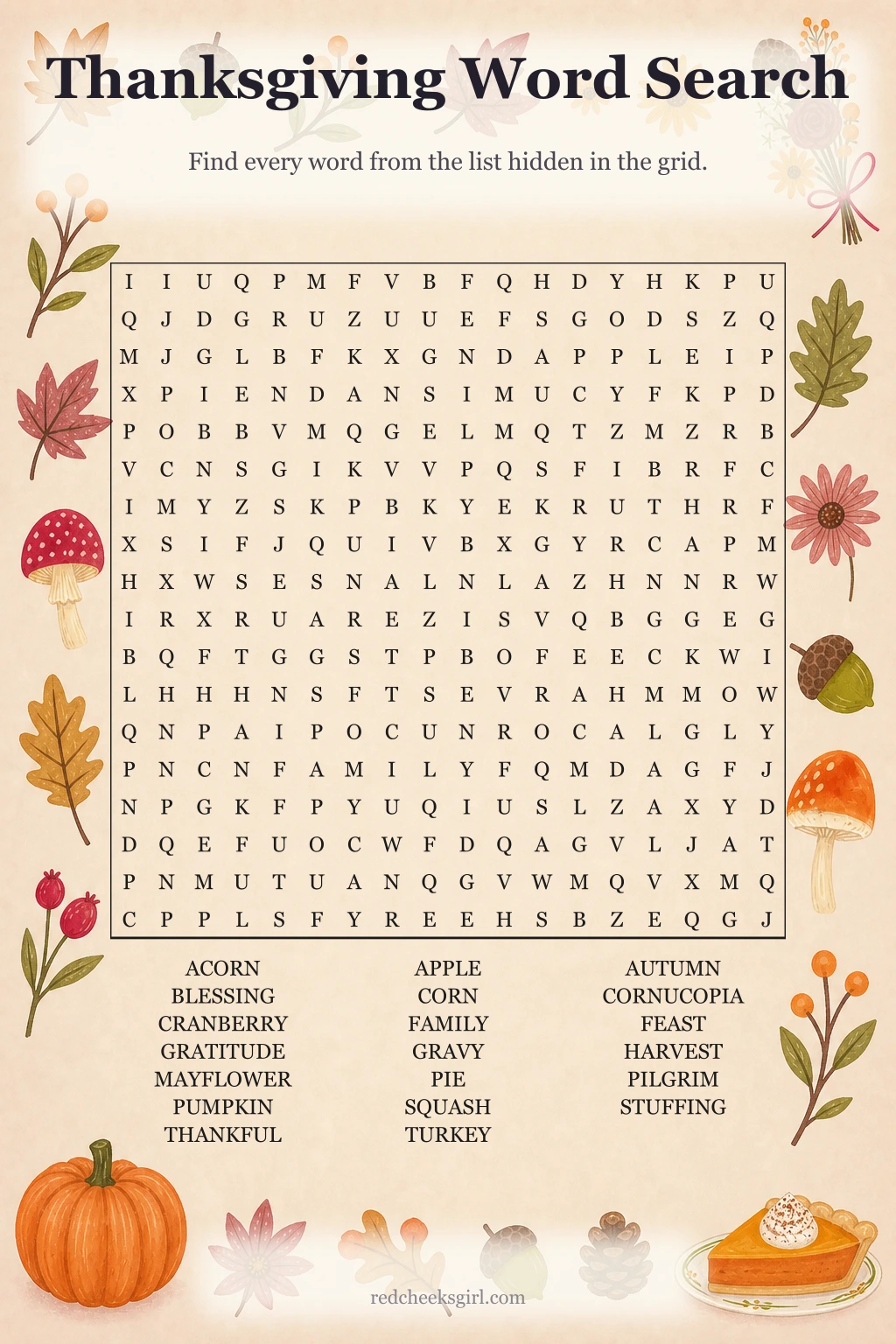
A Thanksgiving word search is one of those perfect independent-work games that keeps every single student quietly occupied at their own desk — and when you’ve got 28 kids coming off a sugar rush from the class treat, that quiet is priceless.
Students receive their sheet and race to find 20 hidden Thanksgiving-themed words tucked inside a 15×15 grid of letters. Words can run horizontally, vertically, and diagonally (forward only for younger grades, reversed for a harder challenge).
The student who circles all 20 words first is the winner, but since word searches are naturally self-paced, even the last finisher still feels successful. Best for grades 2–5 (grade 1 works great with a smaller 10×10 grid).
Print one sheet per student — that’s your entire supply list. No scissors, no glue, no mess. Students need only a pencil or crayon to circle words, and the whole thing fits neatly in their folder to take home afterward.
If you want to add a competitive twist for upper grades, write the 20 words on the board and have students cross them off a list as they find them, then check with a partner — a sneaky vocabulary review hiding in plain sight.
For early finishers, add a bonus challenge printed at the bottom: ‘Use three of the words above in a sentence about what you’re thankful for.’
Here is the teacher secret that makes word searches feel like a party game rather than a worksheet: give a small, ridiculous prize for the winner — a Thanksgiving-themed pencil, a sticker, anything from the dollar store works — and suddenly every kid is hunched over their paper in laser-focus concentration mode.
The room goes completely silent, which is honestly a Thanksgiving miracle in itself. Cleanup time: 30 seconds — collect papers or let kids take them home.
- For K–1, use a 10×10 grid with only 10 words, horizontal and vertical only
- Print the word list in large font beside the grid
- Allow partner play for kindergartners
5. Turkey and Feather Hunt
Think of this as a low-mess, teacher-managed indoor scavenger hunt with a Thanksgiving spin.
Before students arrive (or while they do a quiet starter), the teacher hides 25–30 small paper feather cutouts around the classroom — tucked under a desk edge, taped to the wall behind a poster, slipped into a bookshelf spine, balanced on the pencil tray.
Each feather is a different color (red, orange, yellow, brown) and has a number on the back. On ‘Go!’, students search the room to find and collect as many feathers as they can in two minutes.
When time’s up, everyone returns to their seat, tallies their feathers by color, and the student with the most of any single color wins a round. Best for grades K–3.
Supplies: cut paper feather shapes from colored construction paper or cardstock the day before (takes about five minutes), write numbers 1–30 on the backs, and hide them before class.
Alternatively, print the feathers from a free template online and cut — still only about five minutes of prep.
If you want a math extension, post a point value for each color on the board (red = 3 pts, orange = 2 pts, yellow = 1 pt) and have students calculate their own total score — sneaky mental math practice that feels nothing like a worksheet.
Cleanup time: 2 minutes — collect all feathers back into a zip bag for next year.
Why this game earns its spot over messier alternatives: the feathers are paper, they’re flat, and they fit in a ziploc forever.
There’s no candy to melt on desks, no game pieces to lose under radiators, and no arguing about rules because the hunting phase is simple enough for kindergartners to understand on the first try.
Pro teacher move: if a student finds a feather with a star on the back instead of a number, they win a bonus prize or get to pick the next class activity.
That one little twist keeps everyone checking every single feather they find until the very last second.
- 25–30 paper feather cutouts in 4 colors
- Marker to write numbers on backs
- Optional: point-value chart on board
- Zip bag for storage
6. Rolling for Turkeys (Math)
Rolling for Turkeys is a Thanksgiving math game that genuinely feels like play — kids roll dice, do quick mental math on their sheet, and race to fill up their turkey with feathers before anyone else does.
Each student gets a printed sheet showing a cartoon turkey body in the center with ten blank feather outlines surrounding it. Players take turns rolling two dice, add the numbers together, and write the sum in one of their feather spaces.
The twist: you can only write a sum once, so if you roll a 7 and you’ve already filled in your 7-feather, you lose that turn.
First player to fill all ten feathers wins — or play simultaneously, each student rolling their own die, for a faster version. Best for grades 1–3.
This game needs two standard dice per student (or one die per pair for a partner version) — that’s truly it. The sheet does all the work.
For kindergarten and first grade, use a single die and have students simply write the number rolled, practicing numeral recognition and one-to-one correspondence. For grades 2–3, use two dice and add.
For grades 4–5, upgrade to multiplication dice (or use two dice and multiply) — suddenly ‘Rolling for Turkeys’ is a multiplication fluency drill wearing a very festive disguise.
Have a small cup or tray on each desk to roll dice into so they don’t skitter off desks and become a distraction (teacher pro tip: a Tupperware lid works perfectly). Cleanup time: 1 minute — collect dice into a cup, papers into recycling.
The real magic of this game is that it works beautifully for mixed-ability classrooms because every student can be differentiated with a simple rule change on their individual sheet. Struggling students use one die; on-grade students use two and add; advanced students multiply.
Everyone plays the same turkey game, nobody feels singled out, and you’ve just quietly hit three different math standards in one ten-minute activity.
Your students’ parents will probably hear about this one at the dinner table — and honestly, your colleagues will ask for the printable too.
- Builds addition fluency in a game context
- Easy to differentiate by grade level
- Self-paced so fast and slow learners both finish feeling good
- Requires only dice — no complex prep

7. Simon Says (Turkey Edition)
This is the classic listening game with a Thanksgiving makeover that makes even the most reluctant participant giggle within thirty seconds.
The teacher (or a student leader) becomes ‘Simon the Turkey’ and calls out Thanksgiving-flavored commands: ‘Simon the Turkey says flap your wings!’, ‘Simon the Turkey says stomp like a pilgrim!’, ‘Simon the Turkey says puff up your feathers!’
— and students must only follow commands that start with the full ‘Simon the Turkey says’ phrase. Anyone who moves on a command without the magic phrase sits down, and the last student standing wins the round.
It’s loud, it’s silly, and it burns off about 400% of the pre-holiday fidget energy in approximately three minutes. Best for grades K–3.
Zero supplies, zero prep — the teacher just needs a list of Thanksgiving commands ready to fire off quickly.
Write ten commands on a sticky note before class so you’re not improvising mid-game: ‘waddle like a turkey,’ ‘stir the gravy pot,’ ‘pull a wishbone,’ ‘paddle the Mayflower,’ ‘act like a sleeping pilgrim,’ ‘gobble twice,’ ‘puff up like a pumpkin pie,’ ‘count blessings on your fingers.’
The commands are the entertainment here — the funnier and more specific they are, the more your students will love them.
Deliver them rapid-fire to catch kids off guard, slowing down occasionally to lull everyone into a false sense of security before a sneaky trap command. Cleanup time: zero seconds.
For older grades (3–5) who think Simon Says is ‘too babyish’ (their words, not mine), kick up the difficulty by making the commands two-step: ‘Simon the Turkey says flap your right wing AND gobble once!’
Anyone who only does one part of a two-step command is out — it’s surprisingly challenging and gets very funny, very fast.
You can also flip the leader role to students and use it as a confidence-building exercise: let a quieter student be Simon the Turkey for a round and watch them absolutely own that moment.
It’s one of those thanksgiving classroom games that costs nothing but delivers everything.
Prep a list of 15–20 turkey commands on a notecard before class so the game flows without awkward pauses.
8. Thanksgiving Word Scramble
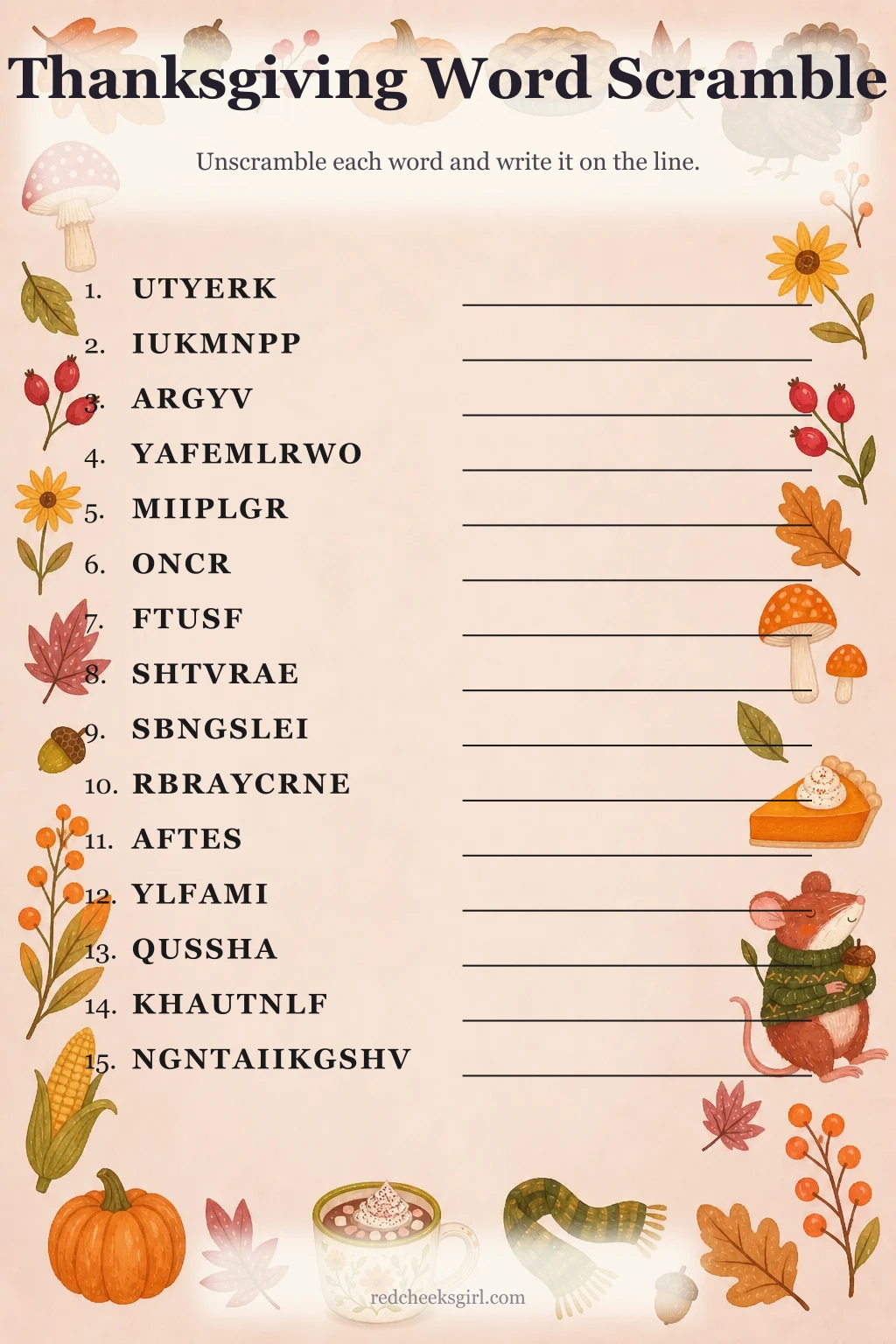
A Thanksgiving Word Scramble is a printable brain teaser that works beautifully as a party opener, a transition activity, or an early-finisher challenge — basically anytime you need students to sit down, focus, and feel smart.
Each student gets a sheet with 15 scrambled Thanksgiving words, each presented as a jumbled set of capital letters with blank lines underneath to write the correct unscrambled word.
The challenge: unscramble words like RYTEKU (TURKEY), LMAFWYREO (MAYFLOWER), or ANSGKNIHTIVG (THANKSGIVING) using only their knowledge and a little brain power. Students work individually or in pairs, and the first to correctly unscramble all 15 wins. Best for grades 2–5.
Print and go — that’s the entire setup. No dice, no scissors, no supplies beyond a pencil.
For grades 2–3, include a word bank at the bottom of the sheet so students can match scrambled letters to known words; for grades 4–5, hide the word bank on the answer key only and let them unscramble cold-turkey (pun absolutely intended).
Time the activity with a visible classroom timer — giving students five minutes creates a nice urgency that makes the room feel like a game show.
When time’s up, go through the answers together as a class using call-and-response: teacher says the clue number, students shout the answer. Cleanup time: 30 seconds.
Here’s why word scrambles outperform plain vocabulary worksheets at a party: the puzzle format activates a different part of the brain — kids are pattern-matching and testing letter arrangements rather than passively reading definitions, which means engagement stays high and the room stays buzzing in the best possible way.
To make it even more festive, add a riddle at the bottom: ‘Unscramble the circled letters from each answer to reveal a hidden Thanksgiving message!’ (The message spells something like ‘BE THANKFUL.’)
That hidden-message bonus keeps fast finishers busy for another two minutes without any extra work on your part.
- Grades 2–5
- Individual or partner play
- 5-minute brain break or party opener
- ELA vocabulary reinforcement
9. Thanksgiving Charades
Thanksgiving Charades is pure, uncut classroom chaos in the very best way — one student acts out a Thanksgiving word or phrase in total silence while the rest of the class shouts guesses.
The acting student draws a folded card from a ‘Thanksgiving hat’ (any container works) and has sixty seconds to act out their clue without speaking, mouthing words, or pointing to objects in the room.
Clues range from ‘cranberry sauce’ (good luck with that one) to ‘football game’ to ‘Mayflower ship’ to ‘eating too much pie.’ The class guesses freely, the teacher keeps time, and anyone who correctly guesses earns a point for their team.
Best for grades 2–5, though confident first-graders absolutely shine at acting.
Prep takes about five minutes: write 20–25 Thanksgiving charades clues on folded slips of paper and drop them in a bowl or paper bag.
Clue ideas include: turkey in the oven, raking leaves, watching the Macy’s parade, passing the mashed potatoes, saying grace, the wishbone snap, a cornucopia, a pilgrim hat, pumpkin pie, a sleeping grandpa on the couch after dinner — specific, silly, relatable clues always outperform vague single words.
Divide the class into two teams; each actor earns a point for their team when the class guesses correctly within the time limit. Tie-breaker: a sudden-death round where the fastest correct guess wins.
Cleanup time: 30 seconds — gather the slips and keep them for next year.
The reason Thanksgiving Charades works so well across all elementary grades is that it requires zero reading (perfect for K–1 if you whisper the clue to the actor) and levels the playing field between high-achievers and struggling readers — suddenly the kid who’s having a hard year in ELA is the funniest actor in the room and everyone cheers for them.
That’s a Thanksgiving moment worth more than any worksheet. If your class is feeling bold, add a ‘team charades’ round where two students act out the same clue together without coordinating beforehand — the resulting chaos is absolutely hilarious and 100% school-appropriate.
- 20–25 clue slips in a bowl or paper bag
- Visible countdown timer (phone or board)
- Optional: two-team scoreboard on whiteboard
10. Thanksgiving Riddles
Thanksgiving Riddles is a printable brain-stretch game that turns vocabulary knowledge and lateral thinking into party entertainment — and kids who don’t usually shine at traditional games suddenly become the stars of this one.
Each student gets a sheet with 12 Thanksgiving-themed riddles printed as short, two-to-three-line poems or clues, each followed by a blank line for the student to write their answer.
Riddles range from easy (I’m round, orange, and you carve my cousin at Halloween — what am I? Answer: pumpkin) to genuinely tricky (I’m not a bird, but I share my name with one. I live at the table but I can’t eat a thing.
What am I? Answer: the turkey platter). Students work individually or with a partner to write answers on the blank lines. Best for grades 2–5.
Print one per student, hand them out, set a seven-minute timer and watch the room hush into focused, furrowed-brow concentration. No supplies needed beyond a pencil.
For K–1, read the riddles aloud as a class and let students shout answers whole-group — it becomes a lively call-and-response game that works beautifully as a morning circle.
For grades 3–5, add a competitive edge by awarding one point per correct answer and tallying up a class leaderboard on the whiteboard.
Going through the answers together at the end is often the most fun part — especially when a clever student defends an unexpected but technically correct answer, which inevitably happens and deserves full credit. Cleanup time: 30 seconds.
What makes riddles uniquely effective as thanksgiving classroom games content is that they sneak in higher-order thinking (inference, wordplay, double meanings) without the stigma of a ‘test.’
Students who read below grade level can still solve riddles through reasoning rather than decoding, and the moment a student’s face lights up with an ‘ohhhh!’ when the answer clicks is genuinely one of the best things you’ll see all November.
Print extras for students to take home and stump their families at the actual Thanksgiving table — free homework, courtesy of you.
Read the hardest riddle aloud last and turn it into a class challenge — first to write the correct answer on their whiteboard or slate wins a point.

11. Pass the Pumpkin (Hot Potato)
Pass the Pumpkin is the Thanksgiving version of Hot Potato — deceptively simple, surprisingly tense, and absolutely guaranteed to get kids on the edges of their seats (literally, because they’re perched and ready to pass the moment the music stops).
Students sit in a circle on the floor or in a tight row of chairs.
A small foam pumpkin, orange ball, or even a balled-up orange construction paper ‘pumpkin’ gets passed around the circle as fast as possible while Thanksgiving music (or any upbeat song) plays from the teacher’s device.
When the music stops, whoever is holding the pumpkin is out — they step into the center of the circle to cheer on their classmates. Last student in the circle wins. Best for grades K–3.
Supplies: one object that can safely represent a pumpkin (a foam ball, a stuffed animal, a balled-up orange paper), plus a device to play and pause music — that’s it.
Use your phone with a Thanksgiving playlist on Spotify or YouTube, or just any upbeat song from your computer speakers.
Make the pauses unpredictable: sometimes stop the music after five seconds, sometimes let it run for twenty, and watch the suspense in the room become genuinely unbearable in the most delightful way.
A key teacher tip: have eliminated students become ‘judges’ who watch for any holding or fumbling — it keeps them engaged and gives them a role rather than just sitting out. Cleanup time: zero seconds.
To turn this into a learning moment without ruining the fun, announce that the student holding the pumpkin when the music stops isn’t out — instead, they have to answer a quick Thanksgiving trivia question to stay in the game.
This variant, sometimes called ‘Hot Pumpkin Trivia,’ is brilliant for grades 3–5 because it ties the active game to content knowledge and means no one ever truly feels eliminated unfairly.
Have five trivia questions on index cards ready to draw from, and make them easy enough that most students can answer with a little thought — the goal is engagement, not humiliation.
For K–1, don’t eliminate students — instead, the holder performs a silly turkey action (gobble, flap, waddle) and stays in the game
12. Thanksgiving Hangman
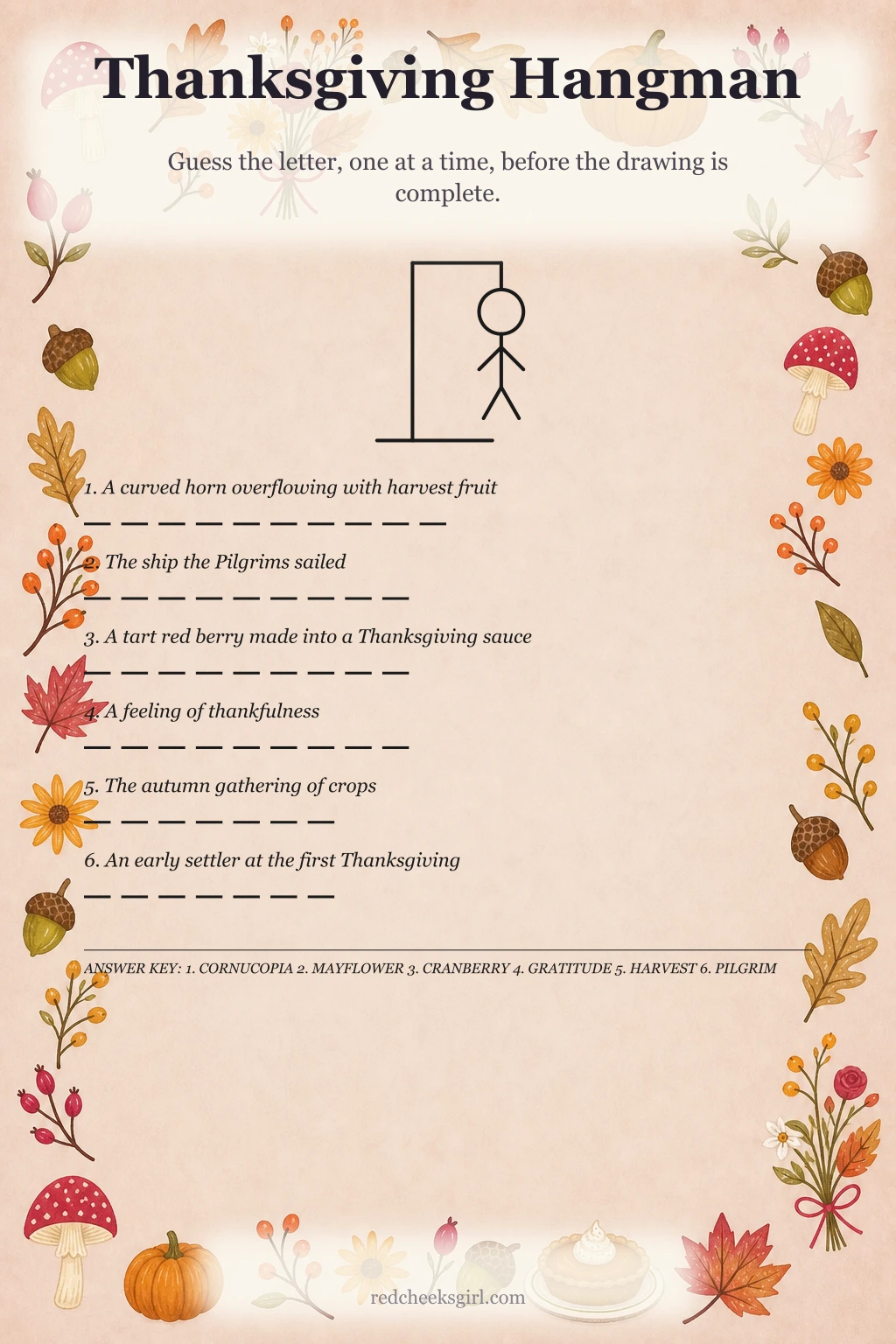
Thanksgiving Hangman gives the classic letter-guessing game a holiday makeover — and unlike the board version, this printable sheet lets every student play simultaneously at their own desk, which means the whole class is engaged at once rather than watching one person at the board.
Each sheet contains six pre-set Hangman puzzles with Thanksgiving-themed mystery words (the letter blanks are printed, the gallows is drawn, and a ‘letters guessed’ tracking box sits beside each puzzle).
Students work individually or with a partner, crossing off letters from the alphabet box as they guess and filling in blanks when they get a hit. The student who solves all six puzzles first wins, or play as a quiet five-minute independent activity.
Best for grades 2–5.
Print one per student. Each puzzle pre-prints a gallows frame and the correct number of blank letter lines for the mystery word — no answer is shown, just dashes. The six mystery words are classic Thanksgiving vocabulary: CORNUCOPIA, MAYFLOWER, CRANBERRY, GRATITUDE, HARVEST, and PILGRIM.
Students cross out letters they’ve guessed in the small alphabet tracker beside each puzzle and add a body part to the hangman drawing for each wrong guess (head, body, arm, arm, leg, leg — six wrong guesses and the man is complete).
Because the words are pre-set, you can print an answer key for early finishers to self-check. Cleanup time: 30 seconds.
The printable version of Hangman actually has a built-in literacy advantage over the board game: because every student plays all six puzzles independently, you get 28 students each practicing spelling, letter-frequency reasoning, and Thanksgiving vocabulary simultaneously — rather than one student at the board while everyone else watches (and inevitably doodles).
For a class extension, have students create their OWN Hangman puzzles on the back of the sheet using any Thanksgiving word they know — then swap with a neighbor to solve. Instant peer interaction, zero extra prep, totally on theme.
- Pick a letter you think is in the mystery word
- If correct, write it on the matching blank line(s)
- If wrong, cross it off the alphabet and draw one body part
- Solve the word before the hangman is complete!
13. Silent Turkey Line-Up
Silent Turkey Line-Up is one of those games that sounds so simple you’ll wonder why you didn’t think of it yourself — and then you’ll watch thirty kids absolutely lose their minds trying to complete it.
The challenge: without speaking, whispering, or mouthing words, the entire class must arrange themselves in a specific order. The teacher announces the category (‘Line up in alphabetical order by first name — silent turkey rules apply!’)
and students must communicate only through gestures, hand signals, holding up fingers, and pointing. Once everyone thinks they’re in order, the teacher reads the line to check. Sheer, silent, completely controlled chaos. Best for grades 2–5.
No supplies, no prep, no cleanup. Just push desks slightly aside to create a line-up lane (takes 45 seconds) and announce the category.
Great Thanksgiving-themed categories include: line up by how many letters are in your last name, arrange by your birthday month (January at one end, December at the other), sort yourselves by how far you live from school, or — for maximum difficulty — arrange yourselves by the first letter of your favorite Thanksgiving food.
That last one creates magnificent confusion when five kids all claim ‘pie’ and try to figure out who goes first. Cleanup time: 2 minutes to push desks back.
Silent Turkey Line-Up works across grades because the difficulty is entirely adjustable: alphabetical-by-first-name is achievable for second grade in under three minutes, while ‘arrange by the number of people in your household’ requires genuine problem-solving negotiation for fifth-graders.
The game also builds an unexpected skill — non-verbal communication — which is genuinely useful socially.
Teachers love it because the silence rule naturally calms the room even while students are moving, so you get all the energy-burning benefits of an active game without the volume that comes with most movement activities. Win-win.
- Grades 2–5
- Energy-burning without noise
- Community building and non-verbal communication
- Can repeat with different categories in same session
14. Roll-a-Turkey (Dice)
Roll-a-Turkey is a wildly popular dice-drawing game where students literally build a turkey one body part at a time by rolling a single die — and the resulting turkeys are always gloriously ridiculous.
Each student gets a printed sheet with an empty square for drawing and a legend showing what each dice number represents: 1 = turkey body, 2 = head, 3 = tail feathers (draw a fan of three), 4 = left wing, 5 = right wing, 6 = feet.
The catch: you must roll a 1 (body) before you can add any other parts, so early rounds are spent impatiently trying to get that first body while your neighbor’s turkey is already sprouting wings. First student to complete all six parts wins!
Best for grades K–3.
Each student needs their own printable sheet and one die — that’s the entire supply list. For classes without enough dice, pair students and have them share a die, taking turns rolling.
The game plays in about five minutes, which means you can fit three or four rounds into a twenty-minute party block with no problem.
For a whole-class simultaneous version, project a giant die on your smartboard using any free online dice roller, roll for the entire class at once, and have everyone draw the same body part at the same time — the room becomes a synchronized turkey-drawing art session, and the gallery of finished turkeys on the wall makes an adorable bulletin board.
Cleanup time: 1 minute — collect dice, keep sheets for a display.
Roll-a-Turkey earns bonus points for being cross-curricular in the sneakiest way: kindergartners practice numeral recognition and one-to-one counting, first and second graders practice probability intuition (‘I keep rolling 4s, why won’t I get a 1?!’), and third graders can track their rolls on a tally chart as a data-collection extension.
The drawings themselves are the real trophy though — every turkey is unique, slightly lopsided, and deeply personal. Collect them for a class ‘Turkey Gallery Walk’ after the game and watch students beam with pride over their artistic masterpieces.
(Some of those turkeys will end up on refrigerators at home, tbh.)
- Roll the die — match your number to the legend
- You MUST roll a 1 (body) before adding any parts
- Draw each body part as you roll it
- First to complete all 6 parts wins!

15. Thanksgiving Anagrams
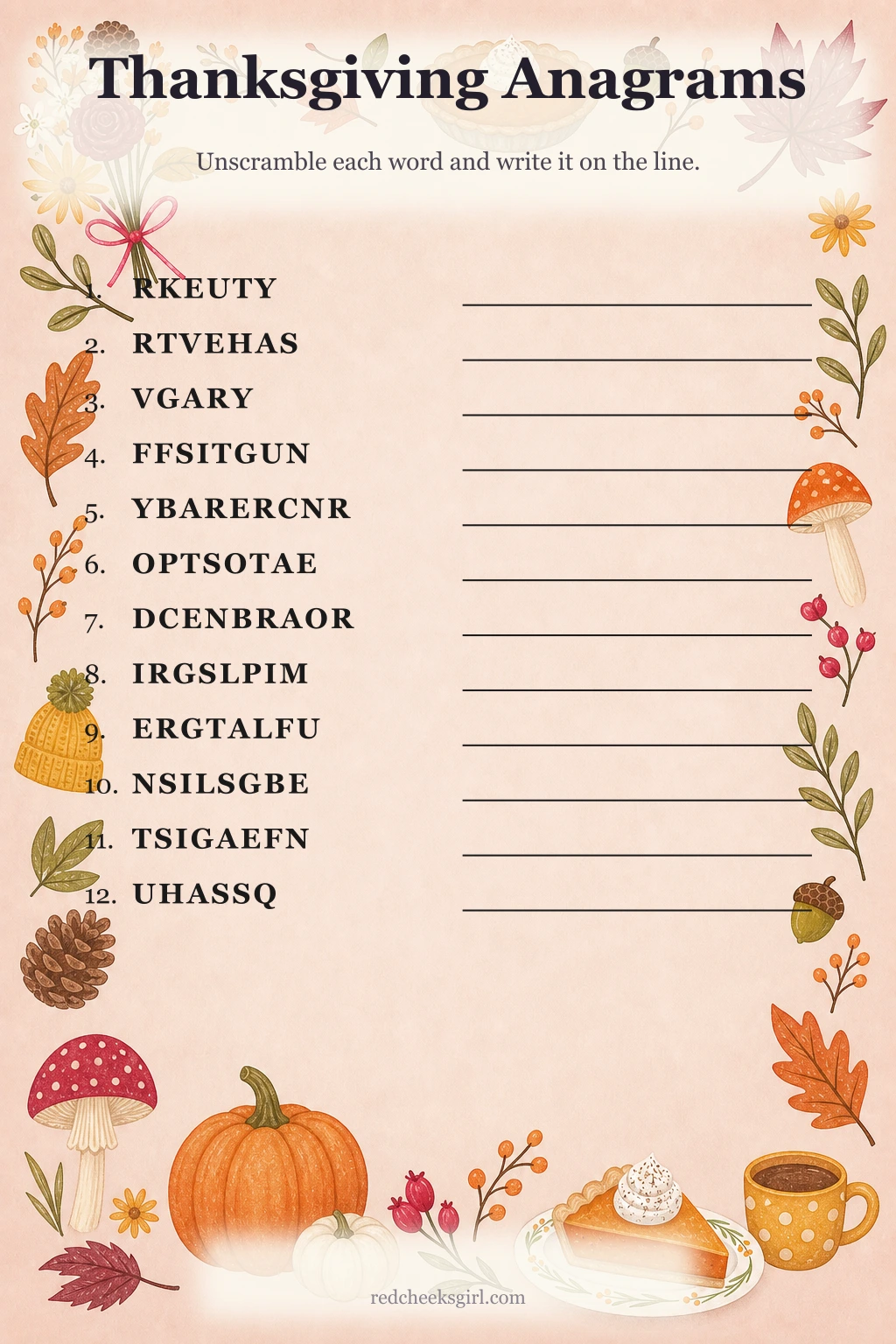
Thanksgiving Anagrams is a printable word puzzle game that will humble even your most confident spellers in the most delightful way.
The concept: each clue gives students a Thanksgiving word, and they must rearrange ALL of its letters to form a new, completely different word — no letters added, no letters removed, just scrambled into something new. For example, TURKEY can become…
hmm, no spoilers, but there’s a common word hiding in there. HARVEST rearranges into a word meaning ‘to stare.’ PILGRIM contains the letters for a type of music.
The sheet has 12 anagram pairs to solve, with the starting word printed and a blank line below it for the answer. Best for grades 3–5.
Print one per student and hand them out with a pencil. No other supplies needed.
These work beautifully as a timed competition (set a seven-minute timer and see who can solve the most) or as a collaborative partner activity where two students work together — the second format sparks fantastic discussion and justification (‘No, those letters definitely make that word!’)
that doubles as oral language practice. Post the answer key on the projector only after everyone has had a genuine go — nothing deflates an anagram session faster than showing answers too early.
For early finishers, challenge them to find a second anagram hiding in the same word, or to create their own Thanksgiving anagram for a partner to solve. Cleanup time: 30 seconds.
Anagrams work at this age because they sit at the intersection of vocabulary, spelling, and puzzle-solving, which means language-arts standards get hit from three angles in one ten-minute game.
Students who think they’re just playing a party game are actually practicing phoneme manipulation, letter-pattern recognition, and sight-word recall simultaneously — and because the ‘aha!’ moment when an anagram clicks is genuinely satisfying, even reluctant writers will stay engaged through the whole sheet.
This one pairs especially well with a post-game vocabulary discussion: ‘Did you know the word ACRES is hiding inside SCARECROW? Let’s talk about what an acre is…’
- Grades 3–5
- Advanced spellers needing a challenge
- Paired or individual play
- ELA vocabulary and spelling standards
16. Desk Turkey Relay (Pass the Feather)
Desk Turkey Relay is the perfect game for when you want all the fun of a relay race without anyone leaving their seat — which, let’s be honest, is exactly what a Thanksgiving classroom party needs at the two-o’clock wall.
Students pass a paper feather (or a real craft feather — but paper is truly no-mess and works just as well) from desk to desk down each row, but here’s the challenge: they can only move the feather using the eraser end of a pencil.
No hands, no touching the feather directly, just careful pencil-balancing and desk-to-desk transfers. First row to get the feather all the way to the end of the row wins a point. Race three rounds for a full relay match. Best for grades 1–4.
Supplies: one paper feather per row (cut these from brown or orange cardstock in about three minutes), one pencil per student (already on their desks). That’s it.
The paper feather is cut into a basic feather shape — wide at the base, tapered at the tip — light enough that the pencil eraser can nudge and balance it for short distances.
If a feather drops onto the floor during the relay, the student retrieves it and restarts from their desk. The teacher serves as both race-caller and rule-enforcer, which means this game is genuinely easy to manage with a full class of 28 kids.
Cleanup time: 1 minute — collect feathers into a folder.
What makes this one special beyond the novelty factor is the fine motor concentration it requires: balancing a paper feather on a pencil eraser and transferring it to the next person’s pencil is genuinely tricky, and the focus it demands naturally quiets the room between passes.
Students who struggle with the transfer quickly develop a strategy (keep the pencil very still, move slowly rather than quickly) — which is a lovely little lesson in frustration tolerance disguised as a relay race.
For a team challenge version, have two rows race simultaneously and then swap the direction for round two — it builds symmetric fairness into the game and gives every row a shot at winning.
- 1 paper feather per row (cut from cardstock)
- 1 pencil per student (already at desks)
- Visible timer or teacher count-down
17. Thankful ABCs
Thankful ABCs is a printable gratitude-meets-vocabulary race that challenges students to write something they are thankful for starting with every letter of the alphabet — from A to Z — as fast as they can.
Each student gets a sheet with 26 lettered lines, one per letter, each with a visible blank write-in line beside it. The goal: fill every line with a ‘thankful’ word or phrase before time runs out.
A = apples, B = best friends, C = cozy blankets, D = dogs… and then it gets interesting. Q? X? Z? That’s where the room dissolves into furious thinking, peer peeking, and victorious exclamations when someone cracks ‘xylophone music.’
Play as an individual race, as a timed team challenge, or as a whole-class collaborative project on the whiteboard. Best for grades 2–5.
Print one per student — the sheet does all the work. Set a visible seven-minute timer and let students write independently first, then allow two minutes of ‘share and steal’ where students can borrow classmates’ answers for any letters still blank.
This partner-sharing phase doubles as a speaking-and-listening activity and always produces hilarious moments (someone’s thankful for ‘Xtra Gum,’ and honestly, same).
For K–1, do this as a whole-class oral activity projected on the board — the teacher writes, the class brainstorms aloud, and every letter gets a class answer together. Cleanup time: 30 seconds.
Thankful ABCs earns its place as one of the best thanksgiving classroom games because it’s genuinely touching to read the finished sheets — students write things like ‘G = grandma,’ ‘T = teachers who actually care,’ ‘P = pizza Fridays,’ and in that mix of the profound and the hilariously practical, you see your whole class clearly for a moment.
Collect the sheets, snap a photo of the class holding them up, and post it to your classroom page — it makes a beautiful community display and gives parents a window into what their kids value.
If you’re looking for more ways to make the season meaningful without blowing the budget, check out these 12 Cheap Thanksgiving Appetizers That Look Expensive for your own table.
After the game, do a quick class share: ask 3 students to read their most unexpected or funny answer — Q, X, and Z always produce gold.

18. Gratitude Scavenger Hunt
Gratitude Scavenger Hunt is the quiet, meaningful anchor of any Thanksgiving classroom party — a reflective activity that doesn’t require anyone to move more than an arm’s reach but sends every student home having thought genuinely deeply about what they’re thankful for.
The premise is beautifully simple: each student gets a printed (or oral) list of 12 ‘gratitude prompts’ to ‘find’ within themselves, and they write one response for each.
Prompts include: ‘Find something in this room you are thankful for,’ ‘Name a person at home who makes your life better,’ ‘Find a skill you have that you are proud of,’ ‘Name something in nature you love,’ ‘Find a memory from this school year that made you smile.’
It’s a scavenger hunt of the heart, and it hits differently in November. Best for grades K–5.
No prep needed beyond a blank sheet of paper or a simple printed list of prompts — and even the printing is optional if you write the prompts on the board. Students write quietly at their desks, working at their own pace.
For kindergarten, do this orally as a circle activity: the teacher reads each prompt and students take turns sharing a response verbally, building a class gratitude list together on chart paper.
For upper grades, give students fifteen minutes and have them decorate the borders of their paper with Thanksgiving doodles when they’re done — it becomes a keepsake worth taking home. Cleanup time: zero seconds.
This game earns its spot as the quiet closer of a Thanksgiving class party because it genuinely shifts the energy of the room from wild excitement to warm reflection — and that transition is a gift to both the teacher and the students.
Research consistently shows that intentional gratitude practice improves mood and classroom community, so this one activity is doing emotional heavy lifting disguised as a party game.
If you want to extend the activity, bind all the completed sheets into a class ‘Gratitude Book’ and keep it in the classroom reading corner for the rest of the year.
Students revisit it when they need a reminder of what’s good — and that’s not a bad thing to have in a classroom in any month.
- Builds SEL and emotional vocabulary
- No supplies — works from the board
- Creates a keepsake students actually treasure
- Perfect wind-down after high-energy games

Frequently Asked Questions
What are the best Thanksgiving games to play in the classroom?
The best thanksgiving classroom games combine low mess, minimal supplies, and quick rules that work for 20–30 kids.
Top picks include Thanksgiving Kahoot Trivia (zero setup, runs on any device), Heads Up 7 Turkeys (no supplies at all), Thanksgiving Bingo (printable, works every grade), and Simon Says Turkey Edition (pure energy-burner with zero prep).
The winning formula is to mix active games, printable games, and quiet reflection activities across your party block so energy stays balanced the whole time.
What Thanksgiving games are appropriate for elementary school students?
Each game uses age-appropriate vocabulary, rules simple enough for kindergartners to follow, and content relevant to Thanksgiving themes.
Games are labeled with recommended grade ranges — for example, Roll-a-Turkey and Pass the Pumpkin work best for K–3, while Thanksgiving Anagrams and Kahoot Trivia are ideal for grades 3–5. Mix and match based on your class’s grade and reading level.
What are some no-prep Thanksgiving classroom games?
Several games on this list require literally zero prep: Heads Up 7 Turkeys, Simon Says Turkey Edition, Silent Turkey Line-Up, Thanksgiving Charades (five minutes to write clue slips), and Pass the Pumpkin all need nothing beyond a device for music.
The Gratitude Scavenger Hunt can be written on the board in under a minute. For no-prep digital options, Thanksgiving Kahoot Trivia pulls ready-made quizzes from the public library — just search, click, and project.
What are fun Thanksgiving games for kindergarten and preschool students?
Kindergartners and preschoolers do best with movement-based and picture-driven games.
Best picks for this age group include: Pass the Pumpkin (no reading required, all action), Heads Up 7 Turkeys (completely visual), Simon Says Turkey Edition (listening and movement), Roll-a-Turkey Dice game (numeral recognition plus drawing), and Thanksgiving Bingo using picture-only cards.
For Thankful ABCs and Gratitude Scavenger Hunt, do these as whole-class oral activities where the teacher writes responses on chart paper while kids call out answers.
How can Thanksgiving classroom games be made educational?
Almost every game here doubles as a curriculum hit with a small adjustment.
Rolling for Turkeys builds addition and multiplication fluency; Thanksgiving Word Scramble reinforces spelling and vocabulary; Thankful ABCs covers beginning sounds and phonics for early grades; Thanksgiving Anagrams practices letter-pattern recognition and word families; Thanksgiving Riddles builds inference and comprehension; and Gratitude Scavenger Hunt covers SEL and emotional vocabulary standards.
The key is to frame each game with a quick learning connection before and a brief debrief after.
What are some Thanksgiving party game ideas for a classroom?
For a great Thanksgiving classroom party, structure your block in three phases: open with an active game (Thanksgiving Kahoot Trivia or Heads Up 7 Turkeys), move into printable games at desks during snack time (Thanksgiving Bingo, Roll-a-Turkey, Thanksgiving Word Search), and close with a quiet activity (Gratitude Scavenger Hunt or Thankful ABCs).
This arc burns energy first, channels it productively during the middle, and lands the class in a calm, warm place before dismissal — which your students’ families will thank you for.
What Thanksgiving games can be played indoors with a large group of students?
The best large-group options are: Thanksgiving Kahoot Trivia (whole class plays simultaneously on devices), Thanksgiving Bingo (everyone has their own card, no elimination), Heads Up 7 Turkeys (classic classroom game for 15+ students), Pass the Pumpkin (circle game for unlimited players), and Silent Turkey Line-Up (whole-class movement with no supplies).
Printable games like Thanksgiving Word Search and Roll-a-Turkey also work perfectly for large groups since every student gets their own individual sheet.
What are some Thanksgiving games that teach gratitude and thankfulness?
Three games on this list directly target gratitude: Gratitude Scavenger Hunt (students reflect on 12 personal gratitude prompts), Thankful ABCs (students brainstorm something they are grateful for from A to Z), and Thanksgiving Bingo which can include vocabulary words like ‘thankful,’ ‘blessing,’ and ‘gratitude.’
For an extra layer, the Thanksgiving Riddles and Thanksgiving Charades sheets can include gratitude-themed clues. The Gratitude Scavenger Hunt in particular is powerful for SEL — it gives students structured language to articulate feelings of thankfulness, which research links to improved classroom wellbeing.
Are there free printable Thanksgiving games for the classroom?
Always preview before printing to confirm age-appropriateness and alignment to your grade level.
What Thanksgiving games work well for middle school students?
Middle schoolers need games that feel challenging rather than childish.
From this list, the best fits are Thanksgiving Kahoot Trivia (add harder history questions about the 1621 harvest, the National Holiday Act, or indigenous perspectives), Thanksgiving Anagrams (genuinely stumps older students), Thanksgiving Hangman (use harder words), and Silent Turkey Line-Up with complex sorting categories.
Thanksgiving Charades also works beautifully with a middle school crowd — just make the clues more specific and culturally relevant (‘Macy’s Parade float designer,’ ‘Black Friday shopper’). For a full middle school party, pair Kahoot with Charades for a perfect 30-minute block.
You might also find inspiration for your own holiday planning in this <a href=’https://redcheeksgirl.com/2024-christmas-gift-guide/’>2025 Christmas Gift Guide for everyone</a> — because November sneaks up on you fast!
There you have it — 18 thanksgiving classroom games that cover every grade, every energy level, and every five-minute gap between now and the Thanksgiving break bell.
From the whole-class digital buzz of Kahoot Trivia to the quiet reflection of a Gratitude Scavenger Hunt, this lineup is designed to keep 28 kids genuinely engaged, your classroom genuinely clean, and your teacher-sanity genuinely intact.
Pin this list, bookmark it, print the game sheets, and go into your classroom party day with a plan that’s actually fun — because you deserve a good November too.
Happy Thanksgiving — now go gobble up those party games!
📌 Save These for Later
Loved these? Pin your favorite image below so you can find this list again when you’re planning.

15 Thanksgiving drinking games for your best Friendsgiving yet — festive sip-when rules, pong, tas
18 funny Thanksgiving games guaranteed to crack up your whole table — silly, absurd, and zero awkw
Twelve Friendsgiving theme ideas that settle food, decor and dress code in one decision. From cabin
Leave a Reply